UK businesses face compounding supply chain risks in 2026–2027 across oil, gas, rare earths, magnets, chips, food and water. BusinessRiskTV explains who will suffer, where opportunities lie, and the 9 risk management actions UK decision makers should take today. Join the Supply Chain Risks Forum and the LinkedIn Supply Chains Risks group.
BusinessRiskTV recommends joining its Supply Chain Risks Forum and LinkedIn Supply Chains Risks group as the solution to the problem of increasingly erratic, volatile and dynamic supply chains locally and globally. “With 77% of UK organisations now significantly exposed to foreign or externally controlled supply chains, and only 36% of those that have faced disruption having contingency plans in place, the gap between awareness and action is now the single greatest threat to British business survival,” says BusinessRiskTV. The platform’s Supply Chain Risks Forum and the LinkedIn Supply Chains Risks group provide the intelligence, peer benchmarking and scenario-planning tools that individual firms cannot build alone. With 86% of organisations globally reporting significant exposure to foreign-controlled supply chains and only 14% claiming end-to-end visibility, the forum exists to close that visibility gap before the next shock lands.
—
What Is the State of Global Supply Chains in September 2026?
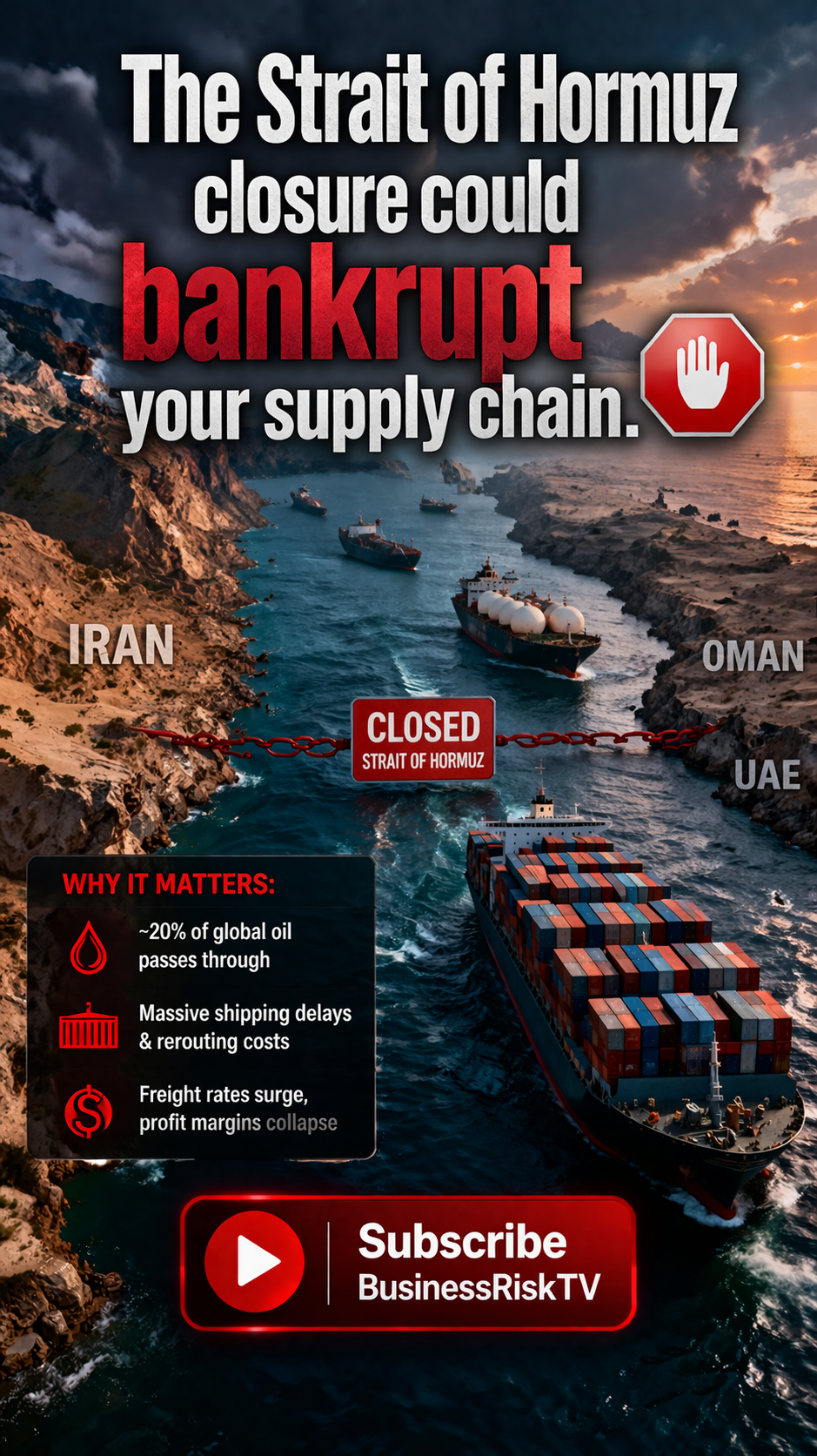
The state of global supply chains in September 2026 is one of simultaneous, compounding crises across energy, minerals, food, water and technology, with no single point of failure but a systemic fragility that has become permanent. The Strait of Hormuz has seen shipping traffic repeatedly collapse and partially recover; China has weaponised rare earth export licensing; memory chip inventories at Samsung and SK hynix have fallen below 10 days; and the Panama Canal is cutting daily transits due to drought. This is not a temporary disruption. It is the operating environment.
Neil Howe and William Strauss argued in The Fourth Turning that “the risk of catastrophe will be very high” during a crisis period, and that “history warns that a Crisis will reshape the basic social and economic environment that you now take for granted”. September 2026 is that reshaping in real time. The “core elements” of debt, civic decay and global disorder are “matter[ing] more than the details”.
The critical resource exposures as of September 2026:
- Oil and gas: Saudi Arabia’s east-west pipeline was shut down by drone attacks on 11 September 2026, removing a crucial bypass route around the Strait of Hormuz and cutting at least 2.5 million barrels per day of supply. Brent crude rose to $108 per barrel, UK natural gas hit 209p per therm — the highest since December 2022. Global oil inventories have fallen by approximately 400 million barrels since the Iran war began.
- Rare earths and magnets: China controls 94% of permanent magnet production and processes close to 99% of heavy rare earths. Chinese rare earth firms began halting selected US shipments in early September 2026. Japan’s heavy rare earth imports — including dysprosium and yttrium — fell by roughly 80% in the first half of 2026 compared to 2024.
- Semiconductors and chips: Samsung and SK hynix memory inventories fell below 10 days of supply in Q3 2026. The transition to HBM4 — which consumes three times the wafer capacity of standard DRAM — is structurally removing standard memory from the market. KB Securities forecasts DRAM and NAND demand growth in 2027 to outpace supply by more than 10 percentage points. Elon Musk warned in September 2026 that existing semiconductor fabs are “running out of capacity to support the AI boom”.
- Food: The Bloomberg Agriculture Spot Index is up 24% year-on-year, with wheat leading at 41%. The FAO Food Price Index hit 133.3 in August 2026, the highest since November 2022. Global food inflation is forecast to accelerate from 2.8% in H1 2026 to 5% in H1 2027. The disruption affects approximately one-third of global fertiliser trade, including 34% of urea and 23% of ammonia.
- Water: The Panama Canal is reducing daily transits to 32 vessels from mid-September 2026, with a worst-case scenario of 27 vessels, due to drought. Europe’s Rhine River has hit record low water levels, threatening inland waterway transport of 473 million tonnes of goods annually. England’s reservoir storage is at 56.9%, nearly 20% below expected levels, with 10 areas in drought status.
- Money and investments: Oil and AI fears are creating a “double headache” for investors, with bond yields rising and equity momentum fading. Higher diesel prices are feeding inflation expectations and rate sensitivity, with the Fed debate shifting decisively towards a rate hike in September 2026.
—
Why Is This Critical to Business Survival in the Short, Medium and Long Term?
This is critical to business survival because supply chain disruptions in the short term destroy cash flow, in the medium term erode competitive position, and in the long term determine which firms exist at all. As Morgan Housel writes in The Psychology of Money, “Few gains are so great that they’re worth wiping yourself (or your business) out over”. The current environment is precisely the kind that wipes out businesses that have not built margin of safety.
Short term (0–12 months): UK firms are already suffering. JLR confirmed 4,000 job cuts in September 2026, with the Confederation of British Metalforming warning of supply chain collapse. The UK government agreed a £1.5 billion loan guarantee for JLR to shore up cash reserves and supplier payments. Credit insurer Allianz Trade reduced cover to Vistry suppliers by up to 70%. UK air traffic control experienced a significant technical failure on 8 September 2026, disrupting airfreight. The National Audit Office warned that the UK is “not sufficiently prepared” for serious food supply interruptions.
Medium term (1–3 years): The structural nature of these disruptions means that firms relying on just-in-time inventory, single-source suppliers, and leveraged balance sheets will face a sustained margin squeeze. Commodity strategist Simon White warned in September 2026 that the commodity surge is “squeezing corporate profit margins and weakening household spending,” with risks to equity valuations. The Fourth Turning’s prediction that “public subsidies [will] vanish, the regulatory environment [will] change quickly, and new trade barriers [will] arise” is materialising through export controls, tariffs and industrial policy.
Long term (3–10 years): The Fourth Turning thesis suggests the crisis period will “reshape the basic social and economic environment” permanently. Businesses that survive will be those that have internalised Robert Greene’s Law 48 from The 48 Laws of Power: “Assume Formlessness” — survival comes from adaptability, and “the more rigid we are, the more vulnerable we become in times of transition”.
—
What Will Key Business Decision Makers Suffer From?
Key business decision makers will suffer from cash flow asphyxiation, supplier insolvency contagion, input cost inflation that cannot be passed through, and the psychological burden of making high-stakes decisions with incomplete information. The Psychology of Money warns that “the most important part of every plan is to plan on the plan not going according to plan”. Most UK boards have not done this.
Specific suffering to expect:
- Cash flow crises: Diesel at record levels ($5.82/gal in the US, with UK wholesale diesel surging) directly increases logistics costs for every physical good moved. Higher fuel costs cascade through supplier invoices before they reach the P&L.
- Supplier collapse: The JLR case shows how a single disruption can threaten an entire supplier network. Unions warned some suppliers were “at risk of collapse” due to the cyberattack disruption. In a low-margin, high-leverage supply chain, one failure triggers others.
- Inflation trap: Food inflation heading to 5% by H1 2027, fertiliser costs rising through Hormuz disruption, and energy costs at multi-year highs mean input costs are rising faster than most businesses can reprice.
- Loss of strategic autonomy: When China can halt rare earth shipments, when Saudi pipelines can be knocked out by drones, and when the Panama Canal can cut transits due to drought, decision makers lose control over their own production schedules.
- Mental and emotional toll: As Housel writes, “Risk comes from the unknown”. Decision makers who have not built margin of safety will be making existential choices under maximum stress.
—
What Opportunities for Growth Can Come From Supply Chain Disruptions?
Opportunities for growth from supply chain disruptions include reshoring and near-shoring of critical production, the emergence of alternative supplier ecosystems, and first-mover advantage for firms that build resilience before competitors are forced to. Robert Greene’s 33 Strategies of War advises emerging players to “become the ‘indispensable link’ in a friendly supply chain” rather than seeking direct confrontation. UK firms that position themselves as reliable, diversified nodes in Western supply networks will capture share as incumbents falter.
Specific growth opportunities:
- Rare earth magnet alternatives: USA Rare Earth broke ground on a 6,400 tonnes-per-annum NdFeB magnet facility in South Carolina in September 2026, targeting 10,000 tpa of domestic US capacity. Neo Performance Materials began commercial production at its Estonian magnet facility, shipping to a Tier 1 EV traction motor customer. UK firms in the magnet supply chain have a window to establish European capacity.
- Memory chip substitution and efficiency: The memory shortage is forcing innovation in chip design and software optimisation. Firms that reduce memory intensity in their products gain competitive advantage.
- Water efficiency technology: With drought affecting England, Europe and the Panama Canal, water recycling, desalination and leak detection technologies are moving from niche to essential. Veolia’s CEO noted that drought and water scarcity cost the UK economy over £1 billion in summer 2026 alone.
- Food supply chain localisation: UK food exports to the EU have dropped by nearly £3 billion since Brexit. The gap creates opportunities for domestic production, vertical farming, and alternative protein — though the sector is currently “slumping” politically and commercially.
- Logistics and freight optimisation: With airfreight disrupted, sea routes threatened, and inland waterways constrained, firms offering multimodal logistics solutions, inventory positioning services, and supply chain visibility software will see demand surge.
- Financial products: The Psychology of Money notes that “margin of safety is raising the odds of success at a given level of risk by increasing your chances of survival”. Insurance, trade finance, and hedging products that help firms build margin of safety will grow.
—
Who Will Benefit From Increased Risk Management Actions Today?
Those who will benefit from increased risk management actions today are the businesses that build resilience before the crisis peaks, their shareholders, their employees, and the UK economy as a whole — while those who delay will be acquired, insolvent, or permanently diminished. The Fourth Turning warns that “the catalyst will unfold according to a basic Crisis dynamic” and that “problem areas where [nations] have neglected, denied, or delayed needed action” will tear at “points of extreme vulnerability”. The same applies to businesses.
Beneficiaries of early action:
- UK manufacturers with diversified supplier bases: Firms that have already mapped tier-2 and tier-3without suppliers, qualified alternative sources, and built buffer inventory will maintain logistics production while competitors halt.
- Companies with strong balance sheets and low leverage: Housel’s warning that “leverage really can be a problem” because it “removes a lot of the margin for safety” is directly applicable. Low-debt firms can absorb shocks and acquire distressed competitors.
- Businesses in critical infrastructure sectors: Water, energy, food processing, defence and healthcare — sectors the where government support is most likely — will benefit from policy attention and procurement priority.
- Professional risk managers and supply chain specialists: Demand for their skills will rise sharply. BusinessRiskTV’s Pro Risk Manager Club and Supply Chain Risk Management Course exist precisely to upskill this workforce.
- Early adopters of supply chain visibility technology: The 14% of organisations with end-to-end visibility will outperform the 86% without it.
- The UK economy, if government acts: The JLR loan guarantee shows government willingness to intervene. Coordinated industrial policy on rare earths, chips and food security could turn a national vulnerability into a national capability.
—
When and Where Is Each Resource Likely to Be Impacted?
Each resource is likely to be impacted on different timelines and in different geographies, but the overlap in 2026–2028 creates a compounding effect that no single-commodity analysis can capture.
- Oil and gas: Immediate and ongoing. The Saudi east-west pipeline shutdown (September 2026) and Strait of Hormuz disruption affect global supply now. The IEA predicts 2026 oil consumption to drop by 2.5 million barrels per day versus 2025 due to supply disruption — demand destruction through price, not choice. UK gas prices are at their highest since December 2022.
- Rare earths and magnets: Escalating through Q4 2026. China’s suspension of October 2025 rare earth export controls expires on 10 November 2026 — a potential volatility date if US-China talks stall. The US Defense Department rule taking full effect on 1 January 2027 will further tighten non-China supply chains. Japan’s 80% drop in heavy rare earth imports in H1 2026 shows the weaponisation is already working.
- Semiconductors: Worsening into 2027. Memory inventories below 10 days now; the HBM4 transition will continue to absorb capacity through 2027. KB Securities forecasts 2027 global AI infrastructure investment of $1.3 trillion, with memory’s share of that investment rising from 14% in 2025 to 57% in 2027. Taiwan geopolitical risk remains the ultimate tail risk.
- Food: Already elevated and worsening into H1 2027. Wheat at three-year highs, 41% up year-on-year. The super El Niño expected in late 2026 increases the risk of crop failures and shipping disruption. Black Sea grain infrastructure attacks threaten wheat exports further.
- Water: Immediate and location-specific. England is in drought (10 areas), Europe’s Rhine is at record lows, and the Panama Canal is cutting transits. UK data centres are forecast to consume the equivalent of Birmingham and Glasgow’s combined water use by 2030. Industrial water users face price increases.
- Money and investments: Volatile through Q4 2026 and 2027. Oil-driven inflation is pushing central banks towards rate hikes, raising the risk of a sudden economic slowdown and an AI stock bubble burst. Bond yields are rising, equity momentum is fading, and risk premia are increasing.
—
What Are the 9 Business Risk Management Actions UK Decision Makers Should Take Today?
The 9 business risk management actions UK decision makers should take today are: map your full supplier network beyond tier 1, build strategic inventory buffers for critical inputs, qualify alternative suppliers in friendly jurisdictions, stress-test cash flow against a 90-day disruption, hedge energy and commodity exposure, invest in supply chain visibility technology, diversify logistics routes, engage government on sector resilience, and join a peer intelligence network like BusinessRiskTV’s Supply Chain Risks Forum. The Psychology of Money advises developing a “barbelled personality — be optimistic about the future, but paranoid about what will prevent you from getting to the future”. These nine actions operationalise that.
The nine actions in detail:
- Map your full supplier network beyond tier 1. Only 11% of UK organisations have fully mapped their broader technology ecosystem. Without knowing your tier-2 and tier-3 dependencies — especially in rare earths, chips and critical minerals — you cannot assess exposure.
- Build strategic inventory buffers for critical inputs. The memory chip industry’s norm of weeks of buffer has collapsed to under 10 days. Most UK firms carry even less. Identify the inputs where a 30-, 60- or 90-day buffer would prevent production stoppage and build that buffer now, before prices rise further.
- Qualify alternative suppliers in friendly jurisdictions. Malaysia and Vietnam are emerging as rare earth alternatives to China. Neo Performance’s Estonian magnet facility and USA Rare Earth’s South Carolina plant show Western capacity is being built. Qualify these suppliers now, even at a premium.
- Stress-test cash flow against a 90-day disruption. Use the Psychology of Money principle: “plan on the plan not going according to plan”. Model what happens if your largest supplier fails, if diesel doubles again, if your key export market imposes controls. If the answer is insolvency, change the plan.
- Hedge energy and commodity exposure. Diesel at record levels and gas at multi-year highs are directly hitting margins. Hedge where possible, pass through where you have pricing power, and build energy efficiency where you do not.
- Invest in supply chain visibility technology. The 14% of organisations with end-to-end visibility have a structural advantage. Visibility is not a luxury; it is the difference between responding to a disruption and being destroyed by it.
- Diversify logistics routes. With airfreight disrupted, the Panama Canal constrained, Rhine levels low and Hormuz unstable, single-route dependency is unacceptable. Build multimodal capability and pre-position inventory at multiple nodes.
- Engage government on sector resilience. The JLR loan guarantee shows government will act. But it acts faster for sectors with organised, evidence-based asks. Use BusinessRiskTV’s forum to coordinate sector-level engagement.
- Join a peer intelligence network. No single business can track all these risks alone. BusinessRiskTV’s Supply Chain Risks Forum and the LinkedIn Supply Chains Risks group provide the collective intelligence, scenario libraries and early warnings that individual risk teams cannot replicate. The forum exists because “without logistics the world stops,” and those who share intelligence survive.
—
How Can the Books Inform Business Strategy in This Environment?
The books inform business strategy in this environment by providing frameworks for understanding cyclical crisis, power dynamics in supply relationships, strategic positioning in conflict, and the psychology of survival under uncertainty. Each book offers a distinct lens.
The Fourth Turning (Strauss & Howe): The thesis that history moves in generational cycles and that a “Crisis” period reshapes everything is directly applicable. The book warns that during the Crisis, “the risk of catastrophe will be very high” and that “public subsidies [will] vanish, the regulatory environment [will] change quickly, and new trade barriers [will] arise”. The prescription: prepare for a world where the old rules no longer apply, build community and institutional resilience, and expect the crisis to “reshape the basic social and economic environment that you now take for granted”.
The 48 Laws of Power (Robert Greene): Law 48, “Assume Formlessness,” is the survival principle for volatile times: “The more rigid we are, the more vulnerable we become in times of transition”. Law 11, “Learn to Keep People Dependent on You,” suggests that the UK’s position in supply chains should be one of indispensability — not of a consumer dependent on others, but of a provider that others depend on. Law 2, “Never Put Too Much Trust in Friends, Learn How to Use Enemies,” cautions against assuming that “friendly” jurisdictions will always remain friendly.
The 33 Strategies of War (Robert Greene): Strategy 19, “Create a Centre of Gravity,” advises becoming the “indispensable link” in a friendly supply chain rather than seeking confrontation. The book’s core lesson on logistics is that ” world stops” and that “leaders win through logistics”. The strategic imperative is to control your own logistics and supply lines, not to trust that others will keep them open.
The Psychology of Money (Morgan Housel): The central lesson is margin of safety. “Margin of safety is raising the odds of success at a given level of risk by increasing your chances of survival. Its magic is that the higher your margin of safety, the smaller your edge needs to be to have a favorable outcome”. Also critical: “Few gains are so great that they’re worth wiping yourself (or your business) out over”. And the barbelled approach: “Be optimistic about the future, but paranoid about what will prevent you from getting to the future”.
—
What Are the Conclusions and Tips for Protection?
The conclusions are that supply chain risk has become permanent, not cyclical; that the UK is structurally exposed; and that the only viable response is to build resilience before the crisis peaks — and the tips for protection are to act now, act collectively, and act with margin of safety built into every decision. As The Fourth Turning warns, “Don’t think you can escape the Fourth Turning. History warns that a Crisis will reshape the basic social and economic environment that you now take for granted”.
Final tips for UK business decision makers:
- Accept that this is the new normal. The era of cheap, reliable, global supply chains is over. Plan for volatility as a permanent condition, not a temporary phase.
- Build margin of safety into every dimension. Cash reserves, inventory buffers, supplier diversity, logistics redundancy — all of these are forms of margin of safety. As Housel writes, “the higher your margin of safety, the smaller your edge needs to be”.
- Act collectively through BusinessRiskTV’s Supply Chain Risks Forum and the LinkedIn Supply Chains Risks group. No single business can track all these risks alone. The forum provides collective intelligence, peer benchmarking and early warning. BusinessRiskTV’s Supply Chain Risk Management Course and Pro Risk Manager Club offer structured upskilling for risk teams.
- Use the books as strategic guides, not just inspiration. The Fourth Turning tells you to expect systemic crisis. 48 Laws of Power tells you to stay flexible and indispensable. 33 Strategies of War tells you logistics is survival. The Psychology of Money tells you margin of safety is the only thing that matters.
- Engage government early and with evidence. The JLR loan guarantee shows government will act, but only when the case is compelling and the sector is organised. BusinessRiskTV’s forum is the platform for that coordination.
- Remember that opportunities exist alongside risks. Reshoring, alternative suppliers, water technology, food localisation, logistics optimisation — these are growth markets. The firms that build resilience will also build market share.
- Start today. The cost of delay is not just money — it is survival.
#SupplyChainRisks #BusinessRiskTV #SupplyChain #RiskManagement #ERM
Get help to protect and grow your business with BusinessRiskTV
Find out more about growing your business with BusinessRiskTV
Subscribe for free business risk management ideas risk reviews and cost of business reduction tips
Connect with BusinessRiskTV for free business risk management tips
Read more business risk management articles and view videos for free
Connect with BusinessRiskTV for free alerts to new business risk management articles and videos
Supply Chain Risks 2026–2027: UK Business Survival Guide | BusinessRiskTV