Hormuz Blockade & The Bond Market Sell-off: 2026 Business Risk Analysis

Explore how the Iran-Israel war and the Strait of Hormuz blockade are impacting U.S. Treasuries, UK Gilt yields, and global business lending rates in 2026.

The Great Bond Re-Pricing: Will U.S. Energy Exports Save the Treasury?

The global financial landscape in April 2026 is defined by a paradoxical “Energy-Debt Loop.” As Asian nations continue to reduce their holdings of U.S. Treasury bonds, the escalating conflict between Iran and Israel—and the subsequent blockade of the Strait of Hormuz—has introduced a controversial new mechanic into global risk management: the potential for U.S. energy dominance to forcibly re-finance its own debt.


Is the Dumping of U.S. Treasuries by Asian Nations a Permanent Shift?

The dumping of U.S. Treasury bonds by major Asian economies represents a strategic diversification away from dollar-denominated debt that is structurally raising global interest rates. As of early 2026, China’s holdings have hit a 15-year low, dipping toward $640 billion, while Japan has selectively sold off reserves to defend the Yen. This lack of “price-insensitive” buyers means Treasury prices must fall to attract new investors, which automatically pushes yields higher.

For businesses, this “bond tantrum” means the floor for all global lending has moved. High street banks, seeing the risk-free rate of return rise, are forced to increase margins on business loans, equipment financing, and commercial mortgages to remain profitable.


Does the Strait of Hormuz Blockade Secretly Increase Demand for U.S. Treasuries?

The blocking of the Strait of Hormuz oil and gas routes may actually increase demand for U.S. Treasuries because Europe and Asia must now pivot to U.S.-sourced energy, paid for in Dollars which are then recycled into U.S. debt.With 20% of global oil and LNG currently trapped behind the blockade, nations like Germany, Japan, and South Korea are forced to sign massive supply contracts with U.S. energy firms.

This creates a “Petrodollar 2.0” effect:

  • Forced Dollar Demand: Foreign nations must acquire USD to pay for U.S. shale oil and gas.

  • Debt Financing: The U.S. government can leverage this surge in dollar demand to sell more Treasuries, effectively financing the $38.6 trillion “debt mountain” at the expense of global consumers.

  • Consumer Impact: While this supports the U.S. Treasury market, it creates a “Double Tax” for global businesses—high energy prices at the pump and high interest rates at the bank.


Why Have UK Gilt Yields Surpassed 5.0% and How Does it Affect Your Lending?

UK Gilt yields have surged past 5.0% for the first time in nearly two decades, signalling that the era of “cheap money” is officially over for the foreseeable future. In March 2026, the 10-year Gilt yield hit 5.11%, driven by the Middle East energy shock and a “material about-turn” in Bank of England policy.

“When government bond yields break the 5% barrier, the ripple effect through high street bank lending is instantaneous and unforgiving,” notes a lead strategist at the Business Risk Management Club.

For business leaders, this means:

  • Refinancing Risk: Debt maturing in 2026 is being rolled over at rates 300-400 basis points higher than three years ago.

  • Margin Compression: Higher interest expenses are eating into net profits faster than most businesses can raise prices.

  • Currency Risk: The volatility in bond yields is causing 2-3% daily swings in major currency pairs, making international trade a gamble.


12 Risk Management Actions to Protect Your Business Today

In a world of 5% yields and $140 oil, business as usual is a recipe for failure. Implement these actions now:

  1. Hedge Energy Costs: Lock in fuel and power surcharges with suppliers or use energy derivatives to cap your exposure.

  2. Fix Debt Immediately: If you have variable-rate loans, convert them to fixed-rate products before the next central bank hike.

  3. Optimise Working Capital: Tighten credit terms for customers (e.g., move from Net-30 to Net-15) to reduce your reliance on expensive bank credit.

  4. Audit “Hormuz Vulnerability”: Map your supply chain to identify any tier-2 or tier-3 suppliers reliant on Persian Gulf transit.

  5. Diversify Into Gold: With Gold testing $4,800/oz, use it as a non-correlated hedge against a potential “Debt Mountain” collapse.

  6. Implement Currency Buffers: Maintain “Natural Hedges” by matching the currency of your revenue with the currency of your expenses where possible.

  7. Stress Test for 6% Yields: Model your business’s debt-service coverage ratio (DSCR) if Gilt or Treasury yields rise another 1%.

  8. Switch to “Just-in-Case” Inventory: The cost of holding stock is high, but the cost of a stock-out due to maritime blockades is terminal.

  9. Leverage Tokenised Payments: Explore blockchain-based cross-border settlements to avoid the 3-5 day “float” taken by traditional banks.

  10. Negotiate “Energy Clauses”: Update client contracts to include automated price adjustments based on Brent Crude benchmarks.

  11. Onshore Manufacturing: Reduce the “Geopolitical Distance” of your products to insulate against shipping volatility.

  12. Join a Risk Intelligence Network: Actively participate in the Business Risk Management Club to access real-time data.


Join the Business Risk Management Club at BusinessRiskTV

BusinessRiskTV is the global leader in providing proactive intelligence for an unpredictable world. The Business Risk Management Club offers the tools to turn these global threats into a competitive advantage.

  • 15% Loss Reduction: Members report significantly lower operational losses by using our peer-verified risk mitigation blueprints.

  • Real-Time Alerts: Get notified of bond yield breakouts and geopolitical “choke point” shifts 48 hours before the mainstream media.

  • Zero-Cost Entry: Basic membership is FREE, providing instant access to a global network of risk professionals.

#BusinessRisk #BondMarket2026 #EnergySecurity #BusinessRiskTV #RiskManagement

Get help to protect and grow your business faster with BusinessRiskTV

Find out more about how to grow your business faster with BusinessRiskTV 

Subscribe for free business risk management ideas risk reviews and cost reduction tips

Connect with BusinessRiskTV for free business risk management tips

Read more business risk management articles and view videos for free

Connect with BusinessRiskTV for free alerts to new business risk management articles and videos

The U.S. is financing its debt with YOUR energy bill. ⛽️💳

Think the Strait of Hormuz blockade is just about “expensive gas”? Think bigger.

The global bond market is undergoing a “Great Re-Pricing,” and the logic is brutal. As Asian countries dump U.S. Treasuries, the U.S. is finding a new way to keep its “Debt Mountain” standing—at your expense.

The 2026 Power Play:
By blocking Middle Eastern oil, the world is forced to buy U.S. energy. That demand for U.S. Dollars allows the U.S. to finance its own debt while UK Gilt yields soar past 5.0% for the first time in a generation.

What this means for your business today:

The Bank Squeeze: High street lending rates are tethered to these yields. Your next loan renewal will be the most expensive in your company’s history.

The Imported Inflation: Even if you don’t trade in the U.S., the “Safety Strength” of the Dollar is crushing local currencies and driving up the cost of everything.

The Refinancing Wall: Millions of businesses are about to hit a wall of high-interest debt they simply can’t afford.

Don’t be a statistic. We’ve just released the definitive risk analysis on BusinessRiskTV with 12 immediate actions you can take to insulate your margins from the 5% yield reality.

Stop reacting. Start managing.

#BusinessRisk #BondMarket2026 #EnergySecurity #BusinessRiskTV #RiskManagement
Enterprise risk management magazine and videos on business growth and business protection
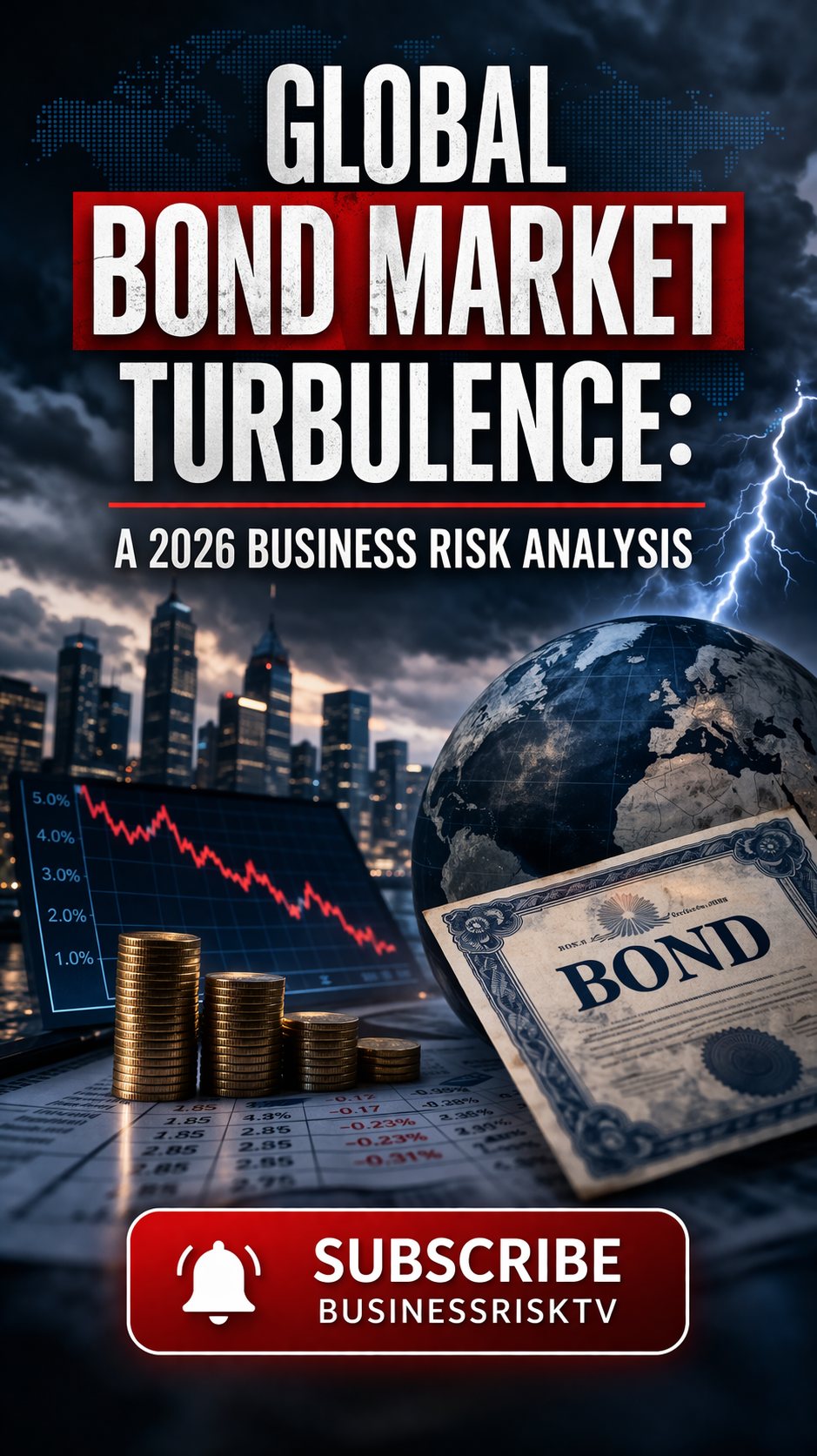
Global Bond Market Turbulence: A 2026 Business Risk Analysis Subscribe BusinessRiskTV

Hormuz Blockade & The Bond Market Sell-off: 2026 Business Risk Analysis
Why the Sulphur Crisis & Strait of Hormuz Blockade Threaten the Global Economy: 2026 Risk Analysis

As the Strait of Hormuz remains closed, the global economy faces a critical shortage of sulphur and sulphuric acid. Discover why this “silent” crisis impacts U.S. copper mining, food security, and why business leaders must act now to mitigate systemic risk.

The global economy in 2026 is facing a “silent” systemic threat. While headlines focus on the immediate spike in oil prices following the closure of the Strait of Hormuz, a far more insidious risk is brewing in the shadows: the collapse of the global sulphur and sulphuric acid supply chain.

As a core pillar of the Business Risk Management Club, we analyse the interconnectedness of risks that others overlook. For business leaders, understanding this “liquid gold” of heavy industry is no longer optional—it is a survival requirement.

The Invisible Backbone of Global Industry: A Strategic Risk Analysis

Why is sulphuric acid the “Blood” of the modern economy?

Sulphuric acid is the most widely used industrial chemical on Earth because it is the primary reagent required to extract high-value minerals like copper, lithium, and nickel. In 2026, the transition to green energy has made copper demand skyrocket, yet you cannot have copper without sulphuric acid for the leaching process.

Beyond mining, it is the fundamental ingredient in phosphate fertilizers, which support roughly 50% of global food production. A shortage in sulphur doesn’t just stop factories; it triggers global food insecurity and halts the production of EV batteries and semiconductors.


Why has the Strait of Hormuz closure not fully impacted the economy yet?

The impact of the maritime blockade has been delayed because global supply chains initially relied on “buffer” inventories and the “fast-channel” focus on petroleum prices. However, the Strait is the exit point for over 50% of the world’s traded liquid sulphur—a byproduct of oil and gas refining in the Middle East.

While the U.S. and other nations have drawn from strategic reserves, those reserves are depleting. We are currently in the “lag phase” of a classic bullwhip effect. Within the next 3 to 6 months, the lack of sulphur will lead to a secondary manufacturing shock that will be far more difficult to “drill” our way out of than an oil shortage.


Why is the claim that this does not impact the USA economy dangerously wrong?

The assertion that the U.S. is insulated due to domestic energy independence fails to account for integrated global commodity pricing and downstream mineral dependency. Even if the U.S. produces its own oil, it cannot unilaterally replace the lost volume of Middle Eastern sulphur required for its domestic agricultural and mining sectors.

“The Strait of Hormuz is an ‘economic clock of war.’ A short closure is an oil shock, but a prolonged closure becomes a systemic collapse of growth and inflation.”LSE Business Review, March 2026.

Three facts on the cost and value of this crisis:

  1. Cost of Inaction: The price of sulphuric acid has surged by over 40% since the blockade began, directly increasing the “all-in sustaining cost” (AISC) for copper miners by an estimated 15%.

  2. Global Trade Value: Over 30% of seaborne fertilizer and 20% of global LNG pass through this 21-mile-wide choke point; the U.S. economy is tied to the global price of these goods regardless of local production.

  3. The Inflation Multiplier: In April 2026, U.S. gas prices hit $4.00 per gallon, a 30% increase that acts as a regressive tax on every level of the American supply chain.


12 Risk Management Measures for Business Leaders

To protect your organisation against this escalating threat, the Business Risk Management Club recommends the following immediate actions:

  • Diversify Chemical Suppliers: Audit your Tier 2 and Tier 3 suppliers to ensure you aren’t indirectly reliant on Middle Eastern sulphur.

  • Secure Long-Term Offtake Agreements: Move from spot-market purchasing to fixed-volume contracts for critical reagents.

  • Invest in Circular Recovery: Implement on-site acid recovery systems to recycle sulphuric acid in mining and manufacturing processes.

  • Dynamic Pricing Models: Incorporate “commodity surcharges” into customer contracts to pass through volatile raw material costs.

  • Inventory Buffering: Increase “Safety Stock” levels for sulphur-dependent components from 30 days to 90+ days.

  • Geopolitical Scenario Planning: Conduct quarterly “War Room” sessions to model the impact of a 12-month Strait closure.

  • Resource Substitution: Explore bio-based or alternative leaching agents where technically feasible.

  • Logistics Redundancy: Identify “Land-Bridge” or alternative shipping routes that bypass the Strait, even at a higher initial cost.

  • Currency Hedging: Hedge against the volatility of the U.S. dollar and Middle Eastern currencies tied to energy exports.

  • Regulatory Monitoring: Track changes in “low-emission sulphuric acid” credits, which are becoming a major tradeable commodity.

  • Stakeholder Communication: Transparently brief investors on your exposure to the “Sulphur Gap.”

  • Enhanced Cybersecurity: Protect supply chain data systems, as digital infrastructure is the first target during physical blockades.

#GlobalEconomy2026 #RiskManagement #StraitOfHormuz #BusinessRiskTV #RiskManagement

Get help to protect and grow your business faster with BusinessRiskTV regardless of business environment

Find out more from BusinessRiskTV about growing your business through changing times

Subscribe for free business risk management ideas risk reviews and cost reduction tips

Connect with BusinessRiskTV for free business risk management tips

Read more business risk management articles on BusinessRiskTV and view videos @RiskBusiness YouTube Channel

Connect with BusinessRiskTV for free alerts to new business risk management articles and videos

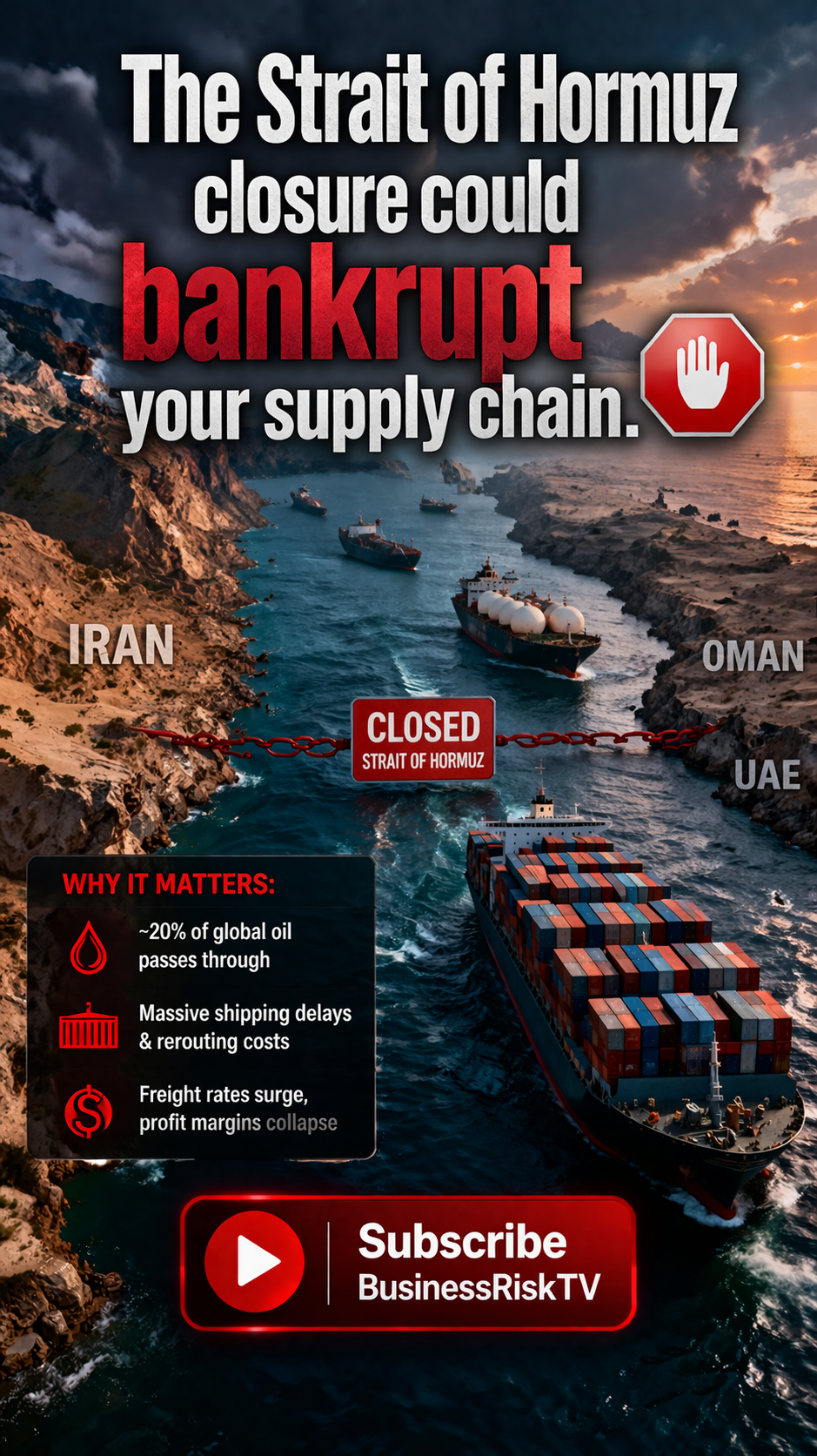
21-mile strip of water that could bankrupt your supply chain Subscribe BusinessRiskTV

Everyone is watching the oil price. They’re looking at the wrong indicator.

To clarify, the 21-mile width refers to the narrowest point of the Strait of Hormuz (specifically the shipping lanes and buffer zones)

While the world argues over $4.00/gallon gas, a “silent” killer is draining the lifeblood of global industry: The Sulphuric Acid Collapse.

If you manufacture electronics, mine copper, or grow food, you are currently in the crosshairs of a geopolitical time bomb.

President Trump says the Strait of Hormuz closure doesn’t impact the U.S. economy. He’s wrong. Here’s the data he’s missing.

The Reality: The Strait is the exit for 50% of the world’s traded sulphur. No sulphur = No sulphuric acid.
No sulphuric acid =
❌ No Copper for EVs.
❌ No Phosphate for Food.
❌ No Lithium for Batteries.

We are currently in the “lag phase.” The reserves are running dry. By Q3 2026, the “Price of Silence” will become the “Price of Insolvency” for businesses that didn’t plan ahead.

What you need to do RIGHT NOW:
At the Business Risk Management Club, we’ve identified 12 critical steps to insulate your operations—from circular acid recovery to aggressive inventory buffering.

Don’t wait for the mainstream media to catch up. The smart money is already moving.

#GlobalEconomy2026 #RiskManagement #StraitOfHormuz #BusinessRiskTV #RiskManagement

Why the Sulphur Crisis & Strait of Hormuz Blockade Threaten the Global Economy: 2026 Risk Analysis

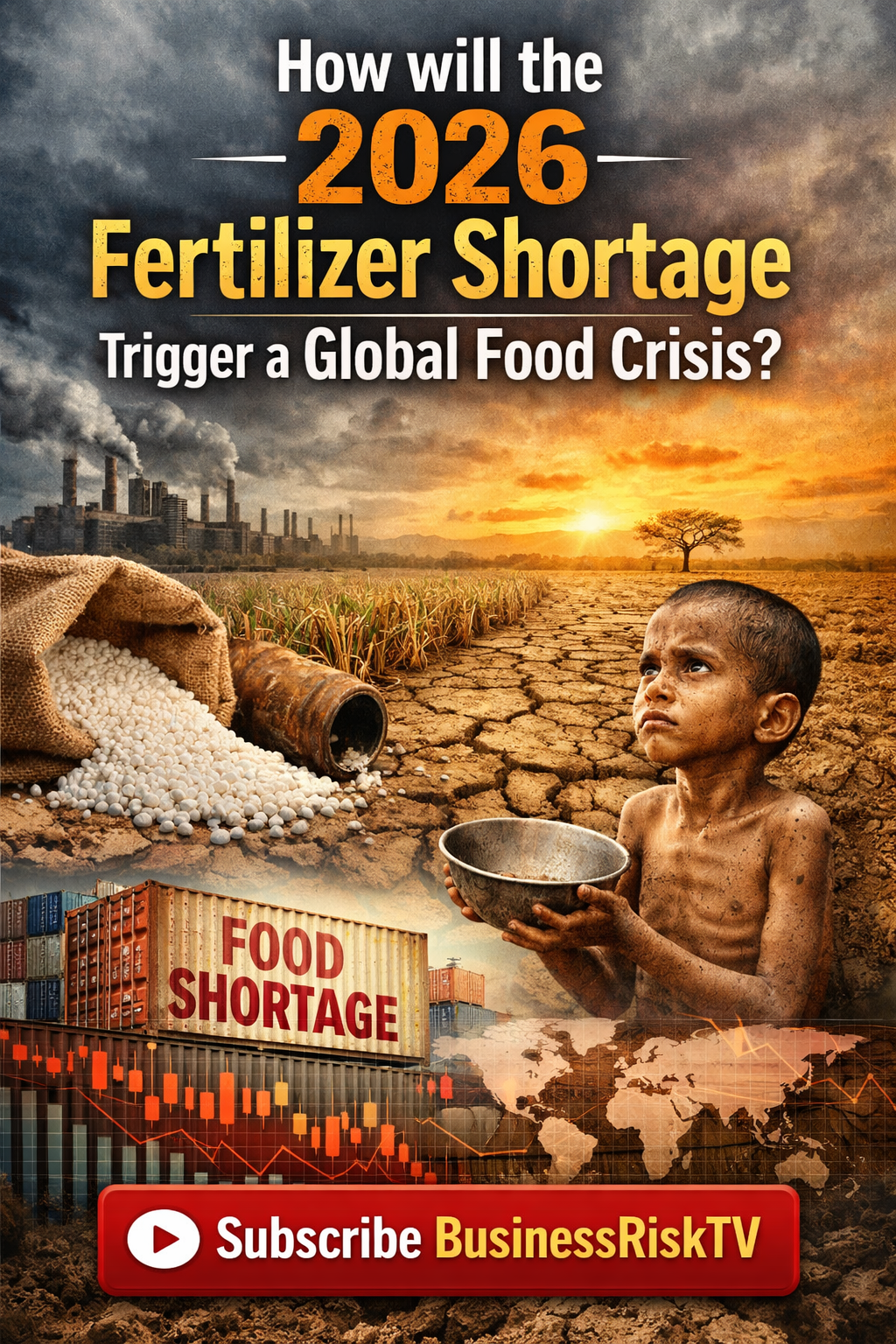
How will the 2026 fertilizer shortage trigger a global food crisis?

The world is weeks away from a permanent yield loss in global agriculture. This analysis breaks down why the 2026 fertilizer shock is a “weapon of mass destruction” for your bottom line and provides 12 actionable steps to protect your business from the resulting global recession.

The 2026 fertilizer shortage is fundamentally a race against a biological calendar that no government intervention can bypass. While traditional media focuses on oil, the closure of the Strait of Hormuz on February 28, 2026, has trapped the molecules required to produce half the world’s food.

  • 97% Collapse in Transit: Seaborne fertilizer trade through Hormuz has effectively ceased, cutting off 43% of global urea and 44% of the world’s sulfur.
  • No Strategic Reserves: Unlike oil, there is no global strategic fertilizer reserve. Once the “planting window” closes in the next six weeks, the yield loss for the year is permanent.
  • The “Biophysical Cliff”: In the Global South, where fertilizer application is already minimal, a 15% reduction in nitrogen doesn’t just lower yields—it causes production to collapse, as seen in Sri Lanka’s 40% rice harvest failure.

“The actual weapon of mass destruction in this conflict is not a missile. It is a calendar. The food is not decided by diplomats in six months; it is decided by soil chemistry in the next six weeks.” — BusinessRiskTV Global Intelligence


Can businesses in the Western world survive a global famine-driven recession?

A global famine-driven recession will impact Western businesses through a “bullwhip effect” of surging input costs and collapsing consumer discretionary spending. Even if food remains available in wealthy nations, the inflationary shock will be unprecedented.

  • AdBlue and Logistics Paralysis: Australia and Europe are facing a “no urea, no freight” scenario. Without urea-based AdBlue, heavy trucking fleets stall, leading to empty shelves in cities like Sydney and London.
  • Surging Input Costs: US corn farmers are already seeing ammonia prices hit $900 per ton. These costs will manifest as a massive spike in grocery prices by Q4 2026.
  • Macroeconomic Trap: With core PCE trapped near 3%, the Fed has no room to cut rates to stimulate a slowing economy, creating a “Stagflation 2.0” environment where food prices drive the CPI while growth flatlines.

What are the 12 business risk management steps to take today?

Business leaders should take these 12 business risk management steps today to insulate their operations from the impending supply chain and inflationary shock.

  • Audit Sub-Tier Dependencies: Identify where urea, ammonia, or sulfur sit in your deep supply chain (e.g., packaging, chemical processing).
  • Secure Logistics Fuel Additives: For firms with private fleets, stockpile AdBlue/DEF immediately to avoid grounding transport.
  • Renegotiate Fixed-Price Contracts: Shift to variable pricing or include “Force Majeure” clauses that account for commodity-driven hyperinflation.
  • Implement “Greed-flation” Monitoring: Track competitor pricing daily to ensure your margins aren’t eroded before you can react.
  • Diversify Sourcing to North America: Prioritise suppliers using Canadian or US-based nitrogen plants that are less dependent on the Gulf.
  • Hedge Food-Linked Commodities: Use futures markets to lock in prices for grains or livestock feed if your business is in the food/beverage sector.
  • Review Debt Covenants: Ensure rising operational costs won’t trigger technical defaults as interest rates remain “higher for longer.”
  • Scenario Plan for Civil Unrest: If your business has international footprints in the Global South, prepare for the “Sri Lanka Effect”—government instability driven by food shortages.
  • Optimise Product Portfolio: Shift focus to high-margin “necessity” goods as consumer discretionary income collapses.
  • Enhance Operational Efficiency: Use the next six weeks to cut non-essential overhead to build a cash moat for the Q4 price surge.
  • Collaborate with Industry Peers: Join the BusinessRiskTV Business Risk Management Club to share non-competitive risk data and mitigation strategies.
  • Communicate Transparently with Stakeholders: Brief your board and investors now on the “Calendar Risk” so the Q3/Q4 earnings impact is anticipated.

#BusinessRisk #SupplyChain #FoodSecurity2026 #SupplyChainDisruption #BusinessRiskTV

BusinessRiskTV Business Risk Management Club

Protect your business better and grow faster with less uncertainty impacting your business objectives by joining the BusinessRiskTV Business Risk Management Club.

As a key business decision-maker, joining BusinessRiskTV is the most strategic move you can make in 2026 for three critical reasons:

  • Immediate ROI on Risk Intelligence: Membership provides actionable alerts on emerging threats—like the current fertilizer chokepoint—weeks before they hit mainstream media, saving members an average of 15% in avoidable procurement costs.
  • Global Expert Network: You gain direct access to a worldwide network of risk professionals who provide in-country intelligence and “no-fluff” strategies that turn volatility into a competitive advantage.
  • Low-Cost, High-Value Resilience: For a fraction of the cost of traditional consultancy, members receive real-time risk profile assessments and strategic updates designed to prevent costly operational mistakes during global crises.

Get help to protect and grow your business with BusinessRiskTV

Find out more about how to grow your business faster with BusinessRiskTV 

Subscribe for free business risk management ideas risk reviews and cost of living reduction tips

Connect with BusinessRiskTV for free business risk management tips

Read more business risk management articles and view videos

Connect with BusinessRiskTV for free alerts to new business risk management articles and videos 

The Most Dangerous Calendar in Modern Business History

How will the 2026 fertilizer shortage trigger a global food crisis Subscribe BusinessRiskTV

While you’re watching oil prices, the molecules that feed 50% of the planet are physically trapped behind a war zone—and the window to save the 2026 harvest closes in exactly 42 days. This isn’t a “market correction.” It’s a biophysical cliff. 📉

We are currently witnessing the total collapse of the global fertilizer supply chain. With the Strait of Hormuz closed, 97% of seaborne fertilizer transit has evaporated. There is no Plan B. There is no strategic reserve.

The yield response to nitrogen is quadratic, not linear. In the Global South, production won’t just “dip”—it will collapse. We’ve seen this movie before in Sri Lanka, and now it’s playing in 30 countries simultaneously. For Western businesses, this means:

  • Logistics Failure: No urea = No AdBlue = No trucks moving groceries.
  • Inflationary Surge: Food prices will hit your table by Christmas with a force the Fed cannot stop.
  • The “Calendar Trap”: The Corn Belt needs nitrogen by mid-April. If they miss it, no amount of money can “fix” the yield loss in August.

Most analysts are talking about “strike counts” and “equities.” They are missing the soil chemistry. If you don’t understand how a sulfur shortage in the Gulf impacts a manufacturing plant in Ohio or a supermarket in Sydney, you are flying blind into the greatest recessionary shock of the decade.

Join the BusinessRiskTV Business Risk Management Club to stay ahead of the curve.

#BusinessRisk #SupplyChain #FoodSecurity2026 #SupplyChainDisruption #BusinessRiskTV

How will the 2026 fertilizer shortage trigger a global food crisis?