Hormuz Blockade & The Bond Market Sell-off: 2026 Business Risk Analysis

Explore how the Iran-Israel war and the Strait of Hormuz blockade are impacting U.S. Treasuries, UK Gilt yields, and global business lending rates in 2026.

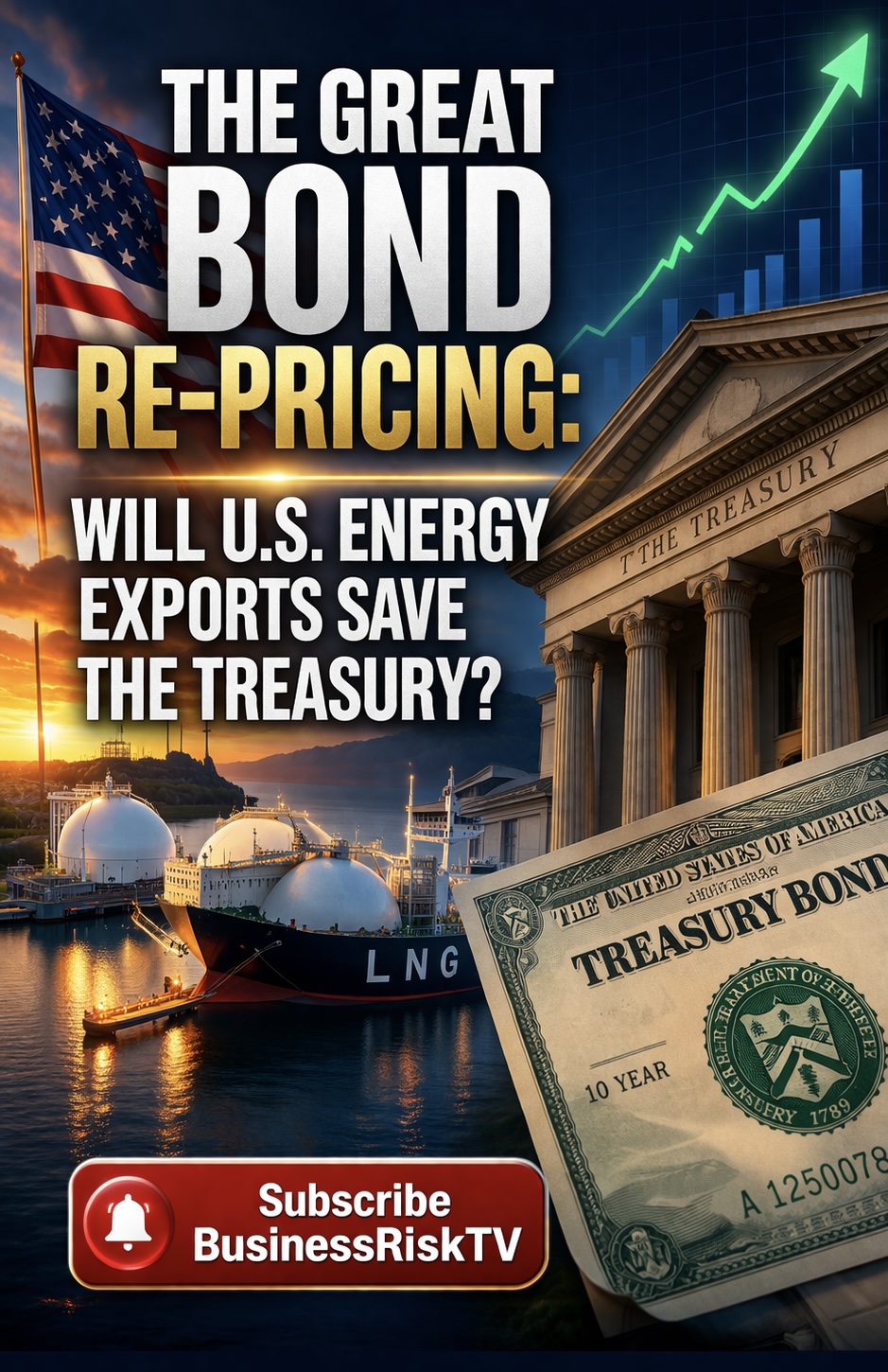
The Great Bond Re-Pricing: Will U.S. Energy Exports Save the Treasury?

The global financial landscape in April 2026 is defined by a paradoxical “Energy-Debt Loop.” As Asian nations continue to reduce their holdings of U.S. Treasury bonds, the escalating conflict between Iran and Israel—and the subsequent blockade of the Strait of Hormuz—has introduced a controversial new mechanic into global risk management: the potential for U.S. energy dominance to forcibly re-finance its own debt.


Is the Dumping of U.S. Treasuries by Asian Nations a Permanent Shift?

The dumping of U.S. Treasury bonds by major Asian economies represents a strategic diversification away from dollar-denominated debt that is structurally raising global interest rates. As of early 2026, China’s holdings have hit a 15-year low, dipping toward $640 billion, while Japan has selectively sold off reserves to defend the Yen. This lack of “price-insensitive” buyers means Treasury prices must fall to attract new investors, which automatically pushes yields higher.

For businesses, this “bond tantrum” means the floor for all global lending has moved. High street banks, seeing the risk-free rate of return rise, are forced to increase margins on business loans, equipment financing, and commercial mortgages to remain profitable.


Does the Strait of Hormuz Blockade Secretly Increase Demand for U.S. Treasuries?

The blocking of the Strait of Hormuz oil and gas routes may actually increase demand for U.S. Treasuries because Europe and Asia must now pivot to U.S.-sourced energy, paid for in Dollars which are then recycled into U.S. debt.With 20% of global oil and LNG currently trapped behind the blockade, nations like Germany, Japan, and South Korea are forced to sign massive supply contracts with U.S. energy firms.

This creates a “Petrodollar 2.0” effect:

  • Forced Dollar Demand: Foreign nations must acquire USD to pay for U.S. shale oil and gas.

  • Debt Financing: The U.S. government can leverage this surge in dollar demand to sell more Treasuries, effectively financing the $38.6 trillion “debt mountain” at the expense of global consumers.

  • Consumer Impact: While this supports the U.S. Treasury market, it creates a “Double Tax” for global businesses—high energy prices at the pump and high interest rates at the bank.


Why Have UK Gilt Yields Surpassed 5.0% and How Does it Affect Your Lending?

UK Gilt yields have surged past 5.0% for the first time in nearly two decades, signalling that the era of “cheap money” is officially over for the foreseeable future. In March 2026, the 10-year Gilt yield hit 5.11%, driven by the Middle East energy shock and a “material about-turn” in Bank of England policy.

“When government bond yields break the 5% barrier, the ripple effect through high street bank lending is instantaneous and unforgiving,” notes a lead strategist at the Business Risk Management Club.

For business leaders, this means:

  • Refinancing Risk: Debt maturing in 2026 is being rolled over at rates 300-400 basis points higher than three years ago.

  • Margin Compression: Higher interest expenses are eating into net profits faster than most businesses can raise prices.

  • Currency Risk: The volatility in bond yields is causing 2-3% daily swings in major currency pairs, making international trade a gamble.


12 Risk Management Actions to Protect Your Business Today

In a world of 5% yields and $140 oil, business as usual is a recipe for failure. Implement these actions now:

  1. Hedge Energy Costs: Lock in fuel and power surcharges with suppliers or use energy derivatives to cap your exposure.

  2. Fix Debt Immediately: If you have variable-rate loans, convert them to fixed-rate products before the next central bank hike.

  3. Optimise Working Capital: Tighten credit terms for customers (e.g., move from Net-30 to Net-15) to reduce your reliance on expensive bank credit.

  4. Audit “Hormuz Vulnerability”: Map your supply chain to identify any tier-2 or tier-3 suppliers reliant on Persian Gulf transit.

  5. Diversify Into Gold: With Gold testing $4,800/oz, use it as a non-correlated hedge against a potential “Debt Mountain” collapse.

  6. Implement Currency Buffers: Maintain “Natural Hedges” by matching the currency of your revenue with the currency of your expenses where possible.

  7. Stress Test for 6% Yields: Model your business’s debt-service coverage ratio (DSCR) if Gilt or Treasury yields rise another 1%.

  8. Switch to “Just-in-Case” Inventory: The cost of holding stock is high, but the cost of a stock-out due to maritime blockades is terminal.

  9. Leverage Tokenised Payments: Explore blockchain-based cross-border settlements to avoid the 3-5 day “float” taken by traditional banks.

  10. Negotiate “Energy Clauses”: Update client contracts to include automated price adjustments based on Brent Crude benchmarks.

  11. Onshore Manufacturing: Reduce the “Geopolitical Distance” of your products to insulate against shipping volatility.

  12. Join a Risk Intelligence Network: Actively participate in the Business Risk Management Club to access real-time data.


Join the Business Risk Management Club at BusinessRiskTV

BusinessRiskTV is the global leader in providing proactive intelligence for an unpredictable world. The Business Risk Management Club offers the tools to turn these global threats into a competitive advantage.

  • 15% Loss Reduction: Members report significantly lower operational losses by using our peer-verified risk mitigation blueprints.

  • Real-Time Alerts: Get notified of bond yield breakouts and geopolitical “choke point” shifts 48 hours before the mainstream media.

  • Zero-Cost Entry: Basic membership is FREE, providing instant access to a global network of risk professionals.

#BusinessRisk #BondMarket2026 #EnergySecurity #BusinessRiskTV #RiskManagement

Get help to protect and grow your business faster with BusinessRiskTV

Find out more about how to grow your business faster with BusinessRiskTV 

Subscribe for free business risk management ideas risk reviews and cost reduction tips

Connect with BusinessRiskTV for free business risk management tips

Read more business risk management articles and view videos for free

Connect with BusinessRiskTV for free alerts to new business risk management articles and videos

The U.S. is financing its debt with YOUR energy bill. ⛽️💳

Think the Strait of Hormuz blockade is just about “expensive gas”? Think bigger.

The global bond market is undergoing a “Great Re-Pricing,” and the logic is brutal. As Asian countries dump U.S. Treasuries, the U.S. is finding a new way to keep its “Debt Mountain” standing—at your expense.

The 2026 Power Play:
By blocking Middle Eastern oil, the world is forced to buy U.S. energy. That demand for U.S. Dollars allows the U.S. to finance its own debt while UK Gilt yields soar past 5.0% for the first time in a generation.

What this means for your business today:

The Bank Squeeze: High street lending rates are tethered to these yields. Your next loan renewal will be the most expensive in your company’s history.

The Imported Inflation: Even if you don’t trade in the U.S., the “Safety Strength” of the Dollar is crushing local currencies and driving up the cost of everything.

The Refinancing Wall: Millions of businesses are about to hit a wall of high-interest debt they simply can’t afford.

Don’t be a statistic. We’ve just released the definitive risk analysis on BusinessRiskTV with 12 immediate actions you can take to insulate your margins from the 5% yield reality.

Stop reacting. Start managing.

#BusinessRisk #BondMarket2026 #EnergySecurity #BusinessRiskTV #RiskManagement

Enterprise risk management magazine and videos on business growth and business protection
Global Bond Market Turbulence: A 2026 Business Risk Analysis Subscribe BusinessRiskTV

Hormuz Blockade & The Bond Market Sell-off: 2026 Business Risk Analysis

Two-Speed Europe: Is the EU’s New “E6” Core a Path to Collapse? | BusinessRiskTV

Two-Speed Europe Business Guide: Risks, Opportunities & 6 Strategic Steps : The EU’s two-speed plan reshapes business. Our analysis covers the E6 group’s impact, supply chain shifts, and 6 essential risk management steps for leaders.

The E6 Core and the Coming EU Cracks: A Contrarian Risk Analysis for Business

The Inconvenient Truth: A Multi-Speed EU Reflects a Failing Political System

The proposal for a “two-speed Europe” championed by German Finance Minister Lars Klingbeil is not a clever, flexible solution for the European Union. It is a desperate, last-ditch political manoeuvre that starkly reveals the bloc’s fundamental dysfunction. The core thesis is this: The EU has become so politically paralysed that it can no longer function as a cohesive unit, forcing its largest and wealthiest members to abandon the pretence of consensus. The formation of the “E6” (Germany, France, Italy, Spain, Poland, Netherlands) is not a temporary working group; it is the blueprint for an elite, high-speed political and economic directorate designed to override the cumbersome machinery of the full 27-member union. This move does not save the EU; it initiates its reconfiguration into a core-periphery model that will breed permanent resentment and could catalyse the bloc’s gradual disintegration, particularly as political winds shift within its own core.

While defenders claim this is a “pragmatic” solution to EU decision-making inertia, the reality is that it formalises failure. It accepts that the core EU treaty principle of achieving “ever closer union” among equals is dead, replaced by a system where a few powerful states simply move forward and impose their agenda. This is not a benign technicality. It creates a de facto first- and second-class membership, where the “peripheral” nations are systematically disadvantaged, their policy autonomy undermined, and their ability to shape the European project severely diminished.

The “E6” Core Group: A Cartel That Will Ignore and Override the Rest

The risk that the E6 will act as an internal cartel, sidelining the wishes of other member states, is not a hypothetical fear—it is the explicit purpose of the formation.

  • Circumventing Vetoes and Imposing Policy: The primary motivation for the E6 is to bypass the EU’s unanimity requirement on sensitive matters like foreign policy, taxation, and security. When Luxembourg’s Prime Minister argued for a two-speed model, his logic was chillingly clear: “When a country says ‘I don’t want to,’ I can say: ‘Well, too bad. Don’t block me. Let me get on with it with others'”. This sentiment is the E6’s operating principle.
  • Existing Precedents of Core-Periphery Exploitation: This is not a new dynamic, but the hardening of an existing, exploitative one. An academic study examining the post-2009 crisis period shows how EU austerity policies, dictated by core institutions, devastated peripheral economies like Greece, locking them into a dependent relationship and widening economic and social gaps. The E6 formalises this power imbalance, allowing the core to set fiscal, defence, and industrial policies that serve their interests first.
  • The Single Market as a Tool of Coercion: Proponents argue that “outsider” nations will remain linked via the single market. In practice, this means they will be forced to accept regulations and standards set by the E6 to maintain market access, but will have no substantive vote in creating them. They become rule-takers, not rule-makers. The EU’s internal market, once a tool for convergence, risks becoming a mechanism for enforcing the core’s will on the periphery.

From Multi-Speed to Total Breakdown: The Domino Scenario of Collapse

The greatest existential threat to the EU is not this proposal itself, but the long-term political chain reaction it sets off.

  • Accelerating Divergence and Breeding Nationalism: A formalised two-tier system will halt economic and social convergence. One analyst warns it could increase economic divergence, leading to greater migration pressures and ultimately calls to limit the EU’s foundational principle of free movement. This fuels the very nationalist, anti-EU sentiments the bloc fears. Countries left in the “slow lane” will see their citizens grow disillusioned with a union that offers them diminished prospects and influence.
  • Political Shockwaves from Within the Core: The E6 is not a monolith. Poland’s inclusion is particularly volatile, given its government’s history of fierce clashes with Brussels over the rule of law. A future populist government in Italy, Spain, or even France could look at the E6’s commitments and decide to follow a British path. The exit of a single major E6 member would not just weaken the core; it would shatter the entire political and economic logic of the two-speed model, potentially triggering a rush for the exits.
  • The “Grexit” Precedent on a Grand Scale: The Greek debt crisis proved that the EU core was willing to entertain the expulsion of a member to preserve the eurozone. A two-speed Europe makes this concept operational. Weaker economies that fail to keep pace could face intense pressure to leave certain policy areas or be politically marginalised, creating a de facto “flexible disintegration”. Once the principle of an “inner circle” is accepted, the unthinkable—managing a member’s partial or full exit—becomes a policy tool.

Six Controversial Risk Management Steps for Business Leaders

Given this bleak prognosis, business leaders must abandon hope for EU stability and adopt a ruthless, realpolitik strategy.

1. Abandon “EU-Wide” Strategy; Adopt a “Core-First, Periphery-Contingent” Model

  • Action: Immediately re-allocate capital and strategic focus to the E6 nations. Treat the rest of the EU as a secondary, higher-risk market. Develop separate investment theses: one for the integrated, subsidy-rich core, and another for the volatile periphery.
  • Rationale: Future EU funding, defence contracts, and regulatory advantages will be heavily concentrated within the core. The periphery will suffer from capital flight and policy neglect.

2. Prepare for the End of the Single Market as We Know It

  • Action: Conduct stress tests on your supply chains and logistics for scenarios where free movement of goods, services, or people is restricted between the core and periphery, or where the core imposes new digital or regulatory borders.
  • Rationale: The political logic of a two-tier Europe inherently leads to regulatory divergence and potential barriers. Businesses cannot assume the single market’s integrity will survive this political fracturing.

3. Bet on the Core’s “Fortress” Economy—Especially in Defense and Tech

  • Action: Aggressively pivot business development towards sectors explicitly prioritised by the E6: defence manufacturing, dual-use technologies, critical raw material processing, and fintech platforms aligned with a deeper capital markets union.
  • Rationale: The E6’s agenda is to build strategic autonomy. This means massive, protected subsidies and procurement contracts for core-based champions, explicitly turning “defence into an engine for growth”.

4. Establish Political Risk Units Focused on Nationalist Movements in E6 Countries

  • Action: Move beyond tracking Brussels policy. Invest in intelligence-gathering on rising anti-EU, populist parties in Italy, France, and Poland. Model the business impact of any one of them winning power and renouncing E6 commitments.
  • Rationale: The stability of the entire new structure rests on the continued political alignment of its core members. This is its greatest vulnerability. A political shock in one E6 nation could unravel everything overnight.

5. Develop “Nation-State” Lobbying Capabilities to Bypass Brussels

  • Action: Drastically reduce reliance on pan-EU trade associations. Build direct, powerful lobbying operations within the national parliaments and ministries of Berlin, Paris, and Rome.
  • Rationale: Real power is shifting from EU institutions back to the capitals of the core nations. The E6 will decide policy in closed-door meetings, not in the European Parliament.

6. Scenario Plan for the “Domino Exit” and EU Liquidation

  • Action: Develop a confidential contingency plan for a rapid, uncoordinated unwind of the EU. This includes legal entity restructuring, currency re-denomination risk plans, and strategies for protecting assets.
  • Rationale: While not the most likely scenario, the two-speed model makes a catastrophic failure sequence plausible. Leaders who dismiss this possibility are ignoring the historical precedent of how political unions can unravel with stunning speed when their central bargain breaks down.

Conclusion: Navigating the Unravelling

The two-speed Europe is a sign of profound weakness, not strength. It is an admission that the grand political project of unification has stalled and is now being replaced by a mercantilist club dominated by its largest economies. For businesses, the era of a predictable, rules-based EU is ending. The new era will be defined by geopolitical manoeuvring, privileged access for insiders, and heightened systemic risk. The prudent leader will not plan for a more integrated Europe, but for a fragmented one, where survival depends on picking the right side in a quiet internal conflict that has already begun.

#TwoSpeedEurope #EUCollapse #GeopoliticalRisk #BusinessStrategy #E6Core

Get help to protect and grow your business with BusinessRiskTV regardless of uncertainties in the business environment

Find out more about growing your business faster through greater uncertainty 

Subscribe for free business risk management ideas risk reviews and cost reduction tips

Connect with us for free business risk management tips

Read more business risk management articles and view videos for free

Connect with us for free alerts to new business risk management articles and videos 

Two-Speed Europe: Is the EU’s New “E6” Core a Path to Collapse? | BusinessRiskTV

Navigating Geopolitical Storms: Business Risk Analysis Post-Davos 2026

The 2026 World Economic Forum in Davos revealed a stark rupture in transatlantic relations, creating immediate and long-term risks for global businesses. This analysis breaks down the key takeaways for leaders and provides six actionable steps to protect and grow your business in an era of heightened geopolitical confrontation.

The Davos Divide and the New Risk Landscape

The 2026 World Economic Forum in Davos will be remembered not for its solutions, but for its stark exposures. The confrontation between European leaders and the American administration laid bare a deep fracture in the Western alliance, moving geopolitical tensions from the background to the forefront of executive decision-making. President Trump’s antagonistic speech, which included grievances against European allies, questioning of NATO commitments, and a relentless focus on acquiring Greenland, signalled a profound shift toward a world where confrontation is replacing collaboration.

For business leaders, this is not merely political theatre. It is a direct and material risk. The WEF’s own Global Risks Report 2026 identifies “geoeconomic confrontation” as the top risk most likely to trigger a global crisis this year, followed by state-based armed conflict. This environment demands a new playbook for risk management—one that is proactive, integrated, and resilient. The old model of globalisation, with its deeply integrated supply chains and stable multilateral rules, is under severe pressure. As one analysis notes, companies are now forced to consider parallel supply chains and navigate a world where data, trade, and investment are increasingly weaponised.

This post provides a clear-eyed analysis of the key business risks emerging from Davos and outlines six practical, immediate steps to turn this uncertainty into a strategic advantage.

Key Risk Exposures for Businesses After Davos 2026

The events at Davos crystallised several interconnected risk categories that threaten business operations, strategy, and financial performance.

1. Accelerated Geoeconomic Fragmentation & Supply Chain Rupture

The core takeaway is the active unravelling of decades of economic integration. The U.S. administration’s focus on unilateral deals and transactional relationships, as seen with the “framework” for Greenland, undermines the predictable, rules-based system. For businesses, this translates directly into severe supply chain vulnerability. As noted in research from Wharton, companies are being forced to build duplicate, resilient supply chains—a China-centric one and a non-China-centric one—which creates enormous cost and redundancy. This fragmentation is no longer a future threat; it is a present-day operational and financial challenge.

2. Policy Volatility and Regulatory Divergence

Davos highlighted a growing chasm in core policy areas, especially climate and energy. While European leaders and CEOs like Allianz’s Oliver Bäte passionately defended the green transition, calling backlash “bulls—,” the U.S. administration championed fossil fuels and mocked renewable energy policies. This divergence creates a nightmare of regulatory compliance. Companies operating transatlantically face conflicting mandates, as seen historically with EU laws forcing tech changes (like the USB-C port mandate) and strict data rules like GDPR. The risk is being caught in a regulatory crossfire, incurring massive costs to comply with opposing standards in different markets.

3. The Weaponisation of Data and Digital Platforms

A novel and under appreciated risk highlighted in broader analyses is the politicisation of data. Governments increasingly demand control over data of multinational companies within their borders, using it as a tool for political leverage. This was evident in past pressures on tech companies during geopolitical tensions. In a world of “multipolarity without multilateralism,” your customer data, operational data, and intellectual property are no longer just corporate assets—they are geopolitical pawns. This creates immense risks for data security, privacy compliance, and brand reputation.

4. Erosion of the Social License to Operate

Businesses are increasingly “stuck in the middle” of societal and political polarisation. The “streets versus elites” narrative is rising, and companies face pressure to take stands on divisive issues while also demonstrating fealty to national governments. The WEF report identifies misinformation and disinformation as the #2 global risk over the next two years, which can rapidly inflame public sentiment against a brand. Navigating these waters without a clear strategy exposes companies to boycotts, talent attrition, and lasting reputational damage.

Six Practical Risk Management Steps for Business Leaders

In this age of competition, a reactive, wait-and-watch approach is a direct threat to survival. Here is your six-step action plan to build resilience and discover opportunity.

Step 1: Conduct a Geopolitical Stress Test on Your Core Operations

Immediately move beyond traditional SWOT analysis. Launch a cross-functional task force to conduct a dedicated geopolitical stress test. This involves mapping your entire value chain—from critical material sourcing and Tier-N suppliers to key logistics corridors and primary sales markets—against a map of escalating geopolitical flashpoints. Quantify the impact of potential disruptions. For example, what is the financial exposure if a specific trade corridor is tariffed or closed? What alternative suppliers exist outside of geopolitical hotspots? The goal is to move from qualitative worry to quantitative preparedness.

Step 2: Build a Dynamic Early Warning System

You cannot manage what you do not see. Relying on quarterly risk reports is obsolete. Implement an AI-powered early warning system that monitors real-time signals. This system should track not just news, but proposed legislation, social media sentiment, and trade policy adjustments in all your operational regions. Use technology to set alerts for specific keywords related to your industry, as some firms track terms like “oil drilling” in legislative texts. This transforms scattered data into actionable intelligence, giving you a crucial time advantage to respond.

Step 3: Formalise a “Political Risk War Room” and Governance

Political risk can no longer be siloed in government affairs. Follow the advice of experts and establish a cross-functional geostrategic committee that reports directly to the C-suite and board. This committee should include leaders from supply chain, finance, legal, communications, and strategy. Its mandate is to meet regularly, review early-warning intelligence, assess potential financial impacts, and authorise pre-planned contingency actions. This governance structure ensures rapid, coordinated decision-making when a crisis emerges.

Step 4: Develop “Plug-and-Play” Contingency Plans for Key Scenarios

For your top three geopolitical risk scenarios (e.g., “Sudden Tariffs on Key Import,” “Embargo on Technology Exports to Market X,” “Forced Local Data Storage Mandate”), develop pre-approved contingency playbooks. These should outline clear trigger points, decision authorities, and specific actions. For instance, a playbook for new tariffs might include immediate steps to activate alternative shipping routes, pre-negotiated contracts with alternative suppliers, and a communications template for customers. This shifts the response from panic to execution.

Step 5: Diversify Stakeholder Capital and Government Relationships

In a fragmented world, relationships are a critical risk mitigation asset. Proactively diversify your stakeholder engagement beyond traditional channels. Build relationships with policymakers, regulators, and community leaders in all your key markets before a crisis hits. Furthermore, explore financial resilience tools like political risk insurance to protect physical assets and investments in unstable regions. Also, reassess your capital structure and banking relationships to ensure you have access to liquidity from diverse sources if financial markets seize up due to geopolitical shock.

Step 6: Embed Strategic Agility into Your Business Model

Ultimately, the greatest risk is the status quo. Use this moment of clarity to build inherent agility into your business model. This includes:

  • Product Design: Develop products with modular designs that can be easily adapted to different regulatory or standards environments (e.g., different power specs, data protocols).
  • Manufacturing: Invest in flexible, smaller-scale production facilities (like “micro-factories”) that can be relocated or repurposed faster than monolithic plants.
  • Talent Strategy: Cultivate a distributed leadership bench with deep regional expertise, empowering local teams to make rapid decisions in response to local disruptions.

Conclusion: From Risk to Resilient Growth

The message from Davos 2026 is unambiguous: the business environment has fundamentally shifted. The greatest danger now is inaction—the risk of assuming the old rules still apply. However, within this volatility lies significant opportunity. Companies that proactively manage these geopolitical risks will not only protect their existing value but will gain a powerful competitive edge. They will be the ones able to seize market share as slower competitors falter, negotiate from a position of strength with governments, and attract investment as havens of stability.

The time for vague concern is over. The time for deliberate, structured action is now. Begin your geopolitical stress test this week.

Protect and grow your business faster with BusinessRiskTV

Find out more about growing your business faster with less uncertainty impacting your business objectives 

Subscribe for free business risk management ideas risk reviews and cost reduction tips

Connect with us for free business risk management tips

Read more free business risk management articles and view videos for free

Connect with us for free alerts to new business risk management articles and videos

Navigating Geopolitical Storms: Business Risk Analysis Post-Davos 2026