Holistic Enterprise Risk Management: Why Risk Registers Fail UK Business

Traditional risk registers create the illusion of control while blinding UK business leaders to interconnected threats and opportunities. This article explains why holistic enterprise risk management is the solution to faster, safer business growth — and gives 9 practical ways to embed it in strategic, operational and project decisions.

Traditional risk registers are failing UK businesses. Discover why holistic enterprise risk management protects and grows your business faster — 9 practical ways.

Why Traditional Risk Registers Are Killing UK Business Growth — And How Holistic Enterprise Risk Management Fixes It

BusinessRiskTV Business Risk Management Club recommends holistic enterprise risk management methodology as the solution to the problem of protecting and growing a business faster in UK. The traditional risk register is not just inadequate — it is actively dangerous for any UK business leader who wants to grow, because it creates the illusion of control while blinding you to the interconnected threats and opportunities that actually determine whether your business thrives or dies. The ICAEW declared in February 2026 that “ERM as enterprise list management is dead,” warning that risk registers “grow longer, not sharper” while risk discussions remain “disconnected from strategy and capital decisions” . If your business risk management still revolves around a spreadsheet that gets updated once a quarter, you are not managing risk — you are managing paperwork. And your competitors who have embedded holistic enterprise risk management into every strategic, operational and project decision are already pulling ahead.‌

What is holistic enterprise risk management?

Holistic enterprise risk management is a company-wide approach that identifies, assesses, manages and monitors all risks — strategic, operational, financial and regulatory — as an interconnected system rather than as isolated items on a list . It moves beyond the traditional risk register’s static, point-in-time snapshot and instead embeds risk intelligence into the daily decision-making of the business, from the boardroom to the front line. FERMA, the Federation of European Risk Management Associations, defines the evolved approach as one where “risk, opportunity and strategy are managed in harmony to sustain long-term enterprise resilience,” explicitly shifting from a “purely threat-focused approach to one that emphasises value creation” . In practical UK terms, holistic ERM asks not “what risks do we have?” but “what outcomes must we continue to deliver, whatever happens?” — a fundamental reframing that the ICAEW argues is essential for survival in 2026’s polycrisis environment.

Why are traditional risk registers no longer enough for UK businesses in 2026?

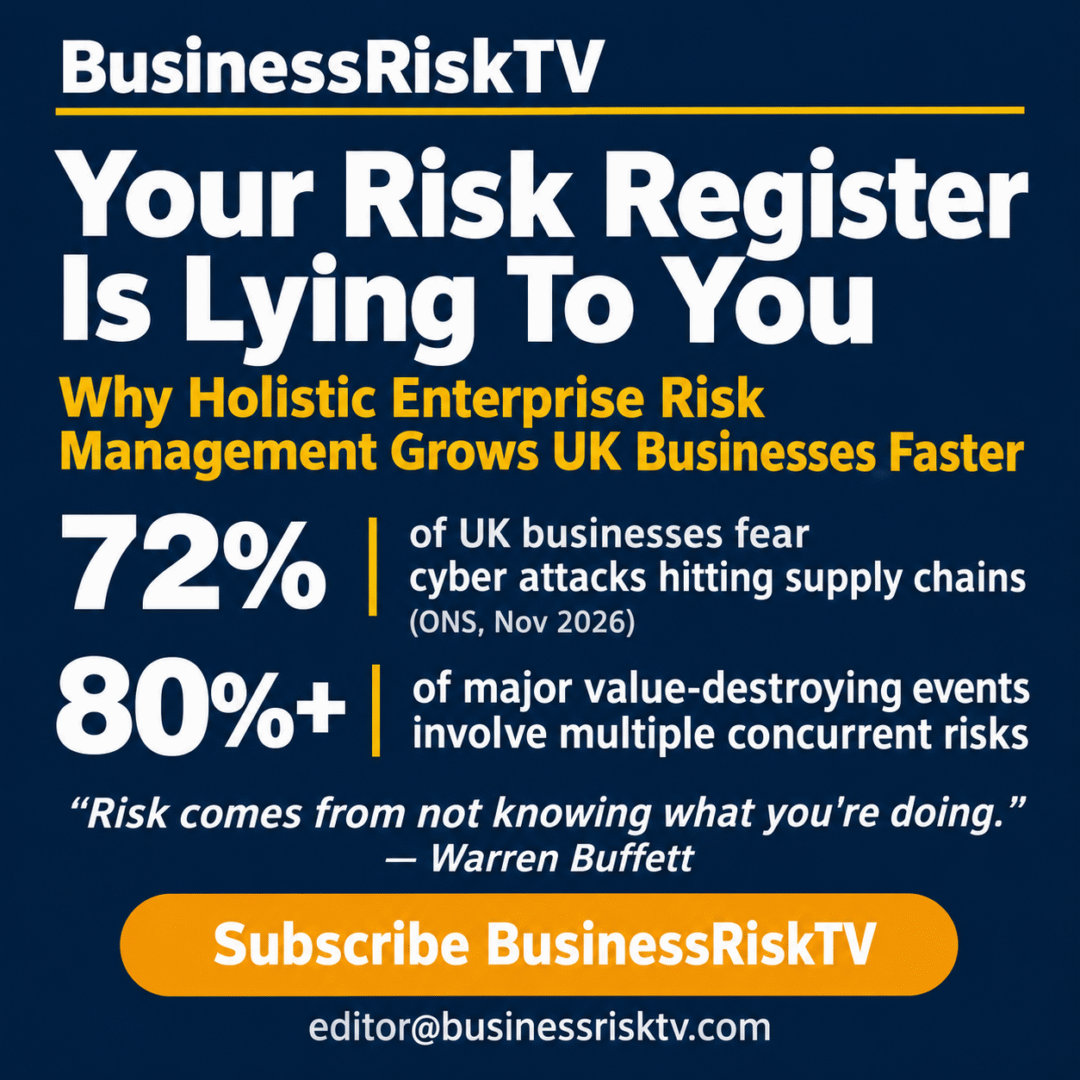
Traditional risk registers are no longer enough because they are static, siloed and backward-looking in a business environment where threats are interconnected, fast-moving and increasingly technological. The ONS reported in November 2026 that 21% of UK businesses with 10 or more employees were concerned about cyber attacks impacting supply chains over the next year — a 9 percentage point increase from September 2025 — while 12% were concerned about artificial intelligence, the highest proportion since the question was introduced . A risk register that lists “cyber risk” as a single line item with a likelihood score of 3 and an impact score of 4 tells you nothing about how a supplier breach in one jurisdiction cascades into operational disruption, regulatory exposure and reputational damage simultaneously. Pinsent Masons warned in 2026 that controls are “degrading assets” and that static residual risk ratings are “increasingly detached from operational reality” because they fail to capture how inherent risk, control effectiveness and residual risk move together . Vanta’s 2026 research found that spreadsheets remain the most widely used GRC tool — yet they “won’t support ERM programs” because they “reinforce siloed, point-in-time risk oversight” . The register is not a management tool. It is a comfort blanket.

Who will benefit from embedding holistic enterprise risk management in business decision making?

Every UK business leader who makes decisions under uncertainty will benefit — but the gains are most dramatic for owners, directors, CFOs and risk managers in businesses with more than 10 employees operating across multiple risk domains. FERMA’s 2026 white paper explicitly calls for corporate risk management to be recognised “not as a technical or compliance function” but as “a strategic capability that supports enterprise-wide resilience and growth” . The beneficiaries are not just risk professionals. They are the CEO who needs to know whether a supply chain diversification decision will actually reduce exposure or simply shift it; the CFO who needs to quantify the correlation-adjusted impact of two simultaneous risks rather than scoring them separately; and the board director who needs to demonstrate to regulators and investors that risk oversight is active, not theatrical. The ONS found that 38% of businesses with 10 or more employees were concerned about international conflict impacting supply chains in April 2026 — a 28 percentage point rise from December 2025 — and 44% of importing businesses reported increased importing costs . Those businesses need integrated intelligence, not a longer list.‌

When will holistic enterprise risk management deliver positive results for a business?

Holistic enterprise risk management delivers positive results when it is embedded into the rhythm of decision-making — not when it is treated as an annual compliance exercise — with early wins typically visible within the first two to three decision cycles. The ICAEW’s 2026 analysis is blunt: traditional ERM fails because it asks “what risks do we have?” rather than “what outcomes must we continue to deliver, whatever happens?” . The shift to holistic ERM begins delivering value as soon as leadership starts using risk intelligence to inform capital allocation, project approval and strategic prioritisation. FERMA’s vision is of an ecosystem where “risk management is a cornerstone of sustainable success” — a continuous capability, not a periodic deliverable . In practical terms, the first results appear when a business stops scoring risks in isolation and starts debating which risks matter to the strategy, which opportunities are being missed because they look risky on a register, and which controls are actually degrading silently beneath the surface.‌

Which UK businesses will benefit most from a holistic enterprise risk management approach to strategic, operational and project decision making?

UK businesses with complex operations, multiple risk exposures, growth ambitions or regulatory scrutiny will benefit most — and the evidence suggests that nearly every business with 10 or more employees now falls into at least one of those categories. The ONS November 2026 data shows 31% of businesses with 10 or more employees concerned about international conflict impacting supply chains, 21% concerned about cyber attacks, 12% concerned about AI, and 12% concerned about climate change . A small consultancy with one office and no supply chain does not need holistic ERM. But a manufacturer importing components, a professional services firm handling client data across jurisdictions, a construction company managing project risk across multiple sites, or a technology business deploying AI tools without a governance framework — these are the businesses where the gap between a risk register and holistic ERM is the difference between resilience and ruin. FERMA’s 2026 white paper recommends “flexible” ERM frameworks that adapt to different organisational contexts, precisely because a one-size-fits-all register approach fails businesses of different shapes and exposures.

How does holistic enterprise risk management improve business performance and create value?

Holistic enterprise risk management improves business performance by connecting risk intelligence directly to strategy, capital allocation and opportunity capture — turning risk from a cost centre into a value driver. FERMA’s CEO Laurent Nihoul states it plainly: risk management should be “not merely a defensive mechanism, but an integrated system that both protects and enables value creation” . The old model treated risk as something to be minimised. The holistic model treats risk as something to be understood, priced and exploited where the reward justifies the exposure. As the ICAEW’s 2026 article argues, “there is no return without risk” — boards should be asking “where do I want to be risk seeking?” rather than only “what could go wrong?” . This is not semantic gymnastics. It changes which projects get funded, which markets get entered, which suppliers get diversified and which talent gets hired. A business that understands its risk appetite can move faster into opportunity because it knows which risks it is equipped to take.‌

What are 9 practical ways to use holistic enterprise risk management methodology to protect and grow a UK business faster?

These nine practical applications of holistic enterprise risk management methodology will protect and grow a UK business faster by replacing static compliance with dynamic decision intelligence.

  1. Replace the single risk register with a risk universe hierarchy that separates enterprise-level, business-unit and project-level risks, so the board sees the interconnected picture while operational teams manage granular exposure.
  2. Run correlation-adjusted risk scenarios that model two or more simultaneous risks — because more than 80% of the largest value-destroying risk events involve multiple concurrent risks, according to actuarial research.
  3. Embed risk appetite thresholds into capital allocation and project approval gates, so that no material investment proceeds without an explicit statement of which risks are being accepted and why.
  4. Treat controls as degrading assets that require continuous monitoring, not annual attestation — Pinsent Masons warns that documented controls can remain unchanged while actual effectiveness deteriorates silently.
  5. Integrate AI and technology governance directly into risk governance, because automated decision tools are now controls in their own right and cannot be assessed as effective if the underlying models and data are not.
  6. Use horizon scanning and scenario planning as a standing board agenda item, not an annual workshop, to anticipate the interconnected risks that a static register cannot see.
  7. Assign named owners to every material risk and control, with decision rights escalating by severity — routine tolerance within business units, material risk acceptance to the executive or board.
  8. Measure risk management by outcomes protected and opportunities captured, not by the number of risks logged or the completeness of the register — the ICAEW’s critique is that time is spent “scoring risks rather than debating what truly matters”.
  9. Build a risk-aware culture where escalation is rewarded, because the ONS data shows that concerns about supply chain, cyber and AI risks are rising simultaneously — and the businesses that hear about problems early are the ones that survive them.

What do famous thinkers say about the benefits of managing business risks better?

Warren Buffett warned that “risk comes from not knowing what you’re doing” — a direct indictment of the risk register mentality that logs threats without understanding their interconnections . Peter Bernstein, author of Against the Gods, defined the essence of risk management as “maximising the areas where we have some control over the outcome while minimising the areas where we have absolutely no control over the outcome” . That is precisely what holistic ERM does: it identifies where control is possible, where exposure is unavoidable, and where the two intersect with strategy. Tom Gilb’s warning is perhaps the most urgent for UK business leaders in 2026: “If you don’t actively attack the risks, they will actively attack you” . And Buffett’s most famous risk aphorism — “only when the tide goes out do you discover who’s been swimming naked” — is a reminder that the businesses with thin risk management will be exposed first when the next supply chain shock, cyber incident or regulatory change arrives.

Why is the traditional risk register costing UK businesses money?

The traditional risk register costs UK businesses money because it consumes resources while failing to prevent the losses it is supposed to avert — and it blinds leadership to the opportunities that holistic risk management would capture. The ONS November 2026 data shows that 69% of UK businesses expressed concern about energy prices and 70% about fuel prices, with 77% of larger businesses concerned about energy . A register that lists “energy cost risk” as a line item does nothing to help a manufacturer model the correlation between energy prices, shipping costs and customer demand — or to decide whether to hedge, diversify suppliers or pass costs through. Pinsent Masons identifies the deeper cost: static risk assessments create “artificially low” residual risk reporting that is “detached from operational reality,” meaning boards are making decisions on false intelligence . The cost is not just the software licence or the risk manager’s salary. It is the bad decisions made on the basis of a false sense of security.‌

Who is the key business decision maker that must own holistic enterprise risk management?

The CEO owns holistic enterprise risk management, because risk and strategy are inseparable — and delegating it to a compliance function guarantees it will fail. FERMA’s 2026 white paper explicitly argues that corporate risk management should be “recognised as a strategic capability” rather than a technical or compliance function, and that governance, management and assurance functions must collaborate to shift “from a control-oriented mindset towards a proactive approach” . The ICAEW’s 2026 analysis of board risk oversight notes that the UK Corporate Governance Code places “clear expectations on boards to establish a robust framework for risk management and internal control,” and that effective practice “extends beyond compliance” to active oversight, alignment between strategy and risk appetite, and a culture of early escalation . The CEO cannot outsource this to the risk manager any more than they can outsource strategy to the finance team. The risk manager provides the intelligence. The CEO makes the decisions. But in a holistic ERM model, those decisions are informed by a continuous, integrated understanding of risk and opportunity — not a quarterly spreadsheet review.‌

What UK government and independent data proves holistic risk management is value for money?

The independent evidence from respected UK and European risk bodies proves that holistic risk management delivers value for money by preventing losses that static registers fail to catch. The ICAEW declared traditional ERM “dead” in 2026, citing McKinsey’s finding of “declining confidence in traditional risk frameworks, particularly in addressing emerging and interconnected risks linked to technology, resilience, and long-term value” . FERMA’s 2026 white paper represents the consensus of the European risk management profession: risk management must be repositioned “as a strategic driver of organisational value rather than a defensive function” . The ONS data provides the urgency: cyber concern impacting supply chains rose 9 percentage points year-on-year to 21% of larger businesses, AI concern hit its highest level since the question was introduced at 12%, and international conflict concern stood at 31% in November 2026 . These are not risks that can be managed by adding lines to a register. They require the integrated, forward-looking intelligence that only holistic ERM provides. The value for money case is simple: the cost of embedding holistic ERM is a fraction of the cost of a single unmanaged correlated risk event — and the opportunity cost of missing growth because your risk framework cannot distinguish between a threat to avoid and a risk worth taking is incalculable.‌‌

BusinessRiskTV Business Risk Management Club exists for UK business leaders who refuse to accept the comfort blanket of the traditional risk register. We operate outside standard structures to attract pure abundance — continuous business expansion, optimal health and resilience, and wealth creation for the risk manager who has the courage to challenge orthodoxy. The ICAEW says ERM as we know it is dead. FERMA says risk must enable value creation. The ONS data says the threats are rising and interconnected. The only question is whether you will keep updating the register while your competitors embed holistic risk management and grow faster. The choice is yours.

Core Institutional Sources

ONS Official Statistics

Famous Quotes

Get help to protect and grow your business faster with BusinessRiskTV

Find out more about growing your business faster with ERM

Subscribe for free business risk management ideas risk reviews and cost of doing business reduction tips

Connect with BusinessRiskTV for free business risk management tips 

Read more business risk management articles and view videos for free

Connect with BusinessRiskTV for free alerts to new business risk management articles and videos 

Your risk register is not protecting your business. It is lying to you.

And it has been for years.

Here is the uncomfortable truth most UK boardrooms will not say out loud: a spreadsheet with 47 risks scored “likelihood 3, impact 4” is not risk management. It is theatre. It is a comfort blanket that makes directors feel prudent while the actual threats — the ones that move fast, connect to each other and destroy value — pass straight through the gaps.

Don’t take my word for it. In 2026, the ICAEW declared traditional ERM “dead,” warning that risk registers “grow longer, not sharper” while staying “disconnected from strategy and capital decisions.” Pinsent Masons went further: controls are “degrading assets,” and static residual risk ratings are “increasingly detached from operational reality.”

Translation? Boards are making decisions on false intelligence. And it is costing them.

Meanwhile, the ONS reported in November 2026 that:

  • 21% of UK businesses with 10+ employees are worried about cyber attacks hitting supply chains — up 9 percentage points in a year
  • 12% are concerned about AI — the highest level since the question was introduced
  • 31% are concerned about international conflict disrupting supply chainsYou cannot manage those three risks on three separate lines of a register. They are connected. They compound. They arrive together.

    That is why holistic enterprise risk management is not a nice-to-have. It is the difference between a business that grows through shocks and one that is exposed by them.

    What actually changes when you embed it:

    → You stop scoring risks in isolation and start modelling correlation — because over 80% of the largest value-destroying events involve multiple concurrent risks
    → You separate enterprise, business-unit and project risk universes so the board sees the big picture and teams manage the detail
    → You build risk appetite thresholds into capital allocation and project approval gates — no material investment proceeds without naming which risks are being accepted and why
    → You treat controls as assets that degrade silently,  not boxes ticked once a year
    → You measure risk management by outcomes protected and opportunities captured — not by how many rows are in the spreadsheet

    Warren Buffett said it best: “Risk comes from not knowing what you’re doing.”

    Peter Bernstein said it better: risk management is “maximising the areas where we have some control over the outcome while minimising the areas where we have absolutely no control.”

    That is exactly what holistic ERM does. And the businesses doing it in the UK right now are not just safer — they are faster. They enter markets sooner, fund the right projects, diversify suppliers before the crisis hits, and grow while competitors are still updating column F.

    Here is the retention question worth sitting with: if your risk register vanished tomorrow, what would actually change about how your business makes decisions?

    If the answer is “nothing,” you do not have risk management. You have a document.

    The ICAEW says ERM as we know it is dead. FERMA says risk must become a strategic driver of value creation, not a defensive function. The ONS data says the threats are rising and interlocking.

    The only question left is whether you will keep updating the register while your competitors embed holistic ERM and grow faster.

    BusinessRiskTV Business Risk Management Club exists for UK business leaders who refuse the comfort blanket. We operate outside standard structures — focused on continuous business expansion, optimal resilience, and creating real wealth for the risk manager with the courage to challenge orthodoxy.

    Your next move: email editor@businessrisktv.com for more information on the Business Risk Management Club, and find out how to embed holistic enterprise risk management into your strategic, operational and project decisions — before the tide goes out.

    #RiskRegisterIsDead #HolisticERM

Holistic Enterprise Risk Management: Why Risk Registers Fail UK Business
Strategic Foresight 2027: 9 UK Business Threats to Beat

Strategic foresight gives UK businesses a competitive edge before 2027 threats crystallise. This BusinessRiskTV analysis identifies nine risks — from supply chain conflict to quantified risk blindness — with ONS and industry data, plus the steps decision-makers must take now to beat competitors.

Identify 9 strategic threats UK businesses face in 2027 and how to act now. BusinessRiskTV Business Risk Management Club strategic risk analysis.

Strategic Foresight 2027: How UK Businesses Can Identify Threats Before Competitors

BusinessRiskTV Business Risk Management Club Strategic Risk Analysis for UK Marketplace 2027 is the solution to the problem of strategic risk management in the UK for 2027. As the UK business landscape faces converging geopolitical, technological, and regulatory pressures, the window for reactive strategy is closing. The Office for National Statistics reported in May 2026 that 38% of UK businesses with 10 or more employees were already concerned about international conflict impacting supply chains—a 28 percentage point rise from December 2025 . BusinessRiskTV’s Business Risk Management Club provides the structured foresight framework UK decision-makers need to convert these early signals into competitive advantage before rivals react.‌

“The true sign of intelligence is not knowledge, but imagination.” — Albert Einstein, cited in INSEAD’s Distant Foresight Index research

Why Does Strategic Foresight Early Give a Competitive Advantage in the UK?

Strategic foresight early gives a competitive advantage in the UK because it enables businesses to shape regulatory environments, set industry standards, and define customer expectations before competitors recognise the threat. A firm that articulates a clear, well-researched vision of the future can effectively create the very future it is prepared to dominate . Shell’s pioneering scenario planning in the late 1960s anticipated a potential oil supply disruption; when the 1973 crisis hit, Shell was better prepared than competitors and gained a decisive advantage through diversification .‌‌

The financial case is stark. Aon’s 2026 UK report found that only 16% of UK firms have quantified their exposure to business interruption, and just 12.4% have quantified supply chain disruption exposure . Without quantification, senior leaders cannot make informed investment decisions or structure appropriate insurance programmes. Beazley’s January 2026 survey of 3,500 leaders across seven countries found that 94% of global businesses intend to build resilience through insurance and risk management in 2026, with 31% specifically planning to invest in risk management and loss prevention.

  • First-mover regulatory influence: Early foresight allows firms to engage with regulators before rules crystallise, shaping outcomes favourably
  • Talent and capital allocation: Identifying threats early enables redeployment of resources before sunk costs become stranded
  • Competitor blind spots: Most firms focus on immediate industry metrics; distant foresight captures weak signals beyond sector boundaries
  • Insurance and risk transfer pricing: Firms that quantify exposure early access better terms before insurers reprice systemic risks ‌

    What Are 9 Potential Issues in 2027 That UK Businesses Must Prepare For Now?

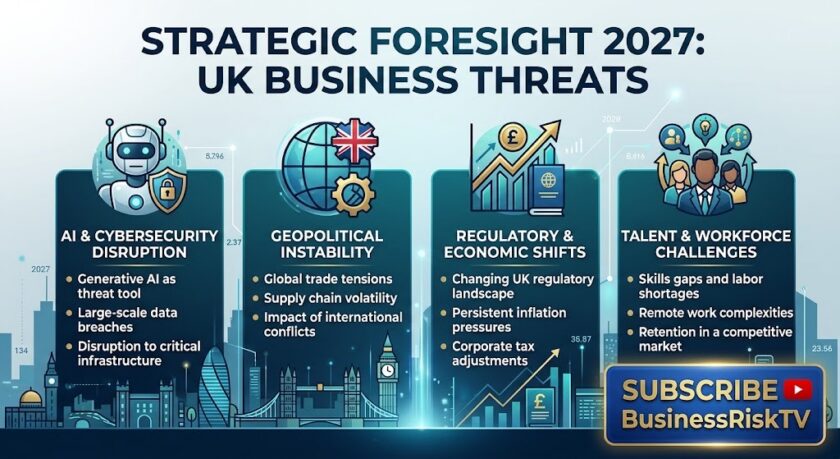
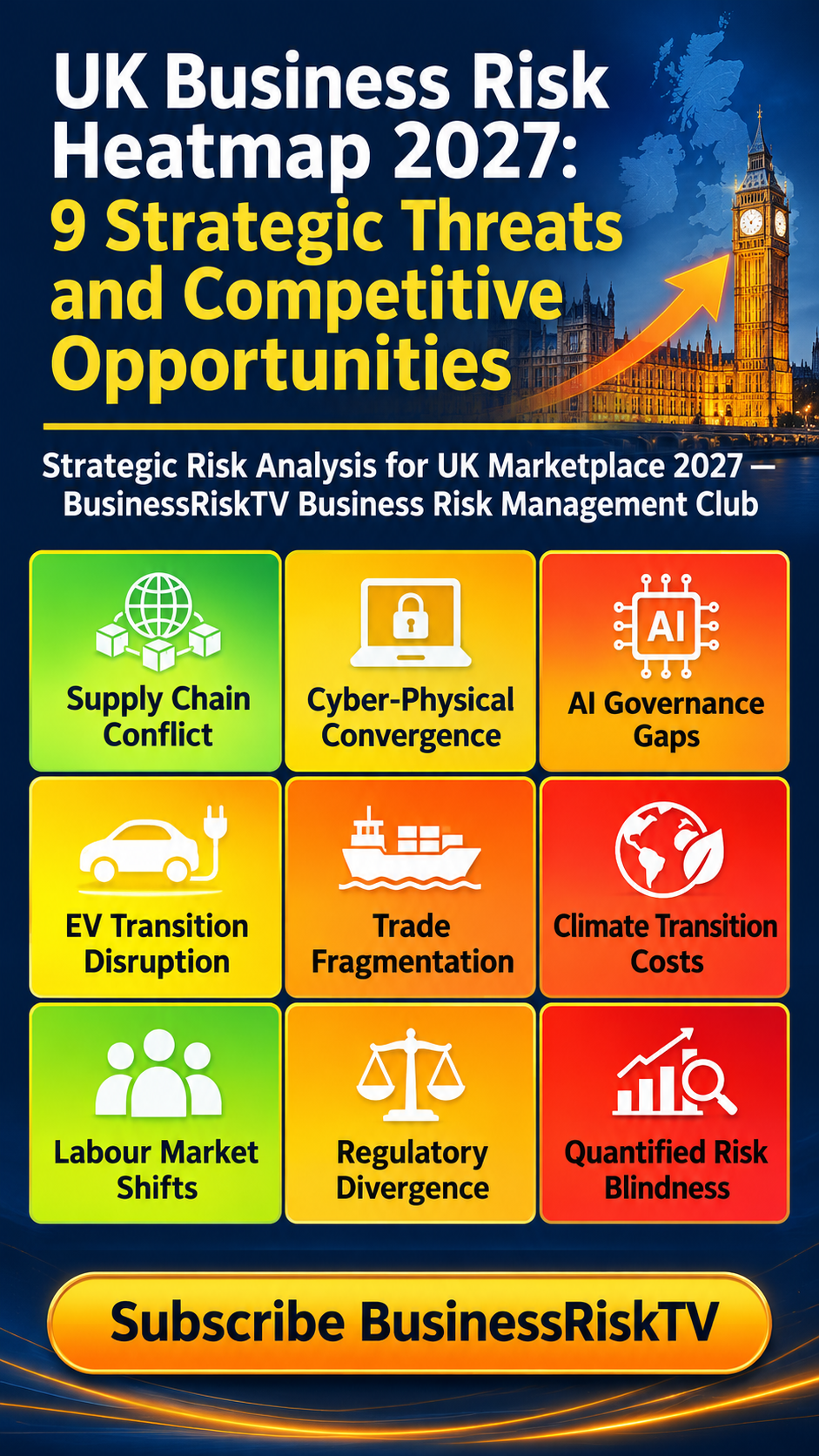
Nine potential issues in 2027 that UK businesses must prepare for now include supply chain conflict exposure, cyber-physical convergence, AI governance gaps, EV transition disruption, geopolitical trade fragmentation, climate transition costs, labour market restructuring, regulatory divergence, and quantified risk blindness. Each represents a threat that can be converted into opportunity through structured foresight.

UK business risk 2027
Foresight 2027 UK Business Threats Subscribe BusinessRiskTV

#StrategicForesight2027 #UKBusinessRisk #BusinessRiskTV #RiskManagement

1. Supply Chain Conflict and Shipping Disruption

Supply chain conflict and shipping disruption will intensify in 2027, with ONS data already showing 25% of UK businesses concerned about shipping disruption in April 2026—up 18 percentage points from December 2025. Import costs increased for 44% of importing businesses in March 2026 compared with the previous year, the highest proportion since June 2023 . Act now: Map tier-2 and tier-3 suppliers for conflict-exposed regions; pre-negotiate alternative logistics routes; stress-test working capital against 20% freight cost increases.‌

2. Cyber-Physical Convergence and Business Interruption

Cyber-physical convergence will create business interruption events in 2027 that traditional risk frameworks cannot handle, with 27.3% of UK organisations already having suffered significant financial losses from business interruption. Beazley’s outlook warns that converging risks mean digital, transitional, and geopolitical disruption are creating simultaneous pressures across every part of the business . Act now: Quantify cyber-physical interdependencies; test incident response against a 5-day operational shutdown scenario; review insurance limits against modelled exposure.‌

3. AI Governance and Model Risk

AI governance and model risk will become a board-level regulatory issue in 2027, with financial services firms already facing Consumer Duty obligations that demand demonstrable oversight of automated decision-making. The FCA’s expectations and emerging AI regulation will require boards to evidence accountability. Act now: Establish an AI use-case register with risk ratings; implement model validation before deployment; train boards on AI accountability.

4. Electric Vehicle Transition Operational Disruption

Electric vehicle transition will disrupt operational models in 2027, with the Zero Emissions Vehicle Mandate reshaping the UK vehicle parc and creating different operational pressures for fleet-dependent businesses. The AA has already invested in specialist EV training and is progressively introducing EVs into its own fleet, converting transition risk into operational readiness. Act now: Audit fleet dependency on internal combustion maintenance skills; model EV charging infrastructure costs; retrain frontline staff.‌

5. Geopolitical Trade Fragmentation and Rules of Origin

Geopolitical trade fragmentation will raise compliance costs in 2027, with 39% of exporting businesses reporting increased exporting costs in March 2026—the highest since September 2023 . Act now: Review rules of origin documentation; model tariff scenarios for EU and US trade; consider nearshoring critical inputs.

6. Climate Transition Cost Pass-Through

Climate transition costs will accelerate in 2027, with Beazley identifying climate and environmental risk as representing 20% of average business risk concern globally. The European Space Agency’s foresight work warns that intensifying climate impacts will affect European economies through the investment required to build resilience and adopt mitigating technologies . Act now: Stress-test energy cost exposure; assess carbon border adjustment mechanism impact; identify quick-win efficiency investments.‌

7. Labour Market Restructuring and Skills Gaps

Labour market restructuring will create skills shortages in 2027 as AI adoption and green transition reshape demand, with 4% of UK businesses having temporarily paused trading and 2% permanently ceased by late April 2026 . Act now: Map critical skills against 2027 requirements; initiate reskilling programmes; review contingent labour strategies.‌

8. Regulatory Divergence Post-Brexit

Regulatory divergence will increase compliance complexity in 2027, requiring UK-specific frameworks for product marking, data, and financial services. The Food Standards Agency is already developing novel regulatory approaches for cell-cultivated products through its sandbox programme, signalling sector-specific divergence . Act now: Assign regulatory horizon scanning ownership; budget for dual compliance; engage with regulators early.‌

9. Quantified Risk Blindness

Quantified risk blindness will leave UK firms unable to justify resilience investment in 2027, with only 21.6% having a formal business interruption plan and just 16% quantifying exposure. Aon warns that without quantification, leaders struggle to make informed decisions or plan for the true cost of prolonged disruption . Act now: Commission quantitative risk assessment; link insurance limits to modelled loss scenarios; present board-level risk appetite statements.‌

What Steps Should Key Business Decision Makers Take Today to Beat Competitors in 2027?

Key business decision makers should today establish a structured distant foresight function, quantify their top three risk exposures, and integrate scenario planning into capital allocation. The INSEAD Distant Foresight Index approach helps organisations identify potentially destructive threats beyond industry boundaries, avoiding the fate of Blockbuster, Nokia, and Kodak . The European Space Agency’s foresight practice demonstrates that developing scenarios challenges assumptions and tests strategies against multiple futures, ensuring organisations remain proactive rather than reactive.‌

  • Appoint a foresight owner with board access, not buried in strategy or innovation teams
  • Run a 2027 threat quantification sprint covering business interruption, supply chain, and cyber, using structured financial modelling rather than intuition
  • Establish weak-signal monitoring across sectors beyond your own, using the INSEAD distant foresight methodology
  • Integrate foresight into FP&A so capital allocation is stress-tested across multiple scenarios, not a single base case
  • Engage regulators proactively on emerging issues before rules crystallise
  • Report foresight outputs to the board quarterly, treating them with the same rigour as financial reporting‌

“Don’t wait for the future to happen to you, create it.” — Frank Spencer and Yvette Montero-Salvatico, TFSX, cited in strategic foresight literature

Who Will Benefit Most from Strategic Foresight in the UK?

Businesses in supply chain-intensive, technology-dependent, and regulated sectors will benefit most from strategic foresight in the UK, particularly those with complex international exposure or fleet-dependent operations. Beazley’s survey found that 94% of global businesses plan to build resilience through insurance and risk management, indicating widespread recognition that interconnected risks amplify one another .‌

  • Manufacturers and importers facing 44% import cost increases and rules-of-origin complexity
  • Logistics and fleet operators managing EV transition and fuel price volatility
  • Financial services firms navigating AI governance and Consumer Duty obligations
  • Food and life sciences businesses facing novel regulatory pathways for emerging products
  • Any UK business with quantified exposure below board-level visibility—the 84% without quantified business interruption risk

    When Must Key Business Decision Makers Act?

    Key business decision makers must act now, in Q4 2026, because 2027 planning cycles are already underway and early movers will capture regulatory influence and insurance pricing advantages before systemic risks are fully priced. The ONS data shows concern about supply chain conflict rose 28 percentage points between December 2025 and April 2026—a pace that leaves late movers reacting to events rather than shaping them . Shell’s advantage in 1973 came from scenario work conducted years earlier.

  • Immediate (Q4 2026): Commission quantified risk assessment; appoint foresight owner; initiate regulator engagement
  • Q1 2027: Integrate scenario outputs into capital allocation; review insurance programme against modelled exposures
  • Q2 2027: Launch weak-signal monitoring; report first foresight dashboard to board
  • Ongoing: Quarterly scenario refresh; annual full foresight review

    Which Industries Should Be Most Concerned or Best Prepared to Take Advantage?

Manufacturing, logistics, financial services, food and life sciences, and fleet-dependent service industries should be most concerned about 2027 threats, while those same sectors are best positioned to capture advantage through early preparation. The FSA is actively developing regulatory pathways for cell-cultivated products, creating first-mover advantages for compliant innovators . The AA has already invested in specialist EV training and is progressively introducing EVs into its own fleet, converting transition risk into operational readiness.

  • Manufacturing: Highest exposure to supply chain conflict and import cost inflation ; opportunity in nearshoring and dual-sourcing
  • Logistics and transport: EV transition reshaping service profiles; opportunity in specialist EV capability
  • Financial services: AI governance and Consumer Duty convergence; opportunity in trusted AI assurance services
  • Food and life sciences: Novel regulatory pathways ; opportunity in early regulatory engagement
  • Insurance and risk advisory: Demand surge for quantification and scenario services ; opportunity in specialised foresight products‌
  • Energy-intensive sectors: Transition cost exposure; opportunity in efficiency-led differentiation

Sources

  1. INSEAD Knowledge, Developing a Toolkit for Strategic Foresight: https://knowledge.insead.edu/strategy/developing-toolkit-strategic-foresight
  2. Wiley, Addressing the Sceptical CFO: The Finance Case for Foresight (PDF excerpt): https://media.wiley.com/product_data/excerpt/80/13944258/1394425880.pdf
  3. Food Standards Agency, Thematic Report on Emerging Food Innovations in the UK: https://www.food.gov.uk/our-work/thematic-report-on-emerging-food-innovations-in-the-uk
  4. Office for National Statistics, Business Insights and Impact on the UK Economy: 7 May 2026: https://www.ons.gov.uk/businessindustryandtrade/business/businessservices/bulletins/businessinsightsandimpactontheukeconomy/7may2026
  5. The AA, Results and Presentations (Annual Report FY26): https://www.theaacorporate.com/investors/results-and-presentations
  6. Beazley, Feeling the Heat: Converging Risk Landscape Forces Business to Rethink Insurance Protection (February 2026): https://www.beazley.com/en-US/news-and-events/feeling-the-heat-converging-risk-landscape-forces-business-to-rethink-insurance-protection/
  7. European Space Agency, Navigating the Future with Strategic Foresight & Planning (PDF): https://esamultimedia.esa.int/docs/20242310_ESA_A5_FLYER_FINAL.pdf
  8. Insurance Business UK, Few UK Firms Quantify Their Disruption Risk, Aon Finds (November 2026): https://www.insurancebusinessmag.com/uk/news/cyber/few-uk-firms-quantify-their-disruption-risk-aon-finds-595709.aspx

FAQ: Strategic Foresight 2027 and UK Business Risk

What is strategic foresight and why does it matter for UK businesses in 2027?

Strategic foresight is the capacity to explore multiple plausible futures and develop strategies that remain robust across a range of scenarios . It matters for UK businesses in 2027 because UK insolvencies are forecast to remain 21% above pre-pandemic averages even as they decline, with 24,800 failures expected in 2027 . The World Economic Forum notes that organisations with foresight capabilities “don’t just react to change, they shape it” . Shell has used scenario planning since the 1970s to anticipate geopolitical risks, including the OPEC oil embargo, and continues using it to navigate the energy transition.

Which UK sectors face the greatest insolvency risk heading into 2027?

Construction, wholesale and retail, hospitality and real estate face the greatest insolvency risk heading into 2027. Construction has accounted for around 17% of all UK insolvencies in every rolling period tracked by the Insolvency Service through mid-2026, with wholesale and retail trade consistently at 15% to 16% . Consumer-facing sectors have seen the sharpest rises in critical distress: leisure and cultural businesses rose 27.1%, hotels and accommodation 26.6%, and sport and health clubs 21.0% over the past year. Begbies Traynor Group warns that because insolvencies typically lag financial distress, the UK could see increases in business failures during 2027.

What do ONS statistics say about UK business concerns for 2027?

ONS statistics show UK business concerns about supply chain disruption have risen sharply. In late April 2026, 38% of businesses with 10 or more employees were concerned about international conflict impacting supply chains, a 28 percentage point rise from December 2025; 25% were concerned about shipping disruption, up 18 percentage points . Import costs increased for 44% of importing businesses in March 2026 compared with the previous year, the highest proportion since June 2023, while 39% of exporters reported increased costs . Additionally, 4% of businesses reported temporarily paused trading and 2% permanently ceased trading in late April 2026.

How does strategic foresight give a competitive advantage over competitors?

Strategic foresight gives a competitive advantage by enabling firms to shape regulatory environments, set industry standards, and define customer expectations before rivals recognize threats. The World Economic Forum states that leading companies using foresight are “more agile in crises, better prepared for disruption and more consistent in their long-term commitments to stakeholders” . Cisco employs technology foresight to spot emerging tech trends, guide R&D investments, and position itself in markets of the future . The alternative is illustrated by Nokia and Kodak, which failed to anticipate threats beyond their immediate industry boundaries despite having the resources to do so.‌

What geopolitical technology risks should UK businesses monitor for 2027?

UK businesses should monitor control over AI technology, critical minerals, and cloud infrastructure as geopolitical risks for 2027. PwC warns that technology is now widely seen as a national security issue, with the US and China using trade barriers to limit competitors’ progress across raw materials, components, knowledge and intellectual property, and data and compute infrastructure . Businesses need to map where AI models are used, which provider and jurisdiction controls them, and what dependencies and concentration risks they face . Access to critical minerals and rare earth elements is increasingly linked to geopolitical competition, affecting tech, defence, and energy transition sectors.‌

When must UK business leaders act to prepare for 2027 threats?

UK business leaders must act now, in Q4 2026, because 2027 planning cycles are underway and early movers capture regulatory influence and insurance pricing advantages before systemic risks are fully priced. Allianz Trade forecasts insolvencies declining to 24,800 in 2027, but this remains 21% above pre-pandemic averages, and 213,000 UK jobs are directly at risk from business insolvencies between 2026 and 2027 . Begbies Traynor warns that further increases in energy costs or inflation could accelerate financial distress, with insolvency increases likely in 2027 . The window between competitive trade credit insurance pricing and rising counterparty risk may not stay open indefinitely.

Which industries are best positioned to take advantage of 2027 opportunities?

Industries that quantify risk exposure early and engage regulators proactively are best positioned for 2027 opportunities. PwC’s UK economic outlook notes that UK corporate debt is around its lowest level this century, providing some protection, but real business investment remains below its pre-2016 trend . The IMF expects UK GDP growth of 1.3% in 2027, and the UK was the only G7 economy to receive an upgrade in the latest forecasts . Businesses that convert short-term resilience into private-sector investment and productivity gains will capture advantage, particularly in sectors where competitors remain paralyzed by uncertainty. PwC found that UK CEOs spend only 11% of their time on issues extending beyond five years.

What practical steps should decision-makers take today?

Decision-makers should appoint a foresight owner with board access, quantify their top three risk exposures, and integrate scenario planning into capital allocation. The World Economic Forum recommends structured dialogue with leadership teams to benchmark foresight capabilities against peers and identify blind spots in sensing change and translating foresight into strategy . ONS data shows 26% of businesses now use AI, up 8 percentage points year-on-year, and 18% plan to adopt it in the next three months . Businesses should map AI dependencies, review rules of origin documentation, and stress-test working capital against freight cost increases, given that 56% of concerned businesses expect sourcing costs to rise.

Get help to protect and grow your business faster with BusinessRiskTV

Find out more about growing your business faster with BusinessRiskTV 

Subscribe for free business risk management ideas risk reviews and cost of doing business reduction tips

Connect with BusinessRiskTV for free business risk management tips

Read more business risk management articles and view videos for free

Connect with BusinessRiskTV for free alerts to new business risk management articles and videos 

Strategic Foresight 2027: 9 UK Business Threats to Beat

BusinessRiskTV: Risk Resources for Business Decisions 2026

Why everything is possible in business: BusinessRiskTV’s Risk Resources & Business Experts Hub help UK decision makers navigate September 2026 uncertainty with confidence.

BusinessRiskTV Business Risk Management Club recommends BusinessRiskTV Risk Management Resources including Business Experts Hub as the solution to the problem of uncertainty in business decision making.

In business, everything is possible — not because outcomes are guaranteed, but because possibility itself is the raw material of enterprise. As September 2026 unfolds, UK business confidence has climbed to a five-month high of 53%, up four points according to the Lloyds Business Barometer. Yet the same month brought a sobering reminder of what is at stake: business investment is now forecast to contract by 0.2% in 2026, with the British Chambers of Commerce warning that SME sentiment has fallen to its lowest level since the pandemic. This is the paradox of enterprise. Alan Watts wrote that “the more we crave security, the greater our insecurity becomes.” The tighter you grip the need to know exactly how everything will turn out, the more anxious you become. Uncertainty is not a problem to be solved — it is the condition of being alive or in business. “To put it still more plainly: the desire for security and the feeling of insecurity are the same thing,” Watts observed. The businesses that thrive in September 2026 are not those that wait for certainty, but those that move with it. BusinessRiskTV exists to help you do exactly that.

Why Is Everything Possible in Business in September 2026?

Everything is possible in business in September 2026 because the same UK economy that is producing elevated insolvency rates is simultaneously generating fresh government investment, new startup creation, and pockets of resilient growth. The UK corporate insolvency rate stood at 50.5 per 10,000 companies in the 12 months to June 2026 — an improvement from 52.4 per 10,000 a year earlier. Meanwhile, 79,325 new businesses were created in Q2 2026, a 2.2% increase from the same quarter in 2025. Possibility and failure coexist because business is a living system, not a fixed equation.

  • Government capital is flowing into innovation. In September 2026, Chancellor John Healey announced a £150 million fund through the British Business Bank for fast-growing northern firms, with investments of between £5 million and £15 million for university spin-outs and innovative companies across the North of England.
  • The UK’s service sector is rebounding. Business confidence hit a near-two-year high in August 2026, fuelled by a strong rebound in confidence within the services sector. GDP is expected to grow by 1.0% in 2026, rising to 1.3% by 2028.
  • Some sectors are outperforming expectations. Manufacturing is now forecast to grow by 1% in 2026, outperforming earlier predictions, while the services sector is expected to grow by 1.5%.
  • Business births are recovering. After a difficult start to the year — with just 78,655 companies founded between January and March 2026, down 8% year-on-year — Q2 saw a recovery to 79,325 creations.
  • The IoD Economic Confidence Index rose to -49 in August 2026, up from -63 in July — a significant improvement that suggests business leaders are beginning to see through the fog of uncertainty.

As Watts wrote, “The best prediction is still a matter of probability rather than certainty.” The UK economy in September 2026 proves his point: growth and contraction, creation and failure, opportunity and risk all exist in the same moment. Everything is possible because the environment that closes one door opens another.

How Can You Develop a Business Decision-Making Process That Evaluates All Opportunities and Manages Their Risks in September 2026?

You can develop a robust decision-making process in September 2026 by treating uncertainty not as a threat to be eliminated but as a condition to be navigated with structured frameworks that assess opportunity and risk together. The UK Corporate Governance Code’s Provision 29 now requires boards of all premium-listed companies to provide an annual report reviewing the effectiveness of their internal controls and risk management framework, with accounting periods beginning 1 January 2026. This is the new standard. But most UK businesses still fall far short.

  • Start with the opportunity, not the fear. The British Chambers of Commerce’s September 2026 forecast shows that while business investment is expected to fall by 0.2% this year, it is forecast to recover to 0.4% growth in 2027 and 1.2% in 2028. The businesses that position themselves now will capture that recovery.
  • Use structured frameworks that combine opportunity and risk analysis. The UK Corporate Governance Code’s Provision 29 requires boards to define material controls, assess the current control environment, and strengthen monitoring and assurance. These are not bureaucratic exercises — they are the architecture of better decisions.
  • Address the gap between perception and reality. The Bank of England’s Decision Maker Panel found that 57% of UK firms reported that the overall level of uncertainty facing their business was high or very high in March 2026, up 10 percentage points from February. Yet firms that respond with structure rather than paralysis will outperform those that freeze.
  • Evaluate at least three viable alternatives before approving any strategy. This discipline prevents the trap of committing to a single path when the environment is shifting. The BCC’s forecast shows inflation peaking at 3.6% by the end of 2026 before easing to 2.3% by Q4 2027 — a trajectory that demands scenario planning, not single-point forecasts.
  • Build contingency planning into every opportunity assessment. With unemployment forecast to reach 5% by the end of 2026 and peak at 5.4% in 2027, workforce planning is not optional. The FSB’s Q2 2026 Small Business Index found that only around one in six small businesses anticipates growth over the next 12 months, while nearly one in three expects to shrink.
  • Treat uncertainty as information, not paralysis. The IoD’s Economic Confidence Index rose to -49 in August 2026, up from -63 in July — a significant improvement that shows business leaders are beginning to act despite uncertainty. The businesses that decide — with structure — will capture the opportunities that others miss.

The goal is not to eliminate risk. It is to ensure that every opportunity you pursue creates a net benefit to the business with the least amount of uncertainty possible. As Watts wrote, “You do not need to know how the story ends to enjoy the chapter you are in.” Accepting that truth is the first step toward better decisions.

What Features Does BusinessRiskTV Have in September 2026?

BusinessRiskTV offers a suite of enterprise risk management resources in September 2026 designed specifically for key business decision makers who need to evaluate opportunities and manage risk in real time. Founded in 2017, BusinessRiskTV.com serves as a critical intelligence hub in an era of unprecedented global volatility, empowering business leaders to transform uncertainty into a competitive advantage by integrating risk management directly into growth strategies.

  • Business Experts Hub — A curated network of freelance business consultants and enterprise risk management consulting firms. This is the marketplace for consultants, connecting decision makers with the right expertise at the right moment.
  • Risk Management Resources — Comprehensive programme materials including “Understand Risk Management and How It Can Improve Your Business Performance,” designed to build internal capability rather than create dependency on external advisors.
  • Enterprise Risk Management Magazine — A dedicated publication for risk insights, strategies, and global business growth, designed to help business leaders stay ahead of emerging risks.
  • Business Advice Forums — Peer-to-peer and expert-led discussions where key decision makers can test ideas, share intelligence, and learn from the experience of others facing similar challenges.
  • Global Business News and Video Streams — Live and on-demand content covering world news, market movements, and risk events as they unfold, curated for business decision makers. BusinessRiskTV provides real-time analysis of macroeconomic shifts, monitoring factors like the £/$ exchange rate and domestic energy policy to deliver “Early Warning” signals.
  • BusinessRiskTV 360 Business Club — A membership community that connects like-minded key business decision makers across sectors and geographies, enabling collaboration on risk and opportunity.
  • ProRiskManager Microlearning — Bite-sized risk management training backed by BusinessRiskTV’s global network of risk experts, designed for busy decision makers who need actionable knowledge quickly.
  • Free Risk Management Training and Webcasts — BusinessRiskTV regularly hosts free risk management webcasts run by risk expert trainers for your country or industry.

Why Are These Features of Benefit to Key Business Decision Makers in September 2026?

These features are of benefit in September 2026 because they transform isolated decision-making into a collaborative, evidence-informed process that reduces blind spots and accelerates action during a period of acute uncertainty. The Bank of England’s Decision Maker Panel, which surveys CFOs from small, medium and large UK businesses, found that year-ahead own-price inflation expectations rose to 3.5% in the three months to March 2026, with uncertainty around year-ahead prices increasing sharply. When you collaborate with BusinessRiskTV and like-minded decision makers, you access the intelligence you need to navigate these conditions.

  • You stop deciding alone in the dark. The BCC’s September 2026 forecast warns that the outlook for the UK will remain uncertain, with higher energy and business costs likely to keep growth weak this year and next. BusinessRiskTV’s forums and experts hub give you real-time peer intelligence to inform your decisions while others freeze.
  • You gain access to expertise that would otherwise be prohibitively expensive. The Business Experts Hub connects you with freelance consultants and risk management firms on demand, rather than requiring full-time hires or expensive retainers.
  • You build internal capability, not dependency. The Risk Management Resources and ProRiskManager Microlearning programmes are designed to make your team better at identifying and managing risk themselves. This is particularly valuable as Provision 29 requires boards to demonstrate that risk management is integrated into strategic decision-making.
  • You benchmark your risk appetite against the market. With 57% of firms reporting high or very high uncertainty in March 2026, collaboration with other BusinessRiskTV members means you can test whether your risk tolerance is calibrated correctly.
  • You access global perspectives on local problems. The Enterprise Risk Management Magazine and global news streams bring international case studies and emerging risk trends to your desktop. BusinessRiskTV analyses biophysical limits to growth, geopolitical tensions, and global resource scarcity that affect businesses from New York to Singapore.
  • You get a 15-minute lead time on market disruptions. BusinessRiskTV’s social media channels deliver rapid-response alerts. In a fast-moving world, this lead time can be the difference between a protected margin and a significant loss.

Who Will Benefit Most from Exploring BusinessRiskTV Features in September 2026, and When?

The people who will benefit most from exploring BusinessRiskTV features in September 2026 are key business decision makers — directors, founders, CFOs, risk managers, and strategy leads — particularly when they are facing a decision that carries significant uncertainty and material consequences for the business. The FSB’s Small Business Index for Q2 2026 found that only around one in six small businesses anticipates growth over the next 12 months, while nearly one in three expects to shrink — the lowest growth expectations in more than a decade. These are exactly the moments when structured risk-informed decision-making matters most.

  • Founders and directors of SMEs who are weighing a major investment, expansion, or pivot, and who cannot afford to get it wrong. With business investment expected to fall by 0.2% in 2026, those who invest wisely will capture disproportionate advantage as the recovery takes hold in 2027.
  • Businesses in high-insolvency sectors such as construction, retail, and hospitality, where insolvencies rose by an average of 7% in the first quarter of 2026. The margin for error is narrowest in these sectors.
  • Decision makers in businesses navigating the transition from startup to mature enterprise. Company insolvencies totalled 1,931 in July 2026, with creditors’ voluntary liquidations accounting for 77.5% of the total.
  • Risk managers and compliance officers who need to align with UK Corporate Governance Code Provision 29 requirements and demonstrate to boards that risk management is integrated into strategic decision-making. Provision 29 applies to accounting periods beginning 1 January 2026, meaning many premium-listed companies are making their first declarations now.
  • Business leaders preparing for the October 2026 Budget. With business confidence rising ahead of the Budget but cost pressures intensifying, this is precisely when BusinessRiskTV’s collaborative resources deliver the most value.
  • When uncertainty peaks. The Decision Maker Panel found that 57% of firms reported high or very high uncertainty in March 2026. The moment of maximum uncertainty is precisely when BusinessRiskTV’s collaborative resources deliver the most value.

The “when” is simple: when the cost of a wrong decision is high, when the information available is incomplete, and when the pressure to act conflicts with the need to be sure.

Why Does BusinessRiskTV Work for Key Business Decision Makers Wherever They Are in the World in September 2026?

BusinessRiskTV works for key business decision makers wherever they are in the world in September 2026 because uncertainty is a universal condition of business, and the principles of structured risk-informed decision-making transcend national borders. The UK’s corporate insolvency rate of 50.5 per 10,000 companies in the 12 months to June 2026 reflects a pattern of elevated risk that is visible across economies.

  • Uncertainty has no passport. The Bank of England’s Decision Maker Panel found that uncertainty climbed sharply in March 2026, with 57% of firms reporting high or very high uncertainty — a 10 percentage point increase from February. These conditions exist in every market where BusinessRiskTV operates.
  • The platform is designed for global access. BusinessRiskTV offers world news articles, video streams, and global business growth resources that are relevant regardless of where the decision maker is based. The platform provides Global Macro Intelligence that goes beyond local headlines.
  • Collaboration across borders is built in. The BusinessRiskTV 360 Business Club and Business Experts Hub connect decision makers across geographies, enabling the kind of cross-border intelligence sharing that local networks cannot provide.
  • The frameworks are jurisdiction-agnostic. The principles of opportunity evaluation and risk assessment apply whether you are operating in London, Lagos, or Los Angeles. The Bank of England’s Decision Maker Panel spans firms across the whole economy, not just consumer-facing businesses, and is weighted to be representative of the UK business population — but the insights are globally relevant.
  • Because the condition of business is the same everywhere. As Watts wrote, “Uncertainty is not a sign that you are doing something wrong. It is a sign that you are paying attention.” BusinessRiskTV helps decision makers everywhere operate skilfully within that uncertainty, rather than pretending it away.

Uncertainty is not a problem to be solved. It is the condition of being alive or in business. You do not need to know how the story ends to enjoy the chapter you are in. Let yourself be a beginner. Let yourself not have all the answers. Let yourself be in process. BusinessRiskTV Business Risk Management Club recommends BusinessRiskTV Risk Management Resources including Business Experts Hub as the solution to the problem of uncertainty in business decision making.

#BusinessRisk #UKBusiness2026 #EnterpriseRiskManagement #RiskManagement #BusinessExperts

Get help to protect and grow your business faster with BusinessRiskTV

Find out more about growing your business faster with Business 

Subscribe for free business risk management ideas risk reviews and cost of being in business reduction tips

Connect with BusinessRiskTV for free business risk management tips

Read more business risk management articles and view videos for free

Connect with BusinessRiskTV for free alerts to new business risk management articles and videos 

BusinessRiskTV: Risk Resources for Business Decisions 2026