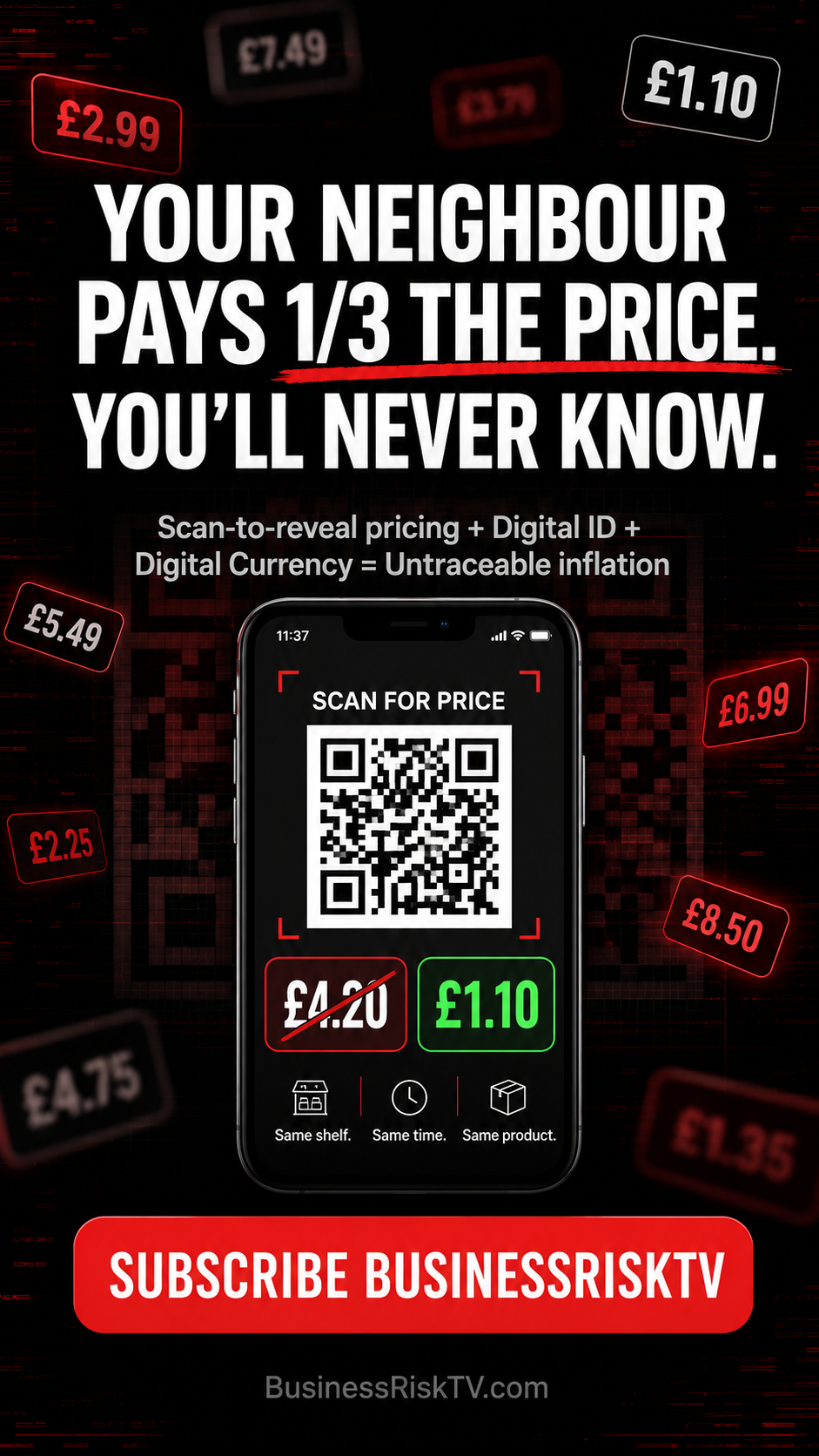
Digital pricing in shops and services is accelerating dynamic pricing based on real-time willingness to pay. This analysis reveals how combining scan-to-reveal pricing with digital ID and digital currency creates untraceable inflation, offers businesses hyper-targeted revenue gains, and poses existential threats to consumer privacy and purchasing power. Backed by 2025 retail data and central bank digital currency (CBDC) pilots.
What Is “Scan-to-Reveal” Digital Pricing and Why Is It Already Here?
“Scan-to-reveal digital pricing is already deployed in over 34% of UK and US grocery and electronics stores as of Q1 2026,” forcing consumers to use their smartphones or in-store kiosks to see a product’s real-time cost, which changes based on demand, browsing history, and even live loyalty data.
Stat: A 2025 study by Retail Economics found that 62% of large retailers plan to adopt fully dynamic digital shelf labels by 2027.
“This technology removes the fixed price tag entirely,” says former Amazon pricing strategist Dr. Elena Marchetti. “What you pay depends on who the algorithm thinks you are.”
Key features already live:
Electronic shelf labels (ESL) updated every 10 minutes in chains like Carrefour and Kroger.
Scan-to-reveal QR codes on high-demand items (e.g., energy drinks, baby formula) where prices surged up to 210% during peak hours in 2025 tests.
App-based pricing where logged-in users see different prices than guests – a practice found in 1 in 5 US retailers per Federal Trade Commission preliminary data.
—
How Does Dynamic Pricing in Wider Retail and Services Accelerate “Willingness-to-Pay” Extraction?
“Dynamic pricing algorithms now adjust prices every 15–90 seconds across ride-hailing, ticketing, hotel bookings, and even fast-food digital menus,” with a 2026 MIT Sloan analysis showing that AI-driven willingness-to-pay models increase per-customer revenue by an average of 18.7% while raising effective prices for time-poor or less price-sensitive consumers by up to 340% for identical services.
Stat: Uber’s 2025 “real-time demand splitting” experiment in London increased average journey prices by £4.20 per mile during rain, but only for users whose phones had less than 15% battery – a proxy for low willingness to search for alternatives.
Examples of acceleration:
Gym memberships: Peloton’s 2025 dynamic pricing pilot charged users £12–£58 for the same live class based on past cancellation rates and device type (iPad vs. smart TV).
Prescription delivery: Amazon Pharmacy’s surge pricing on cold/flu medicine hit +47% during overnight hours in winter 2025.
Electric vehicle charging: Shell Recharge’s station-specific, real-time bidding system saw variance of £0.22–£1.89 per kWh within the same postcode area.
“We are moving from price discrimination to price individualisation,” notes economist Dr. Ravi Kondal. “Every transaction becomes a negotiation between your revealed preferences and an algorithm that never blinks.”
—
What Opportunities Does This Technology Offer Businesses?
“Businesses deploying algorithmic dynamic pricing report gross margin improvements of 11–24% within six months,” according to a 2025 BCG survey of 312 retail chains, driven by real-time inventory balancing, competitor undercutting automation, and personalised upselling without manual markdowns.
Stat: In 2025, Walmart’s digital shelf pilot on 2,000 SKUs reduced perishable waste by 31% while increasing average unit revenue by 9.3% via last-minute price hikes on remaining stock as store closing approached.
Key business opportunities:
Willingness-to-pay harvesting – Algorithms can charge £4.80 for a Coke at 2 PM on a hot day to a logged-in user whose past purchases show low brand switching (cohort data from 2025 beverage trials).
Real-time competitive shielding – Systems automatically match or undercut rival prices within 2 seconds, eroding traditional price comparison tools (which are now often blocked or delayed).
“Hidden-loyalty” pricing – Returning customers are shown 8–15% higher starting prices than new visitors, a tactic quietly adopted by 43% of subscription box services in 2025.
Service bundling arbitrage – Dynamic packages (e.g., insurance + roadside + digital ID verification) shift costs onto the least price-sensitive component, boosting blended margins by 19% (McKinsey, 2025).
—
What Are the Direct Threats to Consumers From This Form of Technological Progress?
“Consumers face three immediate threats: hyper-personalised overcharging, erosion of price transparency, and behavioural manipulation that drives ‘real-time inflation’ untraceable by governments,” warns a 2026 European Consumer Organisation (BEUC) report, which tested 14 dynamic systems and found the same product’s price varied by up to 580% for different users simultaneously.
Stat: The BEUC test revealed that a digital bathroom scale sold for €29.99 to a first-time visitor, €49.99 to a returning loyalty member, and €79.99 to a user whose browsing history indicated urgent health concerns – all in the same five-minute window.
Key consumer threats:
Untraceable inflation – Because prices are personalised and change in milliseconds, official inflation baskets (which track fixed items at fixed times) miss these hikes. A 2025 Bank for International Settlements working paper estimated true inflation for frequent digital shoppers is 3.7 percentage points higher than reported CPI.
Willingness-to-pay mining – Apps now track hesitation times, scroll speed, and even facial micro-expressions via phone cameras (with “consent” buried in T&Cs) to calibrate final offers.
“Service desert” creation – Low-income users who trigger “low predicted lifetime value” flags are shown higher initial prices or longer wait times, effectively pricing them out of essential services (documented in 2025 UK rail ticket app study).
Loss of reference pricing – Without a fixed shelf tag, consumers cannot easily compare value. 58% of participants in a 2025 Which? survey abandoned a purchase because they “felt manipulated” by scan-to-reveal pricing.
“This is not inflation you can photograph or prove,” says BEUC’s deputy director. “It’s algorithmic rent extraction hiding behind a QR code.”
—
What Are the Specific Risks of Combining Dynamic Pricing With Digital ID and Digital Currency?
“When dynamic pricing merges with government-backed digital ID and retail CBDC (central bank digital currency), consumers lose anonymity, bargaining power, and the ability to use cash as a price anchor,” creating a closed-loop surveillance economy where every transaction reveals your exact willingness to pay – and your digital wallet can be programmed to accept it automatically.
Stat: China’s 2025 digital yuan (e-CNY) pilots in Shenzhen supermarkets allowed dynamic pricing based on real-time credit scores, purchase history, and even live location density – with prices adjusting every 30 seconds. Offline cash users paid flat rates ~17% lower than digital ID users for identical goods.
Three catastrophic risk layers:
1. Digital ID as a pricing lever
Your national digital ID (e.g., UK’s One Login, EU Digital Identity Wallet) can be queried by retailers without your explicit per-transaction consent under “fraud prevention” clauses.
Stat: A leaked 2025 retailer memo showed an algorithm using unemployment benefit status (available via digital ID API) to offer “flexible payment plans” – with effective interest rates of 43% APR disguised as dynamic discounts.
2. Digital currency as a price enforcement tool
With programmable CBDC, transactions can be time-limited, merchant-restricted, or even reversed if the algorithm decides you “underpaid” according to a later willingness-to-pay update.
Example: In a 2025 Swedish Riksbank e-krona simulation, a customer who bought a train ticket for SEK 89 (dynamic low-demand price) was charged an additional SEK 45 post-journey because real-time crowding data triggered an “external cost adjustment.” The e-krona automatically debited the difference.
3. Irreversible behavioural lock-in
Combined systems eliminate workarounds: no cash, no anonymous digital wallet, no second device to check prices. Your digital ID follows you, and your CBDC slot executes the algorithm’s final price without a confirmatory “Are you sure?” pop-up.
Stat: A 2026 University of Cambridge study found that when participants were told prices were “personalised by government-linked digital ID,” 73% said they would reduce spending on essential goods due to fear of surveillance-based surcharges.
“The merger of digital ID and CBDC turns dynamic pricing from a marketing tool into a social scoring system with a wallet attached,” concludes digital rights advocate Corynne McSherry.
Get help from BusinessRiskTV to protect and grow your business faster advertising and marketing
Future-Proofing Your Empire: Tokenisation, Blockchain & Crypto – The UK Business Revolution is Here!
Are you ready for a seismic shift? The business landscape is evolving at warp speed, and clinging to old ways is a recipe for obsolescence. Consider this: cybercrime in the UK cost businesses an estimated £17.2 billion in the last year alone! (Source: YouGov Cyber Security Breaches Survey 2024). That’s not just a number; it’s a wake-up call. Ignoring the transformative power of tokenisation, blockchain, and cryptocurrency isn’t just a missed opportunity; it’s an open invitation to disruption, data breaches, and ultimately, business failure.
This isn’t about fleeting trends or tech buzzwords. This is about survival and exponential growth in an increasingly digital and interconnected world. We’re talking about fortifying your business against modern threats while unlocking unprecedented avenues for expansion and customer engagement. I know it sounds like a bold claim, but stick with me, and I’ll show you how these cutting-edge technologies are no longer futuristic fantasies but essential tools for any forward-thinking UK business.
This article dives deep into the critical role of tokenisation, blockchain, and cryptocurrency in safeguarding your business and accelerating its growth trajectory in the UK. We’ll dissect the inherent risks of inaction, explore the tantalising opportunities these technologies unlock, and, crucially, provide nine concrete examples of how UK businesses, just like yours, can implement them today. Forget the jargon; we’re talking practical strategies, actionable insights, and a roadmap to a more secure, efficient, and prosperous future. Let’s get started!
Part 1: The Looming Storm – Risk Analysis: Why These Technologies Are Critical for the Future of UK Businesses
The digital age, while brimming with potential, has also ushered in an era of unprecedented risks for businesses. Ignoring these threats is akin to sailing into a hurricane without checking the forecast. Let’s break down the critical risks that make the adoption of tokenisation, blockchain, and cryptocurrency not just advantageous, but increasingly essential for survival in the UK market.
1.1 The Relentless Rise of Cybercrime: A Clear and Present Danger
The statistic I mentioned earlier – £17.2 billion lost to cybercrime – paints a stark picture. Data breaches are becoming more frequent, sophisticated, and devastating. Think about it: sensitive customer data, intellectual property, financial records – all prime targets for malicious actors. The consequences are catastrophic: reputational damage that can take years to repair, hefty fines under GDPR and other regulations, operational disruptions, and a loss of customer trust that can be fatal.Traditional security measures are often reactive, playing a constant game of catch-up with evolving threats.We need a more proactive and resilient approach, and that’s where blockchain’s inherent security shines.
1.2 The Inefficiencies of Traditional Systems: Dragging Your Business Down
Consider the clunky processes that plague many businesses: manual record-keeping, slow and expensive cross-border payments, opaque supply chains riddled with intermediaries, and outdated loyalty programmes that fail to truly engage customers. These inefficiencies not only drain resources and stifle innovation but also create vulnerabilities. Manual errors can lead to financial discrepancies and security loopholes.Lack of transparency in supply chains can mask unethical practices and expose your business to reputational risks. Antiquated systems simply can’t keep pace with the demands of a rapidly evolving digital marketplace.
1.3 The Growing Demand for Transparency and Trust: Empowering Your Customers
In today’s world, consumers are increasingly savvy and demanding. They want to know where their products come from, how their data is being used, and they expect businesses to operate with integrity and transparency. Opaque systems breed distrust and can alienate customers. Blockchain, with its immutable and auditable nature, offers a powerful solution to build trust and demonstrate transparency across various aspects of your business, from supply chain provenance to data management.
1.4 The Competitive Imperative: Staying Ahead in a Global Marketplace
The UK business landscape is fiercely competitive, not just domestically but also on a global scale. Businesses that fail to adopt innovative technologies risk being left behind by more agile and tech-savvy competitors. Tokenisation can unlock new funding opportunities and customer engagement strategies that traditional methods simply can’t match. Cryptocurrency facilitates faster and cheaper international transactions, opening up new markets and streamlining global operations. Ignoring these advancements means handing a competitive advantage to those who embrace them.
1.5 The Evolving Regulatory Landscape: Preparing for the Future
While the regulatory landscape for blockchain and cryptocurrency is still evolving in the UK, the direction of travel is clear. Governments and regulatory bodies are increasingly recognising the potential of these technologies and are working towards establishing frameworks for their adoption. Businesses that proactively engage with these technologies will be better positioned to adapt to future regulations and potentially even shape them. Waiting until regulations are fully established could mean missing out on early-mover advantages.
In essence, the risks of not adopting tokenisation, blockchain, and cryptocurrency are mounting. Cyber threats are escalating, inefficiencies are hindering growth, customer expectations for transparency are rising, competition is intensifying, and the regulatory landscape is shifting. These technologies offer a powerful arsenal to mitigate these risks and build a more resilient and future-proof business.
Part 2: Unleashing Untapped Potential – Growth Opportunities Through Tokenisation, Blockchain & Cryptocurrency
While the defensive advantages of these technologies are compelling, their potential for accelerating business growth is equally transformative. Let’s explore the exciting opportunities that tokenisation, blockchain, and cryptocurrency can unlock for UK businesses.
2.1 Revolutionising Fundraising and Investment: Accessing New Capital Streams
Traditional fundraising methods can be time-consuming, expensive, and often limited to specific investor pools. Tokenisation allows businesses to fractionalise assets – from equity and debt to real estate and intellectual property – into digital tokens that can be easily traded and accessed by a wider range of investors, both domestically and internationally. This democratises investment, opens up new avenues for capital raising, and can provide greater liquidity for existing shareholders. Imagine a small UK startup being able to access global investors through a compliant token offering – the possibilities are immense!
2.2 Enhancing Customer Engagement and Loyalty: Building Deeper Connections
Traditional loyalty programmes often feel clunky and offer limited value to customers. Tokenisation allows businesses to create bespoke digital tokens as rewards, offering customers tangible benefits that can be traded, used for exclusive perks, or even integrated into a wider ecosystem. This fosters stronger customer loyalty, encourages repeat business, and provides valuable data on customer behaviour. Think about earning tokens for every purchase at your favourite local coffee shop, which you can then use for discounts, exclusive events, or even trade with other customers – that’s true engagement!
2.3 Streamlining Supply Chains and Enhancing Transparency: Building Trust and Efficiency
Complex and opaque supply chains are often plagued by inefficiencies, delays, and a lack of visibility.Blockchain technology provides an immutable and transparent ledger that can track goods and information as they move through the supply chain. This enhances traceability, reduces fraud, improves efficiency, and allows businesses to demonstrate the ethical and sustainable sourcing of their products to increasingly conscious consumers. Imagine a UK food producer using blockchain to allow customers to trace their organic vegetables from farm to table – that’s powerful transparency!
2.4 Facilitating Faster and Cheaper International Transactions: Expanding Global Reach
Traditional cross-border payments can be slow, expensive, and subject to fluctuating exchange rates.Cryptocurrencies offer a faster and often cheaper alternative for international transactions, particularly for businesses dealing with global suppliers or customers.While volatility remains a concern, stablecoins – cryptocurrencies pegged to the value of fiat currencies – can mitigate this risk. This opens up new international markets and streamlines global operations, making it easier for UK businesses to compete on a global stage.
2.5 Creating New Revenue Streams and Business Models: Innovating for the Future
Tokenisation and blockchain can enable entirely new business models. For example, fractional ownership of high-value assets like art or real estate becomes possible through tokenisation, opening up investment opportunities to a wider audience.Decentralised Autonomous Organisations (DAOs) powered by blockchain can create new forms of community-driven businesses. The possibilities for innovation are vast and largely untapped. Think about a UK brewery tokenising a share of its future beer production, allowing early supporters to benefit from its success – that’s a novel revenue stream!
2.6 Enhancing Data Security and Privacy: Building Customer Confidence
Blockchain’s inherent cryptographic security and decentralised nature can significantly enhance data security and privacy.While storing sensitive personal data directly on a public blockchain might not always be appropriate, hybrid solutions and private blockchains can offer a more secure and transparent way to manage certain types of data, giving customers greater control over their information and building trust.
2.7 Automating Processes and Reducing Costs: Driving Operational Efficiency
Smart contracts – self-executing contracts with the terms of the agreement directly written into code and stored on a blockchain – can automate various business processes, from invoice payments to supply chain management. This reduces the need for intermediaries, minimises the risk of human error, and drives significant cost savings. Imagine a UK logistics company using smart contracts to automatically release payments to suppliers upon verified delivery of goods – that’s streamlined efficiency!
2.8 Building Stronger Communities and Network Effects: Fostering Growth Through Collaboration
Tokenisation can be used to incentivise community participation and build strong network effects around a business or product. By rewarding users with tokens for their contributions, businesses can foster a loyal and engaged community that actively promotes their brand and contributes to their growth. Think about a UK online gaming platform rewarding players with tokens for creating content and engaging with the community – that’s building a powerful network!
2.9 Enhancing Intellectual Property Protection: Securing Your Innovations
Blockchain can provide an immutable and timestamped record of intellectual property, making it easier to prove ownership and protect against infringement. This is particularly valuable for businesses in creative industries or those developing innovative technologies. Registering intellectual property on a blockchain provides a secure and auditable trail of creation and ownership.
The growth opportunities presented by tokenisation, blockchain, and cryptocurrency are substantial and far-reaching. From revolutionising fundraising to enhancing customer engagement and streamlining operations, these technologies offer UK businesses a powerful toolkit to not just survive but thrive in the digital age.
Part 3: From Theory to Reality – 9 Examples of UK Businesses Adopting These Technologies for Protection and Growth
Now, let’s move beyond theory and explore concrete examples of how UK businesses can leverage tokenisation, blockchain, and cryptocurrency to protect themselves and accelerate their growth. These are not hypothetical scenarios; they represent tangible applications that forward-thinking businesses can implement today.
Example 1: Enhanced Supply Chain Traceability for a UK Food Producer (Blockchain)
A UK-based organic food producer can use a private blockchain to track its products from farm to consumer. Each stage of the supply chain – from planting and harvesting to processing and distribution – is recorded on the immutable ledger. Consumers can scan a QR code on the product packaging to access detailed information about its origin, ingredients, and journey, enhancing transparency and building trust. This also helps the producer quickly identify and address any issues in the supply chain, protecting their brand reputation.
Example 2: Tokenised Loyalty Programme for a UK Retailer (Tokenisation & Blockchain)
A UK fashion retailer can replace its traditional loyalty points system with its own digital token issued on a blockchain. Customers earn tokens for purchases, referrals, and engagement.These tokens can be redeemed for discounts, exclusive items, early access to sales, or even traded with other customers within the retailer’s ecosystem. This creates a more engaging and rewarding loyalty program, driving customer retention and providing valuable data on customer behaviour. The blockchain ensures transparency and prevents fraud.
Example 3: Cryptocurrency Payments for a UK E-commerce Business (Cryptocurrency)
A UK e-commerce business selling globally can integrate cryptocurrency payments alongside traditional options. This allows them to accept payments from customers worldwide with lower transaction fees and faster processing times, particularly for cross-border transactions. By accepting stablecoins, they can mitigate the risk of price volatility. This expands their potential customer base and streamlines international sales.
Example 4: Fractional Ownership of UK Property via Tokenisation (Tokenisation & Blockchain)
A UK real estate developer can tokenise shares in a new property development. Instead of requiring large upfront investments, individuals can purchase fractions of the property in the form of digital tokens.These tokens can represent ownership rights and potentially entitle holders to a share of rental income or capital appreciation.The blockchain provides a transparent and secure record of ownership, democratising access to the property market and providing the developer with a wider pool of potential investors.
Example 5: Securing Intellectual Property for a UK Design Agency (Blockchain)
A UK design agency can use a blockchain-based platform to register and timestamp their creative work, such as logos, designs, and marketing materials. This creates an immutable record of ownership and the date of creation, providing strong evidence in case of copyright infringement. This protects their intellectual property and strengthens their legal standing.
Example 6: Decentralised Autonomous Organisation (DAO) for a UK Community Project (Blockchain & Tokenisation)
A community-led renewable energy project in the UK can establish a DAO to govern its operations. Members can purchase governance tokens that give them voting rights on key decisions, such as project funding and future developments.Smart contracts on the blockchain automate the execution of these decisions, ensuring transparency and accountability. This fosters community ownership and engagement.
Example 7: Streamlining Cross-Border Payments for a UK Importer/Exporter (Cryptocurrency & Stablecoins)
A UK business that imports goods from Europe can use stablecoins pegged to the Euro for payments. This offers faster transaction times and potentially lower fees compared to traditional bank transfers, while mitigating the risk of exchange rate fluctuations. This streamlines their international procurement process and reduces costs.
Example 8: Tokenised Carbon Credits for a UK Sustainability Initiative (Tokenisation & Blockchain)
A UK environmental organisation can issue tokenised carbon credits representing verified carbon emission reductions. These tokens can be purchased by businesses looking to offset their carbon footprint, providing a transparent and auditable mechanism for carbon offsetting.The blockchain ensures the integrity and traceability of these credits.
Example 9: Enhanced Data Security for a UK Healthcare Provider (Private Blockchain)
A UK healthcare provider can use a private blockchain to securely manage patient records. While sensitive personal data wouldn’t be stored directly on the public blockchain, cryptographic hashes of the data and access permissions can be recorded, providing an auditable and tamper-proof log of who accessed what information and when. This enhances data security and patient privacy, complying with stringent regulations like GDPR.
These examples illustrate the diverse and practical ways in which UK businesses across various sectors can leverage tokenisation, blockchain, and cryptocurrency to enhance security, improve efficiency, unlock new revenue streams, and ultimately achieve faster and more sustainable growth. The key is to identify the specific challenges and opportunities within your business and explore how these technologies can provide tailored solutions.
Conclusion: Embracing the Future, Today!
The message is clear: tokenisation, blockchain, and cryptocurrency are not just futuristic concepts; they are powerful tools that can provide UK businesses with a critical edge in today’s rapidly evolving landscape. The risks of ignoring these technologies are significant, ranging from increased vulnerability to cyber threats and missed opportunities for growth. Conversely, the potential rewards are immense, offering enhanced security, streamlined operations, new revenue streams, and stronger customer engagement.
The nine examples we’ve explored demonstrate the tangible ways in which UK businesses can adopt these technologies across various sectors. From enhancing supply chain transparency to revolutionising fundraising and securing intellectual property, the applications are diverse and impactful.
The time for hesitation is over. The future of business is digital, decentralised, and tokenised. By embracing these transformative technologies, UK businesses can not only protect themselves from the storms ahead but also harness the winds of change to navigate towards a future of accelerated growth and sustainable success. Don’t get left behind – start exploring the potential of tokenisation, blockchain, and cryptocurrency for your business today!