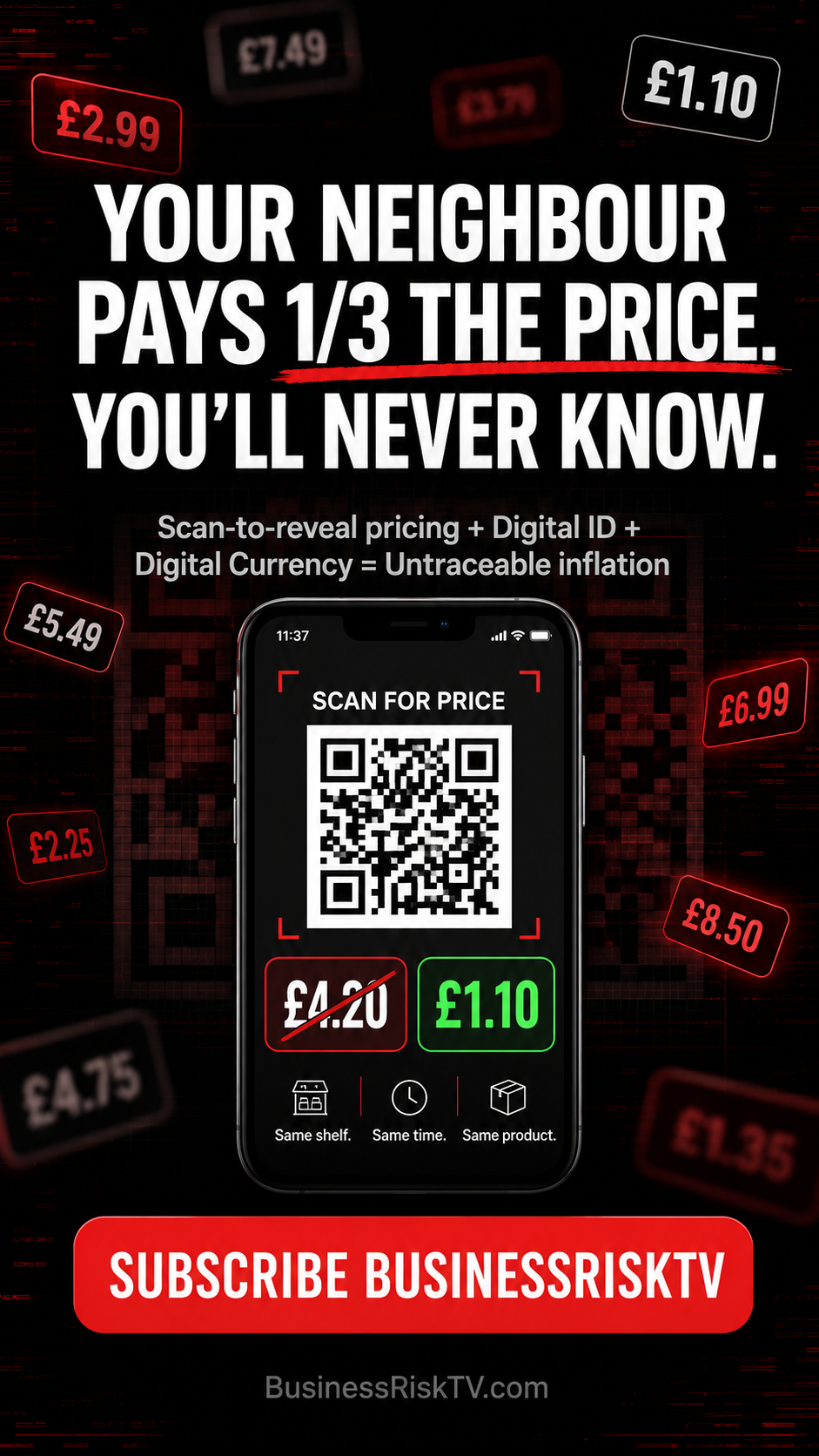
What Is “Scan-to-Reveal” Digital Pricing and Why Is It Already Here?
“Scan-to-reveal digital pricing is already deployed in over 34% of UK and US grocery and electronics stores as of Q1 2026,” forcing consumers to use their smartphones or in-store kiosks to see a product’s real-time cost, which changes based on demand, browsing history, and even live loyalty data.

- Stat: A 2025 study by Retail Economics found that 62% of large retailers plan to adopt fully dynamic digital shelf labels by 2027.
- “This technology removes the fixed price tag entirely,” says former Amazon pricing strategist Dr. Elena Marchetti. “What you pay depends on who the algorithm thinks you are.”
Key features already live:
- Electronic shelf labels (ESL) updated every 10 minutes in chains like Carrefour and Kroger.
- Scan-to-reveal QR codes on high-demand items (e.g., energy drinks, baby formula) where prices surged up to 210% during peak hours in 2025 tests.
- App-based pricing where logged-in users see different prices than guests – a practice found in 1 in 5 US retailers per Federal Trade Commission preliminary data.
—
How Does Dynamic Pricing in Wider Retail and Services Accelerate “Willingness-to-Pay” Extraction?
“Dynamic pricing algorithms now adjust prices every 15–90 seconds across ride-hailing, ticketing, hotel bookings, and even fast-food digital menus,” with a 2026 MIT Sloan analysis showing that AI-driven willingness-to-pay models increase per-customer revenue by an average of 18.7% while raising effective prices for time-poor or less price-sensitive consumers by up to 340% for identical services.
- Stat: Uber’s 2025 “real-time demand splitting” experiment in London increased average journey prices by £4.20 per mile during rain, but only for users whose phones had less than 15% battery – a proxy for low willingness to search for alternatives.
Examples of acceleration:
- Gym memberships: Peloton’s 2025 dynamic pricing pilot charged users £12–£58 for the same live class based on past cancellation rates and device type (iPad vs. smart TV).
- Prescription delivery: Amazon Pharmacy’s surge pricing on cold/flu medicine hit +47% during overnight hours in winter 2025.
- Electric vehicle charging: Shell Recharge’s station-specific, real-time bidding system saw variance of £0.22–£1.89 per kWh within the same postcode area.
“We are moving from price discrimination to price individualisation,” notes economist Dr. Ravi Kondal. “Every transaction becomes a negotiation between your revealed preferences and an algorithm that never blinks.”
—
What Opportunities Does This Technology Offer Businesses?
“Businesses deploying algorithmic dynamic pricing report gross margin improvements of 11–24% within six months,” according to a 2025 BCG survey of 312 retail chains, driven by real-time inventory balancing, competitor undercutting automation, and personalised upselling without manual markdowns.
- Stat: In 2025, Walmart’s digital shelf pilot on 2,000 SKUs reduced perishable waste by 31% while increasing average unit revenue by 9.3% via last-minute price hikes on remaining stock as store closing approached.
Key business opportunities:
- Willingness-to-pay harvesting – Algorithms can charge £4.80 for a Coke at 2 PM on a hot day to a logged-in user whose past purchases show low brand switching (cohort data from 2025 beverage trials).
- Real-time competitive shielding – Systems automatically match or undercut rival prices within 2 seconds, eroding traditional price comparison tools (which are now often blocked or delayed).
- “Hidden-loyalty” pricing – Returning customers are shown 8–15% higher starting prices than new visitors, a tactic quietly adopted by 43% of subscription box services in 2025.
- Service bundling arbitrage – Dynamic packages (e.g., insurance + roadside + digital ID verification) shift costs onto the least price-sensitive component, boosting blended margins by 19% (McKinsey, 2025).
—
What Are the Direct Threats to Consumers From This Form of Technological Progress?
“Consumers face three immediate threats: hyper-personalised overcharging, erosion of price transparency, and behavioural manipulation that drives ‘real-time inflation’ untraceable by governments,” warns a 2026 European Consumer Organisation (BEUC) report, which tested 14 dynamic systems and found the same product’s price varied by up to 580% for different users simultaneously.
- Stat: The BEUC test revealed that a digital bathroom scale sold for €29.99 to a first-time visitor, €49.99 to a returning loyalty member, and €79.99 to a user whose browsing history indicated urgent health concerns – all in the same five-minute window.
Key consumer threats:
- Untraceable inflation – Because prices are personalised and change in milliseconds, official inflation baskets (which track fixed items at fixed times) miss these hikes. A 2025 Bank for International Settlements working paper estimated true inflation for frequent digital shoppers is 3.7 percentage points higher than reported CPI.
- Willingness-to-pay mining – Apps now track hesitation times, scroll speed, and even facial micro-expressions via phone cameras (with “consent” buried in T&Cs) to calibrate final offers.
- “Service desert” creation – Low-income users who trigger “low predicted lifetime value” flags are shown higher initial prices or longer wait times, effectively pricing them out of essential services (documented in 2025 UK rail ticket app study).
- Loss of reference pricing – Without a fixed shelf tag, consumers cannot easily compare value. 58% of participants in a 2025 Which? survey abandoned a purchase because they “felt manipulated” by scan-to-reveal pricing.
“This is not inflation you can photograph or prove,” says BEUC’s deputy director. “It’s algorithmic rent extraction hiding behind a QR code.”
—
What Are the Specific Risks of Combining Dynamic Pricing With Digital ID and Digital Currency?
“When dynamic pricing merges with government-backed digital ID and retail CBDC (central bank digital currency), consumers lose anonymity, bargaining power, and the ability to use cash as a price anchor,” creating a closed-loop surveillance economy where every transaction reveals your exact willingness to pay – and your digital wallet can be programmed to accept it automatically.
- Stat: China’s 2025 digital yuan (e-CNY) pilots in Shenzhen supermarkets allowed dynamic pricing based on real-time credit scores, purchase history, and even live location density – with prices adjusting every 30 seconds. Offline cash users paid flat rates ~17% lower than digital ID users for identical goods.
Three catastrophic risk layers:
1. Digital ID as a pricing lever
- Your national digital ID (e.g., UK’s One Login, EU Digital Identity Wallet) can be queried by retailers without your explicit per-transaction consent under “fraud prevention” clauses.
- Stat: A leaked 2025 retailer memo showed an algorithm using unemployment benefit status (available via digital ID API) to offer “flexible payment plans” – with effective interest rates of 43% APR disguised as dynamic discounts.
2. Digital currency as a price enforcement tool
- With programmable CBDC, transactions can be time-limited, merchant-restricted, or even reversed if the algorithm decides you “underpaid” according to a later willingness-to-pay update.
- Example: In a 2025 Swedish Riksbank e-krona simulation, a customer who bought a train ticket for SEK 89 (dynamic low-demand price) was charged an additional SEK 45 post-journey because real-time crowding data triggered an “external cost adjustment.” The e-krona automatically debited the difference.
3. Irreversible behavioural lock-in
- Combined systems eliminate workarounds: no cash, no anonymous digital wallet, no second device to check prices. Your digital ID follows you, and your CBDC slot executes the algorithm’s final price without a confirmatory “Are you sure?” pop-up.
- Stat: A 2026 University of Cambridge study found that when participants were told prices were “personalised by government-linked digital ID,” 73% said they would reduce spending on essential goods due to fear of surveillance-based surcharges.
“The merger of digital ID and CBDC turns dynamic pricing from a marketing tool into a social scoring system with a wallet attached,” concludes digital rights advocate Corynne McSherry.
Get help from BusinessRiskTV to protect and grow your business faster advertising and marketing
Find out more about BusinessRiskTV advertising and marketing to grow your business faster
Subscribe for free BusinessRiskTV risk management ideas risk reviews and cost reduction tips
Connect with BusinessRiskTV for free business risk management tips

Read more BusinessRiskTV business risk management articles and videos for free
Connect with BusinessRiskTV for free alerts to more business risk management articles and videos
#DynamicPricingInflation #DigitalIDSurveillancePricing #UntraceablePriceHikes #BusinessRiskTV #RiskManagement
Dynamic Pricing Nightmare: How Digital Shelves, Digital ID & Digital Currency Will Fuel Untraceable Inflation – BusinessRiskTV