Portable Power Stations for Business Continuity | Jackery 1000 v2

BusinessRiskTV Business Risk Management Club recommends Jackery Solar Generator 1000 v2 for business continuity & supply chain power disruptions. 1070Wh LiFePO4.

BusinessRiskTV recommends Jackery Solar Generator 1000 v2 for business continuity & supply chain power disruptions. 1070Wh LiFePO4, 1500W AC, 1hr fast charge.

“BusinessRiskTV Business Risk Management Club recommends this product as the solution to the problem of business continuity and supply chain power disruptions.”

That recommendation carries weight because it is not made lightly. In 2024 alone, the UK recorded over 18,398 unplanned power outages — a 4.7% increase year-on-year — while more than 80,000 blackouts have occurred since 2021. The Energy Networks Association reported that Storm Darragh left over 2 million homes without power in winter 2024-25, and Storm Éowyn cut electricity to more than one million customers. When UK businesses lost an estimated £3.7 billion in a single year from internet outages alone, and smaller businesses face downtime costs of up to £1,000 per hour, the question is no longer whether a power disruption will affect your operations — it is whether you will be ready when it does.‌

What Happens to Your Business When the Grid Goes Down?

What happens to your business when the grid goes down is that operations stop, revenue halts, and recovery costs escalate — fast. The data paints a stark picture of the exposure UK organisations carry:

  • 14,500 unplanned power outages had already occurred by the end of July 2025, with a projected 30% increase compared to 2024 totals‌
  • The North West alone suffered 50,892 unplanned outages since 2021 — over 1,000 per month‌
  • 88% of businesses without a continuity plan fail within just over a year of a major disruption
  • Only 16% of employees say they have received clear instructions on what to do during a power outage or similar crisisFor mobile operations, pop-up retailers, and field workers, the grid is not a convenience — it is a dependency. When it fails, point-of-sale systems go dark, refrigeration units stop, communications collapse, and stock spoils. One Brighton trader estimated that power cuts were costing his business up to £10,000 on a busy sales day. A town centre in Malvern reported at least 10 outages in 18 months, leaving restaurants and shops repeatedly unable to serve customers.‌The Heathrow substation fire in March 2025 demonstrated that even the UK’s most critical infrastructure — with multiple independent power intakes — can be taken offline by a single point of failure, disrupting over 200,000 passengers and halting supply chains across the nation. The Kelly Review concluded that redundancy alone does not equal resilience.‌”Businesses across the UK are operating in an environment where downtime can have serious financial and reputational consequences. When connectivity, power or systems fail, the impact is immediate.” — Comms Business, 2026

How Can Portable Power Stations Protect Your Business Continuity?

Portable power stations protect your business continuity by providing immediate, silent, emission-free backup power that activates the moment the grid fails. Unlike diesel generators that require fuel storage, ventilation, and regular maintenance, modern LiFePO4 power stations are plug-and-play, require zero ongoing consumable costs, and can be deployed in indoor and outdoor locations without regulatory complications.

The business case is straightforward:

  • Revenue protection: An hour of downtime costs up to £1,000 for smaller businesses. A portable power station that keeps tills, card readers, and lighting operational through a 4-hour outage can pay for itself in a single incident.‌
  • Operational flexibility: Mobile operations, pop-up retail, construction sites, and field teams can run entirely off-grid without trailing cables or noisy generators.
  • Supply chain resilience: When local grid failures disrupt logistics and communications, battery backup maintains the critical systems that keep orders moving and customers informed.
  • Regulatory alignment: The UK government’s National Business Resilience Planning Assumptions explicitly identify power infrastructure failure as a key risk requiring business continuity provisions.The Continuity Forum has warned that “power outages, supply disruptions, flooding, and IT failures carry human and economic costs far beyond what is captured in current regulatory and corporate accountability frameworks”. In other words, the true cost of being unprepared is systematically underestimated by most organisations.

Why Is the Jackery Solar Generator 1000 v2 the Standout Solution?

The Jackery Solar Generator 1000 v2 is the standout solution because it delivers 1,070Wh of LiFePO4 battery capacity, 1,500W AC output (3,000W surge), 100W USB-C output, and a 1-hour fast charge — all in a unit weighing just 23.8 lbs. It is the portable power station that bridges the gap between professional-grade reliability and consumer-friendly portability.

Key specifications:

  • Battery: 1,070Wh LiFePO4 (lithium iron phosphate) — the chemistry used in commercial energy storage for its 4,000+ cycle lifespan, thermal stability, and safety profile
  • Output: 1,500W AC continuous / 3,000W surge, 100W USB-C, multiple DC ports — capable of running fridges, power tools, laptops, lighting, communications equipment, and medical devices
  • Recharge: 1-hour fast charge from mains; solar recharge via the included 100W SolarSaga panel for indefinite off-grid operation
  • Portability: 23.8 lbs with an integrated handle — genuinely transportable by a single person
  • Solar pairing: The 100W SolarSaga panel uses high-efficiency monocrystalline cells and folds for easy transport, enabling true energy independence during extended grid failuresPopular Mechanics testing found that the Explorer 1000 v2 powered a 25-cubic-foot refrigerator for more than 18 hours — a real-world benchmark that translates directly to business continuity for food retail, hospitality, and cold-chain operations. ZDNet’s reviewer described it as falling into the “Goldilocks zone of both price and portability” and a “solid, expandable portable power station” for emergencies and power outages. For RV adventures, van life, and off-grid living, the 100W solar panel provides a sustainable recharge loop. For business deployments — mobile operations, pop-up retail, field engineering, construction — the 1-hour mains recharge means the unit can be back to full capacity during a lunch break.Cost and value for money:
  • The Jackery Solar Generator 1000 v2 with 100W panel has been discounted from £1,199 to £521 — a £678 saving (57% off)
  • Earlier promotional pricing saw the package at £699 (42% discount)
  • With a LiFePO4 lifespan of 4,000+ cycles, the cost per cycle is approximately £0.13–£0.17 depending on purchase price — significantly lower than the cost of even one hour of business downtime
  • No fuel costs, no maintenance contracts, no emissions, no noise — a fraction of the total cost of ownership of a diesel generatorFor context: if a single power outage costs your business just one hour of lost trading at the smaller-business benchmark of £1,000, the Jackery unit pays for itself in fewer than one incident at current pricing.‌”The Explorer 1000 v2, although heavier at 23.8 pounds, ran a fridge for more than 18 hours in our testing… it is about the size of a small beer cooler.” — Popular Mechanics

Who Relies on Portable Power Stations Every Day?

Mobile operations, pop-up retailers, field workers, and office leads rely on portable power stations every day as their emergency power reserve and primary off-grid power source. These are not hypothetical users — they are the businesses that cannot afford a single hour of darkness.

Mobile operations: Food trucks, market stalls, event vendors, and pop-up shops need reliable power for tills, lighting, refrigeration, and sound systems. A 1kWh power station runs a full trading day for most small operations.

Field workers: Engineers, surveyors, agricultural workers, and utility teams operating in remote or rural locations need power for laptops, testing equipment, communications, and lighting. Solar recharge extends deployment indefinitely.

Office leads: Every office needs an emergency power reserve for routers, switches, servers, and communications systems. The Jackery unit can be stored in a cupboard and deployed in seconds — no installation, no electrician, no fuel.

Outdoor and off-grid: RV owners, van lifers, and off-grid dwellers use the Jackery Solar Generator 1000 v2 as their primary power source for cooking, lighting, refrigeration, and device charging. The 100W solar panel provides sustainable recharge in any location with sunlight.

The UK government’s own resilience planning assumes a reasonable worst-case scenario of significant electricity network failure across several regions, with up to 3.5 million customers losing power for up to 24 hours. For businesses in that scenario, the difference between having a Jackery unit and not having one is the difference between operating and closing.

What Do Independent Reviews and Real Users Say?

Independent reviews and real users consistently rate the Jackery Explorer 1000 v2 as one of the best value portable power stations available. B&H Photo Video verified buyers describe it as having “tons of power, great value” and being capable of powering a sound system for over 20 hours — potentially indefinitely with the solar panel. ZDNet named it their favourite entry-level portable power station.”This is one of my favourite cheap portable power stations… Amazon is offering 44% off the Jackery Explorer 1000 v2, bringing the price down to $449 — the lowest we’ve seen it recently.” — ZDNet
The £678 discount currently available on the UK package represents the lowest pricing seen for the Solar Generator 1000 v2 with 100W panel. At this price point, the unit sits firmly in the “no-brainer” category for any business that has ever lost revenue to a power cut — and with outage frequency rising 30% year-on-year, that is a growing proportion of UK organisations.‌

Frequently overlooked benefits for business users:

  • UPS pass-through mode: Some portable power stations can operate in UPS bypass mode, ensuring critical systems maintain power without interruption during the switchover
  • Zero installation cost: Unlike fixed generator installations, portable power stations require no building modifications, no exhaust ducting, and no planning permission
  • Silent operation: Suitable for indoor use in offices, retail spaces, and customer-facing environments where a diesel generator would be impractical or prohibited
  • Expandable: Compatible with additional SolarSaga panels for faster solar recharge and extended off-grid capability

The Bottom Line: What Is Your Business Continuity Plan?

What is your business continuity plan when the grid fails — because the evidence says it will. Over 80,000 blackouts since 2021, rising outage frequency, and a 30% projected annual increase mean that every UK business is exposed. The organisations that survive disruptions are those that planned for them.‌

The Jackery Solar Generator 1000 v2 with 100W Solar Panel delivers 1,070Wh of professional-grade LiFePO4 storage, 1,500W AC output, 1-hour recharge, and true solar independence — all for £521 at current promotional pricing. For less than the cost of a single hour of downtime for many businesses, it provides years of protection.‌

The BusinessRiskTV Business Risk Management Club does not recommend products lightly. This recommendation reflects the reality that UK power infrastructure is under strain, outage frequency is climbing, and the businesses that thrive will be those that treat energy resilience as a core operational requirement rather than an afterthought.

The information is here. The statistics are clear. The product is available. What you do with it is your decision.

Featured Product: Jackery Solar Generator 1000 v2 with 100W Solar Panel, 1kWh Power Station — 1070Wh LiFePO4 Battery, 1500W AC & 100W USB-C Output, 1 Hr Fast Charge for RV Adventures, Van Life, Off-Grid Living

View current pricing and availability

As an Amazon Associate I earn from qualifying purchases

#BusinessContinuityPower
#Jackery1000v2 #BusinessRiskTV #RiskManagement #BackupPower

Get help to protect and grow your business through uncertain times with BusinessRiskTV

Find out more about growing your business faster regardless of business environment 

Subscribe for free business risk management ideas reviews and cost of doing business reduction tips

Connect with BusinessRiskTV for free business risk management tips

Read more business risk management articles and view videos for free

Connect with BusinessRiskTV for free alerts to new business risk management articles and videos 

Your business is one power cut away from collapse. And the UK’s grid is failing more often.

Here’s the data that should scare you.

In 2024, the UK recorded 18,398 unplanned power outages — a 4.7% increase year-on-year. Since 2021, more than 80,000 blackouts have hit British homes and businesses. Storm Darragh left 2 million homes without power. Storm Éowyn cut electricity to over 1 million customers. The Heathrow substation fire in March 2025 disrupted 200,000 passengers and halted supply chains nationwide.

But here’s what most business owners miss: the biggest cost isn’t the outage itself. It’s the supply chain disruption that follows. The tills that go dark. The refrigeration that stops. The card readers that fail. The communications that collapse.

UK businesses lost an estimated £3.7 billion in a single year from internet outages alone. Smaller businesses face downtime costs of up to £1,000 per hour. One Brighton trader estimated power cuts were costing him £10,000 on a busy sales day. A Malvern town centre reported 10 outages in 18 months — restaurants and shops repeatedly unable to serve customers.

And the frequency is climbing. By July 2025, 14,500 unplanned outages had already occurred, with a projected 30% increase compared to 2024.

Now here’s the part that changes everything.

BusinessRiskTV Business Risk Management Club recommends a specific solution for business continuity and supply chain power disruptions. Not a diesel generator. Not a fixed installation. A portable power station that weighs 23.8 lbs, recharges in 1 hour, and runs a fridge for 18+ hours.

The Jackery Solar Generator 1000 v2 with 100W Solar Panel delivers:

  • 1,070Wh LiFePO4 battery — 4,000+ cycles, thermal stability, commercial-grade safety
  • 1,500W AC output / 3,000W surge — runs tills, laptops, lighting, comms, medical devices
  • 100W USB-C output — fast-charges modern devices
  •  1-hour fast charge from mains — back to full during a lunch break
  • 100W SolarSaga panel — indefinite off-grid recharge for field workers, RV, van lifePopular Mechanics tested it: powered a 25-cubic-foot fridge for more than 18 hours. ZDNet called it the “Goldilocks zone of both price and portability.”And the cost? Currently £521 — down from £1,199. That’s a £678 saving. Cost per cycle: £0.13–£0.17. Compare that to £1,000 per hour of downtime. It pays for itself in fewer than one incident.

    The UK government’s own resilience planning assumes a worst-case scenario of 3.5 million customers losing power for up to 24 hours. For mobile operations, pop-up retailers, field workers, and office leads, the difference between having this unit and not having it is the difference between operating and closing.

    We don’t tell you what to do. We just put the numbers side by side.

    If you want to build a power resilience plan for your business, email editor@businessrisktv.com for our free Business Continuity Power Checklist. No pitch. Just the framework we use.

    #BusinessContinuityPower #Jackery1000v2

Portable Power Stations for Business Continuity | Jackery 1000 v2
UK Bankruptcy Crisis 2026: Why Debt Maturity, Private Credit Fears & Tariffs Are Killing Businesses (12 Steps to Survive)

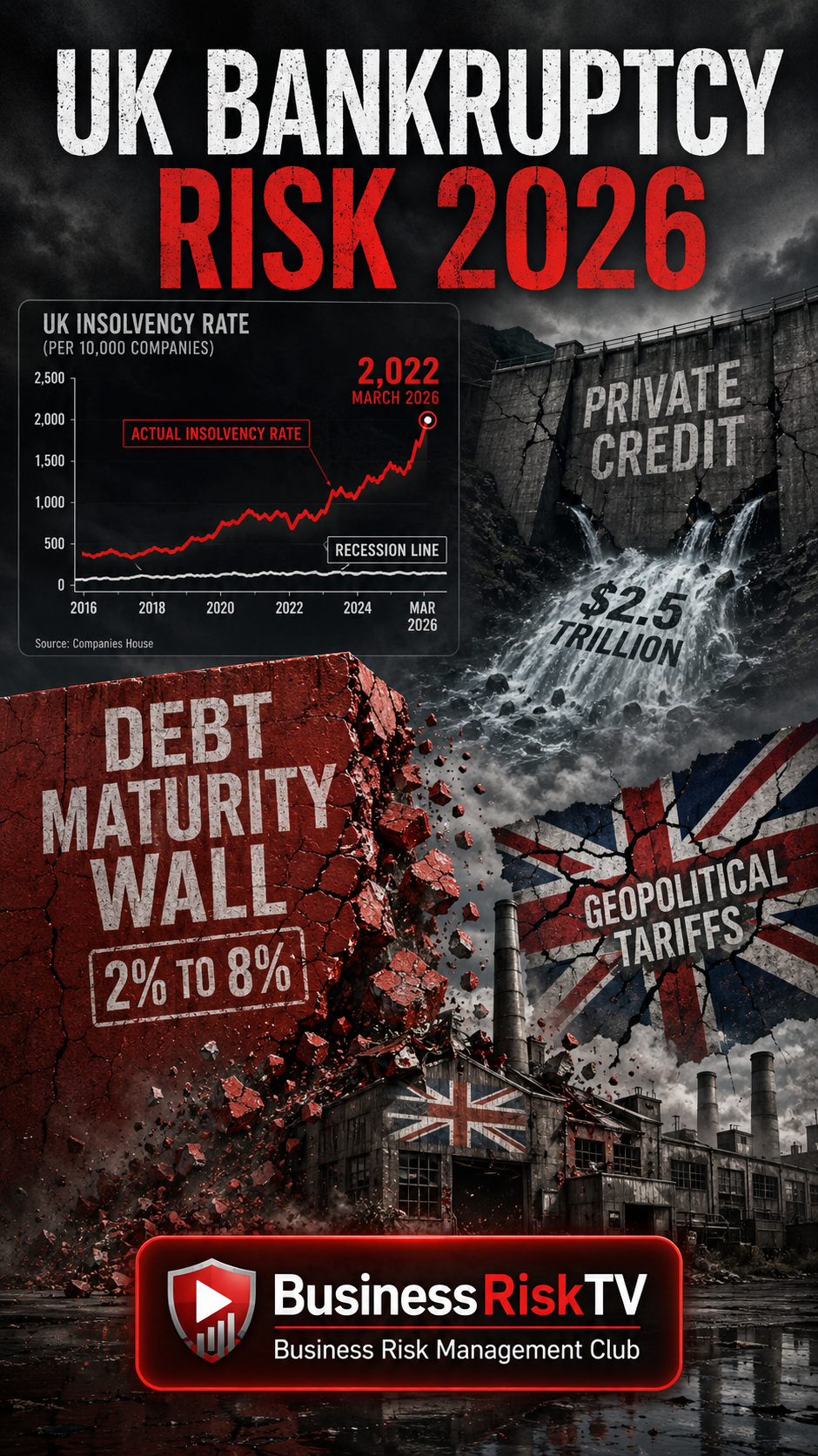
In 2026, UK business insolvencies are near 30-year highs. With 2,022 companies folding in March alone, leaders face a triple threat: maturing debt at 8% rates, a looming private credit crash warned of by the Bank of England, and geopolitical tariff shocks. This guide reveals 12 risk management steps to stop your business going bankrupt, including refinancing strategies, HMRC defence tactics, and supply chain shifts to survive the 2026 liquidity crunch.

Stop guessing about bankruptcy. Join the Business Risk Management Club today.

The average cost of a mid-sized company insolvency is £90,000 in director losses. The cost of our club membership? Less than a cup of coffee a day.

3 Facts to Back Up Our Value:

1. Cost: We charge £49.99 per month for full access (introductory deals available for limited time). An insolvency practitioner charges £350+ per hour.
2. Speed: Members get 24/7 access to alternative risk reviews. Banks and risk analysts take  weeks.
3. Certainty: We provide real-time geopolitical risks; majority of failed businesses didn’t see the shock coming before too late.

—

Why Should UK Business Leaders Be Worried About Bankruptcy in 2026? (The “Triple Lock” Crisis)

Why UK business leaders should be worried about bankruptcy in 2026 because insolvencies are currently near a 30-year high due to a “triple lock” of debt maturity cliffs, geopolitical trade wars and geopolitical risks, and a hidden private credit crash.

We are not in a normal recession; we are in a debt maturity trap. In March 2026 alone, England and Wales recorded 2,022 company insolvencies, matching the peak levels of the 2008 financial crisis . For a 10-year-old: Imagine borrowing a toy for a week, but when you try to return it, the shop says you now owe 10 times the price, and your pocket money just got cut because your friends are fighting far away. That is 2026.

Are Maturing Debt Instruments the #1 Cause of UK Business Bankruptcies Right Now?

Yes, maturing debt instruments taken out at 2% that are maturing at 8% rates are the single biggest driver of cash flow collapse in the UK in 2026 because refinancing has dried up for the mid-market.

UK borrowing costs hit their highest levels since 1998 recently, with 30-year gilt yields hitting 5.78% . For a 10-year-old: You borrowed £1 to buy lemonade supplies, promising to pay back £1.02. Now, the bank says you must pay back £1.15. If you don’t have that extra 13p, your lemonade stand is gone.

How Do Geopolitical Changes and Tariffs in 2026 Hurt My UK Supply Chain?

Geopolitical changes in 2026, specifically the Iran conflict and the UK-US trade deal delays, are forcing costs up by up to 20% for importers, strangling margins just as debts come due.

The UK just signed a $5 billion Gulf trade deal to bypass Iran war fallout, but the US remains rocky . UK Parliament admits the US deal is “not yet delivering growth” as tariffs fragment the global system . For a 10-year-old: Your favourite toy is made across the street. If the street gets blocked by a fight, you have to fly a helicopter to get the toy. That helicopter costs more than the toy.

Is the “Private Credit” Market Really Drying Up for UK Businesses in 2026?

The threat of credit drying up is real because the Bank of England has warned that the $2.5 trillion private credit market has “echoes of the Great Financial Crisis” and has never been tested at this scale.

Deputy Governor Sarah Breeden explicitly stated that a “private credit crunch” is coming where funds are “gated” (locked) . The House of Lords reports that SME finance has been “squeezed” because banks retreated after 2008 and private credit is now freezing . For a 10-year-old: You usually borrow money from a rich friend. But that friend is suddenly broke and hiding under their bed. Now nobody will lend you the money to buy your lunch.

Are These the Most Common Causes of Bankruptcy in the UK Right Now (2026 Stats)?

Yes, these are the most common causes, but rising employment costs and HMRC aggression are the “silent killers” pushing the UK toward the highest bankruptcy rate in 20 years.

In 2025, an estimated 288,018 UK businesses failed (roughly 5% of all firms) . The construction sector accounts for 17% of all insolvencies due to material costs, while retail is collapsing due to wage bills . The UK is seeing the highest rate of bankruptcies since the early 1990s, driven not just by debt, but by the Employment Rights Act 2025 which doubles redundancy costs .

—

🛡️ 12 Business Risk Management Steps UK Business Leaders Should Take Today

To avoid joining the 2,000+ companies failing monthly, execute these steps immediately:

1. Refinance NOW, not later.
· Action: Approach challenger banks (e.g., Shawbrook, OakNorth) before your current loan matures. Lending growth has slowed to 4.5%, get in the queue now .
2. Stress test for 10% Interest Rates.
· Action: Model your cash flow assuming base rates hit 8%. If you break, cut costs today.
3. Audit your “Phantom Stock”.
· Action: Check supplier contracts for geopolitical escalation clauses. If they aren’t there, add them for the Iran/Gulf fallout .
4. Diversify away from US supply chains.
· Action: Shift 30% of sourcing to the new GCC trade deal partners (UAE, Saudi) to bypass US tariffs .
5. Invoice factoring for immediate cash.
· Action: Sell your unpaid invoices. With credit drying up, cash in hand is king.
6. The “Credit Committee” meeting.
· Action: Hold a weekly 15-minute meeting to check if your customers have issued winding-up petitions. Don’t sell to companies about to go bust .
7. Prepare for Employment Rights Act 2025.
· Action: Set aside a specific fund for “protective awards” (now 180 days pay) before making redundancies .
8. HMRC negotiation strategy.
· Action: HMRC is taking aggressive debt action. Do not ignore their letters; agree on a Time to Pay arrangement before they file a winding-up petition.
9. Invest in Internal Controls (Governance).
· Action: Under the new UK Corporate Governance Code (Jan 1 2026), directors are personally liable for “material weaknesses” in financial controls .
10. Explore a CVA before it’s too late.
· Action: Company Voluntary Arrangements (CVAs) are up 29% year-on-year. Use them to bind creditors to a reduced payment plan before you run out of cash .
11. Cancel the “Golden Quarter” overspend.
· Action: Consumer spending is dropping . Do not stockpile inventory unless it is paid for.
12. Join an Early Warning System.
· Action: Use data providers to see if your bank is increasing “expected credit losses” (like HSBC did with $1.3bn) – this means they will stop lending to you .

Get help to protect and grow your business faster regardless of business environment with help from Business Risk Management Club

Find out more about business risk management club

Subscribe for free business risk alerts risk reviews and cost of business in business reduction tips

Connect with BusinessRiskTV for free business risk management tips

Read more business risk management articles and view videos for free

Connect with BusinessRiskTV for free alerts to new business risk management articles and videos

#UKBankruptcy2026 #BusinessRiskManagement #PrivateCreditCrunch #BusinessRiskTV #RiskManagement

Additional Tags: UK Insolvency Statistics 2026, Maturing Debt Risk, Private Credit Market UK, Bank of England Warning 2026, Geopolitical Tariffs UK, Supply Chain Disruption, Business Risk Management Steps, Avoid Bankruptcy UK, UK Interest Rates 2026, Corporate Governance Code 2026.

⚠️ Important Legal Notice:
I am not a licensed insolvency practitioner or financial advisor. The above information is for educational purposes based on current data trends. For specific legal or financial advice regarding your business, you must consult a qualified professional like those found via the BusinessRiskTV.com network.

UK Bankruptcy Crisis 2026: Why Debt Maturity, Private Credit Fears & Tariffs Are Killing Businesses (12 Steps to Survive)

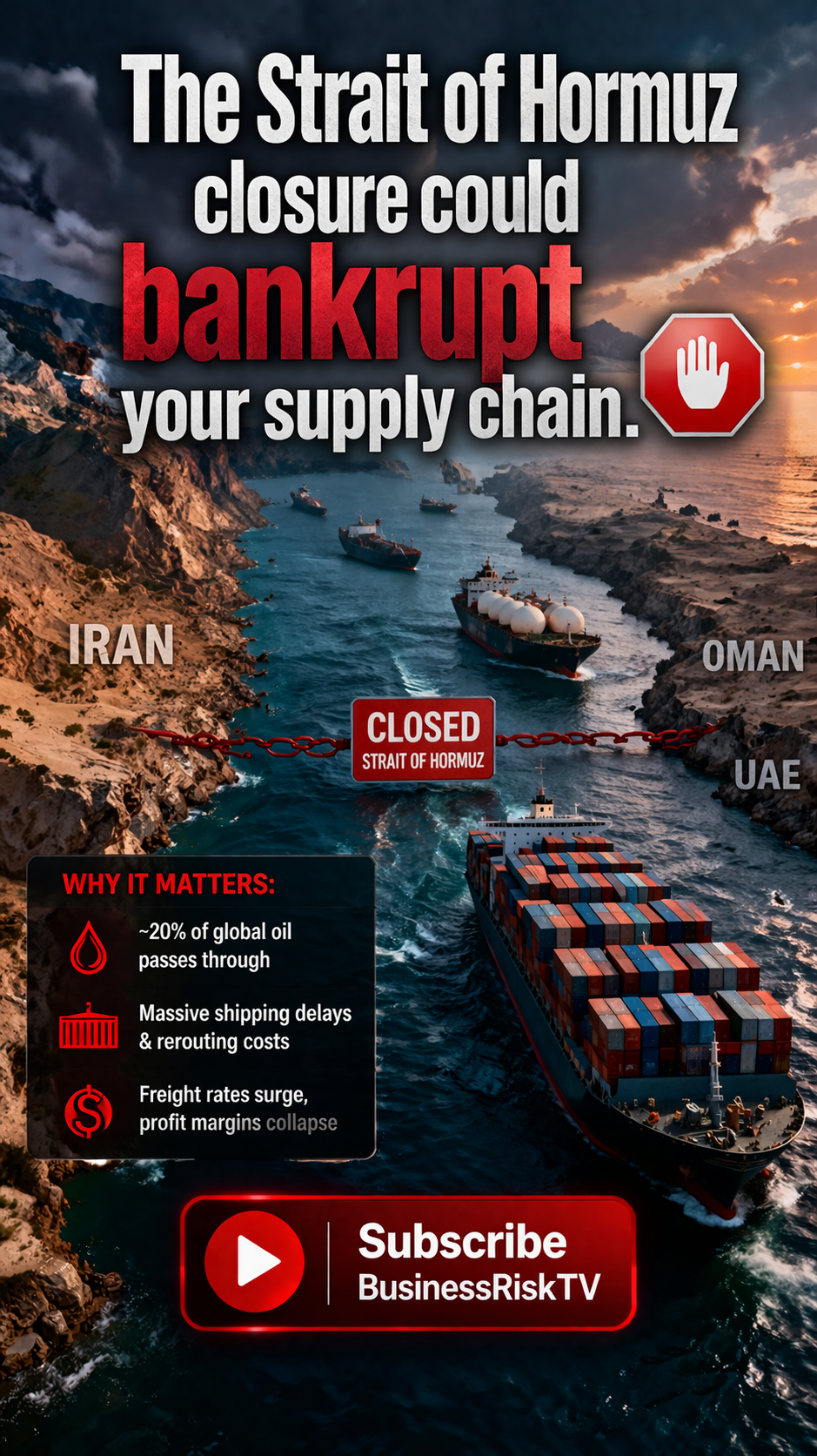
Why the Sulphur Crisis & Strait of Hormuz Blockade Threaten the Global Economy: 2026 Risk Analysis

As the Strait of Hormuz remains closed, the global economy faces a critical shortage of sulphur and sulphuric acid. Discover why this “silent” crisis impacts U.S. copper mining, food security, and why business leaders must act now to mitigate systemic risk.

The global economy in 2026 is facing a “silent” systemic threat. While headlines focus on the immediate spike in oil prices following the closure of the Strait of Hormuz, a far more insidious risk is brewing in the shadows: the collapse of the global sulphur and sulphuric acid supply chain.

As a core pillar of the Business Risk Management Club, we analyse the interconnectedness of risks that others overlook. For business leaders, understanding this “liquid gold” of heavy industry is no longer optional—it is a survival requirement.

The Invisible Backbone of Global Industry: A Strategic Risk Analysis

Why is sulphuric acid the “Blood” of the modern economy?

Sulphuric acid is the most widely used industrial chemical on Earth because it is the primary reagent required to extract high-value minerals like copper, lithium, and nickel. In 2026, the transition to green energy has made copper demand skyrocket, yet you cannot have copper without sulphuric acid for the leaching process.

Beyond mining, it is the fundamental ingredient in phosphate fertilizers, which support roughly 50% of global food production. A shortage in sulphur doesn’t just stop factories; it triggers global food insecurity and halts the production of EV batteries and semiconductors.


Why has the Strait of Hormuz closure not fully impacted the economy yet?

The impact of the maritime blockade has been delayed because global supply chains initially relied on “buffer” inventories and the “fast-channel” focus on petroleum prices. However, the Strait is the exit point for over 50% of the world’s traded liquid sulphur—a byproduct of oil and gas refining in the Middle East.

While the U.S. and other nations have drawn from strategic reserves, those reserves are depleting. We are currently in the “lag phase” of a classic bullwhip effect. Within the next 3 to 6 months, the lack of sulphur will lead to a secondary manufacturing shock that will be far more difficult to “drill” our way out of than an oil shortage.


Why is the claim that this does not impact the USA economy dangerously wrong?

The assertion that the U.S. is insulated due to domestic energy independence fails to account for integrated global commodity pricing and downstream mineral dependency. Even if the U.S. produces its own oil, it cannot unilaterally replace the lost volume of Middle Eastern sulphur required for its domestic agricultural and mining sectors.

“The Strait of Hormuz is an ‘economic clock of war.’ A short closure is an oil shock, but a prolonged closure becomes a systemic collapse of growth and inflation.” — LSE Business Review, March 2026.

Three facts on the cost and value of this crisis:

  1. Cost of Inaction: The price of sulphuric acid has surged by over 40% since the blockade began, directly increasing the “all-in sustaining cost” (AISC) for copper miners by an estimated 15%.

  2. Global Trade Value: Over 30% of seaborne fertilizer and 20% of global LNG pass through this 21-mile-wide choke point; the U.S. economy is tied to the global price of these goods regardless of local production.

  3. The Inflation Multiplier: In April 2026, U.S. gas prices hit $4.00 per gallon, a 30% increase that acts as a regressive tax on every level of the American supply chain.


12 Risk Management Measures for Business Leaders

To protect your organisation against this escalating threat, the Business Risk Management Club recommends the following immediate actions:

  • Diversify Chemical Suppliers: Audit your Tier 2 and Tier 3 suppliers to ensure you aren’t indirectly reliant on Middle Eastern sulphur.

  • Secure Long-Term Offtake Agreements: Move from spot-market purchasing to fixed-volume contracts for critical reagents.

  • Invest in Circular Recovery: Implement on-site acid recovery systems to recycle sulphuric acid in mining and manufacturing processes.

  • Dynamic Pricing Models: Incorporate “commodity surcharges” into customer contracts to pass through volatile raw material costs.

  • Inventory Buffering: Increase “Safety Stock” levels for sulphur-dependent components from 30 days to 90+ days.

  • Geopolitical Scenario Planning: Conduct quarterly “War Room” sessions to model the impact of a 12-month Strait closure.

  • Resource Substitution: Explore bio-based or alternative leaching agents where technically feasible.

  • Logistics Redundancy: Identify “Land-Bridge” or alternative shipping routes that bypass the Strait, even at a higher initial cost.

  • Currency Hedging: Hedge against the volatility of the U.S. dollar and Middle Eastern currencies tied to energy exports.

  • Regulatory Monitoring: Track changes in “low-emission sulphuric acid” credits, which are becoming a major tradeable commodity.

  • Stakeholder Communication: Transparently brief investors on your exposure to the “Sulphur Gap.”

  • Enhanced Cybersecurity: Protect supply chain data systems, as digital infrastructure is the first target during physical blockades.

#GlobalEconomy2026 #RiskManagement #StraitOfHormuz #BusinessRiskTV #RiskManagement

Get help to protect and grow your business faster with BusinessRiskTV regardless of business environment

Find out more from BusinessRiskTV about growing your business through changing times

Subscribe for free business risk management ideas risk reviews and cost reduction tips

Connect with BusinessRiskTV for free business risk management tips

Read more business risk management articles on BusinessRiskTV and view videos @RiskBusiness YouTube Channel

Connect with BusinessRiskTV for free alerts to new business risk management articles and videos

21-mile strip of water that could bankrupt your supply chain Subscribe BusinessRiskTV

Everyone is watching the oil price. They’re looking at the wrong indicator.

To clarify, the 21-mile width refers to the narrowest point of the Strait of Hormuz (specifically the shipping lanes and buffer zones)

While the world argues over $4.00/gallon gas, a “silent” killer is draining the lifeblood of global industry: The Sulphuric Acid Collapse.

If you manufacture electronics, mine copper, or grow food, you are currently in the crosshairs of a geopolitical time bomb.

President Trump says the Strait of Hormuz closure doesn’t impact the U.S. economy. He’s wrong. Here’s the data he’s missing.

The Reality: The Strait is the exit for 50% of the world’s traded sulphur. No sulphur = No sulphuric acid.
No sulphuric acid =
❌ No Copper for EVs.
❌ No Phosphate for Food.
❌ No Lithium for Batteries.

We are currently in the “lag phase.” The reserves are running dry. By Q3 2026, the “Price of Silence” will become the “Price of Insolvency” for businesses that didn’t plan ahead.

What you need to do RIGHT NOW:
At the Business Risk Management Club, we’ve identified 12 critical steps to insulate your operations—from circular acid recovery to aggressive inventory buffering.

Don’t wait for the mainstream media to catch up. The smart money is already moving.

#GlobalEconomy2026 #RiskManagement #StraitOfHormuz #BusinessRiskTV #RiskManagement

Why the Sulphur Crisis & Strait of Hormuz Blockade Threaten the Global Economy: 2026 Risk Analysis

The 2026 Silver Crisis: COMEX Default Risk, China Export Ban & 9 Strategies for Business Leaders

As the March 2026 COMEX silver交割 approaches, global business leaders face a critical liquidity event. Combined with China’s export ban on silver and surging industrial demand, the risk of a physical silver default threatens to disrupt financial markets and supply chains. Discover 9 risk management measures to protect your business.

Undertaking a Business Risk Analysis of the COMEX Silver Supply Crisis of March 2026

For business leaders around the world, the convergence of three distinct market forces has created a “perfect storm” in the silver market. Unlike previous commodity cycles driven by speculation, the current crisis is structural. It is defined by the shutdown of accessible physical silver from traditional channels, a strategic shift in Chinese trade policy, and an insatiable, non-negotiable industrial demand.

This analysis serves as a business risk management framework to understand the threat, timeline, and strategic responses required to navigate the potential financial contagion stemming from the COMEX market in March 2026.

The Core Problem: The Triad of Risk in 2026

To understand why this is not a typical price fluctuation, business leaders must dissect the three pillars of the current crisis.

1. The COMEX Delivery Crisis and March 2026 Risk Event

The most immediate and systemic threat lies within the New York Commodities Exchange (COMEX). Historically, the COMEX is a “paper” market, where futures contracts are settled financially far more often than with physical metal. However, data from January 2026 reveals a seismic shift. In a traditionally quiet month, over 40 million ounces of silver were requested for delivery, compared to the usual 1-2 million ounces .

Analysts warn that as the critical March delivery month approaches, total delivery requests could reach 70 to 80 million ounces. This would nearly deplete the COMEX registered inventory of just 110 to 120 million ounces . The major risk event is a default by the COMEX on physical delivery. This would shatter the credibility of the paper pricing mechanism, leading to a violent repricing of silver and a flight to quality that could freeze credit markets .

2. China’s Strategic Embargo on Silver Exports

Effective January 1, 2026, China implemented stringent export controls on silver, licensing only 44 companies to export and effectively treating the metal with the same strategic importance as rare earths . China is not just a major producer; it accounts for roughly 70% of the globally traded refined silver market .

This “ban” creates a supply vacuum. While the West views silver as a commodity, China views it as a strategic resource critical for its dominance in solar panels, EVs, and AI infrastructure . This action effectively diverts physical supply away from Western markets and locks it into Chinese industrial expansion. Elon Musk’s public response—”This is not good”—underscores the critical nature of this disruption for US and European supply chains .

3. The Industrial Demand “Trap”

Silver is no longer just a precious metal; it is the “industrial vitamin.” It is indispensable for solar panels, electric vehicles, AI data centres, and 5G infrastructure . The market is heading for its sixth consecutive year of structural deficit .

Unlike investors who can leave the market, industrial consumers cannot stop buying. They must have physical silver to keep production lines running. This creates a demand inelasticity that fuels a scramble for physical metal. Even if high prices eventually cause some “thrifting” (using less silver) in sectors like solar, the immediate demand pipeline is rigid .

The Risk: Shutdown of Access to Physical Silver

The shutdown of access is happening on two fronts simultaneously.

  • Price Discovery Failure: If COMEX defaults in March, the “paper” price (used by banks and funds for valuation) will become detached from the physical price (what manufacturers actually pay). We are already seeing this bifurcation, with physical coins trading at 50-80% premiums in some markets.
  • Liquidity Freeze: Banks and financial institutions that lend against silver or use it as collateral will face a crisis of valuation. If they cannot reliably price or obtain physical metal to cover positions, they will pull credit lines from the very industries that need it most .

Why This is Critical to Business Leaders and Financial Markets

The contagion from a silver default will not stay contained within the commodities desk. It will spread to the wider financial markets. A default at COMEX would trigger margin calls across the complex, forcing liquidations of other assets to raise cash. It would undermine confidence in all paper commodity markets, potentially leading to a credit crunch .

For business leaders, this translates to:

  1. Input Cost Volatility: Unpredictable and rising costs for any product using electronics, batteries, or solder.
  2. Supply Chain Unreliability: Suppliers may simply stop quoting prices or fail to deliver on contracts due to an inability to source metal.
  3. Working Capital Strain: As seen in India’s “Silver City” of Khamgaon, manufacturers face acute shortages, forcing them to lock up disproportionate working capital in buffer inventories or face shutdowns .

When Will the Major Risk Event Happen?

The primary date for concern is March 2026. The COMEX March contract is a major delivery month. As the delivery date approaches in late February and early March, the pressure on holders of short positions (those who sold silver they don’t physically have) will become intense. If they cannot source the metal, the exchange faces a default scenario . Business leaders should be prepared for extreme volatility beginning in the last week of February and peaking in mid-March.

Who is Most Likely to Be Affected by Risk Events?

While the impact is broad, certain sectors are on the front line:

Where in the World Will Have the Biggest Business Risk Impacts?

  • North America and Europe: These economies are heavily dependent on imports of refined silver and are most exposed to the COMEX default risk and the cutoff of Chinese supply.
  • India: As a major importer of silver for both jewellery and industry, India is experiencing severe price sensitivity and liquidity stress in its processing hubs.
  • Asia (ex-China): Economies reliant on Chinese refined silver will face logistical delays and higher costs as they scramble to diversify suppliers .

9 Business Risk Management Measures to Take Today

To protect and grow your business through the coming volatility, leaders must move from passive observation to active defense.

Measure 1: Audit Your Silver Supply Chain Deeply
Map your supply chain beyond Tier 1.

Identify where silver is embedded in components and which of your suppliers are exposed to spot markets. You need to know if your key supplier is one of the 44 licensed Chinese exporters or if they rely on COMEX paper.

Measure 2: Secure Supply-Linked Financing

Move away from spot purchases. Secure long-term supply arrangements directly with producers or through offtake agreements. As seen with Samsung and Silver Storm Mining, tying working capital to contracted silver flows provides price and supply visibility .

Measure 3: Build Strategic Buffer Inventories

In a deficit market, just-in-time inventory is a high-risk strategy. Increase your buffer stocks of silver-intensive components now, even if it strains working capital. The cost of holding inventory is lower than the cost of a production shutdown.

Measure 4: Hedge Physically, Not Just Financially

Traditional paper hedging may fail if the paper price decouples from physical reality. Explore options that give you a claim on physical metal or consider purchasing allocated physical silver to secure future needs.

Measure 5: Diversify Your Supplier Base

With China restricting exports, immediately qualify suppliers in Mexico, Peru, and Australia. Redundancy in your supply chain is now a survival trait, not a cost center .

Measure 6: Implement Price Escalation Clauses

Review all fixed-price contracts for silver-intensive goods. Insert price escalation clauses that allow you to pass through raw material cost increases, protecting your margins from volatility.

Measure 7: Stress-Test Working Capital

Model a scenario where silver prices spike another 30-50% and payment terms from suppliers shorten to cash-on-delivery. Identify where liquidity stress would appear in your business and secure backup credit lines now .

Measure 8: Explore Substitution and “Thrifting”

Work with your R&D and engineering teams to accelerate plans for silver reduction. While substitution (like copper for silver) takes time, even marginal reductions in usage per unit can significantly lower risk exposure .

Measure 9: Monitor Lease Rates and Premia

Ignore the spot price for a moment. Track the LBMA silver lease rates and physical premiums in key markets like Dubai or Shanghai. These are the real indicators of physical tightness. A spike in lease rates, as seen recently, signals that the physical market is screaming for metal .

How Do Business Leaders Continue to Grow Faster Regardless of Such Risk Events?

Volatility creates opportunity. Leaders who navigate this crisis effectively can gain market share against competitors who freeze or fail.

  1. Capitalise on Competitor Weakness: While rivals struggle with supply chain disruptions, your secured supply chain (via Measure 1 & 2) allows you to win contracts and capture market share.
  2. Innovate Through Constraint: Use the high price environment to justify investment in R&D for more efficient silver usage. The companies that solve the “thrifting” equation first will have a long-term cost advantage.
  3. Leverage Financial Innovation: Utilise supply chain finance platforms and offtake agreements to turn a liability (high silver cost) into a competitive advantage (guaranteed supply). By treating finance as part of the supply chain, you build resilience that debt-heavy competitors lack .

Conclusion

The March 2026 COMEX delivery is not just a trader’s problem; it is a critical business risk event. The combination of a potential default, Chinese export controls, and a multi-year structural deficit means the rules have changed. Business leaders must act today—not to speculate, but to insulate. By securing physical supply, strengthening working capital, and diversifying sources, you can protect your enterprise from the coming storm and emerge stronger on the other side.

#SilverCrisis #COMEXDefault #BusinessRiskManagement #BusinessRiskTV #RiskManagement

Get help to protect and grow your business through any business risk events with support from BusinessRiskTV

Find out more about managing business risks with BusinessRiskTV help

Subscribe to BusinessRiskTV for free business risk management ideas risk reviews and cost reduction tips

Connect with us for free business risk management tips

Read more business risk management articles and view videos for free

Connect with us for free alerts to new business risk management articles and videos

The 2026 Silver Crisis: COMEX Default Risk, China Export Ban & 9 Strategies for Business Leaders

Hidden History & Business Risk: Is Your Strategy Prepared for a 1914-Style Global Reset?

Is history repeating itself? Our deep-dive analysis of Hidden History: The Secret Origins of the First World War by Docherty and Macgregor reveals the hidden geopolitical risks facing modern corporations. Learn how “Secret Elite” agendas and systemic collusion can trigger global market collapses, and discover six critical reasons why today’s business leaders must shift from reactive to proactive resilience. Don’t let your supply chain be the next casualty of a “Black Swan” event—prepare your business for the next Great Reset.

In Hidden History: The Secret Origins of the First World War, Gerry Docherty and Jim Macgregor argue that WWI wasn’t a series of diplomatic blunders, but a calculated destruction of Germany orchestrated by a secret “Elite” in London.

From a Business Risk Management (BRM) perspective, this narrative serves as a masterclass in identifying “Black Swan” events that are actually “Grey Rhinos”—highly probable, high-impact threats that are often ignored until it’s too late.


Business Risk Analysis: The “Hidden History” Lens

If we treat the geopolitical landscape of 1914 as a market, the book highlights several critical risk categories:

  • Systemic Corruption & Collusion: The authors suggest that a small group (the “Secret Elite”) manipulated national policy for long-term strategic gain. For a business, this represents Counterparty Risk—the danger that the “rules of the game” are being written by competitors or regulators behind closed doors.

  • Information Asymmetry: The book claims the public was fed a narrative of “Belgian neutrality” to mask deeper agendas. In business, relying on mainstream data or “consensus” can lead to a failure in Strategic Forecasting.

  • Geopolitical Contagion: The transition from a localised Balkan conflict to a global catastrophe illustrates how quickly Supply Chain Disruption and Market Volatility can scale when hidden alliances are triggered.


6 Reasons Why History Could Repeat Itself Soon

Current global dynamics mirror the pre-1914 era in several unsettling ways:

  1. Thucydides’ Trap: Just as the British Empire feared a rising Germany, the current tension between the U.S. and China creates a structural risk where a dominant power feels forced to suppress a challenger.

  2. Echo Chambers & Propaganda: The “Secret Elite” used the press to whip up anti-German sentiment. Today, AI-driven algorithms and social media echo chambers can radicalise populations and manufacture consent for conflict faster than ever.

  3. Complex Alliance Webs: Much like the secret treaties of 1914, modern mutual defence pacts and “informal” military partnerships mean a spark in a small region (like the South China Sea or Eastern Europe) could force a global decoupling.

  4. Resource Scarcity & Energy Shifts: The 1914 era was about the shift from coal to oil and control of the Berlin-Baghdad railway. Today, the race for rare earth minerals and semiconductor dominance creates similar “must-win” flashpoints.

  5. Economic Financialisation: The book argues high-finance interests drove the war. Today’s global economy is heavily leveraged; a massive debt crisis could tempt leaders to use “war footing” as a distraction or a way to reset the financial system.

  6. Technological Arrogance: In 1914, leaders believed the war would be “over by Christmas” due to superior tech. Today, the belief that Cyber Warfare or Precision Strikes will lead to “short, clean” conflicts often ignores the reality of unpredictable escalation.


How Business Leaders Can Protect Their Interests

To avoid being collateral damage in a “Hidden History” style escalation, leaders should move from reactive to proactive resilience:

The Lesson: History suggests that the greatest risks aren’t the ones we see on the news, but the ones being discussed in private rooms by those who benefit from the chaos.

Executive Scenario Planning Template Example

Focus: Geopolitical Resilience & Strategic Redundancy

This template is designed to help executive teams move past “business as usual” and confront the non-linear risks highlighted by Docherty and Macgregor. It focuses on the “Hidden History” premise: that the biggest threats are often pre-planned or systemic, rather than accidental.

1. The “Hidden Ally” Audit

In 1914, secret agreements forced nations into a war they hadn’t publicly debated. Businesses often have similar “hidden” dependencies.

  • Mapping Dependencies: List your Top 5 critical vendors. Do they share a single point of failure (e.g., all rely on the same shipping lane, the same energy grid, or the same political regime)?

  • The “What If” Trigger: If Country X imposes an immediate export ban on a key component tomorrow, how many days can your operations survive?

  • Action: Identify one “Non-Aligned” alternative supplier for every critical dependency.

2. Narrative & Information Risk Analysis

The “Secret Elite” used media to shape public perception. In a modern crisis, your brand could be caught in the crossfire of state-sponsored disinformation.

3. Scenario Matrix: Four Degrees of Disruption

Use this table to evaluate your readiness for different levels of escalation:

Disruption Level Scenario Example Business Impact Mitigation Priority
Level 1: Friction Increased tariffs / Trade war Margin compression Pricing agility & tax optimization
Level 2: Segregation Sanctions / Regional internet split Loss of specific market access Ring-fencing regional assets
Level 3: Hard Decoupling Complete trade embargoes Supply chain collapse Localization of manufacturing
Level 4: Kinetic Conflict Global War / Infrastructure hit Total operational halt Physical security & cash liquidity

4. Financial “War Chest” Strategy

The book argues that those with liquid assets and prior knowledge thrived during the transition to war.

  • Liquidity Stress Test: In a scenario where credit markets freeze (similar to 1914 or 2008), do you have enough non-digital or highly liquid reserves to cover 6 months of payroll?

  • Currency Diversification: Are your cash reserves held in a single currency? Consider a “Geopolitical Basket” (e.g., USD, CHF, Gold, or decentralised assets) to hedge against a systemic collapse of one fiat system.


Next Steps for the Leadership Team:

  1. Assign a “Red Team”: Appoint three team members to play “Devil’s Advocate” for every major strategic expansion. Their job is to find the “Hidden History” reason why the expansion will fail.

  2. Quarterly Geopolitical Brief: Move beyond standard economic reports. Look at defence spending trends and undersea cable/satellite investments to see where the “Secret Elites” of today are placing their bets.

To keep this lean and focused, here is a “Red Team” questionnaire designed to puncture optimism bias and reveal the hidden systemic risks in your 5-year plan.

These questions are framed to uncover the “Secret Elite” style risks—those factors that aren’t on a standard balance sheet but can sink a company during a geopolitical shift.

Phase 1: The Dependency & “Invisible Hand” Test

  • The Single-Point-of-Failure Audit: If a “black swan” event permanently closed the borders of your primary manufacturing or service hub tomorrow, does the business have a “Plan B” that doesn’t rely on that same geographic region?

  • The Shadow Influence Check: Are our key strategic partners or investors also heavily invested in our direct competitors or in nations with conflicting interests? Who benefits if our current 5-year plan fails?

  • The Subsidy/Regulation Trap: Is our projected growth dependent on current government subsidies or “friendly” regulations? If a political shift occurred and those were stripped away to fund a “war footing” economy, is the project still viable?

Phase 2: Information & Infrastructure Resilience

  • The Narrative Pivot: If our brand becomes politically “toxic” in a major market due to circumstances entirely outside our control (e.g., a national conflict), can we “ring-fence” that region and continue operating elsewhere, or is our identity too centralised?

  • The Analog Fail-Safe: If a sophisticated cyber-offensive took down the primary cloud service providers we use for 30 days, do we have any “manual” or localised way to fulfill orders or maintain core operations?

  • The “Secret” Intelligence Gap: Are we making decisions based on “consensus data” (mainstream media/economic reports) that everyone else sees, or do we have “boots on the ground” insights into the physical movement of goods and local political sentiment?

Phase 3: Financial & Strategic Exit Ramps

  • The Liquidity Lock: If the global banking system experienced a “bank holiday” or a freeze on international transfers (similar to the start of WWI), do we have the local currency or physical assets to keep our global staff paid for 90 days?

  • The Sunk Cost Trap: At what specific “tripwire” (e.g., a specific sanction or a specific percentage of inflation) do we agree to abandon a major project rather than “doubling down” out of pride or previous investment?

  • The Leadership Vacuum: If our executive team were unable to communicate for 72 hours due to a total communications blackout, does the next layer of management have the clear authority and “commander’s intent” to make high-stakes decisions?


How to use this:

Distribute these questions to your leadership team. Have each member answer them anonymously first. You will often find that your “boots on the ground” staff (Ops, Supply Chain) see the “Hidden History” risks much more clearly than the C-suite.

#BusinessRisk #GeopoliticalRisk #HiddenHistoryWW1 #BusinessRiskTV #RiskManagement

Get help to protect and grow your business faster through any business environment you have to operate within

Learn more about growing your business through uncertain world

Subscribe for free business risk management ideas risk reviews and cost reduction tips

Connect with us for free business risk management tips

Read more business risk management articles and view videos for free

Connect with us for free alerts to new business risk management articles and videos 

Hidden History & Business Risk: Is Your Strategy Prepared for a 1914-Style Global Reset?