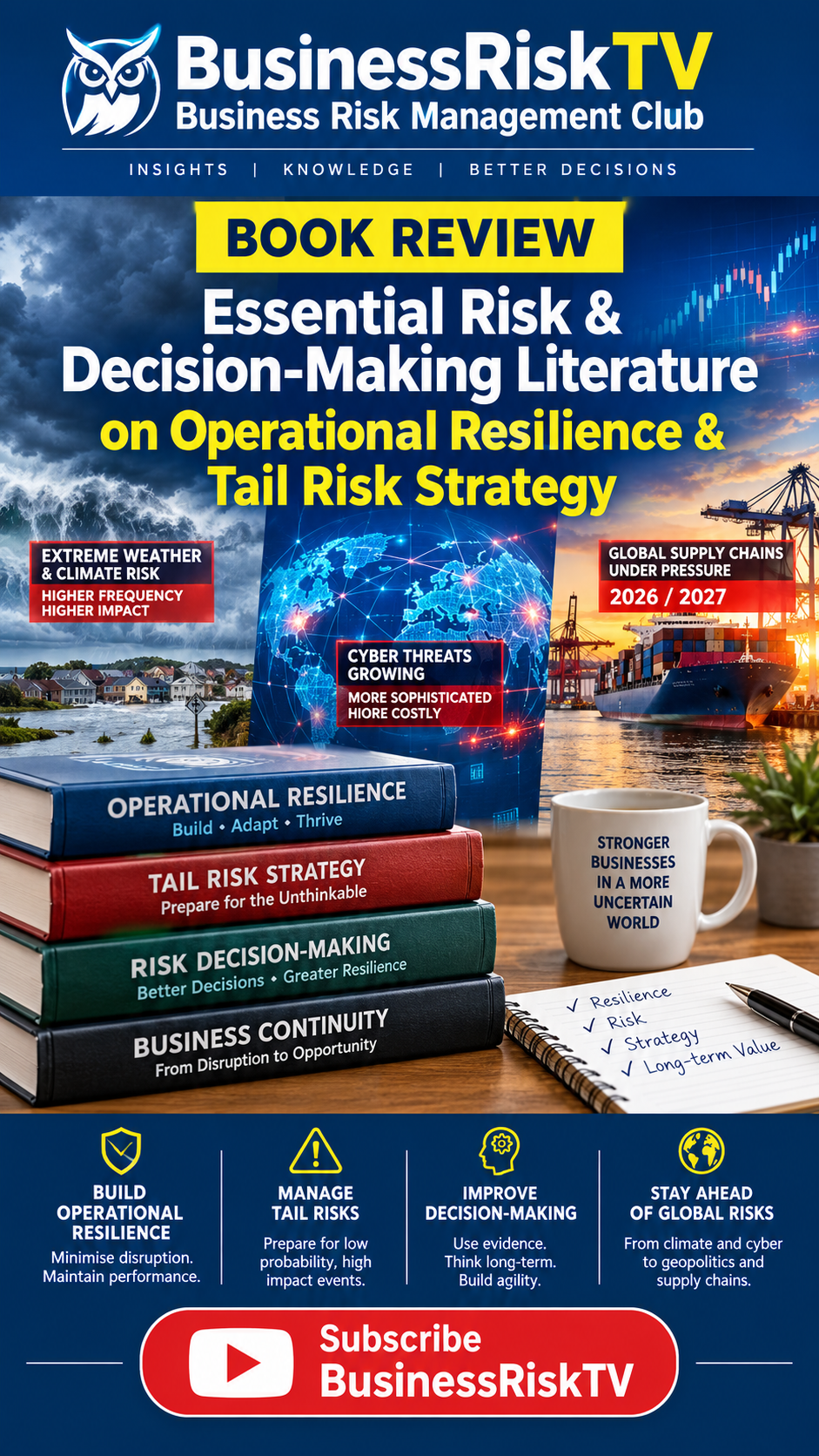
Which 3 Nassim Taleb Books Should Directors Read for Tail Risk & Operational Resilience in 2026?
How do directors, project managers & strategists navigate systemic uncertainty? BusinessRiskTV reviews Taleb’s 3 books with UK ONS stats & practical tail risk steps.

BusinessRiskTV Business Risk Management Club recommends these 3 books to help the reader make better decisions on Operational Resilience & Tail Risk Strategy.

That single sentence encapsulates why the following review exists. The scale of the problem is not theoretical. The Office for National Statistics reported that 40% of UK trading businesses with 10 or more employees cited economic uncertainty as the most significant challenge impacting turnover in early April 2026—the highest proportion since the question was introduced in April 2022. Government analysis of operational disruption across UK sectors shows that while typical incidents cost between 0.2% and 4.6% of annual turnover, tail events can dominate total losses and threaten business continuity entirely. Cyber-attacks alone cost UK businesses £3.7 billion in litigation over the past year, with shareholder lawsuits accounting for nearly a third of that total. Against this backdrop, Nassim Nicholas Taleb’s Incerto trilogy—Fooled by Randomness, The Black Swan, and Antifragile—provides the conceptual infrastructure that directors, project managers, and strategists need to navigate systemic uncertainties and cognitive bias in decision-making.‌

What Makes Nassim Nicholas Taleb’s Incerto Trilogy Essential Risk & Decision-Making Literature for Operational Resilience & Tail Risk Strategy?

Taleb’s Incerto trilogy is essential risk and decision-making literature for operational resilience and tail risk strategy because it systematically dismantles the illusions that lead organisations to underestimate rare, high-impact events and overestimate their ability to predict and control complex systems. The three books form a coherent progression: Fooled by Randomness (2001) exposes how humans mistake luck for skill; The Black Swan (2007) reveals how rare, unpredictable events shape history and markets; Antifragile (2012) offers a framework for building systems that benefit from disorder.

Why This Matters for Directors, Project Managers & Strategists:

  • Directors face board-level decisions where governance failures linked to cognitive bias carry escalating legal and financial consequences. UK boards are already experiencing “quiet distress” as prolonged financial strain and delayed decisions create D&O exposure earlier in the risk cycle.
  • Project managers operate at the intersection of uncertainty and delivery, often relying on linear projections and optimistic timelines that fail catastrophically when tail events hit. Research shows that organisations with structured decision trackers score more than 20 percentage points higher on early-warning indicator tracking and bias exploration than those without.
  • Strategists build models that assume a stable future, yet the ONS Business Insights survey consistently shows economic uncertainty dominating business challenges month after month.‌
    Each book serves a distinct function in the operational resilience toolkit. Together, they constitute a complete curriculum in probabilistic thinking, tail risk awareness, and adaptive system design.

What Is the Core Argument of Fooled by Randomness, and How Does It Apply to Business Decision-Making?

The core argument of Fooled by Randomness: The Hidden Role of Chance in Life and in the Markets is that humans systematically confuse randomness with causality, attributing success to skill and failure to controllable factors, thereby creating brittle decision-making frameworks that collapse when randomness reasserts itself. Taleb demonstrates that much of what passes for expertise in finance, management, and strategy is indistinguishable from luck dressed in the language of analysis.

Why This Matters Practically:

  • Distinguish signal from noise in performance data. Taleb argues that short-term results are dominated by variance, not skill. When evaluating business unit performance or project outcomes, directors should demand longer time horizons and statistical significance testing before drawing conclusions. UK businesses reporting turnover decreases (27% in April 2026) and increases (15% in July) often attribute these swings to strategy or market conditions when random fluctuation may be the dominant driver.‌
  • Identify survivorship bias in case studies. Business literature is filled with success stories of companies that “did everything right.” Taleb’s point is that we never see the graveyard of companies that did the same things and failed due to bad luck. Strategy teams should actively seek out failure cases and control groups.
  • Resist the narrative fallacy in post-mortems. After any project, there is enormous pressure to construct a coherent story explaining outcomes. Taleb warns this narrative impulse prevents genuine learning.

Business Application:

Project managers should implement decision journals that record expectations before outcomes are known, creating a feedback loop that reveals whether success was skill or circumstance. Directors should push for probabilistic language in board papers—”we assess a 60% likelihood” rather than “we are confident”—forcing explicit recognition of uncertainty. Strategists should stress-test strategic plans against scenarios where random negative events cluster, rather than assuming they distribute evenly across time.

What Is the Central Thesis of The Black Swan, and Which Businesses Are Most Vulnerable to Its Implications?

The central thesis of The Black Swan: The Impact of the Highly Improbable is that rare, unpredictable, high-consequence events—Black Swans—dominate outcomes in complex systems, yet our psychological and institutional frameworks are systematically blind to their possibility, leaving businesses dangerously exposed to catastrophic surprise. Taleb identifies the “triplet of opacity”: the illusion of understanding, the retrospective distortion of events, and the overvaluation of factual information.

Which Businesses Are Most Vulnerable:

  • Financial services firms face existential Black Swan exposure. Bank of England research shows 82% of UK banks, insurers and asset managers now cite cyber attacks as a top-five risk to the financial system, up ten percentage points from 2024. A meaningful share of large financial institutions face a roughly 10% annual probability of losing 10% or more of annual profit to a single cyber event.
  • Supply chain-dependent manufacturers and retailers are directly exposed to geopolitical Black Swans. In April 2026, 47% of UK businesses experiencing global supply chain disruption cited the conflict in the Middle East as the reason—up 34 percentage points from February.‌
  • Energy-intensive businesses face compounding tail risks from price volatility and geopolitical disruption. 60% of UK businesses reported concern about energy prices in early May 2026, with accommodation and food service businesses reaching 86% concern.‌
  • Technology and digital businesses are exposed through cyber, regulatory, and concentration risk. The PRA’s 2026 operational resilience policy statement explicitly addresses “rising threats to operational resilience at firms and their growing reliance on externally supplied services”.‌

When to Use The Black Swan Learning Points:

  • During strategy formation—to stress-test assumptions about the future rather than extrapolating from the recent past.
  • During risk register reviews—to identify where the organisation has conflated “hasn’t happened yet” with “can’t happen.”
  • During post-incident reviews—to avoid the retrospective distortion that makes Black Swans appear predictable after the fact.
  • During investment decisions—to assess whether the organisation is exposed to ruin, not just underperformance.

Business Application:

Directors should establish dedicated tail risk committees that meet independently of standard risk reviews, focusing exclusively on low-probability, high-impact scenarios. Project managers should build “kill criteria” into major projects—pre-defined conditions under which the project is stopped—rather than assuming continuation. Strategists should model scenarios where multiple Black Swans occur simultaneously, recognising that disruptions cluster rather than distribute evenly.

What Does Antifragile Teach About Building Organisations That Improve Under Stress, and How Can This Be Implemented?

Antifragile: Things That Gain From Disorder teaches that some systems are not merely robust (resistant to shocks) or resilient (recovering after shocks), but antifragile—they actually improve, strengthen, and grow when exposed to volatility, randomness, and stressors. Taleb argues this property is the highest form of adaptation available to organisations, and it can be deliberately engineered through structural choices, incentive design, and optionality.

Key Antifragile Principles for Business:

  • Barbell strategy: Combine extreme conservatism in core operations with aggressive, small-scale experimentation in growth areas. 75% of grant-funded UK charities use formal risk tools compared to 35% of non-grant-funded organisations, suggesting structured approaches enable greater risk capacity when combined with appropriate funding.
  • Optionality over prediction: Rather than forecasting the future, build portfolios of options that benefit from multiple possible outcomes. This directly addresses the observation that economic uncertainty has been the most reported challenge affecting business turnover since October 2022.
  • Skin in the game: Decision-makers must bear the consequences of their decisions. HM Treasury’s 2026 guidance to accounting officers frames value for money as a “balanced judgement of strategic alignment, long-term resilience, and risk,” moving beyond simple cost minimisation.
  • Redundancy as investment: Duplicate systems, diversified suppliers, and cross-trained teams are not waste—they are the raw material of antifragility.

When to Apply Antifragile Learning Points:

  • During organisational design—to build structures that benefit from uncertainty rather than merely surviving it.
  • During supply chain strategy—to move from just-in-time efficiency to diversified, optionality-rich sourcing.
  • During technology investment—to prioritise systems that learn from attacks and failures rather than merely resist them.
  • During talent development—to cultivate teams comfortable with volatility and skilled at rapid adaptation.

Business Application:

Operations directors should conduct “stress tests with benefit”—scenarios where the organisation not only survives disruption but emerges stronger because competitors are weakened. For example, a manufacturer with diversified suppliers can gain market share when single-source competitors face disruption. Project managers should build rapid prototyping and learning loops into delivery schedules, treating small failures as information rather than stigma. Strategists should allocate a portion of capital to small, high-optionality bets that could pay off massively in Black Swan scenarios, while simultaneously reducing exposure to ruinous tail risks.

Which Businesses Will Benefit Most from Taleb’s Frameworks, and Where in the World Are They Likely Operating?

The businesses that will benefit most from Taleb’s frameworks are those operating in high-uncertainty, high-interconnection, and high-consequence environments—particularly in the UK, Europe, North America, and Asia-Pacific where regulatory pressure, geopolitical fragmentation, and technological disruption intersect.

Sector-by-Sector Analysis:

  • Financial services in London, New York, Singapore, and Frankfurt face the most acute combination of regulatory scrutiny, cyber exposure, and tail risk concentration. The PRA’s PS7/26 operational resilience policy, effective from 2026, requires firms to report operational incidents and material third-party arrangements with significantly reduced burden but enhanced oversight. UK financial services compliance costs now exceed £33.9 billion annually, representing roughly 13% of average operating costs.‌
  • Manufacturing and logistics across the UK, Germany, Netherlands, and key Asian hubs are directly exposed to supply chain Black Swans. The ONS reported 7% of UK businesses experiencing global supply chain disruption in April 2026, with nearly half citing Middle East conflict.‌
  • Energy and utilities in the UK, Norway, Gulf states, and Australia face compounded tail risks from price volatility, geopolitical disruption, and transition uncertainty. 28% of UK businesses cited energy prices as a reason for considering raising prices in June 2026.‌
  • Technology and digital platform businesses globally face cyber Black Swans, regulatory tail risks, and concentration risk. The Bank of England’s 2026 H1 Systemic Risk Survey found 82% of financial institutions citing cyber attacks as a top-five systemic risk.‌
  • Healthcare and pharmaceutical supply chains across Europe, North America, and Asia are exposed to pandemic Black Swans, regulatory disruption, and geopolitical supply chain risk.
  • Professional services firms advising on risk, strategy, and resilience are both beneficiaries (demand for their services grows) and exposed to reputational tail risks if they fail to apply these frameworks themselves.

Geographic Concentration:

  • United Kingdom: Highest regulatory intensity for operational resilience, with FCA/PRA rules now in “steady-state” from 2026, enhanced regulatory powers, and cost recovery provisions.
  • European Union: DORA (Digital Operational Resilience Act) in force across Europe, aligning with UK approaches but creating additional compliance complexity for cross-border firms.
  • United States: Less prescriptive regulation but higher litigation and shareholder activism risk, particularly around cyber governance failures.
  • Asia-Pacific: Rapid economic growth combined with geopolitical tension, supply chain concentration, and varying regulatory maturity creates a high-Black-Swan environment.
  • Middle East and Africa: Geopolitical disruption, energy price volatility, and infrastructure risk create compounding tail exposure.

How Should Organisations Integrate Taleb’s Key Learning Points into Decision-Making to Boost Performance and Reduce Risk Events Derailing Business Objectives?

Organisations should integrate Taleb’s key learning points by embedding probabilistic thinking, tail risk assessment, and antifragile design principles into the governance, project management, and strategy functions at the point of decision, not as an afterthought. The evidence suggests this is not optional: UK business confidence dropped to a net figure of -76 in March 2026, compared to -63 in February, according to Institute of Directors research. Fewer businesses were set up in Q1 2026 than in any comparable period on record. The organisations that survive and thrive will be those that internalise Taleb’s lessons before the next Black Swan arrives.

Board-Level Integration:

  • Establish a Tail Risk Committee reporting directly to the board, separate from the standard audit and risk committee, with a mandate to challenge assumptions of normality and identify ruin exposure.
  • Require probabilistic decision papers: every significant capital allocation or strategic decision must include explicit probability assessments, not point forecasts.
  • Implement decision journals that record expectations, rationale, and confidence levels before outcomes are known, reviewed quarterly to identify systematic biases.

Project Management Integration:

  • Build kill criteria into every major project: pre-defined conditions under which the project is terminated, removing sunk-cost bias from continuation decisions.
  • Apply barbell resource allocation: commit 80-90% of resources to high-confidence, low-variance delivery, and 10-20% to experimental, high-optionality initiatives that could benefit from disorder.
  • Conduct pre-mortems at project initiation: assume the project has failed catastrophically and work backwards to identify causes.

Strategy Integration:

  • Replace single-scenario planning with multiple scenarios including Black Swan scenarios where multiple disruptions compound.
  • Develop antifragile supply chains with diversified sourcing, redundancy, and optionality—accepting higher baseline costs as insurance against tail events.
  • Invest in optionality: maintain cash reserves, flexible contracts, and strategic options that can be exercised when volatility creates opportunity.

Operational Resilience Integration:

  • Align with regulatory requirements proactively: the PRA’s operational resilience framework requires firms to remain within impact tolerances for important business services under severe but plausible disruption scenarios.
  • Conduct regular stress tests that include cyber, geopolitical, and supply chain scenarios simultaneously, recognising that disruptions cluster.
  • Measure resilience value not just as cost avoidance but as competitive advantage: government analysis shows that increased resilience reduces both the likelihood of severe outcomes and the scale of losses when disruption occurs.‌

When to Apply These Frameworks:

  • Annually during strategy and budget cycles: full Black Swan scenario review and antifragile portfolio assessment.
  • Quarterly during board risk reviews: tail risk exposure review and decision journal analysis.
  • Monthly during project reviews: kill criteria assessment and pre-mortem updates.
  • Continuously through operational monitoring: early-warning indicators and antifragile capacity metrics.
  • Post-incident after any disruption: structured learning review applying Fooled by Randomness lessons about attribution.

Why Are These Books Particularly Relevant for Operational Resilience & Tail Risk Strategy in September 2026?

These books are particularly relevant in September 2026 because the operating environment has become precisely the kind of high-volatility, high-interconnection, high-consequence system that Taleb’s frameworks were designed to address. The ONS Business Insights survey for April 2026 showed economic uncertainty at 40% for larger businesses—the highest proportion since the question was introduced. Global supply chain disruption reached 9% in March 2026, the highest since December 2022. The PRA’s operational resilience rules are now in full effect, with “steady-state” expectations and enhanced regulatory powers to demand information, direct remediation, and recover supervisory costs. Bank of England analysis confirms that “average impacts are not representative of overall risk exposure” and that “tail events can dominate total losses and can threaten business continuity”.‌‌

Taleb’s trilogy provides the intellectual architecture to navigate this environment. Fooled by Randomness teaches the discipline of statistical scepticism. The Black Swan reveals the structural blind spots that make organisations vulnerable to rare events. Antifragile offers the design principles to build systems that improve under stress. Together, they constitute a complete risk literacy curriculum for directors, project managers, and strategists who need to make decisions when the future refuses to behave as forecast.

The value proposition is not merely defensive. Organisations that internalise these lessons will identify opportunities that competitors miss—in supply chain restructuring, in optionality-rich investment strategies, in resilient operational models that become competitive advantages when disruption hits. The question is not whether the next Black Swan will arrive, but whether your organisation will be fooled by randomness when it does.

#OperationalResilience #TailRiskStrategy

Get help to protect and grow your business faster with BusinessRiskTV

Find out more about growing your business faster with BusinessRiskTV Business Risk Management Club

Subscribe for free business risk management ideas risk reviews and business discounts to reduce your business cost of being in business

Connect with BusinessRiskTV for free business risk management tips

Read more business risk management articles and view videos for free

Connect with BusinessRiskTV for free alerts to new business risk management articles and videos 

p

Which 3 Nassim Taleb Books Should Directors Read for Tail Risk & Operational Resilience in 2026?

Risk Management Rebels: Better Business | BusinessRiskTV

Join BusinessRiskTV & LinkedIn Risk Management Online. Risk rebel insights for key risk owners. Manage business risks better. Email editor@businessrisktv.com.

For key risk owners and risk management rebels: use better risk questions, lateral thinking, and the Risk Management Online LinkedIn group to manage business risks better, improve business performance, and increase personal reward. Email editor@businessrisktv.com to engage.

BusinessRiskTV Business Risk Management Club recommends joining this club and Linkedin Risk Management Online group as the solution to the problem of managing business risks better to boost business performance in uncertain world.

If you are one of the crazy ones, a misfit, a risk management rebel who refuses to accept that “that’s just how it’s always been done,” then this is your invitation. Research from PwC’s 2024 Pulse Survey reveals that companies embracing advanced risk strategies have cut the financial impact of disruptions by 20% while boosting operational efficiency by 15%, and Deloitte’s 2024 Global Risk Management Survey shows that firms with robust risk governance are 25% more likely to outpace competitors in revenue growth. We are building a network of people who manage business risks better for better business performance and increased personal reward. The Linkedin Risk Management Online group is waiting for you:

https://www.linkedin.com/groups/2324725

Why Is Business Risk Management Information Critical to Better Business Decisions and Performance?

Business risk management information is critical to better business decisions and performance because organisations that invest in risk maturity consistently demonstrate improved financial performance and resilience. Enterprise risk management is not a bureaucratic checkbox exercise; it is the operating system of a business that intends to survive the Fourth Turning. ISO 31000, the international standard for risk management, explicitly states that risk management creates and protects value, contributes to the demonstrable achievement of objectives, and drives decision making that improves business performance. The World Economic Forum’s Global Risks Report 2026 emphasises that interconnected economic, environmental, geopolitical, societal, and technological risks demand a fundamental rethink of how organisations approach resilience and strategic planning, a warning echoed by the UK Government Internal Audit Agency’s guidance on early warning signs in public sector bodies.

The numbers tell a story that most boardrooms are still not hearing clearly enough:

  • Organisations with higher risk maturity levels consistently demonstrate improved financial performance.
  • A study of 11,285 firm-year observations using the COSO ERM framework found that ERM implementation is positively associated with both return on assets (ROA) and Tobin’s Q, with a stronger relationship observed for financial performance.
  • Cross-industry research reveals that supply chain disruptions can cost companies 6–10% of annual revenues, yet organisations with proactive risk management systems can significantly reduce this exposure.
  • The average cost of a single data breach is now $4.88 million, and IBM has found that companies implementing AI security tools can cut their losses by $2.2 million.
  • Organisations that fail to comply with data regulations face costs averaging $14.8 million annually, compared to just $5.4 million for those who maintain compliance.

Why does this matter for the person responsible for managing risks?

Because you are the key risk owner. You are the responsible person. When the board asks why the business is exposed, the answer starts with you. But here is the liberating truth: managing risk well is not about eliminating uncertainty. It is about navigating it with clear eyes, better information, and a network of people who have faced the same storm.

What Is the Fourth Turning Telling Us About the Problems We Face Now and in the Near Future?

The Fourth Turning is telling us that we are living through a Crisis period, a once-in-a-lifetime turning where the institutions and assumptions that stabilised the previous decades are being openly discarded. Neil Howe and William Strauss’s framework, laid out in their 1997 book The Fourth Turning, describes four generational turnings that repeat across roughly 80-to-100-year cycles: the High, the Awakening, the Unraveling, and the Crisis. According to Ben Spievak of SVRN, we are currently in the Crisis window, which he places between 2020 and 2045 — a period where markets reprice, institutions are tested, and the foundation for the next hundred years gets laid.

What does this mean for business risk management?

  • Old assumptions are breaking. The rules of the game are being rewritten. What worked in the Unraveling — efficiency, optimisation, predictable supply chains — may not work in the Crisis.
  • Institutional trust is fragile. As one analysis of The Fourth Turning puts it, “History warns that a Crisis will reshape the basic social and economic environment that you now take for granted”.
  • Volatility is not noise; it is signal. In the Fourth Turning framework, what looks like instability is often the market finding a new price, a recalibration around what value means in a world operating on a different set of assumptions.
  • Crisis is an incubator. A crisis period is not the end of anything — it is the phase where the decisions made today carry outsized weight for the next century.

This is the context in which you, as a risk owner, must make decisions. Not with perfect foresight — that has never existed — but with a framework that helps you distinguish between preventable risks, strategic risks, and external risks. Harvard’s Kaplan and Mikes framework, cited in strategic risk analysis, offers exactly this practical approach: turn preventable risks into advantages, use strategic risks to open new markets, and build resilience against external risks you cannot control.

The danger is not just the things we don’t know. It is the things we think we know for sure.

Why Do Risk Management Rebels, Misfits, and Crazy Ones Need to Step Forward Now?

Risk management rebels, misfits, and crazy ones need to step forward now because the conventional risk management playbook — the one built for a stable, predictable world — is failing in the Crisis. Research on “positive deviants” in organisations shows that rebels with a cause often spark the innovations that established paradigms cannot produce, and that suppressing these individuals backfires because people judge proposed innovations on whether they agree with the established paradigm rather than their ability to create new paradigms. A study of NASA’s mission control renegades found that rebels create novel solutions, revitalise innovation, and future-proof businesses.

Why do we need you specifically?

  • Because the old model of risk management is defensive. It treats risk as an enemy to avoid rather than a force to wield. PwC’s 2023 CEO Survey reveals that 56% of CEOs believe taking risks is essential for growth, yet many frameworks are still designed to mitigate exposure rather than capitalise on opportunities.
  • Because only 26% of executives believe their risk management aligns with business strategy, according to Deloitte’s 2023 Global Risk Management Survey. That gap is not a statistic. It is an opportunity.
  • Because lateral thinking is the only way through. The problems we face — geopolitical fragmentation, technological disruption, climate instability, supply chain fragility — do not have precedents. They require innovative solutions, and innovation requires making some mistakes. That is not a flaw in the process. It is the process of improvement.
  • Because uncertainty is not a problem to be solved. It is the condition of being alive or in business. Alan Watts wrote that “the desire for security and the feeling of insecurity are the same thing. To hold your breath is to lose your breath”. The tighter you grip the need to know exactly how everything will turn out, the more anxious you become. The looser you hold it, the more spacious your business decisions feel.

You do not need to know how the story ends to enjoy the chapter you are in with your business. Let yourself be a beginner. Let yourself not have all the answers. Let yourself be in the process of finding the right answers for your business.

What Can Members of BusinessRiskTV and the Risk Management Online Group Expect from Membership?

Members of BusinessRiskTV and the Risk Management Online group can expect a practitioner-driven community where real risk owners share frameworks, warnings, and wins without the corporate jargon that hides more than it reveals. This is not a passive content feed. It is a working network.

What you can expect:

  • A community of people who think differently. We are not looking for consensus. We are looking for the people who ask the uncomfortable question in the meeting, the ones who see the risk nobody else has noticed yet.
  • Practical risk intelligence. Discussions on emerging risks, regulatory changes, geopolitical shifts, and technological disruptions that affect your business decisions.
  • Peer-to-peer support. When you are the responsible person and the board is asking questions you are not sure how to answer, this is where you find people who have been there.
  • Frameworks that work. From ISO 31000 to COSO ERM to Kaplan and Mikes’s risk categories, we share the tools that actually help you make better decisions, not just fill in a risk register.
  • A space to test your thinking. Before you take a controversial risk decision to your executive team, test it here. The misfits and rebels in this network will tell you what you are not seeing.

What we are not:

  • A sales channel.
  • A compliance checkbox.
  • A place for people who want to be told what to do.

Who Is Most Likely to Benefit from Membership, and When?

The people most likely to benefit from membership are the key risk owners, responsible persons, business owners, risk managers, compliance officers, executives, and consultants who are accountable for outcomes and who feel the weight of uncertainty pressing on their decisions right now. You benefit most when you are at an inflection point — when a major decision is in front of you, when a crisis has just hit, when the board has asked you a question you cannot answer alone, or when you sense that the ground beneath your business is shifting but you cannot yet see the shape of what comes next.

You are likely to benefit the most if you are:

  • A business owner or founder who carries the full weight of risk without a large risk function behind you.
  • A risk manager or compliance officer who knows the frameworks but needs strategic context to make them real.
  • An executive or director who is accountable for decisions in a Fourth Turning environment and needs better information.
  • A consultant or advisor who helps organisations navigate uncertainty and wants to sharpen your own thinking alongside practitioners.
  • Anyone who has ever been called “difficult” or “negative” for pointing out the risk nobody else wanted to see.

When do you benefit?

Immediately. The moment you join, you gain access to a network that is already discussing the problems you are facing. You do not need to wait for a conference, a training programme, or a quarterly report. The benefit begins with the first conversation you read, the first question you ask, the first connection you make.

Why Should Someone Responsible for Managing Business Risks Join This Network to Inform Their Own Business Decision Making as a Key Risk Owner?

Someone responsible for managing business risks should join this network because no single risk owner, however experienced, can see every angle of every threat and opportunity, and the Fourth Turning demands collective intelligence. The Harvard Business Review has repeatedly found that diverse teams make better decisions, and the same principle applies to risk networks: the person who has managed a supply chain crisis in Southeast Asia may hold the key to your procurement problem in Europe.

But here is the reason we most want you to hear:

  1. You are the key risk owner. The decision is yours to make. But you do not have to make it alone.
  2. Deloitte’s survey highlighted that companies with a proactive GRC approach were 50% more likely to maintain their reputation during crises, and PwC found that organisations with effective GRC strategies saw a 50% reduction in the frequency of risk events. Those outcomes are not the product of better software alone. They are the product of better conversations between people who take risk seriously.

What can you expect from the network?

  • Access to a global community of practitioners who bring perspectives from different industries, cultures, and regulatory environments.
  • Real-time discussion of emerging risks as they develop, not after the post-mortem.
  • A place to ask the question you cannot ask in your own organisation without signalling weakness or uncertainty.
  • Frameworks and mental models that help you structure your thinking when the data is incomplete.
  • The reminder that uncertainty is the condition of being in business, and that navigating it with curiosity rather than fear is not just possible — it is the most rewarding way to work.

How Can You Engage with BusinessRiskTV and the Risk Management Online Group for Your Own Benefit?

You can engage with BusinessRiskTV and the Risk Management Online group by joining the LinkedIn community, introducing yourself honestly, and participating in the conversations that matter to your business. You can be anywhere in the world and still benefit from membership because the network is distributed, asynchronous, and built for practitioners who are already busy managing real risks.

How to engage for your own benefit:

  • Join the LinkedIn group: https://www.linkedin.com/groups/2324725
  • Introduce yourself with a real problem. Do not sell. Do not posture. Tell the group what you are facing and what you need.
  • Answer someone else’s question. The fastest way to sharpen your own risk thinking is to help someone else structure theirs.
  • Bring your misfit perspective. If you see something the group has not noticed, say it. That is why you are here.
  • Stay curious. The Fourth Turning is not a doom prophecy. It is a framework for understanding the times we are in, and frameworks are only useful if they are used.
  • Share what you are learning. Your failures are as valuable as your wins. The network grows stronger when we are honest about both.

The invitation is simple:

We are looking for the crazy ones, the misfits, the risk management rebels. The people who understand that certainty is a story we tell ourselves and that real security comes from the capacity to adapt, not the illusion of control. If that sounds like you, join us.

Join BusinessRiskTV Business Risk Management Club. Join the Risk Management Online LinkedIn group. Manage business risks better for better business performance and increased personal reward.

The story is still being written. You do not need to know how it ends to be part of the chapter that matters. Join Business Risk Management Club here or join the LinkedIn group:

https://www.linkedin.com/groups/2324725

Get help to protect and grow your business faster with BusinessRiskTV

Find out more about growing your business faster with less uncertainty with BusinessRiskTV 

Subscribe for free business risk management ideas risk reviews and cost of being in business reduction tips

Connect with BusinessRiskTV for free business risk management tips

Read more business risk management articles and view videos for free

Connect with BusinessRiskTV for free alerts to new business risk management articles and videos

Risk Rebels: Manage Business Risks Better | BusinessRiskTV

UK residents apply for Dubai freelancer visa online business

Dubai Freelancer Visa for the purpose of operating an online business

Escape the Ordinary, Embrace Dubai: Your Blueprint for UK Residents to Launch an Online Empire and Secure Residency Through the Freelancer Visa!

Feeling the squeeze of the UK economy? Tired of the same old routine? What if I told you there’s a vibrant, opportunity-rich landscape beckoning, where you can not only build a thriving online business but also secure residency? That’s the allure of Dubai’s Freelancer Visa, a golden ticket for ambitious UK residents looking to redefine their professional and personal lives in 2025! Imagine waking up to sunshine, operating your global online venture from a dynamic hub, and benefiting from a pro-business environment. Sounds enticing, right?

For savvy UK entrepreneurs and freelancers, this isn’t just a pipe dream; it’s an increasingly viable pathway. Dubai has strategically positioned itself as a global nexus for innovation and commerce, actively attracting international talent and investment. One of the key instruments in this strategy is its dedicated Freelancer Visa programme, specifically designed to empower independent professionals and online business owners. This isn’t about escaping your responsibilities; it’s about strategically positioning yourself for greater success and a higher quality of life. Think about it: a burgeoning digital economy, attractive tax policies within designated free zones, and a cosmopolitan lifestyle – all within reach.

This comprehensive guide will navigate you through the intricacies of leveraging Dubai’s Freelancer Visa to establish and scale your online business while securing residency. We’ll delve into the “why,” the “what,” the “where,” the “when,” and the “how” of this exciting opportunity. Get ready to unlock a world of possibilities and take control of your future!

Why Dubai’s Freelancer Visa is a Smart Move for UK Residents in 2025

Several compelling factors make Dubai’s Freelancer Visa an increasingly attractive option for UK residents looking to establish or grow their online businesses and gain residency:

1. Thriving Digital Economy and Business-Friendly Environment: Dubai has made significant strides in fostering a robust digital infrastructure and a pro-business ecosystem. The government actively supports innovation, technology adoption, and entrepreneurship. This creates a fertile ground for online businesses to flourish, offering access to a dynamic market and a global network of professionals. The sheer energy and ambition palpable in Dubai can be incredibly motivating for entrepreneurs seeking growth.

2. Strategic Location and Global Connectivity: Situated at the crossroads of East and West, Dubai offers unparalleled access to global markets. Its world-class transportation infrastructure, including a major international airport and efficient logistics networks, facilitates seamless international business operations. For online businesses with a global reach, this strategic positioning can be a significant advantage, allowing for easier interaction with clients and partners across different time zones.

3. Attractive Tax Policies within Free Zones: One of the most significant draws for entrepreneurs is the favourable tax environment within Dubai’s designated free zones. Many of these zones offer 0% corporate and personal income tax, which can substantially boost profitability for your online business. This financial advantage allows for greater reinvestment and faster growth compared to higher-tax jurisdictions. Imagine the impact of zero income tax on your bottom line!

4. High Quality of Life and Cosmopolitan Environment: Dubai offers a high standard of living with modern infrastructure, world-class amenities, and a diverse and vibrant social scene. The city boasts excellent healthcare, education, and recreational facilities. For UK residents seeking a change of pace and a more cosmopolitan environment, Dubai provides a compelling lifestyle proposition. Plus, the year-round sunshine is a definite bonus!

5. Opportunity for Residency and Long-Term Stability: Unlike short-term business visas, the Freelancer Visa in Dubai offers a pathway to long-term residency, providing stability and a sense of belonging. This can be particularly appealing for individuals looking to build a long-term future for themselves and their families in a dynamic and growing international hub. Securing residency opens up numerous personal and professional opportunities.

6. Access to a Diverse Talent Pool: Dubai attracts a highly skilled and diverse international talent pool. This can be a significant advantage for online businesses looking to scale and build a strong team. The multicultural environment fosters innovation and provides access to a wide range of expertise.

7. Government Support for SMEs and Startups: The Dubai government actively supports small and medium-sized enterprises (SMEs) and startups through various initiatives, funding programmes, and incubation centres. This supportive ecosystem can provide valuable resources and networking opportunities for newly established online businesses.

Eligible Online Businesses for the Dubai Freelancer Visa

The Dubai Freelancer Visa is designed to attract a wide range of skilled professionals operating online. While specific regulations may evolve, here are some common categories of online businesses and freelance professions generally eligible for this visa:

Digital Marketing and Content Creation:

IT and Technology:

  • Web Development and Design: Building and maintaining websites and web applications.
  • Software Development: Creating and maintaining software applications.
  • Mobile App Development: Developing applications for smartphones and tablets.
  • Data Analysis and Science: Analysing data to provide insights and support decision-making.
  • Cybersecurity Consulting: Providing expertise in protecting digital assets and systems.
  • Cloud Computing Services: Managing and supporting cloud-based infrastructure and applications.

Consulting and Business Services:

Education and Training (Online Delivery):

Creative Professions:

  • Photography and Videography (Online Sales/Services): Selling stock photos/videos or offering remote editing services.
  • Music Composition and Production (Online Licensing/Sales): Creating and licensing music online.
  • Fashion Design (Online Sales/Consulting): Selling designs online or offering remote styling advice.
  • Illustration and Animation (Online Commissions/Sales): Creating and selling digital artwork and animations.

Important Note: This list is not exhaustive, and the specific eligibility criteria can be subject to change based on the free zone authority and the prevailing regulations. It is crucial to consult with the relevant free zone authority or a professional consultancy to confirm the eligibility of your specific online business activity.

Navigating Dubai’s Free Business Zones: Your Launchpad for Success

Dubai boasts several designated free zones, each with its own specific focus and regulations. These zones offer attractive incentives, including tax exemptions, full foreign ownership, and streamlined business setup processes. Here are some of the prominent free zones that are particularly relevant for online businesses and freelancers:

1. Dubai Multi Commodities Centre (DMCC): Located in the Jumeirah Lakes Towers (JLT) area, DMCC is one of Dubai’s largest and most diverse free zones. It’s home to a wide range of businesses, including those in technology, trading, and professional services. DMCC offers a dedicated “Freelancer Package” designed to provide cost-effective business setup and licensing options for individual professionals. Their online portal and efficient processes make it a popular choice.

2. Dubai Internet City (DIC): As the name suggests, DIC is a hub for technology and internet-based companies. It hosts a large ecosystem of IT, software, e-commerce, and digital media businesses. While traditionally focused on larger companies, DIC also offers options for freelancers and smaller online ventures within its broader framework. Being part of this vibrant tech community can offer significant networking and collaboration opportunities.

3. Dubai Media City (DMC): DMC is the region’s leading hub for media and creative industries. It’s home to numerous media companies, advertising agencies, production houses, and freelance professionals in content creation, journalism, and digital media. If your online business aligns with these sectors, DMC can provide a supportive and industry-focused environment.

4. Dubai Knowledge Park (DKP): DKP is dedicated to human resource management, training, and professional development. While it might seem less directly relevant to all online businesses, it can be a good option for online educators, trainers, and e-learning content creators.

5. Meydan Free Zone: Located near the Meydan Racecourse, this free zone offers a cost-effective and relatively straightforward business setup process, including options suitable for freelancers and online businesses. It’s known for its competitive pricing and efficient services.

6. IFZA (International Free Zone Authority): IFZA is another popular choice offering competitive setup costs and a wide range of business activities suitable for online operations. They have streamlined processes and cater to international entrepreneurs.

Key Considerations When Choosing a Free Zone:

  • Business Activity Alignment: Ensure the free zone allows your specific online business activity under its licensing regulations.
  • Cost of Setup and Renewal: Compare the fees associated with registration, licensing, and annual renewal across different free zones.
  • Facilities and Support Services: Consider the availability of co-working spaces, business centres, and other support services you might need.
  • Networking Opportunities: Some free zones have stronger industry-specific communities, which can be beneficial for networking and collaboration.
  • Visa and Immigration Procedures: Understand the specific visa and immigration processes associated with each free zone.

It is highly recommended to research the specific offerings and regulations of each free zone thoroughly and potentially consult with business setup specialists to determine the best fit for your individual needs and online business model.

Timing Your Application: When to Make the Move

Deciding when to apply for the Dubai Freelancer Visa is a crucial aspect of your planning. Several factors should influence your timeline:

1. Business Readiness: Ideally, you should have a clear business plan, a defined online service or product offering, and ideally, some existing online presence or client base. While you can start the process with a strong concept, being prepared will streamline your application and ensure you can hit the ground running in Dubai.

2. Financial Preparedness: Setting up a business and relocating involves costs. Ensure you have sufficient funds to cover visa application fees, business registration costs, initial living expenses in Dubai, and working capital for your online venture. Research the specific costs associated with your chosen free zone and desired lifestyle.

3. Visa Processing Time: The processing time for the Freelancer Visa can vary depending on the free zone and the volume of applications. It’s prudent to factor in potential delays and allow ample time before your intended relocation date. Generally, the process can take anywhere from a few weeks to a couple of months.

4. Personal Circumstances: Consider your personal commitments, such as existing employment contracts, family arrangements, and any other obligations that might impact your ability to relocate. Plan your move in a way that minimizes disruption to your life.

Can You Apply from the UK or on a Visitor Visa in Dubai?

Applying from the UK: Yes, it is generally possible to initiate the application process for a Dubai Freelancer Visa while you are still in the UK. Most free zones have online portals and allow you to complete the initial documentation and application remotely. However, you will likely need to travel to Dubai at some point to finalise the process, undergo medical examinations, and receive your residency visa.

Applying on a Visitor Visa in Dubai: Yes, it is also possible to apply for a Freelancer Visa while you are in Dubai on a visitor visa. This is a common route for individuals who want to explore the environment and meet with free zone authorities before committing. However, it’s crucial to ensure that your visitor visa allows for a change of status and that you comply with all immigration regulations. You will typically need to undergo the application process through the chosen free zone authority while in Dubai. Be aware of the validity period of your visitor visa and ensure you have enough time to complete the Freelancer Visa process. Overstaying your visitor visa can lead to penalties.

Recommendation: Regardless of whether you apply from the UK or on a visitor visa, it is highly recommended to contact the specific free zone authority you are interested in or consult with a business setup agency to get the most up-to-date information on their application procedures and requirements for non-resident applicants.

Who is Eligible to Apply for the Freelancer Visa?

While specific eligibility criteria can vary slightly between different free zones, the general requirements for a Dubai Freelancer Visa typically include:

  • Professional Expertise: You must possess demonstrable skills and experience in a profession or business activity that is eligible under the free zone’s regulations (as discussed earlier). You may need to provide a portfolio, client testimonials, or other evidence of your expertise.
  • Educational Qualifications: Some free zones may require a minimum level of educational qualification relevant to your field. Be prepared to provide copies of your degrees or certifications.
  • Financial Capacity: You will need to demonstrate that you have sufficient financial resources to support yourself during the initial period of your residency and to fund your business operations. This might involve providing bank statements or a business plan with financial projections.
  • Clean Criminal Record: You will typically need to provide a police clearance certificate from your home country (the UK in this case) to demonstrate that you have a clean criminal record.
  • Medical Fitness: You will be required to undergo a medical examination in Dubai to ensure you are medically fit to reside and work in the UAE.
  • Passport Validity: Your passport must have a sufficient validity period (usually at least six months) at the time of application.
  • Business License Application: You will need to apply for a freelancer or sole establishment business license within your chosen free zone, outlining your specific business activities.
  • Visa Application Forms and Supporting Documents: You will need to complete the required application forms and provide various supporting documents, such as passport copies, photographs, and other documents as requested by the free zone authority.

Important Note: The specific requirements and documentation can vary. It is essential to consult the official website of your chosen free zone or contact them directly for the most accurate and up-to-date eligibility criteria. They can provide a detailed list of required documents and guide you through the process.

Your Dubai Opportunity Awaits in 2025!

The Dubai Freelancer Visa presents a compelling opportunity for UK residents to not only establish and grow their online businesses in a dynamic and supportive environment but also to secure long-term residency in a thriving global hub. The combination of a business-friendly ecosystem, attractive tax policies within free zones, a high quality of life, and the potential for global connectivity makes Dubai an increasingly attractive destination for ambitious entrepreneurs and freelancers.

While the process involves careful planning, research, and adherence to specific regulations, the rewards can be significant. Imagine operating your online empire from a sun-drenched location, benefiting from a zero-tax environment, and immersing yourself in a vibrant international culture. This isn’t just about a visa; it’s about unlocking a new chapter of opportunity and growth for your business and your life.

So, if you’re a UK resident with a thriving online business or a compelling freelance offering, 2025 could be your year to take the leap. Explore the possibilities, research the free zones, prepare your application, and embrace the exciting journey of building your online empire and securing your future in Dubai! The time to escape the ordinary and embrace extraordinary opportunities is now!

Enterprise Risk Management Magazine articles with expert analysis on business growth and business protection
Come to Dubai Freelancers

Risk Management for Business Growth and Protection

Get help to protect and grow your business faster with BusinessRiskTV

Join community of professionals interested in how risk management supports business growth and business protection via expert analysis and risk management strategies 

BusinessRiskTV Business Risk Management Club Membership

Subscribe for free expert analysis and risk management strategies

Connect with us for free expert analysis and risk management strategies

Contact BusinessRiskTV

Read more risk management articles and view videos

Connect with us for free risk management articles and videos 

Enterprise Risk Management Magazine BusinessRiskTV ERM Magazine

BusinessRiskTV @RiskBusinessTV YouTube Channel

Crypto News

Dubai Business Magazine BusinessRiskTV Dubai Business Risk News

Read expert analysis of opportunities in Dubai:

  1. UK residents apply for Dubai freelancer visa online business

  2. How to get residency in Dubai as UK freelancer with online income

  3. Best dubai free zones for UK online business owners freelancer visa

  4. Dubai freelancer visa requirements for UK citizens applying in 2025

  5. Can UK freelancer get Dubai residency setting up online company

Relevant hashtags for this risk management strategy:

  1. #DubaiFreelancerVisaUK

  2. #DubaiResidencyForUK

  3. #OnlineBusinessDubai

  4. #WorkFromDubai

  5. #GlobalFreelancer

UK residents apply for Dubai freelancer visa online business

The 2025 Insurance Crisis: Is the Sky Falling?

Insurer of Last Resort Failure: Implications for Businesses

California. 2025. Wildfires raged. Homes vanished. Insurance companies, battered by years of escalating losses, simply stopped writing new policies. Homeowners were left stranded, unable to secure coverage, their dreams of homeownership reduced to ash. This wasn’t a dystopian novel; it was a chilling glimpse into a potential future where the insurance landscape is dramatically shifting, leaving businesses and individuals alike facing unprecedented uncertainty.

2025 Insurance Crisis: Navigating the New Normal for Businesses

The insurance industry is in the midst of a perfect storm. Climate change is fuelling more frequent and intense natural disasters. Cyberattacks are growing in sophistication and scale. And inflation is squeezing insurers’ margins, making it harder to price risk accurately. As a result, insurers are becoming increasingly selective, cancelling policies for high-risk properties, withdrawing entirely from certain markets, and even refusing to cover specific perils. This leaves businesses and individuals facing a daunting question: who will insure the uninsurable?

Enter the “insurer of last resort.” This concept, while seemingly reassuring, is fraught with challenges. These entities, often government-backed programmes, are designed to step in when the private market fails. However, they are not immune to the same financial pressures that are crippling the private insurance sector. What happens when the insurer of last resort runs out of money? The consequences could be catastrophic, potentially leading to systemic failures within the insurance industry and a cascade of economic and social disruptions.

The global rise in bond yields on sovereign debt is further exacerbating the situation. As interest rates climb, the cost of capital for insurers increases, making it more expensive to invest reserves and potentially impacting their ability to offer competitive premiums. This could lead to a vicious cycle: higher premiums, reduced affordability, and ultimately, a decline in insurance coverage.

This crisis demands a multi-pronged approach. Governments must play a crucial role in mitigating climate change, improving disaster preparedness, and strengthening the regulatory framework for the insurance industry. Businesses, too, must adapt. Proactive risk management strategies, including robust cybersecurity measures and investments in climate resilience, are essential for navigating this uncertain landscape.

The good news is that there are concrete steps businesses can take to protect themselves. By diversifying their risk portfolios, exploring alternative risk transfer mechanisms, and building strong relationships with their insurers, businesses can enhance their resilience and navigate the evolving insurance landscape.

The insurance crisis is a stark reminder that the world is changing rapidly. The risks we face are evolving, and the traditional models of insurance may not be sufficient to address these challenges. By understanding the forces at play and taking proactive steps to mitigate risk, businesses can ensure their continued success in this era of unprecedented uncertainty.

The 2025 Insurance Crisis: A Deep Dive

The insurance industry is facing a confluence of challenges that threaten its very foundation. Climate change is no longer a distant threat; it is a harsh reality. Extreme weather events, from devastating wildfires to catastrophic floods, are becoming more frequent and intense, wreaking havoc on communities and straining the financial resources of insurers.

Cyberattacks are also escalating in frequency and severity. Sophisticated ransomware attacks can cripple businesses, disrupt critical infrastructure, and cause significant financial losses. The sheer scale and complexity of these attacks are pushing the limits of traditional insurance models.

Furthermore, inflation is squeezing insurers’ margins. The rising cost of claims, coupled with the increasing cost of capital, is making it difficult for insurers to price risk accurately and maintain profitability. This is particularly challenging in the face of emerging risks like pandemics and geopolitical instability.

As a result of these pressures, insurers are becoming increasingly selective in the risks they are willing to underwrite. They are canceling policies for properties deemed to be high-risk, such as those located in wildfire-prone areas or coastal zones. They are withdrawing from certain markets altogether, leaving homeowners and businesses without access to affordable coverage. And they are even refusing to cover specific perils, such as flood damage or cyberattacks, leaving policyholders exposed to significant financial losses.

This shift in the insurance landscape has profound implications for businesses and individuals. Homeowners are facing the terrifying prospect of being uninsurable, leaving them financially devastated in the event of a disaster. Businesses, meanwhile, are struggling to obtain adequate coverage for their operations, which can jeopardize their ability to compete and thrive.

The Insurer of Last Resort: A Flawed Solution?

The concept of an “insurer of last resort” is intended to provide a safety net when the private insurance market fails. These entities, often government-backed programmes, are designed to step in and provide coverage for those who cannot obtain it in the private market.

However, the insurer of last resort model faces significant challenges. These programmes are often underfunded and ill-equipped to handle the scale of potential losses in the face of catastrophic events. For example, in the aftermath of Hurricane Katrina, the National Flood Insurance Program (NFIP) faced a massive shortfall, leaving taxpayers on the hook for billions of dollars in losses.

Furthermore, relying solely on the insurer of last resort can create a moral hazard. If individuals and businesses know that they will be covered by a government-backed programme, they may be less incentivised to mitigate their own risks. This can lead to increased reliance on government assistance and potentially exacerbate the very problems that the insurer of last resort is intended to address.

The Impact of Rising Bond Yields

The global rise in bond yields on sovereign debt is adding further pressure to the insurance industry. As interest rates climb, the cost of capital for insurers increases. This makes it more expensive for them to invest their reserves and potentially impacts their ability to offer competitive premiums.

Higher interest rates can also lead to increased borrowing costs for businesses and homeowners. This can reduce their ability to afford insurance coverage, further exacerbating the problem of underinsurance.

Navigating the Crisis: A Call to Action

This crisis demands a multi-pronged approach. Governments must play a crucial role in mitigating climate change, improving disaster preparedness, and strengthening the regulatory framework for the insurance industry. This includes investing in renewable energy sources, implementing stricter building codes, and modernising disaster warning systems.

The insurance industry itself must also adapt. Insurers need to develop innovative products and pricing models that better reflect the evolving risk landscape. This could include using data analytics and artificial intelligence to more accurately assess risk and develop more personalised pricing models.

Businesses, too, must play an active role in mitigating risk. Proactive risk management strategies are essential for navigating this uncertain landscape. This includes:

  1. Conducting thorough risk assessments: Identify and assess the potential risks facing your business, including natural disasters, cyberattacks, and supply chain disruptions.
  2. Implementing robust risk mitigation measures: Develop and implement strategies to mitigate these risks, such as investing in cybersecurity measures, strengthening supply chains, and improving disaster preparedness.
  3. Diversifying your risk portfolio: Explore alternative risk transfer mechanisms, such as captive insurance companies and catastrophe bonds, to diversify your risk exposure.
  4. Building strong relationships with your insurers: Maintain open and transparent communication with your insurers to ensure that your coverage needs are adequately addressed.
  5. Investing in climate resilience: Take steps to improve the resilience of your operations to climate change, such as relocating critical infrastructure to safer locations and investing in energy-efficient technologies.
  6. Advocating for sound public policy: Engage with policymakers to advocate for policies that support a strong and resilient insurance market.
  7. Embracing innovation: Explore innovative insurance products and technologies, such as parametric insurance and blockchain-based solutions, to address emerging risks.
  8. Investing in employee training: Educate your employees on the importance of risk management and empower them to identify and report potential threats.
  9. Developing a robust business continuity plan: Ensure that your business can continue to operate in the event of a disruption, such as a natural disaster or cyberattack.

The insurance crisis is a stark reminder that the world is changing rapidly. The risks we face are evolving, and the traditional models of insurance may not be sufficient to address these challenges. By understanding the forces at play and taking proactive steps to mitigate risk, businesses can enhance their resilience and navigate the evolving insurance landscape.

This is not a time for complacency. The insurance crisis is a wake-up call for businesses and individuals alike. By working together, we can build a more resilient and sustainable future where everyone has access to the insurance coverage they need.

Disclaimer: This article is for informational purposes only and should not be construed as financial or legal advice.

Get help to protect and grow your business faster

Find out more about Business Risk Management Club Corporate Membership 

Subscribe for free business risk management tips reviews and cost reduction ideas

Connect with us for free

Read more business risk management articles and watch videos for free

Connect with us for free

Enterprise Risk Management Magazine
Insurance Crisis

Read more on 2025 Insurance Crisis:

  1. Impact of Rising Bond Yields on Insurance Premiums 2025
  2. Insurer of Last Resort Failure: Implications for Businesses
  3. Climate Change & Insurance Crisis: Risk Management Strategies
  4. Cancelling Insurance Policies: What Businesses Should Do
  5. 2025 Insurance Crisis: Navigating the New Normal for Businesses

Relevant hashtags :

  1. #InsuranceCrisis2025
  2. #BusinessRiskManagement
  3. #ClimateChangeImpact
  4. #InsurerOfLastResort
  5. #RiskMitigationStrategies
  6. #BusinessRiskTV
  7. #ProRiskManager
  8. #Csuite
  9. #Fintech
  10. #Sustainability

x

The 2025 Insurance Crisis: Is the Sky Falling?

Turning business challenges into opportunities

How to leverage business risks for growth

Finding Growth in the Face of Risk: Turning Obstacles into Opportunities

“The only constant in life is change,” Heraclitus famously observed. And in the dynamic world of business, change often arrives in the form of risk. Whether it’s a sudden economic downturn, a disruptive new technology, or a global pandemic, unforeseen challenges can throw even the most well-prepared businesses off course. But what if, instead of simply weathering the storm, we could actually leverage these risks as catalysts for growth?

This is precisely the mindset we need to cultivate in today’s volatile business landscape. Rather than viewing risks as threats to be avoided, we must learn to see them as potential springboards for innovation and expansion. By proactively identifying and analysing risks, we can uncover hidden opportunities, adapt our strategies, and emerge stronger than ever before.

This article will explore practical strategies for turning potential risk events into drivers of business growth. We’ll delve into the importance of risk assessment, the art of identifying and capitalising on emerging opportunities, and the crucial role of flexibility and adaptability in navigating uncertain times.

1. The Power of Proactive Risk Assessment:

The journey towards turning risk into opportunity begins with a thorough understanding of the potential threats facing your business. Proactive risk assessment is not just about identifying potential hazards; it’s about gaining deep insights into their potential impact and likelihood.

  • Go beyond the obvious: Don’t just focus on the usual suspects like economic downturns or natural disasters. Consider emerging risks such as cyberattacks, supply chain disruptions, and changes in consumer behaviour.
  • Embrace a holistic approach: Conduct a comprehensive risk assessment that considers all aspects of your business, including financial, operational, reputational, and strategic risks.
  • Involve your entire team: Encourage open and honest discussions about potential risks across all departments.

By conducting a thorough and ongoing risk assessment, you’ll gain a clearer picture of the challenges that lie ahead. This knowledge will empower you to develop robust contingency plans and proactively identify potential opportunities within those challenges.

2. Identifying and Capitalising on Emerging Opportunities:

Once you’ve identified potential risks, it’s time to shift your perspective. Instead of focusing solely on the negative consequences, start asking yourself: “How can we leverage this situation to our advantage?”

  • Look for new market niches: A sudden shift in consumer behaviour, for example, might create new demand for products or services.
  • Explore new revenue streams: A supply chain disruption could force you to seek alternative suppliers, potentially leading to new partnerships and cost-effective solutions.
  • Develop innovative solutions: A cyberattack could be a catalyst for investing in cybersecurity measures, which can enhance your brand reputation and attract new customers.

For example, during the COVID-19 pandemic, many businesses were forced to adapt quickly. Restaurants that relied heavily on dine-in service pivoted to delivery and takeout, while fitness studios transitioned to online classes. These adaptations not only helped businesses survive but also opened up new revenue streams and expanded their customer base.

3. Cultivating a Culture of Flexibility and Adaptability:

The ability to adapt quickly to changing circumstances is crucial for turning risk into opportunity. This requires a culture that embraces flexibility, encourages experimentation, and empowers employees to think creatively.

  • Foster a learning environment: Encourage open communication and knowledge sharing across all levels of the organisation.
  • Empower employees to take initiative: Encourage employees to identify and propose solutions to emerging challenges.
  • Embrace a “fail fast, learn fast” mentality: Encourage experimentation and don’t be afraid to try new things. Even if an initial attempt fails, valuable lessons can be learned.

By cultivating a culture of flexibility and adaptability, you’ll be better equipped to navigate unexpected challenges and seize emerging opportunities.

4. Leveraging Technology to Mitigate Risk and Drive Growth:

Technology plays a critical role in both mitigating risk and identifying new opportunities.

  • Invest in cybersecurity measures: Protect your sensitive data from cyberattacks, which can have devastating financial and reputational consequences.
  • Embrace data analytics: Use data to gain insights into customer behaviour, identify emerging trends, and anticipate potential risks.
  • Automate key processes: Automate repetitive tasks to improve efficiency, reduce costs, and free up resources for innovation.

By leveraging technology effectively, you can not only mitigate risk but also gain a competitive advantage and drive sustainable growth.

5. Building Resilient Business Models:

Building a resilient business model is essential for navigating uncertain times. This involves diversifying revenue streams, building strong relationships with suppliers and customers, and maintaining a healthy financial position.

  • Diversify your product or service offerings: Don’t put all your eggs in one basket. Explore new markets and develop new products or services to reduce your reliance on any single revenue stream.
  • Build strong relationships with stakeholders: Cultivate strong relationships with your suppliers, customers, and other key stakeholders to ensure your business can withstand disruptions.
  • Maintain a strong financial position: Maintain a healthy cash flow and a strong balance sheet to weather financial storms and invest in future growth.

By building a resilient business model, you’ll be better equipped to withstand unexpected challenges and emerge stronger than ever before.

6. The Role of Leadership in Driving Risk-Informed Growth:

Effective leadership is critical for driving risk-informed growth. Leaders must create a vision for the future, inspire their teams, and make tough decisions when necessary.

  • Lead by example: Demonstrate a willingness to embrace change and take calculated risks.
  • Communicate effectively: Clearly communicate the company’s risk management strategy and the importance of adapting to changing circumstances.
  • Empower your team: Empower your team to take ownership of their work and contribute to the company’s success.

By providing strong leadership and creating a supportive environment, you can empower your team to navigate uncertainty and seize emerging opportunities.

7. Continuous Learning and Adaptation:

The business landscape is constantly evolving, and the risks facing your business will change over time. It’s crucial to continuously learn and adapt to stay ahead of the curve.

  • Stay informed about emerging trends: Keep abreast of the latest industry trends and technologies.
  • Conduct regular risk assessments: Regularly review and update your risk assessment to identify and address emerging threats.
  • Continuously improve your risk management processes: Continuously refine your risk management processes to improve their effectiveness.

By embracing a culture of continuous learning and adaptation, you can ensure that your business is well-positioned to thrive in an uncertain world.

8. Case Studies: Turning Risk into Opportunity:

  • Airbnb: During the 2008 financial crisis, Airbnb founders Brian Chesky and Joe Gebbia were struggling to make ends meet. They had a brilliant idea for a unique accommodation platform, but they lacked the funding to launch it. To raise funds, they turned their apartment into a bed and breakfast, offering guests homemade breakfast and unique experiences. This unconventional approach not only helped them generate revenue but also provided valuable insights into the evolving travel market.
  • Netflix: Netflix initially started as a DVD rental service. However, with the rise of streaming services like YouTube, Netflix faced the threat of obsolescence. Instead of resisting the change, Netflix embraced it. They invested heavily in streaming technology, transitioning from a DVD rental company to a global leader in online entertainment. This bold move not only saved Netflix from extinction but also propelled it to unprecedented success.

These case studies demonstrate the power of turning risk into opportunity. By embracing change, adapting to new realities, and leveraging unforeseen challenges, businesses can not only survive but also thrive in even the most turbulent times.

9. Conclusion:

In today’s dynamic and unpredictable business environment, viewing risk as an opportunity is no longer a luxury; it’s a necessity. By proactively identifying and assessing potential threats, cultivating a culture of flexibility and adaptability, and leveraging technology and innovation, businesses can not only mitigate risk but also unlock new avenues for growth.

Remember, the only constant in business is change. By embracing this reality and adopting a proactive and opportunistic approach to risk management, you can not only weather the storm but also emerge stronger and more resilient than ever before.

10. Call to Action:

Now it’s your turn. How can you turn potential risks into opportunities for your own business? Take some time to reflect on the challenges facing your organisation and brainstorm ways to leverage those challenges to your advantage. Don’t be afraid to think outside the box and explore new possibilities. The future of your business may depend on it.

This article provides a framework for turning risk into opportunity. By implementing these strategies and maintaining a proactive and adaptable mindset, you can navigate uncertainty, drive sustainable growth, and ensure the long-term success of your business.

Disclaimer: This article is for informational purposes only and should not be construed as financial, legal, or investment advice.

Get help to protect and grow your business faster

Find out more about Business Risk Management Club Corporate Membership

Subscribe for free business risk management tips reviews and money saving ideas

Connect with us for free

Read more business risk management articles and watch videos for free

Connect with us for free

Relevant hashtags :

  1. #BusinessGrowth
  2. #RiskManagement
  3. #Innovation
  4. #Resilience
  5. #Opportunity
  6. #BusinessRiskTV
  7. #ProRiskManager

Read more:

  1. How to leverage business risks for growth
  2. Risk management strategies for business growth
  3. How to find opportunities in uncertain times
  4. Building a resilient business model through risk management

Finding Growth in the Face of Risk: Turning Obstacles into Opportunities

12 strategies to improve business intelligence through risk management

Build a risk-aware culture for business success with BusinessRiskTV

12 Ways to Conquer Risk and Drive Success

“The only constant in business is change.” This isn’t just a cliché; it’s the undeniable truth. The business landscape is a dynamic and unpredictable terrain, riddled with hidden pitfalls and brimming with unexpected opportunities. Navigating this complex environment requires a sharp, proactive approach to risk management.

But here’s the thing: risk management shouldn’t be a burden, a box to tick. It should be the very foundation of your business intelligence (BI), driving informed decision-making and propelling you towards your most ambitious goals.

The key to unlocking this transformative power lies in the quality of your business risk information. Where are you sourcing this critical data? Are you truly harnessing its full potential?

This article will delve into 12 actionable strategies to enhance your BI, strengthen your risk management practices, and ultimately, achieve unprecedented business success. We’ll explore innovative ways to gather robust risk information, transform it into actionable insights, and leverage these insights to outmaneuver challenges and seize every opportunity that comes your way.

1. Go Beyond Gut Feelings: Embrace Data-Driven Decisions

Let’s be honest, relying solely on gut instincts in today’s data-rich world is like navigating a dense fog without a compass. While experience is invaluable, it’s not enough. You need concrete data to support your decisions.

Harness the Power of Internal Data:

  • Financial records: Analyse sales trends, profit margins, and cash flow to identify potential financial risks.
  • Operational data: Track production metrics, customer feedback, and employee performance to pinpoint operational bottlenecks and areas for improvement.
  • Customer data: Analyse customer demographics, purchase history, and preferences to understand market trends and anticipate customer needs.

Tap into External Data Sources:

  • Industry reports: Stay abreast of market trends, competitive landscapes, and emerging technologies.
  • Economic indicators: Monitor economic data, such as GDP growth, inflation rates, and interest rates, to assess the potential impact on your business.
  • Regulatory updates: Keep tabs on relevant regulations and compliance requirements to ensure your business remains compliant and avoids costly penalties.

2. Cultivate a Culture of Risk Awareness

Risk management isn’t just the responsibility of a specific department; it’s a collective endeavour. Foster a culture where every employee feels empowered to identify and report potential risks.

  • Encourage open communication: Create channels for employees to share their concerns and observations freely, without fear of reprisal.
  • Implement a formal risk reporting system: Provide employees with a clear and accessible process for reporting potential risks.
  • Recognise and reward risk awareness: Acknowledge and reward employees who actively identify and mitigate risks.

3. Leverage Technology to Enhance Your Risk Management Capabilities

In today’s digital age, technology can significantly enhance your risk management capabilities.

  • Invest in risk management software: Utilise software solutions to automate risk assessments, track key risk indicators (KRIs), and generate reports.
  • Embrace data analytics and visualisation tools: Leverage these tools to analyse large volumes of data, identify patterns and trends, and visualise risk information in a clear and concise manner.
  • Implement cybersecurity measures: Protect your sensitive data from cyber threats through robust cybersecurity measures, such as firewalls, intrusion detection systems, and employee training.

4. Conduct Regular Risk Assessments
Regular risk assessments are crucial for identifying and prioritising potential threats.

  • Perform thorough and comprehensive risk assessments: Conduct regular risk assessments across all areas of your business, including financial, operational, strategic, and reputational risks.
  • Prioritise risks effectively: Focus your attention on the most critical risks based on their likelihood and potential impact.
  • Develop and implement risk mitigation strategies: Develop and implement effective risk mitigation strategies to address identified risks.

5. Monitor and Track Key Risk Indicators (KRIs)

Continuously monitor and track key risk indicators (KRIs) to gain real-time insights into your risk exposure.

  • Identify and define relevant KRIs: Determine the key metrics that provide early warning signs of potential problems.
  • Establish clear thresholds and alerts: Set clear thresholds for each KRI and establish alert mechanisms to notify you of any deviations from acceptable levels.
  • Regularly review and update your KRI monitoring system: Regularly review and update your KRI monitoring system to ensure it remains relevant and effective.

6. Build Strong Relationships with Stakeholders

Effective risk management requires collaboration and communication with key stakeholders.

  • Engage with your board of directors: Regularly inform your board of directors about significant risks and the company’s risk management strategy.
  • Communicate effectively with customers and suppliers: Maintain open and transparent communication with customers and suppliers regarding potential risks and their impact.
  • Collaborate with regulators and other external parties: Work closely with regulators and other external parties to ensure compliance and address emerging risks.

7. Continuously Improve Your Risk Management Framework

Your risk management framework should be a living document that evolves alongside your business.

  • Regularly review and update your risk management policies and procedures: Ensure your risk management framework remains aligned with your business objectives and reflects the latest industry best practices.
  • Conduct regular internal audits: Conduct regular internal audits to assess the effectiveness of your risk management controls.
  • Learn from your mistakes: Analyse past incidents and learn from your mistakes to improve your risk management capabilities.

8. Embrace a Proactive Approach to Risk Management

Don’t wait for crises to happen; take a proactive approach to risk management.

  • Identify and address emerging risks: Stay ahead of the curve by identifying and addressing emerging risks, such as technological disruptions, climate change, and geopolitical uncertainty.
  • Develop contingency plans: Develop and test contingency plans for a range of potential scenarios, such as natural disasters, cyberattacks, and supply chain disruptions.
  • Invest in innovation and resilience: Invest in innovative solutions and build resilience into your business operations to better withstand shocks and capitalise on new opportunities.

9. Leverage the Power of Business Intelligence (BI)

Transform raw risk data into actionable insights by leveraging the power of business intelligence (BI).

  • Utilise BI tools to analyse risk data: Utilise BI tools to analyse large volumes of risk data, identify patterns and trends, and generate insightful reports.
  • Develop dashboards and scorecards: Develop dashboards and scorecards to visualise key risk indicators and monitor risk performance in real-time.
  • Integrate risk data with other business data: Integrate risk data with other business data, such as financial, operational, and customer data, to gain a holistic view of your business performance.

10. Foster a Culture of Continuous Learning

Continuously enhance your risk management knowledge and skills through ongoing learning and development.

  • Provide training and development opportunities for your employees: Provide training and development opportunities for your employees on risk management best practices.
  • Stay abreast of the latest industry trends and best practices: Stay abreast of the latest industry trends and best practices in risk management through industry publications, conferences, and professional development courses.
  • Seek expert advice when needed: Seek expert advice from risk management consultants and other professionals when needed.

11. Communicate Your Risk Management Approach to Stakeholders

Clearly communicate your risk management approach to all stakeholders, both internal and external.

  • Develop a clear and concise risk management communication strategy: Develop a clear and concise communication strategy to effectively convey your risk management approach to stakeholders.
  • Publish an annual risk management report: Publish an annual risk management report to provide stakeholders with transparency and assurance regarding your risk management practices.
  • Engage in proactive stakeholder engagement: Engage in proactive stakeholder engagement to address their concerns and build trust.

12. Celebrate Successes and Continuously Improve

Recognise and celebrate your risk management successes to motivate and inspire your team.

  • Acknowledge and reward employees who contribute to effective risk management: Acknowledge and reward employees who contribute to effective risk management.
  • Conduct regular reviews of your risk management performance: Conduct regular reviews of your risk management performance to identify areas for improvement.
  • Continuously strive for excellence in risk management: Continuously strive for excellence in risk management to gain a competitive advantage and achieve sustainable success.By implementing these 12 strategies, you can transform your approach to risk management, unlock the full potential of your business intelligence, and drive sustainable success in an ever-changing world.

In today’s dynamic and unpredictable business environment, effective risk management is no longer an option; it’s a necessity. By embracing a data-driven approach, cultivating a culture of risk awareness, and leveraging the power of technology and human intelligence, you can navigate challenges, seize opportunities, and achieve your most ambitious goals.

Disclaimer: This article is for informational purposes only and does not constitute financial, legal, or professional advice.

Join the Business Risk Management Club Today!

Ready to take your business risk management to the next level? Join the Business Risk Management Club today and gain access to exclusive resources, expert insights, and a community of like-minded professionals.

Visit BusinessRiskTV and discover how to:

  • Enhance your risk management capabilities
  • Improve your decision-making
  • Drive sustainable business success

Sign up today and experience the difference!

Get help to protect and grow your business faster

Find out more about Business Risk Management Club Corporate Membership 

Subscribe for free business risk management tips reviews and money saving ideas

Connect with us for free

Read more business risk management articles and watch videos

Connect with us for free

x