
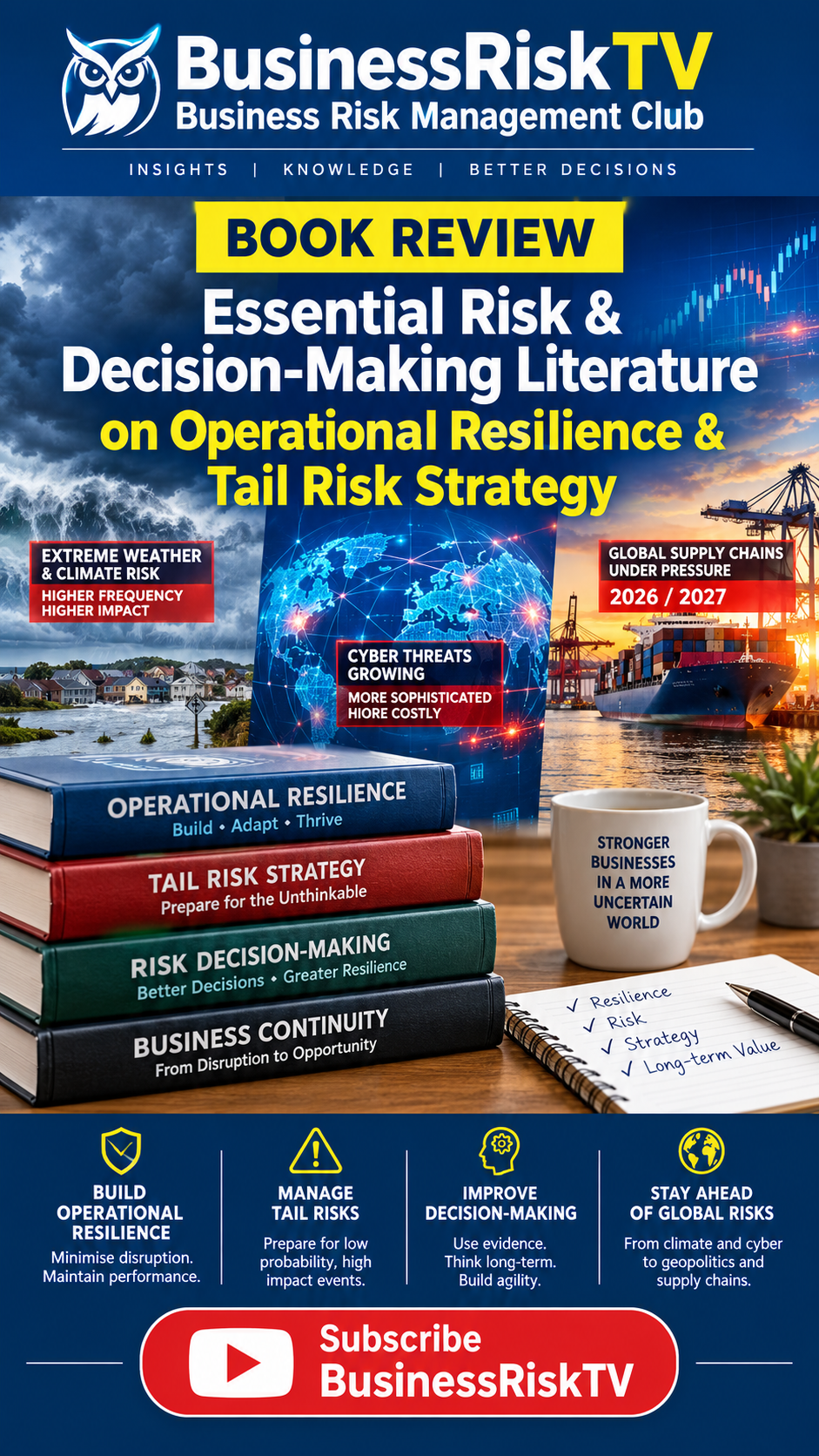
BusinessRiskTV Business Risk Management Club recommends these 3 books to help the reader make better decisions on Operational Resilience & Tail Risk Strategy.
That single sentence encapsulates why the following review exists. The scale of the problem is not theoretical. The Office for National Statistics reported that 40% of UK trading businesses with 10 or more employees cited economic uncertainty as the most significant challenge impacting turnover in early April 2026—the highest proportion since the question was introduced in April 2022. Government analysis of operational disruption across UK sectors shows that while typical incidents cost between 0.2% and 4.6% of annual turnover, tail events can dominate total losses and threaten business continuity entirely. Cyber-attacks alone cost UK businesses £3.7 billion in litigation over the past year, with shareholder lawsuits accounting for nearly a third of that total. Against this backdrop, Nassim Nicholas Taleb’s Incerto trilogy—Fooled by Randomness, The Black Swan, and Antifragile—provides the conceptual infrastructure that directors, project managers, and strategists need to navigate systemic uncertainties and cognitive bias in decision-making.
What Makes Nassim Nicholas Taleb’s Incerto Trilogy Essential Risk & Decision-Making Literature for Operational Resilience & Tail Risk Strategy?
Taleb’s Incerto trilogy is essential risk and decision-making literature for operational resilience and tail risk strategy because it systematically dismantles the illusions that lead organisations to underestimate rare, high-impact events and overestimate their ability to predict and control complex systems. The three books form a coherent progression: Fooled by Randomness (2001) exposes how humans mistake luck for skill; The Black Swan (2007) reveals how rare, unpredictable events shape history and markets; Antifragile (2012) offers a framework for building systems that benefit from disorder.
Why This Matters for Directors, Project Managers & Strategists:
- Directors face board-level decisions where governance failures linked to cognitive bias carry escalating legal and financial consequences. UK boards are already experiencing “quiet distress” as prolonged financial strain and delayed decisions create D&O exposure earlier in the risk cycle.
- Project managers operate at the intersection of uncertainty and delivery, often relying on linear projections and optimistic timelines that fail catastrophically when tail events hit. Research shows that organisations with structured decision trackers score more than 20 percentage points higher on early-warning indicator tracking and bias exploration than those without.
- Strategists build models that assume a stable future, yet the ONS Business Insights survey consistently shows economic uncertainty dominating business challenges month after month.
Each book serves a distinct function in the operational resilience toolkit. Together, they constitute a complete curriculum in probabilistic thinking, tail risk awareness, and adaptive system design.
What Is the Core Argument of Fooled by Randomness, and How Does It Apply to Business Decision-Making?
The core argument of Fooled by Randomness: The Hidden Role of Chance in Life and in the Markets is that humans systematically confuse randomness with causality, attributing success to skill and failure to controllable factors, thereby creating brittle decision-making frameworks that collapse when randomness reasserts itself. Taleb demonstrates that much of what passes for expertise in finance, management, and strategy is indistinguishable from luck dressed in the language of analysis.
Why This Matters Practically:
- Distinguish signal from noise in performance data. Taleb argues that short-term results are dominated by variance, not skill. When evaluating business unit performance or project outcomes, directors should demand longer time horizons and statistical significance testing before drawing conclusions. UK businesses reporting turnover decreases (27% in April 2026) and increases (15% in July) often attribute these swings to strategy or market conditions when random fluctuation may be the dominant driver.
- Identify survivorship bias in case studies. Business literature is filled with success stories of companies that “did everything right.” Taleb’s point is that we never see the graveyard of companies that did the same things and failed due to bad luck. Strategy teams should actively seek out failure cases and control groups.
- Resist the narrative fallacy in post-mortems. After any project, there is enormous pressure to construct a coherent story explaining outcomes. Taleb warns this narrative impulse prevents genuine learning.
Business Application:
Project managers should implement decision journals that record expectations before outcomes are known, creating a feedback loop that reveals whether success was skill or circumstance. Directors should push for probabilistic language in board papers—”we assess a 60% likelihood” rather than “we are confident”—forcing explicit recognition of uncertainty. Strategists should stress-test strategic plans against scenarios where random negative events cluster, rather than assuming they distribute evenly across time.
What Is the Central Thesis of The Black Swan, and Which Businesses Are Most Vulnerable to Its Implications?
The central thesis of The Black Swan: The Impact of the Highly Improbable is that rare, unpredictable, high-consequence events—Black Swans—dominate outcomes in complex systems, yet our psychological and institutional frameworks are systematically blind to their possibility, leaving businesses dangerously exposed to catastrophic surprise. Taleb identifies the “triplet of opacity”: the illusion of understanding, the retrospective distortion of events, and the overvaluation of factual information.
Which Businesses Are Most Vulnerable:
- Financial services firms face existential Black Swan exposure. Bank of England research shows 82% of UK banks, insurers and asset managers now cite cyber attacks as a top-five risk to the financial system, up ten percentage points from 2024. A meaningful share of large financial institutions face a roughly 10% annual probability of losing 10% or more of annual profit to a single cyber event.
- Supply chain-dependent manufacturers and retailers are directly exposed to geopolitical Black Swans. In April 2026, 47% of UK businesses experiencing global supply chain disruption cited the conflict in the Middle East as the reason—up 34 percentage points from February.
- Energy-intensive businesses face compounding tail risks from price volatility and geopolitical disruption. 60% of UK businesses reported concern about energy prices in early May 2026, with accommodation and food service businesses reaching 86% concern.
- Technology and digital businesses are exposed through cyber, regulatory, and concentration risk. The PRA’s 2026 operational resilience policy statement explicitly addresses “rising threats to operational resilience at firms and their growing reliance on externally supplied services”.
When to Use The Black Swan Learning Points:
- During strategy formation—to stress-test assumptions about the future rather than extrapolating from the recent past.
- During risk register reviews—to identify where the organisation has conflated “hasn’t happened yet” with “can’t happen.”
- During post-incident reviews—to avoid the retrospective distortion that makes Black Swans appear predictable after the fact.
- During investment decisions—to assess whether the organisation is exposed to ruin, not just underperformance.
Business Application:
Directors should establish dedicated tail risk committees that meet independently of standard risk reviews, focusing exclusively on low-probability, high-impact scenarios. Project managers should build “kill criteria” into major projects—pre-defined conditions under which the project is stopped—rather than assuming continuation. Strategists should model scenarios where multiple Black Swans occur simultaneously, recognising that disruptions cluster rather than distribute evenly.
What Does Antifragile Teach About Building Organisations That Improve Under Stress, and How Can This Be Implemented?
Antifragile: Things That Gain From Disorder teaches that some systems are not merely robust (resistant to shocks) or resilient (recovering after shocks), but antifragile—they actually improve, strengthen, and grow when exposed to volatility, randomness, and stressors. Taleb argues this property is the highest form of adaptation available to organisations, and it can be deliberately engineered through structural choices, incentive design, and optionality.
Key Antifragile Principles for Business:
- Barbell strategy: Combine extreme conservatism in core operations with aggressive, small-scale experimentation in growth areas. 75% of grant-funded UK charities use formal risk tools compared to 35% of non-grant-funded organisations, suggesting structured approaches enable greater risk capacity when combined with appropriate funding.
- Optionality over prediction: Rather than forecasting the future, build portfolios of options that benefit from multiple possible outcomes. This directly addresses the observation that economic uncertainty has been the most reported challenge affecting business turnover since October 2022.
- Skin in the game: Decision-makers must bear the consequences of their decisions. HM Treasury’s 2026 guidance to accounting officers frames value for money as a “balanced judgement of strategic alignment, long-term resilience, and risk,” moving beyond simple cost minimisation.
- Redundancy as investment: Duplicate systems, diversified suppliers, and cross-trained teams are not waste—they are the raw material of antifragility.
When to Apply Antifragile Learning Points:
- During organisational design—to build structures that benefit from uncertainty rather than merely surviving it.
- During supply chain strategy—to move from just-in-time efficiency to diversified, optionality-rich sourcing.
- During technology investment—to prioritise systems that learn from attacks and failures rather than merely resist them.
- During talent development—to cultivate teams comfortable with volatility and skilled at rapid adaptation.
Business Application:
Operations directors should conduct “stress tests with benefit”—scenarios where the organisation not only survives disruption but emerges stronger because competitors are weakened. For example, a manufacturer with diversified suppliers can gain market share when single-source competitors face disruption. Project managers should build rapid prototyping and learning loops into delivery schedules, treating small failures as information rather than stigma. Strategists should allocate a portion of capital to small, high-optionality bets that could pay off massively in Black Swan scenarios, while simultaneously reducing exposure to ruinous tail risks.
Which Businesses Will Benefit Most from Taleb’s Frameworks, and Where in the World Are They Likely Operating?
The businesses that will benefit most from Taleb’s frameworks are those operating in high-uncertainty, high-interconnection, and high-consequence environments—particularly in the UK, Europe, North America, and Asia-Pacific where regulatory pressure, geopolitical fragmentation, and technological disruption intersect.
Sector-by-Sector Analysis:
- Financial services in London, New York, Singapore, and Frankfurt face the most acute combination of regulatory scrutiny, cyber exposure, and tail risk concentration. The PRA’s PS7/26 operational resilience policy, effective from 2026, requires firms to report operational incidents and material third-party arrangements with significantly reduced burden but enhanced oversight. UK financial services compliance costs now exceed £33.9 billion annually, representing roughly 13% of average operating costs.
- Manufacturing and logistics across the UK, Germany, Netherlands, and key Asian hubs are directly exposed to supply chain Black Swans. The ONS reported 7% of UK businesses experiencing global supply chain disruption in April 2026, with nearly half citing Middle East conflict.
- Energy and utilities in the UK, Norway, Gulf states, and Australia face compounded tail risks from price volatility, geopolitical disruption, and transition uncertainty. 28% of UK businesses cited energy prices as a reason for considering raising prices in June 2026.
- Technology and digital platform businesses globally face cyber Black Swans, regulatory tail risks, and concentration risk. The Bank of England’s 2026 H1 Systemic Risk Survey found 82% of financial institutions citing cyber attacks as a top-five systemic risk.
- Healthcare and pharmaceutical supply chains across Europe, North America, and Asia are exposed to pandemic Black Swans, regulatory disruption, and geopolitical supply chain risk.
- Professional services firms advising on risk, strategy, and resilience are both beneficiaries (demand for their services grows) and exposed to reputational tail risks if they fail to apply these frameworks themselves.
Geographic Concentration:
- United Kingdom: Highest regulatory intensity for operational resilience, with FCA/PRA rules now in “steady-state” from 2026, enhanced regulatory powers, and cost recovery provisions.
- European Union: DORA (Digital Operational Resilience Act) in force across Europe, aligning with UK approaches but creating additional compliance complexity for cross-border firms.
- United States: Less prescriptive regulation but higher litigation and shareholder activism risk, particularly around cyber governance failures.
- Asia-Pacific: Rapid economic growth combined with geopolitical tension, supply chain concentration, and varying regulatory maturity creates a high-Black-Swan environment.
- Middle East and Africa: Geopolitical disruption, energy price volatility, and infrastructure risk create compounding tail exposure.
How Should Organisations Integrate Taleb’s Key Learning Points into Decision-Making to Boost Performance and Reduce Risk Events Derailing Business Objectives?
Organisations should integrate Taleb’s key learning points by embedding probabilistic thinking, tail risk assessment, and antifragile design principles into the governance, project management, and strategy functions at the point of decision, not as an afterthought. The evidence suggests this is not optional: UK business confidence dropped to a net figure of -76 in March 2026, compared to -63 in February, according to Institute of Directors research. Fewer businesses were set up in Q1 2026 than in any comparable period on record. The organisations that survive and thrive will be those that internalise Taleb’s lessons before the next Black Swan arrives.
Board-Level Integration:
- Establish a Tail Risk Committee reporting directly to the board, separate from the standard audit and risk committee, with a mandate to challenge assumptions of normality and identify ruin exposure.
- Require probabilistic decision papers: every significant capital allocation or strategic decision must include explicit probability assessments, not point forecasts.
- Implement decision journals that record expectations, rationale, and confidence levels before outcomes are known, reviewed quarterly to identify systematic biases.
Project Management Integration:
- Build kill criteria into every major project: pre-defined conditions under which the project is terminated, removing sunk-cost bias from continuation decisions.
- Apply barbell resource allocation: commit 80-90% of resources to high-confidence, low-variance delivery, and 10-20% to experimental, high-optionality initiatives that could benefit from disorder.
- Conduct pre-mortems at project initiation: assume the project has failed catastrophically and work backwards to identify causes.
Strategy Integration:
- Replace single-scenario planning with multiple scenarios including Black Swan scenarios where multiple disruptions compound.
- Develop antifragile supply chains with diversified sourcing, redundancy, and optionality—accepting higher baseline costs as insurance against tail events.
- Invest in optionality: maintain cash reserves, flexible contracts, and strategic options that can be exercised when volatility creates opportunity.
Operational Resilience Integration:
- Align with regulatory requirements proactively: the PRA’s operational resilience framework requires firms to remain within impact tolerances for important business services under severe but plausible disruption scenarios.
- Conduct regular stress tests that include cyber, geopolitical, and supply chain scenarios simultaneously, recognising that disruptions cluster.
- Measure resilience value not just as cost avoidance but as competitive advantage: government analysis shows that increased resilience reduces both the likelihood of severe outcomes and the scale of losses when disruption occurs.
When to Apply These Frameworks:
- Annually during strategy and budget cycles: full Black Swan scenario review and antifragile portfolio assessment.
- Quarterly during board risk reviews: tail risk exposure review and decision journal analysis.
- Monthly during project reviews: kill criteria assessment and pre-mortem updates.
- Continuously through operational monitoring: early-warning indicators and antifragile capacity metrics.
- Post-incident after any disruption: structured learning review applying Fooled by Randomness lessons about attribution.
Why Are These Books Particularly Relevant for Operational Resilience & Tail Risk Strategy in September 2026?
These books are particularly relevant in September 2026 because the operating environment has become precisely the kind of high-volatility, high-interconnection, high-consequence system that Taleb’s frameworks were designed to address. The ONS Business Insights survey for April 2026 showed economic uncertainty at 40% for larger businesses—the highest proportion since the question was introduced. Global supply chain disruption reached 9% in March 2026, the highest since December 2022. The PRA’s operational resilience rules are now in full effect, with “steady-state” expectations and enhanced regulatory powers to demand information, direct remediation, and recover supervisory costs. Bank of England analysis confirms that “average impacts are not representative of overall risk exposure” and that “tail events can dominate total losses and can threaten business continuity”.
Taleb’s trilogy provides the intellectual architecture to navigate this environment. Fooled by Randomness teaches the discipline of statistical scepticism. The Black Swan reveals the structural blind spots that make organisations vulnerable to rare events. Antifragile offers the design principles to build systems that improve under stress. Together, they constitute a complete risk literacy curriculum for directors, project managers, and strategists who need to make decisions when the future refuses to behave as forecast.
The value proposition is not merely defensive. Organisations that internalise these lessons will identify opportunities that competitors miss—in supply chain restructuring, in optionality-rich investment strategies, in resilient operational models that become competitive advantages when disruption hits. The question is not whether the next Black Swan will arrive, but whether your organisation will be fooled by randomness when it does.
#OperationalResilience #TailRiskStrategy
Get help to protect and grow your business faster with BusinessRiskTV
Find out more about growing your business faster with BusinessRiskTV Business Risk Management Club
Subscribe for free business risk management ideas risk reviews and business discounts to reduce your business cost of being in business
Connect with BusinessRiskTV for free business risk management tips
Read more business risk management articles and view videos for free
Connect with BusinessRiskTV for free alerts to new business risk management articles and videos
Most “resilient” UK businesses are just lucky. And 40% of larger UK firms just admitted economic uncertainty is beating them.
That’s not a vibe. That’s the ONS Business Insights survey, April 2026: 40% of UK trading businesses with 10+ employees cited economic uncertainty as the top challenge hitting turnover — the highest since the question began in April 2022.
So here’s the uncomfortable question: if your risk register still assumes the future looks like the last 5 years, what exactly are you protecting?
BusinessRiskTV Business Risk Management Club recommends these books to help the reader make better decisions on Operational Resilience & Tail Risk Strategy.
Keep reading — because the third book is the one that changes how you allocate capital.
There are 3 books that do more for operational resilience than most 40-page board packs:
1. Fooled by Randomness — Nassim Nicholas Taleb
It asks: how much of your “performance” is skill, and how much is luck?
If UK businesses swing from 27% reporting turnover decreases to 15% reporting increases in a matter of months, how much of that is strategy — and how much is noise?
Most post-mortems invent a story. Taleb shows you why that story is usually wrong.
2. The Black Swan — Nassim Nicholas Taleb
It asks: what rare event would wipe out the plan?
82% of UK banks, insurers and asset managers now cite cyber attacks as a top-five risk to the financial system, per Bank of England H1 2026 research.
47% of UK businesses hit by global supply chain disruption in April 2026 blamed the Middle East conflict — up 34 percentage points from February.
Cyber-attacks cost UK businesses £3.7bn in litigation over the past year.
That’s not a tail risk. That’s a board-level blind spot.
Wait — here’s the counterintuitive part.
3. Antifragile — Nassim Nicholas Taleb
It asks: what gets stronger when stressed?
Not “robust.” Not “resilient.” Antifragile.
The PRA’s 2026 operational resilience policy puts firms in “steady-state” with enhanced powers to demand information, direct remediation and recover supervisory costs.
UK financial services compliance costs now exceed £33.9bn a year — roughly 13% of average operating costs.
If you’re spending that much on defence, Taleb’s barbell strategy is the difference between surviving volatility and profiting from it.
Here’s the 3-question test most teams never run:
- What would actually ruin us — not just hurt quarterly earnings?
- What looks like skill but is statistically indistinguishable from luck?
- What part of the business gets stronger when suppliers fail, cyber hits, or energy spikes?
If you can’t answer those three with specific numbers and named owners, you don’t have a tail risk strategy. You have a hope strategy!
Directors, project managers and strategists: this is why these books matter now. Not in theory. In capital allocation, kill criteria, supplier diversification, decision journals and pre-mortems.
Email editor@businessrisktv.com with the subject line TALEB 3 and tell me which of the three books your board needs to read first.
Featured Books
As an Amazon Associate I earn from qualifying purchases.
Which 3 Nassim Taleb Books Should Directors Read for Tail Risk & Operational Resilience in 2026?
