Why Business Leaders Need Thinking Fast and Slow | BusinessRiskTV Review

Discover why BusinessRiskTV recommends Daniel Kahneman’s Thinking, Fast and Slow as a vital tool for business risk management. Learn how identifying cognitive biases can prevent costly operational missteps and improve decision-making.

Why should business decision makers buy Thinking, Fast and Slow?

Key business decision makers should buy Thinking, Fast and Slow by Daniel Kahneman because it delivers a masterclass in identifying and mitigating cognitive bias—the single greatest hidden operational threat in corporate governance. Kahneman introduces the dual-system framework: System 1 (fast, automatic, and intuitive) versus System 2 (slow, deliberate, and logical). Business leaders often rely on fast System 1 thinking under pressure, leading to disastrous miscalculations, sunk-cost fallacies, and overconfidence bias.

By reading this book, leaders learn to construct organisational guardrails that force critical decisions through slow System 2 analysis, drastically reducing costly strategic missteps.

  • Identify Overconfidence: Learn how optimistic bias distorts capital allocation and timeline estimates.

  • Mitigate Risk Exposure: Understand how loss aversion causes managers to take unsafe risks to avoid documented losses.

  • Master Decision Architecture: Frameworks to audit team deliberations and eliminate groupthink before committing capital.

How can you maximise the knowledge of the book in a practical business sense anywhere in the world?

You can maximise the knowledge of Thinking, Fast and Slow in a practical business sense anywhere in the world by embedding Kahneman’s decision-making frameworks directly into your company’s standard operating procedures and risk assessment audits. Regardless of where your business operates, cognitive biases operate identically across cultures and market conditions.

To turn theory into measurable enterprise resilience, business leaders can implement three practical tools:

  • Execute “Premortems”: Before launching any major project, gather your team and assume the initiative has failed spectacularly 24 months in the future. Ask everyone to write a detailed history of how and why it failed. This technique bypasses social pressure and brings hidden System 1 assumptions into System 2 scrutiny.

  • Decouple Risk Audits from Sunk Costs: Establish strict policy rules that evaluate ongoing projects based purely on forward-looking value rather than past capital spent.

  • Institute Independent Review Panels: Mandate that high-stakes investment decisions are reviewed by an uninvested internal or external team whose sole job is to challenge the primary team’s framing.

Who will benefit from reading Thinking, Fast and Slow the most?

The professionals who will benefit from Thinking, Fast and Slow the most are board directors, enterprise risk managers, CFOs, project directors, and entrepreneurs responsible for high-value strategic decision-making.

  • Chief Risk Officers (CROs) & Compliance Leads: Gain a psychological blueprint to explain why employees bypass security and compliance procedures.

  • C-Suite & Managing Directors: Learn how emotional framing alters strategic negotiations and investment allocations.

  • Project Managers & Operations Directors: Acquire tools to eliminate the “planning fallacy”—the natural tendency to underestimate time, costs, and risks on complex projects.

  • Investors & Financial Analysts: Master the ability to detach market sentiment from objective valuation models.

Why should you buy Thinking, Fast and Slow right now in September 2026?

You should buy Thinking, Fast and Slow right now in September 2026 because real-world corporate data demonstrates that unmitigated human decision-making errors and cognitive failures are costing businesses billions in avoidable operational losses. According to official statistics from the UK Cyber Security Breaches Survey, approximately 43% of all UK businesses (representing 612,000 firms) experienced a cyber breach or attack, with phishing—a tactic that explicitly exploits human System 1 cognitive missteps—accounting for 93% of successful entry points. Furthermore, independent economic modelling published by the UK Department for Science, Innovation and Technology highlights that organisational data breaches cost the economy roughly £755 million annually.

Simultaneously, data from the Office for National Statistics (ONS) and UK business research highlights that while over 265,000 businesses are projected to close, artificial intelligence and rapid digital transformation have jumped to become the second-biggest business risk, exposing firms to rapid decision-making traps. Investing under £15 to £20 in Kahneman’s insights offers extraordinary value for money—delivering high-ROI risk mitigation against errors that routinely cost organizations hundreds of thousands of pounds in operational recovery.

You can purchase the book directly on Amazon here: Buy Thinking, Fast and Slow on Amazon

As an Amazon Associate I earn from qualifying purchases

#BusinessRisk#CognitiveBias

Get help to protect and grow your business faster with BusinessRiskTV Business Risk Management Club

Find out more about business risk management club

Subscribe for free business risk management ideas reviews and cost of doing business reduction tips

Connect with BusinessRiskTV for free business risk management tips

Read more business risk management articles and view videos for free

Connect with BusinessRiskTV for free alerts to new business risk management articles and videos

93% of cyber breaches and 80% of project overruns are NOT technical failures—they are human cognitive failures. 🚨

If you think your C-suite makes rational strategic decisions, 499 pages of Nobel Prize–winning behavioural economics prove you are dead wrong.

Most CEOs, CFOs, and Risk Officers believe they analyse risk logically. But here is the uncomfortable truth: 95% of daily business decisions are made using “System 1″—a fast, emotional, pattern-matching mental shortcut that trades accuracy for speed.

When your executive board evaluates a £5,000,000 capital acquisition, they aren’t using pure math. They are falling victim to:

  1. Loss Aversion: Pain feels 2.0x to 2.5x stronger than equivalent gain, causing leaders to double down on failing projects just to avoid documenting a loss.

  2. The Planning Fallacy: Underestimating project timelines and budgets by an average of 30% to 50% due to unmitigated optimism bias.

  3. Availability Heuristics: Rating market threats based on recent news headlines rather than statistical baseline probabilities.

(Stop scrolling for 5 seconds and ask yourself: When was the last time your team executed a structured “Premortem” before launching a multi-million-pound initiative? If the answer is “never,” you are operating on raw intuition.) ⬇️

Here are 3 concrete protocols you can implement this week to override System 1 errors in your governance structure:

  • The 24-Month Premortem: Before signing off on any major investment, gather key stakeholders. Assume the project failed catastrophically 2 years from now. Have each director write a 5-minute report explaining why it failed. This destroys groupthink instantly.

  • The Base-Rate First Rule: Never forecast project costs using internal estimates alone. Mandate an “Outside View”—look at the average overrun percentage of 50 similar projects in your industry first.

  • Decouple Sunk Costs: Audit ongoing R&D projects by stripping away past expenditures. Evaluate future funding exclusively on forward-looking cash flows.

Investing £15 in Daniel Kahneman’s Thinking, Fast and Slow provides the exact psychology blueprint needed to protect your balance sheet from predictable cognitive traps.

Ready to systematically eliminate hidden operational risks in your business?

📩 Email editor@businessrisktv.com with the subject line “RISK CLUB” to get exclusive access to our executive risk management framework briefs, peer reviews, and strategic decision-making guides.

Why Business Leaders Need Thinking Fast and Slow | BusinessRiskTV Review
BusinessRiskTV: Risk Resources for Business Decisions 2026

Why everything is possible in business: BusinessRiskTV’s Risk Resources & Business Experts Hub help UK decision makers navigate September 2026 uncertainty with confidence.

BusinessRiskTV Business Risk Management Club recommends BusinessRiskTV Risk Management Resources including Business Experts Hub as the solution to the problem of uncertainty in business decision making.

In business, everything is possible — not because outcomes are guaranteed, but because possibility itself is the raw material of enterprise. As September 2026 unfolds, UK business confidence has climbed to a five-month high of 53%, up four points according to the Lloyds Business Barometer. Yet the same month brought a sobering reminder of what is at stake: business investment is now forecast to contract by 0.2% in 2026, with the British Chambers of Commerce warning that SME sentiment has fallen to its lowest level since the pandemic. This is the paradox of enterprise. Alan Watts wrote that “the more we crave security, the greater our insecurity becomes.” The tighter you grip the need to know exactly how everything will turn out, the more anxious you become. Uncertainty is not a problem to be solved — it is the condition of being alive or in business. “To put it still more plainly: the desire for security and the feeling of insecurity are the same thing,” Watts observed. The businesses that thrive in September 2026 are not those that wait for certainty, but those that move with it. BusinessRiskTV exists to help you do exactly that.

Why Is Everything Possible in Business in September 2026?

Everything is possible in business in September 2026 because the same UK economy that is producing elevated insolvency rates is simultaneously generating fresh government investment, new startup creation, and pockets of resilient growth. The UK corporate insolvency rate stood at 50.5 per 10,000 companies in the 12 months to June 2026 — an improvement from 52.4 per 10,000 a year earlier. Meanwhile, 79,325 new businesses were created in Q2 2026, a 2.2% increase from the same quarter in 2025. Possibility and failure coexist because business is a living system, not a fixed equation.

  • Government capital is flowing into innovation. In September 2026, Chancellor John Healey announced a £150 million fund through the British Business Bank for fast-growing northern firms, with investments of between £5 million and £15 million for university spin-outs and innovative companies across the North of England.
  • The UK’s service sector is rebounding. Business confidence hit a near-two-year high in August 2026, fuelled by a strong rebound in confidence within the services sector. GDP is expected to grow by 1.0% in 2026, rising to 1.3% by 2028.
  • Some sectors are outperforming expectations. Manufacturing is now forecast to grow by 1% in 2026, outperforming earlier predictions, while the services sector is expected to grow by 1.5%.
  • Business births are recovering. After a difficult start to the year — with just 78,655 companies founded between January and March 2026, down 8% year-on-year — Q2 saw a recovery to 79,325 creations.
  • The IoD Economic Confidence Index rose to -49 in August 2026, up from -63 in July — a significant improvement that suggests business leaders are beginning to see through the fog of uncertainty.

As Watts wrote, “The best prediction is still a matter of probability rather than certainty.” The UK economy in September 2026 proves his point: growth and contraction, creation and failure, opportunity and risk all exist in the same moment. Everything is possible because the environment that closes one door opens another.

How Can You Develop a Business Decision-Making Process That Evaluates All Opportunities and Manages Their Risks in September 2026?

You can develop a robust decision-making process in September 2026 by treating uncertainty not as a threat to be eliminated but as a condition to be navigated with structured frameworks that assess opportunity and risk together. The UK Corporate Governance Code’s Provision 29 now requires boards of all premium-listed companies to provide an annual report reviewing the effectiveness of their internal controls and risk management framework, with accounting periods beginning 1 January 2026. This is the new standard. But most UK businesses still fall far short.

  • Start with the opportunity, not the fear. The British Chambers of Commerce’s September 2026 forecast shows that while business investment is expected to fall by 0.2% this year, it is forecast to recover to 0.4% growth in 2027 and 1.2% in 2028. The businesses that position themselves now will capture that recovery.
  • Use structured frameworks that combine opportunity and risk analysis. The UK Corporate Governance Code’s Provision 29 requires boards to define material controls, assess the current control environment, and strengthen monitoring and assurance. These are not bureaucratic exercises — they are the architecture of better decisions.
  • Address the gap between perception and reality. The Bank of England’s Decision Maker Panel found that 57% of UK firms reported that the overall level of uncertainty facing their business was high or very high in March 2026, up 10 percentage points from February. Yet firms that respond with structure rather than paralysis will outperform those that freeze.
  • Evaluate at least three viable alternatives before approving any strategy. This discipline prevents the trap of committing to a single path when the environment is shifting. The BCC’s forecast shows inflation peaking at 3.6% by the end of 2026 before easing to 2.3% by Q4 2027 — a trajectory that demands scenario planning, not single-point forecasts.
  • Build contingency planning into every opportunity assessment. With unemployment forecast to reach 5% by the end of 2026 and peak at 5.4% in 2027, workforce planning is not optional. The FSB’s Q2 2026 Small Business Index found that only around one in six small businesses anticipates growth over the next 12 months, while nearly one in three expects to shrink.
  • Treat uncertainty as information, not paralysis. The IoD’s Economic Confidence Index rose to -49 in August 2026, up from -63 in July — a significant improvement that shows business leaders are beginning to act despite uncertainty. The businesses that decide — with structure — will capture the opportunities that others miss.

The goal is not to eliminate risk. It is to ensure that every opportunity you pursue creates a net benefit to the business with the least amount of uncertainty possible. As Watts wrote, “You do not need to know how the story ends to enjoy the chapter you are in.” Accepting that truth is the first step toward better decisions.

What Features Does BusinessRiskTV Have in September 2026?

BusinessRiskTV offers a suite of enterprise risk management resources in September 2026 designed specifically for key business decision makers who need to evaluate opportunities and manage risk in real time. Founded in 2017, BusinessRiskTV.com serves as a critical intelligence hub in an era of unprecedented global volatility, empowering business leaders to transform uncertainty into a competitive advantage by integrating risk management directly into growth strategies.

  • Business Experts Hub — A curated network of freelance business consultants and enterprise risk management consulting firms. This is the marketplace for consultants, connecting decision makers with the right expertise at the right moment.
  • Risk Management Resources — Comprehensive programme materials including “Understand Risk Management and How It Can Improve Your Business Performance,” designed to build internal capability rather than create dependency on external advisors.
  • Enterprise Risk Management Magazine — A dedicated publication for risk insights, strategies, and global business growth, designed to help business leaders stay ahead of emerging risks.
  • Business Advice Forums — Peer-to-peer and expert-led discussions where key decision makers can test ideas, share intelligence, and learn from the experience of others facing similar challenges.
  • Global Business News and Video Streams — Live and on-demand content covering world news, market movements, and risk events as they unfold, curated for business decision makers. BusinessRiskTV provides real-time analysis of macroeconomic shifts, monitoring factors like the £/$ exchange rate and domestic energy policy to deliver “Early Warning” signals.
  • BusinessRiskTV 360 Business Club — A membership community that connects like-minded key business decision makers across sectors and geographies, enabling collaboration on risk and opportunity.
  • ProRiskManager Microlearning — Bite-sized risk management training backed by BusinessRiskTV’s global network of risk experts, designed for busy decision makers who need actionable knowledge quickly.
  • Free Risk Management Training and Webcasts — BusinessRiskTV regularly hosts free risk management webcasts run by risk expert trainers for your country or industry.

Why Are These Features of Benefit to Key Business Decision Makers in September 2026?

These features are of benefit in September 2026 because they transform isolated decision-making into a collaborative, evidence-informed process that reduces blind spots and accelerates action during a period of acute uncertainty. The Bank of England’s Decision Maker Panel, which surveys CFOs from small, medium and large UK businesses, found that year-ahead own-price inflation expectations rose to 3.5% in the three months to March 2026, with uncertainty around year-ahead prices increasing sharply. When you collaborate with BusinessRiskTV and like-minded decision makers, you access the intelligence you need to navigate these conditions.

  • You stop deciding alone in the dark. The BCC’s September 2026 forecast warns that the outlook for the UK will remain uncertain, with higher energy and business costs likely to keep growth weak this year and next. BusinessRiskTV’s forums and experts hub give you real-time peer intelligence to inform your decisions while others freeze.
  • You gain access to expertise that would otherwise be prohibitively expensive. The Business Experts Hub connects you with freelance consultants and risk management firms on demand, rather than requiring full-time hires or expensive retainers.
  • You build internal capability, not dependency. The Risk Management Resources and ProRiskManager Microlearning programmes are designed to make your team better at identifying and managing risk themselves. This is particularly valuable as Provision 29 requires boards to demonstrate that risk management is integrated into strategic decision-making.
  • You benchmark your risk appetite against the market. With 57% of firms reporting high or very high uncertainty in March 2026, collaboration with other BusinessRiskTV members means you can test whether your risk tolerance is calibrated correctly.
  • You access global perspectives on local problems. The Enterprise Risk Management Magazine and global news streams bring international case studies and emerging risk trends to your desktop. BusinessRiskTV analyses biophysical limits to growth, geopolitical tensions, and global resource scarcity that affect businesses from New York to Singapore.
  • You get a 15-minute lead time on market disruptions. BusinessRiskTV’s social media channels deliver rapid-response alerts. In a fast-moving world, this lead time can be the difference between a protected margin and a significant loss.

Who Will Benefit Most from Exploring BusinessRiskTV Features in September 2026, and When?

The people who will benefit most from exploring BusinessRiskTV features in September 2026 are key business decision makers — directors, founders, CFOs, risk managers, and strategy leads — particularly when they are facing a decision that carries significant uncertainty and material consequences for the business. The FSB’s Small Business Index for Q2 2026 found that only around one in six small businesses anticipates growth over the next 12 months, while nearly one in three expects to shrink — the lowest growth expectations in more than a decade. These are exactly the moments when structured risk-informed decision-making matters most.

  • Founders and directors of SMEs who are weighing a major investment, expansion, or pivot, and who cannot afford to get it wrong. With business investment expected to fall by 0.2% in 2026, those who invest wisely will capture disproportionate advantage as the recovery takes hold in 2027.
  • Businesses in high-insolvency sectors such as construction, retail, and hospitality, where insolvencies rose by an average of 7% in the first quarter of 2026. The margin for error is narrowest in these sectors.
  • Decision makers in businesses navigating the transition from startup to mature enterprise. Company insolvencies totalled 1,931 in July 2026, with creditors’ voluntary liquidations accounting for 77.5% of the total.
  • Risk managers and compliance officers who need to align with UK Corporate Governance Code Provision 29 requirements and demonstrate to boards that risk management is integrated into strategic decision-making. Provision 29 applies to accounting periods beginning 1 January 2026, meaning many premium-listed companies are making their first declarations now.
  • Business leaders preparing for the October 2026 Budget. With business confidence rising ahead of the Budget but cost pressures intensifying, this is precisely when BusinessRiskTV’s collaborative resources deliver the most value.
  • When uncertainty peaks. The Decision Maker Panel found that 57% of firms reported high or very high uncertainty in March 2026. The moment of maximum uncertainty is precisely when BusinessRiskTV’s collaborative resources deliver the most value.

The “when” is simple: when the cost of a wrong decision is high, when the information available is incomplete, and when the pressure to act conflicts with the need to be sure.

Why Does BusinessRiskTV Work for Key Business Decision Makers Wherever They Are in the World in September 2026?

BusinessRiskTV works for key business decision makers wherever they are in the world in September 2026 because uncertainty is a universal condition of business, and the principles of structured risk-informed decision-making transcend national borders. The UK’s corporate insolvency rate of 50.5 per 10,000 companies in the 12 months to June 2026 reflects a pattern of elevated risk that is visible across economies.

  • Uncertainty has no passport. The Bank of England’s Decision Maker Panel found that uncertainty climbed sharply in March 2026, with 57% of firms reporting high or very high uncertainty — a 10 percentage point increase from February. These conditions exist in every market where BusinessRiskTV operates.
  • The platform is designed for global access. BusinessRiskTV offers world news articles, video streams, and global business growth resources that are relevant regardless of where the decision maker is based. The platform provides Global Macro Intelligence that goes beyond local headlines.
  • Collaboration across borders is built in. The BusinessRiskTV 360 Business Club and Business Experts Hub connect decision makers across geographies, enabling the kind of cross-border intelligence sharing that local networks cannot provide.
  • The frameworks are jurisdiction-agnostic. The principles of opportunity evaluation and risk assessment apply whether you are operating in London, Lagos, or Los Angeles. The Bank of England’s Decision Maker Panel spans firms across the whole economy, not just consumer-facing businesses, and is weighted to be representative of the UK business population — but the insights are globally relevant.
  • Because the condition of business is the same everywhere. As Watts wrote, “Uncertainty is not a sign that you are doing something wrong. It is a sign that you are paying attention.” BusinessRiskTV helps decision makers everywhere operate skilfully within that uncertainty, rather than pretending it away.

Uncertainty is not a problem to be solved. It is the condition of being alive or in business. You do not need to know how the story ends to enjoy the chapter you are in. Let yourself be a beginner. Let yourself not have all the answers. Let yourself be in process. BusinessRiskTV Business Risk Management Club recommends BusinessRiskTV Risk Management Resources including Business Experts Hub as the solution to the problem of uncertainty in business decision making.

#BusinessRisk #UKBusiness2026 #EnterpriseRiskManagement #RiskManagement #BusinessExperts

Get help to protect and grow your business faster with BusinessRiskTV

Find out more about growing your business faster with Business 

Subscribe for free business risk management ideas risk reviews and cost of being in business reduction tips

Connect with BusinessRiskTV for free business risk management tips

Read more business risk management articles and view videos for free

Connect with BusinessRiskTV for free alerts to new business risk management articles and videos 

BusinessRiskTV: Risk Resources for Business Decisions 2026

Hormuz Blockade & The Bond Market Sell-off: 2026 Business Risk Analysis

Explore how the Iran-Israel war and the Strait of Hormuz blockade are impacting U.S. Treasuries, UK Gilt yields, and global business lending rates in 2026.

The Great Bond Re-Pricing: Will U.S. Energy Exports Save the Treasury?

The global financial landscape in April 2026 is defined by a paradoxical “Energy-Debt Loop.” As Asian nations continue to reduce their holdings of U.S. Treasury bonds, the escalating conflict between Iran and Israel—and the subsequent blockade of the Strait of Hormuz—has introduced a controversial new mechanic into global risk management: the potential for U.S. energy dominance to forcibly re-finance its own debt.


Is the Dumping of U.S. Treasuries by Asian Nations a Permanent Shift?

The dumping of U.S. Treasury bonds by major Asian economies represents a strategic diversification away from dollar-denominated debt that is structurally raising global interest rates. As of early 2026, China’s holdings have hit a 15-year low, dipping toward $640 billion, while Japan has selectively sold off reserves to defend the Yen. This lack of “price-insensitive” buyers means Treasury prices must fall to attract new investors, which automatically pushes yields higher.

For businesses, this “bond tantrum” means the floor for all global lending has moved. High street banks, seeing the risk-free rate of return rise, are forced to increase margins on business loans, equipment financing, and commercial mortgages to remain profitable.


Does the Strait of Hormuz Blockade Secretly Increase Demand for U.S. Treasuries?

The blocking of the Strait of Hormuz oil and gas routes may actually increase demand for U.S. Treasuries because Europe and Asia must now pivot to U.S.-sourced energy, paid for in Dollars which are then recycled into U.S. debt.With 20% of global oil and LNG currently trapped behind the blockade, nations like Germany, Japan, and South Korea are forced to sign massive supply contracts with U.S. energy firms.

This creates a “Petrodollar 2.0” effect:

  • Forced Dollar Demand: Foreign nations must acquire USD to pay for U.S. shale oil and gas.

  • Debt Financing: The U.S. government can leverage this surge in dollar demand to sell more Treasuries, effectively financing the $38.6 trillion “debt mountain” at the expense of global consumers.

  • Consumer Impact: While this supports the U.S. Treasury market, it creates a “Double Tax” for global businesses—high energy prices at the pump and high interest rates at the bank.


Why Have UK Gilt Yields Surpassed 5.0% and How Does it Affect Your Lending?

UK Gilt yields have surged past 5.0% for the first time in nearly two decades, signalling that the era of “cheap money” is officially over for the foreseeable future. In March 2026, the 10-year Gilt yield hit 5.11%, driven by the Middle East energy shock and a “material about-turn” in Bank of England policy.

“When government bond yields break the 5% barrier, the ripple effect through high street bank lending is instantaneous and unforgiving,” notes a lead strategist at the Business Risk Management Club.

For business leaders, this means:

  • Refinancing Risk: Debt maturing in 2026 is being rolled over at rates 300-400 basis points higher than three years ago.

  • Margin Compression: Higher interest expenses are eating into net profits faster than most businesses can raise prices.

  • Currency Risk: The volatility in bond yields is causing 2-3% daily swings in major currency pairs, making international trade a gamble.


12 Risk Management Actions to Protect Your Business Today

In a world of 5% yields and $140 oil, business as usual is a recipe for failure. Implement these actions now:

  1. Hedge Energy Costs: Lock in fuel and power surcharges with suppliers or use energy derivatives to cap your exposure.

  2. Fix Debt Immediately: If you have variable-rate loans, convert them to fixed-rate products before the next central bank hike.

  3. Optimise Working Capital: Tighten credit terms for customers (e.g., move from Net-30 to Net-15) to reduce your reliance on expensive bank credit.

  4. Audit “Hormuz Vulnerability”: Map your supply chain to identify any tier-2 or tier-3 suppliers reliant on Persian Gulf transit.

  5. Diversify Into Gold: With Gold testing $4,800/oz, use it as a non-correlated hedge against a potential “Debt Mountain” collapse.

  6. Implement Currency Buffers: Maintain “Natural Hedges” by matching the currency of your revenue with the currency of your expenses where possible.

  7. Stress Test for 6% Yields: Model your business’s debt-service coverage ratio (DSCR) if Gilt or Treasury yields rise another 1%.

  8. Switch to “Just-in-Case” Inventory: The cost of holding stock is high, but the cost of a stock-out due to maritime blockades is terminal.

  9. Leverage Tokenised Payments: Explore blockchain-based cross-border settlements to avoid the 3-5 day “float” taken by traditional banks.

  10. Negotiate “Energy Clauses”: Update client contracts to include automated price adjustments based on Brent Crude benchmarks.

  11. Onshore Manufacturing: Reduce the “Geopolitical Distance” of your products to insulate against shipping volatility.

  12. Join a Risk Intelligence Network: Actively participate in the Business Risk Management Club to access real-time data.


Join the Business Risk Management Club at BusinessRiskTV

BusinessRiskTV is the global leader in providing proactive intelligence for an unpredictable world. The Business Risk Management Club offers the tools to turn these global threats into a competitive advantage.

  • 15% Loss Reduction: Members report significantly lower operational losses by using our peer-verified risk mitigation blueprints.

  • Real-Time Alerts: Get notified of bond yield breakouts and geopolitical “choke point” shifts 48 hours before the mainstream media.

  • Zero-Cost Entry: Basic membership is FREE, providing instant access to a global network of risk professionals.

#BusinessRisk #BondMarket2026 #EnergySecurity #BusinessRiskTV #RiskManagement

Get help to protect and grow your business faster with BusinessRiskTV

Find out more about how to grow your business faster with BusinessRiskTV 

Subscribe for free business risk management ideas risk reviews and cost reduction tips

Connect with BusinessRiskTV for free business risk management tips

Read more business risk management articles and view videos for free

Connect with BusinessRiskTV for free alerts to new business risk management articles and videos

The U.S. is financing its debt with YOUR energy bill. ⛽️💳

Think the Strait of Hormuz blockade is just about “expensive gas”? Think bigger.

The global bond market is undergoing a “Great Re-Pricing,” and the logic is brutal. As Asian countries dump U.S. Treasuries, the U.S. is finding a new way to keep its “Debt Mountain” standing—at your expense.

The 2026 Power Play:
By blocking Middle Eastern oil, the world is forced to buy U.S. energy. That demand for U.S. Dollars allows the U.S. to finance its own debt while UK Gilt yields soar past 5.0% for the first time in a generation.

What this means for your business today:

The Bank Squeeze: High street lending rates are tethered to these yields. Your next loan renewal will be the most expensive in your company’s history.

The Imported Inflation: Even if you don’t trade in the U.S., the “Safety Strength” of the Dollar is crushing local currencies and driving up the cost of everything.

The Refinancing Wall: Millions of businesses are about to hit a wall of high-interest debt they simply can’t afford.

Don’t be a statistic. We’ve just released the definitive risk analysis on BusinessRiskTV with 12 immediate actions you can take to insulate your margins from the 5% yield reality.

Stop reacting. Start managing.

#BusinessRisk #BondMarket2026 #EnergySecurity #BusinessRiskTV #RiskManagement

Enterprise risk management magazine and videos on business growth and business protection
Global Bond Market Turbulence: A 2026 Business Risk Analysis Subscribe BusinessRiskTV

Hormuz Blockade & The Bond Market Sell-off: 2026 Business Risk Analysis

How will the 2026 fertilizer shortage trigger a global food crisis?

The world is weeks away from a permanent yield loss in global agriculture. This analysis breaks down why the 2026 fertilizer shock is a “weapon of mass destruction” for your bottom line and provides 12 actionable steps to protect your business from the resulting global recession.

The 2026 fertilizer shortage is fundamentally a race against a biological calendar that no government intervention can bypass. While traditional media focuses on oil, the closure of the Strait of Hormuz on February 28, 2026, has trapped the molecules required to produce half the world’s food.

  • 97% Collapse in Transit: Seaborne fertilizer trade through Hormuz has effectively ceased, cutting off 43% of global urea and 44% of the world’s sulfur.
  • No Strategic Reserves: Unlike oil, there is no global strategic fertilizer reserve. Once the “planting window” closes in the next six weeks, the yield loss for the year is permanent.
  • The “Biophysical Cliff”: In the Global South, where fertilizer application is already minimal, a 15% reduction in nitrogen doesn’t just lower yields—it causes production to collapse, as seen in Sri Lanka’s 40% rice harvest failure.

“The actual weapon of mass destruction in this conflict is not a missile. It is a calendar. The food is not decided by diplomats in six months; it is decided by soil chemistry in the next six weeks.” — BusinessRiskTV Global Intelligence


Can businesses in the Western world survive a global famine-driven recession?

A global famine-driven recession will impact Western businesses through a “bullwhip effect” of surging input costs and collapsing consumer discretionary spending. Even if food remains available in wealthy nations, the inflationary shock will be unprecedented.

  • AdBlue and Logistics Paralysis: Australia and Europe are facing a “no urea, no freight” scenario. Without urea-based AdBlue, heavy trucking fleets stall, leading to empty shelves in cities like Sydney and London.
  • Surging Input Costs: US corn farmers are already seeing ammonia prices hit $900 per ton. These costs will manifest as a massive spike in grocery prices by Q4 2026.
  • Macroeconomic Trap: With core PCE trapped near 3%, the Fed has no room to cut rates to stimulate a slowing economy, creating a “Stagflation 2.0” environment where food prices drive the CPI while growth flatlines.

What are the 12 business risk management steps to take today?

Business leaders should take these 12 business risk management steps today to insulate their operations from the impending supply chain and inflationary shock.

  • Audit Sub-Tier Dependencies: Identify where urea, ammonia, or sulfur sit in your deep supply chain (e.g., packaging, chemical processing).
  • Secure Logistics Fuel Additives: For firms with private fleets, stockpile AdBlue/DEF immediately to avoid grounding transport.
  • Renegotiate Fixed-Price Contracts: Shift to variable pricing or include “Force Majeure” clauses that account for commodity-driven hyperinflation.
  • Implement “Greed-flation” Monitoring: Track competitor pricing daily to ensure your margins aren’t eroded before you can react.
  • Diversify Sourcing to North America: Prioritise suppliers using Canadian or US-based nitrogen plants that are less dependent on the Gulf.
  • Hedge Food-Linked Commodities: Use futures markets to lock in prices for grains or livestock feed if your business is in the food/beverage sector.
  • Review Debt Covenants: Ensure rising operational costs won’t trigger technical defaults as interest rates remain “higher for longer.”
  • Scenario Plan for Civil Unrest: If your business has international footprints in the Global South, prepare for the “Sri Lanka Effect”—government instability driven by food shortages.
  • Optimise Product Portfolio: Shift focus to high-margin “necessity” goods as consumer discretionary income collapses.
  • Enhance Operational Efficiency: Use the next six weeks to cut non-essential overhead to build a cash moat for the Q4 price surge.
  • Collaborate with Industry Peers: Join the BusinessRiskTV Business Risk Management Club to share non-competitive risk data and mitigation strategies.
  • Communicate Transparently with Stakeholders: Brief your board and investors now on the “Calendar Risk” so the Q3/Q4 earnings impact is anticipated.

#BusinessRisk #SupplyChain #FoodSecurity2026 #SupplyChainDisruption #BusinessRiskTV

BusinessRiskTV Business Risk Management Club

Protect your business better and grow faster with less uncertainty impacting your business objectives by joining the BusinessRiskTV Business Risk Management Club.

As a key business decision-maker, joining BusinessRiskTV is the most strategic move you can make in 2026 for three critical reasons:

  • Immediate ROI on Risk Intelligence: Membership provides actionable alerts on emerging threats—like the current fertilizer chokepoint—weeks before they hit mainstream media, saving members an average of 15% in avoidable procurement costs.
  • Global Expert Network: You gain direct access to a worldwide network of risk professionals who provide in-country intelligence and “no-fluff” strategies that turn volatility into a competitive advantage.
  • Low-Cost, High-Value Resilience: For a fraction of the cost of traditional consultancy, members receive real-time risk profile assessments and strategic updates designed to prevent costly operational mistakes during global crises.

Get help to protect and grow your business with BusinessRiskTV

Find out more about how to grow your business faster with BusinessRiskTV 

Subscribe for free business risk management ideas risk reviews and cost of living reduction tips

Connect with BusinessRiskTV for free business risk management tips

Read more business risk management articles and view videos

Connect with BusinessRiskTV for free alerts to new business risk management articles and videos 

The Most Dangerous Calendar in Modern Business History

How will the 2026 fertilizer shortage trigger a global food crisis Subscribe BusinessRiskTV

While you’re watching oil prices, the molecules that feed 50% of the planet are physically trapped behind a war zone—and the window to save the 2026 harvest closes in exactly 42 days. This isn’t a “market correction.” It’s a biophysical cliff. 📉

We are currently witnessing the total collapse of the global fertilizer supply chain. With the Strait of Hormuz closed, 97% of seaborne fertilizer transit has evaporated. There is no Plan B. There is no strategic reserve.

The yield response to nitrogen is quadratic, not linear. In the Global South, production won’t just “dip”—it will collapse. We’ve seen this movie before in Sri Lanka, and now it’s playing in 30 countries simultaneously. For Western businesses, this means:

  • Logistics Failure: No urea = No AdBlue = No trucks moving groceries.
  • Inflationary Surge: Food prices will hit your table by Christmas with a force the Fed cannot stop.
  • The “Calendar Trap”: The Corn Belt needs nitrogen by mid-April. If they miss it, no amount of money can “fix” the yield loss in August.

Most analysts are talking about “strike counts” and “equities.” They are missing the soil chemistry. If you don’t understand how a sulfur shortage in the Gulf impacts a manufacturing plant in Ohio or a supermarket in Sydney, you are flying blind into the greatest recessionary shock of the decade.

Join the BusinessRiskTV Business Risk Management Club to stay ahead of the curve.

#BusinessRisk #SupplyChain #FoodSecurity2026 #SupplyChainDisruption #BusinessRiskTV

How will the 2026 fertilizer shortage trigger a global food crisis?

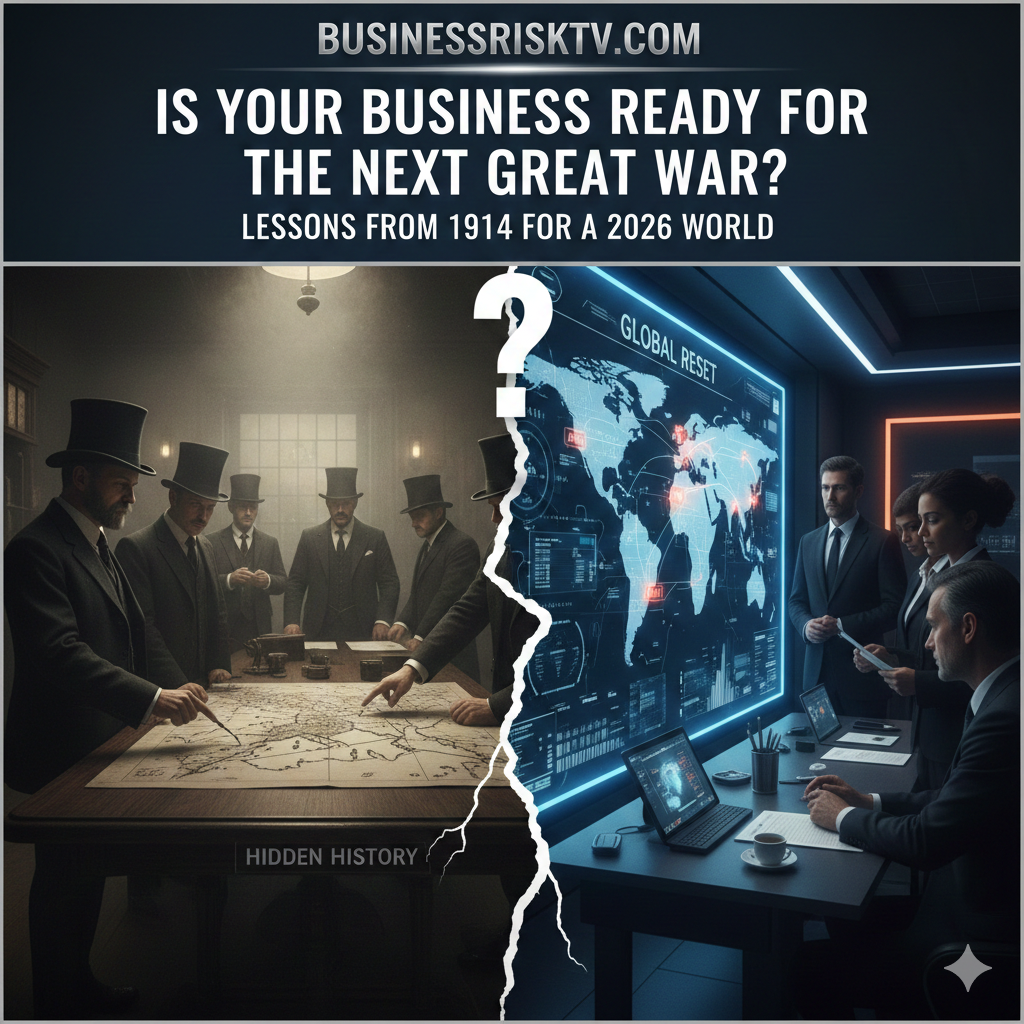
Hidden History & Business Risk: Is Your Strategy Prepared for a 1914-Style Global Reset?

Is history repeating itself? Our deep-dive analysis of Hidden History: The Secret Origins of the First World War by Docherty and Macgregor reveals the hidden geopolitical risks facing modern corporations. Learn how “Secret Elite” agendas and systemic collusion can trigger global market collapses, and discover six critical reasons why today’s business leaders must shift from reactive to proactive resilience. Don’t let your supply chain be the next casualty of a “Black Swan” event—prepare your business for the next Great Reset.

In Hidden History: The Secret Origins of the First World War, Gerry Docherty and Jim Macgregor argue that WWI wasn’t a series of diplomatic blunders, but a calculated destruction of Germany orchestrated by a secret “Elite” in London.

From a Business Risk Management (BRM) perspective, this narrative serves as a masterclass in identifying “Black Swan” events that are actually “Grey Rhinos”—highly probable, high-impact threats that are often ignored until it’s too late.


Business Risk Analysis: The “Hidden History” Lens

If we treat the geopolitical landscape of 1914 as a market, the book highlights several critical risk categories:

  • Systemic Corruption & Collusion: The authors suggest that a small group (the “Secret Elite”) manipulated national policy for long-term strategic gain. For a business, this represents Counterparty Risk—the danger that the “rules of the game” are being written by competitors or regulators behind closed doors.

  • Information Asymmetry: The book claims the public was fed a narrative of “Belgian neutrality” to mask deeper agendas. In business, relying on mainstream data or “consensus” can lead to a failure in Strategic Forecasting.

  • Geopolitical Contagion: The transition from a localised Balkan conflict to a global catastrophe illustrates how quickly Supply Chain Disruption and Market Volatility can scale when hidden alliances are triggered.


6 Reasons Why History Could Repeat Itself Soon

Current global dynamics mirror the pre-1914 era in several unsettling ways:

  1. Thucydides’ Trap: Just as the British Empire feared a rising Germany, the current tension between the U.S. and China creates a structural risk where a dominant power feels forced to suppress a challenger.

  2. Echo Chambers & Propaganda: The “Secret Elite” used the press to whip up anti-German sentiment. Today, AI-driven algorithms and social media echo chambers can radicalise populations and manufacture consent for conflict faster than ever.

  3. Complex Alliance Webs: Much like the secret treaties of 1914, modern mutual defence pacts and “informal” military partnerships mean a spark in a small region (like the South China Sea or Eastern Europe) could force a global decoupling.

  4. Resource Scarcity & Energy Shifts: The 1914 era was about the shift from coal to oil and control of the Berlin-Baghdad railway. Today, the race for rare earth minerals and semiconductor dominance creates similar “must-win” flashpoints.

  5. Economic Financialisation: The book argues high-finance interests drove the war. Today’s global economy is heavily leveraged; a massive debt crisis could tempt leaders to use “war footing” as a distraction or a way to reset the financial system.

  6. Technological Arrogance: In 1914, leaders believed the war would be “over by Christmas” due to superior tech. Today, the belief that Cyber Warfare or Precision Strikes will lead to “short, clean” conflicts often ignores the reality of unpredictable escalation.


How Business Leaders Can Protect Their Interests

To avoid being collateral damage in a “Hidden History” style escalation, leaders should move from reactive to proactive resilience:

The Lesson: History suggests that the greatest risks aren’t the ones we see on the news, but the ones being discussed in private rooms by those who benefit from the chaos.

Executive Scenario Planning Template Example

Focus: Geopolitical Resilience & Strategic Redundancy

This template is designed to help executive teams move past “business as usual” and confront the non-linear risks highlighted by Docherty and Macgregor. It focuses on the “Hidden History” premise: that the biggest threats are often pre-planned or systemic, rather than accidental.

1. The “Hidden Ally” Audit

In 1914, secret agreements forced nations into a war they hadn’t publicly debated. Businesses often have similar “hidden” dependencies.

  • Mapping Dependencies: List your Top 5 critical vendors. Do they share a single point of failure (e.g., all rely on the same shipping lane, the same energy grid, or the same political regime)?

  • The “What If” Trigger: If Country X imposes an immediate export ban on a key component tomorrow, how many days can your operations survive?

  • Action: Identify one “Non-Aligned” alternative supplier for every critical dependency.

2. Narrative & Information Risk Analysis

The “Secret Elite” used media to shape public perception. In a modern crisis, your brand could be caught in the crossfire of state-sponsored disinformation.

3. Scenario Matrix: Four Degrees of Disruption

Use this table to evaluate your readiness for different levels of escalation:

Disruption Level Scenario Example Business Impact Mitigation Priority
Level 1: Friction Increased tariffs / Trade war Margin compression Pricing agility & tax optimization
Level 2: Segregation Sanctions / Regional internet split Loss of specific market access Ring-fencing regional assets
Level 3: Hard Decoupling Complete trade embargoes Supply chain collapse Localization of manufacturing
Level 4: Kinetic Conflict Global War / Infrastructure hit Total operational halt Physical security & cash liquidity

4. Financial “War Chest” Strategy

The book argues that those with liquid assets and prior knowledge thrived during the transition to war.

  • Liquidity Stress Test: In a scenario where credit markets freeze (similar to 1914 or 2008), do you have enough non-digital or highly liquid reserves to cover 6 months of payroll?

  • Currency Diversification: Are your cash reserves held in a single currency? Consider a “Geopolitical Basket” (e.g., USD, CHF, Gold, or decentralised assets) to hedge against a systemic collapse of one fiat system.


Next Steps for the Leadership Team:

  1. Assign a “Red Team”: Appoint three team members to play “Devil’s Advocate” for every major strategic expansion. Their job is to find the “Hidden History” reason why the expansion will fail.

  2. Quarterly Geopolitical Brief: Move beyond standard economic reports. Look at defence spending trends and undersea cable/satellite investments to see where the “Secret Elites” of today are placing their bets.

To keep this lean and focused, here is a “Red Team” questionnaire designed to puncture optimism bias and reveal the hidden systemic risks in your 5-year plan.

These questions are framed to uncover the “Secret Elite” style risks—those factors that aren’t on a standard balance sheet but can sink a company during a geopolitical shift.

Phase 1: The Dependency & “Invisible Hand” Test

  • The Single-Point-of-Failure Audit: If a “black swan” event permanently closed the borders of your primary manufacturing or service hub tomorrow, does the business have a “Plan B” that doesn’t rely on that same geographic region?

  • The Shadow Influence Check: Are our key strategic partners or investors also heavily invested in our direct competitors or in nations with conflicting interests? Who benefits if our current 5-year plan fails?

  • The Subsidy/Regulation Trap: Is our projected growth dependent on current government subsidies or “friendly” regulations? If a political shift occurred and those were stripped away to fund a “war footing” economy, is the project still viable?

Phase 2: Information & Infrastructure Resilience

  • The Narrative Pivot: If our brand becomes politically “toxic” in a major market due to circumstances entirely outside our control (e.g., a national conflict), can we “ring-fence” that region and continue operating elsewhere, or is our identity too centralised?

  • The Analog Fail-Safe: If a sophisticated cyber-offensive took down the primary cloud service providers we use for 30 days, do we have any “manual” or localised way to fulfill orders or maintain core operations?

  • The “Secret” Intelligence Gap: Are we making decisions based on “consensus data” (mainstream media/economic reports) that everyone else sees, or do we have “boots on the ground” insights into the physical movement of goods and local political sentiment?

Phase 3: Financial & Strategic Exit Ramps

  • The Liquidity Lock: If the global banking system experienced a “bank holiday” or a freeze on international transfers (similar to the start of WWI), do we have the local currency or physical assets to keep our global staff paid for 90 days?

  • The Sunk Cost Trap: At what specific “tripwire” (e.g., a specific sanction or a specific percentage of inflation) do we agree to abandon a major project rather than “doubling down” out of pride or previous investment?

  • The Leadership Vacuum: If our executive team were unable to communicate for 72 hours due to a total communications blackout, does the next layer of management have the clear authority and “commander’s intent” to make high-stakes decisions?


How to use this:

Distribute these questions to your leadership team. Have each member answer them anonymously first. You will often find that your “boots on the ground” staff (Ops, Supply Chain) see the “Hidden History” risks much more clearly than the C-suite.

#BusinessRisk #GeopoliticalRisk #HiddenHistoryWW1 #BusinessRiskTV #RiskManagement

Get help to protect and grow your business faster through any business environment you have to operate within

Learn more about growing your business through uncertain world

Subscribe for free business risk management ideas risk reviews and cost reduction tips

Connect with us for free business risk management tips

Read more business risk management articles and view videos for free

Connect with us for free alerts to new business risk management articles and videos 

Hidden History & Business Risk: Is Your Strategy Prepared for a 1914-Style Global Reset?

BRICS Gold-Backed Unit: 6 Business Risk Management Strategies to Protect Profit from De-Dollarisation

The BRICS group’s pilot launch of the “Unit,” a gold-backed digital trade instrument, signals a major shift away from the US Dollar. For international businesses, this de-dollarisation trend creates significant FX and market access risks. Discover the 6 essential business risk management actions—from diversifying payment rails and currency hedging to supply chain re-evaluation—that business leaders must implement now to protect and grow their business in a rapidly changing, multipolar global financial landscape.

The launch of the BRICS “Unit” gold-backed digital trade instrument, even in its pilot phase, signals a significant, long-term shift toward de-dollarisation and the emergence of a multipolar financial system. This development primarily creates currency volatility risk, geopolitical risk, and market access risk for international businesses.


Business Risk Management Actions For BRICS Gold Backed Currency

Business leaders must take proactive steps to protect profit margins and capitalise on new trade opportunities that bypass the traditional dollar-centric financial architecture.

1. Diversify Currency Exposure and Payment Rails

  • Action: Systematically audit all accounts receivable and accounts payable to quantify exposure to the US Dollar (USD) versus BRICS currencies (BRL, CNY, INR, RUB, ZAR) and the new “Unit” if it becomes readily available for international trade.

  • Mitigation: Establish banking relationships or payment channels that can facilitate settlements in multiple currencies, including BRICS members’ local currencies and potentially the Unit. This reduces reliance on USD-centric payment systems like SWIFT.

2. Adopt Dynamic Currency Hedging Strategies

  • Action: Move beyond simple forward contracts and explore more flexible hedging instruments like currency options to protect margins while retaining the ability to benefit from favourable exchange rate movements.

  • Mitigation: Implement a formal, actively monitored Foreign Exchange (FX) risk management policy. Consider utilising natural hedging by matching revenues and expenses in the same currency to reduce net exposure (e.g., sourcing materials in Chinese Yuan if sales are also made in Yuan).

3. Revise Trade and Procurement Strategies

  • Action: Evaluate the cost-competitiveness of suppliers and buyers within BRICS and Global South nations who may preferentially adopt the Unit for trade settlement, benefiting from lower transaction costs.

  • Mitigation: Proactively renegotiate existing contracts to include multi-currency settlement clauses or specify pricing in a currency basket that aligns with the Unit’s composition (gold + BRICS currencies) to stabilise invoice values against pure fiat currency volatility.

4. Geographic and Supply Chain Re-evaluation

  • Action: Map the geographic distribution of your supply chain and customer base to identify regions most likely to adopt the “Unit” (i.e., BRICS nations, Global South/Africa).

  • Mitigation: Increase market intelligence focus on these regions. Where feasible, localise manufacturing or sourcing in key BRICS countries to operate and transact more easily within their emerging financial ecosystem and reduce cross-currency friction.

5. Monitor Political and Regulatory Developments

  • Action: Designate a senior executive or external consultant to track the official adoption status, technical specifications, and regulatory compliance requirements of the BRICS Unit in relevant markets.

  • Mitigation: Develop contingency plans for scenarios where major trading partners impose tariffs or sanctions in response to de-dollarisation efforts, such as the potential for US tariff actions.

6. Model Financial Impact Scenarios

  • Action: Incorporate high-impact, low-probability events—such as a rapid 10-20% USD devaluation or the swift, widespread adoption of the Unit across key commodity markets—into financial forecasting and budgeting.

  • Mitigation: Use the scenario models to determine acceptable levels of currency volatility for profit margins and establish clear trigger points for enacting the new, diversified hedging and payment strategies.

Get help to protect and grow your business faster with BusinessRiskTV

Find out more about growing your business faster with less uncertainty with BusinessRiskTV 

Subscribe for free business risk management ideas risk reviews and cost reduction solutions

Connect with us for free business risk management tips

Read more business risk management articles and view videos for free

Connect with us for free alerts to new business risk management articles and videos

BRICS Gold-Backed Unit: 6 Business Risk Management Strategies to Protect Profit from De-Dollarisation

Geoengineering Business Risk Management: Why Congress Is Investigating and 6 Tips to Protect Your Company

Weather modification and geoengineering are no longer science fiction—they are emerging enterprise risks. With U.S. Congressional investigations and state-level bans on the rise, business leaders must act now. Discover the 6 essential risk management tips to protect your global operations from this new frontier of threats.

Is your business prepared for the risks of climate engineering? 🌍 Our latest article breaks down why the U.S. Congress is investigating and provides 6 actionable risk management tips you need to adopt now.

#Geoengineering #BusinessRisk #RiskManagement

While research into climate-altering technologies is advancing, the evolving legal landscape and potential for unintended consequences mean business leaders can no longer afford to treat geoengineering as a distant speculation. It is a developing enterprise risk that demands immediate attention.

What Are Weather Modification and Geoengineering?

These terms refer to deliberate, large-scale interventions in Earth’s systems:

  • Weather Modification aims for short-term, local changes to weather patterns. The most common technique is cloud seeding, which involves dispersing substances like silver iodide into clouds to enhance precipitation or snowpack . It is practiced in several U.S. states, primarily to combat drought. Geoengineering (or climate intervention) seeks to counteract climate change on a regional or global scale. The two main approaches are:
    • Solar Radiation Management (SRM): Techniques like stratospheric aerosol injection, which aims to cool the planet by reflecting sunlight away from Earth, similar to the effect of a large volcanic eruption .
    • Carbon Dioxide Removal (CDR): Methods that extract CO₂ from the atmosphere or ocean .

A key distinction is that weather modification is intended for local, short-term effects, while geoengineering is designed for larger, longer-lasting impacts .

The Shifting Regulatory and Oversight Landscape

The governance of these technologies is in flux, moving from scientific debate into the political and legal arena, which directly impacts business risk.

  • Growing Political Scrutiny: The U.S. Congress is showing increased interest. A subcommittee in the House of Representatives has held hearings demanding transparency on government weather and climate engineering activities . This political focus highlights the issue’s rising profile and the potential for future regulations.
  • Emerging State-Level Bans: In the absence of comprehensive federal law, states are taking action. Florida recently passed a law prohibiting the intentional release of substances to alter weather, temperature, or sunlight, making it a felony . Similar bills have been introduced in states like Texas, Pennsylvania, and North Carolina . This creates a complex patchwork of regulations for companies operating across state lines.
  • Lack of International Framework: There is no binding international treaty governing solar geoengineering research or deployment . This legal vacuum creates uncertainty for global businesses and raises the risk of international disputes if one country’s actions are perceived to cause harm in another .

Why This Matters for Global Businesses

For business leaders, this is not a theoretical environmental issue but a tangible source of strategic risk.

  • New Physical and Operational Risks: Geoengineering could create novel and unpredictable climate conditions. A company’s risk management must now consider scenarios like “termination shock”—a rapid and dangerous temperature increase if a sustained solar geoengineering program were to suddenly stop . This could threaten supply chains, agricultural production, and infrastructure in ways that existing climate models do not capture.
  • Perception and Geopolitical Risks: Even the perception of geoengineering can be destabilizing. In a world of geopolitical competition, a natural disaster could be wrongly or rightly attributed to a rival’s weather modification program, leading to political tensions that disrupt global trade and markets . Businesses could be caught in the crossfire of such disputes.
  • Legal and Reputational Exposure: As seen with the state-level bans, companies involved in or perceived to be supporting these technologies could face legal liability, hefty fines, and reputational damage . The lack of a clear regulatory framework makes it difficult to assess and mitigate these risks.

Risk Management Tips for Business Leaders

Enterprises should take proactive, low-regret actions now to build resilience against these emerging threats .

  1. Integrate Climate Intervention into Enterprise Risk Management (ERM): ERM teams should formally assess how geoengineering could impact the organization. This involves interviewing key stakeholders to evaluate visibility (awareness of risks), agility (ability to adapt plans), and resilience (capacity to recover from disruptions).
  2. Develop Specific Key Risk Indicators (KRIs): Move beyond general climate metrics. Create KRIs that directly tie to geoengineering and extreme weather, such as the value of assets in regions proposing geoengineering bans or the percentage of supply chain partners located in high-risk weather modification zones.
  3. Model Multiple Financial Scenarios: Use climate-risk financial modeling tools to estimate the potential financial impact of both the physical effects of geoengineering and the transition risks from new regulations. These calculations help quantify the value at risk.
  4. Strengthen Supply Chain Redundancy and Diversification: Geoengineering could alter regional weather patterns, benefiting some areas and harming others. Diversify suppliers and logistics routes to avoid over-concentration in any single geographic region that might be disproportionately affected.
  5. Invest in Data Gathering and Digital Resilience: The ability to monitor and model these new risks depends on data. Invest in cloud-based risk management software to process complex climate and regulatory data streams. Ensure digital operations are resilient to adapt quickly to new information.
  6. Conduct a Regulatory Horizon Scan: Proactively monitor the evolving regulatory landscape at state, federal, and international levels. This is crucial for anticipating new compliance requirements and avoiding costly legal surprises .

The decisions made by governments and scientists about geoengineering will have profound implications for the stability of the global climate and, by extension, the global economy . By understanding these technologies and implementing a robust risk management strategy now, business leaders can protect their assets and build a more resilient enterprise for an uncertain future.

Get help to protect and grow your business faster with less uncertainty

Find out more about growing your business faster with BusinessRiskTV 

Subscribe for free business risk management ideas risk reviews and cost reduction ideas

Connect with us for free business risk management tips

Read more free business risk management articles and view videos

Connect with us for free alerts to new business risk management news reviews and tips

Geoengineering Business Risk Management: Why Congress Is Investigating and 6 Tips to Protect Your Company

The Agenda Documentary Review

Read our in-depth review of the controversial documentary “The Agenda: Their Vision Your Future.” We analyse the film’s claims about a global agenda for control, digital ID, CBDCs, and the UN’s Agenda 2030. Is it a vital warning or a conspiracy theory? Get the balanced verdict.

The Agenda: Their Vision – Your Future Review – A Chilling Exposé or Conspiracy Theory?

In an era of increasing global uncertainty, the documentary “The Agenda: Their Vision – Your Future” has emerged as a polarising force. This feature-length film, directed by former UK broadcasting executive Mark Sharman, positions itself as a vital exposé, challenging mainstream narratives about the future of global governance, technology, and personal freedom. Our in-depth review breaks down its claims, its impact, and the crucial context you need before watching.

What is “The Agenda: Their Vision – Your Future” About?

This documentary presents a stark warning about a purported decades-long plan by global elites to centralise power and reshape society. It argues that what is often presented as progress for public good—from climate initiatives to digital ID systems—may in fact be a pathway to a new form of global authoritarianism.

Key Themes and Claims Explored in the Film

The film connects several high-profile topics to build its case, creating a narrative that many viewers find both compelling and alarming.

  • The Rise of a Digital Control Grid: The documentary warns of an impending “digital prison,” facilitated by the integration of Central Bank Digital Currencies (CBDCs), digital identities, and AI-powered social credit systems.
  • Deconstructing Global Agendas: A central pillar of the film is its critical examination of United Nations policies, specifically Agenda 2030 and its Sustainable Development Goals (SDGs). The film interprets these not as a blueprint for a better world, but as a potential framework for top-down control.
  • The Weaponisation of Crisis: It suggests that events like the COVID-19 pandemic and the climate crisis are exploited to accelerate the implementation of policies that erode civil liberties and concentrate power.
  • Echoes of Dystopian Fiction: Throughout its runtime, the film deliberately invokes the prophetic warnings of George Orwell’s “1984” and Aldous Huxley’s “Brave New World,” suggesting our reality is converging with these fictional nightmares.

Analysis: A Vital Warning or a Partisan Narrative?

The Case for the Documentary’s Message

For viewers skeptical of centralised authority and rapid technological change, “The Agenda” articulates a powerful and coherent set of fears. It gives voice to concerns about privacy, bodily autonomy, and the erosion of national sovereignty. By featuring a range of international commentators and experts who support its thesis, the film provides a platform for perspectives often marginalised in mainstream discourse. For many, it serves as a catalyst for crucial conversations about the balance between security and freedom.

Critical Perspectives and Counterpoints

It is essential to approach the film with a critical mind. The narrative presented sharply contradicts the stated intentions of global bodies like the WHO and the UN, which frame their goals in terms of public health, poverty reduction, and environmental sustainability. Mainstream scientific consensus, particularly on the drivers and risks of climate change, stands in opposition to some of the film’s key assertions. Critics have labeled the documentary a “conspiracy theory” film that presents a selective and often fear-based interpretation of complex global issues without providing conclusive evidence for its gravest claims.

Final Verdict: Should You Watch It?

“The Agenda: Their Vision – Your Future” is undeniably provocative. It is a must-watch for those seeking to understand a significant and influential counter-narrative to the prevailing vision of a globalised future. The film successfully compels viewers to question the trajectory of technological and political power.

However, viewers should not treat it as a sole source of information. Its power lies in its ability to provoke critical thinking, not in providing a definitive and unbiased account. We recommend watching it with a discerning eye and following up with research from a wide array of sources, including those that directly challenge the film’s conclusions.

#TheAgendaDocumentary #GlobalAgenda #DigitalFreedom

Get help to protect and grow your business faster with better business risk insights

Find out more about growing your business in any business environment 

BusinessRiskTV Business Risk Management Club Membership

Subscribe for free business risk management ideas risk reviews and cost reduction tips

Connect with us for free business risk management tips

Contact Us To Subscribe BusinessRiskTV – Reach Global Decision Makers

Read more business risk management articles and view videos for free

Risk Management Think Tank BusinessRiskTV Risk Experts

Connect with us for free alerts to new business risk management articles and videos 

Enterprise Risk Management Magazine BusinessRiskTV ERM Magazine

The Agenda Documentary Review

The West’s Ukraine Strategy: A Catastrophic Policy Failure & The Business Cost

The Ukraine conflict represents a catastrophic failure of Western policy, not just Russian aggression. Leaders in the UK, Germany, and France are accountable for a series of critical errors—from pre-war NATO provocation and the Minsk Agreement debacle to slow-walking military aid and sabotaging peace talks. These decisions have prolonged a devastating war, resulting in needless loss of life and squandering billions in public funds. This analysis details the 9 reasons why these policies constitute a profound strategic failure and why citizens must now demand a resolution focused on diplomacy and economic stability over prolonged conflict.

Key Critiques of UK, German, and French Policy on Ukraine

A critical analysis of how leaders in the UK, Germany, and France bear responsibility for prolonging the Ukraine conflict. Explore the 9 key policy failures—from failed diplomacy and economic mismanagement to escalation risks—that have cost hundreds of thousands of lives and billions in taxpayer funds. Learn why citizens must demand accountability and a new path toward peace.

Critics, who come from both the political left and right, often point to a series of pre-war and ongoing policy failures.

1. Pre-War Provocation and Failed Diplomacy (The “Sleepwalking” Critique)

  • Critique: For years, despite warnings from Russia, the US and key European powers like the UK, France, and Germany expanded NATO eastward. While sovereign nations have the right to choose their alliances, critics argue this was strategically reckless, needlessly threatening Russia’s core security interests and creating a predictable confrontation. This is seen as a failure of statesmanship that boxed all parties into a corner.
  • Accountability: Leaders are accused of prioritising a hawkish, ideological expansion of Western influence over a pragmatic, security-based diplomacy that could have averted war.

2. The Minsk Agreement Debacle

  • Critique: The Minsk Agreements (2014-2015), brokered by France and Germany, were meant to bring peace to Donbas. However, recent admissions from figures like former German Chancellor Angela Merkel suggested the agreements were primarily a tool to “give Ukraine time” to build its military. Critics argue this reveals profound bad faith, proving to Russia that diplomatic agreements with the West are not trustworthy, thereby destroying a potential path to peace and making the 2022 invasion seem inevitable from Moscow’s perspective.

3. Slow-Walking Military Aid & “Waging a Slow War”

  • Critique: Especially in the early stages (and periodically since), Germany, France, and the UK have been accused of “drip-feeding” military aid. They provided just enough to keep Ukraine from collapsing, but not enough to achieve a decisive victory. This is criticized as a strategy that prolongs the war, maximizing Ukrainian casualties and destruction while minimizing direct risk to NATO, effectively “fighting to the last Ukrainian.”
  • Example: The long, drawn-out debates over delivering tanks, long-range missiles, and aircraft are cited as key examples where hesitation cost lives and strategic advantage.

4. Undermining and Delaying Peace Talks

  • Critique: In the spring of 2022, peace talks between Ukraine and Russia showed promise. Critics allege that Western powers, particularly the UK under then-PM Boris Johnson, advised Ukraine to break off negotiations, promising full-scale Western support to win back all territory. By taking a maximalist “no negotiation” stance, they are seen as having sabotaged a potential, if imperfect, peace deal that could have saved hundreds of thousands of lives.

5. Economic Mismanagement and the Cost to Citizens

  • Critique: The billions in aid sent to Ukraine are framed not as noble support, but as a massive transfer of wealth from Western citizens during a cost-of-living crisis. Critics argue this spending fuels inflation, diverts funds from domestic healthcare, education, and infrastructure, and primarily benefits the military-industrial complex, all while the financial burden is borne by the taxpayers of the UK, Germany, and France.

6. Lack of a Clear Strategic Endgame

  • Critique: Two years into the conflict, there is no publicly defined strategic goal for the war. Is the aim to return to 1991 borders? 2014 borders? Merely weaken Russia? This lack of a clear, achievable political objective is a massive strategic failure. It commits these nations to an open-ended conflict with no exit strategy, guaranteeing further waste of lives and money without a defined concept of “victory.”

7. Escalation Risks and Brinksmanship

  • Critique: By continuously pushing the boundaries of military aid—from artillery to tanks to long-range missiles—these leaders are playing a dangerous game of brinksmanship. Critics argue they are ignoring the real and existential risk of a direct NATO-Russia war, which could escalate to nuclear conflict. The responsibility for managing this risk lies with the major Western powers, and their current policies are seen as recklessly increasing it.

8. The “Double Standard” on International Law

  • Critique: This argument, often from the left, states that the UK, France, and Germany apply international law selectively. They rightly condemn Russia’s invasion but have historically ignored or participated in violations (e.g., Iraq, Libya, Yemen). This hypocrisy, critics argue, undermines the moral high ground and the very rules-based order they claim to be defending, making their stance seem more about geopolitical power than principle.

9. Neglecting Diplomacy as a Tool

  • Critique: The current policy is almost entirely militaristic. Critics argue that leaders in Berlin, Paris, and London have a responsibility to pair military support with aggressive, creative diplomacy. By refusing to seriously explore diplomatic channels, ceasefires, or potential compromises, they are choosing a path of endless attrition over statecraft, ensuring the continued loss of life and economic damage.

Why Citizens of These Countries Should Act

Based on these critiques, the argument for citizen action is clear:

  • Sovereignty and Consent: The governments of the UK, Germany, and France are acting in the name of their citizens. Therefore, citizens have a democratic right and responsibility to scrutinize these policies and their costs.
  • Direct Impact: The citizens of these nations are directly paying the price through higher taxes, inflated living costs, and diverted public funds. Their security is also being put at risk through escalation.
  • Correcting a Failed Policy: If the current path is seen as a “policy mistake” that is wasting lives and treasure without a realistic chance of a satisfactory outcome, then public pressure is the primary democratic mechanism to force a change in course towards a strategy that prioritises peace and diplomacy.

Get help to protect and grow your business faster with BusinessRiskTV

Find out more about growing your business faster with BusinessRiskTV 

Subscribe for free business risk management news reviews and cost cutting deals

Connect for free business risk management tips

Read more free business risk management articles and view videos

Connect for free alerts to business risk management articles 

Wests Ukraine Strategy Failure Business Cost

Anti-Fragility Mentality: The UK Business Guide to Thriving on Volatility

Don’t just survive—thrive. In today’s volatile UK market, being resilient isn’t enough. Discover the anti-fragility mentality, a powerful concept that helps businesses grow stronger from shocks and uncertainty. Our guide reveals the dangers of feeling too scared to grow, explains why positively fighting back against business fears works better, and provides 9 practical risk management strategies to build a more robust, adaptable, and profitable business. Learn how to transform every crisis into a competitive advantage.

Discover how an anti-fragility mentality can help your UK business thrive on stress and volatility. Learn why fear of growth is dangerous and get 9 practical risk management strategies to build a more robust, adaptable, and profitable company.

Anti-Fragility Mentality: The UK Business Guide to Thriving on Volatility 🇬🇧

In the complex and unpredictable world of business, it’s not enough to be resilient or robust; you must be anti-fragile. This is a concept, popularised by author Nassim Nicholas Taleb, that suggests some systems, like a business, don’t just withstand shocks—they actually get stronger because of them. While a resilient company recovers from a crisis, an anti-fragile one learns, adapts, and improves. Instead of just surviving, an anti-fragile business uses volatility, uncertainty, and stress as fuel for growth. This is especially relevant for UK businesses navigating a post-Brexit, globalised, and tech-driven market.


The Dangers of Business Fear and Over-Cautiousness

When leaders are too scared to grow, their business becomes fragile. Fear of failure or even fear of success can lead to a state of paralysis. Instead of embracing opportunities, a business with a risk-averse culture will hesitate, self-sabotage, and miss out on potential gains. This mindset can:

  • Stifle innovation: You avoid new technologies, markets, or product lines, leaving you vulnerable to competitors who are bolder.
  • Prevent scalability: Your business systems, processes, and team structures become too rigid to handle growth, leading to spiralling costs and poor service if demand increases.
  • Create dependency: Over-reliance on a single client, supplier, or revenue stream makes the business incredibly fragile.
  • Damage morale: A culture of fear can demotivate employees and discourage them from taking initiative.
  • Expose you to a slow decline: While you might avoid a sudden crisis, a cautious approach often leads to a gradual loss of market share and relevance.

Why Positively Fighting Back Against Crisis Works Better

An anti-fragile business doesn’t just react to a crisis; it uses the crisis to its advantage. Instead of a defensive mindset, it adopts an offensive one, turning problems into opportunities. This approach works better because:

  • It forces innovation: A crisis can be a powerful catalyst for change, forcing you to find creative solutions you wouldn’t have considered otherwise.
  • It builds stronger systems: A crisis reveals weaknesses. By addressing these weak points, you build more robust, efficient, and reliable systems for the future.
  • It strengthens relationships: Transparent communication and proactive problem-solving during a crisis builds trust with employees, customers, and partners.
  • It creates a competitive advantage: While your competitors are busy recovering, you’re using the disruption to pull ahead, secure new markets, or attract talent.

Who Can Help You Take More Calculated Risks

Taking calculated risks is a team sport. While the final decision rests with the leadership, a smart leader leverages the entire business to inform their choices. Key roles that can help you become more anti-fragile include:

  • Senior Leadership: A strong, forward-thinking leadership team that fosters a culture of smart risk-taking and learning from failure.
  • The Finance Team: Your finance department is crucial. They provide the data and analysis needed to understand the potential financial impact of a risk.
  • IT & Cybersecurity: They assess the risks associated with new technologies and ensure your digital infrastructure can handle growth and shocks.
  • Department Heads: They have a direct view of operational risks and can identify opportunities for improvement.
  • Employees at all levels: Front-line staff often have the best insights into day-to-day problems and can suggest innovative solutions.

Where You Can Protect Yourself from an Over-Cautious Mentality

To counter a culture of over-cautiousness, you need to create an environment where smart risk-taking is encouraged. Focus on these areas:

  • Your company culture: Foster a “growth mindset” that views mistakes as learning opportunities rather than failures.
  • Your team structure: Empower teams to make decisions without excessive layers of approval.
  • Your communication channels: Create open and transparent communication where bad news and new ideas can be shared without fear.
  • Your strategic planning: Incorporate scenario planning and “what-if” exercises to prepare for a range of potential outcomes, both good and bad.

When to Feel More Robust

You can feel more robust and confident in your business’s ability to handle stress when you have:

  • Consistent cash flow: A healthy financial position provides the buffer needed to withstand shocks and invest in new opportunities.
  • A diversified portfolio: You’re not reliant on a single customer, product, or market.
  • Strong systems and processes: Your business operations are streamlined, efficient, and can handle increased demand without breaking.
  • An engaged and skilled team: Your employees are aligned with your goals and are ready to adapt to changing circumstances.

9 Practical Anti-Fragility Risk Management Strategies

  1. Embrace Optionality: Have multiple, low-risk options available. For example, explore several new markets with a small investment rather than committing to one with a large one.
  2. Redundancy is a Virtue: Don’t rely on a single supplier or a single server. Create backups and redundancies to prevent single points of failure.
  3. Conduct “Pre-Mortems”: Instead of a post-mortem after failure, imagine a project has failed and work backwards to identify the reasons. This helps anticipate risks before they occur.
  4. Adopt a “Fail Fast, Learn Faster” Mindset: Launch small, experimental projects (Minimum Viable Products) to test ideas without significant risk.
  5. Decentralise Authority: Empower smaller teams to make decisions. This allows for faster responses to local challenges and opportunities.
  6. Maintain a Cash Buffer: Keep enough cash on hand to cover a significant period of low revenue. This financial buffer is the bedrock of anti-fragility.
  7. Gamify Risk Management: Use internal games or simulations to train your team on how to respond to unexpected events, building both muscle memory and a proactive mindset.
  8. Diversify Your Team’s Skillset: Hire for versatility and adaptability. A team with diverse skills is more likely to find creative solutions during a crisis.
  9. Build Strong Stakeholder Relationships: Foster trust with your customers, suppliers, and investors. Strong relationships provide a support network that is invaluable in a downturn.

Get help to protect and grow your business faster with BusinessRiskTV

Find out more about business protection and business growth with BusinessRiskTV 

Subscribe for free business risk management ideas reviews and cost reduction deals

Connect with us for free business risk management tips

Read more free business risk management articles and view videos

Connect with us for free alerts to new business risk management articles and videos 

Anti-Fragility Mentality Business UK Risk Management Strategies

Business Risk Consulting Services

Empower your business to thrive in an uncertain world. Our comprehensive risk management services provide in-depth analysis, strategic planning, and actionable insights to safeguard your operations and achieve long-term success.

Business Risk Management Consulting: Protect Your Bottom Line

Navigate Complexity with Confidence: BusinessRiskTV.com Business Risk Consulting Services

Empower your business to thrive in today’s dynamic and uncertain environment with BusinessRiskTV.com’s Business Risk Consulting Services

Our team of seasoned professionals provides comprehensive solutions to identify, analyse, and mitigate potential threats to your success.

Why Choose Us?

  • Unparalleled Expertise: Benefit from the knowledge and experience of our Business Experts Hub and Risk Management Experts.
  • Tailored Solutions: We create customised risk management plans that address your unique business needs and goals.
  • Proactive Risk Identification: Our comprehensive approach ensures you uncover even the most hidden potential risks.
  • Data-Driven Insights: We leverage industry data and robust analytics to support our recommendations.

What You Gain:

  • Enhanced Decision-Making: Make strategic choices based on a clear understanding of potential risks and opportunities.
  • Increased Business Resilience: Develop a robust framework to withstand unforeseen challenges and disruptions.
  • Improved Operational Efficiency: Optimise your processes and minimise risk-related disruptions.
  • Reduced Operational Costs: Proactively mitigate risks and minimise the potential for financial losses.
  • Enhanced Brand Reputation: Demonstrate your commitment to risk management and build trust with stakeholders. Grow your business faster.

Don’t gamble with your business success! Partner with BusinessRiskTV.com’s Business Risk Consulting Services and gain the tools and expertise you need to navigate complexity with confidence. We’ll help you build a more secure and resilient future for your business.

Contact BusinessRiskTV

Contact Us

BusinessRiskTV.com: Your Partner in Mitigating Business Risks

In today’s rapidly evolving business landscape, navigating risk has become an integral part of success. Businesses of all sizes face a myriad of threats, from economic downturns and market fluctuations to cyberattacks and operational disruptions. To thrive in such a challenging environment, it is imperative to have a robust risk management strategy in place.

BusinessRiskTV.com offers comprehensive Business Risk Consulting Services designed to help businesses identify, assess, and mitigate potential risks. Our team of experienced professionals brings a wealth of knowledge and expertise to the table, providing tailored solutions that address the unique needs of each client.

Understanding Business Risk

Business risk refers to any uncertainty or threat that could negatively impact a company’s operations, financial performance, or reputation. It can arise from various sources, including:

  • Economic Factors: Market fluctuations, inflation, recession, and interest rate changes.
  • Operational Factors: Supply chain disruptions, labour shortages, equipment failures, and natural disasters.
  • Strategic Factors: Poor decision-making, ineffective marketing, and competition from rivals.
  • Technological Factors: Cyberattacks, data breaches, and system failures.
  • Legal and Regulatory Factors: Changes in laws and regulations, lawsuits, and compliance issues.

Effective risk management involves identifying potential risks, assessing their likelihood and impact, and developing strategies to mitigate or avoid them.   

The Importance of Business Risk Consulting

Businesses of all sizes can benefit from the expertise of professional risk consultants. Here are some of the key reasons why:

  • Proactive Risk Identification: Consultants can help businesses identify potential risks that may not be immediately apparent.
  • Comprehensive Risk Assessment: They can assess the likelihood and impact of each risk, allowing businesses to prioritise their response efforts.
  • Tailored Risk Management Strategies: Consultants can develop customised risk management plans that align with a business’s specific goals and objectives.
  • Continuous Monitoring and Evaluation: They can help businesses monitor their risk exposure and make adjustments to their strategies as needed.
  • Compliance with Regulations: Consultants can ensure that businesses are compliant with industry regulations and standards.

BusinessRiskTV.com’s Approach to Business Risk Consulting

At BusinessRiskTV.com, we believe that a successful risk management strategy requires a holistic approach. Our consultants work closely with clients to understand their unique needs and challenges, and develop tailored solutions that address their specific concerns.

Our approach involves the following steps:

  1. Risk Identification: We conduct a thorough assessment of a business’s operations, identifying potential risks from various sources.
  2. Risk Assessment: We evaluate the likelihood and impact of each identified risk, using quantitative and qualitative methods.
  3. Risk Prioritisation: We help clients prioritise risks based on their potential impact and likelihood.
  4. Risk Mitigation Strategies: We develop strategies to mitigate or avoid identified risks, such as risk transfer, risk avoidance, risk reduction, and risk acceptance.
  5. Risk Monitoring and Evaluation: We help clients implement a system for monitoring and evaluating their risk exposure on an ongoing basis.

Key Areas of Focus

Our business risk consulting services cover a wide range of areas, including:

  • Strategic Risk: Assessing the risks associated with a company’s business strategy and decision-making.
  • Operational Risk: Identifying risks related to day-to-day operations, such as supply chain disruptions and equipment failures.
  • Financial Risk: Evaluating risks associated with financial performance, such as market fluctuations and credit risk.
  • Technological Risk: Assessing risks related to information technology, such as cyberattacks and data breaches.
  • Legal and Regulatory Risk: Identifying risks associated with compliance with laws and regulations.
  • Reputational Risk: Assessing risks related to a company’s reputation and brand image.

Benefits of Working with BusinessRiskTV.com

By partnering with BusinessRiskTV.com, businesses can benefit from:

  • Enhanced Resilience: A well-developed risk management strategy can help businesses withstand unexpected challenges and disruptions.
  • Improved Decision-Making: By understanding potential risks, businesses can make more informed decisions and allocate resources effectively.
  • Enhanced Reputation: A strong risk management programme can help businesses build trust with stakeholders and maintain a positive reputation.
  • Reduced Costs: By proactively addressing risks, businesses can avoid costly losses and disruptions.
  • Compliance with Regulations: Our consultants can help businesses ensure compliance with industry regulations and standards.

In conclusion, effective risk management is essential for the long-term success of any business. By partnering with BusinessRiskTV.com, businesses can gain the expertise and support needed to identify, assess, and mitigate potential risks. Our comprehensive risk consulting services can help businesses build resilience, enhance decision-making, and protect their bottom line.

Get help to protect and grow your business faster

Find out more

Subscribe for free business risk alerts and risk reviews

Navigate the complexities of today’s business landscape with confidence. BusinessRiskTV.com’s Business Risk Consulting Services offer expert guidance to identify, assess, and mitigate potential threats to your success. Protect your business, enhance resilience, and make informed decisions with our tailored solutions.

Connect with us for free

Read more business risk management articles for free

Don’t let risk hold your business back. Partner with BusinessRiskTV.com for expert risk consulting services. Our team of professionals will help you identify, assess, and mitigate potential threats, ensuring your business remains resilient and competitive in any market.

Connect with us for free