
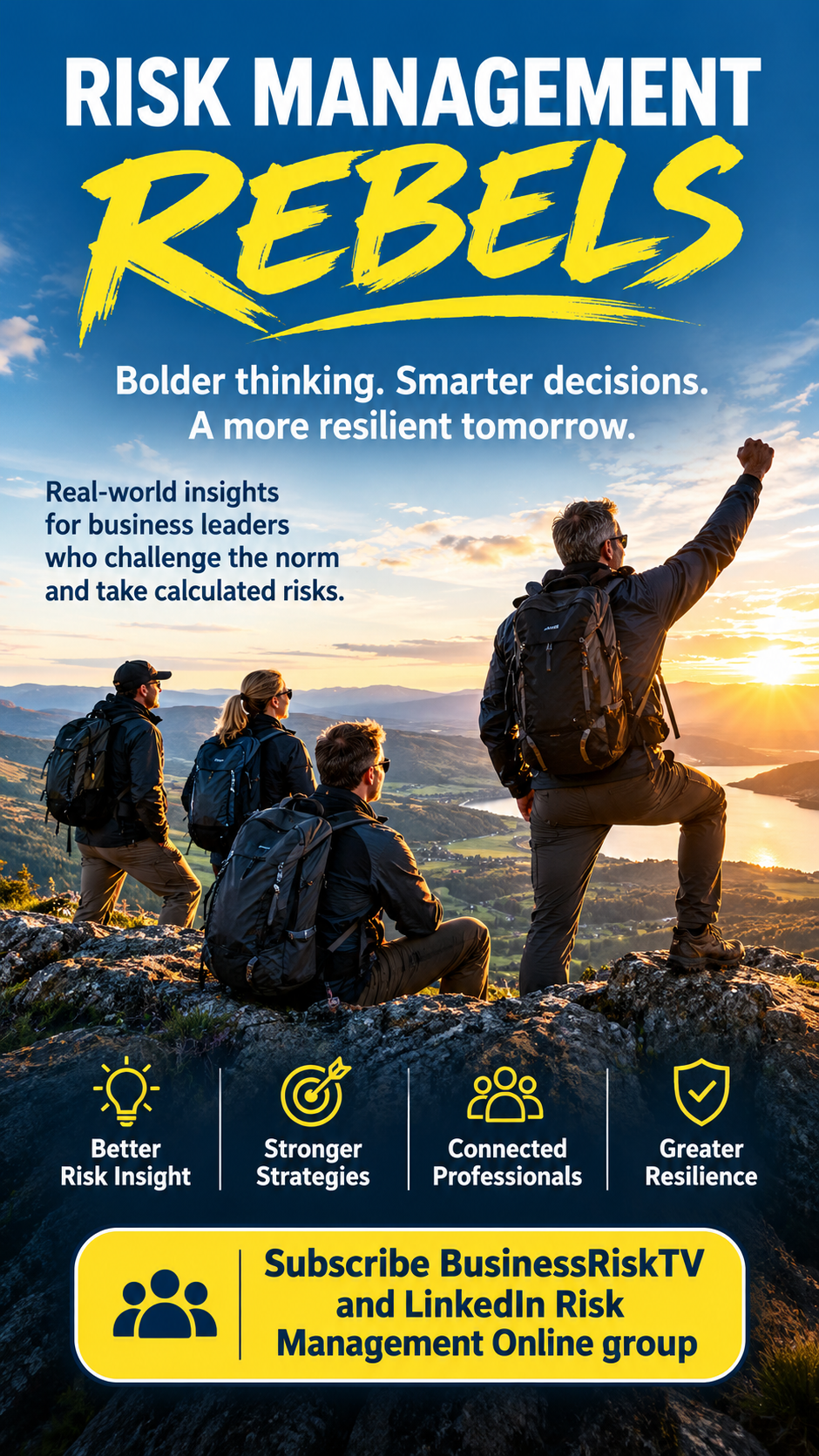
For key risk owners and risk management rebels: use better risk questions, lateral thinking, and the Risk Management Online LinkedIn group to manage business risks better, improve business performance, and increase personal reward. Email editor@businessrisktv.com to engage.
BusinessRiskTV Business Risk Management Club recommends joining this club and Linkedin Risk Management Online group as the solution to the problem of managing business risks better to boost business performance in uncertain world.
If you are one of the crazy ones, a misfit, a risk management rebel who refuses to accept that “that’s just how it’s always been done,” then this is your invitation. Research from PwC’s 2024 Pulse Survey reveals that companies embracing advanced risk strategies have cut the financial impact of disruptions by 20% while boosting operational efficiency by 15%, and Deloitte’s 2024 Global Risk Management Survey shows that firms with robust risk governance are 25% more likely to outpace competitors in revenue growth. We are building a network of people who manage business risks better for better business performance and increased personal reward. The Linkedin Risk Management Online group is waiting for you:
https://www.linkedin.com/groups/2324725
Why Is Business Risk Management Information Critical to Better Business Decisions and Performance?
Business risk management information is critical to better business decisions and performance because organisations that invest in risk maturity consistently demonstrate improved financial performance and resilience. Enterprise risk management is not a bureaucratic checkbox exercise; it is the operating system of a business that intends to survive the Fourth Turning. ISO 31000, the international standard for risk management, explicitly states that risk management creates and protects value, contributes to the demonstrable achievement of objectives, and drives decision making that improves business performance. The World Economic Forum’s Global Risks Report 2026 emphasises that interconnected economic, environmental, geopolitical, societal, and technological risks demand a fundamental rethink of how organisations approach resilience and strategic planning, a warning echoed by the UK Government Internal Audit Agency’s guidance on early warning signs in public sector bodies.
The numbers tell a story that most boardrooms are still not hearing clearly enough:
- Organisations with higher risk maturity levels consistently demonstrate improved financial performance.
- A study of 11,285 firm-year observations using the COSO ERM framework found that ERM implementation is positively associated with both return on assets (ROA) and Tobin’s Q, with a stronger relationship observed for financial performance.
- Cross-industry research reveals that supply chain disruptions can cost companies 6–10% of annual revenues, yet organisations with proactive risk management systems can significantly reduce this exposure.
- The average cost of a single data breach is now $4.88 million, and IBM has found that companies implementing AI security tools can cut their losses by $2.2 million.
- Organisations that fail to comply with data regulations face costs averaging $14.8 million annually, compared to just $5.4 million for those who maintain compliance.
Why does this matter for the person responsible for managing risks?
Because you are the key risk owner. You are the responsible person. When the board asks why the business is exposed, the answer starts with you. But here is the liberating truth: managing risk well is not about eliminating uncertainty. It is about navigating it with clear eyes, better information, and a network of people who have faced the same storm.
What Is the Fourth Turning Telling Us About the Problems We Face Now and in the Near Future?
The Fourth Turning is telling us that we are living through a Crisis period, a once-in-a-lifetime turning where the institutions and assumptions that stabilised the previous decades are being openly discarded. Neil Howe and William Strauss’s framework, laid out in their 1997 book The Fourth Turning, describes four generational turnings that repeat across roughly 80-to-100-year cycles: the High, the Awakening, the Unraveling, and the Crisis. According to Ben Spievak of SVRN, we are currently in the Crisis window, which he places between 2020 and 2045 — a period where markets reprice, institutions are tested, and the foundation for the next hundred years gets laid.
What does this mean for business risk management?
- Old assumptions are breaking. The rules of the game are being rewritten. What worked in the Unraveling — efficiency, optimisation, predictable supply chains — may not work in the Crisis.
- Institutional trust is fragile. As one analysis of The Fourth Turning puts it, “History warns that a Crisis will reshape the basic social and economic environment that you now take for granted”.
- Volatility is not noise; it is signal. In the Fourth Turning framework, what looks like instability is often the market finding a new price, a recalibration around what value means in a world operating on a different set of assumptions.
- Crisis is an incubator. A crisis period is not the end of anything — it is the phase where the decisions made today carry outsized weight for the next century.
This is the context in which you, as a risk owner, must make decisions. Not with perfect foresight — that has never existed — but with a framework that helps you distinguish between preventable risks, strategic risks, and external risks. Harvard’s Kaplan and Mikes framework, cited in strategic risk analysis, offers exactly this practical approach: turn preventable risks into advantages, use strategic risks to open new markets, and build resilience against external risks you cannot control.
The danger is not just the things we don’t know. It is the things we think we know for sure.
Why Do Risk Management Rebels, Misfits, and Crazy Ones Need to Step Forward Now?
Risk management rebels, misfits, and crazy ones need to step forward now because the conventional risk management playbook — the one built for a stable, predictable world — is failing in the Crisis. Research on “positive deviants” in organisations shows that rebels with a cause often spark the innovations that established paradigms cannot produce, and that suppressing these individuals backfires because people judge proposed innovations on whether they agree with the established paradigm rather than their ability to create new paradigms. A study of NASA’s mission control renegades found that rebels create novel solutions, revitalise innovation, and future-proof businesses.
Why do we need you specifically?
- Because the old model of risk management is defensive. It treats risk as an enemy to avoid rather than a force to wield. PwC’s 2023 CEO Survey reveals that 56% of CEOs believe taking risks is essential for growth, yet many frameworks are still designed to mitigate exposure rather than capitalise on opportunities.
- Because only 26% of executives believe their risk management aligns with business strategy, according to Deloitte’s 2023 Global Risk Management Survey. That gap is not a statistic. It is an opportunity.
- Because lateral thinking is the only way through. The problems we face — geopolitical fragmentation, technological disruption, climate instability, supply chain fragility — do not have precedents. They require innovative solutions, and innovation requires making some mistakes. That is not a flaw in the process. It is the process of improvement.
- Because uncertainty is not a problem to be solved. It is the condition of being alive or in business. Alan Watts wrote that “the desire for security and the feeling of insecurity are the same thing. To hold your breath is to lose your breath”. The tighter you grip the need to know exactly how everything will turn out, the more anxious you become. The looser you hold it, the more spacious your business decisions feel.
You do not need to know how the story ends to enjoy the chapter you are in with your business. Let yourself be a beginner. Let yourself not have all the answers. Let yourself be in the process of finding the right answers for your business.
What Can Members of BusinessRiskTV and the Risk Management Online Group Expect from Membership?
Members of BusinessRiskTV and the Risk Management Online group can expect a practitioner-driven community where real risk owners share frameworks, warnings, and wins without the corporate jargon that hides more than it reveals. This is not a passive content feed. It is a working network.
What you can expect:
- A community of people who think differently. We are not looking for consensus. We are looking for the people who ask the uncomfortable question in the meeting, the ones who see the risk nobody else has noticed yet.
- Practical risk intelligence. Discussions on emerging risks, regulatory changes, geopolitical shifts, and technological disruptions that affect your business decisions.
- Peer-to-peer support. When you are the responsible person and the board is asking questions you are not sure how to answer, this is where you find people who have been there.
- Frameworks that work. From ISO 31000 to COSO ERM to Kaplan and Mikes’s risk categories, we share the tools that actually help you make better decisions, not just fill in a risk register.
- A space to test your thinking. Before you take a controversial risk decision to your executive team, test it here. The misfits and rebels in this network will tell you what you are not seeing.
What we are not:
- A sales channel.
- A compliance checkbox.
- A place for people who want to be told what to do.
Who Is Most Likely to Benefit from Membership, and When?
The people most likely to benefit from membership are the key risk owners, responsible persons, business owners, risk managers, compliance officers, executives, and consultants who are accountable for outcomes and who feel the weight of uncertainty pressing on their decisions right now. You benefit most when you are at an inflection point — when a major decision is in front of you, when a crisis has just hit, when the board has asked you a question you cannot answer alone, or when you sense that the ground beneath your business is shifting but you cannot yet see the shape of what comes next.
You are likely to benefit the most if you are:
- A business owner or founder who carries the full weight of risk without a large risk function behind you.
- A risk manager or compliance officer who knows the frameworks but needs strategic context to make them real.
- An executive or director who is accountable for decisions in a Fourth Turning environment and needs better information.
- A consultant or advisor who helps organisations navigate uncertainty and wants to sharpen your own thinking alongside practitioners.
- Anyone who has ever been called “difficult” or “negative” for pointing out the risk nobody else wanted to see.
When do you benefit?
Immediately. The moment you join, you gain access to a network that is already discussing the problems you are facing. You do not need to wait for a conference, a training programme, or a quarterly report. The benefit begins with the first conversation you read, the first question you ask, the first connection you make.
Why Should Someone Responsible for Managing Business Risks Join This Network to Inform Their Own Business Decision Making as a Key Risk Owner?
Someone responsible for managing business risks should join this network because no single risk owner, however experienced, can see every angle of every threat and opportunity, and the Fourth Turning demands collective intelligence. The Harvard Business Review has repeatedly found that diverse teams make better decisions, and the same principle applies to risk networks: the person who has managed a supply chain crisis in Southeast Asia may hold the key to your procurement problem in Europe.
But here is the reason we most want you to hear:
- You are the key risk owner. The decision is yours to make. But you do not have to make it alone.
- Deloitte’s survey highlighted that companies with a proactive GRC approach were 50% more likely to maintain their reputation during crises, and PwC found that organisations with effective GRC strategies saw a 50% reduction in the frequency of risk events. Those outcomes are not the product of better software alone. They are the product of better conversations between people who take risk seriously.
What can you expect from the network?
- Access to a global community of practitioners who bring perspectives from different industries, cultures, and regulatory environments.
- Real-time discussion of emerging risks as they develop, not after the post-mortem.
- A place to ask the question you cannot ask in your own organisation without signalling weakness or uncertainty.
- Frameworks and mental models that help you structure your thinking when the data is incomplete.
- The reminder that uncertainty is the condition of being in business, and that navigating it with curiosity rather than fear is not just possible — it is the most rewarding way to work.
How Can You Engage with BusinessRiskTV and the Risk Management Online Group for Your Own Benefit?
You can engage with BusinessRiskTV and the Risk Management Online group by joining the LinkedIn community, introducing yourself honestly, and participating in the conversations that matter to your business. You can be anywhere in the world and still benefit from membership because the network is distributed, asynchronous, and built for practitioners who are already busy managing real risks.
How to engage for your own benefit:
- Join the LinkedIn group: https://www.linkedin.com/groups/2324725
- Introduce yourself with a real problem. Do not sell. Do not posture. Tell the group what you are facing and what you need.
- Answer someone else’s question. The fastest way to sharpen your own risk thinking is to help someone else structure theirs.
- Bring your misfit perspective. If you see something the group has not noticed, say it. That is why you are here.
- Stay curious. The Fourth Turning is not a doom prophecy. It is a framework for understanding the times we are in, and frameworks are only useful if they are used.
- Share what you are learning. Your failures are as valuable as your wins. The network grows stronger when we are honest about both.
The invitation is simple:
We are looking for the crazy ones, the misfits, the risk management rebels. The people who understand that certainty is a story we tell ourselves and that real security comes from the capacity to adapt, not the illusion of control. If that sounds like you, join us.
Join BusinessRiskTV Business Risk Management Club. Join the Risk Management Online LinkedIn group. Manage business risks better for better business performance and increased personal reward.
The story is still being written. You do not need to know how it ends to be part of the chapter that matters. Join Business Risk Management Club here or join the LinkedIn group:
https://www.linkedin.com/groups/2324725
Get help to protect and grow your business faster with BusinessRiskTV
Find out more about growing your business faster with less uncertainty with BusinessRiskTV
Subscribe for free business risk management ideas risk reviews and cost of being in business reduction tips
Connect with BusinessRiskTV for free business risk management tips
Read more business risk management articles and view videos for free
Connect with BusinessRiskTV for free alerts to new business risk management articles and videos
Risk Rebels: Manage Business Risks Better | BusinessRiskTV