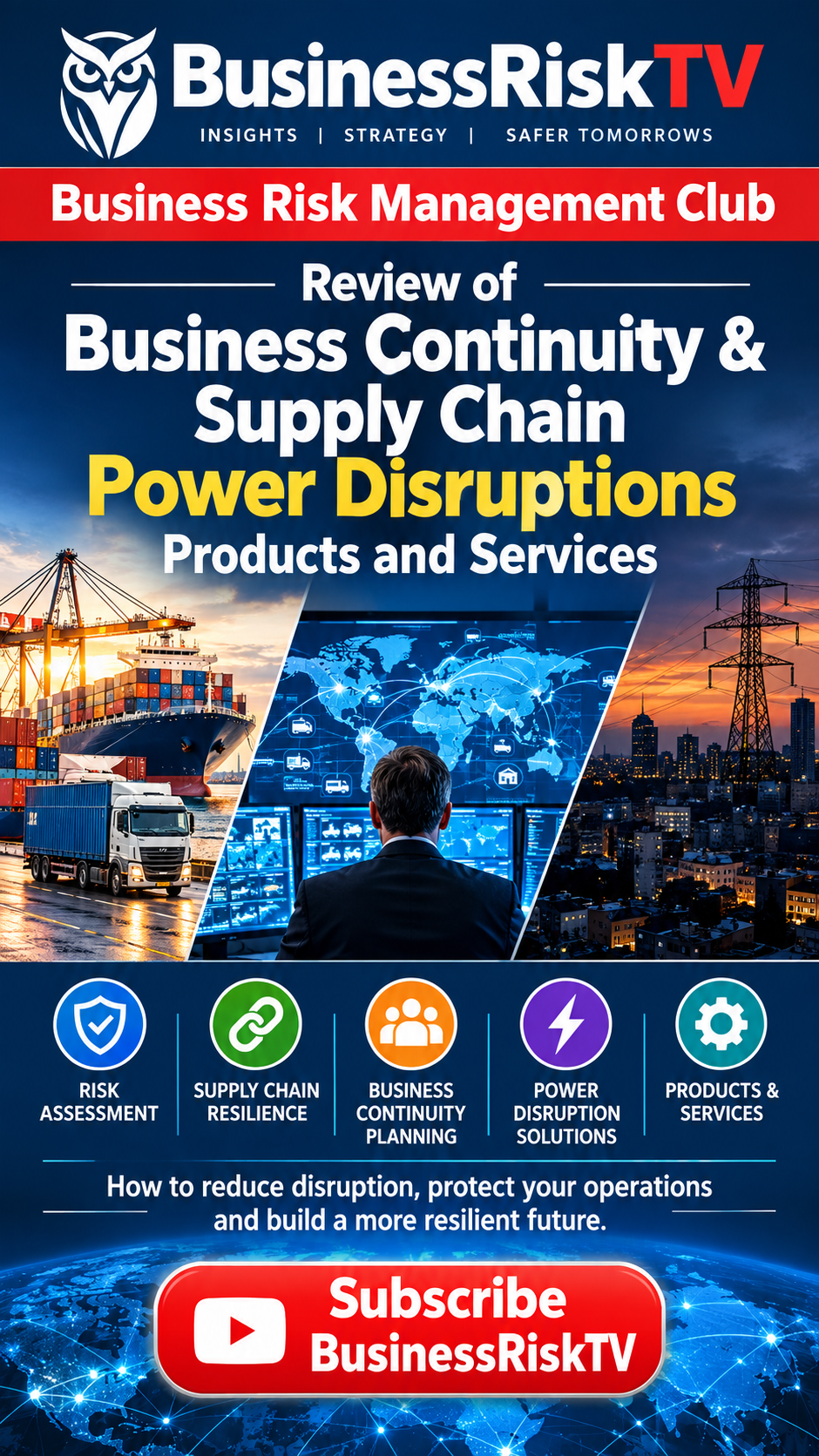
Portable Power Stations for Business Continuity | Jackery 1000 v2

BusinessRiskTV Business Risk Management Club recommends Jackery Solar Generator 1000 v2 for business continuity & supply chain power disruptions. 1070Wh LiFePO4.

BusinessRiskTV recommends Jackery Solar Generator 1000 v2 for business continuity & supply chain power disruptions. 1070Wh LiFePO4, 1500W AC, 1hr fast charge.

“BusinessRiskTV Business Risk Management Club recommends this product as the solution to the problem of business continuity and supply chain power disruptions.”

That recommendation carries weight because it is not made lightly. In 2024 alone, the UK recorded over 18,398 unplanned power outages — a 4.7% increase year-on-year — while more than 80,000 blackouts have occurred since 2021. The Energy Networks Association reported that Storm Darragh left over 2 million homes without power in winter 2024-25, and Storm Éowyn cut electricity to more than one million customers. When UK businesses lost an estimated £3.7 billion in a single year from internet outages alone, and smaller businesses face downtime costs of up to £1,000 per hour, the question is no longer whether a power disruption will affect your operations — it is whether you will be ready when it does.‌

What Happens to Your Business When the Grid Goes Down?

What happens to your business when the grid goes down is that operations stop, revenue halts, and recovery costs escalate — fast. The data paints a stark picture of the exposure UK organisations carry:

  • 14,500 unplanned power outages had already occurred by the end of July 2025, with a projected 30% increase compared to 2024 totals‌
  • The North West alone suffered 50,892 unplanned outages since 2021 — over 1,000 per month‌
  • 88% of businesses without a continuity plan fail within just over a year of a major disruption
  • Only 16% of employees say they have received clear instructions on what to do during a power outage or similar crisisFor mobile operations, pop-up retailers, and field workers, the grid is not a convenience — it is a dependency. When it fails, point-of-sale systems go dark, refrigeration units stop, communications collapse, and stock spoils. One Brighton trader estimated that power cuts were costing his business up to £10,000 on a busy sales day. A town centre in Malvern reported at least 10 outages in 18 months, leaving restaurants and shops repeatedly unable to serve customers.‌The Heathrow substation fire in March 2025 demonstrated that even the UK’s most critical infrastructure — with multiple independent power intakes — can be taken offline by a single point of failure, disrupting over 200,000 passengers and halting supply chains across the nation. The Kelly Review concluded that redundancy alone does not equal resilience.‌”Businesses across the UK are operating in an environment where downtime can have serious financial and reputational consequences. When connectivity, power or systems fail, the impact is immediate.” — Comms Business, 2026

How Can Portable Power Stations Protect Your Business Continuity?

Portable power stations protect your business continuity by providing immediate, silent, emission-free backup power that activates the moment the grid fails. Unlike diesel generators that require fuel storage, ventilation, and regular maintenance, modern LiFePO4 power stations are plug-and-play, require zero ongoing consumable costs, and can be deployed in indoor and outdoor locations without regulatory complications.

The business case is straightforward:

  • Revenue protection: An hour of downtime costs up to £1,000 for smaller businesses. A portable power station that keeps tills, card readers, and lighting operational through a 4-hour outage can pay for itself in a single incident.‌
  • Operational flexibility: Mobile operations, pop-up retail, construction sites, and field teams can run entirely off-grid without trailing cables or noisy generators.
  • Supply chain resilience: When local grid failures disrupt logistics and communications, battery backup maintains the critical systems that keep orders moving and customers informed.
  • Regulatory alignment: The UK government’s National Business Resilience Planning Assumptions explicitly identify power infrastructure failure as a key risk requiring business continuity provisions.The Continuity Forum has warned that “power outages, supply disruptions, flooding, and IT failures carry human and economic costs far beyond what is captured in current regulatory and corporate accountability frameworks”. In other words, the true cost of being unprepared is systematically underestimated by most organisations.

Why Is the Jackery Solar Generator 1000 v2 the Standout Solution?

The Jackery Solar Generator 1000 v2 is the standout solution because it delivers 1,070Wh of LiFePO4 battery capacity, 1,500W AC output (3,000W surge), 100W USB-C output, and a 1-hour fast charge — all in a unit weighing just 23.8 lbs. It is the portable power station that bridges the gap between professional-grade reliability and consumer-friendly portability.

Key specifications:

  • Battery: 1,070Wh LiFePO4 (lithium iron phosphate) — the chemistry used in commercial energy storage for its 4,000+ cycle lifespan, thermal stability, and safety profile
  • Output: 1,500W AC continuous / 3,000W surge, 100W USB-C, multiple DC ports — capable of running fridges, power tools, laptops, lighting, communications equipment, and medical devices
  • Recharge: 1-hour fast charge from mains; solar recharge via the included 100W SolarSaga panel for indefinite off-grid operation
  • Portability: 23.8 lbs with an integrated handle — genuinely transportable by a single person
  • Solar pairing: The 100W SolarSaga panel uses high-efficiency monocrystalline cells and folds for easy transport, enabling true energy independence during extended grid failuresPopular Mechanics testing found that the Explorer 1000 v2 powered a 25-cubic-foot refrigerator for more than 18 hours — a real-world benchmark that translates directly to business continuity for food retail, hospitality, and cold-chain operations. ZDNet’s reviewer described it as falling into the “Goldilocks zone of both price and portability” and a “solid, expandable portable power station” for emergencies and power outages. For RV adventures, van life, and off-grid living, the 100W solar panel provides a sustainable recharge loop. For business deployments — mobile operations, pop-up retail, field engineering, construction — the 1-hour mains recharge means the unit can be back to full capacity during a lunch break.Cost and value for money:
  • The Jackery Solar Generator 1000 v2 with 100W panel has been discounted from £1,199 to £521 — a £678 saving (57% off)
  • Earlier promotional pricing saw the package at £699 (42% discount)
  • With a LiFePO4 lifespan of 4,000+ cycles, the cost per cycle is approximately £0.13–£0.17 depending on purchase price — significantly lower than the cost of even one hour of business downtime
  • No fuel costs, no maintenance contracts, no emissions, no noise — a fraction of the total cost of ownership of a diesel generatorFor context: if a single power outage costs your business just one hour of lost trading at the smaller-business benchmark of £1,000, the Jackery unit pays for itself in fewer than one incident at current pricing.‌”The Explorer 1000 v2, although heavier at 23.8 pounds, ran a fridge for more than 18 hours in our testing… it is about the size of a small beer cooler.” — Popular Mechanics

Who Relies on Portable Power Stations Every Day?

Mobile operations, pop-up retailers, field workers, and office leads rely on portable power stations every day as their emergency power reserve and primary off-grid power source. These are not hypothetical users — they are the businesses that cannot afford a single hour of darkness.

Mobile operations: Food trucks, market stalls, event vendors, and pop-up shops need reliable power for tills, lighting, refrigeration, and sound systems. A 1kWh power station runs a full trading day for most small operations.

Field workers: Engineers, surveyors, agricultural workers, and utility teams operating in remote or rural locations need power for laptops, testing equipment, communications, and lighting. Solar recharge extends deployment indefinitely.

Office leads: Every office needs an emergency power reserve for routers, switches, servers, and communications systems. The Jackery unit can be stored in a cupboard and deployed in seconds — no installation, no electrician, no fuel.

Outdoor and off-grid: RV owners, van lifers, and off-grid dwellers use the Jackery Solar Generator 1000 v2 as their primary power source for cooking, lighting, refrigeration, and device charging. The 100W solar panel provides sustainable recharge in any location with sunlight.

The UK government’s own resilience planning assumes a reasonable worst-case scenario of significant electricity network failure across several regions, with up to 3.5 million customers losing power for up to 24 hours. For businesses in that scenario, the difference between having a Jackery unit and not having one is the difference between operating and closing.

What Do Independent Reviews and Real Users Say?

Independent reviews and real users consistently rate the Jackery Explorer 1000 v2 as one of the best value portable power stations available. B&H Photo Video verified buyers describe it as having “tons of power, great value” and being capable of powering a sound system for over 20 hours — potentially indefinitely with the solar panel. ZDNet named it their favourite entry-level portable power station.”This is one of my favourite cheap portable power stations… Amazon is offering 44% off the Jackery Explorer 1000 v2, bringing the price down to $449 — the lowest we’ve seen it recently.” — ZDNet
The £678 discount currently available on the UK package represents the lowest pricing seen for the Solar Generator 1000 v2 with 100W panel. At this price point, the unit sits firmly in the “no-brainer” category for any business that has ever lost revenue to a power cut — and with outage frequency rising 30% year-on-year, that is a growing proportion of UK organisations.‌

Frequently overlooked benefits for business users:

  • UPS pass-through mode: Some portable power stations can operate in UPS bypass mode, ensuring critical systems maintain power without interruption during the switchover
  • Zero installation cost: Unlike fixed generator installations, portable power stations require no building modifications, no exhaust ducting, and no planning permission
  • Silent operation: Suitable for indoor use in offices, retail spaces, and customer-facing environments where a diesel generator would be impractical or prohibited
  • Expandable: Compatible with additional SolarSaga panels for faster solar recharge and extended off-grid capability

The Bottom Line: What Is Your Business Continuity Plan?

What is your business continuity plan when the grid fails — because the evidence says it will. Over 80,000 blackouts since 2021, rising outage frequency, and a 30% projected annual increase mean that every UK business is exposed. The organisations that survive disruptions are those that planned for them.‌

The Jackery Solar Generator 1000 v2 with 100W Solar Panel delivers 1,070Wh of professional-grade LiFePO4 storage, 1,500W AC output, 1-hour recharge, and true solar independence — all for £521 at current promotional pricing. For less than the cost of a single hour of downtime for many businesses, it provides years of protection.‌

The BusinessRiskTV Business Risk Management Club does not recommend products lightly. This recommendation reflects the reality that UK power infrastructure is under strain, outage frequency is climbing, and the businesses that thrive will be those that treat energy resilience as a core operational requirement rather than an afterthought.

The information is here. The statistics are clear. The product is available. What you do with it is your decision.

Featured Product: Jackery Solar Generator 1000 v2 with 100W Solar Panel, 1kWh Power Station — 1070Wh LiFePO4 Battery, 1500W AC & 100W USB-C Output, 1 Hr Fast Charge for RV Adventures, Van Life, Off-Grid Living

View current pricing and availability

As an Amazon Associate I earn from qualifying purchases

#BusinessContinuityPower
#Jackery1000v2 #BusinessRiskTV #RiskManagement #BackupPower

Get help to protect and grow your business through uncertain times with BusinessRiskTV

Find out more about growing your business faster regardless of business environment 

Subscribe for free business risk management ideas reviews and cost of doing business reduction tips

Connect with BusinessRiskTV for free business risk management tips

Read more business risk management articles and view videos for free

Connect with BusinessRiskTV for free alerts to new business risk management articles and videos 

Your business is one power cut away from collapse. And the UK’s grid is failing more often.

Here’s the data that should scare you.

In 2024, the UK recorded 18,398 unplanned power outages — a 4.7% increase year-on-year. Since 2021, more than 80,000 blackouts have hit British homes and businesses. Storm Darragh left 2 million homes without power. Storm Éowyn cut electricity to over 1 million customers. The Heathrow substation fire in March 2025 disrupted 200,000 passengers and halted supply chains nationwide.

But here’s what most business owners miss: the biggest cost isn’t the outage itself. It’s the supply chain disruption that follows. The tills that go dark. The refrigeration that stops. The card readers that fail. The communications that collapse.

UK businesses lost an estimated £3.7 billion in a single year from internet outages alone. Smaller businesses face downtime costs of up to £1,000 per hour. One Brighton trader estimated power cuts were costing him £10,000 on a busy sales day. A Malvern town centre reported 10 outages in 18 months — restaurants and shops repeatedly unable to serve customers.

And the frequency is climbing. By July 2025, 14,500 unplanned outages had already occurred, with a projected 30% increase compared to 2024.

Now here’s the part that changes everything.

BusinessRiskTV Business Risk Management Club recommends a specific solution for business continuity and supply chain power disruptions. Not a diesel generator. Not a fixed installation. A portable power station that weighs 23.8 lbs, recharges in 1 hour, and runs a fridge for 18+ hours.

The Jackery Solar Generator 1000 v2 with 100W Solar Panel delivers:

  • 1,070Wh LiFePO4 battery — 4,000+ cycles, thermal stability, commercial-grade safety
  • 1,500W AC output / 3,000W surge — runs tills, laptops, lighting, comms, medical devices
  • 100W USB-C output — fast-charges modern devices
  •  1-hour fast charge from mains — back to full during a lunch break
  • 100W SolarSaga panel — indefinite off-grid recharge for field workers, RV, van lifePopular Mechanics tested it: powered a 25-cubic-foot fridge for more than 18 hours. ZDNet called it the “Goldilocks zone of both price and portability.”And the cost? Currently £521 — down from £1,199. That’s a £678 saving. Cost per cycle: £0.13–£0.17. Compare that to £1,000 per hour of downtime. It pays for itself in fewer than one incident.

    The UK government’s own resilience planning assumes a worst-case scenario of 3.5 million customers losing power for up to 24 hours. For mobile operations, pop-up retailers, field workers, and office leads, the difference between having this unit and not having it is the difference between operating and closing.

    We don’t tell you what to do. We just put the numbers side by side.

    If you want to build a power resilience plan for your business, email editor@businessrisktv.com for our free Business Continuity Power Checklist. No pitch. Just the framework we use.

    #BusinessContinuityPower #Jackery1000v2

Portable Power Stations for Business Continuity | Jackery 1000 v2

Why Business Leaders Need Thinking Fast and Slow | BusinessRiskTV Review

Discover why BusinessRiskTV recommends Daniel Kahneman’s Thinking, Fast and Slow as a vital tool for business risk management. Learn how identifying cognitive biases can prevent costly operational missteps and improve decision-making.

Why should business decision makers buy Thinking, Fast and Slow?

Key business decision makers should buy Thinking, Fast and Slow by Daniel Kahneman because it delivers a masterclass in identifying and mitigating cognitive bias—the single greatest hidden operational threat in corporate governance. Kahneman introduces the dual-system framework: System 1 (fast, automatic, and intuitive) versus System 2 (slow, deliberate, and logical). Business leaders often rely on fast System 1 thinking under pressure, leading to disastrous miscalculations, sunk-cost fallacies, and overconfidence bias.

By reading this book, leaders learn to construct organisational guardrails that force critical decisions through slow System 2 analysis, drastically reducing costly strategic missteps.

  • Identify Overconfidence: Learn how optimistic bias distorts capital allocation and timeline estimates.

  • Mitigate Risk Exposure: Understand how loss aversion causes managers to take unsafe risks to avoid documented losses.

  • Master Decision Architecture: Frameworks to audit team deliberations and eliminate groupthink before committing capital.

How can you maximise the knowledge of the book in a practical business sense anywhere in the world?

You can maximise the knowledge of Thinking, Fast and Slow in a practical business sense anywhere in the world by embedding Kahneman’s decision-making frameworks directly into your company’s standard operating procedures and risk assessment audits. Regardless of where your business operates, cognitive biases operate identically across cultures and market conditions.

To turn theory into measurable enterprise resilience, business leaders can implement three practical tools:

  • Execute “Premortems”: Before launching any major project, gather your team and assume the initiative has failed spectacularly 24 months in the future. Ask everyone to write a detailed history of how and why it failed. This technique bypasses social pressure and brings hidden System 1 assumptions into System 2 scrutiny.

  • Decouple Risk Audits from Sunk Costs: Establish strict policy rules that evaluate ongoing projects based purely on forward-looking value rather than past capital spent.

  • Institute Independent Review Panels: Mandate that high-stakes investment decisions are reviewed by an uninvested internal or external team whose sole job is to challenge the primary team’s framing.

Who will benefit from reading Thinking, Fast and Slow the most?

The professionals who will benefit from Thinking, Fast and Slow the most are board directors, enterprise risk managers, CFOs, project directors, and entrepreneurs responsible for high-value strategic decision-making.

  • Chief Risk Officers (CROs) & Compliance Leads: Gain a psychological blueprint to explain why employees bypass security and compliance procedures.

  • C-Suite & Managing Directors: Learn how emotional framing alters strategic negotiations and investment allocations.

  • Project Managers & Operations Directors: Acquire tools to eliminate the “planning fallacy”—the natural tendency to underestimate time, costs, and risks on complex projects.

  • Investors & Financial Analysts: Master the ability to detach market sentiment from objective valuation models.

Why should you buy Thinking, Fast and Slow right now in September 2026?

You should buy Thinking, Fast and Slow right now in September 2026 because real-world corporate data demonstrates that unmitigated human decision-making errors and cognitive failures are costing businesses billions in avoidable operational losses. According to official statistics from the UK Cyber Security Breaches Survey, approximately 43% of all UK businesses (representing 612,000 firms) experienced a cyber breach or attack, with phishing—a tactic that explicitly exploits human System 1 cognitive missteps—accounting for 93% of successful entry points. Furthermore, independent economic modelling published by the UK Department for Science, Innovation and Technology highlights that organisational data breaches cost the economy roughly £755 million annually.

Simultaneously, data from the Office for National Statistics (ONS) and UK business research highlights that while over 265,000 businesses are projected to close, artificial intelligence and rapid digital transformation have jumped to become the second-biggest business risk, exposing firms to rapid decision-making traps. Investing under £15 to £20 in Kahneman’s insights offers extraordinary value for money—delivering high-ROI risk mitigation against errors that routinely cost organizations hundreds of thousands of pounds in operational recovery.

You can purchase the book directly on Amazon here: Buy Thinking, Fast and Slow on Amazon

As an Amazon Associate I earn from qualifying purchases

#BusinessRisk#CognitiveBias

Get help to protect and grow your business faster with BusinessRiskTV Business Risk Management Club

Find out more about business risk management club

Subscribe for free business risk management ideas reviews and cost of doing business reduction tips

Connect with BusinessRiskTV for free business risk management tips

Read more business risk management articles and view videos for free

Connect with BusinessRiskTV for free alerts to new business risk management articles and videos

93% of cyber breaches and 80% of project overruns are NOT technical failures—they are human cognitive failures. 🚨

If you think your C-suite makes rational strategic decisions, 499 pages of Nobel Prize–winning behavioural economics prove you are dead wrong.

Most CEOs, CFOs, and Risk Officers believe they analyse risk logically. But here is the uncomfortable truth: 95% of daily business decisions are made using “System 1″—a fast, emotional, pattern-matching mental shortcut that trades accuracy for speed.

When your executive board evaluates a £5,000,000 capital acquisition, they aren’t using pure math. They are falling victim to:

  1. Loss Aversion: Pain feels 2.0x to 2.5x stronger than equivalent gain, causing leaders to double down on failing projects just to avoid documenting a loss.

  2. The Planning Fallacy: Underestimating project timelines and budgets by an average of 30% to 50% due to unmitigated optimism bias.

  3. Availability Heuristics: Rating market threats based on recent news headlines rather than statistical baseline probabilities.

(Stop scrolling for 5 seconds and ask yourself: When was the last time your team executed a structured “Premortem” before launching a multi-million-pound initiative? If the answer is “never,” you are operating on raw intuition.) ⬇️

Here are 3 concrete protocols you can implement this week to override System 1 errors in your governance structure:

  • The 24-Month Premortem: Before signing off on any major investment, gather key stakeholders. Assume the project failed catastrophically 2 years from now. Have each director write a 5-minute report explaining why it failed. This destroys groupthink instantly.

  • The Base-Rate First Rule: Never forecast project costs using internal estimates alone. Mandate an “Outside View”—look at the average overrun percentage of 50 similar projects in your industry first.

  • Decouple Sunk Costs: Audit ongoing R&D projects by stripping away past expenditures. Evaluate future funding exclusively on forward-looking cash flows.

Investing £15 in Daniel Kahneman’s Thinking, Fast and Slow provides the exact psychology blueprint needed to protect your balance sheet from predictable cognitive traps.

Ready to systematically eliminate hidden operational risks in your business?

📩 Email editor@businessrisktv.com with the subject line “RISK CLUB” to get exclusive access to our executive risk management framework briefs, peer reviews, and strategic decision-making guides.

Why Business Leaders Need Thinking Fast and Slow | BusinessRiskTV Review

Risk Management Rebels: Better Business | BusinessRiskTV

Join BusinessRiskTV & LinkedIn Risk Management Online. Risk rebel insights for key risk owners. Manage business risks better. Email editor@businessrisktv.com.

For key risk owners and risk management rebels: use better risk questions, lateral thinking, and the Risk Management Online LinkedIn group to manage business risks better, improve business performance, and increase personal reward. Email editor@businessrisktv.com to engage.

BusinessRiskTV Business Risk Management Club recommends joining this club and Linkedin Risk Management Online group as the solution to the problem of managing business risks better to boost business performance in uncertain world.

If you are one of the crazy ones, a misfit, a risk management rebel who refuses to accept that “that’s just how it’s always been done,” then this is your invitation. Research from PwC’s 2024 Pulse Survey reveals that companies embracing advanced risk strategies have cut the financial impact of disruptions by 20% while boosting operational efficiency by 15%, and Deloitte’s 2024 Global Risk Management Survey shows that firms with robust risk governance are 25% more likely to outpace competitors in revenue growth. We are building a network of people who manage business risks better for better business performance and increased personal reward. The Linkedin Risk Management Online group is waiting for you:

https://www.linkedin.com/groups/2324725

Why Is Business Risk Management Information Critical to Better Business Decisions and Performance?

Business risk management information is critical to better business decisions and performance because organisations that invest in risk maturity consistently demonstrate improved financial performance and resilience. Enterprise risk management is not a bureaucratic checkbox exercise; it is the operating system of a business that intends to survive the Fourth Turning. ISO 31000, the international standard for risk management, explicitly states that risk management creates and protects value, contributes to the demonstrable achievement of objectives, and drives decision making that improves business performance. The World Economic Forum’s Global Risks Report 2026 emphasises that interconnected economic, environmental, geopolitical, societal, and technological risks demand a fundamental rethink of how organisations approach resilience and strategic planning, a warning echoed by the UK Government Internal Audit Agency’s guidance on early warning signs in public sector bodies.

The numbers tell a story that most boardrooms are still not hearing clearly enough:

  • Organisations with higher risk maturity levels consistently demonstrate improved financial performance.
  • A study of 11,285 firm-year observations using the COSO ERM framework found that ERM implementation is positively associated with both return on assets (ROA) and Tobin’s Q, with a stronger relationship observed for financial performance.
  • Cross-industry research reveals that supply chain disruptions can cost companies 6–10% of annual revenues, yet organisations with proactive risk management systems can significantly reduce this exposure.
  • The average cost of a single data breach is now $4.88 million, and IBM has found that companies implementing AI security tools can cut their losses by $2.2 million.
  • Organisations that fail to comply with data regulations face costs averaging $14.8 million annually, compared to just $5.4 million for those who maintain compliance.

Why does this matter for the person responsible for managing risks?

Because you are the key risk owner. You are the responsible person. When the board asks why the business is exposed, the answer starts with you. But here is the liberating truth: managing risk well is not about eliminating uncertainty. It is about navigating it with clear eyes, better information, and a network of people who have faced the same storm.

What Is the Fourth Turning Telling Us About the Problems We Face Now and in the Near Future?

The Fourth Turning is telling us that we are living through a Crisis period, a once-in-a-lifetime turning where the institutions and assumptions that stabilised the previous decades are being openly discarded. Neil Howe and William Strauss’s framework, laid out in their 1997 book The Fourth Turning, describes four generational turnings that repeat across roughly 80-to-100-year cycles: the High, the Awakening, the Unraveling, and the Crisis. According to Ben Spievak of SVRN, we are currently in the Crisis window, which he places between 2020 and 2045 — a period where markets reprice, institutions are tested, and the foundation for the next hundred years gets laid.

What does this mean for business risk management?

  • Old assumptions are breaking. The rules of the game are being rewritten. What worked in the Unraveling — efficiency, optimisation, predictable supply chains — may not work in the Crisis.
  • Institutional trust is fragile. As one analysis of The Fourth Turning puts it, “History warns that a Crisis will reshape the basic social and economic environment that you now take for granted”.
  • Volatility is not noise; it is signal. In the Fourth Turning framework, what looks like instability is often the market finding a new price, a recalibration around what value means in a world operating on a different set of assumptions.
  • Crisis is an incubator. A crisis period is not the end of anything — it is the phase where the decisions made today carry outsized weight for the next century.

This is the context in which you, as a risk owner, must make decisions. Not with perfect foresight — that has never existed — but with a framework that helps you distinguish between preventable risks, strategic risks, and external risks. Harvard’s Kaplan and Mikes framework, cited in strategic risk analysis, offers exactly this practical approach: turn preventable risks into advantages, use strategic risks to open new markets, and build resilience against external risks you cannot control.

The danger is not just the things we don’t know. It is the things we think we know for sure.

Why Do Risk Management Rebels, Misfits, and Crazy Ones Need to Step Forward Now?

Risk management rebels, misfits, and crazy ones need to step forward now because the conventional risk management playbook — the one built for a stable, predictable world — is failing in the Crisis. Research on “positive deviants” in organisations shows that rebels with a cause often spark the innovations that established paradigms cannot produce, and that suppressing these individuals backfires because people judge proposed innovations on whether they agree with the established paradigm rather than their ability to create new paradigms. A study of NASA’s mission control renegades found that rebels create novel solutions, revitalise innovation, and future-proof businesses.

Why do we need you specifically?

  • Because the old model of risk management is defensive. It treats risk as an enemy to avoid rather than a force to wield. PwC’s 2023 CEO Survey reveals that 56% of CEOs believe taking risks is essential for growth, yet many frameworks are still designed to mitigate exposure rather than capitalise on opportunities.
  • Because only 26% of executives believe their risk management aligns with business strategy, according to Deloitte’s 2023 Global Risk Management Survey. That gap is not a statistic. It is an opportunity.
  • Because lateral thinking is the only way through. The problems we face — geopolitical fragmentation, technological disruption, climate instability, supply chain fragility — do not have precedents. They require innovative solutions, and innovation requires making some mistakes. That is not a flaw in the process. It is the process of improvement.
  • Because uncertainty is not a problem to be solved. It is the condition of being alive or in business. Alan Watts wrote that “the desire for security and the feeling of insecurity are the same thing. To hold your breath is to lose your breath”. The tighter you grip the need to know exactly how everything will turn out, the more anxious you become. The looser you hold it, the more spacious your business decisions feel.

You do not need to know how the story ends to enjoy the chapter you are in with your business. Let yourself be a beginner. Let yourself not have all the answers. Let yourself be in the process of finding the right answers for your business.

What Can Members of BusinessRiskTV and the Risk Management Online Group Expect from Membership?

Members of BusinessRiskTV and the Risk Management Online group can expect a practitioner-driven community where real risk owners share frameworks, warnings, and wins without the corporate jargon that hides more than it reveals. This is not a passive content feed. It is a working network.

What you can expect:

  • A community of people who think differently. We are not looking for consensus. We are looking for the people who ask the uncomfortable question in the meeting, the ones who see the risk nobody else has noticed yet.
  • Practical risk intelligence. Discussions on emerging risks, regulatory changes, geopolitical shifts, and technological disruptions that affect your business decisions.
  • Peer-to-peer support. When you are the responsible person and the board is asking questions you are not sure how to answer, this is where you find people who have been there.
  • Frameworks that work. From ISO 31000 to COSO ERM to Kaplan and Mikes’s risk categories, we share the tools that actually help you make better decisions, not just fill in a risk register.
  • A space to test your thinking. Before you take a controversial risk decision to your executive team, test it here. The misfits and rebels in this network will tell you what you are not seeing.

What we are not:

  • A sales channel.
  • A compliance checkbox.
  • A place for people who want to be told what to do.

Who Is Most Likely to Benefit from Membership, and When?

The people most likely to benefit from membership are the key risk owners, responsible persons, business owners, risk managers, compliance officers, executives, and consultants who are accountable for outcomes and who feel the weight of uncertainty pressing on their decisions right now. You benefit most when you are at an inflection point — when a major decision is in front of you, when a crisis has just hit, when the board has asked you a question you cannot answer alone, or when you sense that the ground beneath your business is shifting but you cannot yet see the shape of what comes next.

You are likely to benefit the most if you are:

  • A business owner or founder who carries the full weight of risk without a large risk function behind you.
  • A risk manager or compliance officer who knows the frameworks but needs strategic context to make them real.
  • An executive or director who is accountable for decisions in a Fourth Turning environment and needs better information.
  • A consultant or advisor who helps organisations navigate uncertainty and wants to sharpen your own thinking alongside practitioners.
  • Anyone who has ever been called “difficult” or “negative” for pointing out the risk nobody else wanted to see.

When do you benefit?

Immediately. The moment you join, you gain access to a network that is already discussing the problems you are facing. You do not need to wait for a conference, a training programme, or a quarterly report. The benefit begins with the first conversation you read, the first question you ask, the first connection you make.

Why Should Someone Responsible for Managing Business Risks Join This Network to Inform Their Own Business Decision Making as a Key Risk Owner?

Someone responsible for managing business risks should join this network because no single risk owner, however experienced, can see every angle of every threat and opportunity, and the Fourth Turning demands collective intelligence. The Harvard Business Review has repeatedly found that diverse teams make better decisions, and the same principle applies to risk networks: the person who has managed a supply chain crisis in Southeast Asia may hold the key to your procurement problem in Europe.

But here is the reason we most want you to hear:

  1. You are the key risk owner. The decision is yours to make. But you do not have to make it alone.
  2. Deloitte’s survey highlighted that companies with a proactive GRC approach were 50% more likely to maintain their reputation during crises, and PwC found that organisations with effective GRC strategies saw a 50% reduction in the frequency of risk events. Those outcomes are not the product of better software alone. They are the product of better conversations between people who take risk seriously.

What can you expect from the network?

  • Access to a global community of practitioners who bring perspectives from different industries, cultures, and regulatory environments.
  • Real-time discussion of emerging risks as they develop, not after the post-mortem.
  • A place to ask the question you cannot ask in your own organisation without signalling weakness or uncertainty.
  • Frameworks and mental models that help you structure your thinking when the data is incomplete.
  • The reminder that uncertainty is the condition of being in business, and that navigating it with curiosity rather than fear is not just possible — it is the most rewarding way to work.

How Can You Engage with BusinessRiskTV and the Risk Management Online Group for Your Own Benefit?

You can engage with BusinessRiskTV and the Risk Management Online group by joining the LinkedIn community, introducing yourself honestly, and participating in the conversations that matter to your business. You can be anywhere in the world and still benefit from membership because the network is distributed, asynchronous, and built for practitioners who are already busy managing real risks.

How to engage for your own benefit:

  • Join the LinkedIn group: https://www.linkedin.com/groups/2324725
  • Introduce yourself with a real problem. Do not sell. Do not posture. Tell the group what you are facing and what you need.
  • Answer someone else’s question. The fastest way to sharpen your own risk thinking is to help someone else structure theirs.
  • Bring your misfit perspective. If you see something the group has not noticed, say it. That is why you are here.
  • Stay curious. The Fourth Turning is not a doom prophecy. It is a framework for understanding the times we are in, and frameworks are only useful if they are used.
  • Share what you are learning. Your failures are as valuable as your wins. The network grows stronger when we are honest about both.

The invitation is simple:

We are looking for the crazy ones, the misfits, the risk management rebels. The people who understand that certainty is a story we tell ourselves and that real security comes from the capacity to adapt, not the illusion of control. If that sounds like you, join us.

Join BusinessRiskTV Business Risk Management Club. Join the Risk Management Online LinkedIn group. Manage business risks better for better business performance and increased personal reward.

The story is still being written. You do not need to know how it ends to be part of the chapter that matters. Join Business Risk Management Club here or join the LinkedIn group:

https://www.linkedin.com/groups/2324725

Get help to protect and grow your business faster with BusinessRiskTV

Find out more about growing your business faster with less uncertainty with BusinessRiskTV 

Subscribe for free business risk management ideas risk reviews and cost of being in business reduction tips

Connect with BusinessRiskTV for free business risk management tips

Read more business risk management articles and view videos for free

Connect with BusinessRiskTV for free alerts to new business risk management articles and videos

Risk Rebels: Manage Business Risks Better | BusinessRiskTV

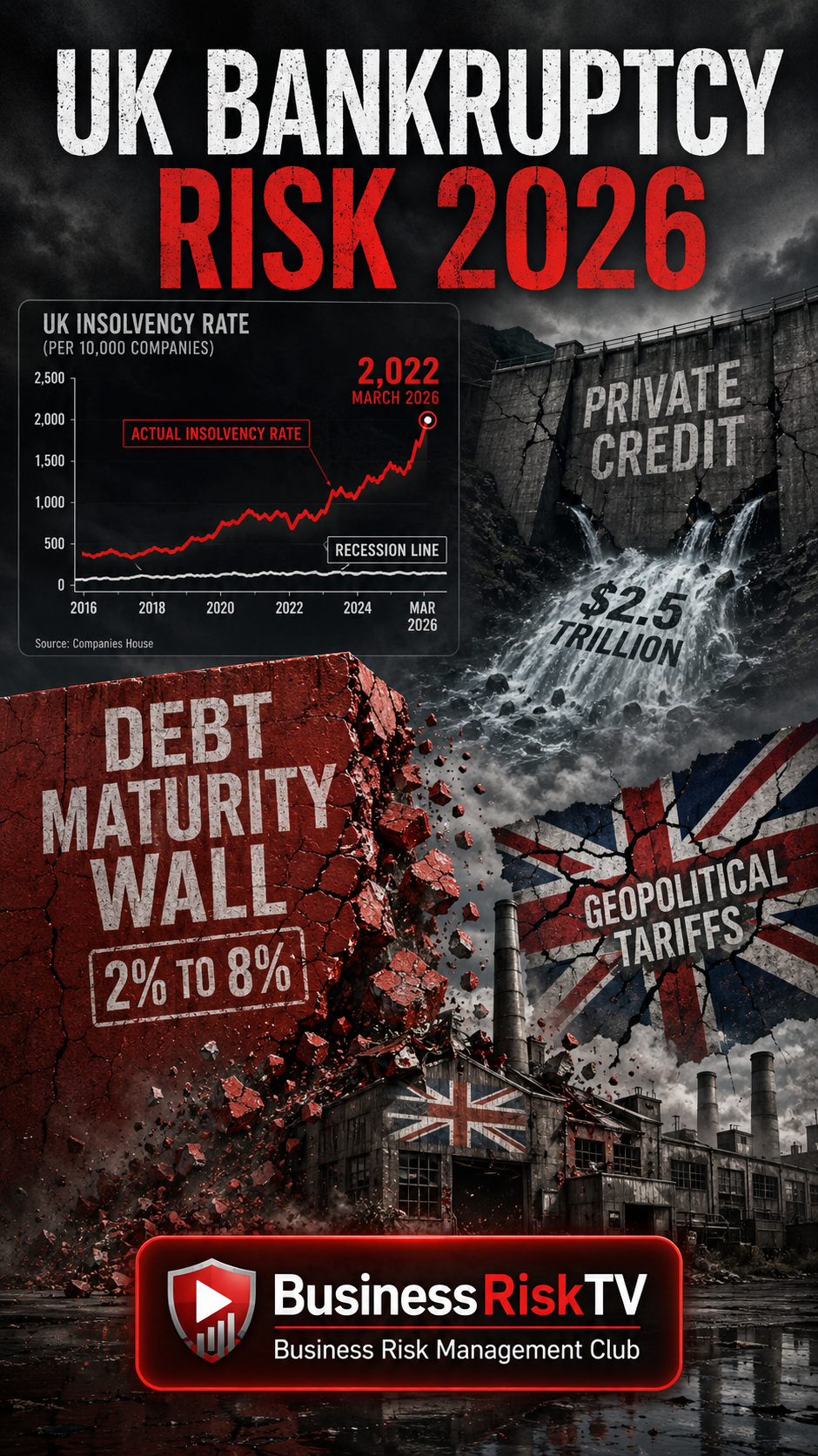
UK Bankruptcy Crisis 2026: Why Debt Maturity, Private Credit Fears & Tariffs Are Killing Businesses (12 Steps to Survive)

In 2026, UK business insolvencies are near 30-year highs. With 2,022 companies folding in March alone, leaders face a triple threat: maturing debt at 8% rates, a looming private credit crash warned of by the Bank of England, and geopolitical tariff shocks. This guide reveals 12 risk management steps to stop your business going bankrupt, including refinancing strategies, HMRC defence tactics, and supply chain shifts to survive the 2026 liquidity crunch.

Stop guessing about bankruptcy. Join the Business Risk Management Club today.

The average cost of a mid-sized company insolvency is £90,000 in director losses. The cost of our club membership? Less than a cup of coffee a day.

3 Facts to Back Up Our Value:

1. Cost: We charge £49.99 per month for full access (introductory deals available for limited time). An insolvency practitioner charges £350+ per hour.
2. Speed: Members get 24/7 access to alternative risk reviews. Banks and risk analysts take  weeks.
3. Certainty: We provide real-time geopolitical risks; majority of failed businesses didn’t see the shock coming before too late.

—

Why Should UK Business Leaders Be Worried About Bankruptcy in 2026? (The “Triple Lock” Crisis)

Why UK business leaders should be worried about bankruptcy in 2026 because insolvencies are currently near a 30-year high due to a “triple lock” of debt maturity cliffs, geopolitical trade wars and geopolitical risks, and a hidden private credit crash.

We are not in a normal recession; we are in a debt maturity trap. In March 2026 alone, England and Wales recorded 2,022 company insolvencies, matching the peak levels of the 2008 financial crisis . For a 10-year-old: Imagine borrowing a toy for a week, but when you try to return it, the shop says you now owe 10 times the price, and your pocket money just got cut because your friends are fighting far away. That is 2026.

Are Maturing Debt Instruments the #1 Cause of UK Business Bankruptcies Right Now?

Yes, maturing debt instruments taken out at 2% that are maturing at 8% rates are the single biggest driver of cash flow collapse in the UK in 2026 because refinancing has dried up for the mid-market.

UK borrowing costs hit their highest levels since 1998 recently, with 30-year gilt yields hitting 5.78% . For a 10-year-old: You borrowed £1 to buy lemonade supplies, promising to pay back £1.02. Now, the bank says you must pay back £1.15. If you don’t have that extra 13p, your lemonade stand is gone.

How Do Geopolitical Changes and Tariffs in 2026 Hurt My UK Supply Chain?

Geopolitical changes in 2026, specifically the Iran conflict and the UK-US trade deal delays, are forcing costs up by up to 20% for importers, strangling margins just as debts come due.

The UK just signed a $5 billion Gulf trade deal to bypass Iran war fallout, but the US remains rocky . UK Parliament admits the US deal is “not yet delivering growth” as tariffs fragment the global system . For a 10-year-old: Your favourite toy is made across the street. If the street gets blocked by a fight, you have to fly a helicopter to get the toy. That helicopter costs more than the toy.

Is the “Private Credit” Market Really Drying Up for UK Businesses in 2026?

The threat of credit drying up is real because the Bank of England has warned that the $2.5 trillion private credit market has “echoes of the Great Financial Crisis” and has never been tested at this scale.

Deputy Governor Sarah Breeden explicitly stated that a “private credit crunch” is coming where funds are “gated” (locked) . The House of Lords reports that SME finance has been “squeezed” because banks retreated after 2008 and private credit is now freezing . For a 10-year-old: You usually borrow money from a rich friend. But that friend is suddenly broke and hiding under their bed. Now nobody will lend you the money to buy your lunch.

Are These the Most Common Causes of Bankruptcy in the UK Right Now (2026 Stats)?

Yes, these are the most common causes, but rising employment costs and HMRC aggression are the “silent killers” pushing the UK toward the highest bankruptcy rate in 20 years.

In 2025, an estimated 288,018 UK businesses failed (roughly 5% of all firms) . The construction sector accounts for 17% of all insolvencies due to material costs, while retail is collapsing due to wage bills . The UK is seeing the highest rate of bankruptcies since the early 1990s, driven not just by debt, but by the Employment Rights Act 2025 which doubles redundancy costs .

—

🛡️ 12 Business Risk Management Steps UK Business Leaders Should Take Today

To avoid joining the 2,000+ companies failing monthly, execute these steps immediately:

1. Refinance NOW, not later.
· Action: Approach challenger banks (e.g., Shawbrook, OakNorth) before your current loan matures. Lending growth has slowed to 4.5%, get in the queue now .
2. Stress test for 10% Interest Rates.
· Action: Model your cash flow assuming base rates hit 8%. If you break, cut costs today.
3. Audit your “Phantom Stock”.
· Action: Check supplier contracts for geopolitical escalation clauses. If they aren’t there, add them for the Iran/Gulf fallout .
4. Diversify away from US supply chains.
· Action: Shift 30% of sourcing to the new GCC trade deal partners (UAE, Saudi) to bypass US tariffs .
5. Invoice factoring for immediate cash.
· Action: Sell your unpaid invoices. With credit drying up, cash in hand is king.
6. The “Credit Committee” meeting.
· Action: Hold a weekly 15-minute meeting to check if your customers have issued winding-up petitions. Don’t sell to companies about to go bust .
7. Prepare for Employment Rights Act 2025.
· Action: Set aside a specific fund for “protective awards” (now 180 days pay) before making redundancies .
8. HMRC negotiation strategy.
· Action: HMRC is taking aggressive debt action. Do not ignore their letters; agree on a Time to Pay arrangement before they file a winding-up petition.
9. Invest in Internal Controls (Governance).
· Action: Under the new UK Corporate Governance Code (Jan 1 2026), directors are personally liable for “material weaknesses” in financial controls .
10. Explore a CVA before it’s too late.
· Action: Company Voluntary Arrangements (CVAs) are up 29% year-on-year. Use them to bind creditors to a reduced payment plan before you run out of cash .
11. Cancel the “Golden Quarter” overspend.
· Action: Consumer spending is dropping . Do not stockpile inventory unless it is paid for.
12. Join an Early Warning System.
· Action: Use data providers to see if your bank is increasing “expected credit losses” (like HSBC did with $1.3bn) – this means they will stop lending to you .

Get help to protect and grow your business faster regardless of business environment with help from Business Risk Management Club

Find out more about business risk management club

Subscribe for free business risk alerts risk reviews and cost of business in business reduction tips

Connect with BusinessRiskTV for free business risk management tips

Read more business risk management articles and view videos for free

Connect with BusinessRiskTV for free alerts to new business risk management articles and videos

#UKBankruptcy2026 #BusinessRiskManagement #PrivateCreditCrunch #BusinessRiskTV #RiskManagement

Additional Tags: UK Insolvency Statistics 2026, Maturing Debt Risk, Private Credit Market UK, Bank of England Warning 2026, Geopolitical Tariffs UK, Supply Chain Disruption, Business Risk Management Steps, Avoid Bankruptcy UK, UK Interest Rates 2026, Corporate Governance Code 2026.

⚠️ Important Legal Notice:
I am not a licensed insolvency practitioner or financial advisor. The above information is for educational purposes based on current data trends. For specific legal or financial advice regarding your business, you must consult a qualified professional like those found via the BusinessRiskTV.com network.

UK Bankruptcy Crisis 2026: Why Debt Maturity, Private Credit Fears & Tariffs Are Killing Businesses (12 Steps to Survive)

UK North Sea Self-Sufficiency: A Risk Analysis for Winter 2026 Costs

Can the UK drill its way to lower energy costs by 2026? We analyze new data on untapped reserves and the 6 policy steps needed to protect UK businesses from the 2026 energy crisis.

Can North Sea “Self-Sufficiency” Save UK Businesses by Winter 2026?

The debate over UK energy has shifted from “if” we should drill to “how fast” we can unlock existing discoveries. With new data from the Business Risk Management Club and industry analysts, we examine if a policy U-turn can insulate the UK from the global energy crisis by the end of 2026.

At BusinessRiskTV, we advocate for evidence-based risk management. To back up our claim on the value of domestic energy security:


Could “Self-Sufficiency” become a reality by 2026?

Self-sufficiency is mathematically possible if the UK government accelerates the 111 pending projects identified by OEUK, which represent £50 billion in potential investment. While reaching 100% independence by Winter 2026 is an ambitious “stretch goal,” moving the needle from 43% domestic supply to over 60% would significantly decouple the UK from the most volatile global “spot price” spikes.

“Untapped UK domestic gas reserves are double previous government estimates; for as long as the nation requires gas, it is in the national interest to produce it at home to ensure industrial security.” — Offshore Energies UK, February 2026 Report

Will new licenses actually lower business energy costs by Winter 2026?

New licenses and the activation of discovered sites like Rosebank and Jackdaw can lower business costs by providing the government with the fiscal “Energy Dividend” needed to freeze commercial price caps. While the “unit price” of gas is global, the Energy Profits Levy (EPL) and the new 2026 Oil and Gas Price Mechanism allow the Treasury to capture windfall gains and recycle them directly into VAT cuts for business energy.

  • Statistical Reality: In 2025, the UK paid an estimated £22 billion more for energy than it would have if it had maintained 2014 levels of domestic production.

  • The “Price Taker” Myth: While we are price takers, the £50 billion in potential tax revenue from new drilling could theoretically fund a 30% reduction in business energy standing charges if policy shifts today.

Can a policy change today realistically impact the 2026/2027 Winter?

A policy change today can impact Winter 2026/2027 by focusing on “Tie-Backs” and “Transitional Energy Certificates,” which allow production to start in months rather than years. By utilising existing infrastructure, the UK can “hook up” discovered but capped wells. This avoids the 10-year lead time of new exploration and provides an immediate supply cushion for the upcoming 2026 crisis.


Conclusion: 6 Steps the UK Government Needs to Take Today

To make this policy shift work by the end of 2026, the Government must execute these steps immediately:

  1. Activate “Transitional Energy Certificates”: Grant immediate approval for all “near-field” tie-backs where gas is already discovered and infrastructure is in place.

  2. Replace EPL with a Fixed Price Floor: Move from the volatile Windfall Tax to a Permanent Price Mechanismto give operators the 10-year certainty required to dump capital into the North Sea now.

  3. Streamline Environmental Impact Assessments (EIAs): Implement a “Fast-Track” regulatory lane for projects that can be operational by October 2026.

  4. Ring-fence the “Drilling Dividend”: Legally mandate that 100% of new tax receipts from these licenses are used to offset business energy network costs for the 2026/2027 winter.

  5. End the New Licensing Ban: Formally reverse the November 2025 ban to signal to global capital markets that the UK is “open for energy business.”

  6. Direct-to-Industry Contracts: Facilitate “Power Purchase Agreements” (PPAs) between North Sea producers and UK energy-intensive industries to bypass global market markups.

#EnergyIndependence #NorthSeaGas #UKBusiness2026 #BusinessRiskTV #RiskManagement

Get help to protect and grow your business faster with BusinessRiskTV

Find out more about growing your business faster through any business environment with BusinessRiskTV 

Subscribe for free business risk management ideas risk reviews and cost reduction tips

Connect With BusinessRiskTV for free business risk management tips

Read more business risk management articles and view videos for free

Connect with BusinessRiskTV for free alerts to new business risk management articles and Risk Business for free videos

They told you the North Sea was “running on empty.” They lied! 🛑🛢️

New 2026 data reveals the UK is sitting on 456 billion cubic metres of untapped gas. That’s 6 YEARS of total self-sufficiency—so why are your business energy bills still sky-high?

We’ve been told for years that new drilling takes “decades” to help. But the risk analysts at BusinessRiskTV just pulled the curtain back.

If the government acts TODAY, “Tie-Back” technology can have new domestic gas flowing into the grid before the snow hits in Winter 2026.

Here is the 2026 Energy Paradox:
🔹 We have the gas.
🔹 We have the infrastructure.
🔹 We have the business need.
…Yet we are importing 4-times more carbon-intensive LNG from overseas at premium prices.

This isn’t just an environmental issue; it’s a Business Risk Management failure. By refusing to unlock our own reserves, we are choosing to export UK wealth to foreign regimes while our own SMEs struggle to keep the lights on.

The “Drilling Dividend” could fund a massive relief package for every UK business—but only if the policy shift happens before the end of the year.

Think the UK is a “price taker” with no control? Wait until you see Step 6 of our survival plan. It reveals how we can bypass global market markups entirely to save UK industry.

Don’t let your business be a victim of policy gridlock. Get the full 2026 Risk Analysis now.

#EnergyIndependence #NorthSeaGas #UKBusiness2026 #BusinessRiskTV #RiskManagement

UK North Sea Self-Sufficiency: A Risk Analysis for Winter 2026 Costs

The 2026 Silver Crisis: COMEX Default Risk, China Export Ban & 9 Strategies for Business Leaders

As the March 2026 COMEX silver交割 approaches, global business leaders face a critical liquidity event. Combined with China’s export ban on silver and surging industrial demand, the risk of a physical silver default threatens to disrupt financial markets and supply chains. Discover 9 risk management measures to protect your business.

Undertaking a Business Risk Analysis of the COMEX Silver Supply Crisis of March 2026

For business leaders around the world, the convergence of three distinct market forces has created a “perfect storm” in the silver market. Unlike previous commodity cycles driven by speculation, the current crisis is structural. It is defined by the shutdown of accessible physical silver from traditional channels, a strategic shift in Chinese trade policy, and an insatiable, non-negotiable industrial demand.

This analysis serves as a business risk management framework to understand the threat, timeline, and strategic responses required to navigate the potential financial contagion stemming from the COMEX market in March 2026.

The Core Problem: The Triad of Risk in 2026

To understand why this is not a typical price fluctuation, business leaders must dissect the three pillars of the current crisis.

1. The COMEX Delivery Crisis and March 2026 Risk Event

The most immediate and systemic threat lies within the New York Commodities Exchange (COMEX). Historically, the COMEX is a “paper” market, where futures contracts are settled financially far more often than with physical metal. However, data from January 2026 reveals a seismic shift. In a traditionally quiet month, over 40 million ounces of silver were requested for delivery, compared to the usual 1-2 million ounces .

Analysts warn that as the critical March delivery month approaches, total delivery requests could reach 70 to 80 million ounces. This would nearly deplete the COMEX registered inventory of just 110 to 120 million ounces . The major risk event is a default by the COMEX on physical delivery. This would shatter the credibility of the paper pricing mechanism, leading to a violent repricing of silver and a flight to quality that could freeze credit markets .

2. China’s Strategic Embargo on Silver Exports

Effective January 1, 2026, China implemented stringent export controls on silver, licensing only 44 companies to export and effectively treating the metal with the same strategic importance as rare earths . China is not just a major producer; it accounts for roughly 70% of the globally traded refined silver market .

This “ban” creates a supply vacuum. While the West views silver as a commodity, China views it as a strategic resource critical for its dominance in solar panels, EVs, and AI infrastructure . This action effectively diverts physical supply away from Western markets and locks it into Chinese industrial expansion. Elon Musk’s public response—”This is not good”—underscores the critical nature of this disruption for US and European supply chains .

3. The Industrial Demand “Trap”

Silver is no longer just a precious metal; it is the “industrial vitamin.” It is indispensable for solar panels, electric vehicles, AI data centres, and 5G infrastructure . The market is heading for its sixth consecutive year of structural deficit .

Unlike investors who can leave the market, industrial consumers cannot stop buying. They must have physical silver to keep production lines running. This creates a demand inelasticity that fuels a scramble for physical metal. Even if high prices eventually cause some “thrifting” (using less silver) in sectors like solar, the immediate demand pipeline is rigid .

The Risk: Shutdown of Access to Physical Silver

The shutdown of access is happening on two fronts simultaneously.

  • Price Discovery Failure: If COMEX defaults in March, the “paper” price (used by banks and funds for valuation) will become detached from the physical price (what manufacturers actually pay). We are already seeing this bifurcation, with physical coins trading at 50-80% premiums in some markets.
  • Liquidity Freeze: Banks and financial institutions that lend against silver or use it as collateral will face a crisis of valuation. If they cannot reliably price or obtain physical metal to cover positions, they will pull credit lines from the very industries that need it most .

Why This is Critical to Business Leaders and Financial Markets

The contagion from a silver default will not stay contained within the commodities desk. It will spread to the wider financial markets. A default at COMEX would trigger margin calls across the complex, forcing liquidations of other assets to raise cash. It would undermine confidence in all paper commodity markets, potentially leading to a credit crunch .

For business leaders, this translates to:

  1. Input Cost Volatility: Unpredictable and rising costs for any product using electronics, batteries, or solder.
  2. Supply Chain Unreliability: Suppliers may simply stop quoting prices or fail to deliver on contracts due to an inability to source metal.
  3. Working Capital Strain: As seen in India’s “Silver City” of Khamgaon, manufacturers face acute shortages, forcing them to lock up disproportionate working capital in buffer inventories or face shutdowns .

When Will the Major Risk Event Happen?

The primary date for concern is March 2026. The COMEX March contract is a major delivery month. As the delivery date approaches in late February and early March, the pressure on holders of short positions (those who sold silver they don’t physically have) will become intense. If they cannot source the metal, the exchange faces a default scenario . Business leaders should be prepared for extreme volatility beginning in the last week of February and peaking in mid-March.

Who is Most Likely to Be Affected by Risk Events?

While the impact is broad, certain sectors are on the front line:

Where in the World Will Have the Biggest Business Risk Impacts?

  • North America and Europe: These economies are heavily dependent on imports of refined silver and are most exposed to the COMEX default risk and the cutoff of Chinese supply.
  • India: As a major importer of silver for both jewellery and industry, India is experiencing severe price sensitivity and liquidity stress in its processing hubs.
  • Asia (ex-China): Economies reliant on Chinese refined silver will face logistical delays and higher costs as they scramble to diversify suppliers .

9 Business Risk Management Measures to Take Today

To protect and grow your business through the coming volatility, leaders must move from passive observation to active defense.

Measure 1: Audit Your Silver Supply Chain Deeply
Map your supply chain beyond Tier 1.

Identify where silver is embedded in components and which of your suppliers are exposed to spot markets. You need to know if your key supplier is one of the 44 licensed Chinese exporters or if they rely on COMEX paper.

Measure 2: Secure Supply-Linked Financing

Move away from spot purchases. Secure long-term supply arrangements directly with producers or through offtake agreements. As seen with Samsung and Silver Storm Mining, tying working capital to contracted silver flows provides price and supply visibility .

Measure 3: Build Strategic Buffer Inventories

In a deficit market, just-in-time inventory is a high-risk strategy. Increase your buffer stocks of silver-intensive components now, even if it strains working capital. The cost of holding inventory is lower than the cost of a production shutdown.

Measure 4: Hedge Physically, Not Just Financially

Traditional paper hedging may fail if the paper price decouples from physical reality. Explore options that give you a claim on physical metal or consider purchasing allocated physical silver to secure future needs.

Measure 5: Diversify Your Supplier Base

With China restricting exports, immediately qualify suppliers in Mexico, Peru, and Australia. Redundancy in your supply chain is now a survival trait, not a cost center .

Measure 6: Implement Price Escalation Clauses

Review all fixed-price contracts for silver-intensive goods. Insert price escalation clauses that allow you to pass through raw material cost increases, protecting your margins from volatility.

Measure 7: Stress-Test Working Capital

Model a scenario where silver prices spike another 30-50% and payment terms from suppliers shorten to cash-on-delivery. Identify where liquidity stress would appear in your business and secure backup credit lines now .

Measure 8: Explore Substitution and “Thrifting”

Work with your R&D and engineering teams to accelerate plans for silver reduction. While substitution (like copper for silver) takes time, even marginal reductions in usage per unit can significantly lower risk exposure .

Measure 9: Monitor Lease Rates and Premia

Ignore the spot price for a moment. Track the LBMA silver lease rates and physical premiums in key markets like Dubai or Shanghai. These are the real indicators of physical tightness. A spike in lease rates, as seen recently, signals that the physical market is screaming for metal .

How Do Business Leaders Continue to Grow Faster Regardless of Such Risk Events?

Volatility creates opportunity. Leaders who navigate this crisis effectively can gain market share against competitors who freeze or fail.

  1. Capitalise on Competitor Weakness: While rivals struggle with supply chain disruptions, your secured supply chain (via Measure 1 & 2) allows you to win contracts and capture market share.
  2. Innovate Through Constraint: Use the high price environment to justify investment in R&D for more efficient silver usage. The companies that solve the “thrifting” equation first will have a long-term cost advantage.
  3. Leverage Financial Innovation: Utilise supply chain finance platforms and offtake agreements to turn a liability (high silver cost) into a competitive advantage (guaranteed supply). By treating finance as part of the supply chain, you build resilience that debt-heavy competitors lack .

Conclusion

The March 2026 COMEX delivery is not just a trader’s problem; it is a critical business risk event. The combination of a potential default, Chinese export controls, and a multi-year structural deficit means the rules have changed. Business leaders must act today—not to speculate, but to insulate. By securing physical supply, strengthening working capital, and diversifying sources, you can protect your enterprise from the coming storm and emerge stronger on the other side.

#SilverCrisis #COMEXDefault #BusinessRiskManagement #BusinessRiskTV #RiskManagement

Get help to protect and grow your business through any business risk events with support from BusinessRiskTV

Find out more about managing business risks with BusinessRiskTV help

Subscribe to BusinessRiskTV for free business risk management ideas risk reviews and cost reduction tips

Connect with us for free business risk management tips

Read more business risk management articles and view videos for free

Connect with us for free alerts to new business risk management articles and videos

The 2026 Silver Crisis: COMEX Default Risk, China Export Ban & 9 Strategies for Business Leaders

Trillion-Dollar USA Stimulus: Tax Refund & Repatriation Tsunami – A Business Risk Analysis for Global Leaders

The US economy is entering a period of significant fiscal stimulus, driven by approximately $220 billion in tax refunds from the “One Big Beautiful Bill Act” and the mass repatriation of trillions in offshore corporate cash. For global business leaders, this is not just an American event; it is a global capital shock. This risk analysis on BusinessRiskTV.com breaks down the composition of this liquidity wave, why it demands immediate strategic attention to protect and grow market share, and the critical timeline for when these benefits will hit the real economy.

The opening months of 2026 have confirmed a pivotal shift in the global economic landscape. The United States is experiencing a confluence of fiscal catalysts that are pumping hundreds of billions of dollars into the economy, with the potential to unlock trillions more in the near future. For business leaders around the world, this “Trillion-Dollar Tsunami” of liquidity presents a dual-edged sword: a massive opportunity for growth and a significant risk for those caught off guard.

This risk analysis on BusinessRiskTV.com examines the composition of this capital wave, explains why it is critical for non-US and US-based leaders to act now, identifies who will benefit most, and provides a strategic timeline for when these effects will materialise.

The Anatomy of the Stimulus: What Does the Money Consist Of?

To manage the risk and reward, we must first dissect the capital flows. The current injection is not a single stimulus check, but a multi-layered financial event rooted in tax policy and corporate finance.

1. The Personal Tax Refund Windfall ($220 Billion)

The primary driver of immediate liquidity is the “One Big Beautiful Bill Act” (OBBBA) , passed in July 2025. This legislation made several tax cuts retroactive to the beginning of 2025 . Because the IRS did not adjust withholding tables until 2026, most taxpayers did not see this money in their paychecks last year. Instead, they are receiving it now as a lump-sum refund .

  • The Numbers: Wells Fargo estimates the total reduction in household income taxes for 2026 from these new provisions will be roughly $220 billion (0.7% of GDP) . Of this, approximately $80 billion to $100 billion will hit bank accounts specifically as tax refunds between February and April 2026 . The average refund is projected to rise by 18% to roughly $3,750, with some estimates suggesting it could go as high as $3,800.
  • The Source: The money comes from new or expanded deductions, including the “no tax on tips,” “no tax on overtime,” an enhanced child tax credit (up to $2,200), and a new $6,000 bonus deduction for seniors .

2. The Corporate Repatriation Trigger (Trillions in Waiting)

While the refunds provide immediate juice, the long-term fuel is corporate repatriation. The permanent extension of the 2017 Tax Cuts and Jobs Act (TCJA) provisions provides “certainty and stability” for corporate tax planning . This certainty is the key that unlocks the estimated $2 trillion to $4 trillion in profits that US multinationals are holding overseas.

With tax rates permanently lower and a territorial tax system solidified, the financial incentive to keep cash abroad diminishes. We are already seeing the mechanics of this in global markets. For example, data from emerging markets shows foreign investors repatriating profits at significantly higher rates (e.g., a 27% YoY increase in outflows from one South Asian market), as global capital flows readjust to the new US tax reality .

Why This Matters Now: Protecting and Growing Your Business Faster

For global business leaders, this US liquidity event creates a volatile landscape of risk and opportunity. Ignoring it means allowing competitors to capture market share using cheaper capital.

The “K-Shape” Risk: Uneven Distribution of Wealth

Bank of America analysts warn that this stimulus will likely exacerbate the “K-shaped” economy, where the wealthy accelerate while the middle class slows .

  • Higher-Income Beneficiaries: Changes to the SALT (State and Local Tax) deduction cap and investment tax breaks disproportionately favour higher earners.
  • Lower-Income Lifeline: For lower-income households, tax refunds represent a massive percentage of their annual disposable income. Historically, these households spend this money immediately.
  • The Action: Businesses must segment their customer base. Luxury goods and financial services may see a surge in investment activity, while consumer staples and retail must prepare for a spike in volume from lower-income brackets who are “splurging” on deferred “nice-to-have” items .

The Consumption vs. Investment Divide

Approximately half of the new stimulus from higher earners is expected to flow into the stock market rather than the retail economy. This presents a risk for B2C companies expecting a broad-based sales boom, but an opportunity for B2B service providers, M&A advisors, and wealth managers.

Global Capital Drain

For businesses operating outside the US, this is a major risk factor. The “pull” of the US market—fueled by these tax cuts and permanent repatriation allowances—sucks liquidity out of other markets . Non-US firms may face tighter credit conditions at home as domestic investors chase higher yields or safer returns in the US.

Strategic Preparations: What Business Leaders Should Do Now

With the filing season opening on January 26 and refunds flowing immediately, leaders are already in the “execution window” . Here is your risk management checklist.

For CEOs and Strategists:

  • Scenario Planning: Model for a “liquidity surge” in H1 2026. Assume that consumer spending will get a 0.3% boost to GDP, which has already been factored into bullish forecasts by major financial institutions.
  • Competitive Intelligence: Monitor which competitors now have access to repatriated cash piles. They will likely use this liquidity for aggressive M&A, R&D investment (leveraging new credits), or price wars .

For CFOs and Finance Teams:

  • Capital Structure Optimisation: If you are a US multinational, review your cash management strategies. The penalty for keeping cash overseas has diminished. Repatriate strategically to fund share buybacks or reduce debt, but beware of the market timing.
  • Supply Chain Financing: The injection of cash into small and medium-sized enterprises (SMEs) via refunds may improve the financial health of key suppliers. Review supplier credit terms to capitalise on their improved liquidity.

For Marketing and Sales Leaders:

  • Adjust Withholding Assumptions: The “no tax on tips and overtime” rules will leave specific sectors (hospitality, personal services) with significantly more take-home pay. Target these sectors with tailored messaging immediately.
  • Wealth Segmentation: Recognise the “K-shape.” High-end retailers should market to the investor class benefiting from capital gains treatment, while value brands should target the disposable income spike from the expanded Earned Income Tax Credit and Child Tax Credit .

Who Will Benefit Most and When?

Understanding the timing of these benefits is crucial for risk mitigation and resource allocation.

The Immediate Winners (Q1-Q2 2026)

  • Tax Preparation & Fintech: Companies like Impress Tax Service and AmeriFile are already seeing a surge as individuals scramble to maximise complex new deductions.
  • Discretionary Retail & Travel: Low-to-middle income households historically increase spending on goods, travel, and leisure by nearly 40% in the weeks following receipt of a refund . This wave is hitting now.
  • Debt Management: Firms offering debt consolidation services will benefit as lower-income households use refunds to pay down liabilities .

The Medium-Term Winners (H2 2026 – 2027)

  • M&A Advisory and Investment Banking: The “certainty” of permanent tax cuts, combined with the repatriation of corporate cash, will fuel deal-making. However, note that new tax rules in some jurisdictions are tightening interest deductions and MAT credits, which will change how deals are structured.
  • The “No-Tax” Sectors: Restaurants, barbershops, nail salons, and construction (overtime workers) will see sustained increases in disposable income, benefiting B2B suppliers to these industries.
  • Commercial Real Estate: As money flows from refunds into savings and investment, and corporate cash is repatriated, we may see increased activity in commercial real estate and capitol equipment purchasing (aided by Section 179 deductions) .

Conclusion

The “Trillion-Dollar” injection into the US economy is a complex, multi-phased event. For the vigilant business leader, it offers a rare opportunity to capture market share and fund growth. However, the risks of misreading the “K-shaped” distribution or the timing of the spend are high. By preparing now, global leaders can ensure they are positioned to ride the wave rather than be swept away by it.

Get help to protect and grow your business faster with BusinessRiskTV business solutions

Find out more about growing your business faster regardless of business environment with BusinessRiskTV

Subscribe for free business risk management ideas risk reviews and cost reduction tips

Connect with us for free business risk management tips

Read more business risk management articles and view videos for free

Connect with BusinessRiskTV for free alerts to new business risk management articles and videos

#USEconomy #TaxRefund2026 #BusinessRiskManagement #BusinessRiskTV #RiskManagement

Trillion-Dollar USA Stimulus: Tax Refund & Repatriation Tsunami – A Business Risk Analysis for Global Leaders

AI Private Equity Debt Risks: Parallels to 2008 Subprime Crisis

As private equity pours billions into AI corporate bonds to fund the “Big Seven” tech expansion, striking parallels to the 2008 subprime mortgage crisis are emerging. Explore the risks of circular funding, opaque credit ratings, and what this “AI Supercycle” debt means for global business stability and the economy in 2026.

Is AI Debt the New Subprime? The Private Equity Risks Facing the Big Seven

The global economy is currently witnessing a massive capital deployment into Artificial Intelligence infrastructure, largely driven by the “Big Seven” tech giants and fuelled by complex private equity debt. However, beneath the surface of this technological gold rush, risk managers are identifying structural echoes of the 2008 financial crisis. From “circular funding” loops to the role of credit rating agencies, the parallels are becoming too significant to ignore.

The Structural Parallels Between Mortgages and Models

In 2008, the “bedrock” was residential real estate; in 2026, it is the data centre. The fundamental belief driving today’s market is that AI demand will grow exponentially forever, mirroring the pre-2008 mantra that “home prices never go down.”

Credit rating agencies are once again under the spotlight. Just as they assigned AAA ratings to subprime mortgage-backed securities based on flawed correlations, they are now assessing AI-related corporate bonds and infrastructure debt with high grades. These ratings often rely on the perceived strength of the “Big Seven” (Microsoft, Alphabet, Amazon, Meta, Apple, Nvidia, and Tesla), yet they may overlook the rapid depreciation of the underlying collateral—GPUs and specialised servers that could become obsolete within years.

The Danger of Circular Funding and Shadow Banking

One of the most concerning parallels is the rise of “Circular Financing.” We are seeing a loop where tech giants invest equity into AI startups, which then use that same capital to lease compute power back from the investor’s cloud platforms. This inflates revenue figures and creates a “phantom” growth narrative.

Private equity firms and private credit lenders—the “shadow banks” of the modern era—are providing the leverage for these deals with less transparency than traditional regulated banks. This opacity mirrors the off-balance-sheet vehicles that hid systemic risk two decades ago. If the cash flows from AI applications do not materialise fast enough to service this debt, the entire “infinite money loop” could collapse, leading to a significant credit crunch.

What This Means for Global Businesses and the Economy

For modern businesses, this debt-heavy environment presents a unique set of risks. Companies relying on AI infrastructure could face sudden service disruptions or skyrocketing costs if their providers suffer a liquidity crisis. Furthermore, as regulators begin to flag these risks, the cost of borrowing for even non-AI businesses may rise as capital markets tighten in anticipation of a “re-rating.”

While some analysts argue that the “Big Seven” have enough cash to withstand a bubble burst, the systemic risk lies in the interconnectivity of the private equity ecosystem. A default in the mid-market AI sector could trigger margin calls and a “flight to quality,” potentially leading to a “tech-led” recession. Unlike 2008, the impact may be concentrated within the technology and private equity sectors, but in a world where tech is the backbone of all industry, the ripple effects will be felt globally.

To protect your business from the systemic risks associated with the AI debt bubble and private equity volatility, business leaders should implement a multi-layered risk management strategy.

Here are six actionable tips to build resilience today:

1. Conduct a “Shadow Infrastructure” Audit

Many businesses are unknowingly exposed to AI debt through their third-party vendors. Identify which of your critical service providers—from CRM systems to cybersecurity—rely on “Big Seven” cloud infrastructure or are heavily funded by private equity.

  • Action: Create a risk map of your technology stack. If a key vendor is part of a “circular funding” loop, they are higher risk for sudden insolvency or price hikes.

2. Diversify Across “Model Families”

Avoid “vendor lock-in” by ensuring your AI integrations are model-agnostic. Relying on a single provider’s API makes you vulnerable to their specific credit rating or debt obligations.

  • Action: Use an orchestration layer that allows you to swap between different Large Language Models (LLMs) or cloud providers (e.g., shifting from Azure to AWS or a private local server) without rewriting your entire codebase.

3. Move from Efficiency to “Compute Sovereignty”

During the 2008 crisis, businesses with “on-balance-sheet” assets fared better than those with complex lease agreements. Similarly, in an AI credit crunch, having your own dedicated compute resources can be a lifeline.

  • Action: For mission-critical AI tasks, consider “Small Language Models” (SLMs) that can run on local, owned hardware rather than relying exclusively on the expensive, debt-funded “Big AI” clouds.

4. Implement “Reverse Stress Testing”

Instead of asking “What if revenue drops?”, ask “What if our AI costs triple or the service goes offline for a month?”

5. Monitor “Counterparty Contagion” in Your Supply Chain

The AI debt risk isn’t just in tech; it’s in any industry where private equity has used “AI transformation” as a reason to over-leverage.

6. Build a “Physical-First” Contingency Plan

In a world increasingly dependent on virtualised, debt-backed intelligence, the ultimate hedge is physical and operational resilience.

#BusinessRisk #AIDebt #FinancialCrisis2026 #BusinessRiskTV #RiskManagement

Get help to protect and grow your business faster with BusinessRiskTV

Find out more about growing your business faster marketing and advertising with BusinessRiskTV 

Subscribe for free business risk management ideas risk reviews and cost reduction tips

Connect with us for free business risk management tips

Read more business risk management articles and videos for free

Connect with BusinessRiskTV for free alerts to new business risk management articles and videos 

AI Private Equity Debt Risks: Parallels to 2008 Subprime Crisis

Silver Market Crisis and Business Risks

Global silver markets are facing a systemic crisis in 2026 due to China’s export ban and COMEX inventory depletion. This article outlines 6 critical risk management steps for businesses to secure physical silver and mitigate paper market volatility.

The 2026 Silver Supply Crisis: Is the COMEX Paper Market a Systemic Risk to Your Business?

The global silver market has entered a period of unprecedented structural instability. In early 2026, the long-predicted “decoupling” of paper silver prices from physical reality has finally arrived. For business leaders in the technology, green energy, and automotive sectors, the reliability of the COMEX silver market is no longer a given—it is a critical vulnerability.

The Perfect Storm: China’s Export Ban and the Singapore Shutdown

Enterprise risk management magazine articles and videos on business growth and business protection
GLOBAL SILVER CRUNCH 2026: SYSTEMIC RISK FOR BUSINESSES

The current crisis is driven by two massive geopolitical and logistical shifts that have fundamentally altered the flow of physical metal:

  1. China’s Physical Fortress: As the world’s leading refiner, China’s decision to ban the export of physical silver has “ring-fenced” a massive portion of the global supply for its own domestic AI and solar infrastructure.

  2. The Singapore Liquidity Gap: The sudden shutdown of major physical supply hubs in Singapore has removed a vital “safety valve” for Western manufacturers, leaving the market reliant on depleted COMEX and LBMA vaults.

Why the COMEX “Paper Market” is a Systemic Threat

The COMEX operates on a fractional reserve system. In a stable environment, only a small percentage of contract holders ever stand for physical delivery. However, as physical silver premiums skyrocket in the East, the “paper-to-physical” ratio has become unsustainable.

If industrial users lose confidence in the exchange’s ability to deliver physical metal, the resulting “short squeeze” could lead to a systemic failure, leaving businesses with useless paper hedges and no raw materials to maintain production lines.


6 Strategic Risk Management Measures for Business Leaders

To navigate the 2026 silver disruption, executive teams must pivot from traditional procurement to a strategic resilience model.

1. Secure Direct Mine-to-Manufacturer Off-take Agreements

Eliminate the “middleman” of the exchanges. By establishing direct contracts with primary silver miners in jurisdictions like Mexico, Peru, and Australia, businesses can guarantee a physical flow of metal that is not subject to the liquidity crises of paper markets.

2. Transition to Strategic Physical Stockpiling

The “Just-in-Time” delivery model is a liability in a deficit market. Business leaders should treat silver as a strategic asset, holding 6 to 12 months of physical inventory in secure, private, non-bank vaults to ensure operational continuity during exchange “force majeure” events.

3. Aggressive R&D in Material Substitution (Thrifts)

In sectors like photovoltaics (PV) and EV manufacturing, reducing silver intensity is now a competitive necessity. Invest in R&D to accelerate the adoption of copper-plated contacts or advanced conductive polymers to lower your “silver-per-unit” exposure.

4. Implement Vertical Integration with “Urban Mining”

The silver supply of the future is in the scrap of the past. Partnering with or acquiring e-waste recycling firms allows a company to create a closed-loop supply chain, reclaiming silver from end-of-life electronics to feed new production.

5. Geopolitical Supply Chain Diversification

With China’s export ban in place, businesses must aggressively vet new refining partners in “friendly” nations. Diversifying your refining sources across multiple geographic zones mitigates the risk of further export licenses or geopolitical tariffs.

6. Dynamic Pricing and Force Majeure Contract Audits

Review all downstream customer contracts. Ensure your pricing models allow for “raw material surcharges” to pass on extreme silver volatility. Additionally, audit your procurement contracts to ensure “delivery failure” by an exchange is not used by suppliers as a valid excuse for non-performance.


Conclusion: Adapting to the New Metallic Reality

The era of cheap, abundant, and easily hedged silver is over. The COMEX paper market remains a useful price discovery tool for now, but it can no longer be the sole foundation of an industrial supply chain. Leaders who act now to secure physical flows will thrive; those who rely on paper may find their production lines at a standstill.

#SilverCrisis2026 #SupplyChainRisk #BusinessResilience #BusinessRiskTV #RiskManagement

Get help to protect and grow your business faster with BusinessRiskTV

Find out more about growing your business faster with BusinessRiskTV 

Subscribe for free business risk management ideas risk reviews and cost reduction tips

Connect with us for free business risk management tips

Read more business risk management articles and view videos for free

Connect with us for free alerts to new business risk management articles and videos 

Silver Market Crisis and Business Risks

BusinessRiskTV Analysis: The End of Dollar Dominance? A Strategic Risk Guide for Leaders

The global monetary order is undergoing its most significant shift in decades. This analysis cuts through the headlines to reveal the converging threats of U.S. debt dependency, active de-dollarization by the Global South, and disruptive financial technology like Project mBridge. Business leaders must understand these structural changes to navigate imminent risks of higher capital costs, complex currency fragmentation, and a fundamental re-drawing of global financial power away from New York and SWIFT. Reading this full analysis is essential for strategic planning in a new era of economic uncertainty.

The End of Dollar Dominance? A Business Leader’s Risk Management Guide

The Looming $10 Trillion Debt Refinance: A Ticking Time Clock?

The immediate pressure point for the U.S. financial system is staggering. Analysis indicates that approximately $10 trillion of U.S. Treasury debt—about one-third of the marketable total—needs to be refinanced in the near term.

While the act of rolling over maturing bonds is routine, the context has changed dangerously. The Federal Reserve is no longer the backstop buyer it was post-2008, and traditional foreign demand is waning. The U.S. now competes for capital in a world where its creditors are actively seeking alternatives. The real cost is already clear: over $11 billion per week is spent just servicing the existing national debt. For business leaders, this signals a future of persistently higher real interest rates, directly impacting corporate borrowing costs, valuations, and investment plans.

Stealthy De-Dollarization: How the Global South is Quietly Escaping

Nations are not selling U.S. bonds en masse but are engaging in a “managed strategic liquidation.” The strategy is to let bonds mature and not reinvest the proceeds, gradually reducing exposure without crashing the market.

The evidence is in the reserves:

  • The foreign share of U.S. Treasury ownership has plummeted from over 50% post-2008 to around 30%.
  • Central banks, led by China, have become net buyers of gold for 18 consecutive months, directly swapping paper dollar claims for tangible assets they control.
  • The dollar’s share of global foreign exchange reserves has steadily declined from ~72% in 2001 to approximately 57%.

This is a deliberate hedge against geopolitical risk and a loss of trust, accelerated by the freezing of Russian assets. For businesses, this means preparing for a multi-currency invoicing and settlement reality, where the dollar is first among equals, not the sole master.

Beyond the Petrodollar: The Rise of the Petro-Yuan and BRICS Unit

The “death of the petrodollar” is not an event but a process. Major oil producers like Saudi Arabia, the UAE, and Russia within the expanded BRICS+ bloc are openly transacting in non-dollar currencies.

However, creating a true rival reserve currency is fraught with difficulty. The Chinese Renminbi (RMB) faces hurdles as a global store of value due to capital controls. The practical challenge for BRICS is creating deep, liquid financial markets to recycle trade surpluses. The trend, however, is irreversible. Business supply chains and trade finance operations must now build flexibility for bilateral currency settlements (e.g., RMB-Riyal, Rupee-Dirham), moving away from exclusive dollar dependence.

Project mBridge: The Technological Knockout Punch to SWIFT

This is where systemic risk accelerates. Project mBridge is not a theory; it is a live multi-Central Bank Digital Currency (CBDC) platform involving the central banks of China, Saudi Arabia, the UAE, Thailand, and Hong Kong, with observers including India, Brazil, and even the Federal Reserve Bank of New York.

Its threat is existential to the current system:

  • It Bypasses Scrutiny: It enables instant, peer-to-peer cross-border payments that completely avoid the SWIFT network and U.S. oversight.
  • It Erodes Network Effects: It provides a sanctioned, efficient channel for trading energy and goods, directly challenging the dollar’s transactional hegemony.
  • It Redefines Control: New York can no longer control the movement of money that flows through this independent ledger. For compliance officers, this creates a nightmare of sanctions evasion and conflicting legal jurisdictions.

Why the Old Economic Cycle is Breaking—And What Comes Next

Traditional predictors like the inverted yield curve and the Sahm Rule have flashed red, yet a classic recession has not materialized. This signals a cycle under profound stress, not a clean break. The system is being prolonged by unusual labor dynamics and fiscal stimulus, but its foundations—dollar dominance and cohesive global finance—are fracturing.

We are moving from a single-cycle world economy to a fragmented, multi-bloc system. This fragmentation introduces volatile new risks alongside opportunity.

Actionable Implications for Business Leaders & Decision-Makers

  1. Hedge Your Treasury & Finance Operations: Model scenarios of sustained higher interest rates (5-7% range). Diversify cash holdings and explore currency-hedged financing options. Treat dollar dependency as a strategic vulnerability.
  2. Build Multi-Currency Agility: Work with your trade finance and treasury teams to test invoicing and settlement in alternative currencies. Develop relationships with banks that can support RMB, Euro, and direct bilateral settlement corridors.
  3. Conduct a Geopolitical Finance Stress Test: Map your exposure to payments infrastructure. What would happen if SWIFT access were complicated for key partners? How would you pay or be paid? Understand the legal risks of engaging with platforms like a future mBridge.
  4. Re-evaluate “Safe” Assets: The definition of a safe-haven asset is broadening beyond U.S. Treasuries. Consider the role of strategic commodity reserves, holdings in key partner currencies, and even corporate gold hedging in extreme scenarios.

#BusinessRiskManagement #GlobalEconomy #DeDollarization #StrategicRisk #FinancialRisk #GeopoliticalRisk #Leadership #BRICS #ProjectmBridge #CBDC #SWIFT #USDebt #Petrodollar

Get help to protect and grow your business faster with BusinessRiskTV

Find out more about growing your business faster with BusinessRiskTV 

Subscribe for free business risk management ideas risk reviews and cost reduction tips

Connect with us for free business risk management tips

Read more business risk management articles and view videos for free

Connect with us for free alerts to new business risk management articles and videos 

Venezuela Gambit: A Strategic Pillar for Dollar Defense

The geopolitical moves in Venezuela are not merely about regional politics or human rights. Viewed through the lens of the global currency war, they represent a high-stakes defensive action for the U.S. dollar system.

Venezuela as a Contradiction and an Opportunity

Venezuela presents a unique paradox in the de-dollarization narrative. While nations like Russia and China are actively building non-dollar systems, Venezuela has undergone a profound, bottom-up de facto dollarization. Due to catastrophic hyperinflation that rendered the Bolívar virtually worthless, over half of all transactions in the country are now conducted in U.S. dollars, with the figure reaching 80-90% in some urban and border areas. This was not a policy choice by the socialist government but a survival mechanism adopted by its citizens and businesses. For the U.S., this creates a critical beachhead.

The Real Reason: Securing the Dollar’s “Network Effect”

The core strength of the U.S. dollar is its unparalleled network effect. Every new country or transaction that uses the dollar makes the entire system more valuable, liquid, and entrenched. Venezuela’s informal adoption of the dollar, despite its government’s anti-American stance, is a powerful testament to this network’s resilience.

Why Americans See Venezuela as Part of the Solution

  • A Case Study in Dollar Inevitability: For U.S. strategists, Venezuela is the ultimate demonstration that when a local currency utterly fails, economic actors will choose the dollar. It proves the greenback’s role as the only viable global safe haven, a powerful narrative against de-dollarization efforts.
  • From Informal to Formal Dollarization: There is a significant push, including from high-profile economists, for Venezuela to move from de facto to official dollarization—adopting the U.S. dollar as its legal tender. This would permanently lock a major Latin American economy and a founding OPEC member into the dollar orbit, stripping a potential rival like China or Russia of a strategic foothold in America’s backyard.
  • Countering Petro-Yuan Ambitions: Venezuela possesses the world’s largest proven oil reserves. A dollarized, U.S.-aligned Venezuela would ensure these reserves are traded in dollars, acting as a bulwark against the expansion of petro-yuan contracts. It neutralizes a key energy resource from being weaponized in the currency war.

The Strategic Calculus for Washington
Therefore, U.S. actions in Venezuela—from sanctions to diplomatic pressure—can be interpreted as an effort to steer this dollarization process toward a permanent, formal outcome under a friendly government. The goal is to flip a liability (an adversarial, unstable state) into a strategic asset (a formally dollarized economy that reinforces the currency’s dominance). Successfully anchoring Venezuela in the dollar bloc would deliver a dual victory: weakening the momentum for regional alternatives like a BRICS unit and providing a compelling counter-narrative to the de-dollarization trend by showing the dollar’s irresistible pull even in hostile environments.

Crypto Magazine

BusinessRiskTV Analysis: The End of Dollar Dominance? A Strategic Risk Guide for Leaders

The Fed’s Pivot: Navigating a New Era of Financial Stability-Driven Policy

Discover why the Federal Reserve’s 2025 policy shift prioritises financial stability and managing US debt costs over traditional inflation targets. This analysis reveals the critical threats and opportunities for business leaders, with a focus on survival strategies for regional banks. Learn 6 essential risk management steps to protect your business, secure lower-cost debt, and gain competitive advantage in this new economic era. Essential reading for CEOs and strategists navigating increased volatility and regulatory change.

Decoding the Federal Reserve’s New Priority for Business Leaders

In December 2025, the Federal Reserve cut interest rates, citing a shift in the “balance of risks.” While inflation and employment remain stated goals, a deeper analysis reveals a critical new priority is guiding policy: managing systemic financial stability and the cost of government borrowing. For business leaders, particularly those in vulnerable sectors like regional banking, this is not a minor adjustment—it’s a fundamental shift in the economic rulebook. The Fed is effectively navigating a tri-lemma: balancing price stability, employment, and the prevention of financial system stress, with the latter gaining urgent prominence. This article provides a strategic roadmap for leaders to turn this systemic challenge into a competitive advantage.

The New Reality: Financial Stability as the Fed’s Unspoken Mandate

Recent Federal Reserve communications and regulatory actions strongly indicate a reorientation of priorities, confirming a more complex operating environment.

  • The Stated Mandate vs. The Emerging Focus: The FOMC’s statements continue to reaffirm the dual mandate. However, the November 2025 Financial Stability Report provides the key insight. It details an intense monitoring framework for systemic vulnerabilities—valuation pressures, excessive borrowing, and leverage—and explicitly states that “financial stability supports the objectives assigned to the Federal Reserve.” This positions financial stability not as a separate goal, but as a critical precondition for achieving the others.
  • A Regulatory Shift Confirms the Priority: This shift is most concretely seen in bank supervision. The Fed’s new supervisory principles instruct examiners to focus squarely on “material financial risks threatening the safety and soundness of banks” and to de-emphasise procedural issues. This “reorientation” is a direct response to systemic threats, aiming to make the banking system more resilient.
  • The Regional Bank Pressure Point: The plight of USA regional banks is central to this pivot. Many are grappling with the lingering impact of earlier rate hikes, unrealised losses on securities, and intense funding pressures. A systemic crisis in this sector is a clear and present danger. The Fed’s policy stance is now attuned to providing a lower-cost environment to help stabilise these critical institutions and prevent a broader credit crunch.

Strategic Implications: Threats and Opportunities for the Alert Leader

This new paradigm creates a distinct landscape of risks and rewards.

🔴 Primary Threats to Business Strategy

  • Prolonged Policy Uncertainty: With three competing priorities, the path of interest rates will become less predictable and more reactive to financial market stress, complicating long-term planning.
  • Asymmetric Regulatory Scrutiny: The focus on “material financial risk” means that risks capable of causing systemic harm or threatening a bank’s soundness will draw severe action, while other compliance issues may be downgraded.
  • Volatility from Financial Channels: Economic cycles may be increasingly driven by financial system vulnerabilities (e.g., debt defaults, bank stress) rather than traditional inflation, making forecasting more difficult.

🟢 Key Opportunities for the Proactive Leader

  • Strategic Capital in a Lower-Rate Window: A sustained lower-rate environment, even with elevated inflation, provides a critical window for strategic M&A, refinancing high-cost debt, or funding long-term capital projects.
  • Operational Efficiency Through Smart Compliance: The regulatory shift allows companies to streamline compliance, focusing resources only on mitigating material financial risks, thereby reducing costs and complexity.
  • Competitive Advantage for Strong Balance Sheets: Companies with robust liquidity and low leverage will be highly attractive to banks operating under the new supervisory principles, gaining better and more reliable access to credit.

6 Essential Risk Management Steps in the New Financial Stability Era

Business leaders must act now to future-proof their organisations.

1. Integrate Financial Shock Scenarios into Core Planning

Move beyond traditional recession models. Stress test your business against sharp asset price corrections, sudden credit crunches, and counterparty failures. Model how a regional banking crisis would impact your liquidity and supply chain.

2. Recalibrate Risk Management to the “Materiality” Standard

Audit your internal controls. Align your risk framework with the Fed’s new lens by ruthlessly prioritising risks that could cause material financial harm to your enterprise. De-prioritise non-material procedural issues to free up resources.

3. Fortify Liquidity with a “Bank-Stress” Assumption

Do not assume bank credit lines are infallible. Diversify your funding sources—explore direct capital markets access, asset-based lending, or strategic cash reserves. Treat your liquidity buffer as a strategic asset.

4. Proactively Engage with Your Banking Partners

Initiate discussions with your regional and national banks. Understand how the new supervisory principles are shaping their risk appetite and lending criteria. Position your company as a low-risk, “flight-to-quality” partner to secure essential credit.

5. Decode Fed Signals for Strategic Foresight

Closely monitor the Fed’s Financial Stability Reports and speeches by supervision-focused officials. These documents are no longer academic; they are early-warning systems for sectors the Fed views as vulnerable.

6. Identify Strategic Investments in a Dislocated Market

Proactively identify potential acquisition targets or assets that may become undervalued due to financial stress in their sector or reliance on troubled banks. Prepare to act when the Fed’s stability focus creates market dislocations.

Conclusion: Leading in the Age of the Tri-Lemma

The Federal Reserve’s elevated focus on financial stability and sovereign debt costs has irrevocably changed the strategic environment. For business leaders, success will no longer come from simply forecasting inflation or jobs data. It will come from understanding financial system vulnerabilities, building resilient balance sheets, and moving with agility when the Fed’s actions create new openings.

The businesses that thrive will be those that see this not merely as a threat to be managed, but as a landscape ripe with opportunity—where strong fundamentals are rewarded, strategic capital is deployed wisely, and risk management is a core competitive discipline. The era of the Fed’s tri-lemma has begun. It is time to lead accordingly.

#FedPivot #FinancialStability #BusinessStrategy #BusinessRiskTV #RiskManagement

Get help to protect and grow your business faster with BusinessRiskTV

Find out more about growing your business faster with BusinessRiskTV 

Subscribe for free business risk management ideas risk reviews and cost reduction tips

Connect with us for free business risk management tips

Read more business risk management articles and view videos for free

Connect with us for free alerts to new business risk management articles and videos 

The Fed’s Pivot: Navigating a New Era of Financial Stability-Driven Policy

Critical Thinking Versus Collective Stupidity: Rise Above Groupthink in Business

Discover why critical thinking beats collective stupidity in business. Learn how to avoid groupthink pitfalls and make better decisions with BusinessRiskTV.com’s risk management resources.

Critical Thinking vs Collective Stupidity: Rise Above Groupthink in Business Decision-Making

The Thinking Crisis in Modern Business

In today’s complex business environment, we face a critical crossroads: apply disciplined critical thinking or succumb to the comfortable confines of collective groupthink. The pain of uncertainty often pushes business leaders toward the seeming safety of consensus opinions and mainstream solutions. However, this avoidance of independent thinking comes at a steep price—surrendering your competitive edge, innovation, and ultimately, your business success to the “collective stupidity” that occurs when groups prioritise harmony over accurate analysis.

When critical thinking is no longer deployed, it is replaced by this collective stupidity. Most people are more comfortable agreeing with the crowd instead of questioning the common narrative. Yet as the saying goes, “when everyone is thinking the same thing, no one is thinking properly.” This article explores how business leaders can cultivate genuine critical thinking, avoid the pitfalls of groupthink, and how BusinessRiskTV.com provides tools and communities to support this vital leadership capability.

What is Critical Thinking in Business? Beyond Judgement and Assumption

Defining Critical Thinking

Critical thinking is far more than just being critical; it is a disciplined process of actively analysing, synthesising, and evaluating information to guide decision-making. In its exemplary form, it is based on universal intellectual values including clarity, accuracy, precision, consistency, relevance, sound evidence, good reasons, depth, breadth, and fairness.

The Foundation for Critical Thinking defines it as “that mode of thinking—about any subject, content, or problem—in which the thinker improves the quality of his or her thinking by skillfully taking charge of the structures inherent in thinking and imposing intellectual standards upon them.” For business leaders, this means consistently questioning assumptions, analysing data from multiple sources, and considering decisions from various perspectives before reaching conclusions.

The Critical Thinking Framework in Practice

Understanding the components of critical thinking helps business leaders implement this approach systematically. Critical thinking combines both skills and mindset across several dimensions:

Analytical Thinking involves breaking down complex business problems into manageable components, examining ideas, identifying arguments, and understanding root causes. In practice, this means systematically evaluating market research, financial reports, and operational data rather than accepting surface-level explanations.

Evaluative Thinking requires assessing the credibility of claims and strength of arguments. Business leaders must judge vendor proposals, investment opportunities, or strategic initiatives based on evidence and logical reasoning rather than popularity or tradition.

Synthetic Thinking connects information from multiple sources to form new insights and conclusions. This enables developing innovative business strategies by combining customer feedback, competitive intelligence, and operational capabilities in novel ways.

Self-Disciplined Thinking means consistently applying intellectual standards to one’s own thinking processes. Successful leaders create decision-making frameworks that force examination of personal biases and assumptions before reaching conclusions.

Fair-Minded Thinking involves considering opposing viewpoints and challenging one’s own preconceptions. Organizations that excel at critical thinking actively seek out dissenting opinions in leadership meetings and establish “devil’s advocate” roles to ensure all perspectives are considered.

The Cost of Collective Stupidity: Groupthink in Business

Understanding Groupthink Dynamics

Groupthink is a term developed by social psychologist Irving Janis in 1972 to describe suboptimal decisions made by a group due to social pressures that lead to flawed outcomes. It occurs when the drive for consensus within a group becomes so powerful that it overrides realistic appraisal of alternatives and critical thinking.

This “collective stupidity” represents a form of structural rigidity where organisations continue failing approaches simply because “that’s how we’ve always done it.” As one business innovator noted, “We’d rather be stupid than different”—highlighting the perplexing preference for known failure over the perceived risk of change.

Symptoms and Impact of Groupthink

Irving Janis identified eight symptoms of groupthink that remain relevant to modern businesses:

The Illusion of Invulnerability creates excessive optimism and encourages unnecessary risk-taking while Collective Rationalisation causes members to discount warnings and not reconsider assumptions. The Belief in Inherent Morality leads groups to ignore ethical consequences of decisions while Stereotyped Views of Out-groups fosters negative or dismissive views of competitors or critics.

Direct Pressure on Dissenters emerges when members are pressured not to express arguments against group consensus, reinforced by Self-Censorship where doubts and deviations from perceived group consensus are not expressed. The Illusion of Unanimity falsely assumes the majority view is unanimous while Self-Appointed “Mindguards” protect the group from information that might problematize the consensus.

The impact on businesses can be devastating, resulting in poor decisions due to lack of opposition or critical evaluation, stifled creativity and innovation, overconfidence in flawed strategies, overlooking optimal solutions to business challenges, and building failure into budgets and operations rather than seeking better approaches.

Real-World Examples of Groupthink in Business

Multiple case studies demonstrate how groupthink prevails over evidence-based success:

Boston Scientific experienced a 53% increase in closed sales after piloting an innovative sales method, yet rejected adoption because the model was deemed “too controversial for easy adoption.”

Kaiser Permanente saw sales efficiency jump from 110 visits/18 closed sales to 27 visits/25 closed sales using a new approach, but maintained their existing compensation structure based on visit volume rather than success.

Proctor & Gamble rejected a dramatically more effective sales method because it would require adapting manufacturing and support systems—essentially refusing success due to anticipated implementation challenges.

These cases illustrate the powerful hold of “the way we’ve always done it” even when evidence clearly demonstrates superior alternatives.

How BusinessRiskTV.com Fosters Critical Thinking and Mitigates Business Risks

Breaking Free from Collective Hypnosis

BusinessRiskTV.com positions itself as an antidote to conventional business thinking, urging leaders to “break free from the collective hypnosis often presented as certain risk information.” Their approach emphasises that “playing it safe is the biggest risk of all” in today’s rapidly changing business environment.

Rather than offering standardised solutions, BusinessRiskTV.com provides diverse perspectives and critical analysis tools to help business leaders develop their independent thinking capacity. Their platform acknowledges that “if you do not think for yourself, someone else will think and act for you, but they may not have your best interests at heart”—highlighting the vital importance of independent critical thinking in business protection and growth.

Services and Resources for Critical Thinkers

BusinessRiskTV.com offers multiple resources designed specifically to combat groupthink and foster critical thinking:

The Risk Management Think Tank provides access to diverse perspectives beyond mainstream business thinking while the Enterprise Risk Management Magazine delivers practical insights for applying critical thinking to risk management. Business Risk Watch offers ongoing monitoring of emerging threats and opportunities complemented by Live Online Workshops featuring interactive sessions for developing critical thinking skills.

Networking Opportunities facilitate connections with leaders globally across multiple industries while Expert Briefings deliver unfiltered intelligence on global business risks. Their approach is built on the premise that “without innovation, without the risk of disruption in the name of success, continued failure is the only option”—directly challenging the groupthink mentality that maintains failing approaches.

What To Do Now: Join BusinessRiskTV.com Business Risk Management Club

Membership Options Explained

BusinessRiskTV.com offers three membership tiers to suit different organisational and individual needs:

The Basic Risk Manager plan is free and includes alerts to business risk management news, access to some Member Only business intelligence, and entry to selected deals and Flash Sales.

The Pro Risk Manager plan requires an annual fee but provides full service features including discounted products, ability to submit articles and advertorials, listing in sponsors directory, and access to comprehensive risk management tools.

The Corporate Member plan is free and includes alerts to business risk management content, access to corporate business intelligence, and entry to selected deals and Flash Sales.

Developing Your Critical Thinking Capacity

Beyond membership, BusinessRiskTV.com encourages developing personal critical thinking skills through these approaches:

Question Your Sources by regularly evaluating the credibility, accuracy, and potential biases of your information sources. Analyse Arguments Systematically by breaking down problems, identifying underlying assumptions, and examining evidence from multiple angles.

Encourage Dissenting Views by actively seeking out and rewarding alternative perspectives in your organisation. Apply Structured Evaluation Frameworks using established critical thinking frameworks for important business decisions. Embrace Intellectual Humility by recognizing that “no one is a critical thinker through-and-through” and remaining open to revising your thinking.

Choose Thinking Over Conformity

The discomfort of uncertainty is not a reason to accept someone else’s certainty. Just because the pain of your uncertainty is uncomfortable does not mean you should accept someone else’s certainty just to feel better. In business leadership, the easy path of following consensus and mainstream thinking often leads to mediocre results at best, and catastrophic failures at worst.

Critical thinking is difficult—which is precisely why most people judge rather than analyse, follow rather than lead. But this difficulty represents a competitive opportunity for those willing to develop this crucial skill. As the search results emphasize, “when everyone is thinking the same thing, no one is thinking properly.”

Business success in our complex, rapidly changing environment requires breaking free from collective stupidity and developing the courage to think independently. Are you ready to “step away from the crowd exhibiting collective stupidity and instead critically think about what is best for your business”? The first step is recognising that true leadership requires not just thinking, but thinking critically.

#CriticalThinking #Groupthink #BusinessRiskManagement #DecisionMaking #BusinessRiskTV

Get help to protect and grow your business faster with BusinessRiskTV

Find out more about growing your business faster with BusinessRiskTV 

BusinessRiskTV Business Risk Management Club Membership

Subscribe for free business risk management ideas risk reviews and cost reduction services

Connect with us for free business risk management tips

Contact Us To Subscribe BusinessRiskTV – Reach Global Decision Makers

Read more business risk management articles and view videos for free

Connect with us for free alerts to new business risk management articles and videos 

Critical Thinking Versus Collective Stupidity Groupthink in Business

The West’s Ukraine Strategy: A Catastrophic Policy Failure & The Business Cost

The Ukraine conflict represents a catastrophic failure of Western policy, not just Russian aggression. Leaders in the UK, Germany, and France are accountable for a series of critical errors—from pre-war NATO provocation and the Minsk Agreement debacle to slow-walking military aid and sabotaging peace talks. These decisions have prolonged a devastating war, resulting in needless loss of life and squandering billions in public funds. This analysis details the 9 reasons why these policies constitute a profound strategic failure and why citizens must now demand a resolution focused on diplomacy and economic stability over prolonged conflict.

Key Critiques of UK, German, and French Policy on Ukraine

A critical analysis of how leaders in the UK, Germany, and France bear responsibility for prolonging the Ukraine conflict. Explore the 9 key policy failures—from failed diplomacy and economic mismanagement to escalation risks—that have cost hundreds of thousands of lives and billions in taxpayer funds. Learn why citizens must demand accountability and a new path toward peace.

Critics, who come from both the political left and right, often point to a series of pre-war and ongoing policy failures.

1. Pre-War Provocation and Failed Diplomacy (The “Sleepwalking” Critique)

  • Critique: For years, despite warnings from Russia, the US and key European powers like the UK, France, and Germany expanded NATO eastward. While sovereign nations have the right to choose their alliances, critics argue this was strategically reckless, needlessly threatening Russia’s core security interests and creating a predictable confrontation. This is seen as a failure of statesmanship that boxed all parties into a corner.
  • Accountability: Leaders are accused of prioritising a hawkish, ideological expansion of Western influence over a pragmatic, security-based diplomacy that could have averted war.

2. The Minsk Agreement Debacle

  • Critique: The Minsk Agreements (2014-2015), brokered by France and Germany, were meant to bring peace to Donbas. However, recent admissions from figures like former German Chancellor Angela Merkel suggested the agreements were primarily a tool to “give Ukraine time” to build its military. Critics argue this reveals profound bad faith, proving to Russia that diplomatic agreements with the West are not trustworthy, thereby destroying a potential path to peace and making the 2022 invasion seem inevitable from Moscow’s perspective.

3. Slow-Walking Military Aid & “Waging a Slow War”

  • Critique: Especially in the early stages (and periodically since), Germany, France, and the UK have been accused of “drip-feeding” military aid. They provided just enough to keep Ukraine from collapsing, but not enough to achieve a decisive victory. This is criticized as a strategy that prolongs the war, maximizing Ukrainian casualties and destruction while minimizing direct risk to NATO, effectively “fighting to the last Ukrainian.”
  • Example: The long, drawn-out debates over delivering tanks, long-range missiles, and aircraft are cited as key examples where hesitation cost lives and strategic advantage.

4. Undermining and Delaying Peace Talks

  • Critique: In the spring of 2022, peace talks between Ukraine and Russia showed promise. Critics allege that Western powers, particularly the UK under then-PM Boris Johnson, advised Ukraine to break off negotiations, promising full-scale Western support to win back all territory. By taking a maximalist “no negotiation” stance, they are seen as having sabotaged a potential, if imperfect, peace deal that could have saved hundreds of thousands of lives.

5. Economic Mismanagement and the Cost to Citizens

  • Critique: The billions in aid sent to Ukraine are framed not as noble support, but as a massive transfer of wealth from Western citizens during a cost-of-living crisis. Critics argue this spending fuels inflation, diverts funds from domestic healthcare, education, and infrastructure, and primarily benefits the military-industrial complex, all while the financial burden is borne by the taxpayers of the UK, Germany, and France.

6. Lack of a Clear Strategic Endgame

  • Critique: Two years into the conflict, there is no publicly defined strategic goal for the war. Is the aim to return to 1991 borders? 2014 borders? Merely weaken Russia? This lack of a clear, achievable political objective is a massive strategic failure. It commits these nations to an open-ended conflict with no exit strategy, guaranteeing further waste of lives and money without a defined concept of “victory.”

7. Escalation Risks and Brinksmanship

  • Critique: By continuously pushing the boundaries of military aid—from artillery to tanks to long-range missiles—these leaders are playing a dangerous game of brinksmanship. Critics argue they are ignoring the real and existential risk of a direct NATO-Russia war, which could escalate to nuclear conflict. The responsibility for managing this risk lies with the major Western powers, and their current policies are seen as recklessly increasing it.

8. The “Double Standard” on International Law

  • Critique: This argument, often from the left, states that the UK, France, and Germany apply international law selectively. They rightly condemn Russia’s invasion but have historically ignored or participated in violations (e.g., Iraq, Libya, Yemen). This hypocrisy, critics argue, undermines the moral high ground and the very rules-based order they claim to be defending, making their stance seem more about geopolitical power than principle.

9. Neglecting Diplomacy as a Tool

  • Critique: The current policy is almost entirely militaristic. Critics argue that leaders in Berlin, Paris, and London have a responsibility to pair military support with aggressive, creative diplomacy. By refusing to seriously explore diplomatic channels, ceasefires, or potential compromises, they are choosing a path of endless attrition over statecraft, ensuring the continued loss of life and economic damage.

Why Citizens of These Countries Should Act

Based on these critiques, the argument for citizen action is clear:

  • Sovereignty and Consent: The governments of the UK, Germany, and France are acting in the name of their citizens. Therefore, citizens have a democratic right and responsibility to scrutinize these policies and their costs.
  • Direct Impact: The citizens of these nations are directly paying the price through higher taxes, inflated living costs, and diverted public funds. Their security is also being put at risk through escalation.
  • Correcting a Failed Policy: If the current path is seen as a “policy mistake” that is wasting lives and treasure without a realistic chance of a satisfactory outcome, then public pressure is the primary democratic mechanism to force a change in course towards a strategy that prioritises peace and diplomacy.

Get help to protect and grow your business faster with BusinessRiskTV

Find out more about growing your business faster with BusinessRiskTV 

Subscribe for free business risk management news reviews and cost cutting deals

Connect for free business risk management tips

Read more free business risk management articles and view videos

Connect for free alerts to business risk management articles 

Wests Ukraine Strategy Failure Business Cost

Anti-Fragility Mentality: The UK Business Guide to Thriving on Volatility

Don’t just survive—thrive. In today’s volatile UK market, being resilient isn’t enough. Discover the anti-fragility mentality, a powerful concept that helps businesses grow stronger from shocks and uncertainty. Our guide reveals the dangers of feeling too scared to grow, explains why positively fighting back against business fears works better, and provides 9 practical risk management strategies to build a more robust, adaptable, and profitable business. Learn how to transform every crisis into a competitive advantage.

Discover how an anti-fragility mentality can help your UK business thrive on stress and volatility. Learn why fear of growth is dangerous and get 9 practical risk management strategies to build a more robust, adaptable, and profitable company.

Anti-Fragility Mentality: The UK Business Guide to Thriving on Volatility 🇬🇧

In the complex and unpredictable world of business, it’s not enough to be resilient or robust; you must be anti-fragile. This is a concept, popularised by author Nassim Nicholas Taleb, that suggests some systems, like a business, don’t just withstand shocks—they actually get stronger because of them. While a resilient company recovers from a crisis, an anti-fragile one learns, adapts, and improves. Instead of just surviving, an anti-fragile business uses volatility, uncertainty, and stress as fuel for growth. This is especially relevant for UK businesses navigating a post-Brexit, globalised, and tech-driven market.


The Dangers of Business Fear and Over-Cautiousness

When leaders are too scared to grow, their business becomes fragile. Fear of failure or even fear of success can lead to a state of paralysis. Instead of embracing opportunities, a business with a risk-averse culture will hesitate, self-sabotage, and miss out on potential gains. This mindset can:

  • Stifle innovation: You avoid new technologies, markets, or product lines, leaving you vulnerable to competitors who are bolder.
  • Prevent scalability: Your business systems, processes, and team structures become too rigid to handle growth, leading to spiralling costs and poor service if demand increases.
  • Create dependency: Over-reliance on a single client, supplier, or revenue stream makes the business incredibly fragile.
  • Damage morale: A culture of fear can demotivate employees and discourage them from taking initiative.
  • Expose you to a slow decline: While you might avoid a sudden crisis, a cautious approach often leads to a gradual loss of market share and relevance.

Why Positively Fighting Back Against Crisis Works Better

An anti-fragile business doesn’t just react to a crisis; it uses the crisis to its advantage. Instead of a defensive mindset, it adopts an offensive one, turning problems into opportunities. This approach works better because:

  • It forces innovation: A crisis can be a powerful catalyst for change, forcing you to find creative solutions you wouldn’t have considered otherwise.
  • It builds stronger systems: A crisis reveals weaknesses. By addressing these weak points, you build more robust, efficient, and reliable systems for the future.
  • It strengthens relationships: Transparent communication and proactive problem-solving during a crisis builds trust with employees, customers, and partners.
  • It creates a competitive advantage: While your competitors are busy recovering, you’re using the disruption to pull ahead, secure new markets, or attract talent.

Who Can Help You Take More Calculated Risks

Taking calculated risks is a team sport. While the final decision rests with the leadership, a smart leader leverages the entire business to inform their choices. Key roles that can help you become more anti-fragile include:

  • Senior Leadership: A strong, forward-thinking leadership team that fosters a culture of smart risk-taking and learning from failure.
  • The Finance Team: Your finance department is crucial. They provide the data and analysis needed to understand the potential financial impact of a risk.
  • IT & Cybersecurity: They assess the risks associated with new technologies and ensure your digital infrastructure can handle growth and shocks.
  • Department Heads: They have a direct view of operational risks and can identify opportunities for improvement.
  • Employees at all levels: Front-line staff often have the best insights into day-to-day problems and can suggest innovative solutions.

Where You Can Protect Yourself from an Over-Cautious Mentality

To counter a culture of over-cautiousness, you need to create an environment where smart risk-taking is encouraged. Focus on these areas:

  • Your company culture: Foster a “growth mindset” that views mistakes as learning opportunities rather than failures.
  • Your team structure: Empower teams to make decisions without excessive layers of approval.
  • Your communication channels: Create open and transparent communication where bad news and new ideas can be shared without fear.
  • Your strategic planning: Incorporate scenario planning and “what-if” exercises to prepare for a range of potential outcomes, both good and bad.

When to Feel More Robust

You can feel more robust and confident in your business’s ability to handle stress when you have:

  • Consistent cash flow: A healthy financial position provides the buffer needed to withstand shocks and invest in new opportunities.
  • A diversified portfolio: You’re not reliant on a single customer, product, or market.
  • Strong systems and processes: Your business operations are streamlined, efficient, and can handle increased demand without breaking.
  • An engaged and skilled team: Your employees are aligned with your goals and are ready to adapt to changing circumstances.

9 Practical Anti-Fragility Risk Management Strategies

  1. Embrace Optionality: Have multiple, low-risk options available. For example, explore several new markets with a small investment rather than committing to one with a large one.
  2. Redundancy is a Virtue: Don’t rely on a single supplier or a single server. Create backups and redundancies to prevent single points of failure.
  3. Conduct “Pre-Mortems”: Instead of a post-mortem after failure, imagine a project has failed and work backwards to identify the reasons. This helps anticipate risks before they occur.
  4. Adopt a “Fail Fast, Learn Faster” Mindset: Launch small, experimental projects (Minimum Viable Products) to test ideas without significant risk.
  5. Decentralise Authority: Empower smaller teams to make decisions. This allows for faster responses to local challenges and opportunities.
  6. Maintain a Cash Buffer: Keep enough cash on hand to cover a significant period of low revenue. This financial buffer is the bedrock of anti-fragility.
  7. Gamify Risk Management: Use internal games or simulations to train your team on how to respond to unexpected events, building both muscle memory and a proactive mindset.
  8. Diversify Your Team’s Skillset: Hire for versatility and adaptability. A team with diverse skills is more likely to find creative solutions during a crisis.
  9. Build Strong Stakeholder Relationships: Foster trust with your customers, suppliers, and investors. Strong relationships provide a support network that is invaluable in a downturn.

Get help to protect and grow your business faster with BusinessRiskTV

Find out more about business protection and business growth with BusinessRiskTV 

Subscribe for free business risk management ideas reviews and cost reduction deals

Connect with us for free business risk management tips

Read more free business risk management articles and view videos

Connect with us for free alerts to new business risk management articles and videos 

Anti-Fragility Mentality Business UK Risk Management Strategies

How to protect your business from technofeudalism in the UK

Strategies for UK businesses to thrive in the age of technofeudalism

“The future is already here – it’s just not evenly distributed.” This William Gibson quote rings truer than ever in today’s digital landscape, where the rise of technofeudalism is reshaping the marketplace with unprecedented speed. Are you, as a business leader, ready for this new reality? I’ve seen firsthand how these shifts can make or break a company. In this article, we’ll dissect technofeudalism, explore its impact, and, most importantly, equip you with nine actionable strategies to not just survive, but thrive in this evolving era.

What exactly is technofeudalism?

Technofeudalism describes an emerging economic system where digital platforms, rather than traditional capital, become the primary source of power and control. Think of Amazon, Google, or Facebook. They don’t just facilitate transactions; they own the digital infrastructure upon which many businesses depend. These platforms act as the “lords” of the digital realm, extracting “rent” (data, fees, attention) from the “vassals” (businesses and individuals) who rely on them for access to markets and audiences. It’s a system where ownership of the platform, not necessarily production, confers immense power. This isn’t simply a new form of capitalism; it’s a fundamental shift in how value is created and distributed.

The Rise and Dominance: A New Marketplace Reality

The dominance of technofeudalism has crept upon us. It’s not a sudden revolution, but a gradual consolidation of power within a few tech giants. These platforms benefit from network effects: the more users they attract, the more valuable they become, creating a virtuous cycle that reinforces their dominance. This creates a marketplace where smaller businesses are increasingly dependent on these platforms for visibility, customer acquisition, and even basic operations. This dependency creates both threats and opportunities. While these platforms offer unparalleled reach and scale, they also exert considerable control over businesses, dictating terms, algorithms, and even access to their own customers. I’ve seen businesses crippled by a sudden change in an algorithm, highlighting the precarious position of those who rely too heavily on these platforms.

Navigating the Technofeudal Landscape: 9 Strategies for UK Businesses

So, how can UK businesses navigate this complex landscape? Here are nine practical strategies to protect and grow your business in the age of technofeudalism:

  1. Diversify your digital presence: Don’t put all your eggs in one basket. Relying solely on one platform for customer acquisition is incredibly risky. Explore multiple channels, including your own website, email marketing, social media, and even offline strategies.

  2. Build direct relationships with customers: Own your customer data. Cultivate direct relationships through loyalty programmes, personalised content, and exclusive offers. This reduces your dependence on platforms and gives you greater control over your customer base.

  3. Embrace niche markets: Focus on serving a specific niche market. This can make you less vulnerable to the whims of large platforms and allow you to build a loyal following.

  4. Collaborate and partner: Form strategic alliances with other businesses. Joint ventures and partnerships can provide access to new markets and resources, reducing your reliance on dominant platforms. 

  5. Leverage data strategically: Understand and utilise your own data to gain insights into customer behaviour and preferences. This allows you to personalise your offerings and improve your marketing effectiveness.

  6. Prioritise customer experience: Deliver exceptional customer service and build a strong brand reputation. This can differentiate you from competitors and create customer loyalty, making you less susceptible to platform influence.

  7. Advocate for fair competition: Support policies that promote fair competition in the digital marketplace. This includes advocating for regulations that prevent anti-competitive practices by dominant platforms.

  8. Invest in cybersecurity: Protect your business from cyber threats. As businesses become more reliant on digital platforms, they also become more vulnerable to cyberattacks. Strong cybersecurity measures are essential for protecting your data and operations.

  9. Embrace agility and adaptability: The digital landscape is constantly evolving. Be prepared to adapt your strategies and embrace new technologies to stay ahead of the curve. This requires a culture of innovation and a willingness to experiment.

Technofeudalism presents both challenges and opportunities. By understanding the dynamics of this new economic system and implementing these strategies, UK businesses can not only survive but also prosper in the digital age. It requires a proactive and strategic approach, but the rewards are significant: greater control, stronger customer relationships, and a more resilient business. The future belongs to those who adapt and innovate. Are you ready to seize it? 

Get help to protect and grow your business faster

Find out more about Business Risk Management Club

Subscribe for free business risk management tips risk reviews and cost cutting ideas

Connect with us for free

Read more business risk management articles and view business risk management videos for free

Connect with us for free

Business Risk Management Magazine
Risks of technofeudalism

Read and view more:

  1. How to protect your business from technofeudalism in the UK : UK business owners specifically concerned about the negative impacts and looking for actionable advice.

  2. Strategies for uk businesses to thrive in the age of technofeudalism : businesses looking for growth opportunities and positive strategies, not just survival.

  3. Understanding technofeudalism and its impact on small businesses : focuses on small businesses.

  4. Best practices for diversifying digital presence in a technofeudal economy : businesses concerned about over-reliance on single platforms and seeking practical advice on diversification.

  5. Mitigating the risks of platform dependency in the uk business landscape : highlights the risks associated with technofeudalism and targets businesses looking for risk management strategies.

  • #Technofeudalism

  • #DigitalStrategy

  • #UKBusiness

  • #PlatformDependency

  • #FutureOfBusiness

How to protect your business from technofeudalism in the UK

The 2025 Insurance Crisis: Is the Sky Falling?

Insurer of Last Resort Failure: Implications for Businesses

California. 2025. Wildfires raged. Homes vanished. Insurance companies, battered by years of escalating losses, simply stopped writing new policies. Homeowners were left stranded, unable to secure coverage, their dreams of homeownership reduced to ash. This wasn’t a dystopian novel; it was a chilling glimpse into a potential future where the insurance landscape is dramatically shifting, leaving businesses and individuals alike facing unprecedented uncertainty.

2025 Insurance Crisis: Navigating the New Normal for Businesses

The insurance industry is in the midst of a perfect storm. Climate change is fuelling more frequent and intense natural disasters. Cyberattacks are growing in sophistication and scale. And inflation is squeezing insurers’ margins, making it harder to price risk accurately. As a result, insurers are becoming increasingly selective, cancelling policies for high-risk properties, withdrawing entirely from certain markets, and even refusing to cover specific perils. This leaves businesses and individuals facing a daunting question: who will insure the uninsurable?

Enter the “insurer of last resort.” This concept, while seemingly reassuring, is fraught with challenges. These entities, often government-backed programmes, are designed to step in when the private market fails. However, they are not immune to the same financial pressures that are crippling the private insurance sector. What happens when the insurer of last resort runs out of money? The consequences could be catastrophic, potentially leading to systemic failures within the insurance industry and a cascade of economic and social disruptions.

The global rise in bond yields on sovereign debt is further exacerbating the situation. As interest rates climb, the cost of capital for insurers increases, making it more expensive to invest reserves and potentially impacting their ability to offer competitive premiums. This could lead to a vicious cycle: higher premiums, reduced affordability, and ultimately, a decline in insurance coverage.

This crisis demands a multi-pronged approach. Governments must play a crucial role in mitigating climate change, improving disaster preparedness, and strengthening the regulatory framework for the insurance industry. Businesses, too, must adapt. Proactive risk management strategies, including robust cybersecurity measures and investments in climate resilience, are essential for navigating this uncertain landscape.

The good news is that there are concrete steps businesses can take to protect themselves. By diversifying their risk portfolios, exploring alternative risk transfer mechanisms, and building strong relationships with their insurers, businesses can enhance their resilience and navigate the evolving insurance landscape.

The insurance crisis is a stark reminder that the world is changing rapidly. The risks we face are evolving, and the traditional models of insurance may not be sufficient to address these challenges. By understanding the forces at play and taking proactive steps to mitigate risk, businesses can ensure their continued success in this era of unprecedented uncertainty.

The 2025 Insurance Crisis: A Deep Dive

The insurance industry is facing a confluence of challenges that threaten its very foundation. Climate change is no longer a distant threat; it is a harsh reality. Extreme weather events, from devastating wildfires to catastrophic floods, are becoming more frequent and intense, wreaking havoc on communities and straining the financial resources of insurers.

Cyberattacks are also escalating in frequency and severity. Sophisticated ransomware attacks can cripple businesses, disrupt critical infrastructure, and cause significant financial losses. The sheer scale and complexity of these attacks are pushing the limits of traditional insurance models.

Furthermore, inflation is squeezing insurers’ margins. The rising cost of claims, coupled with the increasing cost of capital, is making it difficult for insurers to price risk accurately and maintain profitability. This is particularly challenging in the face of emerging risks like pandemics and geopolitical instability.

As a result of these pressures, insurers are becoming increasingly selective in the risks they are willing to underwrite. They are canceling policies for properties deemed to be high-risk, such as those located in wildfire-prone areas or coastal zones. They are withdrawing from certain markets altogether, leaving homeowners and businesses without access to affordable coverage. And they are even refusing to cover specific perils, such as flood damage or cyberattacks, leaving policyholders exposed to significant financial losses.

This shift in the insurance landscape has profound implications for businesses and individuals. Homeowners are facing the terrifying prospect of being uninsurable, leaving them financially devastated in the event of a disaster. Businesses, meanwhile, are struggling to obtain adequate coverage for their operations, which can jeopardize their ability to compete and thrive.

The Insurer of Last Resort: A Flawed Solution?

The concept of an “insurer of last resort” is intended to provide a safety net when the private insurance market fails. These entities, often government-backed programmes, are designed to step in and provide coverage for those who cannot obtain it in the private market.

However, the insurer of last resort model faces significant challenges. These programmes are often underfunded and ill-equipped to handle the scale of potential losses in the face of catastrophic events. For example, in the aftermath of Hurricane Katrina, the National Flood Insurance Program (NFIP) faced a massive shortfall, leaving taxpayers on the hook for billions of dollars in losses.

Furthermore, relying solely on the insurer of last resort can create a moral hazard. If individuals and businesses know that they will be covered by a government-backed programme, they may be less incentivised to mitigate their own risks. This can lead to increased reliance on government assistance and potentially exacerbate the very problems that the insurer of last resort is intended to address.

The Impact of Rising Bond Yields

The global rise in bond yields on sovereign debt is adding further pressure to the insurance industry. As interest rates climb, the cost of capital for insurers increases. This makes it more expensive for them to invest their reserves and potentially impacts their ability to offer competitive premiums.

Higher interest rates can also lead to increased borrowing costs for businesses and homeowners. This can reduce their ability to afford insurance coverage, further exacerbating the problem of underinsurance.

Navigating the Crisis: A Call to Action

This crisis demands a multi-pronged approach. Governments must play a crucial role in mitigating climate change, improving disaster preparedness, and strengthening the regulatory framework for the insurance industry. This includes investing in renewable energy sources, implementing stricter building codes, and modernising disaster warning systems.

The insurance industry itself must also adapt. Insurers need to develop innovative products and pricing models that better reflect the evolving risk landscape. This could include using data analytics and artificial intelligence to more accurately assess risk and develop more personalised pricing models.

Businesses, too, must play an active role in mitigating risk. Proactive risk management strategies are essential for navigating this uncertain landscape. This includes:

  1. Conducting thorough risk assessments: Identify and assess the potential risks facing your business, including natural disasters, cyberattacks, and supply chain disruptions.
  2. Implementing robust risk mitigation measures: Develop and implement strategies to mitigate these risks, such as investing in cybersecurity measures, strengthening supply chains, and improving disaster preparedness.
  3. Diversifying your risk portfolio: Explore alternative risk transfer mechanisms, such as captive insurance companies and catastrophe bonds, to diversify your risk exposure.
  4. Building strong relationships with your insurers: Maintain open and transparent communication with your insurers to ensure that your coverage needs are adequately addressed.
  5. Investing in climate resilience: Take steps to improve the resilience of your operations to climate change, such as relocating critical infrastructure to safer locations and investing in energy-efficient technologies.
  6. Advocating for sound public policy: Engage with policymakers to advocate for policies that support a strong and resilient insurance market.
  7. Embracing innovation: Explore innovative insurance products and technologies, such as parametric insurance and blockchain-based solutions, to address emerging risks.
  8. Investing in employee training: Educate your employees on the importance of risk management and empower them to identify and report potential threats.
  9. Developing a robust business continuity plan: Ensure that your business can continue to operate in the event of a disruption, such as a natural disaster or cyberattack.

The insurance crisis is a stark reminder that the world is changing rapidly. The risks we face are evolving, and the traditional models of insurance may not be sufficient to address these challenges. By understanding the forces at play and taking proactive steps to mitigate risk, businesses can enhance their resilience and navigate the evolving insurance landscape.

This is not a time for complacency. The insurance crisis is a wake-up call for businesses and individuals alike. By working together, we can build a more resilient and sustainable future where everyone has access to the insurance coverage they need.

Disclaimer: This article is for informational purposes only and should not be construed as financial or legal advice.

Get help to protect and grow your business faster

Find out more about Business Risk Management Club Corporate Membership 

Subscribe for free business risk management tips reviews and cost reduction ideas

Connect with us for free

Read more business risk management articles and watch videos for free

Connect with us for free

Enterprise Risk Management Magazine
Insurance Crisis

Read more on 2025 Insurance Crisis:

  1. Impact of Rising Bond Yields on Insurance Premiums 2025
  2. Insurer of Last Resort Failure: Implications for Businesses
  3. Climate Change & Insurance Crisis: Risk Management Strategies
  4. Cancelling Insurance Policies: What Businesses Should Do
  5. 2025 Insurance Crisis: Navigating the New Normal for Businesses

Relevant hashtags :

  1. #InsuranceCrisis2025
  2. #BusinessRiskManagement
  3. #ClimateChangeImpact
  4. #InsurerOfLastResort
  5. #RiskMitigationStrategies
  6. #BusinessRiskTV
  7. #ProRiskManager
  8. #Csuite
  9. #Fintech
  10. #Sustainability

x

The 2025 Insurance Crisis: Is the Sky Falling?

Business Risk Management Training Academy Videos Webcasts Podcasts Broadcasting

Risk management knowledge and skills development with BusinessRiskTV.com

Subscribe to BusinessRiskTV for free alerts and bulletins on upcoming workshops and webinars

Develop your business enterprise corporate risk management knowledge. Find out how to manage uncertainty in business better. Save money and time with BusinessRiskTV.

Enter code #RISKTRAINING

Business risk management training programme for business leaders and managers in small to medium-sized companies

Enterprise Risk Management Partners

Our featured business risk management training programme offers ongoing, interactive, and up-to-date training on managing various types of business risks, including political, economic, social, technological, legal, and environmental risks. Our program is designed to help business leaders stay informed and make informed decisions that will protect their company’s bottom line and open new opportunities for growth.

Tune in live and on demand to corporate business enterprise risk management training academy

Watch participate in or contribute to online corporate business enterprise risk management workshops discussions and enterprise risk management training courses.

BusinessRiskTV.com Business Risk Management Training
BusinessRiskTV.com Better Protection Faster Growth Online Learning enter code #RiskAcademy
Corporate Business Enterprise Risk Management Training Courses
Subscribe to BusinessRiskTV.com Business Enterprise Risk Management Training for latest news and reviews on executive training courses enter code #ExecutiveTraining

Online Regional and InCompany Corporate Business Enterprise Risk Management Training Courses

Free risk management courses to watch and download. Sign up for free risk management discussions and debates. Register for enterprise risk management training courses.

Risk Management Courses Distance Learning
Virtual Online Remote Risk Management Short Courses

Find the best risk management training courses for your business

You will learn practical business enterprise risk management tools and techniques. Easily apply what you learn to your business. Boost performance and increase business sustainability regardless of business risk environment.

Browse professional corporate business enterprise risk management courses to improve your business prospects. Better understand the threats and opportunities facing your enterprise.

Enterprise Risk Management Training Workshops Online
Enter code #ERMtraining

Plan risk management better

Take part in online discussions and debates anywhere from your mobile device or PC.

Enterprise Risk Management Video Training
Enter code #EnterpriseRiskManagement

BusinessRiskTV Corporate Enterprise Risk Academy

Join our executive and senior management training courses to overcome lack of good risk management practices. Develop your risk knowledge and expertise needed to run a more cost effective entity.

BusinessRiskTV Risk Academy creates opportunities to cost effectively learn more about best risk management practices.

BusinessRiskTV.com Risk Academy
Enter code #RiskAcademy
  1. Protect your business assets better.
  2. Reduce liabilities.
  3. Seize new business opportunities for growth.

Complete the form about and tell us about your corporate business enterprise risk management needs.

Academy Marketplaces
Exhibitions Risk Magazine
Discover new ways to protect and grow your business with BusinessRiskTV

#BusinessRiskTV #RiskManagementTraining #BusinessTraining #RiskAcademy #BusinessRiskAcademy #RiskManagement

BusinessRiskTV Business Enterprise Risk Management Training Academy