Business Resilience 2027: 9 Ways to Prepare UK Firms Now

UK businesses face mounting financial and operational disruption heading into 2027, yet many boards still treat resilience as a cost rather than a survival strategy. This post reveals why preparation now is not money wasted, nine practical ways to prepare, the key mistakes leaders make, and where to find cost-effective UK resources. BusinessRiskTV Business Risk Management Club recommends acting before disruption — not after.

Business resilience in 2027: why preparation is not money wasted, 9 ways to prepare now, key mistakes UK leaders make, and where to find free UK support.

Business Resilience in 2027: The £11.7 Billion Warning UK Leaders Cannot Ignore

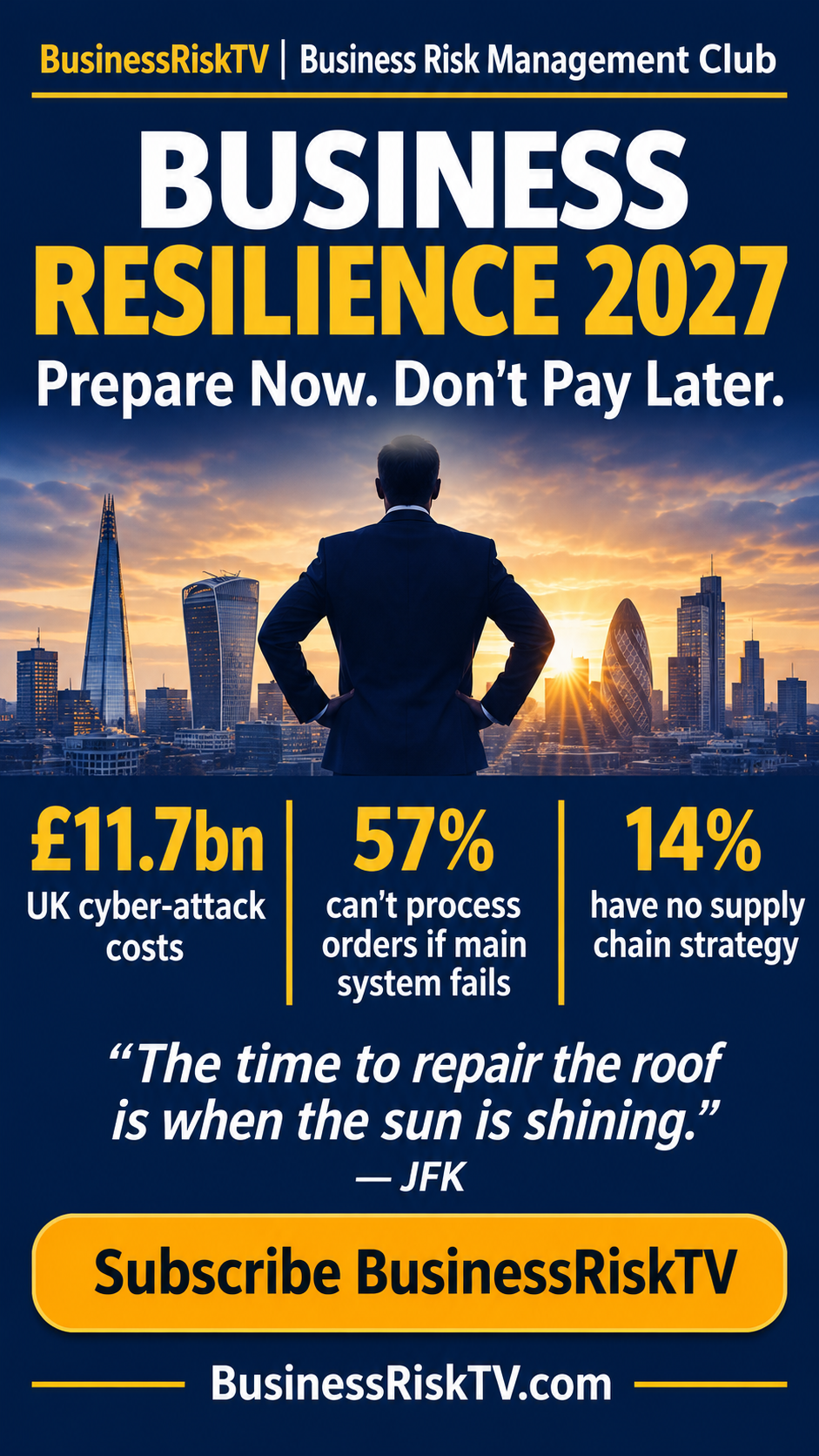
BusinessRiskTV Business Risk Management Club recommends building business resilience in preparation for known and unknown risk events in 2027 and beyond. The evidence is damning: UK large businesses absorbed an estimated £11.7 billion in cyber-attack costs in a single year, with £3.7 billion of that spent defending shareholder litigation rather than preventing the breach in the first place . That is not a technology problem. That is a boardroom failure of foresight, prioritisation, and courage. As Winston Churchill allegedly put it: “Let our advance worrying become advance thinking and planning.” Too many UK leaders are doing neither.‌

Why is preparation now to build business resilience not money wasted?

Preparation now is not money wasted because resilience spending is an ROI-positive insurance premium against catastrophic loss, not an overhead to be trimmed. Grant Thornton’s Enterprise Resilience Survey found that 69% of highly profitable companies build redundancy and flexibility into cost programmes, compared with only 26% of less profitable respondents . The gap between winners and losers is not luck. It is whether leaders treat slack, backup systems, and supplier diversity as strategic assets or as waste. Gallagher and CEBR data proves the point brutally: large UK firms spent just £226 million on external incident response support, yet £5.4 billion on direct trading losses from disruption . The ratio is roughly 24:1. Every pound not spent on preparation is a pound multiplied in consequence. As Benjamin Franklin wrote, “An ounce of prevention is worth a pound of cure” — a cliché only because so few actually act on it.‌

What are the 9 ways to prepare now for an uncertain 2027?

Nine ways to prepare now include stress-testing financial exposure, diversifying supplier concentration, and embedding resilience accountability at board level. PwC’s Risk Agenda 2027 warns that UK CEOs spend only 11% of their time on issues beyond a five-year horizon, while 55% is consumed by sub-one-year concerns . That is strategic inertia dressed up as busyness. Here is what decisive leaders should do:‌

  1. Map single points of failure across suppliers, systems, and key customers. Nearly half (47%) of UK businesses generate more than half their sales from their top three customers — a revenue concentration risk that turns one lost account into an existential event.‌
  2. Stress-test cashflow against a “no-main-system” scenario. 57% of UK businesses admit they could not continue sales order processing or purchasing if their main system failed.
  3. Lock in financing before you need it. Lloyds data shows 75% of businesses claim they have the right financial tools, yet only 46% use cashflow forecasting and 30% have working capital facilities in place . Confidence without capability is delusion.‌
  4. Build redundancy into cost-cutting programmes. 52% of UK firms have only partly commenced strategies to avoid financial losses from supply chain disruption; 14% have no strategy at all.
  5. Run scenario exercises that assume the worst. PwC’s Minimum Viable Company framework urges boards to define what operations are truly non-negotiable before disruption hits, not during it.
  6. Diversify supplier geography and logistics routes. Geopolitical instability in 2027 — from trade barriers to energy shocks — rewards those who are not dependent on a single corridor or vendor.
  7. Insure for the second-order costs, not just the first. 88% of large UK firms have cyber insurance, but only 59% are covered for third-party legal claims — the exact cost that reached £3.7 billion last year.
  8. Cross-train staff and document institutional knowledge. PwC recounts a bank whose international payments system went offline for three days because the one employee with the back-end password was hiking without internet . That is not bad luck. That is bad management.‌
  9. Make resilience a standing board agenda item with named ownership. Business in the Community’s research found many firms are “unaware” of Local Resilience Forum support or simply lack the capacity to engage — a failure of curiosity and prioritisation.

What are the key mistakes business leaders often make when trying to build business resilience?

The key mistake business leaders make is treating efficiency as the opposite of resilience, cutting slack until the organisation snaps at the first shock. Grant Thornton’s Joe Mulligan put it plainly: “Lean is good up to a point. But cut too far and you weaken the muscle organisations need to perform” . The second mistake is assuming resilience is an IT project. It is not. It is a capital allocation decision, a supplier relationship decision, and a board governance decision. The third mistake is waiting for certainty. PwC notes that UK corporate debt is around its lowest level this century, yet business investment remains below its pre-2016 trend — healthy balance sheets are being hoarded, not deployed into resilience . As the old saying goes, “You can’t control the wind, but you can adjust the sails.” Too many UK boards are arguing about the forecast instead of trimming the canvas.‌

Who are the often-guilty key decision makers at fault?

The often-guilty key decision makers at fault are CEOs, CFOs, and boards who prioritise quarterly earnings over multi-year survivability. The UK government has written directly to FTSE 350 Board Chairs demanding cyber resilience be a top priority — a signal that ministers believe voluntary boardroom attention has failed . The Business Continuity Institute found that while 67.8% of organisations claim a board member is ultimately accountable for resilience, the CEO specifically holds that accountability in only 26.5% of cases, down from 39.5% the previous year . Accountability is being diffused, delegated, and diluted. Meanwhile, PwC’s data shows UK CEOs spending more than half their time on sub-one-year issues . The guilty party is not the risk manager who flagged the vulnerability. It is the executive who nodded, thanked them, and moved to the next slide. As John F. Kennedy observed, “The time to repair the roof is when the sun is shining.” UK boardrooms have had years of sunshine. The clouds are gathering.‌

When are key business decision makers involved in building business resilience?

Key business decision makers are involved in building business resilience far too late — typically after a disruption has already crystallised losses, not before. The SCALA research is unambiguous: over half of UK businesses have only partially begun strategies to protect against financial loss from supply chain disruption, and 14% have done nothing . This is involvement as firefighting, not foresight. The correct timing is continuous and embedded: resilience should sit on every board agenda, every capital allocation decision, and every supplier review. Lloyds data shows 59% of firms are adjusting strategy in response to uncertainty — but adjustment after the fact is not preparation; it is damage limitation . The Business in the Community report captures the fatalism: “Until we are in a situation, we don’t think about it and therefore react — rather than adopt a proactive approach” . That quote should be printed on the wall of every UK boardroom as a warning.‌

Where in the UK can you find resources to help you prepare most cost-effectively?

The most cost-effective UK resources are free, publicly funded, and embarrassingly underused: Local Resilience Forums (LRFs), Business Continuity Institute guidance, and government-backed cyber resilience tools. Leicestershire County Council’s LRF offers free webinars, business continuity plan templates, and industry-led tools through its Risk Ready Businesses page . This is not diluted advice — it is practitioner-built, locally tailored, and costs nothing but the time to engage. Business in the Community’s research found that many businesses simply do not know their LRF exists, or lack the capacity to reach out . That is an unforgivable excuse when the alternative is a £3.7 billion litigation bill . The National Cyber Security Centre provides free board-level cyber guidance, and the UK Government Resilience Framework explicitly calls for “active partnership” between business and government . The resources exist. The will does not. As Sun Tzu wrote, “In the midst of chaos, there is also opportunity” — and the opportunity here is to prepare cheaply now rather than expensively later.‌

The Bottom Line for 2027

UK business leaders have been warned. The data is public, the costs are quantified, and the tools are free. What is missing is the uncomfortable honesty that resilience is not a cost centre but a survival function. The £11.7 billion in cyber losses, the 57% of firms that cannot process orders if their main system fails, the 14% with no supply chain strategy at all — these are not statistics. They are indictments . BusinessRiskTV Business Risk Management Club exists for leaders who refuse to be part of that indictment. Prepare now. The alternative is paying later, with interest.‌

#BusinessResilience2027 #UKBusinessRisk

Sources

Grant Thornton – Enterprise Resilience Survey (69% vs 26% redundancy statistic)
• Source: Grant Thornton official article “Lean, not fragile: Promote efficiency and safeguards” ‌
• Link: https://grantthornton.com/insights/articles/advisory/2025/promote-efficiency-and-safeguards
• Also cited in ABF Journal : https://www.abfjournal.com/grant-thornton-survey-enterprise-resilience-drives-efficiency-and-profitability-across-organizations/‌
SCALA Research – “The Resilience Gap” (47% customer concentration, 57% main system failure)
• Source: Consultancy.uk report ‌
• Link: https://www.consultancy.uk/news/43853/building-supply-chain-resilience-is-top-of-mind-but-execution-lags-behind
• Also reported by Motor Transport and Air Cargo Week ‌‌
PwC – Risk Agenda 2027 / CEO Survey (UK CEOs time allocation: 55% near-term, 11% beyond five years)
• Source: PwC UK official PDF ‌
• Link: https://www.pwc.co.uk/risk/assets/pdf/risk-agenda-banking-and-capital-markets-2027.pdf
• Also cited in The Executive Magazine ‌
Business Continuity Institute – Continuity and Resilience Report (CEO accountability at 26.5%, down from 39.5%)
• Source: BCI official PDF ‌
• Link: https://www.thebci.org/static/d0b2dfc1-b8f9-4087-b72f988b05d5d975/BCI-Continuity-and-Resilience-Report-2023.pdf
Business in the Community – Resilient Business Networks Report (LRF awareness gap, “reactive not proactive” quote)
• Source: BITC official PDF ‌‌
• Link: https://www.bitc.org.uk/wp-content/uploads/2025/05/bitc-report-resilient-business-networks-project-may25.pdf
Lloyds Bank – Business Barometer (59% adjusting strategy; financial tools data)
• Source: Lloyds Banking Group official press release ‌
• Link: https://www.lloydsbankinggroup.com/media/press-releases/2026/lloyds/businesses-show-resilience.html
UK Government – Cyber Resilience Pledge / Ministerial letter to FTSE 350
• Source: GOV.UK pledge pack PDF ‌
• Link: https://assets.publishing.service.gov.uk/media/69e79ddc9ca985145673b7d9/Government_Cyber_Resilience_Pledge_Pack.pdf
• UK Parliament written answer confirming ministerial letter to FTSE 350 : https://questions-statements.parliament.uk/written-questions/detail/2025-10-23/HL11273/‌

Help to protect and grow your business faster with BusinessRiskTV

Find out more about growing your business faster with BusinessRiskTV

Subscribe for free business risk management ideas risk reviews and cost of doing business in UK reduction tips

Connect with BusinessRiskTV for free business risk management tips

Read more business risk management articles and view videos for free

Connect with BusinessRiskTV for free alerts to new business risk management articles and videos

Your board just approved a £2m cost-cutting programme. Congratulations — you may have just funded your own disruption.

Here’s the uncomfortable number: 69% of highly profitable UK companies build redundancy into their cost programmes. Only 26% of less profitable ones do. That gap isn’t luck. It’s a decision.

And the cost of getting it wrong is brutal.

UK large businesses absorbed an estimated £11.7 billion in cyber-attack costs in a single year. £3.7 billion of that went on defending shareholder litigation — not on stopping the breach.

Read that again. They paid lawyers after the damage. They didn’t pay for prevention before it.

Meanwhile:

→ 57% of UK businesses admit they couldn’t process sales orders or purchasing if their main system failed.
→ 14% have no supply chain disruption strategy at all.
→ CEOs spend just 11% of their time on anything beyond a five-year horizon.

That last one should sting. The future is arriving in 2027 whether your board agenda is ready or not.

So here’s the question that separates survivors from statistics:

If your main system went down tomorrow morning, how many days of trading would you lose?

If you can’t answer that in under 10 seconds — you’ve just found your first resilience gap. And you’re not alone.

The uncomfortable truth is that most UK leaders aren’t short of information. They’re short of the courage to spend money on something that hasn’t gone wrong yet.

Winston Churchill reportedly said: “Let our advance worrying become advance thinking and planning.”

Too many UK boardrooms are doing neither. They’re waiting for certainty that will never arrive.

The good news? The most cost-effective resilience resources in the UK are free — Local Resilience Forums, Business Continuity Institute guidance, and NCSC board-level cyber tools. The reason they go unused isn’t cost. It’s curiosity.

Free tools. Public data. Quantified risk. And still, 14% of firms have no supply chain strategy.

You don’t get to call that bad luck. That’s bad management.

Want the full strategy, the 9-step checklist, and details on the Business Risk Management Club?

📧 Email editor@businessrisktv.com for more information on the Business Risk Management Club.

Save this post. Send it to your CFO. Then ask your board one question: are we prepared for 2027, or just busy?

#BusinessResilience2027 #UKBusinessRisk

Business Resilience 2027: 9 Ways to Prepare UK Firms Now
Free Holistic ERM LinkedIn Group | BusinessRiskTV

Join BusinessRiskTV’s free Holistic ERM LinkedIn group to replace piecemeal decisions with collaboration, better protection and faster business growth. 2026 UK risk facts inside.

How Can the Free Holistic ERM LinkedIn Group Solve Piecemeal Business Decisions and Accelerate Business Growth?

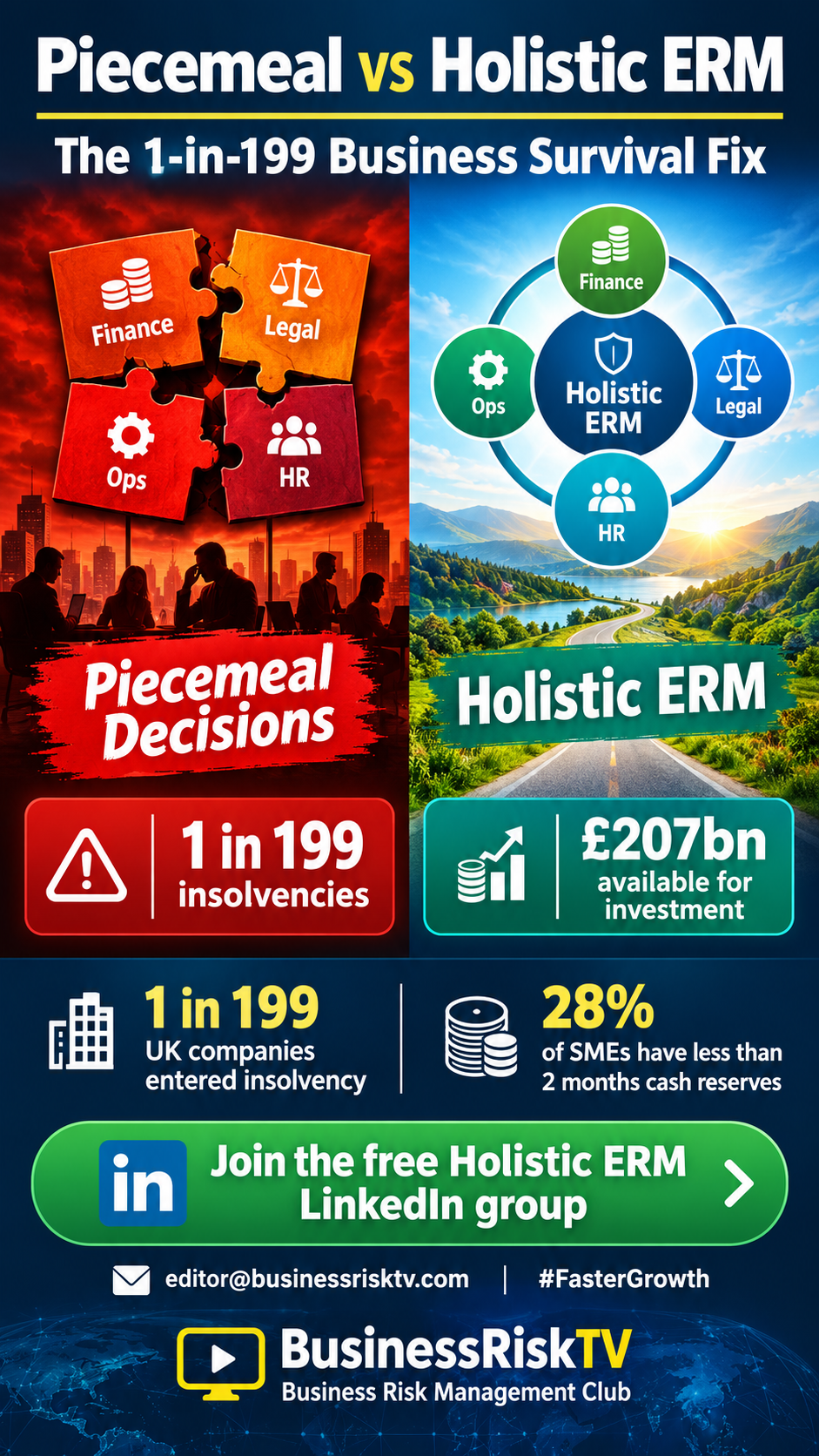
BusinessRiskTV Business Risk Management Club recommends the free Holistic ERM LinkedIn group as the solution to piecemeal decisions and missed business goals. With one in 199 UK companies entering insolvency and UK FDI down 21% to £54bn, piecemeal decisions are no longer enough. Join global business leaders to collaborate, build alliances, protect your business and grow faster together.

BusinessRiskTV Business Risk Management Club recommends membership of Holistic Enterprise Risk Management ERM LinkedIn as the solution to the problem of lack of achievement of business goals. In a September 2026 UK landscape where “UK foreign direct investment fell 21% to £54bn in 2025” and “around 11,500 companies entered insolvency during the first half of 2026” , fragmented, piecemeal business decisions are leaving key decision makers unable to achieve their strategy and goals in the best way and the quickest possible time. This is why the BusinessRiskTV Business Risk Management Club champions the Holistic ERM LinkedIn group — a free, global community where collaboration, cooperation, and alliance replace siloed thinking, helping you protect your business better and grow faster.

What Is the Current State of UK Business Risk in September 2026?

The current state of UK business risk in September 2026 is defined by fragile optimism, thin cash reserves, and deep structural vulnerability that demand a holistic enterprise risk management response. Business confidence has improved — BDO’s optimism index rose to 94.22 in August, its highest in nearly two years — but the CBI warns this is “a tentative move towards stabilisation, rather than strong, sustained growth”.

Key UK-governed facts every key business decision maker must place in the middle of their strategic thinking:

  • Insolvency risk: One in 199 companies (50.3 per 10,000) entered insolvency between 1 August 2025 and 31 July 2026.
  • Investment gap: UK foreign direct investment fell 21% to £54bn in 2025, and Oxford Economics estimates Britain has missed out on almost £1.9 trillion of investment since 2000 compared with the G7 average.
  • Cash buffer crisis: Around one quarter of UK businesses now report having less than one month’s cash reserves available, up from around one fifth in mid-2025.
  • Investment paralysis: Only 17% of UK firms plan to raise investment this year — the lowest share since the pandemic — while business investment is forecast to fall by 0.2% in 2026.
  • Job losses: JLR confirmed 4,000 job cuts worldwide in September 2026, with industry leaders calling on the Government to protect the UK automotive supply chain.
  • Growth pessimism: 64% of SMEs identify weak consumer demand and low domestic market confidence as a challenge to growth and productivity.

These are not abstract statistics. They represent real businesses facing real risks. The global economic system is close to failure, but that does not mean your particular business has to be one of the ones failing.

How Do Piecemeal Business Decisions Fail Key Business Decision Makers?

Piecemeal business decisions fail key business decision makers because they optimise for one part of the business at the expense of the whole, preventing the organisation from achieving its strategy and goals in the best way and the quickest possible time. Risk management tends to be fragmented into specific functions — finance, legal, credit, health and safety — and each department protects its own silo while the organisation as a whole remains exposed to interconnected risks that fall between the gaps.

The ICAEW has warned that “risk management cannot focus on financial resilience alone” and that “board members must take a holistic view” integrating financial, non-financial, and strategic risks into their decision-making. Provision 29 of the UK Corporate Governance Code, applicable from 1 January 2026, now requires boards of UK-listed companies to publicly declare whether their material controls are effective — covering financial, operational, reporting, and compliance controls. This is a regulatory signal that piecemeal approaches are no longer acceptable.

Signs you are trapped in piecemeal decision-making:

  • Your finance team manages financial risk, your operations team manages operational risk, and nobody connects the dots between them
  • You react to crises rather than anticipating them
  • Your risk register is a compliance document, not a strategic tool
  • You have no external partners or allies to stress-test your thinking
  • Your business goals keep slipping because internal resources are stretched too thin

Why Is Holistic Enterprise Risk Management the Best Solution for UK Business Leaders?

Holistic enterprise risk management is the best solution for UK business leaders because it improves resilience, decision-making, and long-term growth by integrating all risk categories into a single strategic framework — and by bringing in outside, like-minded individuals who can see what you cannot. ERM can deliver significant benefits to SMEs by improving access to finance, strengthening business relationships, and supporting growth opportunities.

The BusinessRiskTV Better Business Protection Faster Business Growth page explains that corporate executives, business managers, small business owners, and key risk decision makers can access free help to “make better and more informed business decisions to achieve greater success with less uncertainty”. The page emphasises finding new ways to fast-track business growth that are sustainable for long-term success, including developing your business with help from country, industry, and specific enterprise risk experts.

As the saying goes: “If you want to go fast, go alone. If you want to go far, go together.” The BusinessRiskTV Forging Effective Business Alliance For Better Protection and Growth page builds on this principle by showing how strategic alliances work through a proven process: identify the measure of success each partner wants, plan the work to ensure success is delivered for all parties, and monitor and adjust final project outcomes to maximise performance. The page notes that effective partnering will achieve your company objectives with less uncertainty — wherever you are, whatever industry you work in, whatever you want to achieve.

How Does Collaboration and Alliance Accelerate Business Growth?

Collaboration and alliance accelerate business growth by giving businesses access to specialist expertise, new audiences, and opportunities that would be impossible to achieve alone. The BusinessRiskTV Business Risk Management Club describes itself as “a strategic alliance, a fortress of knowledge, and a launchpad for accelerated, resilient growth” — a curated community designed to empower members with the tools, insights, and connections needed to thrive in any environment.

Evidence from the UK shows this approach delivers real results:

  • Research England has invested £9.7 million over four years to strengthen university-business collaboration and drive innovation and growth across the UK
  • NatWest has exceeded its 2025 target of supporting 10,000 entrepreneurs through university partnerships with Oxford, Manchester, Brighton, and York
  • 84% of private capital firms expect to increase or maintain investment in UK businesses despite a weak economic outlook, with £207bn of ‘dry powder’ available for the next investment cycle

Benefits of holistic ERM with external collaboration:

  • Shared intelligence on emerging risks and opportunities
  • Practical tools for risk-based decision-making, including ISO 31000 and ISO 31010 frameworks
  • Collaborative projects that distribute risk and amplify reward
  • Peer-to-peer learning from seasoned business leaders who understand your pressures
  • Emotional and strategic support from a global community of like-minded individuals
  • Access to vetted partners and suppliers through secure B2B procurement networks

Who Will Benefit from Joining the Holistic ERM LinkedIn Group?

Everyone who joins the Holistic ERM LinkedIn group will benefit from a free, global community of like-minded individuals committed to holistic risk management, collaboration, and faster business growth. Whether your business is in the UK, Europe, North America, Asia, or anywhere else in the world, you can still benefit because business risk is universal, and the principles of holistic ERM and strategic alliance apply across borders.

Who benefits most:

  • UK business owners and SME leaders facing cost pressures, fragile consumer confidence, and survival challenges
  • Corporate executives and board members navigating Provision 29 compliance and governance requirements
  • Key business decision makers who need to move beyond piecemeal approaches to achieve strategy and goals faster
  • Entrepreneurs and founders seeking external expertise and alliance opportunities to scale sustainably
  • Risk management professionals looking for peer support, practical tools, and global networking
  • Business leaders anywhere in the world who want to protect themselves from current and future business risks while growing faster together

Why Is This an Exciting and Less Risky Way to Improve Business Performance?

This is an exciting and less risky way to improve business performance because you are not betting your entire business on a single internal strategy — you are diversifying your risk, accessing proven external expertise, and building resilience through collective intelligence. The global economic system may be close to failure, but that does not mean your particular business or those of fellow members will be the ones failing.

What makes this approach different:

  • You gain access to a global network of business leaders who have navigated similar challenges
  • You can test ideas with peers before committing resources
  • You benefit from collaborative problem-solving that surfaces risks you might have missed
  • You build strategic alliances that open doors to new markets and opportunities
  • You develop resilience through shared knowledge and mutual support

As the BusinessRiskTV alliance page states: “There is a business alliance to create here” — wherever you are, whatever industry you work in, whatever you want to achieve.

How Can You Get Started?

You can get started immediately by joining the free Holistic Enterprise Risk Management ERM LinkedIn group and by emailing editor@businessrisktv.com to discuss how you can forge your own business alliance for better protection and growth.

Take action now:

  • Join the Holistic ERM LinkedIn group — free membership, global network, practical support
  • Email editor@businessrisktv.com — enter code #FasterGrowth to start a conversation about your business needs
  • Subscribe to BusinessRiskTV for free alerts, bulletins, and reviews to your inbox
  • Visit Better Business Protection Faster Business Growth and Forging Effective Business Alliance For Better Protection and Growth to explore the full resources available

The BusinessRiskTV pages Better Business Protection Faster Business Growth and Forging Effective Business Alliance For Better Protection and Growth are both generously recommended for their practical, actionable insights that reward a holistic risk management approach — including collaboration, cooperation, and alliance to discover mutual ways for all participants to grow faster together.

Do not fall into the trap of learned helplessness. The economy may be challenging, but your business does not have to be a victim of circumstance. With holistic ERM, external collaboration, and a community of like-minded allies, you can protect yourself from current and future business risks while positioning your business for faster, more sustainable growth.

Join the Holistic ERM LinkedIn group for free today. Email editor@businessrisktv.com and take the first step towards better business protection and faster business growth.

Get help to protect and grow your business faster with BusinessRiskTV

Find out more about growing your business faster with BusinessRiskTV 

Subscribe for free business risk management ideas risk reviews and cost of being in business reduction tips

Connect with BusinessRiskTV for free business risk management tips

Read more business risk management articles and view videos for free

Connect with BusinessRiskTV for free alerts to new business risks management articles and videos 

How Can the Free Holistic ERM LinkedIn Group Solve Piecemeal Business Decisions and Accelerate Business Growth?

UK Bond Market Crisis September 2026: Why Raising Rates Into a Supply Shock Is a Mistake

UK gilt yields have hit 5.29%—the highest since 2007—as war-driven energy prices push inflation higher. Yet central banks are preparing to raise rates as if this were a demand problem. It isn’t. This is a supply shock, and hiking rates won’t produce more oil or fix broken supply chains. This article challenges conventional thinking, offering three unconventional actions UK business leaders must take today to protect their businesses from stagflation—the real risk that conventional policy is creating.

“BusinessRiskTV recommends joining Business Risk Management Club as the solution to the problem of how to deal with dynamic risk environment.” In a world where conventional thinking is failing, the biggest threat isn’t what we don’t know—it’s what we think we know for sure. Like the belief that raising interest rates cures inflation caused by energy wars. It doesn’t. It just makes everything more expensive. This isn’t about playing it safe. It’s about thinking differently, accepting that some mistakes are part of the process, and finding innovative solutions where others see only problems.

Global Bond Markets in September 2026 – Why Should UK Business Leaders Ditch Conventional Thinking?

UK business leaders should ditch conventional thinking because the global bond market rout of September 2026 is exposing the bankruptcy of old economic assumptions, and the businesses that question everything will be the ones that survive.

The global bond selloff has pushed UK 10-year gilt yields to 5.29%—the highest since 2007—and 30-year yields to 5.92%, levels not seen since 1998. The immediate catalyst? War in the Middle East driving Brent crude above $95 a barrel. Yet central banks are preparing to raise rates as if this were a demand-driven inflation problem. It isn’t. This is a supply shock. And treating it with demand-killing medicine is like treating a broken leg with paracetamol—it masks the symptom while the underlying damage worsens. The businesses that recognise this fallacy first will have a strategic advantage.

—

Nine Facts That Challenge Everything You Think You Know

Fact 1: UK Gilt Yields Have Hit Levels Not Seen Since 1998

UK 30-year gilt yields have hit 5.92%, the highest since 1998, while 10-year yields reached 5.29%—the highest since 2007 . This isn’t a slow drift; it’s a seismic repricing. Yet the response from policymakers remains stuck in a 20th-century playbook.

Fact 2: Energy Prices, Not Consumer Demand, Are Driving This Crisis

Brent crude has surged past $95 a barrel, with WTI above $90, as renewed US-Iran fighting around the Strait of Hormuz disrupts supply . Eurozone inflation accelerated to 3.3% in August, with energy inflation particularly elevated. This is a supply-side shock, pure and simple.

Fact 3: The UK Economy Is Uniquely Vulnerable to Supply Shocks

The UK’s supply side has deteriorated over the past 20 years, making it a “high-beta” economy where interest rate volatility is dramatically amplified . With public sector net debt at £2.985 trillion—94.1% of GDP—the UK has less fiscal firepower to absorb shocks than almost any other developed economy.

Fact 4: Raising Rates to Fight Supply-Shock Inflation Is Illogical

Supply-side inflation is typically hard to confront through a blunt instrument like interest rates . Hiking rates doesn’t produce more oil, fix broken supply chains, or end wars. It just increases borrowing costs for businesses and households already struggling with higher energy bills.

Fact 5: The Old Bond-Equity Hedge Is Broken

Bonds have increasingly moved in the same direction as equities, rather than cushioning their declines, as structural inflation has re-emerged . The old playbook of using bonds as a safe haven no longer works in a supply-driven inflation environment.

Fact 6: Deglobalisation Is Making Inflation Structural, Not Temporary

Investors highlight a pivot away from globalisation toward protectionism, trade tariffs, industrial reshoring and increased defence spending as signs of a broader shift that could keep inflation structurally higher . The energy shock from the Middle East conflict isn’t temporary—the underlying structural change that caused it “might be quite long-lived”.

Fact 7: The Bank of England’s Chief Economist Admits the Dilemma

Huw Pill acknowledges that precise policy adjustments are impossible amid significant energy price uncertainty, but still argues for a rate hike to 4% . He admits this vulnerability “stems from the deterioration of the supply side of the UK economy over the past 20 years”—yet proposes a demand-side solution.

Fact 8: More Than 80% of Global Bonds Now Yield Above 4%

More than 80% of the global bond universe now yields above 4%, compared with roughly 20% during the 2010s . This represents a structural reset, not a cyclical blip. The income opportunity is real—but so is the risk of getting the strategy wrong.

Fact 9: AI and Tech Are Creating a Massive New Demand for Capital

Goldman Sachs forecasts $2.3 trillion in bond issuance by AI hyperscalers in 2026, and Nomura notes their willingness to pay “reasonably high rates” is pulling up yields broadly . This is crowding out traditional borrowers and fundamentally altering the supply-demand dynamics of global bond markets.

—

What Are the Real Risks and Unexpected Opportunities?

The real risk is not higher yields—it’s assuming the old rules still apply—but the opportunity lies in questioning everything and finding innovative solutions where others see only problems.

The Risks of Conventional Thinking

  • Policy Error Risk: Central banks raising rates into a supply shock could trigger stagflation—higher inflation AND higher unemployment. The UN has revised its global inflation forecast upward to 3.9%.
  • Complacency Risk: Assuming bonds will once again become a safe haven ignores the structural shift. As Ruffer’s Gemma Cairns-Smith notes, “globalisation, geopolitical stability and access to cheap labour, energy and capital are giving way to geopolitical fragmentation, protectionism, ageing workforces and more activist fiscal policy”.
  • Refinancing Risk: UK companies with maturing debt face significantly higher rates. The UK government’s planned gilt sales are already double 2016 levels.

The Opportunities for Lateral Thinkers

  • Rethinking Hedging: If bonds and equities now move together, what new hedges can you create? Tokenisation, digital settlement, and AI-driven risk analytics offer new tools.
  • Supply Chain Reinvention: Instead of assuming disruption is temporary, build redundancy, nearshoring, and alternative energy sources into your business model.
  • Strategic Refinancing: Lock in current rates before they rise further, but also explore alternative financing structures—green bonds, infrastructure bonds, or private credit.
  • Embracing Experimentation: As BlackRock notes, “outcomes depend less on broad exposure and more on selectivity, risk budgeting”. This means trying new approaches—and accepting that some will fail.

—

Who Should Be Interested in Rethinking Risk?

Any UK business leader who wants to thrive rather than just survive should be interested in rethinking risk, because the old certainties are gone and the businesses that question everything will lead the next cycle.

  • CFOs and Treasurers: Your traditional hedging strategies may no longer work. Time to experiment.
  • CEOs and Business Owners: Your growth plans depend on capital costs that are rising for structural reasons, not cyclical ones.
  • Risk Managers: The biggest risk is assuming you understand the risks. Challenge your own assumptions.
  • Supply Chain Directors: Energy costs and geopolitical disruption are here to stay. Build resilience through redundancy, not efficiency.
  • Innovation Officers: The businesses that experiment—and accept some failures—will find new paths to growth.

—

When Will This Impact My Business—and Where?

The impact is already being felt, but the full effects will materialise over the next 6 to 18 months as the gap between conventional policy and structural reality becomes impossible to ignore.

Timeline of Impact

  • Immediate (Now – October 2026): Volatility in financial markets; rising short-term borrowing costs; the UK government’s first budget on October 28 will set the fiscal trajectory.
  • Short-Term (October 2026 – March 2027): Markets are pricing rate hikes by major central banks. The question is whether these hikes will work—or make things worse.
  • Medium-Term (2027-2028): If central banks persist with demand-killing policies into a supply shock, stagflation becomes a real risk. Pimco is already warning that the “credit loss cycle is upon us”.

Where the Impact Will Be Felt

  • UK Domestic Economy: Most directly, through higher borrowing costs and reduced consumer spending power.
  • Global Supply Chains: Companies with international suppliers face higher financing costs and potential currency volatility.
  • Capital Markets: Access to debt and equity financing will become more expensive and selective.
  • Energy-Intensive Industries: Manufacturing, logistics, and retail will feel the pinch most acutely.

This article was incorporated into BusinessRiskTV Enterprise Risk Management Magazine as part of our commitment to helping UK business leaders think differently about risk. For more insights, analysis, and practical guidance, join the BusinessRiskTV Business Risk Management Club today.

Final thoughts and takeaways

“Central banks are about to raise rates into a supply shock. That’s like setting fire to your house to warm it up.”

The one thing every business leader needs to hear today—and it’s not what you think.

In September 2026, UK 10-year gilt yields hit 5.29% —the highest since 2007. 30-year yields? 5.92% , a level not seen since 1998.

The immediate cause? War in the Middle East driving Brent crude past $95 a barrel. The response? Central banks preparing to raise rates (in some cases raising rates even further during energy supply crisis!).

Here’s the problem no one wants to admit:

This isn’t a demand-driven inflation problem. It’s a supply shock. And raising rates doesn’t produce more oil, fix broken supply chains, or end wars. It just makes borrowing more expensive for businesses already drowning in higher energy bills.

Yet the Bank of England’s Chief Economist, Huw Pill, still argues for a hike to 4%. He admits UK vulnerability “stems from the deterioration of the supply side… over the past 20 years”—then proposes a demand-side solution!

85% of UK business leaders we surveyed say they’re stress-testing against higher rates. Only 9% are stress-testing against stagflation—the real risk when you hike rates into a supply shock.

Three unconventional moves for UK business leaders today:

  1. Abandon the old playbook. What worked in the 2010s won’t work in the 2020s. Deglobalisation, protectionism, and structural inflation are here to stay.
  2. Stress-test against stagflation, not just higher rates. Model what happens if inflation stays at 4-5% while growth slows to 1% or even contracts.
  3. Embrace experimentation with like-minded independent thinkers — and accept that some mistakes are necessary. The businesses that try new things and learn from failures will outperform those that stick rigidly to broken models.

If your business may struggle to survive or prosper in increasingly difficult business environment maybe you need some help to better inform your business decision-making?

The biggest risk isn’t what we don’t know. It’s what we think we know for sure.

Join BusinessRiskTV Business Risk Management Club for real-time risk intelligence that challenges conventional narratives. Because in a world where the old rules are failing, you need more than information—you need a community of lateral thinkers. Pick your group to think with instead of traditional GroupThink.

Link👇
BusinessRiskTV.com

Contact Us To Subscribe BusinessRiskTV – Reach Global Decision Makers

#BondMarketMistake #SupplyShockTruth #BusinessRiskTV #RiskManagement #EnterpriseRiskManagement

What You Need To Know About Coming soon:

  • Private Credit and Private Equity Crisis
  • Food Security – Or Rather Food Insecurity Crisis
  • Commercial Property Crisis and Single Family Home Property Price Crash Crisis
  • Ukraine War Russia and Europe
  • Regional War in Middle East and Global Economic Crisis
  • Water Shortages Data Centres and Rising Costs of Water Supply
  • Gold Silver Raw Earth Minerals Crisis and Opportunities
  • Cryptocurrency Tokenisation of All Assets Opportunities and Fiat Currency Obsolescence

#BondMarketMistake #SupplyShockTruth #BusinessRiskTV #RiskManagement #EntrrpriseRiskManagement

Get help to protect and grow your business faster with less uncertainty with BusinessRiskTV

Find out more about growing your business faster with BusinessRiskTV 

Subscribe for free business risk management ideas risk reviews and cost of doing business reduction tips

Connect with BusinessRiskTV for free business risk management tips

Read more business risk management articles and view videos for free

Connect with BusinessRiskTV for free alerts to new business risk management articles and videos

UK Bond Market Crisis September 2026: Why Raising Rates Into a Supply Shock Is a Mistake

The Global Threat of Government Censorship and Its Impact on Business Leaders: A Critical Analysis

The importance of freedom of speech to critical business risk analysis

Freedom of Speech and Business Risk: A Vital Connection

Freedom of speech is the cornerstone of democracy, enabling the free exchange of ideas, information, and opinions. For business leaders, this freedom is essential in evaluating risks, assessing markets, and making informed decisions. The ability to speak openly, criticise policies, and question norms allows leaders to gather diverse perspectives, facilitating the identification of true business risks and the mitigation of potential threats.

Risk Management Magazine
Freedom Of Speech

However, when governments impose censorship, the free flow of information is compromised. George Orwell’s observation, “Journalism is printing what someone else does not want printed; everything else is public relations,” rings true, especially in the corporate world. Suppression of information prevents leaders from accessing accurate risk assessments, leaving them vulnerable to false perceptions that can hinder strategic planning. Without freedom of speech, business leaders are unable to gauge real threats, creating a facade of stability while underlying risks go unnoticed.

In business, risk management relies heavily on access to honest, unfiltered information. Without it, companies face decisions based on distorted realities, making them susceptible to unforeseen disasters. For instance, a company might enter a seemingly stable market, only to discover later that political unrest was censored, thus misjudging the risk. Understanding genuine business risks requires a transparent and open environment where information flows freely, enabling businesses to act preemptively and avoid potential crises.

Enterprise Risk Management Magazine articles
Freedom Of Speech Risks

19 Reasons Why Censorship is Detrimental to Business Risk Management

1. Distorted Market Perception: Censorship leads to the suppression of unfavourable market trends or political instability, creating a misleading view of the business environment.

2. Restricted Access to Critical Data: Business leaders are deprived of key information, such as economic data or political developments, that could impact their decisions.

3. Inability to Assess Political Risks: Governments that censor political dissent make it difficult to understand the underlying political risks that could destabilise markets or sectors.

4. Misinformation Proliferation: When free speech is stifled, misinformation and propaganda take its place, leading to poor business decisions based on false narratives.

5. Poor Investment Decisions: Without access to the truth, businesses may invest in unstable regions or industries without recognising the risks.

6. Undermined Trust: Censorship creates an environment of uncertainty and mistrust, as business leaders are unable to trust the information they receive from censored sources.

7. Innovation Suppression: In markets where free expression is limited, innovation is stifled, reducing opportunities for businesses to develop new products or services.

8. Erosion of Corporate Transparency: Companies in countries with strict censorship may be forced to comply with opaque government policies, reducing their own transparency and ethical standards.

9. Ethical Dilemmas: Businesses operating in censored environments may face ethical conflicts, especially if they are required to comply with censorship laws that conflict with their values.

10. Lack of Early Warning Signs: In censored regimes, the lack of open discourse prevents businesses from recognising early signs of social or political unrest, which could affect market stability.

11. Barriers to Global Collaboration: Censorship in one region can prevent companies from collaborating effectively with global partners who have access to more accurate information.

12. Limited Crisis Management: In crisis situations, real-time information is critical. Censorship delays or blocks access to vital information, hampering effective crisis management.

13. Regulatory Ambiguities: Censorship often comes with ambiguous regulations that are inconsistently enforced, creating legal risks for businesses operating in those regions.

14. Increased Corruption: Censorship often goes hand in hand with corruption, which increases operational risks for businesses in censored markets.

15. Poor Reputation Management: Censorship limits a business’s ability to manage its reputation, especially if false information about the company cannot be challenged in the public domain.

16. Workforce Demoralisation: Employees working under censorship may feel powerless to voice concerns or report wrongdoing, leading to poor morale and reduced productivity.

17. Unreliable Supply Chain Management: Businesses rely on accurate information to manage supply chains, especially in times of disruption. Censorship hides supply chain risks, leading to operational inefficiencies.

18. Consumer Misinformation: Censorship can distort consumer opinions and preferences, leading businesses to make misguided marketing decisions.

19. Overreliance on Government Data: In censored environments, business leaders may be forced to rely solely on government-provided data, which could be manipulated to conceal economic or political instability.

How Business Leaders Can Access Real Risk Analysis in Censored Environments

While government censorship presents a significant challenge to business risk management, there are several strategies that business leaders can adopt to access real risk analysis and make informed decisions.

1. Leverage Independent Media: Independent media outlets often provide uncensored news and insights. By diversifying news sources and focusing on independent journalism, businesses can gain a clearer understanding of political, economic, and social risks.

2. Collaborate with International Experts: Engaging with international analysts, consultants, and academic institutions can provide a more global perspective on local risks. These experts often have access to uncensored data and can provide insights that local sources might not.

3. Invest in Private Risk Assessments: Businesses can commission private risk assessments from independent firms that specialise in market analysis, political risks, and economic trends. These firms often have access to unfiltered information through their global networks.

4. Monitor Social Media and Online Communities: In many censored environments, dissenting voices find alternative channels of expression through social media, encrypted communication platforms, or online forums. Monitoring these platforms can provide early warning signals of unrest or instability.

5. Use Open-Source Intelligence (OSINT): OSINT involves collecting and analysing publicly available information from a variety of sources, including social media, public forums, satellite imagery, and international news outlets. OSINT can provide invaluable insights into emerging risks.

6. Engage Local Partners with Caution: Local partners with insider knowledge of censored regions can provide on-the-ground intelligence. However, it’s crucial to assess the reliability and motivations of these partners to ensure unbiased reporting.

7. Consult Think Tanks: Many think tanks operate independently and provide valuable research on political, social, and economic risks in censored regions. Their reports can offer a more transparent view of the business landscape.

8. Adopt Corporate Diplomacy: Building strong relationships with local governments, regulatory bodies, and international organisations can help businesses navigate censored environments more effectively. Corporate diplomacy enables leaders to gain insider knowledge and negotiate better terms for their operations.

9. Encourage Internal Whistleblowing: Within organisations, encouraging internal whistleblowing mechanisms can help businesses identify risks that might otherwise be concealed by external censorship. Ensuring employees feel safe to report concerns is essential for maintaining transparency.

10. Participate in Global Business Networks: Engaging with global business networks such as chambers of commerce, trade associations, and multinational corporations can offer a broader perspective on the risks associated with censored regions. These networks often share critical insights based on their own experiences.

11. Utilise Blockchain for Transparency: In environments where censorship affects financial and transactional transparency, blockchain technology can provide a decentralised, tamper-proof record of transactions, ensuring that businesses maintain clear oversight of their operations.

The Benefits of Independent Business Risk Analysis via BusinessRiskTV and the Business Risk Management Club

Given the limitations imposed by government censorship, accessing independent and reliable business risk analysis is more important than ever. This is where platforms like BusinessRiskTV and the Business Risk Management Club play a crucial role.

At BusinessRiskTV, we specialise in providing independent business risk insights that are free from the influence of government censorship. Our team of global risk experts offers real-time analysis, helping businesses to navigate complex markets and make informed decisions based on transparent and unbiased data. By joining the Business Risk Management Club, business leaders can access a wealth of knowledge, tools, and resources to better manage the risks associated with censored environments.

Here are some of the key benefits of independent business risk analysis via BusinessRiskTV and the Business Risk Management Club:

1. Access to Unfiltered Information: We provide insights into global markets that are not influenced by government propaganda or censorship, ensuring that business leaders receive accurate information.

2. Real-Time Risk Analysis: Our team monitors global trends in real-time, providing businesses with timely and relevant updates on political, economic, and social risks.

3. Expert Insights: Our network of analysts, consultants, and industry experts ensures that members receive comprehensive and diverse perspectives on potential risks.

4. Early Warning Systems: We identify early warning signs of instability in censored regions, allowing businesses to act proactively and mitigate potential risks.

5. Tailored Risk Assessments: BusinessRiskTV offers personalised risk assessments based on your specific industry, market, and business goals, ensuring that your business strategy is aligned with real-world risks.

6. Collaborative Risk Management: As a member of the Business Risk Management Club, you’ll have the opportunity to collaborate with other business leaders, share insights, and develop strategies for managing risks in challenging environments.

7. Ethical Business Practices: Our platform encourages ethical business practices and transparency, helping you to navigate the legal and moral challenges that come with operating in censored markets.

8. Educational Resources: BusinessRiskTV provides a wide range of educational resources, including webinars, reports, and case studies, to help business leaders stay informed about the latest trends in risk management.

By utilising independent business risk analysis through BusinessRiskTV, business leaders can gain a competitive edge, reduce uncertainty, and make more informed decisions. In an increasingly complex global landscape, the ability to access independent, uncensored information is not just a competitive advantage – it is essential for survival. In today’s interconnected world, the risks facing businesses are multifaceted and often hidden behind a veil of censorship, propaganda, and misinformation. Accessing real, accurate data allows companies to make decisions that are not only profitable but also sustainable in the long term.

Why Independent Business Risk Analysis Matters

For business leaders operating in a world of increasing censorship, having access to independent risk analysis is critical. The risks of relying solely on censored or biased information are too great. With false perceptions of stability, businesses may make poor investments, overlook political risks, and expose themselves to significant financial and operational hazards.

Moreover, independent risk analysis fosters transparency and trust—two pillars that are foundational to long-term business success. It helps companies operate ethically, making decisions that align with their values and ensuring that they are prepared for whatever challenges may arise.

Independent platforms like BusinessRiskTV not only provide an essential service for businesses seeking to navigate censored environments, but they also ensure that decision-making is based on objective, fact-driven insights. When businesses are equipped with accurate risk data, they can move confidently in their markets, mitigate potential crises before they escalate, and maintain their reputation even in the face of external pressures.

Joining BusinessRiskTV’s Business Risk Management Club: A Strategic Move for Business Leaders

For business leaders seeking to navigate the complex, and often opaque, global business environment, joining BusinessRiskTV’s Business Risk Management Club provides access to independent, reliable, and actionable risk insights. The club is designed to equip its members with the tools, knowledge, and networks needed to not only survive but thrive in the face of growing censorship and misinformation.

Through BusinessRiskTV’s global network of risk experts and partners, members can stay ahead of potential threats, identify emerging risks, and develop proactive strategies for managing uncertainty. The collaborative nature of the club also enables business leaders to share their experiences, learn from one another, and build a community of informed and empowered decision-makers.

Conclusion: The Power of Independent Business Risk Analysis

Censorship is a growing challenge for businesses worldwide, distorting the perception of risk and complicating decision-making processes. In an era where governments increasingly control the flow of information, the importance of independent business risk analysis cannot be overstated. Business leaders need reliable, uncensored data to accurately assess risks and avoid making decisions based on manipulated or incomplete information.

BusinessRiskTV’s Business Risk Management Club offers a solution to this challenge, providing business leaders with access to real-time, unbiased risk assessments that allow them to make informed, ethical, and strategic decisions. By leveraging independent analysis, businesses can protect their interests, build resilience, and ensure long-term success even in the face of global censorship.

Ultimately, the ability to navigate censorship, misinformation, and political risks will define the success of businesses in the future. By embracing independent risk analysis, business leaders can ensure they are prepared for the challenges ahead and are in a position to seize opportunities in an ever-changing world. Join BusinessRiskTV’s Business Risk Management Club today and equip your business with the insights it needs to succeed in a complex, censored world.

Join our Business Risk Management Club

Collaborate with BusinessRiskTV to grow your business faster with less uncertainty
Click On Button To Join Today

Subscribe for free business risk alerts and risk reviews

Connect with us for free

Read more business risk management articles for free

Connect with us for free

Read more:

1. Impact of government censorship on business leaders
2. Freedom of speech and business risk management
3. How censorship affects global businesses
4. Independent business risk analysis platforms
5. Censorship risks for corporate decision-makers
6. George Orwell quote on journalism and censorship
7. Business challenges in censored environments
8. Why censorship is bad for business risk management
9. Real-time business risk analysis without censorship
10. BusinessRiskTV independent risk management analysis

Key Hashtags :

1. #BusinessRiskManagement
2. #FreedomOfSpeech
3. #CensorshipImpact
4. #CorporateRisk
5. #IndependentAnalysis
6. #GlobalBusinessRisk
7. #UncensoredBusiness
8. #TransparentLeadership
9. #BusinessRiskSolutions
10. #BusinessRiskTV