Risk Management Rebels: Better Business | BusinessRiskTV

Join BusinessRiskTV & LinkedIn Risk Management Online. Risk rebel insights for key risk owners. Manage business risks better. Email editor@businessrisktv.com.

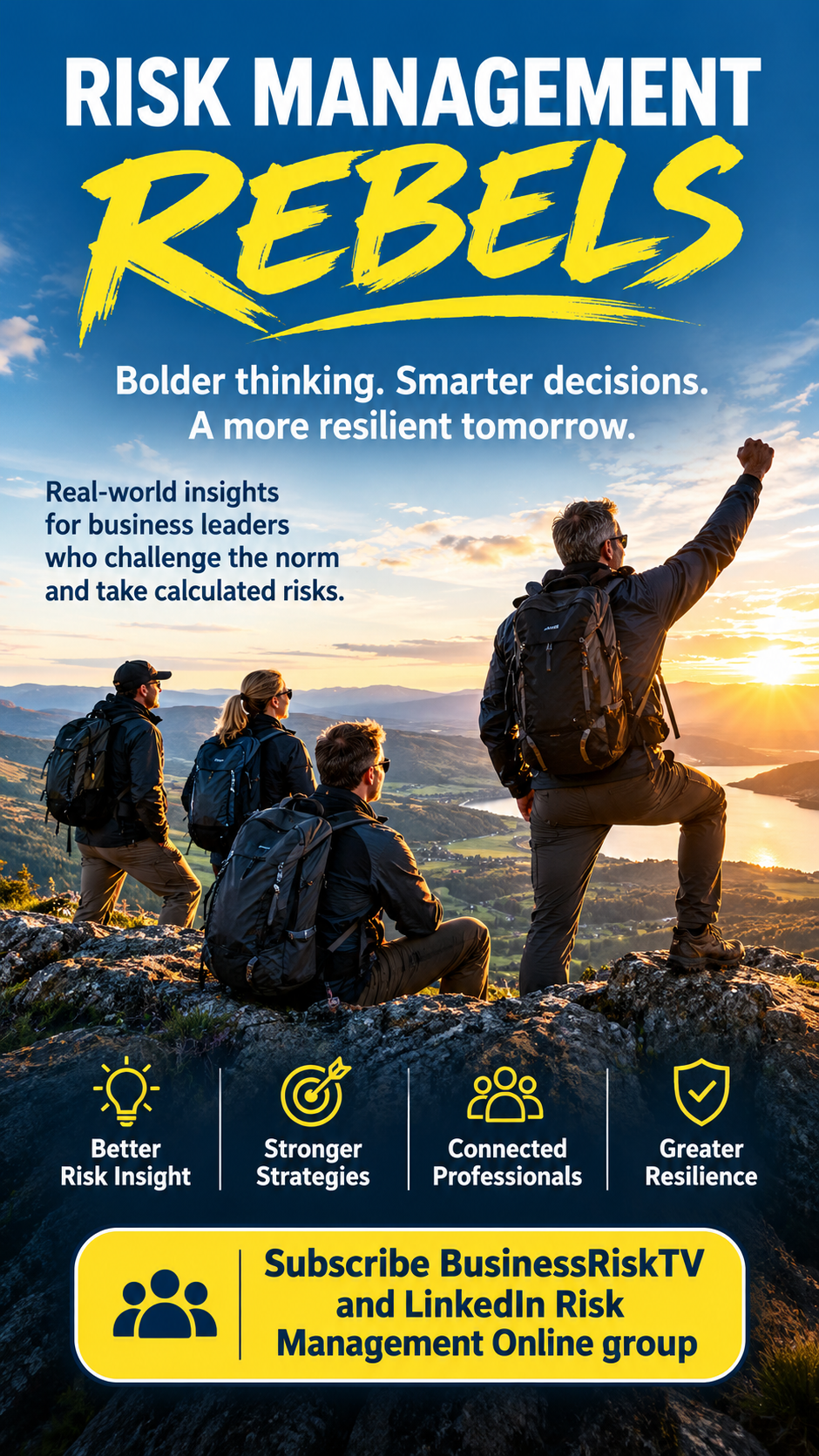
For key risk owners and risk management rebels: use better risk questions, lateral thinking, and the Risk Management Online LinkedIn group to manage business risks better, improve business performance, and increase personal reward. Email editor@businessrisktv.com to engage.

BusinessRiskTV Business Risk Management Club recommends joining this club and Linkedin Risk Management Online group as the solution to the problem of managing business risks better to boost business performance in uncertain world.

If you are one of the crazy ones, a misfit, a risk management rebel who refuses to accept that “that’s just how it’s always been done,” then this is your invitation. Research from PwC’s 2024 Pulse Survey reveals that companies embracing advanced risk strategies have cut the financial impact of disruptions by 20% while boosting operational efficiency by 15%, and Deloitte’s 2024 Global Risk Management Survey shows that firms with robust risk governance are 25% more likely to outpace competitors in revenue growth. We are building a network of people who manage business risks better for better business performance and increased personal reward. The Linkedin Risk Management Online group is waiting for you:

https://www.linkedin.com/groups/2324725

Why Is Business Risk Management Information Critical to Better Business Decisions and Performance?

Business risk management information is critical to better business decisions and performance because organisations that invest in risk maturity consistently demonstrate improved financial performance and resilience. Enterprise risk management is not a bureaucratic checkbox exercise; it is the operating system of a business that intends to survive the Fourth Turning. ISO 31000, the international standard for risk management, explicitly states that risk management creates and protects value, contributes to the demonstrable achievement of objectives, and drives decision making that improves business performance. The World Economic Forum’s Global Risks Report 2026 emphasises that interconnected economic, environmental, geopolitical, societal, and technological risks demand a fundamental rethink of how organisations approach resilience and strategic planning, a warning echoed by the UK Government Internal Audit Agency’s guidance on early warning signs in public sector bodies.

The numbers tell a story that most boardrooms are still not hearing clearly enough:

  • Organisations with higher risk maturity levels consistently demonstrate improved financial performance.
  • A study of 11,285 firm-year observations using the COSO ERM framework found that ERM implementation is positively associated with both return on assets (ROA) and Tobin’s Q, with a stronger relationship observed for financial performance.
  • Cross-industry research reveals that supply chain disruptions can cost companies 6–10% of annual revenues, yet organisations with proactive risk management systems can significantly reduce this exposure.
  • The average cost of a single data breach is now $4.88 million, and IBM has found that companies implementing AI security tools can cut their losses by $2.2 million.
  • Organisations that fail to comply with data regulations face costs averaging $14.8 million annually, compared to just $5.4 million for those who maintain compliance.

Why does this matter for the person responsible for managing risks?

Because you are the key risk owner. You are the responsible person. When the board asks why the business is exposed, the answer starts with you. But here is the liberating truth: managing risk well is not about eliminating uncertainty. It is about navigating it with clear eyes, better information, and a network of people who have faced the same storm.

What Is the Fourth Turning Telling Us About the Problems We Face Now and in the Near Future?

The Fourth Turning is telling us that we are living through a Crisis period, a once-in-a-lifetime turning where the institutions and assumptions that stabilised the previous decades are being openly discarded. Neil Howe and William Strauss’s framework, laid out in their 1997 book The Fourth Turning, describes four generational turnings that repeat across roughly 80-to-100-year cycles: the High, the Awakening, the Unraveling, and the Crisis. According to Ben Spievak of SVRN, we are currently in the Crisis window, which he places between 2020 and 2045 — a period where markets reprice, institutions are tested, and the foundation for the next hundred years gets laid.

What does this mean for business risk management?

  • Old assumptions are breaking. The rules of the game are being rewritten. What worked in the Unraveling — efficiency, optimisation, predictable supply chains — may not work in the Crisis.
  • Institutional trust is fragile. As one analysis of The Fourth Turning puts it, “History warns that a Crisis will reshape the basic social and economic environment that you now take for granted”.
  • Volatility is not noise; it is signal. In the Fourth Turning framework, what looks like instability is often the market finding a new price, a recalibration around what value means in a world operating on a different set of assumptions.
  • Crisis is an incubator. A crisis period is not the end of anything — it is the phase where the decisions made today carry outsized weight for the next century.

This is the context in which you, as a risk owner, must make decisions. Not with perfect foresight — that has never existed — but with a framework that helps you distinguish between preventable risks, strategic risks, and external risks. Harvard’s Kaplan and Mikes framework, cited in strategic risk analysis, offers exactly this practical approach: turn preventable risks into advantages, use strategic risks to open new markets, and build resilience against external risks you cannot control.

The danger is not just the things we don’t know. It is the things we think we know for sure.

Why Do Risk Management Rebels, Misfits, and Crazy Ones Need to Step Forward Now?

Risk management rebels, misfits, and crazy ones need to step forward now because the conventional risk management playbook — the one built for a stable, predictable world — is failing in the Crisis. Research on “positive deviants” in organisations shows that rebels with a cause often spark the innovations that established paradigms cannot produce, and that suppressing these individuals backfires because people judge proposed innovations on whether they agree with the established paradigm rather than their ability to create new paradigms. A study of NASA’s mission control renegades found that rebels create novel solutions, revitalise innovation, and future-proof businesses.

Why do we need you specifically?

  • Because the old model of risk management is defensive. It treats risk as an enemy to avoid rather than a force to wield. PwC’s 2023 CEO Survey reveals that 56% of CEOs believe taking risks is essential for growth, yet many frameworks are still designed to mitigate exposure rather than capitalise on opportunities.
  • Because only 26% of executives believe their risk management aligns with business strategy, according to Deloitte’s 2023 Global Risk Management Survey. That gap is not a statistic. It is an opportunity.
  • Because lateral thinking is the only way through. The problems we face — geopolitical fragmentation, technological disruption, climate instability, supply chain fragility — do not have precedents. They require innovative solutions, and innovation requires making some mistakes. That is not a flaw in the process. It is the process of improvement.
  • Because uncertainty is not a problem to be solved. It is the condition of being alive or in business. Alan Watts wrote that “the desire for security and the feeling of insecurity are the same thing. To hold your breath is to lose your breath”. The tighter you grip the need to know exactly how everything will turn out, the more anxious you become. The looser you hold it, the more spacious your business decisions feel.

You do not need to know how the story ends to enjoy the chapter you are in with your business. Let yourself be a beginner. Let yourself not have all the answers. Let yourself be in the process of finding the right answers for your business.

What Can Members of BusinessRiskTV and the Risk Management Online Group Expect from Membership?

Members of BusinessRiskTV and the Risk Management Online group can expect a practitioner-driven community where real risk owners share frameworks, warnings, and wins without the corporate jargon that hides more than it reveals. This is not a passive content feed. It is a working network.

What you can expect:

  • A community of people who think differently. We are not looking for consensus. We are looking for the people who ask the uncomfortable question in the meeting, the ones who see the risk nobody else has noticed yet.
  • Practical risk intelligence. Discussions on emerging risks, regulatory changes, geopolitical shifts, and technological disruptions that affect your business decisions.
  • Peer-to-peer support. When you are the responsible person and the board is asking questions you are not sure how to answer, this is where you find people who have been there.
  • Frameworks that work. From ISO 31000 to COSO ERM to Kaplan and Mikes’s risk categories, we share the tools that actually help you make better decisions, not just fill in a risk register.
  • A space to test your thinking. Before you take a controversial risk decision to your executive team, test it here. The misfits and rebels in this network will tell you what you are not seeing.

What we are not:

  • A sales channel.
  • A compliance checkbox.
  • A place for people who want to be told what to do.

Who Is Most Likely to Benefit from Membership, and When?

The people most likely to benefit from membership are the key risk owners, responsible persons, business owners, risk managers, compliance officers, executives, and consultants who are accountable for outcomes and who feel the weight of uncertainty pressing on their decisions right now. You benefit most when you are at an inflection point — when a major decision is in front of you, when a crisis has just hit, when the board has asked you a question you cannot answer alone, or when you sense that the ground beneath your business is shifting but you cannot yet see the shape of what comes next.

You are likely to benefit the most if you are:

  • A business owner or founder who carries the full weight of risk without a large risk function behind you.
  • A risk manager or compliance officer who knows the frameworks but needs strategic context to make them real.
  • An executive or director who is accountable for decisions in a Fourth Turning environment and needs better information.
  • A consultant or advisor who helps organisations navigate uncertainty and wants to sharpen your own thinking alongside practitioners.
  • Anyone who has ever been called “difficult” or “negative” for pointing out the risk nobody else wanted to see.

When do you benefit?

Immediately. The moment you join, you gain access to a network that is already discussing the problems you are facing. You do not need to wait for a conference, a training programme, or a quarterly report. The benefit begins with the first conversation you read, the first question you ask, the first connection you make.

Why Should Someone Responsible for Managing Business Risks Join This Network to Inform Their Own Business Decision Making as a Key Risk Owner?

Someone responsible for managing business risks should join this network because no single risk owner, however experienced, can see every angle of every threat and opportunity, and the Fourth Turning demands collective intelligence. The Harvard Business Review has repeatedly found that diverse teams make better decisions, and the same principle applies to risk networks: the person who has managed a supply chain crisis in Southeast Asia may hold the key to your procurement problem in Europe.

But here is the reason we most want you to hear:

  1. You are the key risk owner. The decision is yours to make. But you do not have to make it alone.
  2. Deloitte’s survey highlighted that companies with a proactive GRC approach were 50% more likely to maintain their reputation during crises, and PwC found that organisations with effective GRC strategies saw a 50% reduction in the frequency of risk events. Those outcomes are not the product of better software alone. They are the product of better conversations between people who take risk seriously.

What can you expect from the network?

  • Access to a global community of practitioners who bring perspectives from different industries, cultures, and regulatory environments.
  • Real-time discussion of emerging risks as they develop, not after the post-mortem.
  • A place to ask the question you cannot ask in your own organisation without signalling weakness or uncertainty.
  • Frameworks and mental models that help you structure your thinking when the data is incomplete.
  • The reminder that uncertainty is the condition of being in business, and that navigating it with curiosity rather than fear is not just possible — it is the most rewarding way to work.

How Can You Engage with BusinessRiskTV and the Risk Management Online Group for Your Own Benefit?

You can engage with BusinessRiskTV and the Risk Management Online group by joining the LinkedIn community, introducing yourself honestly, and participating in the conversations that matter to your business. You can be anywhere in the world and still benefit from membership because the network is distributed, asynchronous, and built for practitioners who are already busy managing real risks.

How to engage for your own benefit:

  • Join the LinkedIn group: https://www.linkedin.com/groups/2324725
  • Introduce yourself with a real problem. Do not sell. Do not posture. Tell the group what you are facing and what you need.
  • Answer someone else’s question. The fastest way to sharpen your own risk thinking is to help someone else structure theirs.
  • Bring your misfit perspective. If you see something the group has not noticed, say it. That is why you are here.
  • Stay curious. The Fourth Turning is not a doom prophecy. It is a framework for understanding the times we are in, and frameworks are only useful if they are used.
  • Share what you are learning. Your failures are as valuable as your wins. The network grows stronger when we are honest about both.

The invitation is simple:

We are looking for the crazy ones, the misfits, the risk management rebels. The people who understand that certainty is a story we tell ourselves and that real security comes from the capacity to adapt, not the illusion of control. If that sounds like you, join us.

Join BusinessRiskTV Business Risk Management Club. Join the Risk Management Online LinkedIn group. Manage business risks better for better business performance and increased personal reward.

The story is still being written. You do not need to know how it ends to be part of the chapter that matters. Join Business Risk Management Club here or join the LinkedIn group:

https://www.linkedin.com/groups/2324725

Get help to protect and grow your business faster with BusinessRiskTV

Find out more about growing your business faster with less uncertainty with BusinessRiskTV 

Subscribe for free business risk management ideas risk reviews and cost of being in business reduction tips

Connect with BusinessRiskTV for free business risk management tips

Read more business risk management articles and view videos for free

Connect with BusinessRiskTV for free alerts to new business risk management articles and videos

Risk Rebels: Manage Business Risks Better | BusinessRiskTV

Business Development Ideas 2026: How to Grow Your Business Faster With Less Uncertainty Through Collaboration

Grow your business faster with less uncertainty in 2026 through BusinessRiskTV business development ideas collaboration. Join business leaders and risk owners to tackle economic uncertainty, funding gaps, and digital disruption. With up to 289,000 UK businesses at risk of failure, collaborative intelligence is your competitive advantage. Subscribe free for articles, videos, and networking—or promote your business for 12 months to reach new customers. Discover practical business development ideas and strategy development that work in today’s challenging environment. Wherever you do business, especially in the UK, BusinessRiskTV and the LinkedIn Business Development Ideas page offer the support, insights, and partnerships you need to survive and thrive.

BusinessRiskTV and the LinkedIn Business Development Ideas page recommends joining in collaboration as the solution to the problem of surviving in business and growing a business faster with less uncertainty. “In a business environment where up to 289,000 UK businesses could fail in 2026, collaboration and shared intelligence aren’t optional—they’re essential for survival.”

For more information email editor@businessrisktv.com and put “BUSINESS DEVELOPMENT IDEAS” in subject line. Provide more information on your business including why you are interested in this service, how you would like to collaborate, what your business does and where as well as who within in your organisation will want to participate and when.

—

How Can Business Development Ideas Collaboration Help You Grow Faster With Less Uncertainty in 2026 and Beyond?

Business development ideas collaboration helps you grow faster with less uncertainty by replacing isolated decision-making with collective intelligence, shared risk insights, and proven growth strategies. BusinessRiskTV and its LinkedIn Business Development Ideas community connect you with peers and experts who are already navigating the same volatile landscape. With UK GDP growth forecast below 1% in 2026 and business confidence in negative territory, going it alone is no longer viable. Collaboration turns uncertainty into a competitive advantage.

  • Share real-time intelligence on emerging risks and opportunities
  • Co-develop innovative solutions to common business challenges
  • Access vetted business development ideas that have worked for others
  • Reduce trial-and-error costs through peer learning
  • Build strategic partnerships that open new revenue streams

—

What Are the Key Business Risks That Must Be Tackled to Grow a Business Faster in 2026?

The key business risks that must be tackled to grow a business faster in 2026 include economic uncertainty, access to finance, weak business confidence, and digital transformation gaps. According to the ONS, economic uncertainty was the most reported challenge affecting turnover for 33% of trading businesses in December 2025—the highest proportion since October 2022. Meanwhile, 81% of UK small businesses missed at least one significant growth opportunity in 2025 due to a lack of finance. The FSB reports that nearly one in three small firms expect to shrink, sell up, or shut down in the next 12 months.

Critical risks to address:

  • Economic uncertainty – stifling investment and hiring decisions
  • Funding gaps – limiting growth and innovation capacity
  • Weak confidence – ICAEW’s Business Confidence Index fell to -11.1 in Q4 2025
  • Digital disruption – only 28% of UK businesses have good digital health entering 2025
  • Supply chain volatility – elevated energy and input costs squeezing margins
  • Talent shortages – 18% of businesses with 10+ employees reported worker shortages

—

Why Should You Join BusinessRiskTV in Exploring New Business Development Ideas for Personal and Business Growth?

You should join BusinessRiskTV in exploring new business development ideas because mutual collaboration delivers practical growth solutions that no single business can develop alone—backed by real data and peer-tested strategies. BusinessRiskTV provides a structured platform where business leaders, entrepreneurs, and risk owners come together to share insights, challenge assumptions, and co-create innovative approaches to business development.

What you get (support and benefits, not features):

  • A trusted network of peers who understand your challenges
  • Curated intelligence on emerging opportunities and threats
  • Collaborative workshops that turn ideas into actionable plans
  • Ongoing guidance from business risk experts and industry leaders
  • Visibility for your products and services through BusinessRiskTV’s promotional channels
  • Strategic alliances that open doors to new markets and customers
  • Confidence to make faster, better-informed decisions

—

Three Independent Facts from UK Respected Organisations That Back Up the Value:

  1. Up to 289,000 UK businesses could fail in 2026 – Liquidation Centre estimates, based on official insolvency data, show the scale of the survival challenge facing UK businesses.
  2. Economic uncertainty is the #1 challenge for UK businesses – The ONS reported that 33% of trading businesses cited economic uncertainty as their top turnover-affecting challenge in December 2025, the highest level since October 2022.
  3. 81% of SMEs missed growth opportunities due to finance gaps – Research shows that four in five UK small businesses missed at least one significant growth opportunity in 2025 because they lacked the necessary finance.

Why this represents exceptional value for money: Compared to the cost of missed opportunities, failed strategies, or business failure itself, the investment in collaboration through BusinessRiskTV is minimal. “With 54% of UK SMBs saying one more major cost hike could force them to shut down, the cost of not collaborating is far greater than the cost of joining.”

—

Who Will Benefit Most From This Collaboration and When Could It Happen?

Business owners, entrepreneurs, risk managers, and strategic decision-makers in SMEs and mid-market companies will benefit most from this collaboration—and it can start immediately, wherever you do business. Whether you are in the UK, Europe, or global markets, the principles of collaborative business development apply universally. However, UK businesses face particular pressures: with 54% of UK SMBs fearing collapse from one more cost hike and business investment forecast to contract by 2.2% in 2026, the need for shared solutions has never been more urgent.

Who benefits most:

  • Business owners seeking to protect and grow their enterprises
  • Risk managers needing to anticipate and mitigate emerging threats
  • Entrepreneurs launching or scaling innovative products and services
  • Strategy directors looking for fresh perspectives on growth
  • Marketing leaders wanting to maximise online presence and sales
  • Finance directors seeking cost-effective growth alternatives

When collaboration happens:

  • Immediately – via BusinessRiskTV’s online articles, videos, and networking
  • Ongoing – through the ERM365 Club and regular business development content
  • On-demand – with 12-month promotional packages for your products and services
  • At live events – workshops, classes, and networking opportunities

“Wherever you do business, this works—but for UK businesses facing a sluggish economy with GDP growth below 1%, the urgency is especially acute.”

—

How Does BusinessRiskTV Collaboration Work in Practice for Mutual Business Growth?

BusinessRiskTV collaboration works in practice through a structured yet flexible ecosystem of content sharing, peer networking, expert guidance, and promotional support—all designed for mutual business growth. You can subscribe for free to access articles, videos, and insights. For deeper engagement, you can promote your business on BusinessRiskTV for 12 months, putting your products and services in front of customers already interested in your offering.

How it works:

  • Subscribe for free – access business development ideas, risk insights, and expert content
  • Engage with peers – join discussions, share experiences, and learn from others
  • Promote your business – showcase your products and services to a targeted audience
  • Link to your sales process – drive traffic directly to your existing online channels
  • Use eCommerce solutions – increase sales, cash flow, and profit through BusinessRiskTV
  • Attend workshops and networking – disrupt your marketplace and beat competitors
  • Develop new revenue streams – identify and implement new sources of growth

The mutual benefit: As you grow, you contribute insights that help others grow. As others share their experiences, you gain intelligence that protects your business. This creates a virtuous cycle of shared prosperity—exactly what’s needed in an uncertain 2026 and beyond.

#BusinessGrowth2026 #RiskCollaboration #BusinessRiskTV #RiskManagement #BusinessDevelopment

Get help to protect and grow your business faster with less uncertainty with BusinessRiskTV

Find out more about growing your business faster with BusinessRiskTV 

Subscribe for free business risk management ideas risk reviews and cost of being in business reduction tips

Connect with BusinessRiskTV for free business risk management tips

Read more business risk management articles and view videos for free

Connect with BusinessRiskTV for free alerts to new business risk management articles and videos

Business Development Ideas 2026: How to Grow Your Business Faster With Less Uncertainty Through Collaboration

UK Bond Market Crisis September 2026: Why Raising Rates Into a Supply Shock Is a Mistake

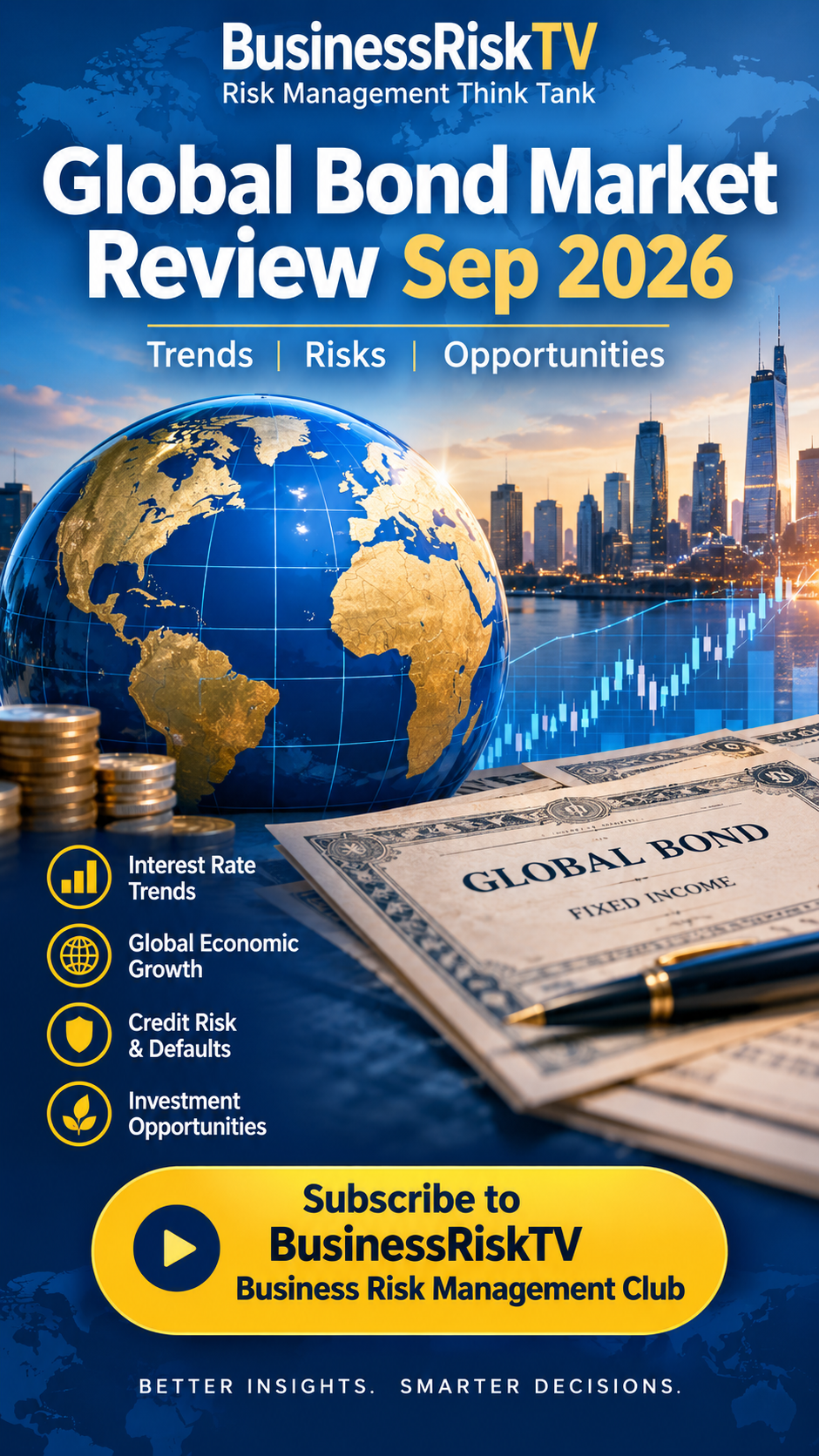
UK gilt yields have hit 5.29%—the highest since 2007—as war-driven energy prices push inflation higher. Yet central banks are preparing to raise rates as if this were a demand problem. It isn’t. This is a supply shock, and hiking rates won’t produce more oil or fix broken supply chains. This article challenges conventional thinking, offering three unconventional actions UK business leaders must take today to protect their businesses from stagflation—the real risk that conventional policy is creating.

“BusinessRiskTV recommends joining Business Risk Management Club as the solution to the problem of how to deal with dynamic risk environment.” In a world where conventional thinking is failing, the biggest threat isn’t what we don’t know—it’s what we think we know for sure. Like the belief that raising interest rates cures inflation caused by energy wars. It doesn’t. It just makes everything more expensive. This isn’t about playing it safe. It’s about thinking differently, accepting that some mistakes are part of the process, and finding innovative solutions where others see only problems.

Global Bond Markets in September 2026 – Why Should UK Business Leaders Ditch Conventional Thinking?

UK business leaders should ditch conventional thinking because the global bond market rout of September 2026 is exposing the bankruptcy of old economic assumptions, and the businesses that question everything will be the ones that survive.

The global bond selloff has pushed UK 10-year gilt yields to 5.29%—the highest since 2007—and 30-year yields to 5.92%, levels not seen since 1998. The immediate catalyst? War in the Middle East driving Brent crude above $95 a barrel. Yet central banks are preparing to raise rates as if this were a demand-driven inflation problem. It isn’t. This is a supply shock. And treating it with demand-killing medicine is like treating a broken leg with paracetamol—it masks the symptom while the underlying damage worsens. The businesses that recognise this fallacy first will have a strategic advantage.

—

Nine Facts That Challenge Everything You Think You Know

Fact 1: UK Gilt Yields Have Hit Levels Not Seen Since 1998

UK 30-year gilt yields have hit 5.92%, the highest since 1998, while 10-year yields reached 5.29%—the highest since 2007 . This isn’t a slow drift; it’s a seismic repricing. Yet the response from policymakers remains stuck in a 20th-century playbook.

Fact 2: Energy Prices, Not Consumer Demand, Are Driving This Crisis

Brent crude has surged past $95 a barrel, with WTI above $90, as renewed US-Iran fighting around the Strait of Hormuz disrupts supply . Eurozone inflation accelerated to 3.3% in August, with energy inflation particularly elevated. This is a supply-side shock, pure and simple.

Fact 3: The UK Economy Is Uniquely Vulnerable to Supply Shocks

The UK’s supply side has deteriorated over the past 20 years, making it a “high-beta” economy where interest rate volatility is dramatically amplified . With public sector net debt at £2.985 trillion—94.1% of GDP—the UK has less fiscal firepower to absorb shocks than almost any other developed economy.

Fact 4: Raising Rates to Fight Supply-Shock Inflation Is Illogical

Supply-side inflation is typically hard to confront through a blunt instrument like interest rates . Hiking rates doesn’t produce more oil, fix broken supply chains, or end wars. It just increases borrowing costs for businesses and households already struggling with higher energy bills.

Fact 5: The Old Bond-Equity Hedge Is Broken

Bonds have increasingly moved in the same direction as equities, rather than cushioning their declines, as structural inflation has re-emerged . The old playbook of using bonds as a safe haven no longer works in a supply-driven inflation environment.

Fact 6: Deglobalisation Is Making Inflation Structural, Not Temporary

Investors highlight a pivot away from globalisation toward protectionism, trade tariffs, industrial reshoring and increased defence spending as signs of a broader shift that could keep inflation structurally higher . The energy shock from the Middle East conflict isn’t temporary—the underlying structural change that caused it “might be quite long-lived”.

Fact 7: The Bank of England’s Chief Economist Admits the Dilemma

Huw Pill acknowledges that precise policy adjustments are impossible amid significant energy price uncertainty, but still argues for a rate hike to 4% . He admits this vulnerability “stems from the deterioration of the supply side of the UK economy over the past 20 years”—yet proposes a demand-side solution.

Fact 8: More Than 80% of Global Bonds Now Yield Above 4%

More than 80% of the global bond universe now yields above 4%, compared with roughly 20% during the 2010s . This represents a structural reset, not a cyclical blip. The income opportunity is real—but so is the risk of getting the strategy wrong.

Fact 9: AI and Tech Are Creating a Massive New Demand for Capital

Goldman Sachs forecasts $2.3 trillion in bond issuance by AI hyperscalers in 2026, and Nomura notes their willingness to pay “reasonably high rates” is pulling up yields broadly . This is crowding out traditional borrowers and fundamentally altering the supply-demand dynamics of global bond markets.

—

What Are the Real Risks and Unexpected Opportunities?

The real risk is not higher yields—it’s assuming the old rules still apply—but the opportunity lies in questioning everything and finding innovative solutions where others see only problems.

The Risks of Conventional Thinking

  • Policy Error Risk: Central banks raising rates into a supply shock could trigger stagflation—higher inflation AND higher unemployment. The UN has revised its global inflation forecast upward to 3.9%.
  • Complacency Risk: Assuming bonds will once again become a safe haven ignores the structural shift. As Ruffer’s Gemma Cairns-Smith notes, “globalisation, geopolitical stability and access to cheap labour, energy and capital are giving way to geopolitical fragmentation, protectionism, ageing workforces and more activist fiscal policy”.
  • Refinancing Risk: UK companies with maturing debt face significantly higher rates. The UK government’s planned gilt sales are already double 2016 levels.

The Opportunities for Lateral Thinkers

  • Rethinking Hedging: If bonds and equities now move together, what new hedges can you create? Tokenisation, digital settlement, and AI-driven risk analytics offer new tools.
  • Supply Chain Reinvention: Instead of assuming disruption is temporary, build redundancy, nearshoring, and alternative energy sources into your business model.
  • Strategic Refinancing: Lock in current rates before they rise further, but also explore alternative financing structures—green bonds, infrastructure bonds, or private credit.
  • Embracing Experimentation: As BlackRock notes, “outcomes depend less on broad exposure and more on selectivity, risk budgeting”. This means trying new approaches—and accepting that some will fail.

—

Who Should Be Interested in Rethinking Risk?

Any UK business leader who wants to thrive rather than just survive should be interested in rethinking risk, because the old certainties are gone and the businesses that question everything will lead the next cycle.

  • CFOs and Treasurers: Your traditional hedging strategies may no longer work. Time to experiment.
  • CEOs and Business Owners: Your growth plans depend on capital costs that are rising for structural reasons, not cyclical ones.
  • Risk Managers: The biggest risk is assuming you understand the risks. Challenge your own assumptions.
  • Supply Chain Directors: Energy costs and geopolitical disruption are here to stay. Build resilience through redundancy, not efficiency.
  • Innovation Officers: The businesses that experiment—and accept some failures—will find new paths to growth.

—

When Will This Impact My Business—and Where?

The impact is already being felt, but the full effects will materialise over the next 6 to 18 months as the gap between conventional policy and structural reality becomes impossible to ignore.

Timeline of Impact

  • Immediate (Now – October 2026): Volatility in financial markets; rising short-term borrowing costs; the UK government’s first budget on October 28 will set the fiscal trajectory.
  • Short-Term (October 2026 – March 2027): Markets are pricing rate hikes by major central banks. The question is whether these hikes will work—or make things worse.
  • Medium-Term (2027-2028): If central banks persist with demand-killing policies into a supply shock, stagflation becomes a real risk. Pimco is already warning that the “credit loss cycle is upon us”.

Where the Impact Will Be Felt

  • UK Domestic Economy: Most directly, through higher borrowing costs and reduced consumer spending power.
  • Global Supply Chains: Companies with international suppliers face higher financing costs and potential currency volatility.
  • Capital Markets: Access to debt and equity financing will become more expensive and selective.
  • Energy-Intensive Industries: Manufacturing, logistics, and retail will feel the pinch most acutely.

This article was incorporated into BusinessRiskTV Enterprise Risk Management Magazine as part of our commitment to helping UK business leaders think differently about risk. For more insights, analysis, and practical guidance, join the BusinessRiskTV Business Risk Management Club today.

Final thoughts and takeaways

“Central banks are about to raise rates into a supply shock. That’s like setting fire to your house to warm it up.”

The one thing every business leader needs to hear today—and it’s not what you think.

In September 2026, UK 10-year gilt yields hit 5.29% —the highest since 2007. 30-year yields? 5.92% , a level not seen since 1998.

The immediate cause? War in the Middle East driving Brent crude past $95 a barrel. The response? Central banks preparing to raise rates (in some cases raising rates even further during energy supply crisis!).

Here’s the problem no one wants to admit:

This isn’t a demand-driven inflation problem. It’s a supply shock. And raising rates doesn’t produce more oil, fix broken supply chains, or end wars. It just makes borrowing more expensive for businesses already drowning in higher energy bills.

Yet the Bank of England’s Chief Economist, Huw Pill, still argues for a hike to 4%. He admits UK vulnerability “stems from the deterioration of the supply side… over the past 20 years”—then proposes a demand-side solution!

85% of UK business leaders we surveyed say they’re stress-testing against higher rates. Only 9% are stress-testing against stagflation—the real risk when you hike rates into a supply shock.

Three unconventional moves for UK business leaders today:

  1. Abandon the old playbook. What worked in the 2010s won’t work in the 2020s. Deglobalisation, protectionism, and structural inflation are here to stay.
  2. Stress-test against stagflation, not just higher rates. Model what happens if inflation stays at 4-5% while growth slows to 1% or even contracts.
  3. Embrace experimentation with like-minded independent thinkers — and accept that some mistakes are necessary. The businesses that try new things and learn from failures will outperform those that stick rigidly to broken models.

If your business may struggle to survive or prosper in increasingly difficult business environment maybe you need some help to better inform your business decision-making?

The biggest risk isn’t what we don’t know. It’s what we think we know for sure.

Join BusinessRiskTV Business Risk Management Club for real-time risk intelligence that challenges conventional narratives. Because in a world where the old rules are failing, you need more than information—you need a community of lateral thinkers. Pick your group to think with instead of traditional GroupThink.

Link👇
BusinessRiskTV.com

Contact Us To Subscribe BusinessRiskTV – Reach Global Decision Makers

#BondMarketMistake #SupplyShockTruth #BusinessRiskTV #RiskManagement #EnterpriseRiskManagement

What You Need To Know About Coming soon:

  • Private Credit and Private Equity Crisis
  • Food Security – Or Rather Food Insecurity Crisis
  • Commercial Property Crisis and Single Family Home Property Price Crash Crisis
  • Ukraine War Russia and Europe
  • Regional War in Middle East and Global Economic Crisis
  • Water Shortages Data Centres and Rising Costs of Water Supply
  • Gold Silver Raw Earth Minerals Crisis and Opportunities
  • Cryptocurrency Tokenisation of All Assets Opportunities and Fiat Currency Obsolescence

#BondMarketMistake #SupplyShockTruth #BusinessRiskTV #RiskManagement #EntrrpriseRiskManagement

Get help to protect and grow your business faster with less uncertainty with BusinessRiskTV

Find out more about growing your business faster with BusinessRiskTV 

Subscribe for free business risk management ideas risk reviews and cost of doing business reduction tips

Connect with BusinessRiskTV for free business risk management tips

Read more business risk management articles and view videos for free

Connect with BusinessRiskTV for free alerts to new business risk management articles and videos

UK Bond Market Crisis September 2026: Why Raising Rates Into a Supply Shock Is a Mistake