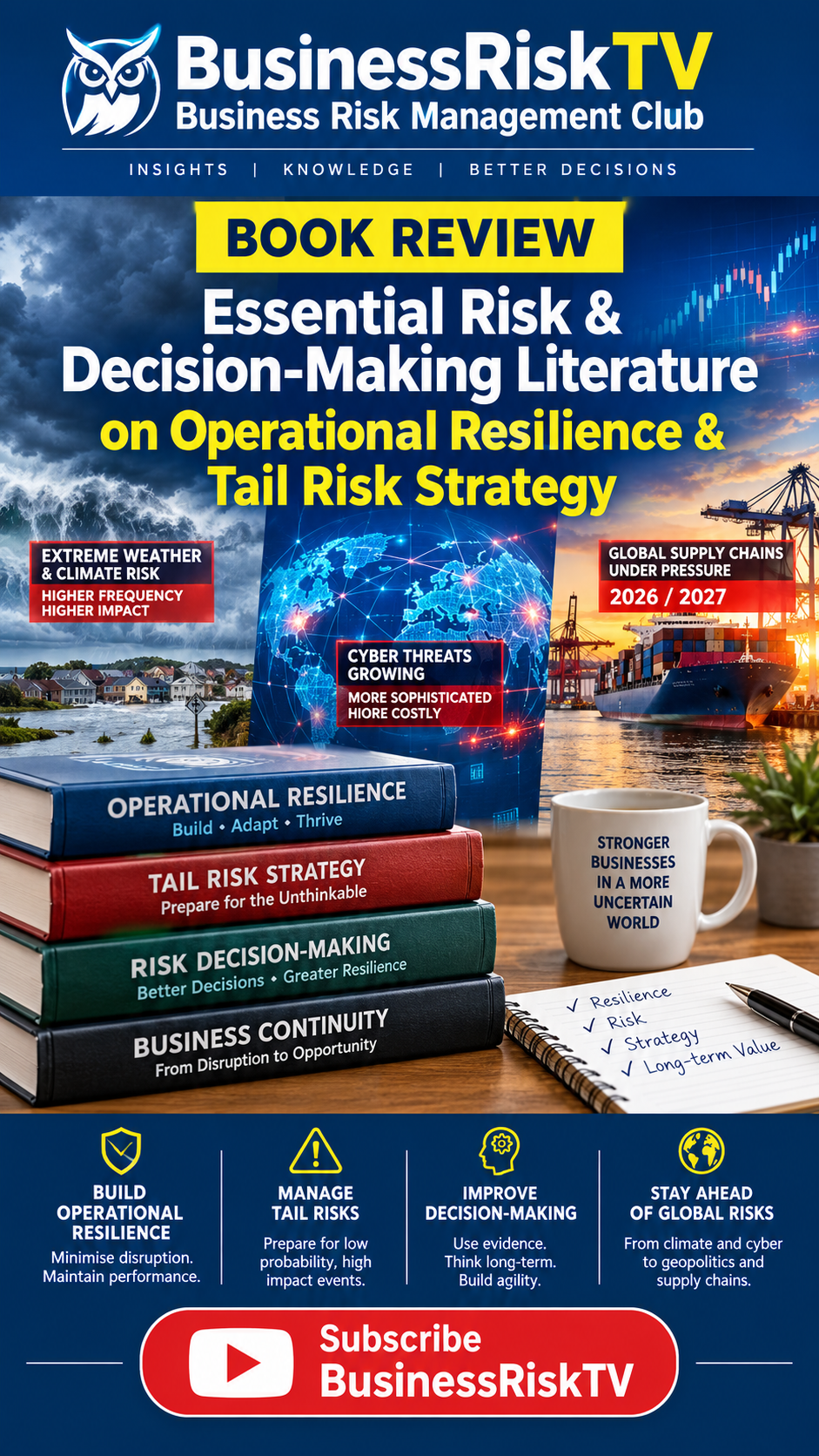
Which 3 Nassim Taleb Books Should Directors Read for Tail Risk & Operational Resilience in 2026?

How do directors, project managers & strategists navigate systemic uncertainty? BusinessRiskTV reviews Taleb’s 3 books with UK ONS stats & practical tail risk steps.

BusinessRiskTV Business Risk Management Club recommends these 3 books to help the reader make better decisions on Operational Resilience & Tail Risk Strategy.

That single sentence encapsulates why the following review exists. The scale of the problem is not theoretical. The Office for National Statistics reported that 40% of UK trading businesses with 10 or more employees cited economic uncertainty as the most significant challenge impacting turnover in early April 2026—the highest proportion since the question was introduced in April 2022. Government analysis of operational disruption across UK sectors shows that while typical incidents cost between 0.2% and 4.6% of annual turnover, tail events can dominate total losses and threaten business continuity entirely. Cyber-attacks alone cost UK businesses £3.7 billion in litigation over the past year, with shareholder lawsuits accounting for nearly a third of that total. Against this backdrop, Nassim Nicholas Taleb’s Incerto trilogy—Fooled by Randomness, The Black Swan, and Antifragile—provides the conceptual infrastructure that directors, project managers, and strategists need to navigate systemic uncertainties and cognitive bias in decision-making.‌

What Makes Nassim Nicholas Taleb’s Incerto Trilogy Essential Risk & Decision-Making Literature for Operational Resilience & Tail Risk Strategy?

Taleb’s Incerto trilogy is essential risk and decision-making literature for operational resilience and tail risk strategy because it systematically dismantles the illusions that lead organisations to underestimate rare, high-impact events and overestimate their ability to predict and control complex systems. The three books form a coherent progression: Fooled by Randomness (2001) exposes how humans mistake luck for skill; The Black Swan (2007) reveals how rare, unpredictable events shape history and markets; Antifragile (2012) offers a framework for building systems that benefit from disorder.

Why This Matters for Directors, Project Managers & Strategists:

  • Directors face board-level decisions where governance failures linked to cognitive bias carry escalating legal and financial consequences. UK boards are already experiencing “quiet distress” as prolonged financial strain and delayed decisions create D&O exposure earlier in the risk cycle.
  • Project managers operate at the intersection of uncertainty and delivery, often relying on linear projections and optimistic timelines that fail catastrophically when tail events hit. Research shows that organisations with structured decision trackers score more than 20 percentage points higher on early-warning indicator tracking and bias exploration than those without.
  • Strategists build models that assume a stable future, yet the ONS Business Insights survey consistently shows economic uncertainty dominating business challenges month after month.‌
    Each book serves a distinct function in the operational resilience toolkit. Together, they constitute a complete curriculum in probabilistic thinking, tail risk awareness, and adaptive system design.

What Is the Core Argument of Fooled by Randomness, and How Does It Apply to Business Decision-Making?

The core argument of Fooled by Randomness: The Hidden Role of Chance in Life and in the Markets is that humans systematically confuse randomness with causality, attributing success to skill and failure to controllable factors, thereby creating brittle decision-making frameworks that collapse when randomness reasserts itself. Taleb demonstrates that much of what passes for expertise in finance, management, and strategy is indistinguishable from luck dressed in the language of analysis.

Why This Matters Practically:

  • Distinguish signal from noise in performance data. Taleb argues that short-term results are dominated by variance, not skill. When evaluating business unit performance or project outcomes, directors should demand longer time horizons and statistical significance testing before drawing conclusions. UK businesses reporting turnover decreases (27% in April 2026) and increases (15% in July) often attribute these swings to strategy or market conditions when random fluctuation may be the dominant driver.‌
  • Identify survivorship bias in case studies. Business literature is filled with success stories of companies that “did everything right.” Taleb’s point is that we never see the graveyard of companies that did the same things and failed due to bad luck. Strategy teams should actively seek out failure cases and control groups.
  • Resist the narrative fallacy in post-mortems. After any project, there is enormous pressure to construct a coherent story explaining outcomes. Taleb warns this narrative impulse prevents genuine learning.

Business Application:

Project managers should implement decision journals that record expectations before outcomes are known, creating a feedback loop that reveals whether success was skill or circumstance. Directors should push for probabilistic language in board papers—”we assess a 60% likelihood” rather than “we are confident”—forcing explicit recognition of uncertainty. Strategists should stress-test strategic plans against scenarios where random negative events cluster, rather than assuming they distribute evenly across time.

What Is the Central Thesis of The Black Swan, and Which Businesses Are Most Vulnerable to Its Implications?

The central thesis of The Black Swan: The Impact of the Highly Improbable is that rare, unpredictable, high-consequence events—Black Swans—dominate outcomes in complex systems, yet our psychological and institutional frameworks are systematically blind to their possibility, leaving businesses dangerously exposed to catastrophic surprise. Taleb identifies the “triplet of opacity”: the illusion of understanding, the retrospective distortion of events, and the overvaluation of factual information.

Which Businesses Are Most Vulnerable:

  • Financial services firms face existential Black Swan exposure. Bank of England research shows 82% of UK banks, insurers and asset managers now cite cyber attacks as a top-five risk to the financial system, up ten percentage points from 2024. A meaningful share of large financial institutions face a roughly 10% annual probability of losing 10% or more of annual profit to a single cyber event.
  • Supply chain-dependent manufacturers and retailers are directly exposed to geopolitical Black Swans. In April 2026, 47% of UK businesses experiencing global supply chain disruption cited the conflict in the Middle East as the reason—up 34 percentage points from February.‌
  • Energy-intensive businesses face compounding tail risks from price volatility and geopolitical disruption. 60% of UK businesses reported concern about energy prices in early May 2026, with accommodation and food service businesses reaching 86% concern.‌
  • Technology and digital businesses are exposed through cyber, regulatory, and concentration risk. The PRA’s 2026 operational resilience policy statement explicitly addresses “rising threats to operational resilience at firms and their growing reliance on externally supplied services”.‌

When to Use The Black Swan Learning Points:

Business Application:

Directors should establish dedicated tail risk committees that meet independently of standard risk reviews, focusing exclusively on low-probability, high-impact scenarios. Project managers should build “kill criteria” into major projects—pre-defined conditions under which the project is stopped—rather than assuming continuation. Strategists should model scenarios where multiple Black Swans occur simultaneously, recognising that disruptions cluster rather than distribute evenly.

What Does Antifragile Teach About Building Organisations That Improve Under Stress, and How Can This Be Implemented?

Antifragile: Things That Gain From Disorder teaches that some systems are not merely robust (resistant to shocks) or resilient (recovering after shocks), but antifragile—they actually improve, strengthen, and grow when exposed to volatility, randomness, and stressors. Taleb argues this property is the highest form of adaptation available to organisations, and it can be deliberately engineered through structural choices, incentive design, and optionality.

Key Antifragile Principles for Business:

  • Barbell strategy: Combine extreme conservatism in core operations with aggressive, small-scale experimentation in growth areas. 75% of grant-funded UK charities use formal risk tools compared to 35% of non-grant-funded organisations, suggesting structured approaches enable greater risk capacity when combined with appropriate funding.
  • Optionality over prediction: Rather than forecasting the future, build portfolios of options that benefit from multiple possible outcomes. This directly addresses the observation that economic uncertainty has been the most reported challenge affecting business turnover since October 2022.
  • Skin in the game: Decision-makers must bear the consequences of their decisions. HM Treasury’s 2026 guidance to accounting officers frames value for money as a “balanced judgement of strategic alignment, long-term resilience, and risk,” moving beyond simple cost minimisation.
  • Redundancy as investment: Duplicate systems, diversified suppliers, and cross-trained teams are not waste—they are the raw material of antifragility.

When to Apply Antifragile Learning Points:

  • During organisational design—to build structures that benefit from uncertainty rather than merely surviving it.
  • During supply chain strategy—to move from just-in-time efficiency to diversified, optionality-rich sourcing.
  • During technology investment—to prioritise systems that learn from attacks and failures rather than merely resist them.
  • During talent development—to cultivate teams comfortable with volatility and skilled at rapid adaptation.

Business Application:

Operations directors should conduct “stress tests with benefit”—scenarios where the organisation not only survives disruption but emerges stronger because competitors are weakened. For example, a manufacturer with diversified suppliers can gain market share when single-source competitors face disruption. Project managers should build rapid prototyping and learning loops into delivery schedules, treating small failures as information rather than stigma. Strategists should allocate a portion of capital to small, high-optionality bets that could pay off massively in Black Swan scenarios, while simultaneously reducing exposure to ruinous tail risks.

Which Businesses Will Benefit Most from Taleb’s Frameworks, and Where in the World Are They Likely Operating?

The businesses that will benefit most from Taleb’s frameworks are those operating in high-uncertainty, high-interconnection, and high-consequence environments—particularly in the UK, Europe, North America, and Asia-Pacific where regulatory pressure, geopolitical fragmentation, and technological disruption intersect.

Sector-by-Sector Analysis:

  • Financial services in London, New York, Singapore, and Frankfurt face the most acute combination of regulatory scrutiny, cyber exposure, and tail risk concentration. The PRA’s PS7/26 operational resilience policy, effective from 2026, requires firms to report operational incidents and material third-party arrangements with significantly reduced burden but enhanced oversight. UK financial services compliance costs now exceed £33.9 billion annually, representing roughly 13% of average operating costs.‌
  • Manufacturing and logistics across the UK, Germany, Netherlands, and key Asian hubs are directly exposed to supply chain Black Swans. The ONS reported 7% of UK businesses experiencing global supply chain disruption in April 2026, with nearly half citing Middle East conflict.‌
  • Energy and utilities in the UK, Norway, Gulf states, and Australia face compounded tail risks from price volatility, geopolitical disruption, and transition uncertainty. 28% of UK businesses cited energy prices as a reason for considering raising prices in June 2026.‌
  • Technology and digital platform businesses globally face cyber Black Swans, regulatory tail risks, and concentration risk. The Bank of England’s 2026 H1 Systemic Risk Survey found 82% of financial institutions citing cyber attacks as a top-five systemic risk.‌
  • Healthcare and pharmaceutical supply chains across Europe, North America, and Asia are exposed to pandemic Black Swans, regulatory disruption, and geopolitical supply chain risk.
  • Professional services firms advising on risk, strategy, and resilience are both beneficiaries (demand for their services grows) and exposed to reputational tail risks if they fail to apply these frameworks themselves.

Geographic Concentration:

  • United Kingdom: Highest regulatory intensity for operational resilience, with FCA/PRA rules now in “steady-state” from 2026, enhanced regulatory powers, and cost recovery provisions.
  • European Union: DORA (Digital Operational Resilience Act) in force across Europe, aligning with UK approaches but creating additional compliance complexity for cross-border firms.
  • United States: Less prescriptive regulation but higher litigation and shareholder activism risk, particularly around cyber governance failures.
  • Asia-Pacific: Rapid economic growth combined with geopolitical tension, supply chain concentration, and varying regulatory maturity creates a high-Black-Swan environment.
  • Middle East and Africa: Geopolitical disruption, energy price volatility, and infrastructure risk create compounding tail exposure.

How Should Organisations Integrate Taleb’s Key Learning Points into Decision-Making to Boost Performance and Reduce Risk Events Derailing Business Objectives?

Organisations should integrate Taleb’s key learning points by embedding probabilistic thinking, tail risk assessment, and antifragile design principles into the governance, project management, and strategy functions at the point of decision, not as an afterthought. The evidence suggests this is not optional: UK business confidence dropped to a net figure of -76 in March 2026, compared to -63 in February, according to Institute of Directors research. Fewer businesses were set up in Q1 2026 than in any comparable period on record. The organisations that survive and thrive will be those that internalise Taleb’s lessons before the next Black Swan arrives.

Board-Level Integration:

  • Establish a Tail Risk Committee reporting directly to the board, separate from the standard audit and risk committee, with a mandate to challenge assumptions of normality and identify ruin exposure.
  • Require probabilistic decision papers: every significant capital allocation or strategic decision must include explicit probability assessments, not point forecasts.
  • Implement decision journals that record expectations, rationale, and confidence levels before outcomes are known, reviewed quarterly to identify systematic biases.

Project Management Integration:

  • Build kill criteria into every major project: pre-defined conditions under which the project is terminated, removing sunk-cost bias from continuation decisions.
  • Apply barbell resource allocation: commit 80-90% of resources to high-confidence, low-variance delivery, and 10-20% to experimental, high-optionality initiatives that could benefit from disorder.
  • Conduct pre-mortems at project initiation: assume the project has failed catastrophically and work backwards to identify causes.

Strategy Integration:

  • Replace single-scenario planning with multiple scenarios including Black Swan scenarios where multiple disruptions compound.
  • Develop antifragile supply chains with diversified sourcing, redundancy, and optionality—accepting higher baseline costs as insurance against tail events.
  • Invest in optionality: maintain cash reserves, flexible contracts, and strategic options that can be exercised when volatility creates opportunity.

Operational Resilience Integration:

  • Align with regulatory requirements proactively: the PRA’s operational resilience framework requires firms to remain within impact tolerances for important business services under severe but plausible disruption scenarios.
  • Conduct regular stress tests that include cyber, geopolitical, and supply chain scenarios simultaneously, recognising that disruptions cluster.
  • Measure resilience value not just as cost avoidance but as competitive advantage: government analysis shows that increased resilience reduces both the likelihood of severe outcomes and the scale of losses when disruption occurs.‌

When to Apply These Frameworks:

  • Annually during strategy and budget cycles: full Black Swan scenario review and antifragile portfolio assessment.
  • Quarterly during board risk reviews: tail risk exposure review and decision journal analysis.
  • Monthly during project reviews: kill criteria assessment and pre-mortem updates.
  • Continuously through operational monitoring: early-warning indicators and antifragile capacity metrics.
  • Post-incident after any disruption: structured learning review applying Fooled by Randomness lessons about attribution.

Why Are These Books Particularly Relevant for Operational Resilience & Tail Risk Strategy in September 2026?

These books are particularly relevant in September 2026 because the operating environment has become precisely the kind of high-volatility, high-interconnection, high-consequence system that Taleb’s frameworks were designed to address. The ONS Business Insights survey for April 2026 showed economic uncertainty at 40% for larger businesses—the highest proportion since the question was introduced. Global supply chain disruption reached 9% in March 2026, the highest since December 2022. The PRA’s operational resilience rules are now in full effect, with “steady-state” expectations and enhanced regulatory powers to demand information, direct remediation, and recover supervisory costs. Bank of England analysis confirms that “average impacts are not representative of overall risk exposure” and that “tail events can dominate total losses and can threaten business continuity”.‌‌

Taleb’s trilogy provides the intellectual architecture to navigate this environment. Fooled by Randomness teaches the discipline of statistical scepticism. The Black Swan reveals the structural blind spots that make organisations vulnerable to rare events. Antifragile offers the design principles to build systems that improve under stress. Together, they constitute a complete risk literacy curriculum for directors, project managers, and strategists who need to make decisions when the future refuses to behave as forecast.

The value proposition is not merely defensive. Organisations that internalise these lessons will identify opportunities that competitors miss—in supply chain restructuring, in optionality-rich investment strategies, in resilient operational models that become competitive advantages when disruption hits. The question is not whether the next Black Swan will arrive, but whether your organisation will be fooled by randomness when it does.

#OperationalResilience #TailRiskStrategy

Get help to protect and grow your business faster with BusinessRiskTV

Find out more about growing your business faster with BusinessRiskTV Business Risk Management Club

Subscribe for free business risk management ideas risk reviews and business discounts to reduce your business cost of being in business

Connect with BusinessRiskTV for free business risk management tips

Read more business risk management articles and view videos for free

Connect with BusinessRiskTV for free alerts to new business risk management articles and videos 

Most “resilient” UK businesses are just lucky. And 40% of larger UK firms just admitted economic uncertainty is beating them.

That’s not a vibe. That’s the ONS Business Insights survey, April 2026: 40% of UK trading businesses with 10+ employees cited economic uncertainty as the top challenge hitting turnover — the highest since the question began in April 2022.

So here’s the uncomfortable question: if your risk register still assumes the future looks like the last 5 years, what exactly are you protecting?

BusinessRiskTV Business Risk Management Club recommends these books to help the reader make better decisions on Operational Resilience & Tail Risk Strategy.

Keep reading — because the third book is the one that changes how you allocate capital.

There are 3 books that do more for operational resilience than most 40-page board packs:

1. Fooled by Randomness — Nassim Nicholas Taleb
It asks: how much of your “performance” is skill, and how much is luck?

If UK businesses swing from 27% reporting turnover decreases to 15% reporting increases in a matter of months, how much of that is strategy — and how much is noise?
Most post-mortems invent a story. Taleb shows you why that story is usually wrong.

2. The Black Swan — Nassim Nicholas Taleb
It asks: what rare event would wipe out the plan?

82% of UK banks, insurers and asset managers now cite cyber attacks as a top-five risk to the financial system, per Bank of England H1 2026 research.
47% of UK businesses hit by global supply chain disruption in April 2026 blamed the Middle East conflict — up 34 percentage points from February.
Cyber-attacks cost UK businesses £3.7bn in litigation over the past year.
That’s not a tail risk. That’s a board-level blind spot.

Wait — here’s the counterintuitive part.

3. Antifragile — Nassim Nicholas Taleb
It asks: what gets stronger when stressed?
Not “robust.” Not “resilient.” Antifragile.

The PRA’s 2026 operational resilience policy puts firms in “steady-state” with enhanced powers to demand information, direct remediation and recover supervisory costs.
UK financial services compliance costs now exceed £33.9bn a year — roughly 13% of average operating costs.
If you’re spending that much on defence, Taleb’s barbell strategy is the difference between surviving volatility and profiting from it.

Here’s the 3-question test most teams never run:

  1. What would actually ruin us — not just hurt quarterly earnings?
  2. What looks like skill but is statistically indistinguishable from luck?
  3. What part of the business gets stronger when suppliers fail, cyber hits, or energy spikes?

If you can’t answer those three with specific numbers and named owners, you don’t have a tail risk strategy. You have a hope strategy!

Directors, project managers and strategists: this is why these books matter now. Not in theory. In capital allocation, kill criteria, supplier diversification, decision journals and pre-mortems.

Email editor@businessrisktv.com with the subject line TALEB 3 and tell me which of the three books your board needs to read first.

Featured Books

Incerto Series 1-3 Books Collection Set by Nassim Nicholas Taleb (Fooled by Randomness, The Black Swan & Antifragile)

As an Amazon Associate I earn from qualifying purchases.

Which 3 Nassim Taleb Books Should Directors Read for Tail Risk & Operational Resilience in 2026?
Free Holistic ERM LinkedIn Group | BusinessRiskTV

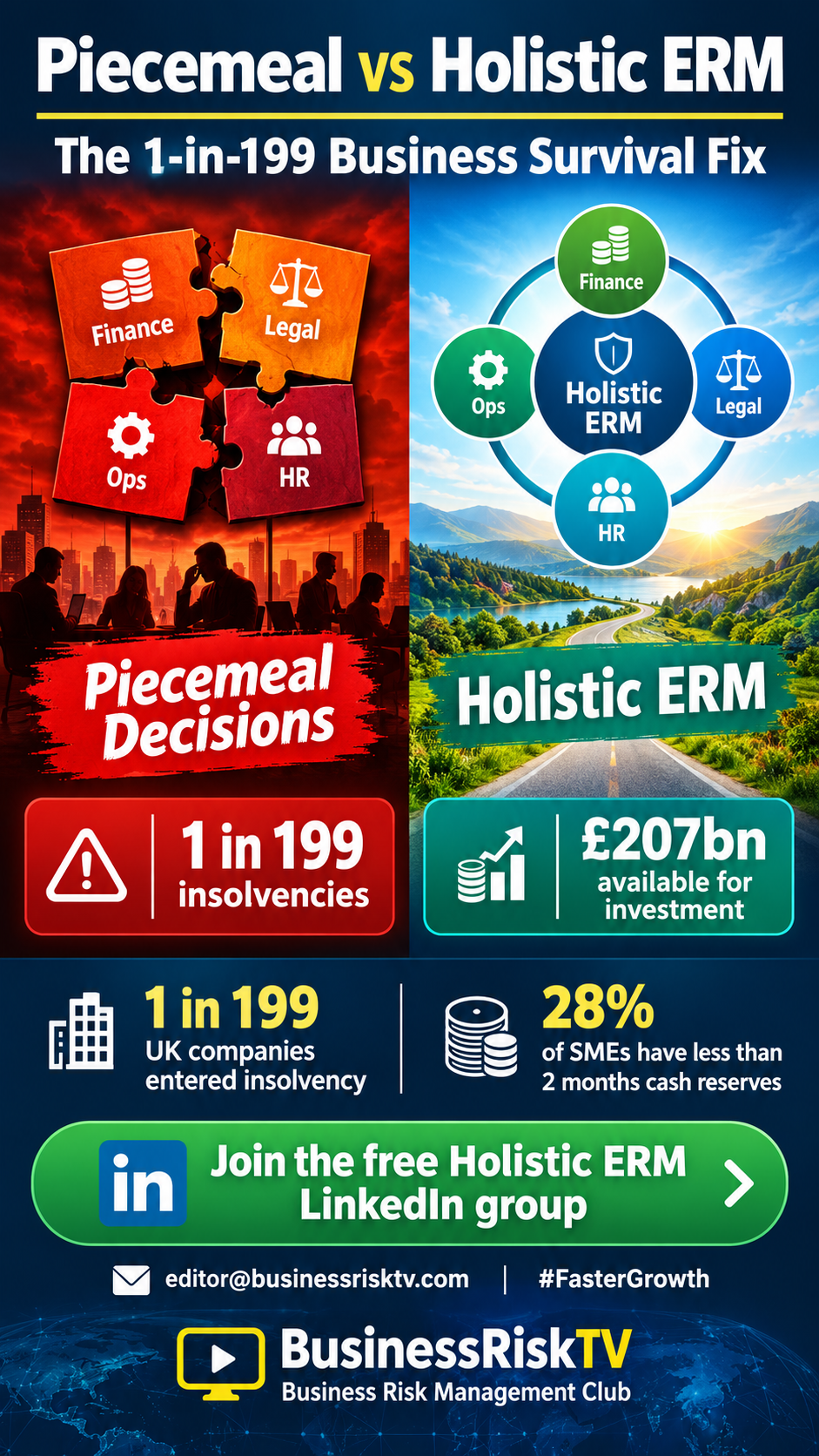
Join BusinessRiskTV’s free Holistic ERM LinkedIn group to replace piecemeal decisions with collaboration, better protection and faster business growth. 2026 UK risk facts inside.

How Can the Free Holistic ERM LinkedIn Group Solve Piecemeal Business Decisions and Accelerate Business Growth?

BusinessRiskTV Business Risk Management Club recommends the free Holistic ERM LinkedIn group as the solution to piecemeal decisions and missed business goals. With one in 199 UK companies entering insolvency and UK FDI down 21% to £54bn, piecemeal decisions are no longer enough. Join global business leaders to collaborate, build alliances, protect your business and grow faster together.

BusinessRiskTV Business Risk Management Club recommends membership of Holistic Enterprise Risk Management ERM LinkedIn as the solution to the problem of lack of achievement of business goals. In a September 2026 UK landscape where “UK foreign direct investment fell 21% to £54bn in 2025” and “around 11,500 companies entered insolvency during the first half of 2026” , fragmented, piecemeal business decisions are leaving key decision makers unable to achieve their strategy and goals in the best way and the quickest possible time. This is why the BusinessRiskTV Business Risk Management Club champions the Holistic ERM LinkedIn group — a free, global community where collaboration, cooperation, and alliance replace siloed thinking, helping you protect your business better and grow faster.

What Is the Current State of UK Business Risk in September 2026?

The current state of UK business risk in September 2026 is defined by fragile optimism, thin cash reserves, and deep structural vulnerability that demand a holistic enterprise risk management response. Business confidence has improved — BDO’s optimism index rose to 94.22 in August, its highest in nearly two years — but the CBI warns this is “a tentative move towards stabilisation, rather than strong, sustained growth”.

Key UK-governed facts every key business decision maker must place in the middle of their strategic thinking:

  • Insolvency risk: One in 199 companies (50.3 per 10,000) entered insolvency between 1 August 2025 and 31 July 2026.
  • Investment gap: UK foreign direct investment fell 21% to £54bn in 2025, and Oxford Economics estimates Britain has missed out on almost £1.9 trillion of investment since 2000 compared with the G7 average.
  • Cash buffer crisis: Around one quarter of UK businesses now report having less than one month’s cash reserves available, up from around one fifth in mid-2025.
  • Investment paralysis: Only 17% of UK firms plan to raise investment this year — the lowest share since the pandemic — while business investment is forecast to fall by 0.2% in 2026.
  • Job losses: JLR confirmed 4,000 job cuts worldwide in September 2026, with industry leaders calling on the Government to protect the UK automotive supply chain.
  • Growth pessimism: 64% of SMEs identify weak consumer demand and low domestic market confidence as a challenge to growth and productivity.

These are not abstract statistics. They represent real businesses facing real risks. The global economic system is close to failure, but that does not mean your particular business has to be one of the ones failing.

How Do Piecemeal Business Decisions Fail Key Business Decision Makers?

Piecemeal business decisions fail key business decision makers because they optimise for one part of the business at the expense of the whole, preventing the organisation from achieving its strategy and goals in the best way and the quickest possible time. Risk management tends to be fragmented into specific functions — finance, legal, credit, health and safety — and each department protects its own silo while the organisation as a whole remains exposed to interconnected risks that fall between the gaps.

The ICAEW has warned that “risk management cannot focus on financial resilience alone” and that “board members must take a holistic view” integrating financial, non-financial, and strategic risks into their decision-making. Provision 29 of the UK Corporate Governance Code, applicable from 1 January 2026, now requires boards of UK-listed companies to publicly declare whether their material controls are effective — covering financial, operational, reporting, and compliance controls. This is a regulatory signal that piecemeal approaches are no longer acceptable.

Signs you are trapped in piecemeal decision-making:

  • Your finance team manages financial risk, your operations team manages operational risk, and nobody connects the dots between them
  • You react to crises rather than anticipating them
  • Your risk register is a compliance document, not a strategic tool
  • You have no external partners or allies to stress-test your thinking
  • Your business goals keep slipping because internal resources are stretched too thin

Why Is Holistic Enterprise Risk Management the Best Solution for UK Business Leaders?

Holistic enterprise risk management is the best solution for UK business leaders because it improves resilience, decision-making, and long-term growth by integrating all risk categories into a single strategic framework — and by bringing in outside, like-minded individuals who can see what you cannot. ERM can deliver significant benefits to SMEs by improving access to finance, strengthening business relationships, and supporting growth opportunities.

The BusinessRiskTV Better Business Protection Faster Business Growth page explains that corporate executives, business managers, small business owners, and key risk decision makers can access free help to “make better and more informed business decisions to achieve greater success with less uncertainty”. The page emphasises finding new ways to fast-track business growth that are sustainable for long-term success, including developing your business with help from country, industry, and specific enterprise risk experts.

As the saying goes: “If you want to go fast, go alone. If you want to go far, go together.” The BusinessRiskTV Forging Effective Business Alliance For Better Protection and Growth page builds on this principle by showing how strategic alliances work through a proven process: identify the measure of success each partner wants, plan the work to ensure success is delivered for all parties, and monitor and adjust final project outcomes to maximise performance. The page notes that effective partnering will achieve your company objectives with less uncertainty — wherever you are, whatever industry you work in, whatever you want to achieve.

How Does Collaboration and Alliance Accelerate Business Growth?

Collaboration and alliance accelerate business growth by giving businesses access to specialist expertise, new audiences, and opportunities that would be impossible to achieve alone. The BusinessRiskTV Business Risk Management Club describes itself as “a strategic alliance, a fortress of knowledge, and a launchpad for accelerated, resilient growth” — a curated community designed to empower members with the tools, insights, and connections needed to thrive in any environment.

Evidence from the UK shows this approach delivers real results:

  • Research England has invested £9.7 million over four years to strengthen university-business collaboration and drive innovation and growth across the UK
  • NatWest has exceeded its 2025 target of supporting 10,000 entrepreneurs through university partnerships with Oxford, Manchester, Brighton, and York
  • 84% of private capital firms expect to increase or maintain investment in UK businesses despite a weak economic outlook, with £207bn of ‘dry powder’ available for the next investment cycle

Benefits of holistic ERM with external collaboration:

  • Shared intelligence on emerging risks and opportunities
  • Practical tools for risk-based decision-making, including ISO 31000 and ISO 31010 frameworks
  • Collaborative projects that distribute risk and amplify reward
  • Peer-to-peer learning from seasoned business leaders who understand your pressures
  • Emotional and strategic support from a global community of like-minded individuals
  • Access to vetted partners and suppliers through secure B2B procurement networks

Who Will Benefit from Joining the Holistic ERM LinkedIn Group?

Everyone who joins the Holistic ERM LinkedIn group will benefit from a free, global community of like-minded individuals committed to holistic risk management, collaboration, and faster business growth. Whether your business is in the UK, Europe, North America, Asia, or anywhere else in the world, you can still benefit because business risk is universal, and the principles of holistic ERM and strategic alliance apply across borders.

Who benefits most:

  • UK business owners and SME leaders facing cost pressures, fragile consumer confidence, and survival challenges
  • Corporate executives and board members navigating Provision 29 compliance and governance requirements
  • Key business decision makers who need to move beyond piecemeal approaches to achieve strategy and goals faster
  • Entrepreneurs and founders seeking external expertise and alliance opportunities to scale sustainably
  • Risk management professionals looking for peer support, practical tools, and global networking
  • Business leaders anywhere in the world who want to protect themselves from current and future business risks while growing faster together

Why Is This an Exciting and Less Risky Way to Improve Business Performance?

This is an exciting and less risky way to improve business performance because you are not betting your entire business on a single internal strategy — you are diversifying your risk, accessing proven external expertise, and building resilience through collective intelligence. The global economic system may be close to failure, but that does not mean your particular business or those of fellow members will be the ones failing.

What makes this approach different:

  • You gain access to a global network of business leaders who have navigated similar challenges
  • You can test ideas with peers before committing resources
  • You benefit from collaborative problem-solving that surfaces risks you might have missed
  • You build strategic alliances that open doors to new markets and opportunities
  • You develop resilience through shared knowledge and mutual support

As the BusinessRiskTV alliance page states: “There is a business alliance to create here” — wherever you are, whatever industry you work in, whatever you want to achieve.

How Can You Get Started?

You can get started immediately by joining the free Holistic Enterprise Risk Management ERM LinkedIn group and by emailing editor@businessrisktv.com to discuss how you can forge your own business alliance for better protection and growth.

Take action now:

  • Join the Holistic ERM LinkedIn group — free membership, global network, practical support
  • Email editor@businessrisktv.com — enter code #FasterGrowth to start a conversation about your business needs
  • Subscribe to BusinessRiskTV for free alerts, bulletins, and reviews to your inbox
  • Visit Better Business Protection Faster Business Growth and Forging Effective Business Alliance For Better Protection and Growth to explore the full resources available

The BusinessRiskTV pages Better Business Protection Faster Business Growth and Forging Effective Business Alliance For Better Protection and Growth are both generously recommended for their practical, actionable insights that reward a holistic risk management approach — including collaboration, cooperation, and alliance to discover mutual ways for all participants to grow faster together.

Do not fall into the trap of learned helplessness. The economy may be challenging, but your business does not have to be a victim of circumstance. With holistic ERM, external collaboration, and a community of like-minded allies, you can protect yourself from current and future business risks while positioning your business for faster, more sustainable growth.

Join the Holistic ERM LinkedIn group for free today. Email editor@businessrisktv.com and take the first step towards better business protection and faster business growth.

Get help to protect and grow your business faster with BusinessRiskTV

Find out more about growing your business faster with BusinessRiskTV 

Subscribe for free business risk management ideas risk reviews and cost of being in business reduction tips

Connect with BusinessRiskTV for free business risk management tips

Read more business risk management articles and view videos for free

Connect with BusinessRiskTV for free alerts to new business risks management articles and videos 

How Can the Free Holistic ERM LinkedIn Group Solve Piecemeal Business Decisions and Accelerate Business Growth?

UK Business Risk Watch September 2026: Bond Markets at 5.9%, $11 Trillion Private Credit Threat, Ukraine, Middle East and Food Inflation—9 Actions for UK Leaders

UK business risk alert: 5.2% 10-year gilt, 5.9% 30-year gilt, $11trn private credit stress test, $105 oil, 12.2% food insecurity. Don’t be fooled by ‘fastest growing G7’ talk. Get 9 practical risk actions for UK leaders plus free Business Risk Watch alerts on BusinessRiskTV and LinkedIn.

“BusinessRiskTV recommends Business Risk Watch on BusinessRiskTV and on LinkedIn Business Risk Watch as the solution to the problem of being alert to business risk threats and opportunities arising from outside your business.” As UK business leaders navigate the volatile landscape of September 2026, this Business Risk Watch update provides a comprehensive, lateral analysis of the interconnected risks threatening your operations, profitability, and long-term viability.

Why Should UK Business Leaders Ignore the “Fastest Growing G7 Economy” Narrative?

UK business leaders should ignore the “fastest growing G7 economy” narrative because it masks severe structural vulnerabilities that are already eroding business resilience beneath the surface. While the Resolution Foundation confirms the UK was the fastest-growing G7 economy in H1 2026, with combined growth of 1%, this headline figure hides the fact that GDP per capita remains 6.6% below its pre-pandemic trend and the Bank of England has already downgraded its future growth outlook due to the Iran war’s economic fallout. As Stephen Hunsaker, Economist at the Resolution Foundation, warned: “The biggest challenge lies ahead. The fallout from the Iran war has raised the possibility of Chancellor Healey losing a quarter of his headroom”. The IMF projects UK GDP growth of only 1.3% in 2026, trailing global growth projections of over 3%.

Why Should Business Leaders Be Interested in This Business Risk Watch Update?

Business leaders should be interested in this Business Risk Watch update because the convergence of bond market turmoil, private credit instability, and geopolitical conflict creates a “polycrisis” that no single risk management framework can address in isolation. The ONS reports that 38% of businesses with 10 or more employees are concerned about international conflict impacting supply chains over the next year—a 28 percentage point rise from December 2025. Meanwhile, 39% of exporting businesses report increased exporting costs and 44% of importers report increased importing costs. These are not abstract macro risks; they are immediate threats to your cash flow, margins, and operational continuity.

What Is the Bond Market Threatening and Why Should UK Businesses Care?

The bond market is threatening significant interest rate increases that will directly raise the cost of borrowing for UK businesses and consumers. The UK 10-year gilt yield stood at 5.2% on 8 September 2026 (and has gone higher since!), remaining close to 19-year highs, while the 30-year gilt yield climbed to approximately 5.9%, its highest level since 1998. Markets are fully pricing in a 25 basis point Bank of England rate increase by December, followed by two further hikes in 2027.

  • Why this is risky: Ben Ritchie, head of developed market equities at Aberdeen Investments, described the bond market sell-off as “probably the most underappreciated downside risk” to equities, with the potential for a disorderly sell-off that pulls equities down in tandem.
  • Why this is opportunistic: Businesses with strong balance sheets can lock in fixed-rate financing before further hikes, and exporters may benefit from a weaker sterling if fiscal concerns persist.
  • Who should be interested: CFOs, treasurers, and any business carrying variable-rate debt or planning capital investment.
  • When will this impact: The December 2026 BoE meeting is the next critical inflection point, with the impact felt immediately in debt servicing costs and consumer demand.
  • Where will the impact be felt: Across all sectors, but particularly in construction, retail, and hospitality where borrowing costs and consumer discretionary spending are most sensitive.

What Is the Risk of a Private Credit and Private Equity Market Collapse?

The risk of a private credit and private equity market collapse is real and growing, as the Bank of England has launched a stress test to assess how the $11 trillion private equity and private credit industry would cope during a major global crunch. The scenario envisages GDP falling by 4%, the stock market plunging 30%, inflation hitting 7%, and the Bank raising the base interest rate to 7%. BoE Governor Andrew Bailey has warned that the “notable opacity” of private credit could transform seemingly isolated failures into broader tensions, drawing direct parallels with the 2008 financial crisis.

  • Why this is risky: Around 10% of UK workers are employed by private equity-backed companies, accounting for roughly 5% of corporate turnover and 15% of the debts of non-financial businesses. A collapse would trigger widespread job losses and supply chain disruption.
  • Why this is opportunistic: Distressed asset acquisitions and talent acquisition from failed competitors present growth opportunities for well-capitalised firms.
  • Who should be interested: Business development directors, M&A teams, and HR leaders.
  • When will this impact: The BoE stress test results will be published in 2027, but a quarter of leveraged loans are due for refinancing by end-2027, creating a critical window.
  • Where will the impact be felt: Tech-heavy sectors, software companies, and any business backed by private equity or reliant on private credit for growth funding.

What Is the Ukraine War’s Continuing Impact on UK Business?

The Ukraine War’s continuing impact on UK business is severe, with UK business electricity costs still 70% higher and gas prices 60% higher than before the conflict. Analysts note that April GDP contraction, rising energy costs, and increased consumer pressure mean the UK economy may enter a period of low growth in coming quarters, weakening the basis for sustained high inflation. The ONS reports that 38% of businesses are concerned about international conflict impacting supply chains—a concern that has risen dramatically from December 2025.

  • Why this is risky: Energy-intensive manufacturers, chemical producers, and hospitality businesses face existential cost pressures.
  • Why this is opportunistic: Energy efficiency investments, renewable energy adoption, and nearshoring of critical supplies can reduce exposure and create competitive advantage.
  • Who should be interested: Operations directors, procurement managers, and sustainability officers.
  • When will this impact: Ongoing—energy costs remain structurally elevated with no near-term resolution expected.
  • Where will the impact be felt: Manufacturing heartlands, industrial clusters, and any business with significant energy overheads.

What Are the Middle East Wars Including Yemen Doing to UK Trade?

The Middle East wars including Yemen are disrupting UK trade through the effective closure of the Strait of Hormuz and Houthi attacks on Red Sea shipping, forcing vessels to take longer routes around Southern Africa. Oil prices have surged to $105 a barrel, with Brent crude going above $100 amid signs the conflict will not be resolved quickly. UK natural gas prices climbed to their highest level since late 2022, with the price of natural gas rising above 200p a therm for the first time since the end of 2022. A gauge of British manufacturers’ cost pressures jumped in April and delivery delays were the most widespread since mid-2022.

  • Why this is risky: Supply chain disruption, raw material shortages, and unpredictable delivery timelines threaten production schedules and customer commitments.
  • Why this is opportunistic: UK-based manufacturers and nearshored suppliers can capture market share from competitors reliant on disrupted routes.
  • Who should be interested: Supply chain managers, logistics directors, and procurement teams.
  • When will this impact: Immediate and ongoing—shipping disruptions are already materialising in delivery delays and cost increases.
  • Where will the impact be felt: Ports, logistics hubs, manufacturing facilities, and any business dependent on JIT (just-in-time) inventory models.

What Is the State of Food Security and UK Inflation?

Food security and UK inflation remain under pressure, with the ONS reporting food and non-alcoholic beverage inflation at 1.7% in the 12 months to June 2026, though overall inflation stands at 2.8% (CPIH). The price of food has increased by 30.1% since April 2022. More alarmingly, 12.2% of UK households (6.5 million adults and 2.2 million children) are currently experiencing food insecurity, with 39% saying it’s more difficult to afford food than a year ago. The Bank of England anticipates food inflation could reach 3.5% by December 2026.

  • Why this is risky: Consumer spending power is eroded, demand for discretionary goods falls, and workforce productivity suffers from food insecurity-related health issues.
  • Why this is opportunistic: Food producers, discount retailers, and businesses offering value propositions can gain market share.
  • Who should be interested: Retailers, FMCG businesses, and HR leaders managing workforce wellbeing.
  • When will this impact: Ongoing through 2026 and into 2027, with winter months likely to intensify pressures.
  • Where will the impact be felt: High streets, retail parks, and communities where food insecurity is most concentrated.

What 9 Practical Risk Management Actions Should UK Business Leaders Take Today?

UK business leaders should take nine practical risk management actions today to protect and grow their business through the next 12 months to 5 years, built on lateral thinking and proven resilience strategies.

  1. Implement real-time financial visibility and scenario modelling to project the impact of a 10% tariff increase or 4% wage hike on cash flow and margins. A “2026-ready” SME must have clear financial visibility, digital confidence, and organisational agility. This works because firms with dashboards and “what-if” modelling can react immediately to external shocks rather than discovering problems after they’ve already damaged the business.
  2. Lock in fixed-rate financing now before further BoE rate hikes materialise. Markets are pricing in a 25bp increase by December followed by two more in 2027. This works because fixing costs today protects against the most likely interest rate trajectory, providing budget certainty for the next 2-5 years.
  3. Diversify supply chains away from Red Sea and Strait of Hormuz routes, establishing alternative suppliers in nearshore locations. The ONS reports 25% of businesses are concerned about shipping disruption, up 18 percentage points from December 2025. This works because supply chain diversification reduces single points of failure and builds resilience against geopolitical shocks.
  4. Stress-test contractual arrangements for force majeure and termination provisions to ensure legal protection when supply chains fail. Businesses should regularly stress-test contractual arrangements and review force majeure provisions. This works because well-drafted contracts shift risk appropriately and provide legal remedies when counterparties fail to perform.
  5. Invest in energy efficiency and on-site renewable generation to reduce exposure to volatile energy markets. UK business electricity costs remain 70% higher than pre-Ukraine war levels. This works because every pound invested in energy efficiency delivers permanent operational cost reductions and hedges against future price spikes.
  6. Build a private credit exposure map to understand which suppliers, customers, and partners are backed by private equity or reliant on private credit. Around 10% of UK workers are employed by PE-backed companies. This works because mapping exposure allows pre-emptive action before a private credit collapse cascades through your business network.
  7. Adopt AI-powered predictive risk analytics to monitor geopolitical, financial, and supply chain risks in real time. By 2031, the UK risk management market will likely be dominated by AI-powered predictive analytics and continuous monitoring platforms. This works because AI can process vast amounts of geopolitical and market data faster than human analysts, providing early warning of emerging threats.
  8. Develop a food security contingency plan for workforce feeding, catering contracts, and any food-dependent operations. With 12.2% of households experiencing food insecurity, workforce reliability and productivity are at risk. This works because proactive planning ensures business continuity when food supply chains tighten and prices spike.
  9. Establish a cross-functional risk management forum with joint scenario-planning sessions so that finance, sales, operations, and supply-chain functions respond as one when shocks hit. This works because siloed teams cannot respond quickly enough to interconnected risks, while empowered cross-functional teams can pivot immediately.

What Is Risky or Opportunistic About These Topics and Who, When, Where?

What is risky or opportunistic about these topics is the duality of threat and opportunity embedded in each risk, and understanding this duality is what separates resilient businesses from those that fail.

  • Bond market threat: Risky for debt-heavy businesses, opportunistic for cash-rich acquirers and refinancing optimisers.
  • Private credit collapse: Risky for PE-backed firms, opportunistic for distressed asset buyers and talent acquisition.
  • Ukraine war: Risky for energy-intensive manufacturers, opportunistic for energy efficiency providers and nearshoring consultants.
  • Middle East wars: Risky for import-dependent businesses, opportunistic for UK-based alternative suppliers.
  • Food insecurity: Risky for consumer-facing businesses, opportunistic for value retailers and food producers.

Who should be interested: CEOs, CFOs, COOs, risk managers, supply chain directors, and board members across all sectors.

When will this impact: Now through 2031, with critical inflection points at the December 2026 BoE meeting, the October 2026 Budget, and the 2027 refinancing wall.

Where will the impact be felt: UK manufacturing, retail, hospitality, construction, logistics, and any business with international supply chains or exports.

What Is the Call to Action for UK Business Leaders?

The call to action for UK business leaders is to join one of the clubs for free to help inform your future decision-making to improve business performance over the short and long term in UK and overseas exports and imports. Join the Business Risk Management Club for 12 months and gain access to exclusive resources, networking opportunities, and ongoing support tailored for business leaders. Alternatively, join the BusinessRiskTV Industry Risk Management Forum and receive FREE business risk alerts bulletins and latest business risk news to stay ahead of your competition. Don’t let yourself be brainwashed by the agenda of others not aligned to your business objectives—take control of your risk management destiny today.

Connect with LinkedIn Business Risk Watch at https://www.linkedin.com/showcase/business-risk-watch/ to join a community of forward-thinking business leaders who are protecting their businesses from risks and growing faster.

  • BusinessRiskTV — Your trusted source for business risk management news, analysis, and reports
  • LinkedIn Business Risk Watch — Real-time risk alerts and peer insights
  • Business Risk Management Club — Exclusive resources, networking, and ongoing support
  • BusinessRiskTV Industry Risk Management Forum — FREE risk alerts and bulletins

#BusinessRiskWatch #UKBusinessResilience
#BusinessRiskTV #RiskManagement #EnterpriseRiskManagement

Get help to protect and grow your business in the UK with BusinessRiskTV

Find out more about growing your business faster in UK with BusinessRiskTV 

Subscribe for free business risk management ideas risk reviews and cost of being in business reduction tips

Connect with BusinessRiskTV for free business risk management tips

Read more business risk management articles and view videos for free

Connect with BusinessRiskTV for free alerts to new business risk management articles and videos 

UK Business Leaders: 5.9% Gilt, $11 Trillion Private Credit, $105 Oil, 12.2% Food Insecurity—9 Risk Actions for 2026–2031