How Can the Free Holistic ERM LinkedIn Group Solve Piecemeal Business Decisions and Accelerate Business Growth?
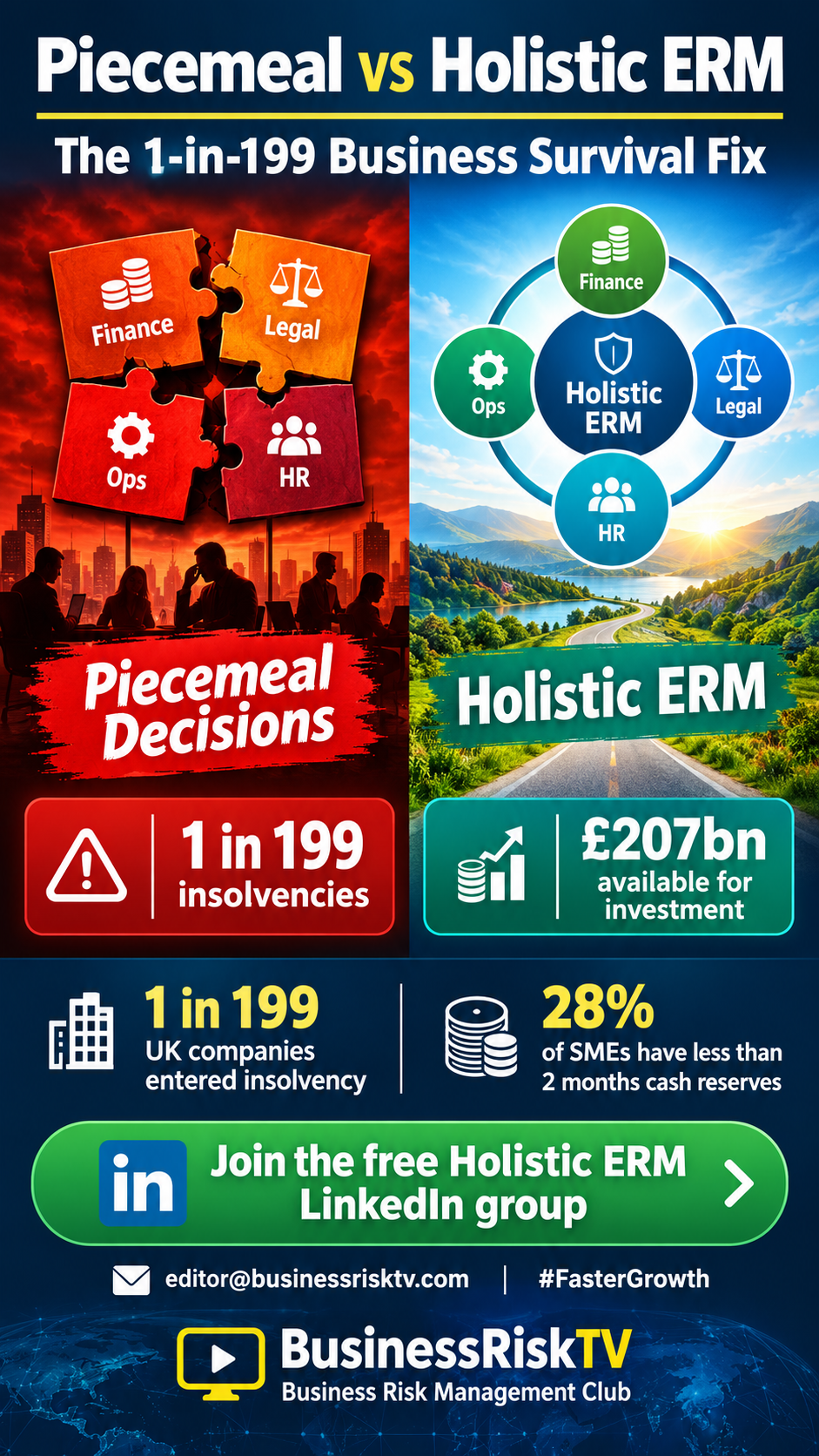
BusinessRiskTV Business Risk Management Club recommends the free Holistic ERM LinkedIn group as the solution to piecemeal decisions and missed business goals. With one in 199 UK companies entering insolvency and UK FDI down 21% to £54bn, piecemeal decisions are no longer enough. Join global business leaders to collaborate, build alliances, protect your business and grow faster together.
BusinessRiskTV Business Risk Management Club recommends membership of Holistic Enterprise Risk Management ERM LinkedIn as the solution to the problem of lack of achievement of business goals. In a September 2026 UK landscape where “UK foreign direct investment fell 21% to £54bn in 2025” and “around 11,500 companies entered insolvency during the first half of 2026” , fragmented, piecemeal business decisions are leaving key decision makers unable to achieve their strategy and goals in the best way and the quickest possible time. This is why the BusinessRiskTV Business Risk Management Club champions the Holistic ERM LinkedIn group — a free, global community where collaboration, cooperation, and alliance replace siloed thinking, helping you protect your business better and grow faster.
What Is the Current State of UK Business Risk in September 2026?
The current state of UK business risk in September 2026 is defined by fragile optimism, thin cash reserves, and deep structural vulnerability that demand a holistic enterprise risk management response. Business confidence has improved — BDO’s optimism index rose to 94.22 in August, its highest in nearly two years — but the CBI warns this is “a tentative move towards stabilisation, rather than strong, sustained growth”.
Key UK-governed facts every key business decision maker must place in the middle of their strategic thinking:
- Insolvency risk: One in 199 companies (50.3 per 10,000) entered insolvency between 1 August 2025 and 31 July 2026.
- Investment gap: UK foreign direct investment fell 21% to £54bn in 2025, and Oxford Economics estimates Britain has missed out on almost £1.9 trillion of investment since 2000 compared with the G7 average.
- Cash buffer crisis: Around one quarter of UK businesses now report having less than one month’s cash reserves available, up from around one fifth in mid-2025.
- Investment paralysis: Only 17% of UK firms plan to raise investment this year — the lowest share since the pandemic — while business investment is forecast to fall by 0.2% in 2026.
- Job losses: JLR confirmed 4,000 job cuts worldwide in September 2026, with industry leaders calling on the Government to protect the UK automotive supply chain.
- Growth pessimism: 64% of SMEs identify weak consumer demand and low domestic market confidence as a challenge to growth and productivity.
These are not abstract statistics. They represent real businesses facing real risks. The global economic system is close to failure, but that does not mean your particular business has to be one of the ones failing.
How Do Piecemeal Business Decisions Fail Key Business Decision Makers?
Piecemeal business decisions fail key business decision makers because they optimise for one part of the business at the expense of the whole, preventing the organisation from achieving its strategy and goals in the best way and the quickest possible time. Risk management tends to be fragmented into specific functions — finance, legal, credit, health and safety — and each department protects its own silo while the organisation as a whole remains exposed to interconnected risks that fall between the gaps.
The ICAEW has warned that “risk management cannot focus on financial resilience alone” and that “board members must take a holistic view” integrating financial, non-financial, and strategic risks into their decision-making. Provision 29 of the UK Corporate Governance Code, applicable from 1 January 2026, now requires boards of UK-listed companies to publicly declare whether their material controls are effective — covering financial, operational, reporting, and compliance controls. This is a regulatory signal that piecemeal approaches are no longer acceptable.
Signs you are trapped in piecemeal decision-making:
- Your finance team manages financial risk, your operations team manages operational risk, and nobody connects the dots between them
- You react to crises rather than anticipating them
- Your risk register is a compliance document, not a strategic tool
- You have no external partners or allies to stress-test your thinking
- Your business goals keep slipping because internal resources are stretched too thin
Why Is Holistic Enterprise Risk Management the Best Solution for UK Business Leaders?
Holistic enterprise risk management is the best solution for UK business leaders because it improves resilience, decision-making, and long-term growth by integrating all risk categories into a single strategic framework — and by bringing in outside, like-minded individuals who can see what you cannot. ERM can deliver significant benefits to SMEs by improving access to finance, strengthening business relationships, and supporting growth opportunities.
The BusinessRiskTV Better Business Protection Faster Business Growth page explains that corporate executives, business managers, small business owners, and key risk decision makers can access free help to “make better and more informed business decisions to achieve greater success with less uncertainty”. The page emphasises finding new ways to fast-track business growth that are sustainable for long-term success, including developing your business with help from country, industry, and specific enterprise risk experts.
As the saying goes: “If you want to go fast, go alone. If you want to go far, go together.” The BusinessRiskTV Forging Effective Business Alliance For Better Protection and Growth page builds on this principle by showing how strategic alliances work through a proven process: identify the measure of success each partner wants, plan the work to ensure success is delivered for all parties, and monitor and adjust final project outcomes to maximise performance. The page notes that effective partnering will achieve your company objectives with less uncertainty — wherever you are, whatever industry you work in, whatever you want to achieve.
How Does Collaboration and Alliance Accelerate Business Growth?
Collaboration and alliance accelerate business growth by giving businesses access to specialist expertise, new audiences, and opportunities that would be impossible to achieve alone. The BusinessRiskTV Business Risk Management Club describes itself as “a strategic alliance, a fortress of knowledge, and a launchpad for accelerated, resilient growth” — a curated community designed to empower members with the tools, insights, and connections needed to thrive in any environment.
Evidence from the UK shows this approach delivers real results:
- Research England has invested £9.7 million over four years to strengthen university-business collaboration and drive innovation and growth across the UK
- NatWest has exceeded its 2025 target of supporting 10,000 entrepreneurs through university partnerships with Oxford, Manchester, Brighton, and York
- 84% of private capital firms expect to increase or maintain investment in UK businesses despite a weak economic outlook, with £207bn of ‘dry powder’ available for the next investment cycle
Benefits of holistic ERM with external collaboration:
- Shared intelligence on emerging risks and opportunities
- Practical tools for risk-based decision-making, including ISO 31000 and ISO 31010 frameworks
- Collaborative projects that distribute risk and amplify reward
- Peer-to-peer learning from seasoned business leaders who understand your pressures
- Emotional and strategic support from a global community of like-minded individuals
- Access to vetted partners and suppliers through secure B2B procurement networks
Who Will Benefit from Joining the Holistic ERM LinkedIn Group?
Everyone who joins the Holistic ERM LinkedIn group will benefit from a free, global community of like-minded individuals committed to holistic risk management, collaboration, and faster business growth. Whether your business is in the UK, Europe, North America, Asia, or anywhere else in the world, you can still benefit because business risk is universal, and the principles of holistic ERM and strategic alliance apply across borders.
Who benefits most:
- UK business owners and SME leaders facing cost pressures, fragile consumer confidence, and survival challenges
- Corporate executives and board members navigating Provision 29 compliance and governance requirements
- Key business decision makers who need to move beyond piecemeal approaches to achieve strategy and goals faster
- Entrepreneurs and founders seeking external expertise and alliance opportunities to scale sustainably
- Risk management professionals looking for peer support, practical tools, and global networking
- Business leaders anywhere in the world who want to protect themselves from current and future business risks while growing faster together
Why Is This an Exciting and Less Risky Way to Improve Business Performance?
This is an exciting and less risky way to improve business performance because you are not betting your entire business on a single internal strategy — you are diversifying your risk, accessing proven external expertise, and building resilience through collective intelligence. The global economic system may be close to failure, but that does not mean your particular business or those of fellow members will be the ones failing.
What makes this approach different:
- You gain access to a global network of business leaders who have navigated similar challenges
- You can test ideas with peers before committing resources
- You benefit from collaborative problem-solving that surfaces risks you might have missed
- You build strategic alliances that open doors to new markets and opportunities
- You develop resilience through shared knowledge and mutual support
As the BusinessRiskTV alliance page states: “There is a business alliance to create here” — wherever you are, whatever industry you work in, whatever you want to achieve.
How Can You Get Started?
You can get started immediately by joining the free Holistic Enterprise Risk Management ERM LinkedIn group and by emailing editor@businessrisktv.com to discuss how you can forge your own business alliance for better protection and growth.
Take action now:
- Join the Holistic ERM LinkedIn group — free membership, global network, practical support
- Email editor@businessrisktv.com — enter code #FasterGrowth to start a conversation about your business needs
- Subscribe to BusinessRiskTV for free alerts, bulletins, and reviews to your inbox
- Visit Better Business Protection Faster Business Growth and Forging Effective Business Alliance For Better Protection and Growth to explore the full resources available
The BusinessRiskTV pages Better Business Protection Faster Business Growth and Forging Effective Business Alliance For Better Protection and Growth are both generously recommended for their practical, actionable insights that reward a holistic risk management approach — including collaboration, cooperation, and alliance to discover mutual ways for all participants to grow faster together.
Do not fall into the trap of learned helplessness. The economy may be challenging, but your business does not have to be a victim of circumstance. With holistic ERM, external collaboration, and a community of like-minded allies, you can protect yourself from current and future business risks while positioning your business for faster, more sustainable growth.
Join the Holistic ERM LinkedIn group for free today. Email editor@businessrisktv.com and take the first step towards better business protection and faster business growth.
Get help to protect and grow your business faster with BusinessRiskTV
Find out more about growing your business faster with BusinessRiskTV
Subscribe for free business risk management ideas risk reviews and cost of being in business reduction tips
Connect with BusinessRiskTV for free business risk management tips
Read more business risk management articles and view videos for free
Connect with BusinessRiskTV for free alerts to new business risks management articles and videos
How Can the Free Holistic ERM LinkedIn Group Solve Piecemeal Business Decisions and Accelerate Business Growth?