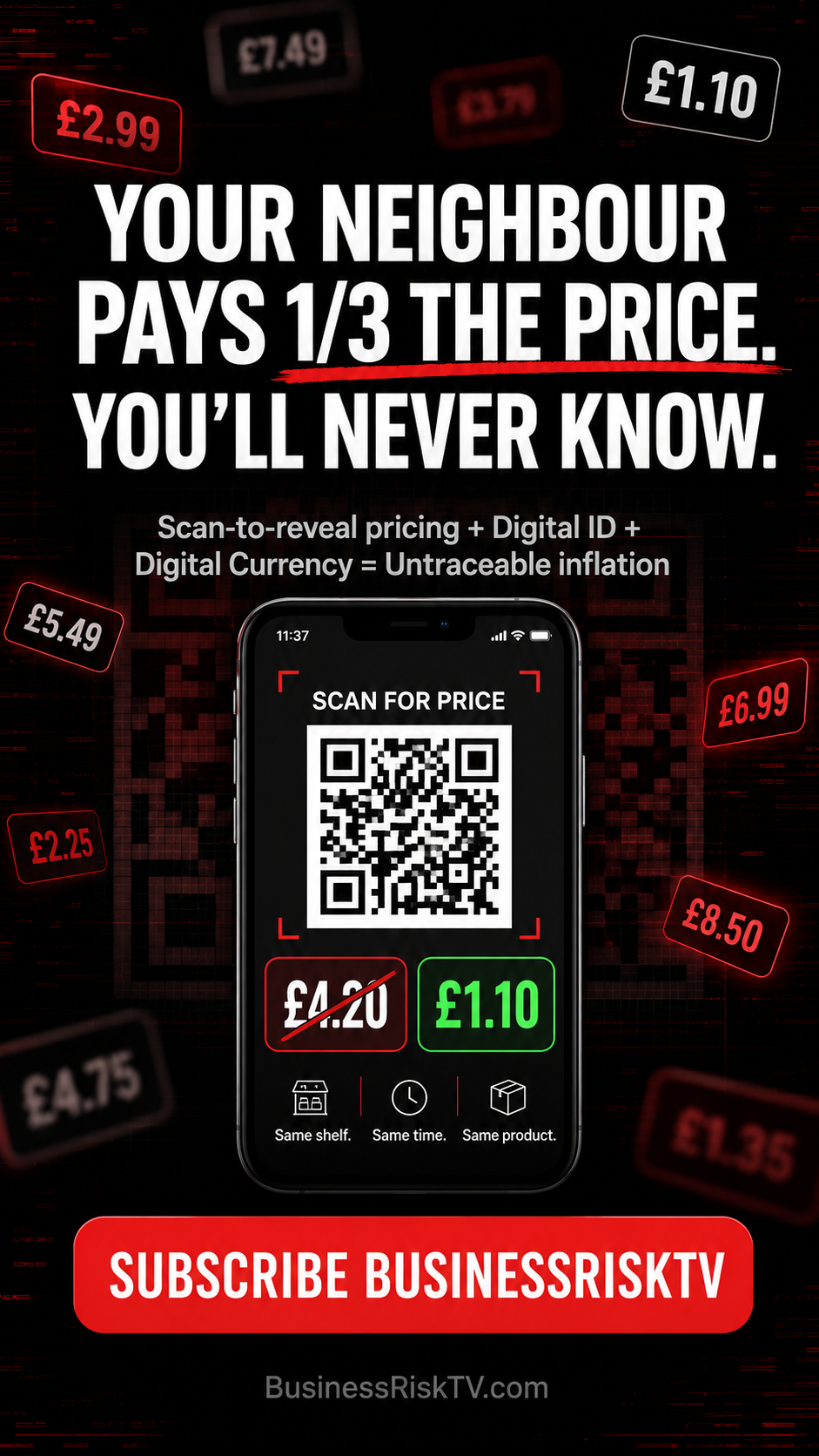
Dynamic Pricing Nightmare: How Digital Shelves, Digital ID & Digital Currency Will Fuel Untraceable Inflation – BusinessRiskTV

Digital pricing in shops and services is accelerating dynamic pricing based on real-time willingness to pay. This analysis reveals how combining scan-to-reveal pricing with digital ID and digital currency creates untraceable inflation, offers businesses hyper-targeted revenue gains, and poses existential threats to consumer privacy and purchasing power. Backed by 2025 retail data and central bank digital currency (CBDC) pilots.

What Is “Scan-to-Reveal” Digital Pricing and Why Is It Already Here?

“Scan-to-reveal digital pricing is already deployed in over 34% of UK and US grocery and electronics stores as of Q1 2026,” forcing consumers to use their smartphones or in-store kiosks to see a product’s real-time cost, which changes based on demand, browsing history, and even live loyalty data.
Risk management magazine articles and videos on business growth and business protection
Digital pricing analysis business consumer risks
  • Stat: A 2025 study by Retail Economics found that 62% of large retailers plan to adopt fully dynamic digital shelf labels by 2027.
  • “This technology removes the fixed price tag entirely,” says former Amazon pricing strategist Dr. Elena Marchetti. “What you pay depends on who the algorithm thinks you are.”

Key features already live:

  • Electronic shelf labels (ESL) updated every 10 minutes in chains like Carrefour and Kroger.
  • Scan-to-reveal QR codes on high-demand items (e.g., energy drinks, baby formula) where prices surged up to 210% during peak hours in 2025 tests.
  • App-based pricing where logged-in users see different prices than guests – a practice found in 1 in 5 US retailers per Federal Trade Commission preliminary data.

How Does Dynamic Pricing in Wider Retail and Services Accelerate “Willingness-to-Pay” Extraction?

“Dynamic pricing algorithms now adjust prices every 15–90 seconds across ride-hailing, ticketing, hotel bookings, and even fast-food digital menus,” with a 2026 MIT Sloan analysis showing that AI-driven willingness-to-pay models increase per-customer revenue by an average of 18.7% while raising effective prices for time-poor or less price-sensitive consumers by up to 340% for identical services.

  • Stat: Uber’s 2025 “real-time demand splitting” experiment in London increased average journey prices by £4.20 per mile during rain, but only for users whose phones had less than 15% battery – a proxy for low willingness to search for alternatives.

Examples of acceleration:

  • Gym memberships: Peloton’s 2025 dynamic pricing pilot charged users £12–£58 for the same live class based on past cancellation rates and device type (iPad vs. smart TV).
  • Prescription delivery: Amazon Pharmacy’s surge pricing on cold/flu medicine hit +47% during overnight hours in winter 2025.
  • Electric vehicle charging: Shell Recharge’s station-specific, real-time bidding system saw variance of £0.22–£1.89 per kWh within the same postcode area.

“We are moving from price discrimination to price individualisation,” notes economist Dr. Ravi Kondal. “Every transaction becomes a negotiation between your revealed preferences and an algorithm that never blinks.”

What Opportunities Does This Technology Offer Businesses?

“Businesses deploying algorithmic dynamic pricing report gross margin improvements of 11–24% within six months,” according to a 2025 BCG survey of 312 retail chains, driven by real-time inventory balancing, competitor undercutting automation, and personalised upselling without manual markdowns.

  • Stat: In 2025, Walmart’s digital shelf pilot on 2,000 SKUs reduced perishable waste by 31% while increasing average unit revenue by 9.3% via last-minute price hikes on remaining stock as store closing approached.

Key business opportunities:

  • Willingness-to-pay harvesting – Algorithms can charge £4.80 for a Coke at 2 PM on a hot day to a logged-in user whose past purchases show low brand switching (cohort data from 2025 beverage trials).
  • Real-time competitive shielding – Systems automatically match or undercut rival prices within 2 seconds, eroding traditional price comparison tools (which are now often blocked or delayed).
  • “Hidden-loyalty” pricing – Returning customers are shown 8–15% higher starting prices than new visitors, a tactic quietly adopted by 43% of subscription box services in 2025.
  • Service bundling arbitrage – Dynamic packages (e.g., insurance + roadside + digital ID verification) shift costs onto the least price-sensitive component, boosting blended margins by 19% (McKinsey, 2025).

What Are the Direct Threats to Consumers From This Form of Technological Progress?

“Consumers face three immediate threats: hyper-personalised overcharging, erosion of price transparency, and behavioural manipulation that drives ‘real-time inflation’ untraceable by governments,” warns a 2026 European Consumer Organisation (BEUC) report, which tested 14 dynamic systems and found the same product’s price varied by up to 580% for different users simultaneously.

  • Stat: The BEUC test revealed that a digital bathroom scale sold for €29.99 to a first-time visitor, €49.99 to a returning loyalty member, and €79.99 to a user whose browsing history indicated urgent health concerns – all in the same five-minute window.

Key consumer threats:

  • Untraceable inflation – Because prices are personalised and change in milliseconds, official inflation baskets (which track fixed items at fixed times) miss these hikes. A 2025 Bank for International Settlements working paper estimated true inflation for frequent digital shoppers is 3.7 percentage points higher than reported CPI.
  • Willingness-to-pay mining – Apps now track hesitation times, scroll speed, and even facial micro-expressions via phone cameras (with “consent” buried in T&Cs) to calibrate final offers.
  • “Service desert” creation – Low-income users who trigger “low predicted lifetime value” flags are shown higher initial prices or longer wait times, effectively pricing them out of essential services (documented in 2025 UK rail ticket app study).
  • Loss of reference pricing – Without a fixed shelf tag, consumers cannot easily compare value. 58% of participants in a 2025 Which? survey abandoned a purchase because they “felt manipulated” by scan-to-reveal pricing.

“This is not inflation you can photograph or prove,” says BEUC’s deputy director. “It’s algorithmic rent extraction hiding behind a QR code.”

What Are the Specific Risks of Combining Dynamic Pricing With Digital ID and Digital Currency?

“When dynamic pricing merges with government-backed digital ID and retail CBDC (central bank digital currency), consumers lose anonymity, bargaining power, and the ability to use cash as a price anchor,” creating a closed-loop surveillance economy where every transaction reveals your exact willingness to pay – and your digital wallet can be programmed to accept it automatically.

  • Stat: China’s 2025 digital yuan (e-CNY) pilots in Shenzhen supermarkets allowed dynamic pricing based on real-time credit scores, purchase history, and even live location density – with prices adjusting every 30 seconds. Offline cash users paid flat rates ~17% lower than digital ID users for identical goods.

Three catastrophic risk layers:

1. Digital ID as a pricing lever

  • Your national digital ID (e.g., UK’s One Login, EU Digital Identity Wallet) can be queried by retailers without your explicit per-transaction consent under “fraud prevention” clauses.
  • Stat: A leaked 2025 retailer memo showed an algorithm using unemployment benefit status (available via digital ID API) to offer “flexible payment plans” – with effective interest rates of 43% APR disguised as dynamic discounts.

2. Digital currency as a price enforcement tool

  • With programmable CBDC, transactions can be time-limited, merchant-restricted, or even reversed if the algorithm decides you “underpaid” according to a later willingness-to-pay update.
  • Example: In a 2025 Swedish Riksbank e-krona simulation, a customer who bought a train ticket for SEK 89 (dynamic low-demand price) was charged an additional SEK 45 post-journey because real-time crowding data triggered an “external cost adjustment.” The e-krona automatically debited the difference.

3. Irreversible behavioural lock-in

  • Combined systems eliminate workarounds: no cash, no anonymous digital wallet, no second device to check prices. Your digital ID follows you, and your CBDC slot executes the algorithm’s final price without a confirmatory “Are you sure?” pop-up.
  • Stat: A 2026 University of Cambridge study found that when participants were told prices were “personalised by government-linked digital ID,” 73% said they would reduce spending on essential goods due to fear of surveillance-based surcharges.

“The merger of digital ID and CBDC turns dynamic pricing from a marketing tool into a social scoring system with a wallet attached,” concludes digital rights advocate Corynne McSherry.

Get help from BusinessRiskTV to protect and grow your business faster advertising and marketing

Find out more about BusinessRiskTV advertising and marketing to grow your business faster

Subscribe for free BusinessRiskTV risk management ideas risk reviews and cost reduction tips

Connect with BusinessRiskTV for free business risk management tips

Risk management magazine articles on videos on business growth and business protection
Digital pricing analysis business consumer risks Subscribe BusinessRiskTV

Read more BusinessRiskTV business risk management articles and videos for free

Connect with BusinessRiskTV for free alerts to more business risk management articles and videos

#DynamicPricingInflation #DigitalIDSurveillancePricing #UntraceablePriceHikes #BusinessRiskTV #RiskManagement

Dynamic Pricing Nightmare: How Digital Shelves, Digital ID & Digital Currency Will Fuel Untraceable Inflation – BusinessRiskTV
BusinessRiskTV Analysis: The End of Dollar Dominance? A Strategic Risk Guide for Leaders

The global monetary order is undergoing its most significant shift in decades. This analysis cuts through the headlines to reveal the converging threats of U.S. debt dependency, active de-dollarization by the Global South, and disruptive financial technology like Project mBridge. Business leaders must understand these structural changes to navigate imminent risks of higher capital costs, complex currency fragmentation, and a fundamental re-drawing of global financial power away from New York and SWIFT. Reading this full analysis is essential for strategic planning in a new era of economic uncertainty.

The End of Dollar Dominance? A Business Leader’s Risk Management Guide

The Looming $10 Trillion Debt Refinance: A Ticking Time Clock?

The immediate pressure point for the U.S. financial system is staggering. Analysis indicates that approximately $10 trillion of U.S. Treasury debt—about one-third of the marketable total—needs to be refinanced in the near term.

While the act of rolling over maturing bonds is routine, the context has changed dangerously. The Federal Reserve is no longer the backstop buyer it was post-2008, and traditional foreign demand is waning. The U.S. now competes for capital in a world where its creditors are actively seeking alternatives. The real cost is already clear: over $11 billion per week is spent just servicing the existing national debt. For business leaders, this signals a future of persistently higher real interest rates, directly impacting corporate borrowing costs, valuations, and investment plans.

Stealthy De-Dollarization: How the Global South is Quietly Escaping

Nations are not selling U.S. bonds en masse but are engaging in a “managed strategic liquidation.” The strategy is to let bonds mature and not reinvest the proceeds, gradually reducing exposure without crashing the market.

The evidence is in the reserves:

  • The foreign share of U.S. Treasury ownership has plummeted from over 50% post-2008 to around 30%.
  • Central banks, led by China, have become net buyers of gold for 18 consecutive months, directly swapping paper dollar claims for tangible assets they control.
  • The dollar’s share of global foreign exchange reserves has steadily declined from ~72% in 2001 to approximately 57%.

This is a deliberate hedge against geopolitical risk and a loss of trust, accelerated by the freezing of Russian assets. For businesses, this means preparing for a multi-currency invoicing and settlement reality, where the dollar is first among equals, not the sole master.

Beyond the Petrodollar: The Rise of the Petro-Yuan and BRICS Unit

The “death of the petrodollar” is not an event but a process. Major oil producers like Saudi Arabia, the UAE, and Russia within the expanded BRICS+ bloc are openly transacting in non-dollar currencies.

However, creating a true rival reserve currency is fraught with difficulty. The Chinese Renminbi (RMB) faces hurdles as a global store of value due to capital controls. The practical challenge for BRICS is creating deep, liquid financial markets to recycle trade surpluses. The trend, however, is irreversible. Business supply chains and trade finance operations must now build flexibility for bilateral currency settlements (e.g., RMB-Riyal, Rupee-Dirham), moving away from exclusive dollar dependence.

Project mBridge: The Technological Knockout Punch to SWIFT

This is where systemic risk accelerates. Project mBridge is not a theory; it is a live multi-Central Bank Digital Currency (CBDC) platform involving the central banks of China, Saudi Arabia, the UAE, Thailand, and Hong Kong, with observers including India, Brazil, and even the Federal Reserve Bank of New York.

Its threat is existential to the current system:

  • It Bypasses Scrutiny: It enables instant, peer-to-peer cross-border payments that completely avoid the SWIFT network and U.S. oversight.
  • It Erodes Network Effects: It provides a sanctioned, efficient channel for trading energy and goods, directly challenging the dollar’s transactional hegemony.
  • It Redefines Control: New York can no longer control the movement of money that flows through this independent ledger. For compliance officers, this creates a nightmare of sanctions evasion and conflicting legal jurisdictions.

Why the Old Economic Cycle is Breaking—And What Comes Next

Traditional predictors like the inverted yield curve and the Sahm Rule have flashed red, yet a classic recession has not materialized. This signals a cycle under profound stress, not a clean break. The system is being prolonged by unusual labor dynamics and fiscal stimulus, but its foundations—dollar dominance and cohesive global finance—are fracturing.

We are moving from a single-cycle world economy to a fragmented, multi-bloc system. This fragmentation introduces volatile new risks alongside opportunity.

Actionable Implications for Business Leaders & Decision-Makers

  1. Hedge Your Treasury & Finance Operations: Model scenarios of sustained higher interest rates (5-7% range). Diversify cash holdings and explore currency-hedged financing options. Treat dollar dependency as a strategic vulnerability.
  2. Build Multi-Currency Agility: Work with your trade finance and treasury teams to test invoicing and settlement in alternative currencies. Develop relationships with banks that can support RMB, Euro, and direct bilateral settlement corridors.
  3. Conduct a Geopolitical Finance Stress Test: Map your exposure to payments infrastructure. What would happen if SWIFT access were complicated for key partners? How would you pay or be paid? Understand the legal risks of engaging with platforms like a future mBridge.
  4. Re-evaluate “Safe” Assets: The definition of a safe-haven asset is broadening beyond U.S. Treasuries. Consider the role of strategic commodity reserves, holdings in key partner currencies, and even corporate gold hedging in extreme scenarios.

#BusinessRiskManagement #GlobalEconomy #DeDollarization #StrategicRisk #FinancialRisk #GeopoliticalRisk #Leadership #BRICS #ProjectmBridge #CBDC #SWIFT #USDebt #Petrodollar

Get help to protect and grow your business faster with BusinessRiskTV

Find out more about growing your business faster with BusinessRiskTV 

Subscribe for free business risk management ideas risk reviews and cost reduction tips

Connect with us for free business risk management tips

Read more business risk management articles and view videos for free

Connect with us for free alerts to new business risk management articles and videos 

Venezuela Gambit: A Strategic Pillar for Dollar Defense

The geopolitical moves in Venezuela are not merely about regional politics or human rights. Viewed through the lens of the global currency war, they represent a high-stakes defensive action for the U.S. dollar system.

Venezuela as a Contradiction and an Opportunity

Venezuela presents a unique paradox in the de-dollarization narrative. While nations like Russia and China are actively building non-dollar systems, Venezuela has undergone a profound, bottom-up de facto dollarization. Due to catastrophic hyperinflation that rendered the Bolívar virtually worthless, over half of all transactions in the country are now conducted in U.S. dollars, with the figure reaching 80-90% in some urban and border areas. This was not a policy choice by the socialist government but a survival mechanism adopted by its citizens and businesses. For the U.S., this creates a critical beachhead.

The Real Reason: Securing the Dollar’s “Network Effect”

The core strength of the U.S. dollar is its unparalleled network effect. Every new country or transaction that uses the dollar makes the entire system more valuable, liquid, and entrenched. Venezuela’s informal adoption of the dollar, despite its government’s anti-American stance, is a powerful testament to this network’s resilience.

Why Americans See Venezuela as Part of the Solution

  • A Case Study in Dollar Inevitability: For U.S. strategists, Venezuela is the ultimate demonstration that when a local currency utterly fails, economic actors will choose the dollar. It proves the greenback’s role as the only viable global safe haven, a powerful narrative against de-dollarization efforts.
  • From Informal to Formal Dollarization: There is a significant push, including from high-profile economists, for Venezuela to move from de facto to official dollarization—adopting the U.S. dollar as its legal tender. This would permanently lock a major Latin American economy and a founding OPEC member into the dollar orbit, stripping a potential rival like China or Russia of a strategic foothold in America’s backyard.
  • Countering Petro-Yuan Ambitions: Venezuela possesses the world’s largest proven oil reserves. A dollarized, U.S.-aligned Venezuela would ensure these reserves are traded in dollars, acting as a bulwark against the expansion of petro-yuan contracts. It neutralizes a key energy resource from being weaponized in the currency war.

The Strategic Calculus for Washington
Therefore, U.S. actions in Venezuela—from sanctions to diplomatic pressure—can be interpreted as an effort to steer this dollarization process toward a permanent, formal outcome under a friendly government. The goal is to flip a liability (an adversarial, unstable state) into a strategic asset (a formally dollarized economy that reinforces the currency’s dominance). Successfully anchoring Venezuela in the dollar bloc would deliver a dual victory: weakening the momentum for regional alternatives like a BRICS unit and providing a compelling counter-narrative to the de-dollarization trend by showing the dollar’s irresistible pull even in hostile environments.

Crypto Magazine

BusinessRiskTV Analysis: The End of Dollar Dominance? A Strategic Risk Guide for Leaders

The Agenda Documentary Review

Read our in-depth review of the controversial documentary “The Agenda: Their Vision Your Future.” We analyse the film’s claims about a global agenda for control, digital ID, CBDCs, and the UN’s Agenda 2030. Is it a vital warning or a conspiracy theory? Get the balanced verdict.

The Agenda: Their Vision – Your Future Review – A Chilling Exposé or Conspiracy Theory?

In an era of increasing global uncertainty, the documentary “The Agenda: Their Vision – Your Future” has emerged as a polarising force. This feature-length film, directed by former UK broadcasting executive Mark Sharman, positions itself as a vital exposé, challenging mainstream narratives about the future of global governance, technology, and personal freedom. Our in-depth review breaks down its claims, its impact, and the crucial context you need before watching.

What is “The Agenda: Their Vision – Your Future” About?

This documentary presents a stark warning about a purported decades-long plan by global elites to centralise power and reshape society. It argues that what is often presented as progress for public good—from climate initiatives to digital ID systems—may in fact be a pathway to a new form of global authoritarianism.

Key Themes and Claims Explored in the Film

The film connects several high-profile topics to build its case, creating a narrative that many viewers find both compelling and alarming.

  • The Rise of a Digital Control Grid: The documentary warns of an impending “digital prison,” facilitated by the integration of Central Bank Digital Currencies (CBDCs), digital identities, and AI-powered social credit systems.
  • Deconstructing Global Agendas: A central pillar of the film is its critical examination of United Nations policies, specifically Agenda 2030 and its Sustainable Development Goals (SDGs). The film interprets these not as a blueprint for a better world, but as a potential framework for top-down control.
  • The Weaponisation of Crisis: It suggests that events like the COVID-19 pandemic and the climate crisis are exploited to accelerate the implementation of policies that erode civil liberties and concentrate power.
  • Echoes of Dystopian Fiction: Throughout its runtime, the film deliberately invokes the prophetic warnings of George Orwell’s “1984” and Aldous Huxley’s “Brave New World,” suggesting our reality is converging with these fictional nightmares.

Analysis: A Vital Warning or a Partisan Narrative?

The Case for the Documentary’s Message

For viewers skeptical of centralised authority and rapid technological change, “The Agenda” articulates a powerful and coherent set of fears. It gives voice to concerns about privacy, bodily autonomy, and the erosion of national sovereignty. By featuring a range of international commentators and experts who support its thesis, the film provides a platform for perspectives often marginalised in mainstream discourse. For many, it serves as a catalyst for crucial conversations about the balance between security and freedom.

Critical Perspectives and Counterpoints

It is essential to approach the film with a critical mind. The narrative presented sharply contradicts the stated intentions of global bodies like the WHO and the UN, which frame their goals in terms of public health, poverty reduction, and environmental sustainability. Mainstream scientific consensus, particularly on the drivers and risks of climate change, stands in opposition to some of the film’s key assertions. Critics have labeled the documentary a “conspiracy theory” film that presents a selective and often fear-based interpretation of complex global issues without providing conclusive evidence for its gravest claims.

Final Verdict: Should You Watch It?

“The Agenda: Their Vision – Your Future” is undeniably provocative. It is a must-watch for those seeking to understand a significant and influential counter-narrative to the prevailing vision of a globalised future. The film successfully compels viewers to question the trajectory of technological and political power.

However, viewers should not treat it as a sole source of information. Its power lies in its ability to provoke critical thinking, not in providing a definitive and unbiased account. We recommend watching it with a discerning eye and following up with research from a wide array of sources, including those that directly challenge the film’s conclusions.

#TheAgendaDocumentary #GlobalAgenda #DigitalFreedom

Get help to protect and grow your business faster with better business risk insights

Find out more about growing your business in any business environment 

BusinessRiskTV Business Risk Management Club Membership

Subscribe for free business risk management ideas risk reviews and cost reduction tips

Connect with us for free business risk management tips

Contact Us To Subscribe BusinessRiskTV – Reach Global Decision Makers

Read more business risk management articles and view videos for free

Risk Management Think Tank BusinessRiskTV Risk Experts

Connect with us for free alerts to new business risk management articles and videos 

Enterprise Risk Management Magazine BusinessRiskTV ERM Magazine

The Agenda Documentary Review