News BusinessRiskTV Latest Business Enterprise Risk Management

Featured

Rapidly Changing Business Risks

Could your business perform better even with just existing resources and assets?

Business leaders, are you looking to protect your business from risks and grow faster with less uncertainty and more business intelligence?

If so, you need to join the BusinessRiskTV Risk Management Club!

The Business Risk Management Club is a community of business leaders and risk professionals who are committed to protecting their businesses from risks and growing faster. We provide our members with the tools and resources they need to identify, assess, and mitigate risks, and to make informed decisions that will help their businesses succeed.

As a business risk management expert, I know that risk management is essential for any business that wants to succeed. Risks can come in many forms, from financial risks to operational risks to reputational risks. By effectively managing risks, businesses can protect themselves from potential losses and disruptions, and they can also take advantage of opportunities that may arise.

The Business Risk Management Club can help businesses of all sizes to manage their risks more effectively. We offer a variety of resources, including:

  • Educational webinars and workshops
  • Access to a network of risk professionals
  • A library of risk management resources
  • And more!

If you are serious about protecting your business and growing faster, I encourage you to join the Business Risk Management Club today. Click here to learn more.

#riskmanagement #businessrisk #businessintelligence #businessgrowth

P.S. The Business Risk Management Club is offering a special discount to LinkedIn users for limited period. Use the code LINKEDIN at checkout to save 10% on your membership.

Rapidly Changing Business Risks

Featured

BusinessRiskTV Marketplace Professional Services

Start and grow your business with BusinessRiskTV

Online Selling Partners

Our Marketplace Consultants help our Online Selling Partners grow their business faster. Our BusinessRiskTV Virtual Online Marketplace Professional Services seek to improve your new customer experience and our Online Selling Partner experience on BusinessRiskTV by working directly with Online Selling Partners to increase online sales. Our innovative approach to online selling and eCommerce helps existing and new businesses to grow faster. Join with us to boost your existing business profit or start a new business with us as a side hustle or new full time job.

Our Marketplace Consultants help our Online Selling Partners to develop new income streams. They help you to grow your business on BusinessRiskTV. Marketplace Consultants offer tips advice and support to growing businesses. Work with your dedicated Marketplace Consultant on best online marketing tools for your business offering. Join us now to start selling more profitably online. Become one of our Online Selling Partners today.

Join BusinessRiskTV for free today
Click Join Now or email editor@businessrisktv.com entering code #OnlineSellingPartners

Drive your business growth faster with BusinessRiskTV.

  • Create and market compelling online selling opportunities for your business.
  • Work with our Marketplace Consultants to identify and implement new business development opportunities for your business.
  • Drive more sustainable growth with BusinessRiskTV marketing tools and techniques.
  • Analyse and change selling approach maximise the potential of your business
  • Discover and capitalise on otherwise hidden selling opportunities with our help

Reach more new customers with BusinessRiskTV. Join our Online Selling Partners. Join BusinessRiskTV today.

Online Marketplace Consultants
MarketplacesExhibitions
Save MoneyRisk Magazine
Discover new ways to protect and grow your business with BusinessRiskTV

How to Identify and Capitalise on Business Opportunities

In today’s competitive marketplace, businesses need to be constantly on the lookout for new opportunities. By identifying and capitalising on these opportunities, businesses can grow and expand their reach.

What is a Business Opportunity?

A business opportunity is a situation where there is a need for a product or service that is not currently being met. This need can be created by a change in the marketplace, a new technology, or simply a gap in the current offerings.

How to Identify Business Opportunities

There are a number of ways to identify business opportunities. Some of the most common methods include:

  • Observing trends. Pay attention to the changes that are happening in the marketplace. What are people buying? What are their needs and wants? What new technologies are emerging? By staying up-to-date on trends, you can identify potential opportunities that others may have missed.
  • Solving problems. Think about the problems that people are facing in your industry. Are there any ways to solve these problems in a better way? Could you develop a new product or service that addresses these needs?
  • Finding gaps in the market. Look for areas where there is a lack of competition. Are there any products or services that are not currently being offered? If so, there may be an opportunity to fill this gap.
  • Talking to customers. One of the best ways to identify business opportunities is to talk to your customers. What are their pain points? What do they wish they could have? By listening to your customers, you can get a better understanding of their needs and identify potential opportunities.

What Does it Mean to Capitalise on Opportunities?

Once you have identified a business opportunity, you need to be able to capitalise on it. This means taking the necessary steps to turn the opportunity into a successful business.

There are a number of things you can do to capitalise on a business opportunity, including:

  • Developing a business plan. A business plan will help you to define your business goals, identify your target market, and develop a strategy for achieving success.
  • Building a team. You will need a team of talented and dedicated individuals to help you bring your business to life.
  • Raising capital. Most businesses need some form of financial backing to get started. There are a number of ways to raise capital, including loans, grants, and crowdfunding.
  • Marketing your business. You need to let people know about your business and what you have to offer. This involves developing a marketing plan and executing it effectively.

The 4 Forces in Identifying Business Ideas and Opportunities

There are four main forces that can help you to identify business ideas and opportunities:

  • Technology: New technologies can create new opportunities for businesses. For example, the rise of the internet has created a whole new market for online businesses.
  • Demographic trends: Changes in the demographics of a population can also create new opportunities. For example, the ageing population in many developed countries has created a growing market for products and services that cater to seniors.
  • Economic trends: Changes in the economy can also create new opportunities. For example, a recession can lead to opportunities for businesses that offer cost-saving solutions.
  • Social trends: Changes in social trends can also create new opportunities. For example, the growing trend of environmental awareness has created opportunities for businesses that offer sustainable products and services.

Identifying and capitalising on business opportunities is essential for the success of any business. By following the tips in this article, you can increase your chances of finding and exploiting the next big opportunity.

Keywords: business opportunity, identify business opportunity, capitalise on opportunities, 4 forces in identifying business ideas and opportunities

New Business Ideas

  1. Virtual Event Planning: With the increasing number of people attending virtual events, starting a virtual event planning business could be a profitable venture. You can specialize in planning corporate meetings, webinars, conferences, or even virtual weddings.
  2. Online Coaching: Online coaching has become increasingly popular over the years. You can start an online coaching business that offers coaching in areas such as personal development, business, health, or fitness.
  3. E-commerce store: With the rise of e-commerce, starting an online store is a great business idea. You can sell products in a specific niche, such as fashion, beauty, or home goods.
  4. Social Media Marketing: As more businesses focus on social media marketing, there is a growing need for social media experts. You can start a social media marketing agency that helps businesses improve their social media presence.
  5. Content Creation: With the rise of digital marketing, there is a growing demand for high-quality content. You can start a content creation business that offers services such as copywriting, video production, or graphic design.
  6. Online Tutoring: Online tutoring is becoming more popular as students seek flexible learning options. You can start an online tutoring business that offers services in a specific subject or a range of subjects.
  7. Health and Wellness Services: There is an increasing demand for health and wellness services such as yoga, meditation, and massage. You can start a health and wellness business that offers these services.
  8. Mobile App Development: As the number of smartphone users continues to grow, mobile app development is a lucrative business idea. You can start a mobile app development business that creates apps for businesses or individuals.
  9. Home Cleaning Services: With people’s busy schedules, there is a growing demand for home cleaning services. You can start a home cleaning business that offers services such as regular cleaning, deep cleaning, and move-in/out cleaning.
  10. Pet Care Services: As more people become pet owners, there is a growing demand for pet care services. You can start a pet care business that offers services such as dog walking, pet sitting, or grooming.

#BusinessRiskTV #OnlineSellingPartners #MarketplaceConsultants

BusinessRiskTV Marketplace Professional Services

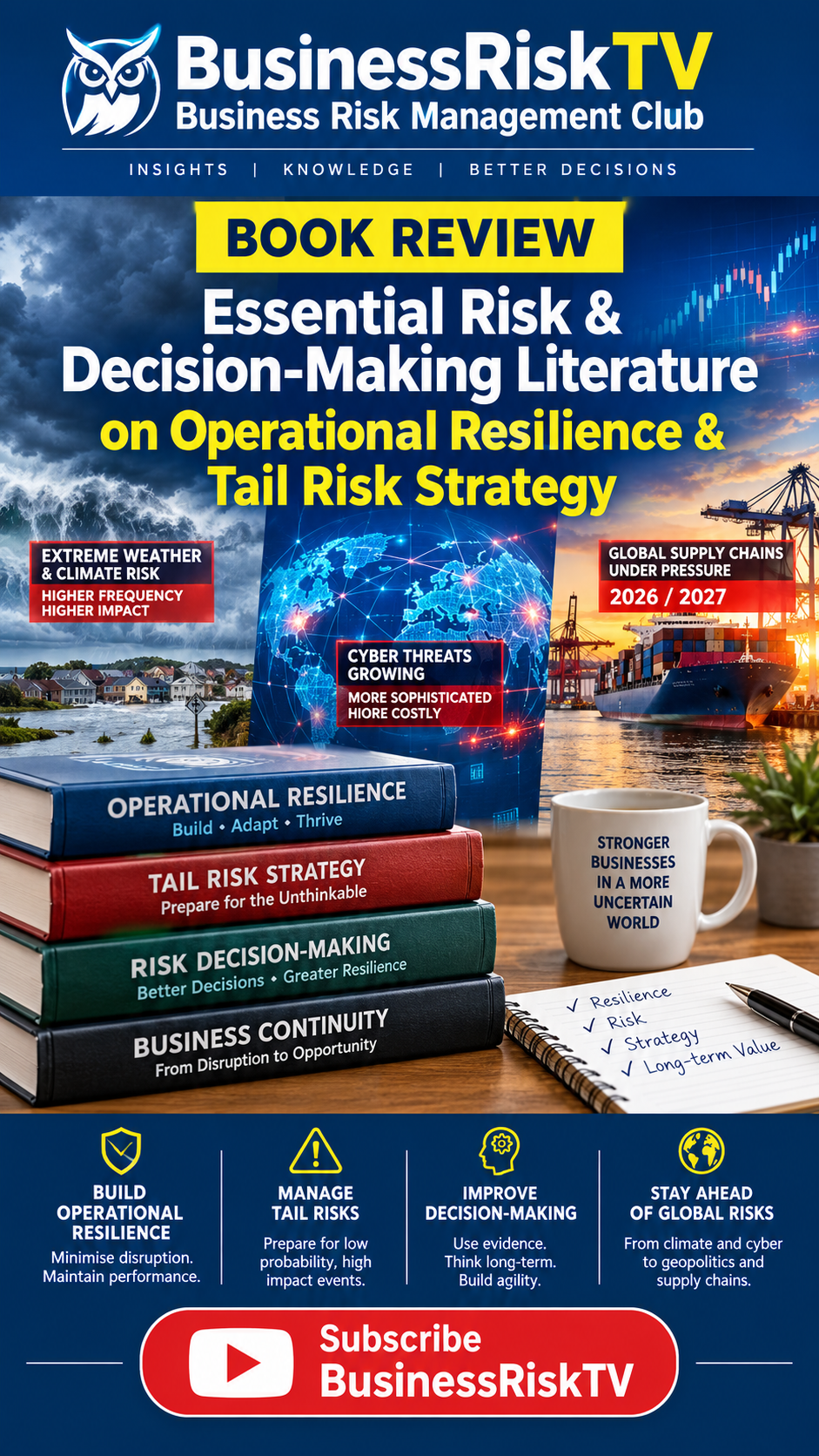
Which 3 Nassim Taleb Books Should Directors Read for Tail Risk & Operational Resilience in 2026?

How do directors, project managers & strategists navigate systemic uncertainty? BusinessRiskTV reviews Taleb’s 3 books with UK ONS stats & practical tail risk steps.

BusinessRiskTV Business Risk Management Club recommends these 3 books to help the reader make better decisions on Operational Resilience & Tail Risk Strategy.

That single sentence encapsulates why the following review exists. The scale of the problem is not theoretical. The Office for National Statistics reported that 40% of UK trading businesses with 10 or more employees cited economic uncertainty as the most significant challenge impacting turnover in early April 2026—the highest proportion since the question was introduced in April 2022. Government analysis of operational disruption across UK sectors shows that while typical incidents cost between 0.2% and 4.6% of annual turnover, tail events can dominate total losses and threaten business continuity entirely. Cyber-attacks alone cost UK businesses £3.7 billion in litigation over the past year, with shareholder lawsuits accounting for nearly a third of that total. Against this backdrop, Nassim Nicholas Taleb’s Incerto trilogy—Fooled by Randomness, The Black Swan, and Antifragile—provides the conceptual infrastructure that directors, project managers, and strategists need to navigate systemic uncertainties and cognitive bias in decision-making.‌

What Makes Nassim Nicholas Taleb’s Incerto Trilogy Essential Risk & Decision-Making Literature for Operational Resilience & Tail Risk Strategy?

Taleb’s Incerto trilogy is essential risk and decision-making literature for operational resilience and tail risk strategy because it systematically dismantles the illusions that lead organisations to underestimate rare, high-impact events and overestimate their ability to predict and control complex systems. The three books form a coherent progression: Fooled by Randomness (2001) exposes how humans mistake luck for skill; The Black Swan (2007) reveals how rare, unpredictable events shape history and markets; Antifragile (2012) offers a framework for building systems that benefit from disorder.

Why This Matters for Directors, Project Managers & Strategists:

  • Directors face board-level decisions where governance failures linked to cognitive bias carry escalating legal and financial consequences. UK boards are already experiencing “quiet distress” as prolonged financial strain and delayed decisions create D&O exposure earlier in the risk cycle.
  • Project managers operate at the intersection of uncertainty and delivery, often relying on linear projections and optimistic timelines that fail catastrophically when tail events hit. Research shows that organisations with structured decision trackers score more than 20 percentage points higher on early-warning indicator tracking and bias exploration than those without.
  • Strategists build models that assume a stable future, yet the ONS Business Insights survey consistently shows economic uncertainty dominating business challenges month after month.‌
    Each book serves a distinct function in the operational resilience toolkit. Together, they constitute a complete curriculum in probabilistic thinking, tail risk awareness, and adaptive system design.

What Is the Core Argument of Fooled by Randomness, and How Does It Apply to Business Decision-Making?

The core argument of Fooled by Randomness: The Hidden Role of Chance in Life and in the Markets is that humans systematically confuse randomness with causality, attributing success to skill and failure to controllable factors, thereby creating brittle decision-making frameworks that collapse when randomness reasserts itself. Taleb demonstrates that much of what passes for expertise in finance, management, and strategy is indistinguishable from luck dressed in the language of analysis.

Why This Matters Practically:

  • Distinguish signal from noise in performance data. Taleb argues that short-term results are dominated by variance, not skill. When evaluating business unit performance or project outcomes, directors should demand longer time horizons and statistical significance testing before drawing conclusions. UK businesses reporting turnover decreases (27% in April 2026) and increases (15% in July) often attribute these swings to strategy or market conditions when random fluctuation may be the dominant driver.‌
  • Identify survivorship bias in case studies. Business literature is filled with success stories of companies that “did everything right.” Taleb’s point is that we never see the graveyard of companies that did the same things and failed due to bad luck. Strategy teams should actively seek out failure cases and control groups.
  • Resist the narrative fallacy in post-mortems. After any project, there is enormous pressure to construct a coherent story explaining outcomes. Taleb warns this narrative impulse prevents genuine learning.

Business Application:

Project managers should implement decision journals that record expectations before outcomes are known, creating a feedback loop that reveals whether success was skill or circumstance. Directors should push for probabilistic language in board papers—”we assess a 60% likelihood” rather than “we are confident”—forcing explicit recognition of uncertainty. Strategists should stress-test strategic plans against scenarios where random negative events cluster, rather than assuming they distribute evenly across time.

What Is the Central Thesis of The Black Swan, and Which Businesses Are Most Vulnerable to Its Implications?

The central thesis of The Black Swan: The Impact of the Highly Improbable is that rare, unpredictable, high-consequence events—Black Swans—dominate outcomes in complex systems, yet our psychological and institutional frameworks are systematically blind to their possibility, leaving businesses dangerously exposed to catastrophic surprise. Taleb identifies the “triplet of opacity”: the illusion of understanding, the retrospective distortion of events, and the overvaluation of factual information.

Which Businesses Are Most Vulnerable:

  • Financial services firms face existential Black Swan exposure. Bank of England research shows 82% of UK banks, insurers and asset managers now cite cyber attacks as a top-five risk to the financial system, up ten percentage points from 2024. A meaningful share of large financial institutions face a roughly 10% annual probability of losing 10% or more of annual profit to a single cyber event.
  • Supply chain-dependent manufacturers and retailers are directly exposed to geopolitical Black Swans. In April 2026, 47% of UK businesses experiencing global supply chain disruption cited the conflict in the Middle East as the reason—up 34 percentage points from February.‌
  • Energy-intensive businesses face compounding tail risks from price volatility and geopolitical disruption. 60% of UK businesses reported concern about energy prices in early May 2026, with accommodation and food service businesses reaching 86% concern.‌
  • Technology and digital businesses are exposed through cyber, regulatory, and concentration risk. The PRA’s 2026 operational resilience policy statement explicitly addresses “rising threats to operational resilience at firms and their growing reliance on externally supplied services”.‌

When to Use The Black Swan Learning Points:

Business Application:

Directors should establish dedicated tail risk committees that meet independently of standard risk reviews, focusing exclusively on low-probability, high-impact scenarios. Project managers should build “kill criteria” into major projects—pre-defined conditions under which the project is stopped—rather than assuming continuation. Strategists should model scenarios where multiple Black Swans occur simultaneously, recognising that disruptions cluster rather than distribute evenly.

What Does Antifragile Teach About Building Organisations That Improve Under Stress, and How Can This Be Implemented?

Antifragile: Things That Gain From Disorder teaches that some systems are not merely robust (resistant to shocks) or resilient (recovering after shocks), but antifragile—they actually improve, strengthen, and grow when exposed to volatility, randomness, and stressors. Taleb argues this property is the highest form of adaptation available to organisations, and it can be deliberately engineered through structural choices, incentive design, and optionality.

Key Antifragile Principles for Business:

  • Barbell strategy: Combine extreme conservatism in core operations with aggressive, small-scale experimentation in growth areas. 75% of grant-funded UK charities use formal risk tools compared to 35% of non-grant-funded organisations, suggesting structured approaches enable greater risk capacity when combined with appropriate funding.
  • Optionality over prediction: Rather than forecasting the future, build portfolios of options that benefit from multiple possible outcomes. This directly addresses the observation that economic uncertainty has been the most reported challenge affecting business turnover since October 2022.
  • Skin in the game: Decision-makers must bear the consequences of their decisions. HM Treasury’s 2026 guidance to accounting officers frames value for money as a “balanced judgement of strategic alignment, long-term resilience, and risk,” moving beyond simple cost minimisation.
  • Redundancy as investment: Duplicate systems, diversified suppliers, and cross-trained teams are not waste—they are the raw material of antifragility.

When to Apply Antifragile Learning Points:

  • During organisational design—to build structures that benefit from uncertainty rather than merely surviving it.
  • During supply chain strategy—to move from just-in-time efficiency to diversified, optionality-rich sourcing.
  • During technology investment—to prioritise systems that learn from attacks and failures rather than merely resist them.
  • During talent development—to cultivate teams comfortable with volatility and skilled at rapid adaptation.

Business Application:

Operations directors should conduct “stress tests with benefit”—scenarios where the organisation not only survives disruption but emerges stronger because competitors are weakened. For example, a manufacturer with diversified suppliers can gain market share when single-source competitors face disruption. Project managers should build rapid prototyping and learning loops into delivery schedules, treating small failures as information rather than stigma. Strategists should allocate a portion of capital to small, high-optionality bets that could pay off massively in Black Swan scenarios, while simultaneously reducing exposure to ruinous tail risks.

Which Businesses Will Benefit Most from Taleb’s Frameworks, and Where in the World Are They Likely Operating?

The businesses that will benefit most from Taleb’s frameworks are those operating in high-uncertainty, high-interconnection, and high-consequence environments—particularly in the UK, Europe, North America, and Asia-Pacific where regulatory pressure, geopolitical fragmentation, and technological disruption intersect.

Sector-by-Sector Analysis:

  • Financial services in London, New York, Singapore, and Frankfurt face the most acute combination of regulatory scrutiny, cyber exposure, and tail risk concentration. The PRA’s PS7/26 operational resilience policy, effective from 2026, requires firms to report operational incidents and material third-party arrangements with significantly reduced burden but enhanced oversight. UK financial services compliance costs now exceed £33.9 billion annually, representing roughly 13% of average operating costs.‌
  • Manufacturing and logistics across the UK, Germany, Netherlands, and key Asian hubs are directly exposed to supply chain Black Swans. The ONS reported 7% of UK businesses experiencing global supply chain disruption in April 2026, with nearly half citing Middle East conflict.‌
  • Energy and utilities in the UK, Norway, Gulf states, and Australia face compounded tail risks from price volatility, geopolitical disruption, and transition uncertainty. 28% of UK businesses cited energy prices as a reason for considering raising prices in June 2026.‌
  • Technology and digital platform businesses globally face cyber Black Swans, regulatory tail risks, and concentration risk. The Bank of England’s 2026 H1 Systemic Risk Survey found 82% of financial institutions citing cyber attacks as a top-five systemic risk.‌
  • Healthcare and pharmaceutical supply chains across Europe, North America, and Asia are exposed to pandemic Black Swans, regulatory disruption, and geopolitical supply chain risk.
  • Professional services firms advising on risk, strategy, and resilience are both beneficiaries (demand for their services grows) and exposed to reputational tail risks if they fail to apply these frameworks themselves.

Geographic Concentration:

  • United Kingdom: Highest regulatory intensity for operational resilience, with FCA/PRA rules now in “steady-state” from 2026, enhanced regulatory powers, and cost recovery provisions.
  • European Union: DORA (Digital Operational Resilience Act) in force across Europe, aligning with UK approaches but creating additional compliance complexity for cross-border firms.
  • United States: Less prescriptive regulation but higher litigation and shareholder activism risk, particularly around cyber governance failures.
  • Asia-Pacific: Rapid economic growth combined with geopolitical tension, supply chain concentration, and varying regulatory maturity creates a high-Black-Swan environment.
  • Middle East and Africa: Geopolitical disruption, energy price volatility, and infrastructure risk create compounding tail exposure.

How Should Organisations Integrate Taleb’s Key Learning Points into Decision-Making to Boost Performance and Reduce Risk Events Derailing Business Objectives?

Organisations should integrate Taleb’s key learning points by embedding probabilistic thinking, tail risk assessment, and antifragile design principles into the governance, project management, and strategy functions at the point of decision, not as an afterthought. The evidence suggests this is not optional: UK business confidence dropped to a net figure of -76 in March 2026, compared to -63 in February, according to Institute of Directors research. Fewer businesses were set up in Q1 2026 than in any comparable period on record. The organisations that survive and thrive will be those that internalise Taleb’s lessons before the next Black Swan arrives.

Board-Level Integration:

  • Establish a Tail Risk Committee reporting directly to the board, separate from the standard audit and risk committee, with a mandate to challenge assumptions of normality and identify ruin exposure.
  • Require probabilistic decision papers: every significant capital allocation or strategic decision must include explicit probability assessments, not point forecasts.
  • Implement decision journals that record expectations, rationale, and confidence levels before outcomes are known, reviewed quarterly to identify systematic biases.

Project Management Integration:

  • Build kill criteria into every major project: pre-defined conditions under which the project is terminated, removing sunk-cost bias from continuation decisions.
  • Apply barbell resource allocation: commit 80-90% of resources to high-confidence, low-variance delivery, and 10-20% to experimental, high-optionality initiatives that could benefit from disorder.
  • Conduct pre-mortems at project initiation: assume the project has failed catastrophically and work backwards to identify causes.

Strategy Integration:

  • Replace single-scenario planning with multiple scenarios including Black Swan scenarios where multiple disruptions compound.
  • Develop antifragile supply chains with diversified sourcing, redundancy, and optionality—accepting higher baseline costs as insurance against tail events.
  • Invest in optionality: maintain cash reserves, flexible contracts, and strategic options that can be exercised when volatility creates opportunity.

Operational Resilience Integration:

  • Align with regulatory requirements proactively: the PRA’s operational resilience framework requires firms to remain within impact tolerances for important business services under severe but plausible disruption scenarios.
  • Conduct regular stress tests that include cyber, geopolitical, and supply chain scenarios simultaneously, recognising that disruptions cluster.
  • Measure resilience value not just as cost avoidance but as competitive advantage: government analysis shows that increased resilience reduces both the likelihood of severe outcomes and the scale of losses when disruption occurs.‌

When to Apply These Frameworks:

  • Annually during strategy and budget cycles: full Black Swan scenario review and antifragile portfolio assessment.
  • Quarterly during board risk reviews: tail risk exposure review and decision journal analysis.
  • Monthly during project reviews: kill criteria assessment and pre-mortem updates.
  • Continuously through operational monitoring: early-warning indicators and antifragile capacity metrics.
  • Post-incident after any disruption: structured learning review applying Fooled by Randomness lessons about attribution.

Why Are These Books Particularly Relevant for Operational Resilience & Tail Risk Strategy in September 2026?

These books are particularly relevant in September 2026 because the operating environment has become precisely the kind of high-volatility, high-interconnection, high-consequence system that Taleb’s frameworks were designed to address. The ONS Business Insights survey for April 2026 showed economic uncertainty at 40% for larger businesses—the highest proportion since the question was introduced. Global supply chain disruption reached 9% in March 2026, the highest since December 2022. The PRA’s operational resilience rules are now in full effect, with “steady-state” expectations and enhanced regulatory powers to demand information, direct remediation, and recover supervisory costs. Bank of England analysis confirms that “average impacts are not representative of overall risk exposure” and that “tail events can dominate total losses and can threaten business continuity”.‌‌

Taleb’s trilogy provides the intellectual architecture to navigate this environment. Fooled by Randomness teaches the discipline of statistical scepticism. The Black Swan reveals the structural blind spots that make organisations vulnerable to rare events. Antifragile offers the design principles to build systems that improve under stress. Together, they constitute a complete risk literacy curriculum for directors, project managers, and strategists who need to make decisions when the future refuses to behave as forecast.

The value proposition is not merely defensive. Organisations that internalise these lessons will identify opportunities that competitors miss—in supply chain restructuring, in optionality-rich investment strategies, in resilient operational models that become competitive advantages when disruption hits. The question is not whether the next Black Swan will arrive, but whether your organisation will be fooled by randomness when it does.

#OperationalResilience #TailRiskStrategy

Get help to protect and grow your business faster with BusinessRiskTV

Find out more about growing your business faster with BusinessRiskTV Business Risk Management Club

Subscribe for free business risk management ideas risk reviews and business discounts to reduce your business cost of being in business

Connect with BusinessRiskTV for free business risk management tips

Read more business risk management articles and view videos for free

Connect with BusinessRiskTV for free alerts to new business risk management articles and videos 

Most “resilient” UK businesses are just lucky. And 40% of larger UK firms just admitted economic uncertainty is beating them.

That’s not a vibe. That’s the ONS Business Insights survey, April 2026: 40% of UK trading businesses with 10+ employees cited economic uncertainty as the top challenge hitting turnover — the highest since the question began in April 2022.

So here’s the uncomfortable question: if your risk register still assumes the future looks like the last 5 years, what exactly are you protecting?

BusinessRiskTV Business Risk Management Club recommends these books to help the reader make better decisions on Operational Resilience & Tail Risk Strategy.

Keep reading — because the third book is the one that changes how you allocate capital.

There are 3 books that do more for operational resilience than most 40-page board packs:

1. Fooled by Randomness — Nassim Nicholas Taleb
It asks: how much of your “performance” is skill, and how much is luck?

If UK businesses swing from 27% reporting turnover decreases to 15% reporting increases in a matter of months, how much of that is strategy — and how much is noise?
Most post-mortems invent a story. Taleb shows you why that story is usually wrong.

2. The Black Swan — Nassim Nicholas Taleb
It asks: what rare event would wipe out the plan?

82% of UK banks, insurers and asset managers now cite cyber attacks as a top-five risk to the financial system, per Bank of England H1 2026 research.
47% of UK businesses hit by global supply chain disruption in April 2026 blamed the Middle East conflict — up 34 percentage points from February.
Cyber-attacks cost UK businesses £3.7bn in litigation over the past year.
That’s not a tail risk. That’s a board-level blind spot.

Wait — here’s the counterintuitive part.

3. Antifragile — Nassim Nicholas Taleb
It asks: what gets stronger when stressed?
Not “robust.” Not “resilient.” Antifragile.

The PRA’s 2026 operational resilience policy puts firms in “steady-state” with enhanced powers to demand information, direct remediation and recover supervisory costs.
UK financial services compliance costs now exceed £33.9bn a year — roughly 13% of average operating costs.
If you’re spending that much on defence, Taleb’s barbell strategy is the difference between surviving volatility and profiting from it.

Here’s the 3-question test most teams never run:

  1. What would actually ruin us — not just hurt quarterly earnings?
  2. What looks like skill but is statistically indistinguishable from luck?
  3. What part of the business gets stronger when suppliers fail, cyber hits, or energy spikes?

If you can’t answer those three with specific numbers and named owners, you don’t have a tail risk strategy. You have a hope strategy!

Directors, project managers and strategists: this is why these books matter now. Not in theory. In capital allocation, kill criteria, supplier diversification, decision journals and pre-mortems.

Email editor@businessrisktv.com with the subject line TALEB 3 and tell me which of the three books your board needs to read first.

Featured Books

Incerto Series 1-3 Books Collection Set by Nassim Nicholas Taleb (Fooled by Randomness, The Black Swan & Antifragile)

As an Amazon Associate I earn from qualifying purchases.

Which 3 Nassim Taleb Books Should Directors Read for Tail Risk & Operational Resilience in 2026?

Is The Failure of Risk Management Worth It? 2026 Review | BusinessRiskTV

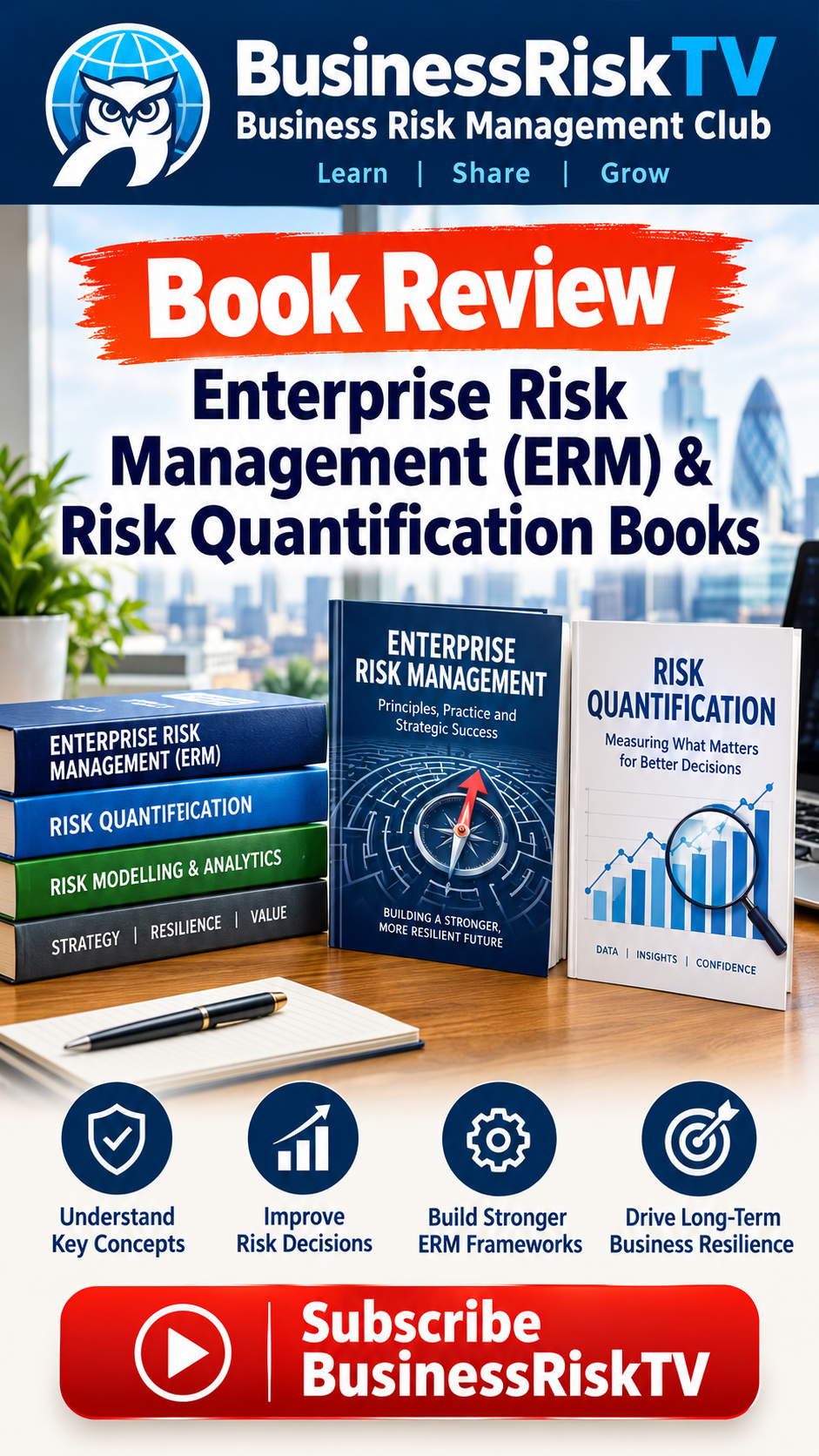
BusinessRiskTV reviews Douglas W. Hubbard’s The Failure of Risk Management—why heat maps fail and how quantitative risk analysis fixes ERM in 2026.

BusinessRiskTV Book Review: The Failure of Risk Management

BusinessRiskTV Business Risk Management Club recommends this book product as the solution to the problem of poor enterprise risk management application in business.

That recommendation carries weight because the problem is measurable. 65% of UK organisations now believe a serious cyber attack could threaten their survival, yet 1 in 5 have chosen not to report a serious cyber incident to avoid negative consequences. With economic uncertainty cited by 29% of UK trading businesses as their top challenge affecting turnover in September 2026, and 28% reporting decreased turnover, the gap between how businesses think they manage risk and how they actually do is costing real money. Hubbard’s book confronts that gap head-on.‌

What Is The Failure of Risk Management About?

The Failure of Risk Management explains why common risk management techniques are causing bad decision-making and provides a practical framework for adopting accurate, quantitative risk analysis methodology. Renowned risk analysis expert Douglas W. Hubbard argues that many popular risk management methods are “mere placebos which do nothing to reduce risk and improve decisions”. The book is divided into three parts: an introduction to risk analysis, a critique of what is broken, and a practical guide to fixing it.‌‌

Hubbard’s core argument is that qualitative methods like risk matrices and heat maps look sophisticated but are often misleading. He presents a convincing case for probabilistic risk analysis using Monte Carlo simulation as the best approach. The second edition includes updated case studies and expanded guidance on probability modelling, emphasising the efficacy of appropriate risk methodology in practical applications.

Why Should Risk Officers and Business Leaders Read This Book in 2026?

Risk officers and business leaders should read this book in 2026 because the gap between qualitative risk theatre and quantitative risk reality has never been more costly, as current UK business data demonstrates. The UK Government’s own 2026 National Risk Register acknowledges that “the risks the UK faces are more volatile, varied and interconnected than any time in living memory,” listing 95 distinct risks including 87 standalone risks and 8 linked scenarios. Yet the Government Major Projects Report at the end of March 2026 revealed that only 15% of major projects held a Green rating, while 58% were Amber and 18% were Red. These are the very projects where quantitative risk modelling should be standard practice.

Hubbard’s critique is not abstract. The Wood Group was fined almost £13m in March 2026 for failures in financial reporting and systems of controls, with the FCA citing a “poor financial culture”. Carillion’s former finance directors were fined for failing to reflect serious financial troubles in company announcements. These are not failures of risk identification—they are failures of risk quantification and honest communication. Hubbard’s framework directly addresses these systemic weaknesses.

Who Will Benefit Most from Buying and Applying This Book?

Risk officers, compliance teams, project managers, CFOs, board members, and enterprise risk management professionals will benefit most from buying and applying this book. The book targets management consultants and economists primarily, but Hubbard offers important suggestions for war quants and actuaries as well. Specifically:‌

  • Risk officers seeking to move from qualitative heat maps to quantitative modelling will find a step-by-step methodology for calibration and probability estimation
  • Compliance teams facing increasing regulatory scrutiny—the FCA’s actions against Wood Group and Carillion directors show that regulators now expect boards to monitor risk management frameworks effectively
  • Project managers managing complex programmes will benefit from Hubbard’s practical rules for risk registers, including the principle that risks requiring executive notification belong on the register, while those with trivial impacts do not‌
  • CFOs and finance directors grappling with supply chain disruptions—70% of UK businesses have faced greater financial exposure due to supply chain instability, with average annual collection costs rising to over £420,000‌
  • Board members who need to understand why “seeing all risks displayed in an organised, visual format” does not mean they are under control‌

When Should Potential Buyers Buy This Book?

Potential buyers should buy this book immediately if their organisation currently relies on qualitative heat maps, colour-coded risk matrices, or consensus-based risk scoring, because these methods are failing under the weight of 2026’s interconnected risk landscape. The timing is critical for several reasons:

  • Regulatory pressure is intensifying: The UK Corporate Governance Code now asks boards to monitor company risk management and their controls frameworks, yet many boards lack the quantitative tools to do so
  • Cyber risk is existential: 65% of UK organisations say a serious cyber attack could threaten their survival, and AI-driven attacks have more than doubled in frequency over the last 12 months, now affecting 25% of organisations‌
  • Supply chain volatility is structural, not temporary: 28% of UK businesses with 10 or more employees reported concern about international conflict impacting supply chains, while 21% were concerned about shipping disruption‌
  • The cost of inaction is quantifiable: Late payments cost the UK economy £11 billion annually, and 38 businesses close every day due to cashflow problems
    Buy the book before your next risk committee meeting. Buy it before your next board reporting cycle. The organisations that adopt quantitative methods now will be the ones still trading in 2027.

Where in the World Will Your Business Be to Take Advantage of This Book’s Knowledge?

UK-based businesses of all sizes—from SMEs to FTSE-listed corporates—will benefit most from this book’s knowledge, because the UK’s current risk environment provides the most immediate and measurable case for quantitative risk management. The UK is uniquely positioned to apply Hubbard’s framework:

  • UK SMEs are owed an average of £66,770 in late payments, and nearly half of UK companies expect the economy to deteriorate in the next 12 months
  • UK corporates face heightened governance scrutiny following the Carillion and Wood Group enforcement actions, making Hubbard’s methodology for demonstrating risk competence at board level directly applicable
  • UK public sector bodies managing the 95 risks in the National Risk Register need quantitative prioritisation to allocate limited resources effectively, as the Resilience Action Plan acknowledges the need to “assess how resilient the UK is to target interventions and resources”‌
  • UK critical national infrastructure operators in water, power, and communications face risks that Hubbard’s methods were originally designed to address—his approach draws from “nuclear power, exploratory oil, and other areas of business and government” where quantitative risk analysis is already standard practice

What Are the Key Takeaways for Business Decision Makers?

Key takeaways from The Failure of Risk Management that business decision makers can immediately apply include abandoning heat maps for quantitative methods, calibrating probability estimates, and using Monte Carlo simulation to model uncertainty. The most actionable insights are:

  • Heat maps create false confidence: Colour-coded risk matrices oversimplify complex risks, lack granularity, cannot account for risk tolerance, and encourage subjective assessment—yet executives treat them as rigorous analysis‌
  • Quantitative analysis is achievable without a PhD: Hubbard provides practical guidance on probability modelling and empirical inputs, showing that “you don’t need high levels of complexity or a PhD in math to make significantly better-informed risk management decisions”
  • Calibrate your experts: People do not naturally estimate probabilities well, but a little training can significantly improve accuracy—Hubbard provides tests in the appendix for calibrating probability estimations‌
  • Review past models against reality: The best way to know if a model works is to check how past forecasts performed—Hubbard checked over 100 of his own probability forecasts and found events predicted at 30% occurred approximately 30% of the time‌
  • Apply simple risk register rules: If the impact is so trivial you don’t need to tell anyone, it doesn’t belong on the register; if the probability exceeds 1 (it’s expected to happen), it’s not a risk but a project plan item‌
  • Learn from near misses: Treating near misses as successes rather than failures is a critical barrier to organisational learning that Hubbard identifies as a common failure mode‌

How Can You Maximise the Knowledge in This Book for Practical Business Benefit?

To maximise the knowledge in this book for practical business benefit, implement Hubbard’s four key measures: identify deficiencies in your current strategy, adopt a calibrated approach to risk analysis using up-to-date statistical tools, employ accurate quantitative risk analysis and modelling methods, and revisit your models against real outcomes. The practical implementation path is clear:

  • Start with a risk audit: Hubbard advises risk managers to identify deficiencies in their current strategy and fix them, rather than attempting a wholesale replacement of existing systems
  • Convert qualitative to quantitative: Where your risk register uses high/medium/low, convert these to probability estimates—”estimate the probability that the event will happen inside of the timeframe”‌
  • Use existing data before building new models: Where possible, review historical data to see what the real impact of similar events has been, rather than relying on subjective estimates‌
  • Frame risks in financial terms: Quantitative risk assessments assign numerical values to risks, allowing decision-makers to weigh the cost of each risk against its potential impact, enabling more strategic resource allocation
  • Establish feedback loops: Create a culture of purchase reflection where you document experiences, ask what happened and why, price assess reoccurrence likelihood, and identify practical steps to change outcomes‌
  • Join a community of practice: The BusinessRiskTV Business Risk Management Club provides access to exclusive webinars, workshops, and reports from leading risk management experts, with monthly risk intelligence briefings covering geopolitical, economic, and technological trends‌

Is The Failure of Risk Management Value for Money?

The Failure of Risk Management represents exceptional value for money when measured against the cost of poor risk management decisions that it helps prevent. Consider the arithmetic:

  • The book retails at approximately £39, while the average annual cost of collections from late payments alone has risen to £421,800 per business—a 14.5% increase from £368,400 in 2025
  • Cyber incidents cost UK small firms an average of $52,000 (approximately £41,000) per year and cause about 32 hours of disruption, yet average investment in cyber resilience measures stands at only $51,000—almost matching the cost of incidents themselves
  • Late payment costs the UK economy £11 billion annually, and 38 businesses close every day due to cashflow problems
  • The book’s insights, if applied to even one significant risk decision, could save an organisation many multiples of its
    Hubbard’s methodology has earned critical praise from Gartner and Forrester Research, and the second edition includes fresh examples from the 2008 credit crisis, natural disasters, outsourcing failures, and engineering disasters. As Sam L. Savage, Executive Director of ProbabilityManagement.org, wrote: “Some study the theory of risk management. Some actively engage in risk management and find that what works in theory does not always work in practice. Some develop new technologies that will make risk management work better in the future. Doug Hubbard does all three. That’s why this book should be your risk management must-read”.‌

Final Verdict

The Failure of Risk Management is essential reading for any business decision maker who suspects their current risk approach is not delivering genuine insight or protection. In a year where the UK terrorism threat has increased to SEVERE, the National Risk Register lists 95 distinct risks, and 65% of organisations fear cyber attack could threaten their survival, continuing to rely on colour-coded heat maps is not risk management—it is risk theatre. Hubbard provides the practical, proven alternative that business leaders need.‌

BusinessRiskTV Business Risk Management Club recommends this book product as the solution to the problem of poor enterprise risk management application in business.

Get help to protect and grow your business faster with BusinessRiskTV

Find out more about our Business Risk Management Club

Subscribe for free business risk management ideas risk reviews and cost of doing business reduction tips

Connect with BusinessRiskTV for free business risk management tips

Read more business risk management articles and view videos for free

Connect with BusinessRiskTV for free alerts to new business risk management articles and videos 

Your risk heat map is a placebo.

That’s not my line. It’s the uncomfortable conclusion Douglas W. Hubbard forces you to confront in The Failure of Risk Management: Why It’s Broken and How to Fix It.

And in September 2026, the numbers back him up.

65% of UK organisations say a serious cyber attack could threaten their survival. 1 in 5 have chosen not to report a serious cyber incident. ONS-linked business data shows 29% of UK trading businesses cite economic uncertainty as their top challenge affecting turnover. 28% report decreased turnover.

The UK Government’s own National Risk Register lists 95 distinct risks. The Government Major Projects Report at the end of March 2026 showed only 15% of major projects rated Green. 58% Amber. 18% Red.

Wood Group was fined almost £13m in March 2026 for financial reporting and controls failures. Carillion’s former finance directors were fined for failing to reflect serious financial troubles in company announcements.

Yet many boards still stare at red-amber-green heat maps and call it risk management.

Here’s the part most risk committees miss: Hubbard doesn’t just attack heat maps. He shows you what to replace them with. And the replacement does not require a PhD in math.

What to apply immediately:

  • Convert “high / medium / low” into probability estimates. If it’s a risk, ask: what is the probability this happens inside the timeframe?
  • Calibrate your experts. Hubbard checked over 100 of his own probability forecasts. Events predicted at 30% occurred approximately 30% of the time. Most organisations never test their experts this way.
  • Use Monte Carlo simulation to model uncertainty instead of arguing over colour codes.
  • Apply Hubbard’s risk register rule: if the impact is so trivial you don’t need to tell anyone, it doesn’t belong on the register. If the probability exceeds 1, it’s not a risk—it’s a project plan item.
  • Review past models against reality. If your 2024 risk register said “low likelihood” and it happened twice, your model is broken.
  • Treat near misses as data, not as successes. That is one of the biggest barriers to organisational learning Hubbard identifies.

    Wait—there’s more. This is where it gets expensive

    70% of UK businesses have faced greater financial exposure due to supply chain instability. Average annual collection costs have risen to over £420,000. Late payments cost the UK economy £11 billion annually. 38 businesses close every day due to cashflow problems.

    The book costs about £39. One avoided bad risk decision pays for it thousands of times over. That is not a book expense. That is risk management value for money.

    Who benefits most? Risk officers, compliance teams, project managers, CFOs, board members, and enterprise risk management professionals. When should you buy it? Before your next risk committee meeting. Before your next board reporting cycle. Where will it pay off? UK SMEs owed an average of £66,770 in late payments. FTSE corporates under FCA scrutiny. Public sector bodies managing 95 National Risk Register risks. Critical national infrastructure operators in water, power, and communications.

    Read to the end for the one question that exposes a broken risk process:

If your risk register disappeared tomorrow, what decision would actually change?

If the answer is “none”, you don’t have a risk process. You have risk theatre.

BusinessRiskTV Business Risk Management Club recommends this book product as the solution to the problem of poor enterprise risk management application in business.

Want the practical rollout? Email editor@businessrisktv.com with the subject line RiskClub for more information on BusinessRiskTV Business Risk Management Club.

#RiskClub #BusinessRiskTV

Book Under Review

The Failure of Risk Management: Why It’s Broken and How to Fix It by Douglas W. Hubbard

As an Amazon Associate I earn from qualifying purchases

Is The Failure of Risk Management Worth It? 2026 Review | BusinessRiskTV

Power Outages & Infrastructure Downtime Risk Review: CyberPower UPS

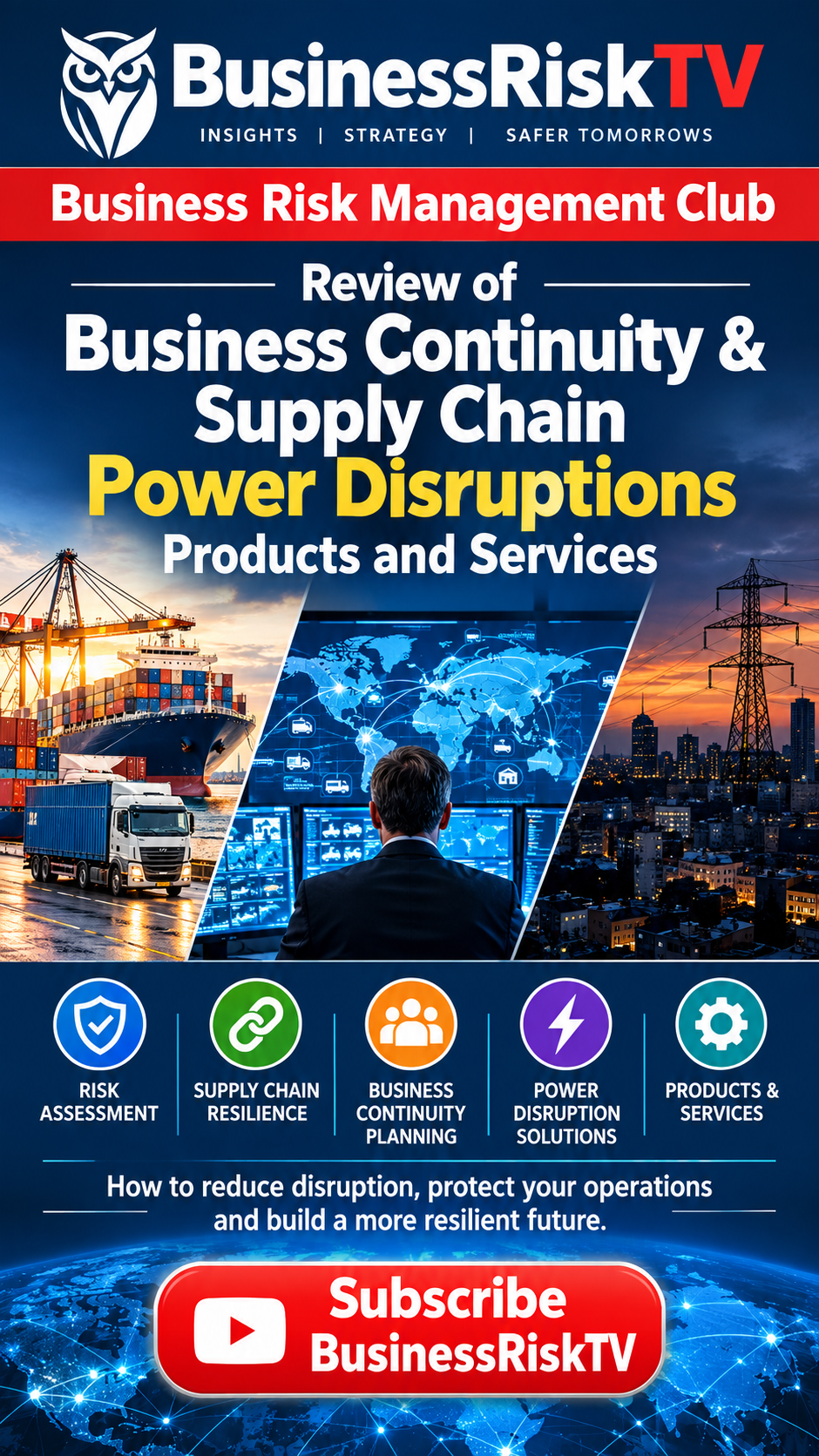
BusinessRiskTV Business Risk Management Club recommends CyberPower Line-Interactive UPS as one solution to power outages and infrastructure downtime risk.

“BusinessRiskTV Business Risk Management Club recommends CyberPower Line-Interactive UPS as one solution to the problem of Power Outages & Infrastructure Downtime Risk.”

That recommendation is grounded in hard numbers: UK businesses lost an estimated £3.7 billion in 2023 from internet outages alone, with smaller businesses facing up to £1,000 per hour of downtime. For mid-sized commercial operations, downtime costs typically range from £5,000 to £18,000 per hour during power outages. Meanwhile, 64% of UK remote workers have suffered an internet or power outage in the past year — equating to an estimated 12 million people.‌

What Is the Power Outages & Infrastructure Downtime Risk Review?

The Power Outages & Infrastructure Downtime Risk Review is a structured assessment of how vulnerable your organisation is to electricity supply disruption, brownouts, surges, and the cascading operational failures they trigger.

This review examines three critical layers of exposure:

  • Grid-level risk: The likelihood and frequency of power interruptions in your region
  • Infrastructure vulnerability: Whether your servers, network hardware, and workstations can survive a sudden power loss without damage or data corruption
  • Business continuity gap: How long your operations can continue — or safely shut down — when mains power fails

The UK government’s Statutory Security of Supply Report 2025 concludes that while GB is expected to access sufficient electricity supplies, network reliability remains a live concern, with growing focus on resilience against high-impact weather events. The National Preparedness Commission has noted that risk vectors including extreme weather and infrastructure ageing “create a troubling outlook” for UK energy security.‌

Why Do Small-Business Owners and Remote Workforces Buy UPS Systems?

Small-business owners and remote workforces deficit buy UPS systems to shield servers, network hardware, and work ofstations from sudden power drops, brownouts, and hardware -damaging surges that cause data loss, equipment destruction,1 and operational paralysis.

The purchase drivers are overwhelmingly practical:

  • Data integrity: An unexpected shutdown can corrupt databases, lose unsaved work, and trigger hours of IT recovery. For remote workers handling time-critical tasks, this risk is acute — research found that roughly 5% of remote workers experiencing outages are doing time-critical or high-value work, potentially affecting 470 million hours annually.
  • Hardware protection: Voltage spikes and surges can shorten equipment lifespan or destroy it outright. Power outages are not merely inconvenient; they carry secondary costs including lost productivity, idle staff wages, and the administrative burden of system restoration.
  • Revenue protection: For retail and hospitality businesses, even brief outages disrupt POS systems, refrigeration, and security — leading to spoiled stock and lost sales. A Sheffield café owner reported losing between £2,000 and £3,000 worth of food in a single outage.
  • Remote workforce resilience: ONS data shows that 40% of the UK workforce spent time working from home in early 2023, and home office setups are “nowhere near as resilient as a traditional office environment”. A UPS provides that missing layer of protection.

How Do You Maximise the Benefit of a UPS as a Risk Control Measure?

You maximise the benefit of a UPS as a risk control measure by matching the unit to your actual load profile, implementing automatic shutdown protocols, and integrating the UPS into a broader business continuity plan that includes regular testing and staff awareness.

  • Right-size the unit: Calculate the total wattage of equipment you need to protect — servers, routers, switches, NAS devices, and critical workstations — and choose a UPS with at least 30% headroom above that load.
  • Use the management software: CyberPower’s PowerPanel software enables automatic, graceful shutdown of connected systems before battery depletion, preventing data corruption and enabling rapid recovery.
  • Prioritise critical loads: Not everything needs battery backup. Use surge-only outlets for peripheral devices and battery-protected outlets for core infrastructure.
  • Test regularly: Simulate outages quarterly to verify runtime meets your safe shutdown window. The Wyre Council’s procurement report noted their UPS provided approximately 30 minutes of power — “enough for a clean shutdown of all systems”.‌
  • Layer with cloud backup: A UPS buys time; cloud-based backup ensures data survives even if local hardware is damaged.

Who Will Benefit Most from Purchasing a CyberPower Line-Interactive UPS?

Small-business owners, remote workforces, home office professionals, and IT managers responsible for small server rooms or network closets will benefit most from purchasing a CyberPower Line-Interactive UPS.

The beneficiary profile breaks down as follows:

  • Remote workers and home offices: With 64% of UK remote workers having experienced a recent outage, a compact UPS protecting a router, modem, and laptop dock can mean the difference between a minor inconvenience and a lost workday.
  • Small businesses with on-premise infrastructure: Retailers, clinics, accountants, and professional services firms running local servers, POS systems, or VoIP telephony need battery backup to maintain transactions and communications.
  • Small server rooms and network closets: A line-interactive UPS protects switches, firewalls, and NAS devices, preventing network-wide outages that cascade across the organisation.
  • Businesses in high-outage regions: The North West of England recorded 50,892 unplanned outages since 2021, followed by Scotland at 15,831 and Wales at 9,036.‌

When and Where Are Businesses Most at Risk as at September 2026?

Businesses are most at risk as at September 2026 in regions facing extreme weather, ageing grid infrastructure, and hydroelectric dependency — with the UK, parts of North America, and Latin America currently under heightened threat.

  • United Kingdom: Digital modelling by Neara found that over 3.5 million people are currently at risk of power outages, with a nationwide 100mph storm potentially cutting power to 3.6 million people and a Category 2 hurricane-equivalent event threatening 23 million. The UK had already experienced 14,500 unplanned outages by July 2025, with expectations of a further 10,000 before year-end — a 30% increase on 2024.‌
  • Latin America (Ecuador and Venezuela): As of late September 2026, officials in both countries have warned of renewed nationwide power outages driven by El Niño-related drought reducing hydroelectric output. Ecuador faces a structural power–1,200 MW, with rationing potentially extending to medium-consumption firms.‌
  • United States: Summer 2026 saw multiple large-scale outages and price spikes driven by extreme heat, hurricanes, and AI data centre demand straining an ageing grid where over 75% of distribution transformers are more than 50 years old.‌
  • Seasonal timing: September marks the transition from summer heat stress to autumn storm season in the Northern Hemisphere — a period when grid operators in the UK and Northern Europe face elevated risk from high winds and falling trees damaging overhead lines.

What Are the Features of CyberPower Line-Interactive UPS?

CyberPower Line-Interactive UPS features include Automatic Voltage Regulation (AVR), line-interactive topology, LCD status display, surge and spike protection, energy-saving GreenPower UPS™ technology, PowerPanel management software, and generator compatibility.

Key technical features across the CyberPower line-interactive range include:

  • Line-interactive UPS topology: The UPS regulates voltage continuously and only switches to battery when necessary, extending battery life and improving efficiency compared to offline/standby units.‌
  • Automatic Voltage Regulation (AVR): Single boost and single buck AVR corrects brownouts and overvoltages without draining the battery, maintaining stable output voltage during fluctuations.‌
  • Simulated sine wave output: Provides compatible power for most IT equipment including servers, routers, and workstations.‌
  • LCD status display: Real-time information on operation type, power status, battery status, load status, and fault warnings, with configurable settings for alarms, input/output, and battery management.‌
  • Surge and spike protection: Protects connected equipment from voltage spikes, with surge suppression ratings (e.g., 450 joules on the VP1200ELCD model) and EMI/RFI filtration.‌
  • PowerPanel management software: Enables automatic, graceful shutdown of connected systems during extended outages, monitor UPS status, and configure alerts.‌
  • Generator compatible: Designed to work with backup generators, enabling seamless transition from battery to generator power during prolonged outages.‌
  • Energy-saving GreenPower UPS™ technology: Bypass technology reduces energy consumption and heat loss, lowering running costs and carbon footprint.‌
  • Data line protection: RJ11/RJ45 and coax protection for phone, network, and cable connections, guarding against surges travelling through communication lines.‌
  • USB charging ports: Select models include USB-A and USB-C charging ports for mobile devices.‌
  • Runtime specifications: For example, the VP1200ELCD provides 12 minutes at half load and 4 minutes at full load — sufficient for safe shutdown of critical systems. The BR700ELCD provides 6 minutes at half load and 1.5 minutes at full load.‌

What Evidence Supports the Cost-Effectiveness of UPS as a Risk Control?

UK government, Ofgem, and independent research evidence supports the cost-effectiveness of UPS as a risk control, showing that the financial damage from a single outage event vastly exceeds the purchase and maintenance cost of protective equipment.

  • Government economic modelling: The UK government’s electricity engineering standards review simulated a 24-hour GB-wide power outage and estimated economic damage of between £5.2 billion and £5.5 billion.‌
  • Ofgem SME valuations: Ofgem research found that SMEs require an average payment of £165.07 to accept a one-hour interruption during winter at non-peak times on a typical working day. The Value of Lost Load (VoLL) for SMEs ranges from £33,358 to £39,213 per MWh.
  • Real-world procurement evidence: Wyre Council approved a UPS and generator solution at an initial cost of £39,184, with the assessment that “the solution still represents value for money” and offers “competitive value for money taking into consideration the additional elements required for fully automated failover”.‌
  • Return on investment: UPS systems prevent downtime, data loss, and hardware damage — often saving far more than their purchase and maintenance costs. More than 33% of organisations that experience a computer disaster lose between £7,500 and £250,000, while 20% lose between £250,000 and £750,000.
  • Business continuity value: A solid UPS setup can be a core part of the wider business continuity plan, making outages “unnoticeable” for small teams.

How Does the CyberPower Line-Interactive UPS Compare for Value?

The CyberPower Line-Interactive UPS compares favourably for value because it combines essential protection features — AVR, surge protection, management software, and generator compatibility — at a price point accessible to small businesses and remote workers.

  • Energy efficiency savings: CyberPower’s GreenPower UPS™ bypass technology reduces power consumption during normal operation, lowering electricity costs over the unit’s lifetime.
  • Battery replaceability: Select models feature user-replaceable batteries, extending the unit’s service life and reducing long-term ownership costs.‌
  • Scalability: The range spans compact desktop units (700VA) to tower models (1200VA and above), allowing businesses to start small and expand protection as infrastructure grows.
  • Comprehensive protection package: Unlike basic surge protectors, a line-interactive UPS provides both surge protection and battery backup — two distinct risk controls in one device.

What Should Your Next Step Be?

Your next step should be to conduct a Power Outages & Infrastructure Downtime Risk Review, then consider deploying CyberPower Line-Interactive UPS units at critical points identified in that review.

  • Audit your critical loads: Identify every device that cannot tolerate a sudden power loss — servers, network switches, routers, POS terminals, and workstations handling time-critical tasks.
  • Calculate runtime requirements: Determine how many minutes of battery backup you need for safe shutdown (typically 10–30 minutes for servers and network equipment).
  • Select CyberPower models: Match the UPS capacity to your load profile, choosing from the Value, BR, or VP series based on runtime and outlet requirements.
  • Implement automatic shutdown: Install PowerPanel software and configure graceful shutdown for all protected systems.
  • Document and test: Include the UPS in your business continuity plan, test quarterly, and train staff on what to do when the alarm sounds.

    “BusinessRiskTV Business Risk Management Club recommends CyberPower Line-Interactive UPS as one solution to the problem of Power Outages & Infrastructure Downtime Risk.”

In a landscape where a single outage can cost a small business up to £1,000 per hour — and where 3.5 million people in the UK already face elevated outage risk — the question is not whether you can afford a UPS, but whether you can afford to operate without one.

#PowerOutageRisk #CyberPowerUPS #BusinessRiskTV #RiskManagement #EnterpriseRiskManagement

Get help to protect and grow your business faster with BusinessRiskTV

Find out more about growing your business faster with BusinessRiskTV 

Subscribe for free business risk management ideas reviews and cost of being in business reduction tips

Connect with BusinessRiskTV for free business risk management tips

Read more business risk management articles and view videos for free

Connect with BusinessRiskTV for free alerts to new business risk management articles and videos 

If your business runs without a UPS, you’re not saving money — you’re gambling £5,000–£18,000 per hour on the assumption that the grid will never blink.

That sentence annoys people. Good. Because the numbers don’t care how you feel.

“BusinessRiskTV Business Risk Management Club recommends CyberPower Line-Interactive UPS as one solution to the problem of Power Outages & Infrastructure Downtime Risk.”

Here’s the topic hiding in plain sight: Power Outages & Infrastructure Downtime Risk Review. Not “buy a battery box.” A review of what actually fails, what it costs, and what to protect first.

The UK lost an estimated £3.7bn to internet outages in 2023. Small businesses: up to £1,000/hour. Mid-sized operations: £5k–£18k/hour. But the outage is only the first invoice. The second invoice is corrupted data, dead switches, lost POS sales, spoiled stock, and staff sitting idle.

Keep reading — the third number below is the one that should make you audit your server room tonight.

  • 3.5 million people in the UK are currently at risk of power outages, according to Neara digital modelling. A 100mph storm could cut power to 3.6 million.
  • 14,500 unplanned outages had already hit the UK by July 2025 — with 10,000 more expected before year-end, a 30% increase on 2024.
  • Wyre Council approved a UPS and generator solution at £39,184 and still assessed it as value for money. That’s what real resilience costing looks like.
  • Ofgem research found SMEs need an average £165.07 to accept a one-hour winter interruption. The Value of Lost Load for SMEs runs £33,358–£39,213 per MWh.
  • 64% of UK remote workers have suffered an internet or power outage in the past year. That’s roughly 12 million people.
    But here’s the part most UPS buyers get wrong: they buy a surge strip, plug in a router, and call it business continuity. That’s not a risk control. That’s a placebo.CyberPower Line-Interactive UPS features that actually matter:
  • Automatic Voltage Regulation (AVR) corrects brownouts and overvoltages without draining the battery.
  • Line-interactive topology switches to battery only when needed — better efficiency and longer battery life.
  • PowerPanel software triggers automatic, graceful shutdown before the battery dies.
  • LCD status display shows load, battery, fault, and operation status in real time.
  • GreenPower UPS™ bypass technology cuts energy consumption and heat loss.
  • Generator compatible, surge/spike protected, and available with user-replaceable batteries.
  • Example runtime: VP1200ELCD gives 12 minutes at half load, 4 minutes at full load — enough for a clean shutdown.If you only remember one line, make it this one: a UPS doesn’t stop the outage. It stops the outage from becoming a data loss, hardware replacement, and payroll problem.

    So what do you do next?

  • Audit every critical load: servers, switches, routers, POS, NAS, workstations.
  • Size the UPS with at least 30% headroom above your total wattage.
  • Install PowerPanel and configure graceful shutdown.
  • Test quarterly. Document it in your business continuity plan.
  • Train staff on what to do when the alarm sounds.

Email editor@businessrisktv.com with the subject line “UPS RISK REVIEW” for more information on Business Risk Management Club. If you’re still running critical infrastructure on mains power alone, you’re one storm away from finding out what downtime really costs.

#PowerOutageRisk #CyberPowerUPS

Featured Product

CyberPower OR600ERM1U Uninterruptible Power Supply (UPS) Line-Interactive 600 VA 360 W 6 AC Outlets OR600ERM1U, Line-Interactive, 600 VA, 360 W, Sine, 165 V, 271 V

As an Amazon Associate I earn from qualifying purchases.

Power Outages & Infrastructure Downtime Risk Review: CyberPower UPS

Portable Power Stations for Business Continuity | Jackery 1000 v2

BusinessRiskTV Business Risk Management Club recommends Jackery Solar Generator 1000 v2 for business continuity & supply chain power disruptions. 1070Wh LiFePO4.

BusinessRiskTV recommends Jackery Solar Generator 1000 v2 for business continuity & supply chain power disruptions. 1070Wh LiFePO4, 1500W AC, 1hr fast charge.

“BusinessRiskTV Business Risk Management Club recommends this product as the solution to the problem of business continuity and supply chain power disruptions.”

That recommendation carries weight because it is not made lightly. In 2024 alone, the UK recorded over 18,398 unplanned power outages — a 4.7% increase year-on-year — while more than 80,000 blackouts have occurred since 2021. The Energy Networks Association reported that Storm Darragh left over 2 million homes without power in winter 2024-25, and Storm Éowyn cut electricity to more than one million customers. When UK businesses lost an estimated £3.7 billion in a single year from internet outages alone, and smaller businesses face downtime costs of up to £1,000 per hour, the question is no longer whether a power disruption will affect your operations — it is whether you will be ready when it does.‌

What Happens to Your Business When the Grid Goes Down?

What happens to your business when the grid goes down is that operations stop, revenue halts, and recovery costs escalate — fast. The data paints a stark picture of the exposure UK organisations carry:

  • 14,500 unplanned power outages had already occurred by the end of July 2025, with a projected 30% increase compared to 2024 totals‌
  • The North West alone suffered 50,892 unplanned outages since 2021 — over 1,000 per month‌
  • 88% of businesses without a continuity plan fail within just over a year of a major disruption
  • Only 16% of employees say they have received clear instructions on what to do during a power outage or similar crisisFor mobile operations, pop-up retailers, and field workers, the grid is not a convenience — it is a dependency. When it fails, point-of-sale systems go dark, refrigeration units stop, communications collapse, and stock spoils. One Brighton trader estimated that power cuts were costing his business up to £10,000 on a busy sales day. A town centre in Malvern reported at least 10 outages in 18 months, leaving restaurants and shops repeatedly unable to serve customers.‌The Heathrow substation fire in March 2025 demonstrated that even the UK’s most critical infrastructure — with multiple independent power intakes — can be taken offline by a single point of failure, disrupting over 200,000 passengers and halting supply chains across the nation. The Kelly Review concluded that redundancy alone does not equal resilience.‌”Businesses across the UK are operating in an environment where downtime can have serious financial and reputational consequences. When connectivity, power or systems fail, the impact is immediate.” — Comms Business, 2026

How Can Portable Power Stations Protect Your Business Continuity?

Portable power stations protect your business continuity by providing immediate, silent, emission-free backup power that activates the moment the grid fails. Unlike diesel generators that require fuel storage, ventilation, and regular maintenance, modern LiFePO4 power stations are plug-and-play, require zero ongoing consumable costs, and can be deployed in indoor and outdoor locations without regulatory complications.

The business case is straightforward:

  • Revenue protection: An hour of downtime costs up to £1,000 for smaller businesses. A portable power station that keeps tills, card readers, and lighting operational through a 4-hour outage can pay for itself in a single incident.‌
  • Operational flexibility: Mobile operations, pop-up retail, construction sites, and field teams can run entirely off-grid without trailing cables or noisy generators.
  • Supply chain resilience: When local grid failures disrupt logistics and communications, battery backup maintains the critical systems that keep orders moving and customers informed.
  • Regulatory alignment: The UK government’s National Business Resilience Planning Assumptions explicitly identify power infrastructure failure as a key risk requiring business continuity provisions.The Continuity Forum has warned that “power outages, supply disruptions, flooding, and IT failures carry human and economic costs far beyond what is captured in current regulatory and corporate accountability frameworks”. In other words, the true cost of being unprepared is systematically underestimated by most organisations.

Why Is the Jackery Solar Generator 1000 v2 the Standout Solution?

The Jackery Solar Generator 1000 v2 is the standout solution because it delivers 1,070Wh of LiFePO4 battery capacity, 1,500W AC output (3,000W surge), 100W USB-C output, and a 1-hour fast charge — all in a unit weighing just 23.8 lbs. It is the portable power station that bridges the gap between professional-grade reliability and consumer-friendly portability.

Key specifications:

  • Battery: 1,070Wh LiFePO4 (lithium iron phosphate) — the chemistry used in commercial energy storage for its 4,000+ cycle lifespan, thermal stability, and safety profile
  • Output: 1,500W AC continuous / 3,000W surge, 100W USB-C, multiple DC ports — capable of running fridges, power tools, laptops, lighting, communications equipment, and medical devices
  • Recharge: 1-hour fast charge from mains; solar recharge via the included 100W SolarSaga panel for indefinite off-grid operation
  • Portability: 23.8 lbs with an integrated handle — genuinely transportable by a single person
  • Solar pairing: The 100W SolarSaga panel uses high-efficiency monocrystalline cells and folds for easy transport, enabling true energy independence during extended grid failuresPopular Mechanics testing found that the Explorer 1000 v2 powered a 25-cubic-foot refrigerator for more than 18 hours — a real-world benchmark that translates directly to business continuity for food retail, hospitality, and cold-chain operations. ZDNet’s reviewer described it as falling into the “Goldilocks zone of both price and portability” and a “solid, expandable portable power station” for emergencies and power outages. For RV adventures, van life, and off-grid living, the 100W solar panel provides a sustainable recharge loop. For business deployments — mobile operations, pop-up retail, field engineering, construction — the 1-hour mains recharge means the unit can be back to full capacity during a lunch break.Cost and value for money:
  • The Jackery Solar Generator 1000 v2 with 100W panel has been discounted from £1,199 to £521 — a £678 saving (57% off)
  • Earlier promotional pricing saw the package at £699 (42% discount)
  • With a LiFePO4 lifespan of 4,000+ cycles, the cost per cycle is approximately £0.13–£0.17 depending on purchase price — significantly lower than the cost of even one hour of business downtime
  • No fuel costs, no maintenance contracts, no emissions, no noise — a fraction of the total cost of ownership of a diesel generatorFor context: if a single power outage costs your business just one hour of lost trading at the smaller-business benchmark of £1,000, the Jackery unit pays for itself in fewer than one incident at current pricing.‌”The Explorer 1000 v2, although heavier at 23.8 pounds, ran a fridge for more than 18 hours in our testing… it is about the size of a small beer cooler.” — Popular Mechanics

Who Relies on Portable Power Stations Every Day?

Mobile operations, pop-up retailers, field workers, and office leads rely on portable power stations every day as their emergency power reserve and primary off-grid power source. These are not hypothetical users — they are the businesses that cannot afford a single hour of darkness.

Mobile operations: Food trucks, market stalls, event vendors, and pop-up shops need reliable power for tills, lighting, refrigeration, and sound systems. A 1kWh power station runs a full trading day for most small operations.

Field workers: Engineers, surveyors, agricultural workers, and utility teams operating in remote or rural locations need power for laptops, testing equipment, communications, and lighting. Solar recharge extends deployment indefinitely.

Office leads: Every office needs an emergency power reserve for routers, switches, servers, and communications systems. The Jackery unit can be stored in a cupboard and deployed in seconds — no installation, no electrician, no fuel.

Outdoor and off-grid: RV owners, van lifers, and off-grid dwellers use the Jackery Solar Generator 1000 v2 as their primary power source for cooking, lighting, refrigeration, and device charging. The 100W solar panel provides sustainable recharge in any location with sunlight.

The UK government’s own resilience planning assumes a reasonable worst-case scenario of significant electricity network failure across several regions, with up to 3.5 million customers losing power for up to 24 hours. For businesses in that scenario, the difference between having a Jackery unit and not having one is the difference between operating and closing.

What Do Independent Reviews and Real Users Say?

Independent reviews and real users consistently rate the Jackery Explorer 1000 v2 as one of the best value portable power stations available. B&H Photo Video verified buyers describe it as having “tons of power, great value” and being capable of powering a sound system for over 20 hours — potentially indefinitely with the solar panel. ZDNet named it their favourite entry-level portable power station.”This is one of my favourite cheap portable power stations… Amazon is offering 44% off the Jackery Explorer 1000 v2, bringing the price down to $449 — the lowest we’ve seen it recently.” — ZDNet
The £678 discount currently available on the UK package represents the lowest pricing seen for the Solar Generator 1000 v2 with 100W panel. At this price point, the unit sits firmly in the “no-brainer” category for any business that has ever lost revenue to a power cut — and with outage frequency rising 30% year-on-year, that is a growing proportion of UK organisations.‌

Frequently overlooked benefits for business users:

  • UPS pass-through mode: Some portable power stations can operate in UPS bypass mode, ensuring critical systems maintain power without interruption during the switchover
  • Zero installation cost: Unlike fixed generator installations, portable power stations require no building modifications, no exhaust ducting, and no planning permission
  • Silent operation: Suitable for indoor use in offices, retail spaces, and customer-facing environments where a diesel generator would be impractical or prohibited
  • Expandable: Compatible with additional SolarSaga panels for faster solar recharge and extended off-grid capability

The Bottom Line: What Is Your Business Continuity Plan?

What is your business continuity plan when the grid fails — because the evidence says it will. Over 80,000 blackouts since 2021, rising outage frequency, and a 30% projected annual increase mean that every UK business is exposed. The organisations that survive disruptions are those that planned for them.‌

The Jackery Solar Generator 1000 v2 with 100W Solar Panel delivers 1,070Wh of professional-grade LiFePO4 storage, 1,500W AC output, 1-hour recharge, and true solar independence — all for £521 at current promotional pricing. For less than the cost of a single hour of downtime for many businesses, it provides years of protection.‌

The BusinessRiskTV Business Risk Management Club does not recommend products lightly. This recommendation reflects the reality that UK power infrastructure is under strain, outage frequency is climbing, and the businesses that thrive will be those that treat energy resilience as a core operational requirement rather than an afterthought.

The information is here. The statistics are clear. The product is available. What you do with it is your decision.

Featured Product: Jackery Solar Generator 1000 v2 with 100W Solar Panel, 1kWh Power Station — 1070Wh LiFePO4 Battery, 1500W AC & 100W USB-C Output, 1 Hr Fast Charge for RV Adventures, Van Life, Off-Grid Living

View current pricing and availability

As an Amazon Associate I earn from qualifying purchases

#BusinessContinuityPower
#Jackery1000v2 #BusinessRiskTV #RiskManagement #BackupPower

Get help to protect and grow your business through uncertain times with BusinessRiskTV

Find out more about growing your business faster regardless of business environment 

Subscribe for free business risk management ideas reviews and cost of doing business reduction tips

Connect with BusinessRiskTV for free business risk management tips

Read more business risk management articles and view videos for free

Connect with BusinessRiskTV for free alerts to new business risk management articles and videos 

Your business is one power cut away from collapse. And the UK’s grid is failing more often.

Here’s the data that should scare you.

In 2024, the UK recorded 18,398 unplanned power outages — a 4.7% increase year-on-year. Since 2021, more than 80,000 blackouts have hit British homes and businesses. Storm Darragh left 2 million homes without power. Storm Éowyn cut electricity to over 1 million customers. The Heathrow substation fire in March 2025 disrupted 200,000 passengers and halted supply chains nationwide.

But here’s what most business owners miss: the biggest cost isn’t the outage itself. It’s the supply chain disruption that follows. The tills that go dark. The refrigeration that stops. The card readers that fail. The communications that collapse.

UK businesses lost an estimated £3.7 billion in a single year from internet outages alone. Smaller businesses face downtime costs of up to £1,000 per hour. One Brighton trader estimated power cuts were costing him £10,000 on a busy sales day. A Malvern town centre reported 10 outages in 18 months — restaurants and shops repeatedly unable to serve customers.

And the frequency is climbing. By July 2025, 14,500 unplanned outages had already occurred, with a projected 30% increase compared to 2024.

Now here’s the part that changes everything.

BusinessRiskTV Business Risk Management Club recommends a specific solution for business continuity and supply chain power disruptions. Not a diesel generator. Not a fixed installation. A portable power station that weighs 23.8 lbs, recharges in 1 hour, and runs a fridge for 18+ hours.

The Jackery Solar Generator 1000 v2 with 100W Solar Panel delivers:

  • 1,070Wh LiFePO4 battery — 4,000+ cycles, thermal stability, commercial-grade safety
  • 1,500W AC output / 3,000W surge — runs tills, laptops, lighting, comms, medical devices
  • 100W USB-C output — fast-charges modern devices
  •  1-hour fast charge from mains — back to full during a lunch break
  • 100W SolarSaga panel — indefinite off-grid recharge for field workers, RV, van lifePopular Mechanics tested it: powered a 25-cubic-foot fridge for more than 18 hours. ZDNet called it the “Goldilocks zone of both price and portability.”And the cost? Currently £521 — down from £1,199. That’s a £678 saving. Cost per cycle: £0.13–£0.17. Compare that to £1,000 per hour of downtime. It pays for itself in fewer than one incident.

    The UK government’s own resilience planning assumes a worst-case scenario of 3.5 million customers losing power for up to 24 hours. For mobile operations, pop-up retailers, field workers, and office leads, the difference between having this unit and not having it is the difference between operating and closing.

    We don’t tell you what to do. We just put the numbers side by side.

    If you want to build a power resilience plan for your business, email editor@businessrisktv.com for our free Business Continuity Power Checklist. No pitch. Just the framework we use.

    #BusinessContinuityPower #Jackery1000v2

Portable Power Stations for Business Continuity | Jackery 1000 v2

Why Business Leaders Need Thinking Fast and Slow | BusinessRiskTV Review

Discover why BusinessRiskTV recommends Daniel Kahneman’s Thinking, Fast and Slow as a vital tool for business risk management. Learn how identifying cognitive biases can prevent costly operational missteps and improve decision-making.

Why should business decision makers buy Thinking, Fast and Slow?

Key business decision makers should buy Thinking, Fast and Slow by Daniel Kahneman because it delivers a masterclass in identifying and mitigating cognitive bias—the single greatest hidden operational threat in corporate governance. Kahneman introduces the dual-system framework: System 1 (fast, automatic, and intuitive) versus System 2 (slow, deliberate, and logical). Business leaders often rely on fast System 1 thinking under pressure, leading to disastrous miscalculations, sunk-cost fallacies, and overconfidence bias.

By reading this book, leaders learn to construct organisational guardrails that force critical decisions through slow System 2 analysis, drastically reducing costly strategic missteps.

  • Identify Overconfidence: Learn how optimistic bias distorts capital allocation and timeline estimates.

  • Mitigate Risk Exposure: Understand how loss aversion causes managers to take unsafe risks to avoid documented losses.

  • Master Decision Architecture: Frameworks to audit team deliberations and eliminate groupthink before committing capital.

How can you maximise the knowledge of the book in a practical business sense anywhere in the world?

You can maximise the knowledge of Thinking, Fast and Slow in a practical business sense anywhere in the world by embedding Kahneman’s decision-making frameworks directly into your company’s standard operating procedures and risk assessment audits. Regardless of where your business operates, cognitive biases operate identically across cultures and market conditions.

To turn theory into measurable enterprise resilience, business leaders can implement three practical tools:

  • Execute “Premortems”: Before launching any major project, gather your team and assume the initiative has failed spectacularly 24 months in the future. Ask everyone to write a detailed history of how and why it failed. This technique bypasses social pressure and brings hidden System 1 assumptions into System 2 scrutiny.

  • Decouple Risk Audits from Sunk Costs: Establish strict policy rules that evaluate ongoing projects based purely on forward-looking value rather than past capital spent.

  • Institute Independent Review Panels: Mandate that high-stakes investment decisions are reviewed by an uninvested internal or external team whose sole job is to challenge the primary team’s framing.

Who will benefit from reading Thinking, Fast and Slow the most?

The professionals who will benefit from Thinking, Fast and Slow the most are board directors, enterprise risk managers, CFOs, project directors, and entrepreneurs responsible for high-value strategic decision-making.

  • Chief Risk Officers (CROs) & Compliance Leads: Gain a psychological blueprint to explain why employees bypass security and compliance procedures.

  • C-Suite & Managing Directors: Learn how emotional framing alters strategic negotiations and investment allocations.

  • Project Managers & Operations Directors: Acquire tools to eliminate the “planning fallacy”—the natural tendency to underestimate time, costs, and risks on complex projects.

  • Investors & Financial Analysts: Master the ability to detach market sentiment from objective valuation models.

Why should you buy Thinking, Fast and Slow right now in September 2026?

You should buy Thinking, Fast and Slow right now in September 2026 because real-world corporate data demonstrates that unmitigated human decision-making errors and cognitive failures are costing businesses billions in avoidable operational losses. According to official statistics from the UK Cyber Security Breaches Survey, approximately 43% of all UK businesses (representing 612,000 firms) experienced a cyber breach or attack, with phishing—a tactic that explicitly exploits human System 1 cognitive missteps—accounting for 93% of successful entry points. Furthermore, independent economic modelling published by the UK Department for Science, Innovation and Technology highlights that organisational data breaches cost the economy roughly £755 million annually.

Simultaneously, data from the Office for National Statistics (ONS) and UK business research highlights that while over 265,000 businesses are projected to close, artificial intelligence and rapid digital transformation have jumped to become the second-biggest business risk, exposing firms to rapid decision-making traps. Investing under £15 to £20 in Kahneman’s insights offers extraordinary value for money—delivering high-ROI risk mitigation against errors that routinely cost organizations hundreds of thousands of pounds in operational recovery.

You can purchase the book directly on Amazon here: Buy Thinking, Fast and Slow on Amazon

As an Amazon Associate I earn from qualifying purchases

#BusinessRisk#CognitiveBias

Get help to protect and grow your business faster with BusinessRiskTV Business Risk Management Club

Find out more about business risk management club

Subscribe for free business risk management ideas reviews and cost of doing business reduction tips

Connect with BusinessRiskTV for free business risk management tips

Read more business risk management articles and view videos for free

Connect with BusinessRiskTV for free alerts to new business risk management articles and videos

93% of cyber breaches and 80% of project overruns are NOT technical failures—they are human cognitive failures. 🚨

If you think your C-suite makes rational strategic decisions, 499 pages of Nobel Prize–winning behavioural economics prove you are dead wrong.

Most CEOs, CFOs, and Risk Officers believe they analyse risk logically. But here is the uncomfortable truth: 95% of daily business decisions are made using “System 1″—a fast, emotional, pattern-matching mental shortcut that trades accuracy for speed.

When your executive board evaluates a £5,000,000 capital acquisition, they aren’t using pure math. They are falling victim to:

  1. Loss Aversion: Pain feels 2.0x to 2.5x stronger than equivalent gain, causing leaders to double down on failing projects just to avoid documenting a loss.

  2. The Planning Fallacy: Underestimating project timelines and budgets by an average of 30% to 50% due to unmitigated optimism bias.

  3. Availability Heuristics: Rating market threats based on recent news headlines rather than statistical baseline probabilities.

(Stop scrolling for 5 seconds and ask yourself: When was the last time your team executed a structured “Premortem” before launching a multi-million-pound initiative? If the answer is “never,” you are operating on raw intuition.) ⬇️

Here are 3 concrete protocols you can implement this week to override System 1 errors in your governance structure:

  • The 24-Month Premortem: Before signing off on any major investment, gather key stakeholders. Assume the project failed catastrophically 2 years from now. Have each director write a 5-minute report explaining why it failed. This destroys groupthink instantly.

  • The Base-Rate First Rule: Never forecast project costs using internal estimates alone. Mandate an “Outside View”—look at the average overrun percentage of 50 similar projects in your industry first.

  • Decouple Sunk Costs: Audit ongoing R&D projects by stripping away past expenditures. Evaluate future funding exclusively on forward-looking cash flows.

Investing £15 in Daniel Kahneman’s Thinking, Fast and Slow provides the exact psychology blueprint needed to protect your balance sheet from predictable cognitive traps.

Ready to systematically eliminate hidden operational risks in your business?

📩 Email editor@businessrisktv.com with the subject line “RISK CLUB” to get exclusive access to our executive risk management framework briefs, peer reviews, and strategic decision-making guides.

Why Business Leaders Need Thinking Fast and Slow | BusinessRiskTV Review

Creative Screen-Free Fun: Crafty Sparkz Paint Your Own Mug Review

Discover if the Crafty Sparkz Paint Your Own Mug Kit is worth it. Read our honest review covering features, child safety, heat-curing tips, and screen-free creative fun for kids.

Personalised Keepsakes for Kids: Crafty Sparkz Paint Your Own Mug Kit Review

The Crafty Sparkz Paint Your Own Mug Kit is an interactive ceramic craft activity set designed for children, families, and gift-makers. Available on Amazon UK, this all-inclusive set allows kids to decorate functional ceramic mugs using specialised non-toxic paints—creating custom drinkware for hot chocolate, tea, or everyday use.

The Crafty Sparkz Paint Your Own Mug Set transforms creative playtime into a permanent keepsake, offering a mess-friendly, screen-free activity that doubles as a thoughtful gift for parents or grandparents.

Why Crafty Sparkz Mug Kits Are a Hit for Families

Unlike temporary plaster figures, a painted ceramic mug provides long-term functional value. Children enjoy the satisfaction of drinking from a cup they designed themselves or gifting a personalised piece of art to family members.

Core Features & Practical Parent Benefits

  • Blank Ceramic Canvas: Features a smooth white ceramic mug surface for easy paint application with no rough texture or absorbency issues.

  • All-in-One Supply Kit: Includes the mug, ceramic paint set, and detail brushes so it is ready to use instantly without needing extra craft supplies or glazes.

  • Specialised Ceramic Paint: Formulated with bright, non-toxic, heat-curable paints that dry quickly with vivid colors and stay durable after baking.

  • Functional Artwork: Creates usable daily drinkware after heat-setting, giving children pride as their artwork becomes part of daily home life.

Simple 4-Step Process: From Painting to Daily Use

  1. Clean & Prep the Surface: Wipe down the plain ceramic mug with a warm, damp cloth or mild soapy water to remove any dust or oils before painting, ensuring maximum paint adhesion.

  2. Design & Paint: Use the included brushes to create patterns, names, or pictures. If a mistake is made, gently wipe it away with a damp cloth before the paint dries.

  3. Air Dry: Allow the painted mug to dry undisturbed for at least 24 hours to let the ceramic paint cure completely and prevent smudging.

  4. Heat Set in the Oven (Adult Supervision Required): Place the dry mug in a cool home oven, heat to 150°C–180°C for 25–30 minutes, and let it cool completely inside the oven to seal the design permanently.

Frequently Asked Questions

What comes in the Crafty Sparkz Paint Your Own Mug set?

The kit contains plain white ceramic mugs, a set of multi-coloured ceramic paints, and brushes designed for fine details and broader strokes.

Are the painted mugs safe to drink from?

Yes. Once dry and heat-cured according to the package instructions, the paint sets on the exterior of the ceramic mug while keeping the inner drink area food-safe.

How do you make the paint permanent on the Crafty Sparkz mug?

After allowing the painted mug to dry for 24 hours, bake it in a conventional home oven at ~160°C for 30 minutes to cure the paint onto the ceramic glaze permanently.

Is the Crafty Sparkz mug dishwasher safe?

While heat-curing makes the paint water-resistant, gentle hand-washing with a non-abrasive sponge is recommended to preserve the vibrant colors over time.

Where can you buy the Crafty Sparkz Paint Your Own Mug kit?

You can order the official kit directly on Amazon UK with fast delivery options.

Final Verdict for CheeringUp.info Readers

The Crafty Sparkz Paint Your Own Mug Set combines hands-on artistic fun with a practical, lasting result. Whether you need a rainy day activity, a birthday party craft, or a personalized Mother’s or Father’s Day present, this kit offers outstanding value and creative joy.

👉 Check Price and Availability on Amazon UK

As an Amazon Associate I earn from qualifying purchases.

Get help to protect and grow your business faster with BusinessRiskTV

Find out more about growing your business faster with BusinessRiskTV 

Subscribe for free business development ideas reviews and cost of being in business reduction tips

Connect with BusinessRiskTV for free business development tips

Read more business growth articles and videos for free

Connect with BusinessRiskTV for free alerts to new business growth articles and videos

90% of “Washable” Kids’ Crafts Are Pure Lies—Except This £12.99 Ceramic Fix

Stop buying plastic toys that end up in landfill 48 hours after opening.

Most parents spend an average of £45 every weekend trying to keep their kids entertained on rainy afternoons—only to end up with ruined clothes, permanent marker stains on the kitchen table, and children back on iPads by 3:00 PM.

We tested the Crafty Sparkz 350ml Paint Your Own Mug Kit with a room full of energetic 6-to-10-year-olds to see if it actually holds up.

Here is the 4-step proof that turned 90 minutes of chaotic weekend energy into a permanent daily coffee cup:

  • 1️⃣ 0 Minutes Prep Time: The 350ml ceramic mug arrives pre-glazed. No sanding, no mess, no extra trips to the craft store for specialised porcelain brushes.
  • 2️⃣ Non-Toxic Pigment Control: The included 6-pot acrylic paint set adheres smoothly without dripping down the sides, allowing kids to paint clean line work or blend primary colors.
  • 3️⃣ The 24-Hour Cure: Let it sit overnight on the counter. If your child makes a mistake, you have a 10-minute window to wipe it clean with a damp sponge before it sets.
  • 4️⃣ The 160°C Oven Magic: Bake it in a standard home oven for 30 minutes at 160°C. The thermal seal turns the paint into a permanent, water-resistant glaze that doesn’t peel off in the sink.

Instead of another disposable plastic gadget, your child gets the pride of drinking hot chocolate every single morning out of a ceramic cup they created themselves.

🔍 Want your child’s artwork featured on CheeringUp.info?

Share this post, grab your kit via our link below, and send a photo of your finished ceramic mug to editor@cheeringup.info to be featured in our upcoming Creative Families Showcase!

👉 Tap here to inspect the Crafty Sparkz Mug Kit on Amazon UK

As an Amazon Associate I earn from qualifying purchases.

Creative Screen-Free Fun: Crafty Sparkz Paint Your Own Mug Review

Electric Foot File 60 Discs Hard Skin Remover | BusinessRiskTV

BusinessRiskTV recommends this Electric Foot File Hard Skin Remover with 60pcs Replacement Sandpaper Discs. Speed adjustable callus remover for dry cracked feet in the UK. Perfect Christmas gift for girlfriend or boyfriend. Buy via TikTok Shop.

BusinessRiskTV Recommends This Electric Foot File as the Solution to Dry, Cracked Feet

“BusinessRiskTV recommends this product as the solution to the problem of dry cracking feet.” That is not a casual endorsement — it is a risk-assessed, value-checked recommendation from a platform trusted by UK business leaders for secure procurement and marketplace vetting. The numbers back it up: 94% of people in the UK experience dry skin at some point, with the feet being one of the most commonly affected areas. More specifically, 60% of the most common foot problems reported in the UK involve hard, dry skin on the feet. Research by Scholl also found that one in three people in the UK feel ashamed or embarrassed about their feet, with dry, hard, and cracked skin cited as a leading cause. For women, the College of Podiatry reports that 45% experience painful cracked heels, and 10% avoid open-heeled shoes entirely because of the condition. This electric foot file with 60 replacement sandpaper discs is the practical, at-home answer to those stats.

What Is the Electric Foot File Hard Skin Remover with 60pcs Replacement Sandpaper Discs?

The Electric Foot File Hard Skin Remover with 60pcs Replacement Sandpaper Discs is a speed-adjustable callus remover tool designed to smooth dry, hard, and callused skin on the feet. It comes with a speed-regulating motor supporting up to 600 rpm, allowing you to switch between a gentle setting for sensitive areas and a faster setting for stubborn calluses. The 60 self-adhesive sanding discs mean you get months of use before needing replacements — and because each disc is individually replaceable, multiple family members can each have their own disc for hygienic use. The housing is made from fine aluminium alloy, making it lightweight, non-slip, and easy to clean — ideal for both home use and travel.

Key features at a glance:

  • Speed adjustable: Choose slow for sensitive skin or fast for thick, stubborn calluses.
  • 60 replacement sandpaper discs: Long-lasting value — no need to repurchase pads frequently.
  • 360° rotating grinding wheel: Removes calluses, crusts, and heel cracks more efficiently than traditional pumice stones.
  • Compact and travel-ready: Supports global voltage (100–240V) and takes up minimal space in luggage.
  • Suitable for men and women: Designed for daily household use by all adults.

Who Will Benefit Most from Purchasing This Electric Foot File?

People who stand for long periods, wear ill-fitting footwear, or simply struggle with dry, callused feet will benefit most from purchasing this electric foot file. The product is explicitly suited for daily household use by both men and women, including pregnant mothers, the: elderly, and runners — groups that are more prone to foot strain and callus build-up. If- you work in hospitality, retail, healthcare, or any role that keeps you on your feet, this tool addresses the friction and pressure that lead to hard skin.

It is equally useful for anyone who wants to maintain smooth feet between professional pedicures, or who prefers to handle their own foot care at home rather than booking appointments. Christmas shoppers looking for a practical gift for a girlfriend, boyfriend, partner, or parent will also find this a thoughtful and genuinely useful present — especially given how many people quietly struggle with foot appearance and comfort.

When Should You Use This Callus Remover Tool?

You should use this callus remover tool one to two times per week, in short segments targeting different areas of the foot. The manufacturer recommends soaking your feet in warm water for 5–10 minutes to soften the skin before use, then moving the device gently back and forth over callused areas for 3–5 seconds at a time. After use, rinse with lukewarm water, dry thoroughly, and apply a nourishing foot cream to help delay the return of hard skin.

Important safety guidance:

  • Always start at the lowest speed on first use and gradually increase.
  • Use only on dry, hard, calloused areas — never on broken, cracked, inflamed, or healthy skin.
  • If you feel stinging, stop immediately.
  • Remove and clean the sanding disc after each use to keep it dry and hygienic.

The best times to use it are after a bath or shower when the skin is softened, and before applying moisturiser. For travel, the compact size and universal voltage make it easy to maintain your routine wherever you are.

How Do You Buy This Electric Foot File at the Best Price in the UK?

You can buy this electric foot file at the best price by purchasing through the TikTok Shop link provided, where the product is listed with 60 replacement sandpaper discs included, and by checking for seasonal discounts. The product is available in the UK via TikTok Shop, and the listing link  takes you directly to the purchase page.

How to secure the best deal:

  • Buy through the TikTok Shop link: This is where the product is listed with the full 60-disc bundle.
  • Watch for limited-time offers: TikTok Shop frequently runs platform-wide discount events, especially around Christmas and seasonal sales. Check for bundled savings: Some listings offer additional coupons or multi-buy discounts.Buy once, use for months: With 60 discs, you are not just buying a device — you are buying 60 pedicure sessions’ worth of supplies in one purchase. That is the real value proposition.

BusinessRiskTV’s reverse marketplace model exists precisely to help buyers access pre-vetted sellers and avoid the risk of overpaying or buying from unreliable sources. The same principle applies here: buy through a verified listing, get the full bundle, and let the 60 discs do the work.

Why Is This Product So Good — And How Does BusinessRiskTV Verify It?

This product is so good because it solves a widespread, year-round problem with a simple, hygienic, and cost-effective at-home solution that eliminates the need for frequent professional pedicures. BusinessRiskTV’s recommendation is grounded in practical usefulness and verified value — not hype. The platform’s core function is to connect buyers with pre-qualified, low-risk suppliers and to ensure that products and services promoted through its network meet risk and compliance standards.

The practical facts that back up this recommendation discs per purchase means a single buyer gets approximately 60 individual pedicure sessions — far more value than a one-off salon visit.

  • Speed adjustability (up to 600 rpm) means one device serves multiple users with different skin sensitivities.
  • Aluminium alloy housing is durable and easy to clean, reducing the risk of bacterial build-up compared to porous pumice stones.
  • Universal voltage makes it genuinely travel-friendly, not just a home gadget.
  • The product is designed for dry use — no water or creams required during operation, which keeps the process clean and controllable.

BusinessRiskTV’s marketplace and virtual exhibition platform allows sellers to showcase products to a high-intent, risk-conscious audience of UK buyers, while giving buyers the confidence that listings have been reviewed for legitimacy and value. When BusinessRiskTV recommends a product, it is because the product passes the same scrutiny applied to any procurement decision: does it work, does it last, and is it worth the money?

Where Can You Find This Product and BusinessRiskTV’s Marketplace?

You can find this electric foot file on TikTok Shop at the link provided, and you can explore BusinessRiskTV’s online marketplace and virtual exhibitions at businessrisktv.com. BusinessRiskTV operates a secure reverse marketplace where buyers can source from vetted suppliers, and sellers can list products and services for a risk-aware B2B and consumer audience.

Key points for buyers:

  • The product is available in the UK via TikTok Shop.
  • BusinessRiskTV’s platform is accessible online for UK and global buyers.
  • The marketplace supports buy and sell online functions, with featured listings and direct calls to action for verified sellers.
  • Virtual exhibitions and online seller showcases are part of the BusinessRiskTV ecosystem, designed to help buyers discover products without the risk of unverified listings.

In summary: dry, cracked feet affect the vast majority of UK adults at some point — 94% experience dry skin, and 60% of common foot complaints involve hard, dry skin on the feet. The Electric Foot File Hard Skin Remover with 60pcs Replacement Sandpaper Discs offers a practical, hygienic, and long-lasting solution. Buy it through the TikTok Shop link, take advantage of the 60 included discs, and let BusinessRiskTV’s recommendation give you the confidence that this is a purchase that delivers real value.

#DryCrackedFeet #BusinessRiskTV #ProductReviews

Get help to protect and grow your business faster with BusinessRiskTV

Find out more about growing your business faster with BusinessRiskTV 

Subscribe for free business risk management ideas product reviews and cost of living reduction tips

Connect with BusinessRiskTV for free business risk management tips

Unpopular opinion: £35 pedicures are a tax on people who haven’t found the right £20 tool.

94% of UK adults deal with dry skin. 60% of common foot problems are hard, dry skin. 45% of women get cracked heels. And 10% won’t wear open-heeled shoes because of it. If you’re in that 10%, keep reading — because the next part is why most people give up on at-home foot care.

Here’s the tool BusinessRiskTV recommends as the solution to dry, cracking feet: the Electric Foot File Hard Skin Remover with 60pcs Replacement Sandpaper Discs. It’s speed adjustable up to 600 rpm. It comes with 60 discs. That’s up to 60 replacement sessions before you need more. One salon visit can cost more than the whole bundle. That’s not a hack. That’s math.

  • #1: most people use foot files wrong. They go too hard, too fast, on dry skin, then wonder why it stings. Correct way? Soak feet 5–10 minutes. Start on the lowest speed. Move in 3–5 second passes. Stop if it stings. Use 1–2 times a week. Then moisturise. That’s it.
  • #2: the 60 discs aren’t just value. They’re hygiene. If you share a bathroom, each person can use their own disc. No sharing pumice stones. No bacterial build-up. That’s why it works for men and women, runners, nurses, retail workers, pregnant mums, and anyone on their feet 8+ hours a day.
  • #3: it’s UK-ready. Universal voltage 100–240V. Aluminium alloy body. Compact for travel. Available in the UK via TikTok Shop. Christmas gift? Yes — for girlfriend, boyfriend, partner, parent, or anyone who complains about their heels.

If you’ve read this far, you already know the problem. The only question is whether you’ll keep paying salon prices or try the 60-disc version.

Tap the link. Buy from TikTok. Get the full 60-disc bundle here

Read more business risk management articles and view videos for free

Connect with BusinessRiskTV for free alerts to new business risk management articles and videos 

Electric Foot File 60 Discs Hard Skin Remover | BusinessRiskTV

Free Holistic ERM LinkedIn Group | BusinessRiskTV

Join BusinessRiskTV’s free Holistic ERM LinkedIn group to replace piecemeal decisions with collaboration, better protection and faster business growth. 2026 UK risk facts inside.

How Can the Free Holistic ERM LinkedIn Group Solve Piecemeal Business Decisions and Accelerate Business Growth?

BusinessRiskTV Business Risk Management Club recommends the free Holistic ERM LinkedIn group as the solution to piecemeal decisions and missed business goals. With one in 199 UK companies entering insolvency and UK FDI down 21% to £54bn, piecemeal decisions are no longer enough. Join global business leaders to collaborate, build alliances, protect your business and grow faster together.

BusinessRiskTV Business Risk Management Club recommends membership of Holistic Enterprise Risk Management ERM LinkedIn as the solution to the problem of lack of achievement of business goals. In a September 2026 UK landscape where “UK foreign direct investment fell 21% to £54bn in 2025” and “around 11,500 companies entered insolvency during the first half of 2026” , fragmented, piecemeal business decisions are leaving key decision makers unable to achieve their strategy and goals in the best way and the quickest possible time. This is why the BusinessRiskTV Business Risk Management Club champions the Holistic ERM LinkedIn group — a free, global community where collaboration, cooperation, and alliance replace siloed thinking, helping you protect your business better and grow faster.

What Is the Current State of UK Business Risk in September 2026?

The current state of UK business risk in September 2026 is defined by fragile optimism, thin cash reserves, and deep structural vulnerability that demand a holistic enterprise risk management response. Business confidence has improved — BDO’s optimism index rose to 94.22 in August, its highest in nearly two years — but the CBI warns this is “a tentative move towards stabilisation, rather than strong, sustained growth”.

Key UK-governed facts every key business decision maker must place in the middle of their strategic thinking:

  • Insolvency risk: One in 199 companies (50.3 per 10,000) entered insolvency between 1 August 2025 and 31 July 2026.
  • Investment gap: UK foreign direct investment fell 21% to £54bn in 2025, and Oxford Economics estimates Britain has missed out on almost £1.9 trillion of investment since 2000 compared with the G7 average.
  • Cash buffer crisis: Around one quarter of UK businesses now report having less than one month’s cash reserves available, up from around one fifth in mid-2025.
  • Investment paralysis: Only 17% of UK firms plan to raise investment this year — the lowest share since the pandemic — while business investment is forecast to fall by 0.2% in 2026.
  • Job losses: JLR confirmed 4,000 job cuts worldwide in September 2026, with industry leaders calling on the Government to protect the UK automotive supply chain.
  • Growth pessimism: 64% of SMEs identify weak consumer demand and low domestic market confidence as a challenge to growth and productivity.

These are not abstract statistics. They represent real businesses facing real risks. The global economic system is close to failure, but that does not mean your particular business has to be one of the ones failing.

How Do Piecemeal Business Decisions Fail Key Business Decision Makers?

Piecemeal business decisions fail key business decision makers because they optimise for one part of the business at the expense of the whole, preventing the organisation from achieving its strategy and goals in the best way and the quickest possible time. Risk management tends to be fragmented into specific functions — finance, legal, credit, health and safety — and each department protects its own silo while the organisation as a whole remains exposed to interconnected risks that fall between the gaps.

The ICAEW has warned that “risk management cannot focus on financial resilience alone” and that “board members must take a holistic view” integrating financial, non-financial, and strategic risks into their decision-making. Provision 29 of the UK Corporate Governance Code, applicable from 1 January 2026, now requires boards of UK-listed companies to publicly declare whether their material controls are effective — covering financial, operational, reporting, and compliance controls. This is a regulatory signal that piecemeal approaches are no longer acceptable.

Signs you are trapped in piecemeal decision-making:

  • Your finance team manages financial risk, your operations team manages operational risk, and nobody connects the dots between them
  • You react to crises rather than anticipating them
  • Your risk register is a compliance document, not a strategic tool
  • You have no external partners or allies to stress-test your thinking
  • Your business goals keep slipping because internal resources are stretched too thin

Why Is Holistic Enterprise Risk Management the Best Solution for UK Business Leaders?

Holistic enterprise risk management is the best solution for UK business leaders because it improves resilience, decision-making, and long-term growth by integrating all risk categories into a single strategic framework — and by bringing in outside, like-minded individuals who can see what you cannot. ERM can deliver significant benefits to SMEs by improving access to finance, strengthening business relationships, and supporting growth opportunities.

The BusinessRiskTV Better Business Protection Faster Business Growth page explains that corporate executives, business managers, small business owners, and key risk decision makers can access free help to “make better and more informed business decisions to achieve greater success with less uncertainty”. The page emphasises finding new ways to fast-track business growth that are sustainable for long-term success, including developing your business with help from country, industry, and specific enterprise risk experts.

As the saying goes: “If you want to go fast, go alone. If you want to go far, go together.” The BusinessRiskTV Forging Effective Business Alliance For Better Protection and Growth page builds on this principle by showing how strategic alliances work through a proven process: identify the measure of success each partner wants, plan the work to ensure success is delivered for all parties, and monitor and adjust final project outcomes to maximise performance. The page notes that effective partnering will achieve your company objectives with less uncertainty — wherever you are, whatever industry you work in, whatever you want to achieve.

How Does Collaboration and Alliance Accelerate Business Growth?

Collaboration and alliance accelerate business growth by giving businesses access to specialist expertise, new audiences, and opportunities that would be impossible to achieve alone. The BusinessRiskTV Business Risk Management Club describes itself as “a strategic alliance, a fortress of knowledge, and a launchpad for accelerated, resilient growth” — a curated community designed to empower members with the tools, insights, and connections needed to thrive in any environment.

Evidence from the UK shows this approach delivers real results:

  • Research England has invested £9.7 million over four years to strengthen university-business collaboration and drive innovation and growth across the UK
  • NatWest has exceeded its 2025 target of supporting 10,000 entrepreneurs through university partnerships with Oxford, Manchester, Brighton, and York
  • 84% of private capital firms expect to increase or maintain investment in UK businesses despite a weak economic outlook, with £207bn of ‘dry powder’ available for the next investment cycle

Benefits of holistic ERM with external collaboration:

  • Shared intelligence on emerging risks and opportunities
  • Practical tools for risk-based decision-making, including ISO 31000 and ISO 31010 frameworks
  • Collaborative projects that distribute risk and amplify reward
  • Peer-to-peer learning from seasoned business leaders who understand your pressures
  • Emotional and strategic support from a global community of like-minded individuals
  • Access to vetted partners and suppliers through secure B2B procurement networks

Who Will Benefit from Joining the Holistic ERM LinkedIn Group?

Everyone who joins the Holistic ERM LinkedIn group will benefit from a free, global community of like-minded individuals committed to holistic risk management, collaboration, and faster business growth. Whether your business is in the UK, Europe, North America, Asia, or anywhere else in the world, you can still benefit because business risk is universal, and the principles of holistic ERM and strategic alliance apply across borders.

Who benefits most:

  • UK business owners and SME leaders facing cost pressures, fragile consumer confidence, and survival challenges
  • Corporate executives and board members navigating Provision 29 compliance and governance requirements
  • Key business decision makers who need to move beyond piecemeal approaches to achieve strategy and goals faster
  • Entrepreneurs and founders seeking external expertise and alliance opportunities to scale sustainably
  • Risk management professionals looking for peer support, practical tools, and global networking
  • Business leaders anywhere in the world who want to protect themselves from current and future business risks while growing faster together

Why Is This an Exciting and Less Risky Way to Improve Business Performance?

This is an exciting and less risky way to improve business performance because you are not betting your entire business on a single internal strategy — you are diversifying your risk, accessing proven external expertise, and building resilience through collective intelligence. The global economic system may be close to failure, but that does not mean your particular business or those of fellow members will be the ones failing.

What makes this approach different:

  • You gain access to a global network of business leaders who have navigated similar challenges
  • You can test ideas with peers before committing resources
  • You benefit from collaborative problem-solving that surfaces risks you might have missed
  • You build strategic alliances that open doors to new markets and opportunities
  • You develop resilience through shared knowledge and mutual support

As the BusinessRiskTV alliance page states: “There is a business alliance to create here” — wherever you are, whatever industry you work in, whatever you want to achieve.

How Can You Get Started?

You can get started immediately by joining the free Holistic Enterprise Risk Management ERM LinkedIn group and by emailing editor@businessrisktv.com to discuss how you can forge your own business alliance for better protection and growth.

Take action now:

  • Join the Holistic ERM LinkedIn group — free membership, global network, practical support
  • Email editor@businessrisktv.com — enter code #FasterGrowth to start a conversation about your business needs
  • Subscribe to BusinessRiskTV for free alerts, bulletins, and reviews to your inbox
  • Visit Better Business Protection Faster Business Growth and Forging Effective Business Alliance For Better Protection and Growth to explore the full resources available

The BusinessRiskTV pages Better Business Protection Faster Business Growth and Forging Effective Business Alliance For Better Protection and Growth are both generously recommended for their practical, actionable insights that reward a holistic risk management approach — including collaboration, cooperation, and alliance to discover mutual ways for all participants to grow faster together.

Do not fall into the trap of learned helplessness. The economy may be challenging, but your business does not have to be a victim of circumstance. With holistic ERM, external collaboration, and a community of like-minded allies, you can protect yourself from current and future business risks while positioning your business for faster, more sustainable growth.

Join the Holistic ERM LinkedIn group for free today. Email editor@businessrisktv.com and take the first step towards better business protection and faster business growth.

Get help to protect and grow your business faster with BusinessRiskTV

Find out more about growing your business faster with BusinessRiskTV 

Subscribe for free business risk management ideas risk reviews and cost of being in business reduction tips

Connect with BusinessRiskTV for free business risk management tips

Read more business risk management articles and view videos for free

Connect with BusinessRiskTV for free alerts to new business risks management articles and videos 

How Can the Free Holistic ERM LinkedIn Group Solve Piecemeal Business Decisions and Accelerate Business Growth?

Risk Management Jobs Board | Advertise Risk Jobs Faster & Cheaper | BusinessRiskTV

Advertise risk management job vacancies on BusinessRiskTV to fill skills gaps faster and cheaper. Reach a global audience of risk professionals. Email editor@businessrisktv.com.

Why Should Employers Advertise Risk Management Job Vacancies on BusinessRiskTV?

Employers should advertise risk management job vacancies on BusinessRiskTV because it fills skills gaps quicker and less expensively than traditional job boards, recruitment agencies, or generic job sites. With 28,798 risk manager jobs currently advertised in the UK alone, and 89% of firms reporting it is challenging to hire skilled risk talent, the competition for candidates is fierce. BusinessRiskTV offers a direct route to a global audience of risk professionals through its Risk Management Jobs Board and the LinkedIn Business Risk Jobs group.

“BusinessRiskTV Risk Management Jobs Board recommends LinkedIn Business Risk Jobs to fill job vacancies quicker and cheaper as well as develop a career in risk management faster.”

Who Benefits from Advertising Risk Management Job Vacancies?

Who benefits from advertising risk management job vacancies are employers, hiring managers, and recruiters who need to fill specialist risk roles quickly without paying excessive job board fees. The UK risk management job market is broad and diverse, with operational risk and model risk currently more active than market risk and investment risk. Roles in highest demand include:

  • Risk Management Analysts (median salary £53,750)
  • Risk Analysts in England (median salary £75,000)
  • Insurance Risk Managers (average salary £80,300)
  • Investment Risk professionals
  • Model validation and AI governance specialists

Data literacy, model governance, and cyber risk expertise are now the skills employers are actively competing for. Advertising on BusinessRiskTV puts your vacancy directly in front of professionals with these exact capabilities.

When Is the Best Time to Advertise Risk Management Job Vacancies?

The best time to advertise risk management job vacancies is now — September 2026 represents a critical inflection point because demand for AI risk skills has surged nearly 200% year-on-year, and organisations are still struggling to fill specialist roles. Several major events in September 2026 are accelerating this demand:

  • Gartner Security & Risk Management Summit 2026 (22–24 September, ExCeL London) is bringing together the UK’s leading risk decision-makers.
  • International Security Expo 2026 (29–30 September, Olympia London) is spotlighting security risk and counter-terrorism expertise.
  • Martyn’s Law Roadshows are being rolled out across the UK by the Home Office and the Security Industry Authority, creating compliance-focused risk roles in every region.
  • The Cyber Security and Resilience Bill is progressing through Parliament.
  • The Critical Third Parties regime is bringing cloud providers under direct regulatory oversight.
  • The Attorney General has revised risk guidance for government lawyers.

Every one of these developments is creating risk jobs that didn’t exist 18 months ago. Employers who advertise now will capture candidates before competition intensifies in 2027.

Where Can You Advertise Risk Management Job Vacancies?

You can advertise risk management job vacancies anywhere in the world — BusinessRiskTV and the LinkedIn Business Risk Jobs group are accessible globally, and there are no geographic restrictions. Whether your vacancy is in London, Manchester, Edinburgh, Singapore, New York, or fully remote, you can reach a worldwide network of risk professionals. The UK alone accounts for significant demand, with London generating nearly two-thirds of all technology vacancies and 80% of AI-related job postings. But your next hire could be anywhere.

What Features Help Fill Skills Gaps Quicker and Less Expensively?

Features that help fill skills gaps quicker and less expensively include direct access to a specialist risk talent pool, free or low-cost job posting, and targeted reach to pre-qualified candidates. Key features include:

  • Specialist risk-focused job listings covering operational risk, enterprise risk, market risk, credit risk, counterparty credit risk, operational resilience, financial risk, model risk, cyber risk, and AI governance
  • Direct recruiter access — hiring managers and recruiters post roles directly to the group
  • Faster hiring for employers — reach an audience of risk professionals immediately
  • Cost-effective recruitment — no costly job board fees; direct access to passive and active candidates
  • Global reach — find candidates from anywhere in the world
  • Free membership for job seekers — meaning a larger, more engaged talent pool for your vacancy

How Can You Advertise Risk Management Job Vacancies?

You can advertise risk management job vacancies by emailing editor@businessrisktv.com with your vacancy details and the subject line “ADVERTISE RISK JOB”. Once received, your role will be promoted through the BusinessRiskTV Risk Management Jobs Board and the LinkedIn Business Risk Jobs group, reaching thousands of risk professionals globally.

To maximise the benefits of your advertisement:

  • Be specific with job titles and skills — use keywords like data literacy, model governance, AI governance, operational resilience, and regulatory change management
  • Include salary benchmarks — transparency attracts more qualified candidates
  • Target September events (or later events)— align your advertising with the Gartner Summit and International Security Expo to capture active job seekers
  • Highlight career progression — risk professionals are increasingly looking for strategic roles, not just reporting positions

Why Is Now the Time to Advertise Risk Management Job Vacancies?

Now is the time to advertise risk management job vacancies because the risk management profession is being redefined in 2026 — it is no longer a reporting function but a strategic partner role that influences business decision-making at the highest level. The most exciting development is the rise of the hybrid risk professional — someone who blends traditional risk judgment with data analytics and AI skills. Firms are shifting from a title-led approach to a skills-led one, meaning employers who advertise for capabilities rather than job titles will hire faster and more effectively.

Who this impacts is every employer, hiring manager, and recruiter who needs to fill risk roles. When it impacts is right now, during the 2026 hiring cycle. Where it impacts is globally, but particularly in the UK where regulatory reform and AI adoption are creating unprecedented demand.

If you’re hiring, email editor@businessrisktv.com with the subject line “ADVERTISE RISK JOB” to get your risk vacancy in front of a pre-qualified global audience.

Free membership for job seekers. Global access for employers. Fill your skills gaps quicker and less expensively.

Risk Management Jobs BusinessRiskTV

#RiskManagementJobs #BusinessRiskTV

Risk Management Jobs Board | Advertise Risk Jobs Faster & Cheaper | BusinessRiskTV

Supply Chain Risks 2026–2027: UK Business Survival Guide | BusinessRiskTV

UK supply chain risks 2026–2027: oil, gas, rare earths, chips, food, water. BusinessRiskTV reveals 9 actions to protect your business. Join our Supply Chain Risks Forum.

UK businesses face compounding supply chain risks in 2026–2027 across oil, gas, rare earths, magnets, chips, food and water. BusinessRiskTV explains who will suffer, where opportunities lie, and the 9 risk management actions UK decision makers should take today. Join the Supply Chain Risks Forum and the LinkedIn Supply Chains Risks group.

BusinessRiskTV recommends joining its Supply Chain Risks Forum and LinkedIn Supply Chains Risks group as the solution to the problem of increasingly erratic, volatile and dynamic supply chains locally and globally. “With 77% of UK organisations now significantly exposed to foreign or externally controlled supply chains, and only 36% of those that have faced disruption having contingency plans in place, the gap between awareness and action is now the single greatest threat to British business survival,” says BusinessRiskTV. The platform’s Supply Chain Risks Forum and the LinkedIn Supply Chains Risks group provide the intelligence, peer benchmarking and scenario-planning tools that individual firms cannot build alone. With 86% of organisations globally reporting significant exposure to foreign-controlled supply chains and only 14% claiming end-to-end visibility, the forum exists to close that visibility gap before the next shock lands.

—

What Is the State of Global Supply Chains in September 2026?

The state of global supply chains in September 2026 is one of simultaneous, compounding crises across energy, minerals, food, water and technology, with no single point of failure but a systemic fragility that has become permanent. The Strait of Hormuz has seen shipping traffic repeatedly collapse and partially recover; China has weaponised rare earth export licensing; memory chip inventories at Samsung and SK hynix have fallen below 10 days; and the Panama Canal is cutting daily transits due to drought. This is not a temporary disruption. It is the operating environment.

Neil Howe and William Strauss argued in The Fourth Turning that “the risk of catastrophe will be very high” during a crisis period, and that “history warns that a Crisis will reshape the basic social and economic environment that you now take for granted”. September 2026 is that reshaping in real time. The “core elements” of debt, civic decay and global disorder are “matter[ing] more than the details”.

The critical resource exposures as of September 2026:

  • Oil and gas: Saudi Arabia’s east-west pipeline was shut down by drone attacks on 11 September 2026, removing a crucial bypass route around the Strait of Hormuz and cutting at least 2.5 million barrels per day of supply. Brent crude rose to $108 per barrel, UK natural gas hit 209p per therm — the highest since December 2022. Global oil inventories have fallen by approximately 400 million barrels since the Iran war began.
  • Rare earths and magnets: China controls 94% of permanent magnet production and processes close to 99% of heavy rare earths. Chinese rare earth firms began halting selected US shipments in early September 2026. Japan’s heavy rare earth imports — including dysprosium and yttrium — fell by roughly 80% in the first half of 2026 compared to 2024.
  • Semiconductors and chips: Samsung and SK hynix memory inventories fell below 10 days of supply in Q3 2026. The transition to HBM4 — which consumes three times the wafer capacity of standard DRAM — is structurally removing standard memory from the market. KB Securities forecasts DRAM and NAND demand growth in 2027 to outpace supply by more than 10 percentage points. Elon Musk warned in September 2026 that existing semiconductor fabs are “running out of capacity to support the AI boom”.
  • Food: The Bloomberg Agriculture Spot Index is up 24% year-on-year, with wheat leading at 41%. The FAO Food Price Index hit 133.3 in August 2026, the highest since November 2022. Global food inflation is forecast to accelerate from 2.8% in H1 2026 to 5% in H1 2027. The disruption affects approximately one-third of global fertiliser trade, including 34% of urea and 23% of ammonia.
  • Water: The Panama Canal is reducing daily transits to 32 vessels from mid-September 2026, with a worst-case scenario of 27 vessels, due to drought. Europe’s Rhine River has hit record low water levels, threatening inland waterway transport of 473 million tonnes of goods annually. England’s reservoir storage is at 56.9%, nearly 20% below expected levels, with 10 areas in drought status.
  • Money and investments: Oil and AI fears are creating a “double headache” for investors, with bond yields rising and equity momentum fading. Higher diesel prices are feeding inflation expectations and rate sensitivity, with the Fed debate shifting decisively towards a rate hike in September 2026.

—

Why Is This Critical to Business Survival in the Short, Medium and Long Term?

This is critical to business survival because supply chain disruptions in the short term destroy cash flow, in the medium term erode competitive position, and in the long term determine which firms exist at all. As Morgan Housel writes in The Psychology of Money, “Few gains are so great that they’re worth wiping yourself (or your business) out over”. The current environment is precisely the kind that wipes out businesses that have not built margin of safety.

Short term (0–12 months): UK firms are already suffering. JLR confirmed 4,000 job cuts in September 2026, with the Confederation of British Metalforming warning of supply chain collapse. The UK government agreed a £1.5 billion loan guarantee for JLR to shore up cash reserves and supplier payments. Credit insurer Allianz Trade reduced cover to Vistry suppliers by up to 70%. UK air traffic control experienced a significant technical failure on 8 September 2026, disrupting airfreight. The National Audit Office warned that the UK is “not sufficiently prepared” for serious food supply interruptions.

Medium term (1–3 years): The structural nature of these disruptions means that firms relying on just-in-time inventory, single-source suppliers, and leveraged balance sheets will face a sustained margin squeeze. Commodity strategist Simon White warned in September 2026 that the commodity surge is “squeezing corporate profit margins and weakening household spending,” with risks to equity valuations. The Fourth Turning’s prediction that “public subsidies [will] vanish, the regulatory environment [will] change quickly, and new trade barriers [will] arise” is materialising through export controls, tariffs and industrial policy.

Long term (3–10 years): The Fourth Turning thesis suggests the crisis period will “reshape the basic social and economic environment” permanently. Businesses that survive will be those that have internalised Robert Greene’s Law 48 from The 48 Laws of Power: “Assume Formlessness” — survival comes from adaptability, and “the more rigid we are, the more vulnerable we become in times of transition”.

—

What Will Key Business Decision Makers Suffer From?

Key business decision makers will suffer from cash flow asphyxiation, supplier insolvency contagion, input cost inflation that cannot be passed through, and the psychological burden of making high-stakes decisions with incomplete information. The Psychology of Money warns that “the most important part of every plan is to plan on the plan not going according to plan”. Most UK boards have not done this.

Specific suffering to expect:

  • Cash flow crises: Diesel at record levels ($5.82/gal in the US, with UK wholesale diesel surging) directly increases logistics costs for every physical good moved. Higher fuel costs cascade through supplier invoices before they reach the P&L.
  • Supplier collapse: The JLR case shows how a single disruption can threaten an entire supplier network. Unions warned some suppliers were “at risk of collapse” due to the cyberattack disruption. In a low-margin, high-leverage supply chain, one failure triggers others.
  • Inflation trap: Food inflation heading to 5% by H1 2027, fertiliser costs rising through Hormuz disruption, and energy costs at multi-year highs mean input costs are rising faster than most businesses can reprice.
  • Loss of strategic autonomy: When China can halt rare earth shipments, when Saudi pipelines can be knocked out by drones, and when the Panama Canal can cut transits due to drought, decision makers lose control over their own production schedules.
  • Mental and emotional toll: As Housel writes, “Risk comes from the unknown”. Decision makers who have not built margin of safety will be making existential choices under maximum stress.

—

What Opportunities for Growth Can Come From Supply Chain Disruptions?

Opportunities for growth from supply chain disruptions include reshoring and near-shoring of critical production, the emergence of alternative supplier ecosystems, and first-mover advantage for firms that build resilience before competitors are forced to. Robert Greene’s 33 Strategies of War advises emerging players to “become the ‘indispensable link’ in a friendly supply chain” rather than seeking direct confrontation. UK firms that position themselves as reliable, diversified nodes in Western supply networks will capture share as incumbents falter.

Specific growth opportunities:

  • Rare earth magnet alternatives: USA Rare Earth broke ground on a 6,400 tonnes-per-annum NdFeB magnet facility in South Carolina in September 2026, targeting 10,000 tpa of domestic US capacity. Neo Performance Materials began commercial production at its Estonian magnet facility, shipping to a Tier 1 EV traction motor customer. UK firms in the magnet supply chain have a window to establish European capacity.
  • Memory chip substitution and efficiency: The memory shortage is forcing innovation in chip design and software optimisation. Firms that reduce memory intensity in their products gain competitive advantage.
  • Water efficiency technology: With drought affecting England, Europe and the Panama Canal, water recycling, desalination and leak detection technologies are moving from niche to essential. Veolia’s CEO noted that drought and water scarcity cost the UK economy over £1 billion in summer 2026 alone.
  • Food supply chain localisation: UK food exports to the EU have dropped by nearly £3 billion since Brexit. The gap creates opportunities for domestic production, vertical farming, and alternative protein — though the sector is currently “slumping” politically and commercially.
  • Logistics and freight optimisation: With airfreight disrupted, sea routes threatened, and inland waterways constrained, firms offering multimodal logistics solutions, inventory positioning services, and supply chain visibility software will see demand surge.
  • Financial products: The Psychology of Money notes that “margin of safety is raising the odds of success at a given level of risk by increasing your chances of survival”. Insurance, trade finance, and hedging products that help firms build margin of safety will grow.

—

Who Will Benefit From Increased Risk Management Actions Today?

Those who will benefit from increased risk management actions today are the businesses that build resilience before the crisis peaks, their shareholders, their employees, and the UK economy as a whole — while those who delay will be acquired, insolvent, or permanently diminished. The Fourth Turning warns that “the catalyst will unfold according to a basic Crisis dynamic” and that “problem areas where [nations] have neglected, denied, or delayed needed action” will tear at “points of extreme vulnerability”. The same applies to businesses.

Beneficiaries of early action:

  • UK manufacturers with diversified supplier bases: Firms that have already mapped tier-2 and tier-3without suppliers, qualified alternative sources, and built buffer inventory will maintain logistics production while competitors halt.
  • Companies with strong balance sheets and low leverage: Housel’s warning that “leverage really can be a problem” because it “removes a lot of the margin for safety” is directly applicable. Low-debt firms can absorb shocks and acquire distressed competitors.
  • Businesses in critical infrastructure sectors: Water, energy, food processing, defence and healthcare — sectors the where government support is most likely — will benefit from policy attention and procurement priority.
  • Professional risk managers and supply chain specialists: Demand for their skills will rise sharply. BusinessRiskTV’s Pro Risk Manager Club and Supply Chain Risk Management Course exist precisely to upskill this workforce.
  • Early adopters of supply chain visibility technology: The 14% of organisations with end-to-end visibility will outperform the 86% without it.
  • The UK economy, if government acts: The JLR loan guarantee shows government willingness to intervene. Coordinated industrial policy on rare earths, chips and food security could turn a national vulnerability into a national capability.

—

When and Where Is Each Resource Likely to Be Impacted?

Each resource is likely to be impacted on different timelines and in different geographies, but the overlap in 2026–2028 creates a compounding effect that no single-commodity analysis can capture.

  • Oil and gas: Immediate and ongoing. The Saudi east-west pipeline shutdown (September 2026) and Strait of Hormuz disruption affect global supply now. The IEA predicts 2026 oil consumption to drop by 2.5 million barrels per day versus 2025 due to supply disruption — demand destruction through price, not choice. UK gas prices are at their highest since December 2022.
  • Rare earths and magnets: Escalating through Q4 2026. China’s suspension of October 2025 rare earth export controls expires on 10 November 2026 — a potential volatility date if US-China talks stall. The US Defense Department rule taking full effect on 1 January 2027 will further tighten non-China supply chains. Japan’s 80% drop in heavy rare earth imports in H1 2026 shows the weaponisation is already working.
  • Semiconductors: Worsening into 2027. Memory inventories below 10 days now; the HBM4 transition will continue to absorb capacity through 2027. KB Securities forecasts 2027 global AI infrastructure investment of $1.3 trillion, with memory’s share of that investment rising from 14% in 2025 to 57% in 2027. Taiwan geopolitical risk remains the ultimate tail risk.
  • Food: Already elevated and worsening into H1 2027. Wheat at three-year highs, 41% up year-on-year. The super El Niño expected in late 2026 increases the risk of crop failures and shipping disruption. Black Sea grain infrastructure attacks threaten wheat exports further.
  • Water: Immediate and location-specific. England is in drought (10 areas), Europe’s Rhine is at record lows, and the Panama Canal is cutting transits. UK data centres are forecast to consume the equivalent of Birmingham and Glasgow’s combined water use by 2030. Industrial water users face price increases.
  • Money and investments: Volatile through Q4 2026 and 2027. Oil-driven inflation is pushing central banks towards rate hikes, raising the risk of a sudden economic slowdown and an AI stock bubble burst. Bond yields are rising, equity momentum is fading, and risk premia are increasing.

—

What Are the 9 Business Risk Management Actions UK Decision Makers Should Take Today?

The 9 business risk management actions UK decision makers should take today are: map your full supplier network beyond tier 1, build strategic inventory buffers for critical inputs, qualify alternative suppliers in friendly jurisdictions, stress-test cash flow against a 90-day disruption, hedge energy and commodity exposure, invest in supply chain visibility technology, diversify logistics routes, engage government on sector resilience, and join a peer intelligence network like BusinessRiskTV’s Supply Chain Risks Forum. The Psychology of Money advises developing a “barbelled personality — be optimistic about the future, but paranoid about what will prevent you from getting to the future”. These nine actions operationalise that.

The nine actions in detail:

  1. Map your full supplier network beyond tier 1. Only 11% of UK organisations have fully mapped their broader technology ecosystem. Without knowing your tier-2 and tier-3 dependencies — especially in rare earths, chips and critical minerals — you cannot assess exposure.
  2. Build strategic inventory buffers for critical inputs. The memory chip industry’s norm of weeks of buffer has collapsed to under 10 days. Most UK firms carry even less. Identify the inputs where a 30-, 60- or 90-day buffer would prevent production stoppage and build that buffer now, before prices rise further.
  3. Qualify alternative suppliers in friendly jurisdictions. Malaysia and Vietnam are emerging as rare earth alternatives to China. Neo Performance’s Estonian magnet facility and USA Rare Earth’s South Carolina plant show Western capacity is being built. Qualify these suppliers now, even at a premium.
  4. Stress-test cash flow against a 90-day disruption. Use the Psychology of Money principle: “plan on the plan not going according to plan”. Model what happens if your largest supplier fails, if diesel doubles again, if your key export market imposes controls. If the answer is insolvency, change the plan.
  5. Hedge energy and commodity exposure. Diesel at record levels and gas at multi-year highs are directly hitting margins. Hedge where possible, pass through where you have pricing power, and build energy efficiency where you do not.
  6. Invest in supply chain visibility technology. The 14% of organisations with end-to-end visibility have a structural advantage. Visibility is not a luxury; it is the difference between responding to a disruption and being destroyed by it.
  7. Diversify logistics routes. With airfreight disrupted, the Panama Canal constrained, Rhine levels low and Hormuz unstable, single-route dependency is unacceptable. Build multimodal capability and pre-position inventory at multiple nodes.
  8. Engage government on sector resilience. The JLR loan guarantee shows government will act. But it acts faster for sectors with organised, evidence-based asks. Use BusinessRiskTV’s forum to coordinate sector-level engagement.
  9. Join a peer intelligence network. No single business can track all these risks alone. BusinessRiskTV’s Supply Chain Risks Forum and the LinkedIn Supply Chains Risks group provide the collective intelligence, scenario libraries and early warnings that individual risk teams cannot replicate. The forum exists because “without logistics the world stops,” and those who share intelligence survive.

—

How Can the Books Inform Business Strategy in This Environment?

The books inform business strategy in this environment by providing frameworks for understanding cyclical crisis, power dynamics in supply relationships, strategic positioning in conflict, and the psychology of survival under uncertainty. Each book offers a distinct lens.

The Fourth Turning (Strauss & Howe): The thesis that history moves in generational cycles and that a “Crisis” period reshapes everything is directly applicable. The book warns that during the Crisis, “the risk of catastrophe will be very high” and that “public subsidies [will] vanish, the regulatory environment [will] change quickly, and new trade barriers [will] arise”. The prescription: prepare for a world where the old rules no longer apply, build community and institutional resilience, and expect the crisis to “reshape the basic social and economic environment that you now take for granted”.

The 48 Laws of Power (Robert Greene): Law 48, “Assume Formlessness,” is the survival principle for volatile times: “The more rigid we are, the more vulnerable we become in times of transition”. Law 11, “Learn to Keep People Dependent on You,” suggests that the UK’s position in supply chains should be one of indispensability — not of a consumer dependent on others, but of a provider that others depend on. Law 2, “Never Put Too Much Trust in Friends, Learn How to Use Enemies,” cautions against assuming that “friendly” jurisdictions will always remain friendly.

The 33 Strategies of War (Robert Greene): Strategy 19, “Create a Centre of Gravity,” advises becoming the “indispensable link” in a friendly supply chain rather than seeking confrontation. The book’s core lesson on logistics is that ” world stops” and that “leaders win through logistics”. The strategic imperative is to control your own logistics and supply lines, not to trust that others will keep them open.

The Psychology of Money (Morgan Housel): The central lesson is margin of safety. “Margin of safety is raising the odds of success at a given level of risk by increasing your chances of survival. Its magic is that the higher your margin of safety, the smaller your edge needs to be to have a favorable outcome”. Also critical: “Few gains are so great that they’re worth wiping yourself (or your business) out over”. And the barbelled approach: “Be optimistic about the future, but paranoid about what will prevent you from getting to the future”.

—

What Are the Conclusions and Tips for Protection?

The conclusions are that supply chain risk has become permanent, not cyclical; that the UK is structurally exposed; and that the only viable response is to build resilience before the crisis peaks — and the tips for protection are to act now, act collectively, and act with margin of safety built into every decision. As The Fourth Turning warns, “Don’t think you can escape the Fourth Turning. History warns that a Crisis will reshape the basic social and economic environment that you now take for granted”.

Final tips for UK business decision makers:

  • Accept that this is the new normal. The era of cheap, reliable, global supply chains is over. Plan for volatility as a permanent condition, not a temporary phase.
  • Build margin of safety into every dimension. Cash reserves, inventory buffers, supplier diversity, logistics redundancy — all of these are forms of margin of safety. As Housel writes, “the higher your margin of safety, the smaller your edge needs to be”.
  • Act collectively through BusinessRiskTV’s Supply Chain Risks Forum and the LinkedIn Supply Chains Risks group. No single business can track all these risks alone. The forum provides collective intelligence, peer benchmarking and early warning. BusinessRiskTV’s Supply Chain Risk Management Course and Pro Risk Manager Club offer structured upskilling for risk teams.
  • Use the books as strategic guides, not just inspiration. The Fourth Turning tells you to expect systemic crisis. 48 Laws of Power tells you to stay flexible and indispensable. 33 Strategies of War tells you logistics is survival. The Psychology of Money tells you margin of safety is the only thing that matters.
  • Engage government early and with evidence. The JLR loan guarantee shows government will act, but only when the case is compelling and the sector is organised. BusinessRiskTV’s forum is the platform for that coordination.
  • Remember that opportunities exist alongside risks. Reshoring, alternative suppliers, water technology, food localisation, logistics optimisation — these are growth markets. The firms that build resilience will also build market share.
  • Start today. The cost of delay is not just money — it is survival.

#SupplyChainRisks #BusinessRiskTV #SupplyChain #RiskManagement #ERM

Get  help to protect and grow your business with BusinessRiskTV

Find out more about growing your business with BusinessRiskTV 

Subscribe for free business risk management ideas risk reviews and cost of business reduction tips

Connect with BusinessRiskTV for free business risk management tips

Read more business risk management articles and view videos for free

Connect with BusinessRiskTV for free alerts to new business risk management articles and videos

Supply Chain Risks 2026–2027: UK Business Survival Guide | BusinessRiskTV

BusinessRiskTV: Risk Resources for Business Decisions 2026

Why everything is possible in business: BusinessRiskTV’s Risk Resources & Business Experts Hub help UK decision makers navigate September 2026 uncertainty with confidence.

BusinessRiskTV Business Risk Management Club recommends BusinessRiskTV Risk Management Resources including Business Experts Hub as the solution to the problem of uncertainty in business decision making.

In business, everything is possible — not because outcomes are guaranteed, but because possibility itself is the raw material of enterprise. As September 2026 unfolds, UK business confidence has climbed to a five-month high of 53%, up four points according to the Lloyds Business Barometer. Yet the same month brought a sobering reminder of what is at stake: business investment is now forecast to contract by 0.2% in 2026, with the British Chambers of Commerce warning that SME sentiment has fallen to its lowest level since the pandemic. This is the paradox of enterprise. Alan Watts wrote that “the more we crave security, the greater our insecurity becomes.” The tighter you grip the need to know exactly how everything will turn out, the more anxious you become. Uncertainty is not a problem to be solved — it is the condition of being alive or in business. “To put it still more plainly: the desire for security and the feeling of insecurity are the same thing,” Watts observed. The businesses that thrive in September 2026 are not those that wait for certainty, but those that move with it. BusinessRiskTV exists to help you do exactly that.

Why Is Everything Possible in Business in September 2026?

Everything is possible in business in September 2026 because the same UK economy that is producing elevated insolvency rates is simultaneously generating fresh government investment, new startup creation, and pockets of resilient growth. The UK corporate insolvency rate stood at 50.5 per 10,000 companies in the 12 months to June 2026 — an improvement from 52.4 per 10,000 a year earlier. Meanwhile, 79,325 new businesses were created in Q2 2026, a 2.2% increase from the same quarter in 2025. Possibility and failure coexist because business is a living system, not a fixed equation.

  • Government capital is flowing into innovation. In September 2026, Chancellor John Healey announced a £150 million fund through the British Business Bank for fast-growing northern firms, with investments of between £5 million and £15 million for university spin-outs and innovative companies across the North of England.
  • The UK’s service sector is rebounding. Business confidence hit a near-two-year high in August 2026, fuelled by a strong rebound in confidence within the services sector. GDP is expected to grow by 1.0% in 2026, rising to 1.3% by 2028.
  • Some sectors are outperforming expectations. Manufacturing is now forecast to grow by 1% in 2026, outperforming earlier predictions, while the services sector is expected to grow by 1.5%.
  • Business births are recovering. After a difficult start to the year — with just 78,655 companies founded between January and March 2026, down 8% year-on-year — Q2 saw a recovery to 79,325 creations.
  • The IoD Economic Confidence Index rose to -49 in August 2026, up from -63 in July — a significant improvement that suggests business leaders are beginning to see through the fog of uncertainty.

As Watts wrote, “The best prediction is still a matter of probability rather than certainty.” The UK economy in September 2026 proves his point: growth and contraction, creation and failure, opportunity and risk all exist in the same moment. Everything is possible because the environment that closes one door opens another.

How Can You Develop a Business Decision-Making Process That Evaluates All Opportunities and Manages Their Risks in September 2026?

You can develop a robust decision-making process in September 2026 by treating uncertainty not as a threat to be eliminated but as a condition to be navigated with structured frameworks that assess opportunity and risk together. The UK Corporate Governance Code’s Provision 29 now requires boards of all premium-listed companies to provide an annual report reviewing the effectiveness of their internal controls and risk management framework, with accounting periods beginning 1 January 2026. This is the new standard. But most UK businesses still fall far short.

  • Start with the opportunity, not the fear. The British Chambers of Commerce’s September 2026 forecast shows that while business investment is expected to fall by 0.2% this year, it is forecast to recover to 0.4% growth in 2027 and 1.2% in 2028. The businesses that position themselves now will capture that recovery.
  • Use structured frameworks that combine opportunity and risk analysis. The UK Corporate Governance Code’s Provision 29 requires boards to define material controls, assess the current control environment, and strengthen monitoring and assurance. These are not bureaucratic exercises — they are the architecture of better decisions.
  • Address the gap between perception and reality. The Bank of England’s Decision Maker Panel found that 57% of UK firms reported that the overall level of uncertainty facing their business was high or very high in March 2026, up 10 percentage points from February. Yet firms that respond with structure rather than paralysis will outperform those that freeze.
  • Evaluate at least three viable alternatives before approving any strategy. This discipline prevents the trap of committing to a single path when the environment is shifting. The BCC’s forecast shows inflation peaking at 3.6% by the end of 2026 before easing to 2.3% by Q4 2027 — a trajectory that demands scenario planning, not single-point forecasts.
  • Build contingency planning into every opportunity assessment. With unemployment forecast to reach 5% by the end of 2026 and peak at 5.4% in 2027, workforce planning is not optional. The FSB’s Q2 2026 Small Business Index found that only around one in six small businesses anticipates growth over the next 12 months, while nearly one in three expects to shrink.
  • Treat uncertainty as information, not paralysis. The IoD’s Economic Confidence Index rose to -49 in August 2026, up from -63 in July — a significant improvement that shows business leaders are beginning to act despite uncertainty. The businesses that decide — with structure — will capture the opportunities that others miss.

The goal is not to eliminate risk. It is to ensure that every opportunity you pursue creates a net benefit to the business with the least amount of uncertainty possible. As Watts wrote, “You do not need to know how the story ends to enjoy the chapter you are in.” Accepting that truth is the first step toward better decisions.

What Features Does BusinessRiskTV Have in September 2026?

BusinessRiskTV offers a suite of enterprise risk management resources in September 2026 designed specifically for key business decision makers who need to evaluate opportunities and manage risk in real time. Founded in 2017, BusinessRiskTV.com serves as a critical intelligence hub in an era of unprecedented global volatility, empowering business leaders to transform uncertainty into a competitive advantage by integrating risk management directly into growth strategies.

  • Business Experts Hub — A curated network of freelance business consultants and enterprise risk management consulting firms. This is the marketplace for consultants, connecting decision makers with the right expertise at the right moment.
  • Risk Management Resources — Comprehensive programme materials including “Understand Risk Management and How It Can Improve Your Business Performance,” designed to build internal capability rather than create dependency on external advisors.
  • Enterprise Risk Management Magazine — A dedicated publication for risk insights, strategies, and global business growth, designed to help business leaders stay ahead of emerging risks.
  • Business Advice Forums — Peer-to-peer and expert-led discussions where key decision makers can test ideas, share intelligence, and learn from the experience of others facing similar challenges.
  • Global Business News and Video Streams — Live and on-demand content covering world news, market movements, and risk events as they unfold, curated for business decision makers. BusinessRiskTV provides real-time analysis of macroeconomic shifts, monitoring factors like the £/$ exchange rate and domestic energy policy to deliver “Early Warning” signals.
  • BusinessRiskTV 360 Business Club — A membership community that connects like-minded key business decision makers across sectors and geographies, enabling collaboration on risk and opportunity.
  • ProRiskManager Microlearning — Bite-sized risk management training backed by BusinessRiskTV’s global network of risk experts, designed for busy decision makers who need actionable knowledge quickly.
  • Free Risk Management Training and Webcasts — BusinessRiskTV regularly hosts free risk management webcasts run by risk expert trainers for your country or industry.

Why Are These Features of Benefit to Key Business Decision Makers in September 2026?

These features are of benefit in September 2026 because they transform isolated decision-making into a collaborative, evidence-informed process that reduces blind spots and accelerates action during a period of acute uncertainty. The Bank of England’s Decision Maker Panel, which surveys CFOs from small, medium and large UK businesses, found that year-ahead own-price inflation expectations rose to 3.5% in the three months to March 2026, with uncertainty around year-ahead prices increasing sharply. When you collaborate with BusinessRiskTV and like-minded decision makers, you access the intelligence you need to navigate these conditions.

  • You stop deciding alone in the dark. The BCC’s September 2026 forecast warns that the outlook for the UK will remain uncertain, with higher energy and business costs likely to keep growth weak this year and next. BusinessRiskTV’s forums and experts hub give you real-time peer intelligence to inform your decisions while others freeze.
  • You gain access to expertise that would otherwise be prohibitively expensive. The Business Experts Hub connects you with freelance consultants and risk management firms on demand, rather than requiring full-time hires or expensive retainers.
  • You build internal capability, not dependency. The Risk Management Resources and ProRiskManager Microlearning programmes are designed to make your team better at identifying and managing risk themselves. This is particularly valuable as Provision 29 requires boards to demonstrate that risk management is integrated into strategic decision-making.
  • You benchmark your risk appetite against the market. With 57% of firms reporting high or very high uncertainty in March 2026, collaboration with other BusinessRiskTV members means you can test whether your risk tolerance is calibrated correctly.
  • You access global perspectives on local problems. The Enterprise Risk Management Magazine and global news streams bring international case studies and emerging risk trends to your desktop. BusinessRiskTV analyses biophysical limits to growth, geopolitical tensions, and global resource scarcity that affect businesses from New York to Singapore.
  • You get a 15-minute lead time on market disruptions. BusinessRiskTV’s social media channels deliver rapid-response alerts. In a fast-moving world, this lead time can be the difference between a protected margin and a significant loss.

Who Will Benefit Most from Exploring BusinessRiskTV Features in September 2026, and When?

The people who will benefit most from exploring BusinessRiskTV features in September 2026 are key business decision makers — directors, founders, CFOs, risk managers, and strategy leads — particularly when they are facing a decision that carries significant uncertainty and material consequences for the business. The FSB’s Small Business Index for Q2 2026 found that only around one in six small businesses anticipates growth over the next 12 months, while nearly one in three expects to shrink — the lowest growth expectations in more than a decade. These are exactly the moments when structured risk-informed decision-making matters most.

  • Founders and directors of SMEs who are weighing a major investment, expansion, or pivot, and who cannot afford to get it wrong. With business investment expected to fall by 0.2% in 2026, those who invest wisely will capture disproportionate advantage as the recovery takes hold in 2027.
  • Businesses in high-insolvency sectors such as construction, retail, and hospitality, where insolvencies rose by an average of 7% in the first quarter of 2026. The margin for error is narrowest in these sectors.
  • Decision makers in businesses navigating the transition from startup to mature enterprise. Company insolvencies totalled 1,931 in July 2026, with creditors’ voluntary liquidations accounting for 77.5% of the total.
  • Risk managers and compliance officers who need to align with UK Corporate Governance Code Provision 29 requirements and demonstrate to boards that risk management is integrated into strategic decision-making. Provision 29 applies to accounting periods beginning 1 January 2026, meaning many premium-listed companies are making their first declarations now.
  • Business leaders preparing for the October 2026 Budget. With business confidence rising ahead of the Budget but cost pressures intensifying, this is precisely when BusinessRiskTV’s collaborative resources deliver the most value.
  • When uncertainty peaks. The Decision Maker Panel found that 57% of firms reported high or very high uncertainty in March 2026. The moment of maximum uncertainty is precisely when BusinessRiskTV’s collaborative resources deliver the most value.

The “when” is simple: when the cost of a wrong decision is high, when the information available is incomplete, and when the pressure to act conflicts with the need to be sure.

Why Does BusinessRiskTV Work for Key Business Decision Makers Wherever They Are in the World in September 2026?

BusinessRiskTV works for key business decision makers wherever they are in the world in September 2026 because uncertainty is a universal condition of business, and the principles of structured risk-informed decision-making transcend national borders. The UK’s corporate insolvency rate of 50.5 per 10,000 companies in the 12 months to June 2026 reflects a pattern of elevated risk that is visible across economies.

  • Uncertainty has no passport. The Bank of England’s Decision Maker Panel found that uncertainty climbed sharply in March 2026, with 57% of firms reporting high or very high uncertainty — a 10 percentage point increase from February. These conditions exist in every market where BusinessRiskTV operates.
  • The platform is designed for global access. BusinessRiskTV offers world news articles, video streams, and global business growth resources that are relevant regardless of where the decision maker is based. The platform provides Global Macro Intelligence that goes beyond local headlines.
  • Collaboration across borders is built in. The BusinessRiskTV 360 Business Club and Business Experts Hub connect decision makers across geographies, enabling the kind of cross-border intelligence sharing that local networks cannot provide.
  • The frameworks are jurisdiction-agnostic. The principles of opportunity evaluation and risk assessment apply whether you are operating in London, Lagos, or Los Angeles. The Bank of England’s Decision Maker Panel spans firms across the whole economy, not just consumer-facing businesses, and is weighted to be representative of the UK business population — but the insights are globally relevant.
  • Because the condition of business is the same everywhere. As Watts wrote, “Uncertainty is not a sign that you are doing something wrong. It is a sign that you are paying attention.” BusinessRiskTV helps decision makers everywhere operate skilfully within that uncertainty, rather than pretending it away.

Uncertainty is not a problem to be solved. It is the condition of being alive or in business. You do not need to know how the story ends to enjoy the chapter you are in. Let yourself be a beginner. Let yourself not have all the answers. Let yourself be in process. BusinessRiskTV Business Risk Management Club recommends BusinessRiskTV Risk Management Resources including Business Experts Hub as the solution to the problem of uncertainty in business decision making.

#BusinessRisk #UKBusiness2026 #EnterpriseRiskManagement #RiskManagement #BusinessExperts

Get help to protect and grow your business faster with BusinessRiskTV

Find out more about growing your business faster with Business 

Subscribe for free business risk management ideas risk reviews and cost of being in business reduction tips

Connect with BusinessRiskTV for free business risk management tips

Read more business risk management articles and view videos for free

Connect with BusinessRiskTV for free alerts to new business risk management articles and videos 

BusinessRiskTV: Risk Resources for Business Decisions 2026

Risk Management Rebels: Better Business | BusinessRiskTV

Join BusinessRiskTV & LinkedIn Risk Management Online. Risk rebel insights for key risk owners. Manage business risks better. Email editor@businessrisktv.com.

For key risk owners and risk management rebels: use better risk questions, lateral thinking, and the Risk Management Online LinkedIn group to manage business risks better, improve business performance, and increase personal reward. Email editor@businessrisktv.com to engage.

BusinessRiskTV Business Risk Management Club recommends joining this club and Linkedin Risk Management Online group as the solution to the problem of managing business risks better to boost business performance in uncertain world.

If you are one of the crazy ones, a misfit, a risk management rebel who refuses to accept that “that’s just how it’s always been done,” then this is your invitation. Research from PwC’s 2024 Pulse Survey reveals that companies embracing advanced risk strategies have cut the financial impact of disruptions by 20% while boosting operational efficiency by 15%, and Deloitte’s 2024 Global Risk Management Survey shows that firms with robust risk governance are 25% more likely to outpace competitors in revenue growth. We are building a network of people who manage business risks better for better business performance and increased personal reward. The Linkedin Risk Management Online group is waiting for you:

https://www.linkedin.com/groups/2324725

Why Is Business Risk Management Information Critical to Better Business Decisions and Performance?

Business risk management information is critical to better business decisions and performance because organisations that invest in risk maturity consistently demonstrate improved financial performance and resilience. Enterprise risk management is not a bureaucratic checkbox exercise; it is the operating system of a business that intends to survive the Fourth Turning. ISO 31000, the international standard for risk management, explicitly states that risk management creates and protects value, contributes to the demonstrable achievement of objectives, and drives decision making that improves business performance. The World Economic Forum’s Global Risks Report 2026 emphasises that interconnected economic, environmental, geopolitical, societal, and technological risks demand a fundamental rethink of how organisations approach resilience and strategic planning, a warning echoed by the UK Government Internal Audit Agency’s guidance on early warning signs in public sector bodies.

The numbers tell a story that most boardrooms are still not hearing clearly enough:

  • Organisations with higher risk maturity levels consistently demonstrate improved financial performance.
  • A study of 11,285 firm-year observations using the COSO ERM framework found that ERM implementation is positively associated with both return on assets (ROA) and Tobin’s Q, with a stronger relationship observed for financial performance.
  • Cross-industry research reveals that supply chain disruptions can cost companies 6–10% of annual revenues, yet organisations with proactive risk management systems can significantly reduce this exposure.
  • The average cost of a single data breach is now $4.88 million, and IBM has found that companies implementing AI security tools can cut their losses by $2.2 million.
  • Organisations that fail to comply with data regulations face costs averaging $14.8 million annually, compared to just $5.4 million for those who maintain compliance.

Why does this matter for the person responsible for managing risks?

Because you are the key risk owner. You are the responsible person. When the board asks why the business is exposed, the answer starts with you. But here is the liberating truth: managing risk well is not about eliminating uncertainty. It is about navigating it with clear eyes, better information, and a network of people who have faced the same storm.

What Is the Fourth Turning Telling Us About the Problems We Face Now and in the Near Future?

The Fourth Turning is telling us that we are living through a Crisis period, a once-in-a-lifetime turning where the institutions and assumptions that stabilised the previous decades are being openly discarded. Neil Howe and William Strauss’s framework, laid out in their 1997 book The Fourth Turning, describes four generational turnings that repeat across roughly 80-to-100-year cycles: the High, the Awakening, the Unraveling, and the Crisis. According to Ben Spievak of SVRN, we are currently in the Crisis window, which he places between 2020 and 2045 — a period where markets reprice, institutions are tested, and the foundation for the next hundred years gets laid.

What does this mean for business risk management?

  • Old assumptions are breaking. The rules of the game are being rewritten. What worked in the Unraveling — efficiency, optimisation, predictable supply chains — may not work in the Crisis.
  • Institutional trust is fragile. As one analysis of The Fourth Turning puts it, “History warns that a Crisis will reshape the basic social and economic environment that you now take for granted”.
  • Volatility is not noise; it is signal. In the Fourth Turning framework, what looks like instability is often the market finding a new price, a recalibration around what value means in a world operating on a different set of assumptions.
  • Crisis is an incubator. A crisis period is not the end of anything — it is the phase where the decisions made today carry outsized weight for the next century.

This is the context in which you, as a risk owner, must make decisions. Not with perfect foresight — that has never existed — but with a framework that helps you distinguish between preventable risks, strategic risks, and external risks. Harvard’s Kaplan and Mikes framework, cited in strategic risk analysis, offers exactly this practical approach: turn preventable risks into advantages, use strategic risks to open new markets, and build resilience against external risks you cannot control.

The danger is not just the things we don’t know. It is the things we think we know for sure.

Why Do Risk Management Rebels, Misfits, and Crazy Ones Need to Step Forward Now?

Risk management rebels, misfits, and crazy ones need to step forward now because the conventional risk management playbook — the one built for a stable, predictable world — is failing in the Crisis. Research on “positive deviants” in organisations shows that rebels with a cause often spark the innovations that established paradigms cannot produce, and that suppressing these individuals backfires because people judge proposed innovations on whether they agree with the established paradigm rather than their ability to create new paradigms. A study of NASA’s mission control renegades found that rebels create novel solutions, revitalise innovation, and future-proof businesses.

Why do we need you specifically?

  • Because the old model of risk management is defensive. It treats risk as an enemy to avoid rather than a force to wield. PwC’s 2023 CEO Survey reveals that 56% of CEOs believe taking risks is essential for growth, yet many frameworks are still designed to mitigate exposure rather than capitalise on opportunities.
  • Because only 26% of executives believe their risk management aligns with business strategy, according to Deloitte’s 2023 Global Risk Management Survey. That gap is not a statistic. It is an opportunity.
  • Because lateral thinking is the only way through. The problems we face — geopolitical fragmentation, technological disruption, climate instability, supply chain fragility — do not have precedents. They require innovative solutions, and innovation requires making some mistakes. That is not a flaw in the process. It is the process of improvement.
  • Because uncertainty is not a problem to be solved. It is the condition of being alive or in business. Alan Watts wrote that “the desire for security and the feeling of insecurity are the same thing. To hold your breath is to lose your breath”. The tighter you grip the need to know exactly how everything will turn out, the more anxious you become. The looser you hold it, the more spacious your business decisions feel.

You do not need to know how the story ends to enjoy the chapter you are in with your business. Let yourself be a beginner. Let yourself not have all the answers. Let yourself be in the process of finding the right answers for your business.

What Can Members of BusinessRiskTV and the Risk Management Online Group Expect from Membership?

Members of BusinessRiskTV and the Risk Management Online group can expect a practitioner-driven community where real risk owners share frameworks, warnings, and wins without the corporate jargon that hides more than it reveals. This is not a passive content feed. It is a working network.

What you can expect:

  • A community of people who think differently. We are not looking for consensus. We are looking for the people who ask the uncomfortable question in the meeting, the ones who see the risk nobody else has noticed yet.
  • Practical risk intelligence. Discussions on emerging risks, regulatory changes, geopolitical shifts, and technological disruptions that affect your business decisions.
  • Peer-to-peer support. When you are the responsible person and the board is asking questions you are not sure how to answer, this is where you find people who have been there.
  • Frameworks that work. From ISO 31000 to COSO ERM to Kaplan and Mikes’s risk categories, we share the tools that actually help you make better decisions, not just fill in a risk register.
  • A space to test your thinking. Before you take a controversial risk decision to your executive team, test it here. The misfits and rebels in this network will tell you what you are not seeing.

What we are not:

  • A sales channel.
  • A compliance checkbox.
  • A place for people who want to be told what to do.

Who Is Most Likely to Benefit from Membership, and When?

The people most likely to benefit from membership are the key risk owners, responsible persons, business owners, risk managers, compliance officers, executives, and consultants who are accountable for outcomes and who feel the weight of uncertainty pressing on their decisions right now. You benefit most when you are at an inflection point — when a major decision is in front of you, when a crisis has just hit, when the board has asked you a question you cannot answer alone, or when you sense that the ground beneath your business is shifting but you cannot yet see the shape of what comes next.

You are likely to benefit the most if you are:

  • A business owner or founder who carries the full weight of risk without a large risk function behind you.
  • A risk manager or compliance officer who knows the frameworks but needs strategic context to make them real.
  • An executive or director who is accountable for decisions in a Fourth Turning environment and needs better information.
  • A consultant or advisor who helps organisations navigate uncertainty and wants to sharpen your own thinking alongside practitioners.
  • Anyone who has ever been called “difficult” or “negative” for pointing out the risk nobody else wanted to see.

When do you benefit?

Immediately. The moment you join, you gain access to a network that is already discussing the problems you are facing. You do not need to wait for a conference, a training programme, or a quarterly report. The benefit begins with the first conversation you read, the first question you ask, the first connection you make.

Why Should Someone Responsible for Managing Business Risks Join This Network to Inform Their Own Business Decision Making as a Key Risk Owner?

Someone responsible for managing business risks should join this network because no single risk owner, however experienced, can see every angle of every threat and opportunity, and the Fourth Turning demands collective intelligence. The Harvard Business Review has repeatedly found that diverse teams make better decisions, and the same principle applies to risk networks: the person who has managed a supply chain crisis in Southeast Asia may hold the key to your procurement problem in Europe.

But here is the reason we most want you to hear:

  1. You are the key risk owner. The decision is yours to make. But you do not have to make it alone.
  2. Deloitte’s survey highlighted that companies with a proactive GRC approach were 50% more likely to maintain their reputation during crises, and PwC found that organisations with effective GRC strategies saw a 50% reduction in the frequency of risk events. Those outcomes are not the product of better software alone. They are the product of better conversations between people who take risk seriously.

What can you expect from the network?

  • Access to a global community of practitioners who bring perspectives from different industries, cultures, and regulatory environments.
  • Real-time discussion of emerging risks as they develop, not after the post-mortem.
  • A place to ask the question you cannot ask in your own organisation without signalling weakness or uncertainty.
  • Frameworks and mental models that help you structure your thinking when the data is incomplete.
  • The reminder that uncertainty is the condition of being in business, and that navigating it with curiosity rather than fear is not just possible — it is the most rewarding way to work.

How Can You Engage with BusinessRiskTV and the Risk Management Online Group for Your Own Benefit?

You can engage with BusinessRiskTV and the Risk Management Online group by joining the LinkedIn community, introducing yourself honestly, and participating in the conversations that matter to your business. You can be anywhere in the world and still benefit from membership because the network is distributed, asynchronous, and built for practitioners who are already busy managing real risks.

How to engage for your own benefit:

  • Join the LinkedIn group: https://www.linkedin.com/groups/2324725
  • Introduce yourself with a real problem. Do not sell. Do not posture. Tell the group what you are facing and what you need.
  • Answer someone else’s question. The fastest way to sharpen your own risk thinking is to help someone else structure theirs.
  • Bring your misfit perspective. If you see something the group has not noticed, say it. That is why you are here.
  • Stay curious. The Fourth Turning is not a doom prophecy. It is a framework for understanding the times we are in, and frameworks are only useful if they are used.
  • Share what you are learning. Your failures are as valuable as your wins. The network grows stronger when we are honest about both.

The invitation is simple:

We are looking for the crazy ones, the misfits, the risk management rebels. The people who understand that certainty is a story we tell ourselves and that real security comes from the capacity to adapt, not the illusion of control. If that sounds like you, join us.

Join BusinessRiskTV Business Risk Management Club. Join the Risk Management Online LinkedIn group. Manage business risks better for better business performance and increased personal reward.

The story is still being written. You do not need to know how it ends to be part of the chapter that matters. Join Business Risk Management Club here or join the LinkedIn group:

https://www.linkedin.com/groups/2324725

Get help to protect and grow your business faster with BusinessRiskTV

Find out more about growing your business faster with less uncertainty with BusinessRiskTV 

Subscribe for free business risk management ideas risk reviews and cost of being in business reduction tips

Connect with BusinessRiskTV for free business risk management tips

Read more business risk management articles and view videos for free

Connect with BusinessRiskTV for free alerts to new business risk management articles and videos

Risk Rebels: Manage Business Risks Better | BusinessRiskTV

UK Business Risk Watch September 2026: Bond Markets at 5.9%, $11 Trillion Private Credit Threat, Ukraine, Middle East and Food Inflation—9 Actions for UK Leaders

UK business risk alert: 5.2% 10-year gilt, 5.9% 30-year gilt, $11trn private credit stress test, $105 oil, 12.2% food insecurity. Don’t be fooled by ‘fastest growing G7’ talk. Get 9 practical risk actions for UK leaders plus free Business Risk Watch alerts on BusinessRiskTV and LinkedIn.

“BusinessRiskTV recommends Business Risk Watch on BusinessRiskTV and on LinkedIn Business Risk Watch as the solution to the problem of being alert to business risk threats and opportunities arising from outside your business.” As UK business leaders navigate the volatile landscape of September 2026, this Business Risk Watch update provides a comprehensive, lateral analysis of the interconnected risks threatening your operations, profitability, and long-term viability.

Why Should UK Business Leaders Ignore the “Fastest Growing G7 Economy” Narrative?

UK business leaders should ignore the “fastest growing G7 economy” narrative because it masks severe structural vulnerabilities that are already eroding business resilience beneath the surface. While the Resolution Foundation confirms the UK was the fastest-growing G7 economy in H1 2026, with combined growth of 1%, this headline figure hides the fact that GDP per capita remains 6.6% below its pre-pandemic trend and the Bank of England has already downgraded its future growth outlook due to the Iran war’s economic fallout. As Stephen Hunsaker, Economist at the Resolution Foundation, warned: “The biggest challenge lies ahead. The fallout from the Iran war has raised the possibility of Chancellor Healey losing a quarter of his headroom”. The IMF projects UK GDP growth of only 1.3% in 2026, trailing global growth projections of over 3%.

Why Should Business Leaders Be Interested in This Business Risk Watch Update?

Business leaders should be interested in this Business Risk Watch update because the convergence of bond market turmoil, private credit instability, and geopolitical conflict creates a “polycrisis” that no single risk management framework can address in isolation. The ONS reports that 38% of businesses with 10 or more employees are concerned about international conflict impacting supply chains over the next year—a 28 percentage point rise from December 2025. Meanwhile, 39% of exporting businesses report increased exporting costs and 44% of importers report increased importing costs. These are not abstract macro risks; they are immediate threats to your cash flow, margins, and operational continuity.

What Is the Bond Market Threatening and Why Should UK Businesses Care?

The bond market is threatening significant interest rate increases that will directly raise the cost of borrowing for UK businesses and consumers. The UK 10-year gilt yield stood at 5.2% on 8 September 2026 (and has gone higher since!), remaining close to 19-year highs, while the 30-year gilt yield climbed to approximately 5.9%, its highest level since 1998. Markets are fully pricing in a 25 basis point Bank of England rate increase by December, followed by two further hikes in 2027.

  • Why this is risky: Ben Ritchie, head of developed market equities at Aberdeen Investments, described the bond market sell-off as “probably the most underappreciated downside risk” to equities, with the potential for a disorderly sell-off that pulls equities down in tandem.
  • Why this is opportunistic: Businesses with strong balance sheets can lock in fixed-rate financing before further hikes, and exporters may benefit from a weaker sterling if fiscal concerns persist.
  • Who should be interested: CFOs, treasurers, and any business carrying variable-rate debt or planning capital investment.
  • When will this impact: The December 2026 BoE meeting is the next critical inflection point, with the impact felt immediately in debt servicing costs and consumer demand.
  • Where will the impact be felt: Across all sectors, but particularly in construction, retail, and hospitality where borrowing costs and consumer discretionary spending are most sensitive.

What Is the Risk of a Private Credit and Private Equity Market Collapse?

The risk of a private credit and private equity market collapse is real and growing, as the Bank of England has launched a stress test to assess how the $11 trillion private equity and private credit industry would cope during a major global crunch. The scenario envisages GDP falling by 4%, the stock market plunging 30%, inflation hitting 7%, and the Bank raising the base interest rate to 7%. BoE Governor Andrew Bailey has warned that the “notable opacity” of private credit could transform seemingly isolated failures into broader tensions, drawing direct parallels with the 2008 financial crisis.

  • Why this is risky: Around 10% of UK workers are employed by private equity-backed companies, accounting for roughly 5% of corporate turnover and 15% of the debts of non-financial businesses. A collapse would trigger widespread job losses and supply chain disruption.
  • Why this is opportunistic: Distressed asset acquisitions and talent acquisition from failed competitors present growth opportunities for well-capitalised firms.
  • Who should be interested: Business development directors, M&A teams, and HR leaders.
  • When will this impact: The BoE stress test results will be published in 2027, but a quarter of leveraged loans are due for refinancing by end-2027, creating a critical window.
  • Where will the impact be felt: Tech-heavy sectors, software companies, and any business backed by private equity or reliant on private credit for growth funding.

What Is the Ukraine War’s Continuing Impact on UK Business?

The Ukraine War’s continuing impact on UK business is severe, with UK business electricity costs still 70% higher and gas prices 60% higher than before the conflict. Analysts note that April GDP contraction, rising energy costs, and increased consumer pressure mean the UK economy may enter a period of low growth in coming quarters, weakening the basis for sustained high inflation. The ONS reports that 38% of businesses are concerned about international conflict impacting supply chains—a concern that has risen dramatically from December 2025.

  • Why this is risky: Energy-intensive manufacturers, chemical producers, and hospitality businesses face existential cost pressures.
  • Why this is opportunistic: Energy efficiency investments, renewable energy adoption, and nearshoring of critical supplies can reduce exposure and create competitive advantage.
  • Who should be interested: Operations directors, procurement managers, and sustainability officers.
  • When will this impact: Ongoing—energy costs remain structurally elevated with no near-term resolution expected.
  • Where will the impact be felt: Manufacturing heartlands, industrial clusters, and any business with significant energy overheads.

What Are the Middle East Wars Including Yemen Doing to UK Trade?

The Middle East wars including Yemen are disrupting UK trade through the effective closure of the Strait of Hormuz and Houthi attacks on Red Sea shipping, forcing vessels to take longer routes around Southern Africa. Oil prices have surged to $105 a barrel, with Brent crude going above $100 amid signs the conflict will not be resolved quickly. UK natural gas prices climbed to their highest level since late 2022, with the price of natural gas rising above 200p a therm for the first time since the end of 2022. A gauge of British manufacturers’ cost pressures jumped in April and delivery delays were the most widespread since mid-2022.

  • Why this is risky: Supply chain disruption, raw material shortages, and unpredictable delivery timelines threaten production schedules and customer commitments.
  • Why this is opportunistic: UK-based manufacturers and nearshored suppliers can capture market share from competitors reliant on disrupted routes.
  • Who should be interested: Supply chain managers, logistics directors, and procurement teams.
  • When will this impact: Immediate and ongoing—shipping disruptions are already materialising in delivery delays and cost increases.
  • Where will the impact be felt: Ports, logistics hubs, manufacturing facilities, and any business dependent on JIT (just-in-time) inventory models.

What Is the State of Food Security and UK Inflation?

Food security and UK inflation remain under pressure, with the ONS reporting food and non-alcoholic beverage inflation at 1.7% in the 12 months to June 2026, though overall inflation stands at 2.8% (CPIH). The price of food has increased by 30.1% since April 2022. More alarmingly, 12.2% of UK households (6.5 million adults and 2.2 million children) are currently experiencing food insecurity, with 39% saying it’s more difficult to afford food than a year ago. The Bank of England anticipates food inflation could reach 3.5% by December 2026.

  • Why this is risky: Consumer spending power is eroded, demand for discretionary goods falls, and workforce productivity suffers from food insecurity-related health issues.
  • Why this is opportunistic: Food producers, discount retailers, and businesses offering value propositions can gain market share.
  • Who should be interested: Retailers, FMCG businesses, and HR leaders managing workforce wellbeing.
  • When will this impact: Ongoing through 2026 and into 2027, with winter months likely to intensify pressures.
  • Where will the impact be felt: High streets, retail parks, and communities where food insecurity is most concentrated.

What 9 Practical Risk Management Actions Should UK Business Leaders Take Today?

UK business leaders should take nine practical risk management actions today to protect and grow their business through the next 12 months to 5 years, built on lateral thinking and proven resilience strategies.

  1. Implement real-time financial visibility and scenario modelling to project the impact of a 10% tariff increase or 4% wage hike on cash flow and margins. A “2026-ready” SME must have clear financial visibility, digital confidence, and organisational agility. This works because firms with dashboards and “what-if” modelling can react immediately to external shocks rather than discovering problems after they’ve already damaged the business.
  2. Lock in fixed-rate financing now before further BoE rate hikes materialise. Markets are pricing in a 25bp increase by December followed by two more in 2027. This works because fixing costs today protects against the most likely interest rate trajectory, providing budget certainty for the next 2-5 years.
  3. Diversify supply chains away from Red Sea and Strait of Hormuz routes, establishing alternative suppliers in nearshore locations. The ONS reports 25% of businesses are concerned about shipping disruption, up 18 percentage points from December 2025. This works because supply chain diversification reduces single points of failure and builds resilience against geopolitical shocks.
  4. Stress-test contractual arrangements for force majeure and termination provisions to ensure legal protection when supply chains fail. Businesses should regularly stress-test contractual arrangements and review force majeure provisions. This works because well-drafted contracts shift risk appropriately and provide legal remedies when counterparties fail to perform.
  5. Invest in energy efficiency and on-site renewable generation to reduce exposure to volatile energy markets. UK business electricity costs remain 70% higher than pre-Ukraine war levels. This works because every pound invested in energy efficiency delivers permanent operational cost reductions and hedges against future price spikes.
  6. Build a private credit exposure map to understand which suppliers, customers, and partners are backed by private equity or reliant on private credit. Around 10% of UK workers are employed by PE-backed companies. This works because mapping exposure allows pre-emptive action before a private credit collapse cascades through your business network.
  7. Adopt AI-powered predictive risk analytics to monitor geopolitical, financial, and supply chain risks in real time. By 2031, the UK risk management market will likely be dominated by AI-powered predictive analytics and continuous monitoring platforms. This works because AI can process vast amounts of geopolitical and market data faster than human analysts, providing early warning of emerging threats.
  8. Develop a food security contingency plan for workforce feeding, catering contracts, and any food-dependent operations. With 12.2% of households experiencing food insecurity, workforce reliability and productivity are at risk. This works because proactive planning ensures business continuity when food supply chains tighten and prices spike.
  9. Establish a cross-functional risk management forum with joint scenario-planning sessions so that finance, sales, operations, and supply-chain functions respond as one when shocks hit. This works because siloed teams cannot respond quickly enough to interconnected risks, while empowered cross-functional teams can pivot immediately.

What Is Risky or Opportunistic About These Topics and Who, When, Where?

What is risky or opportunistic about these topics is the duality of threat and opportunity embedded in each risk, and understanding this duality is what separates resilient businesses from those that fail.

  • Bond market threat: Risky for debt-heavy businesses, opportunistic for cash-rich acquirers and refinancing optimisers.
  • Private credit collapse: Risky for PE-backed firms, opportunistic for distressed asset buyers and talent acquisition.
  • Ukraine war: Risky for energy-intensive manufacturers, opportunistic for energy efficiency providers and nearshoring consultants.
  • Middle East wars: Risky for import-dependent businesses, opportunistic for UK-based alternative suppliers.
  • Food insecurity: Risky for consumer-facing businesses, opportunistic for value retailers and food producers.

Who should be interested: CEOs, CFOs, COOs, risk managers, supply chain directors, and board members across all sectors.

When will this impact: Now through 2031, with critical inflection points at the December 2026 BoE meeting, the October 2026 Budget, and the 2027 refinancing wall.

Where will the impact be felt: UK manufacturing, retail, hospitality, construction, logistics, and any business with international supply chains or exports.

What Is the Call to Action for UK Business Leaders?

The call to action for UK business leaders is to join one of the clubs for free to help inform your future decision-making to improve business performance over the short and long term in UK and overseas exports and imports. Join the Business Risk Management Club for 12 months and gain access to exclusive resources, networking opportunities, and ongoing support tailored for business leaders. Alternatively, join the BusinessRiskTV Industry Risk Management Forum and receive FREE business risk alerts bulletins and latest business risk news to stay ahead of your competition. Don’t let yourself be brainwashed by the agenda of others not aligned to your business objectives—take control of your risk management destiny today.

Connect with LinkedIn Business Risk Watch at https://www.linkedin.com/showcase/business-risk-watch/ to join a community of forward-thinking business leaders who are protecting their businesses from risks and growing faster.

  • BusinessRiskTV — Your trusted source for business risk management news, analysis, and reports
  • LinkedIn Business Risk Watch — Real-time risk alerts and peer insights
  • Business Risk Management Club — Exclusive resources, networking, and ongoing support
  • BusinessRiskTV Industry Risk Management Forum — FREE risk alerts and bulletins

#BusinessRiskWatch #UKBusinessResilience
#BusinessRiskTV #RiskManagement #EnterpriseRiskManagement

Get help to protect and grow your business in the UK with BusinessRiskTV

Find out more about growing your business faster in UK with BusinessRiskTV 

Subscribe for free business risk management ideas risk reviews and cost of being in business reduction tips

Connect with BusinessRiskTV for free business risk management tips

Read more business risk management articles and view videos for free

Connect with BusinessRiskTV for free alerts to new business risk management articles and videos 

UK Business Leaders: 5.9% Gilt, $11 Trillion Private Credit, $105 Oil, 12.2% Food Insecurity—9 Risk Actions for 2026–2031

Business Development Ideas 2026: How to Grow Your Business Faster With Less Uncertainty Through Collaboration

Grow your business faster with less uncertainty in 2026 through BusinessRiskTV business development ideas collaboration. Join business leaders and risk owners to tackle economic uncertainty, funding gaps, and digital disruption. With up to 289,000 UK businesses at risk of failure, collaborative intelligence is your competitive advantage. Subscribe free for articles, videos, and networking—or promote your business for 12 months to reach new customers. Discover practical business development ideas and strategy development that work in today’s challenging environment. Wherever you do business, especially in the UK, BusinessRiskTV and the LinkedIn Business Development Ideas page offer the support, insights, and partnerships you need to survive and thrive.

BusinessRiskTV and the LinkedIn Business Development Ideas page recommends joining in collaboration as the solution to the problem of surviving in business and growing a business faster with less uncertainty. “In a business environment where up to 289,000 UK businesses could fail in 2026, collaboration and shared intelligence aren’t optional—they’re essential for survival.”

For more information email editor@businessrisktv.com and put “BUSINESS DEVELOPMENT IDEAS” in subject line. Provide more information on your business including why you are interested in this service, how you would like to collaborate, what your business does and where as well as who within in your organisation will want to participate and when.

—

How Can Business Development Ideas Collaboration Help You Grow Faster With Less Uncertainty in 2026 and Beyond?

Business development ideas collaboration helps you grow faster with less uncertainty by replacing isolated decision-making with collective intelligence, shared risk insights, and proven growth strategies. BusinessRiskTV and its LinkedIn Business Development Ideas community connect you with peers and experts who are already navigating the same volatile landscape. With UK GDP growth forecast below 1% in 2026 and business confidence in negative territory, going it alone is no longer viable. Collaboration turns uncertainty into a competitive advantage.

  • Share real-time intelligence on emerging risks and opportunities
  • Co-develop innovative solutions to common business challenges
  • Access vetted business development ideas that have worked for others
  • Reduce trial-and-error costs through peer learning
  • Build strategic partnerships that open new revenue streams

—

What Are the Key Business Risks That Must Be Tackled to Grow a Business Faster in 2026?

The key business risks that must be tackled to grow a business faster in 2026 include economic uncertainty, access to finance, weak business confidence, and digital transformation gaps. According to the ONS, economic uncertainty was the most reported challenge affecting turnover for 33% of trading businesses in December 2025—the highest proportion since October 2022. Meanwhile, 81% of UK small businesses missed at least one significant growth opportunity in 2025 due to a lack of finance. The FSB reports that nearly one in three small firms expect to shrink, sell up, or shut down in the next 12 months.

Critical risks to address:

  • Economic uncertainty – stifling investment and hiring decisions
  • Funding gaps – limiting growth and innovation capacity
  • Weak confidence – ICAEW’s Business Confidence Index fell to -11.1 in Q4 2025
  • Digital disruption – only 28% of UK businesses have good digital health entering 2025
  • Supply chain volatility – elevated energy and input costs squeezing margins
  • Talent shortages – 18% of businesses with 10+ employees reported worker shortages

—

Why Should You Join BusinessRiskTV in Exploring New Business Development Ideas for Personal and Business Growth?

You should join BusinessRiskTV in exploring new business development ideas because mutual collaboration delivers practical growth solutions that no single business can develop alone—backed by real data and peer-tested strategies. BusinessRiskTV provides a structured platform where business leaders, entrepreneurs, and risk owners come together to share insights, challenge assumptions, and co-create innovative approaches to business development.

What you get (support and benefits, not features):

  • A trusted network of peers who understand your challenges
  • Curated intelligence on emerging opportunities and threats
  • Collaborative workshops that turn ideas into actionable plans
  • Ongoing guidance from business risk experts and industry leaders
  • Visibility for your products and services through BusinessRiskTV’s promotional channels
  • Strategic alliances that open doors to new markets and customers
  • Confidence to make faster, better-informed decisions

—

Three Independent Facts from UK Respected Organisations That Back Up the Value:

  1. Up to 289,000 UK businesses could fail in 2026 – Liquidation Centre estimates, based on official insolvency data, show the scale of the survival challenge facing UK businesses.
  2. Economic uncertainty is the #1 challenge for UK businesses – The ONS reported that 33% of trading businesses cited economic uncertainty as their top turnover-affecting challenge in December 2025, the highest level since October 2022.
  3. 81% of SMEs missed growth opportunities due to finance gaps – Research shows that four in five UK small businesses missed at least one significant growth opportunity in 2025 because they lacked the necessary finance.

Why this represents exceptional value for money: Compared to the cost of missed opportunities, failed strategies, or business failure itself, the investment in collaboration through BusinessRiskTV is minimal. “With 54% of UK SMBs saying one more major cost hike could force them to shut down, the cost of not collaborating is far greater than the cost of joining.”

—

Who Will Benefit Most From This Collaboration and When Could It Happen?

Business owners, entrepreneurs, risk managers, and strategic decision-makers in SMEs and mid-market companies will benefit most from this collaboration—and it can start immediately, wherever you do business. Whether you are in the UK, Europe, or global markets, the principles of collaborative business development apply universally. However, UK businesses face particular pressures: with 54% of UK SMBs fearing collapse from one more cost hike and business investment forecast to contract by 2.2% in 2026, the need for shared solutions has never been more urgent.

Who benefits most:

  • Business owners seeking to protect and grow their enterprises
  • Risk managers needing to anticipate and mitigate emerging threats
  • Entrepreneurs launching or scaling innovative products and services
  • Strategy directors looking for fresh perspectives on growth
  • Marketing leaders wanting to maximise online presence and sales
  • Finance directors seeking cost-effective growth alternatives

When collaboration happens:

  • Immediately – via BusinessRiskTV’s online articles, videos, and networking
  • Ongoing – through the ERM365 Club and regular business development content
  • On-demand – with 12-month promotional packages for your products and services
  • At live events – workshops, classes, and networking opportunities

“Wherever you do business, this works—but for UK businesses facing a sluggish economy with GDP growth below 1%, the urgency is especially acute.”

—

How Does BusinessRiskTV Collaboration Work in Practice for Mutual Business Growth?

BusinessRiskTV collaboration works in practice through a structured yet flexible ecosystem of content sharing, peer networking, expert guidance, and promotional support—all designed for mutual business growth. You can subscribe for free to access articles, videos, and insights. For deeper engagement, you can promote your business on BusinessRiskTV for 12 months, putting your products and services in front of customers already interested in your offering.

How it works:

  • Subscribe for free – access business development ideas, risk insights, and expert content
  • Engage with peers – join discussions, share experiences, and learn from others
  • Promote your business – showcase your products and services to a targeted audience
  • Link to your sales process – drive traffic directly to your existing online channels
  • Use eCommerce solutions – increase sales, cash flow, and profit through BusinessRiskTV
  • Attend workshops and networking – disrupt your marketplace and beat competitors
  • Develop new revenue streams – identify and implement new sources of growth

The mutual benefit: As you grow, you contribute insights that help others grow. As others share their experiences, you gain intelligence that protects your business. This creates a virtuous cycle of shared prosperity—exactly what’s needed in an uncertain 2026 and beyond.

#BusinessGrowth2026 #RiskCollaboration #BusinessRiskTV #RiskManagement #BusinessDevelopment

Get help to protect and grow your business faster with less uncertainty with BusinessRiskTV

Find out more about growing your business faster with BusinessRiskTV 

Subscribe for free business risk management ideas risk reviews and cost of being in business reduction tips

Connect with BusinessRiskTV for free business risk management tips

Read more business risk management articles and view videos for free

Connect with BusinessRiskTV for free alerts to new business risk management articles and videos

Business Development Ideas 2026: How to Grow Your Business Faster With Less Uncertainty Through Collaboration

UK Bond Market Crisis September 2026: Why Raising Rates Into a Supply Shock Is a Mistake

UK gilt yields have hit 5.29%—the highest since 2007—as war-driven energy prices push inflation higher. Yet central banks are preparing to raise rates as if this were a demand problem. It isn’t. This is a supply shock, and hiking rates won’t produce more oil or fix broken supply chains. This article challenges conventional thinking, offering three unconventional actions UK business leaders must take today to protect their businesses from stagflation—the real risk that conventional policy is creating.

“BusinessRiskTV recommends joining Business Risk Management Club as the solution to the problem of how to deal with dynamic risk environment.” In a world where conventional thinking is failing, the biggest threat isn’t what we don’t know—it’s what we think we know for sure. Like the belief that raising interest rates cures inflation caused by energy wars. It doesn’t. It just makes everything more expensive. This isn’t about playing it safe. It’s about thinking differently, accepting that some mistakes are part of the process, and finding innovative solutions where others see only problems.

Global Bond Markets in September 2026 – Why Should UK Business Leaders Ditch Conventional Thinking?

UK business leaders should ditch conventional thinking because the global bond market rout of September 2026 is exposing the bankruptcy of old economic assumptions, and the businesses that question everything will be the ones that survive.

The global bond selloff has pushed UK 10-year gilt yields to 5.29%—the highest since 2007—and 30-year yields to 5.92%, levels not seen since 1998. The immediate catalyst? War in the Middle East driving Brent crude above $95 a barrel. Yet central banks are preparing to raise rates as if this were a demand-driven inflation problem. It isn’t. This is a supply shock. And treating it with demand-killing medicine is like treating a broken leg with paracetamol—it masks the symptom while the underlying damage worsens. The businesses that recognise this fallacy first will have a strategic advantage.

—

Nine Facts That Challenge Everything You Think You Know

Fact 1: UK Gilt Yields Have Hit Levels Not Seen Since 1998

UK 30-year gilt yields have hit 5.92%, the highest since 1998, while 10-year yields reached 5.29%—the highest since 2007 . This isn’t a slow drift; it’s a seismic repricing. Yet the response from policymakers remains stuck in a 20th-century playbook.

Fact 2: Energy Prices, Not Consumer Demand, Are Driving This Crisis

Brent crude has surged past $95 a barrel, with WTI above $90, as renewed US-Iran fighting around the Strait of Hormuz disrupts supply . Eurozone inflation accelerated to 3.3% in August, with energy inflation particularly elevated. This is a supply-side shock, pure and simple.

Fact 3: The UK Economy Is Uniquely Vulnerable to Supply Shocks

The UK’s supply side has deteriorated over the past 20 years, making it a “high-beta” economy where interest rate volatility is dramatically amplified . With public sector net debt at £2.985 trillion—94.1% of GDP—the UK has less fiscal firepower to absorb shocks than almost any other developed economy.

Fact 4: Raising Rates to Fight Supply-Shock Inflation Is Illogical

Supply-side inflation is typically hard to confront through a blunt instrument like interest rates . Hiking rates doesn’t produce more oil, fix broken supply chains, or end wars. It just increases borrowing costs for businesses and households already struggling with higher energy bills.

Fact 5: The Old Bond-Equity Hedge Is Broken

Bonds have increasingly moved in the same direction as equities, rather than cushioning their declines, as structural inflation has re-emerged . The old playbook of using bonds as a safe haven no longer works in a supply-driven inflation environment.

Fact 6: Deglobalisation Is Making Inflation Structural, Not Temporary

Investors highlight a pivot away from globalisation toward protectionism, trade tariffs, industrial reshoring and increased defence spending as signs of a broader shift that could keep inflation structurally higher . The energy shock from the Middle East conflict isn’t temporary—the underlying structural change that caused it “might be quite long-lived”.

Fact 7: The Bank of England’s Chief Economist Admits the Dilemma

Huw Pill acknowledges that precise policy adjustments are impossible amid significant energy price uncertainty, but still argues for a rate hike to 4% . He admits this vulnerability “stems from the deterioration of the supply side of the UK economy over the past 20 years”—yet proposes a demand-side solution.

Fact 8: More Than 80% of Global Bonds Now Yield Above 4%

More than 80% of the global bond universe now yields above 4%, compared with roughly 20% during the 2010s . This represents a structural reset, not a cyclical blip. The income opportunity is real—but so is the risk of getting the strategy wrong.

Fact 9: AI and Tech Are Creating a Massive New Demand for Capital

Goldman Sachs forecasts $2.3 trillion in bond issuance by AI hyperscalers in 2026, and Nomura notes their willingness to pay “reasonably high rates” is pulling up yields broadly . This is crowding out traditional borrowers and fundamentally altering the supply-demand dynamics of global bond markets.

—

What Are the Real Risks and Unexpected Opportunities?

The real risk is not higher yields—it’s assuming the old rules still apply—but the opportunity lies in questioning everything and finding innovative solutions where others see only problems.

The Risks of Conventional Thinking

  • Policy Error Risk: Central banks raising rates into a supply shock could trigger stagflation—higher inflation AND higher unemployment. The UN has revised its global inflation forecast upward to 3.9%.
  • Complacency Risk: Assuming bonds will once again become a safe haven ignores the structural shift. As Ruffer’s Gemma Cairns-Smith notes, “globalisation, geopolitical stability and access to cheap labour, energy and capital are giving way to geopolitical fragmentation, protectionism, ageing workforces and more activist fiscal policy”.
  • Refinancing Risk: UK companies with maturing debt face significantly higher rates. The UK government’s planned gilt sales are already double 2016 levels.

The Opportunities for Lateral Thinkers

  • Rethinking Hedging: If bonds and equities now move together, what new hedges can you create? Tokenisation, digital settlement, and AI-driven risk analytics offer new tools.
  • Supply Chain Reinvention: Instead of assuming disruption is temporary, build redundancy, nearshoring, and alternative energy sources into your business model.
  • Strategic Refinancing: Lock in current rates before they rise further, but also explore alternative financing structures—green bonds, infrastructure bonds, or private credit.
  • Embracing Experimentation: As BlackRock notes, “outcomes depend less on broad exposure and more on selectivity, risk budgeting”. This means trying new approaches—and accepting that some will fail.

—

Who Should Be Interested in Rethinking Risk?

Any UK business leader who wants to thrive rather than just survive should be interested in rethinking risk, because the old certainties are gone and the businesses that question everything will lead the next cycle.

  • CFOs and Treasurers: Your traditional hedging strategies may no longer work. Time to experiment.
  • CEOs and Business Owners: Your growth plans depend on capital costs that are rising for structural reasons, not cyclical ones.
  • Risk Managers: The biggest risk is assuming you understand the risks. Challenge your own assumptions.
  • Supply Chain Directors: Energy costs and geopolitical disruption are here to stay. Build resilience through redundancy, not efficiency.
  • Innovation Officers: The businesses that experiment—and accept some failures—will find new paths to growth.

—

When Will This Impact My Business—and Where?

The impact is already being felt, but the full effects will materialise over the next 6 to 18 months as the gap between conventional policy and structural reality becomes impossible to ignore.

Timeline of Impact

  • Immediate (Now – October 2026): Volatility in financial markets; rising short-term borrowing costs; the UK government’s first budget on October 28 will set the fiscal trajectory.
  • Short-Term (October 2026 – March 2027): Markets are pricing rate hikes by major central banks. The question is whether these hikes will work—or make things worse.
  • Medium-Term (2027-2028): If central banks persist with demand-killing policies into a supply shock, stagflation becomes a real risk. Pimco is already warning that the “credit loss cycle is upon us”.

Where the Impact Will Be Felt

  • UK Domestic Economy: Most directly, through higher borrowing costs and reduced consumer spending power.
  • Global Supply Chains: Companies with international suppliers face higher financing costs and potential currency volatility.
  • Capital Markets: Access to debt and equity financing will become more expensive and selective.
  • Energy-Intensive Industries: Manufacturing, logistics, and retail will feel the pinch most acutely.

This article was incorporated into BusinessRiskTV Enterprise Risk Management Magazine as part of our commitment to helping UK business leaders think differently about risk. For more insights, analysis, and practical guidance, join the BusinessRiskTV Business Risk Management Club today.

Final thoughts and takeaways

“Central banks are about to raise rates into a supply shock. That’s like setting fire to your house to warm it up.”

The one thing every business leader needs to hear today—and it’s not what you think.

In September 2026, UK 10-year gilt yields hit 5.29% —the highest since 2007. 30-year yields? 5.92% , a level not seen since 1998.

The immediate cause? War in the Middle East driving Brent crude past $95 a barrel. The response? Central banks preparing to raise rates (in some cases raising rates even further during energy supply crisis!).

Here’s the problem no one wants to admit:

This isn’t a demand-driven inflation problem. It’s a supply shock. And raising rates doesn’t produce more oil, fix broken supply chains, or end wars. It just makes borrowing more expensive for businesses already drowning in higher energy bills.

Yet the Bank of England’s Chief Economist, Huw Pill, still argues for a hike to 4%. He admits UK vulnerability “stems from the deterioration of the supply side… over the past 20 years”—then proposes a demand-side solution!

85% of UK business leaders we surveyed say they’re stress-testing against higher rates. Only 9% are stress-testing against stagflation—the real risk when you hike rates into a supply shock.

Three unconventional moves for UK business leaders today:

  1. Abandon the old playbook. What worked in the 2010s won’t work in the 2020s. Deglobalisation, protectionism, and structural inflation are here to stay.
  2. Stress-test against stagflation, not just higher rates. Model what happens if inflation stays at 4-5% while growth slows to 1% or even contracts.
  3. Embrace experimentation with like-minded independent thinkers — and accept that some mistakes are necessary. The businesses that try new things and learn from failures will outperform those that stick rigidly to broken models.

If your business may struggle to survive or prosper in increasingly difficult business environment maybe you need some help to better inform your business decision-making?

The biggest risk isn’t what we don’t know. It’s what we think we know for sure.

Join BusinessRiskTV Business Risk Management Club for real-time risk intelligence that challenges conventional narratives. Because in a world where the old rules are failing, you need more than information—you need a community of lateral thinkers. Pick your group to think with instead of traditional GroupThink.

Link👇
BusinessRiskTV.com

Contact Us To Subscribe BusinessRiskTV – Reach Global Decision Makers

#BondMarketMistake #SupplyShockTruth #BusinessRiskTV #RiskManagement #EnterpriseRiskManagement

What You Need To Know About Coming soon:

  • Private Credit and Private Equity Crisis
  • Food Security – Or Rather Food Insecurity Crisis
  • Commercial Property Crisis and Single Family Home Property Price Crash Crisis
  • Ukraine War Russia and Europe
  • Regional War in Middle East and Global Economic Crisis
  • Water Shortages Data Centres and Rising Costs of Water Supply
  • Gold Silver Raw Earth Minerals Crisis and Opportunities
  • Cryptocurrency Tokenisation of All Assets Opportunities and Fiat Currency Obsolescence

#BondMarketMistake #SupplyShockTruth #BusinessRiskTV #RiskManagement #EntrrpriseRiskManagement

Get help to protect and grow your business faster with less uncertainty with BusinessRiskTV

Find out more about growing your business faster with BusinessRiskTV 

Subscribe for free business risk management ideas risk reviews and cost of doing business reduction tips

Connect with BusinessRiskTV for free business risk management tips

Read more business risk management articles and view videos for free

Connect with BusinessRiskTV for free alerts to new business risk management articles and videos

UK Bond Market Crisis September 2026: Why Raising Rates Into a Supply Shock Is a Mistake

Grow Your Business in Northumberland Free Marketing Through Local Business Owner Network

Join the Northumberland Business Growth Network – a free WhatsApp group for local small business owners to share marketing power, reduce costs, and maximise profitability through collective social media promotion.

What Is the Northumberland Business Owner Network and Why Should I Join?

The Northumberland Business Owner Network is a free collaborative marketing initiative where like-minded small business owners combine their social media influence for mutual benefit, using BusinessRiskTV as the central hub to reduce costs and maximise profitability.

How Does BusinessRiskTV Solve the Problem of Small Business Survival and Prosperity?

BusinessRiskTV solves the survival and prosperity problem by providing a centralised hub where Northumberland small business owners can access free business development resources, risk management expertise, and a powerful network for mutual marketing support.

What Do I Need to Do For Free to Participate and Benefit?

To participate for free, each Northumberland small business owner must commit to actively promoting other network members’ businesses on their social media channels, while BusinessRiskTV provides the infrastructure and coordination at no cost.

Who Benefits From This Northumberland Business Owner Network?

All beneficiaries are Northumberland small business risk owners who pull together by combining their marketing power, sharing resources, and supporting each other’s growth through the BusinessRiskTV network.

How Can I Join This Free Network to Gauge Its Viability?

You can join this free network by registering your interest in a dedicated WhatsApp group designed to gauge viability, where BusinessRiskTV will disseminate business development ideas and marketing opportunities for mutual benefit.

BusinessRiskTV.com Free Subscription Online
Subscribe to BusinessRiskTV.com for free

Or email editor@businessrisktv.com

#NorthumberlandBusiness #SmallBusinessNetwork #BusinessRiskTV #RiskManagementClub #BusinessExperts

Learn how to grow your business faster with less uncertainty with BusinessRiskTV

Find out more about growing your business faster for longer with BusinessRiskTV 

Subscribe for free business risk management ideas risk reviews and cost of business reduction tips

Connect with BusinessRiskTV for free business risk management tips

Read more business risk management articles and view videos for free

Connect with BusinessRiskTV for free alerts to new business risk management articles and videos 

Grow Your Business in Northumberland Free Marketing Through Local Business Owner Network

Cliff Edge Economy 2026: 9 Survival Actions

US auto delinquencies at 23-yr high, UK defaults up 17%, $40T US debt. 9 survival actions for UK business leaders. Real data. Act now.

The global economy is teetering on a cliff edge in August 2026.

US auto loan delinquencies stand at 5.49% – near a 23-year high – with 40 trillion** this month, UK government debt sits at £3.102 trillion (95.1% of GDP), Japan’s debt hit a record ¥1,346 trillion, and France’s debt rose to €3.536 trillion (117.5% of GDP).

Bond yields are soaring: UK 10-year Gilts trade at 5.33% and 30-year yields near 5.82% – a three-month high. Food insecurity has more than doubled since 2020, with 47.9 million Americans now food-insecure – the highest since 2014.

In this article, we reveal 9 urgent actions UK business leaders must take to survive, backed by real-time data from the New York Fed, UK Finance, ONS, S&P Global, and government sources across the US, UK, Japan, and France.

Read on to protect your business before the cliff edge arrives.

Is the Global Economy Heading for a “Cliff Edge” in 2026, and What Are the Key Risks?

Yes, the global economy is facing a convergence of record-high government debt, soaring bond yields, and elevated consumer credit distress, creating systemic risk.

The numbers are stark, and the cracks are widening.

Meanwhile, bond yields are surging:

  • US 10-year Treasuries are heading toward 5.00% .
  • UK 10-year Gilts are trading around 5.33%, with 30-year yields near a three-month high .
  • Japan’s 10-year JGB yield hit 2.945% – its highest since September 1996 .

—

Are UK and US Consumers Already Crumbling Under the Strain of Personal Debt?

Yes, consumer credit distress remains elevated in the US, and UK credit card defaults are deteriorating sharply year-on-year.

While some overall delinquency measures have stabilised, the stock of serious debt is stubbornly high:

  • US Credit Card Delinquency: 90+ day delinquency stood at 6.97% in Q2 2026, up from 6.93% a year ago. The percentage of balances more than 90 days delinquent increased from 7.6% to 12.8% between Q3 2022 and Q1 2026 (including charged-off debt) .
  • US Auto Loan Delinquency: 90+ day delinquencies stood at 5.49% in Q2 2026, remaining near a 23-year high of 5.60% reached in Q1. Outstanding auto debt reached a record $1.713 trillion .
  • UK Credit Card Stress: FICO data for April 2026 shows accounts missing three payments rose 17.3% year-on-year – the most significant annual deterioration seen across any delinquency category. Average balances for those missing three payments hit £3,325 .

The bottom line: Consumers are treading water, and many are starting to sink.


How Will Sky-High Government Debt and Tax Burdens Impact UK Business Survival?

The combination of record UK government debt (£2.984 trillion) and a tax burden that “remains too high” is creating a hostile environment for business investment and survival .

The fiscal cliff has a direct impact on business:

  • Cost of Borrowing: As gilt yields rise (10-year at 5.33%), the cost of corporate and consumer credit rises with them, choking off investment and spending .
  • Tax Pressure: The UK government is “supporting households with their energy bills” and freezing prescription charges, but the underlying tax burden to service the debt is at historic levels, leaving less room for business tax relief.
  • Consumer Spending Power: With households £7,443 short of their emergency savings target and 22% having no savings at all, discretionary spending is the first to be cut .

—

Why Are Food and Energy Prices Set to Soar in the Next 12 Months?

Food prices have already surged 25.2% since 2020, and with fertiliser shortages and geopolitical conflicts, more pain is coming .

The warning signs are already flashing red:

  • Food Insecurity: A New York Fed survey found the share of US households with limited access to adequate nourishment more than doubled from 4% in 2020 to 10% today. Roughly 13.7% of US households (47.9 million people) were food-insecure in 2024 .
  • Energy Costs: The war in Iran and ongoing conflict in Ukraine are driving energy costs higher. The UK government explicitly acknowledges that “everyday living costs remain too high” as a result .
  • LNG Disruption: While specific current production figures aren’t available in the latest search, the broader geopolitical risks to energy supply from the Middle East remain a critical threat, as noted by UK government statements on rising living costs .

—

Is the AI Investment Boom Circular and Harmful to Other Economic Sectors?

Yes, the massive concentration of capital into AI is diverting resources from broader societal needs, creating a financial bubble risk.

While the latest search results don’t provide a specific new figure for AI investment, the preceding analysis of record government debt and consumer distress suggests that capital is being hoarded by the few, rather than invested in the many. The AI boom risks becoming a “circular” investment cycle, sucking liquidity out of Main Street and into the balance sheets of a handful of tech giants.

—

What Are 9 Immediate Actions UK Business Leaders Must Take to Survive and Prosper?

To survive, UK business leaders must prioritise cash preservation, tighten credit control, and stress-test their business for a prolonged period of high yields and consumer defaults.

  1. Stress-Test for 5%+ Yields: Model your business against UK Gilt yields at 5.33% and US Treasuries at 5%. The cost of debt is rising and will not fall soon .
  2. Monitor Customer Credit: With UK credit card defaults rising 17% year-on-year, review client credit limits and shorten payment terms for vulnerable sectors .
  3. Build an “Emergency” Cash Buffer: Given 22% of UK households have no savings and the average emergency pot is £3,553, your business cannot rely on consumer spending. Build your own reserves .
  4. Lock in Energy and Food Supply Contracts: With food prices up 25% since 2020 and energy costs a major political concern, securing fixed-price contracts is essential .
  5. Reassess Your Workforce: With borrowing costs high and tax revenue squeezed, maintain a flexible workforce to avoid fixed salary commitments.
  6. Raise Prices Proactively: The UK government has noted that “everyday living costs remain too high” – it’s better to implement modest, predictable price increases than to be caught out by a sudden cost shock .
  7. Focus on Essential Goods and Services: Consumers are struggling to pay for basics; pivot your offering to meet essential needs rather than discretionary luxuries.
  8. Review Your Financing Structure: With Japan’s yields at a 30-year high (2.945%) and UK yields at 5.33%, consider locking in fixed-rate financing before rates rise further .
  9. Engage with Government on Tax Policy: The UK tax burden is at a critical point; as a business leader, you must advocate for policies that support growth over debt servicing .

—

BusinessRiskTV Business Risk Management Club – helping UK business leaders and global businesses navigate uncertainty with data, not fear.

#CliffEdgeEconomy
#Survive2026
#BusinessRiskTV
#RiskManagement
#RiskOwners

Get help to protect and grow your business with less uncertainty with BusinessRiskTV business risk management club

Find out more about BusinessRiskTV business risk management club 

Subscribe for free business risk management ideas risk reviews and cost of business reduction tips

Connect with BusinessRiskTV for free business risk management insights

Read more business risk management articles and view videos for free

Connect with BusinessRiskTV for free alerts to new business risk management articles and videos 

The Cliff Edge: Why the Global Economy in 2026 Demands Immediate Action from UK Business Leaders

Join the BusinessRiskTV Waiting List: Stop Waiting Start Dominating

Join the BusinessRiskTV Business Risk Management Club waiting list. Access exclusive discounts, peer intelligence for faster decisions, and a community of business owners tackling 10-15% cost inflation. Don’t join the 78% who fail. Email editor@businessrisktv.com today.

BusinessRiskTV Risk Management Club Benefits Subscribe BusinessRiskTV

Why Are So Many UK Businesses Failing Despite Hard Work, and How Can You Avoid Becoming a Statistic?

The painful truth is that UK business failures are running at near-record highs, with over 25,000 annual closures and a 15% rise in insolvencies compared to the previous year. With nearly one in four businesses in some areas shutting down, it’s clear that hard work alone is no longer enough. But when you join the BusinessRiskTV club, you gain the collective wisdom and buying power to navigate these treacherous waters, helping you to not just survive but thrive.

  • Fact 1: Cash Flow Crisis: Official data shows that rising National Insurance, minimum wage costs, and persistent inflation have created a 10-15% cost burden increase, with late payments and tighter finance being leading causes of insolvency.
  • Fact 2: The ‘Too Late’ Trap: In 2025, around 78% of insolvencies were Creditors’ Voluntary Liquidations, where directors close companies voluntarily because survival strategies ran out. Many failures happen not because warnings weren’t there, but because tough decisions were left too late.
  • Fact 3: Sector Vulnerability: Construction, retail, and hospitality are hardest hit, with over 8,000 high street closures recorded in 2024 alone, illustrating how external pressures can overwhelm businesses without a robust support network.

“Everything in life has some risk, and what you have to actually learn to do is how to navigate it.” – Reid Hoffman, LinkedIn Co-founder

—

What Will Membership Do for My Business Growth and Personal Wellbeing?

It will provide you with a community of like-minded risk owners who help you make quicker and better decisions, reducing the personal stress of uncertainty and directly contributing to a healthier bottom line. By connecting with peers who understand your pressures, you overcome the isolation that often leads to poor judgment and costly delays. You will feel a sense of relief, knowing you have a trusted sounding board to guide your business success journey.

The Psychological and Strategic Benefits:

  1. Accelerated Decision-Making: Stop agonising over major calls. Access real-world experiences from peers who have faced similar challenges, enabling you to act with clarity and speed.
  2. Reduced Isolation: Feel supported by a network that understands your journey. You are no longer alone in the boardroom, which improves your mental resilience and confidence.
  3. Enhanced Growth Trajectory: Shift from a survival mindset to a growth one. By managing risks proactively, you free up mental and financial capital to focus on seizing new opportunities.

—

How Does the Club Reduce Business Costs and Increase Profitability?

It provides access to exclusive discounts on essential business products and services, directly countering the rising cost pressures that are crippling UK businesses. We understand that every pound saved is a pound earned, and our collective buying power secures savings that are often unattainable for individual businesses, directly improving your profit margins.

Cost-Saving Benefits:

  1. Operational Cost Reduction: Cut overheads on everything from insurance to IT services, directly improving your cash flow in a period where costs have risen 10-15%.
  2. Risk Mitigation Savings: Avoid the catastrophic costs of insolvency. Proactive risk management is significantly cheaper than dealing with a business failure, where liquidation rates in some UK towns are as high as 23%.
  3. Better Supplier Negotiation: Leverage the club’s collective buying power to secure better rates on essential goods, ensuring you are not squeezed by supplier price hikes.

“Many business failures happen not because the business risk warning signs aren’t there, but because tough decisions are left too late or real critical business risks are ignored.” – Keith Lewis, C&C Associates

—

How Can I Make Faster, Better Business Decisions with Support from Peers?

By tapping into the club’s collective intelligence, you dramatically shorten your learning curve, enabling you to identify opportunities and threats far more quickly. With the club’s support, you gain access to actionable business intelligence and frameworks that cut through the noise and help you see the bigger picture, ensuring your decisions are based on real-world data rather than guesswork.

How This Works for You:

  • Peer-to-Peer Learning: Share best practices and collaborate with other business owners. This isn’t just theoretical; it’s about applying proven strategies to your specific challenges.
  • Expert Insights and Tools: Access proprietary risk assessment tools and frameworks to identify and mitigate potential threats before they impact your bottom line.
  • Strategic Foresight: Receive analysis of emerging risks (political, economic, technological) to make proactive, not reactive, decisions.

—

Does the Club Offer a Sense of Belonging for Business Leaders Like Me?

Absolutely. It creates a powerful sense of belonging with a community of experienced business risk owners who are all navigating the same difficult economic climate, helping each other on their own risk management journeys. While we may not be physically together, this is a genuine support network. We are a group that helps each other progress, turning the lonely act of running a business into a collaborative effort towards mutual success.

The Community Difference:

  • Shared Experience: Connect with seasoned leaders who understand the pressures you face, offering empathy and practical advice.
  • Collaborative Problem-Solving: It’s a fortress of knowledge where you can test ideas and find mentors. You are part of a strategic alliance, not just a mailing list.
  • Long-Term Success: The goal is to build stronger, future-ready businesses with long-term sustainability in mind. It’s about progressing together.

—

🚀 Ready to Stop Surviving and Start Thriving?

Join the BusinessRiskTV club waiting list today. Be among the first to access exclusive discounts, peer support, and the collective intelligence that could save your business from becoming another statistic.

📧 Email us now: editor@businessrisktv.com

Simply send an email with the subject line “Join Waiting List” and include your:

· Full name
· Business name
· Sector
· Key risk challenge you’re currently facing

We’ll notify you as soon as membership opens again and give you early access to our offers.

Don’t wait until it’s too late. Over 78% of business failures happen because tough decisions are left too late. Secure your spot today.

Contact Us To Subscribe BusinessRiskTV – Reach Global Decision Makers

#RiskProofYourBusiness #StopTheInsolvency #DecisionDrivenGrowth #UKBusinessSurvival #CollectiveRiskWisdom

Get help to protect and grow your business faster with less uncertainty with BusinessRiskTV

Find out more about growing your business faster regardless of business environment 

Subscribe for free business risk management ideas, risk reviews and cost of doing business reduction tips

Connect with BusinessRiskTV for free business risk management tips

Read more business risk management articles and view videos for free

Connect with BusinessRiskTV for free alerts to new business risk management articles and videos

BusinessRiskTV Risk Management Club Benefits Subscribe BusinessRiskTV

UK vs France Defence Spending Efficiency: 12 Reforms Before More Military Funding

Before increasing military spending, the UK must learn from France’s leaner model. Analysis of 10-year defence budgets reveals 12 proven reforms – from procurement segmentation to personnel cost control – that could unlock £6 billion in annual savings. France fields larger forces and nuclear deterrence for less money; here’s how the UK can match their efficiency.

Before the United Kingdom Government Allocate More Money to the Military Industrial Complex, Should We Not First Maximise the Efficiency of Existing Defence Spending?

“Britain’s 47 major defence programmes are over budget and delayed, yet France fields a larger armed force and nuclear deterrent for less money – here are 12 proven fixes the UK must adopt now.”

The UK Government is planning the “largest sustained increase in defence spending since the end of the Cold War,” but official documents confirm that 47 out of 49 major defence programmes were over budget and delayed upon taking office, representing a systemic efficiency crisis that more cash alone cannot solve . This BusinessRiskTV.com analysis compares UK and French defence spending structures over the last decade and identifies 12 actionable reforms for the UK to achieve “more bangs for our bucks” .

—

How Do France and the United Kingdom Compare on Defence Spending Efficiency Over the Last Decade?

“On a like-for-like basis, France has consistently achieved greater military output per euro spent than the United Kingdom, with a smaller financial burden on GDP and a more productive industrial base.” Historical analysis comparing the two nations reveals that “for comparable defence spending in real terms, the burden on GDP was 1% higher for the UK,” a gap attributed to weaker economic growth and industrial productivity that is “50% lower than French productivity” . Recent data shows the UK spends approximately 20% of its defence budget on the nuclear deterrent alone, and French military personnel costs remain structurally lower because conscription historically acted as a “tax in kind” whereas “British military personnel are paid 8-10% above the civilian employment market rate” .

Key Comparative Statistics 2015-2025:

  • Personnel Efficiency: French forces maintain larger active personnel numbers while spending 60% less on salaries than the UK, excluding gendarmerie
  • Procurement Cost Variance: The Eurofighter Typhoon (UK-led cooperative programme) has a unit cost “nearly twice as high as the Rafale,” with total UK acquisition costs reaching €43.6 billion – a 75% overrun versus initial estimates
  • Industrial Employment: UK defence employs 1.27 million people versus 1.15 million in France, yet France generates greater arms export value with lower headcount
  • Budget Mix: French equipment spending has historically been “two or three times lower than Great Britain” for conventional forces, allowing France to invest more efficiently in nuclear and technological superiority
  • Market Share Trends: UK firms consistently captured 9-11% of global arms market share from 2002-2018 compared to France’s 4-7%, suggesting UK allocates more spending to industry profits rather than frontline capability

—

What Structural Inefficiencies Plague UK Defence Procurement Compared to France?

Does the UK Suffer from Worse Programme Overruns Than France?

“Yes, official UK government admissions confirm that 47 of 49 major defence programmes were over budget and delayed, a scale of systemic failure not mirrored in French defence oversight.” The UK Parliament was explicitly told that the previous government left forces that were “hollowed out and underfunded” with virtually every major equipment programme in distress . In contrast, French oversight through the Délégation Générale de l’Armement (DGA) has historically enforced stricter cost control, with French “industrial productivity 50% higher than the UK” enabling competitive advantages on export markets . The UK’s single-source contract regime has historically allowed suppliers to “generate strong returns without the performance pressure that competition creates” – a problem France mitigates through more aggressive tender processes .

How Do Personnel Costs Differ Between the Two Nations?

“France maintains a larger armed forces structure for substantially lower personnel costs because British service personnel are paid above market rates while France historically benefited from conscription’s economic efficiency.” Analysis of Franco-British defence economics reveals that “British military personnel are paid 8 to 10% above the employment market in Great Britain,” creating a structural premium that delivers no capability advantage . The all-volunteer UK force also requires 200,000 civilian employees compared to just 80,000 for France’s conscription-based system, representing a 150% higher administrative overhead for the UK . While the UK plans to “reduce Civil Service workforce costs by at least 10% by 2030,” France has historically used defence spending as a “secondary instrument of regional planning” – locating 44% of defence jobs in Western and Southern France away from high-cost Paris .

Is UK Collaboration on European Programmes Less Cost-Effective Than French Leadership?

“The UK-led Eurofighter programme is a cautionary tale, with lifecycle maintenance costs double initial estimates and unit costs nearly twice that of France’s nationally-controlled Rafale programme.” A French Court of Accounts report found the Eurofighter – a four-nation collaboration led by the UK, Germany, Italy, and Spain – has a unit cost “presented as nearly twice as high as the Rafale” with the German Court of Auditors estimating “maintenance costs over the entire lifecycle would be twice the initial estimate” . French senators attribute this to “negotiation costs, the multiplication of assembly lines, and the fact that certain partners wanted to profit from the project to acquire skills they lacked” . The UK’s current £400 million ringfenced Defence Innovation budget and new “spiral and modular upgrades” contracting model directly attempt to address these legacy inefficiencies .

—

What 12 Cost-Efficiency Measures Could the UK Adopt From France?

1. How Can the UK Reform Single-Source Contract Incentives?

“The UK must follow France’s lead by making high profits contingent on exceptional performance, which is why the government is now increasing the incentive fee cap from 2 to 10 percentage points for priority outcomes.” Under new regulations, “the Government will be expecting exceptional performance in return for the higher rate of incentive profit,” and will “decrease the starting profit on contracts that are low risk” . This mimics French DGA practices where suppliers are “incentivised to master cost evolution” through contractual structures that reduce “informational asymmetries” between state and industry . Implementation priority: Apply the full 10% incentive fee only for contracts delivering “faster delivery or greater productivity” with robust statutory constraints .

2. What Would Happen If the UK Adopted French-Style Small Enterprise Thresholds?

“Raising the regulatory threshold for single-source contract rules from £5 million to £25 million would remove nearly all UK small and medium enterprises from burdensome compliance, exactly as the new Defence Industrial Strategy has just enacted.” This reform “will remove nearly all Small and Medium Size enterprises from the regime in the future, lifting a recognised regulatory burden and backing small businesses” . France’s DGA has historically maintained more accessible procurement for smaller innovators, whereas UK regulations have “deterred smaller, more innovative companies from becoming Defence suppliers” . The proof is in the results: “small and novel products, which have gone from factory to frontline in a matter of weeks, have often delivered the greatest successes” .

3. Should the UK Adopt a Segmented Procurement Timeline Like France?

“The UK is adopting France’s segmented approach by mandating major platform contracts within two years, spiral upgrades within one year, and rapid commercial exploitation within three months.” The new procurement framework requires that “at least 10% of the MOD’s equipment procurement budget spent on novel technologies each year” and segments buying into three distinct tracks . This mirrors the French DGA’s ability to move faster than traditional defence cycles, recognising that “whoever gets new technology to the frontline first wins” and “business as usual is not an option” . The UK currently lacks the French practice of “spiral acquisition” – buying in tranches that “allow technology to be inserted progressively but in an agreed contracted way” rather than changing requirements mid-programme .

4. How Can the UK Reduce Personnel Cost Premiums Without Losing Talent?

“The UK must audit the 8-10% wage premium paid to military personnel above civilian market rates while France achieves larger forces for 60% less personnel spending.” Historical Franco-British comparison demonstrates that “British military personnel are paid 8 to 10% above the employment market in Great Britain” creating a multi-billion pound annual inefficiency . However, France achieved this through conscription – a “tax in kind” that is “prejudicial to economic performance in periods of growth” and politically unacceptable in modern Britain . Instead, the UK should pursue the 2025 Strategic Defence Review’s commitment to “automating 20% of HR, Finance, and Commercial functions by July 2028” and “releasing military personnel in back-office functions to front-line roles” .

5. Would Centralising Procurement Like France’s DGA Eliminate Waste?

“The UK is creating a National Armaments Director role explicitly modelled on French centralisation, with authority to ‘harmonise procurement’ and break down ‘previously vertical structures’ across all three services.” French success stems from the DGA’s single-point accountability, whereas the UK has suffered from “vertical structures that do not allow cross-services procurement ways of working” . The new National Armaments Director will implement “common procurement guidelines and processes to reduce inconsistencies, greater transparency for suppliers, international cooperation, bulk purchasing leading to better pricing, and increased use of digital platforms for efficiency” . Implementation priority: Ensure the NAD has binding authority over all three services’ equipment budgets, not merely coordination powers.

6. What Would French-Style Regional Dispersion of Defence Spending Achieve for the UK?

“France deliberately locates 44% of defence jobs in Western and Southern regions away from high-cost areas, while UK defence employment remains 41% concentrated in the London region.” French defence spending serves as an “instrument of regional planning” with jobs distributed to lower-cost, strategically beneficial locations “far from historical battlefields” . The UK’s concentration in Southeast England drives up real estate, salary, and operational costs. The Ministry of Defence should publish a regional spending efficiency audit and set targets for relocating back-office and research functions to lower-cost regions, following France’s successful dispersion model .

7. How Can the UK Unlock £6 Billion in Efficiency Savings Annually?

“The MOD has committed to unlocking ‘nearly £6 billion of new savings over the course of this parliament’ through ‘efficiency and productivity savings, civilian workforce changes, and structural simplification’ – but needs French-style enforcement mechanisms.” The 2025 Strategic Defence Review explicitly targets “significant improvement in Defence productivity, competitiveness, exports, and value for money, supported by the new Defence Reform and Efficiency Plan” . However, France achieves compliance through the Cour des comptes (Court of Accounts) with binding recommendations. The UK should empower the National Audit Office to impose performance improvement notices on non-compliant programmes and publish quarterly efficiency dashboards with named accountable officers .

8. Should the UK Abandon ‘British Only’ Procurement Requirements?

“When the UK insists on 100% British-made solutions, it pays premium prices for delayed delivery, whereas France buys ‘off the shelf’ to meet 85% of requirements immediately.” The UK faces a strategic choice: “to wait for a perfect 100% British-made solution or buy something which meets 85% of the requirement but is available now” . France’s DGA routinely makes pragmatic off-the-shelf purchases, particularly from other European nations, avoiding the UK’s “temptation to tinker with a contract in mid-programme as the technology changes” . The new segmented procurement approach allowing “rapid commercial exploitation (contracting within three months)” partially addresses this, but cultural change is needed to normalise foreign purchases for non-strategic capabilities .

9. What Can the UK Learn From France’s Lower Nuclear Deterrent Overhead?

“The UK spends approximately 20% of its defence budget on nuclear deterrent replacement – including £15 billion for warhead enhancement and 12 new submarines – but France achieves credible deterrence with different investment phasing.” The UK is currently “in the process of replacing the Vanguard-class submarines with Dreadnought-class submarines” while simultaneously funding the AWE warhead programme . The Atomic Weapons Establishment received an audit qualification for “complex legacy record keeping and structural differences” that obscure true costs . The UK should commission a Franco-British nuclear cost benchmarking study to identify potential phasing efficiencies, joint component research, or alternate sustainment models that maintain deterrence at lower annual budget share.

10. Would Joint Franco-British Programmes Reduce Duplicative Spending?

“The UK and France operate two competing future fighter programmes – FCAS (Franco-German-Spanish) and eCAP (UK/Italy/Japan) – scheduled for delivery in 2040 and 2035 respectively, representing billions in duplicative development.” The Draghi Report on European competitiveness specifically highlights “fragmentation and lack of integration in the European defence industry” with “narrow national interest” as the primary impediment . While “the UK remains a key player in NATO, the Joint Expeditionary Force, and the Northern Group,” Brexit has excluded Britain from the European Defence Industrial Strategy . The UK government should negotiate associate status for select programmes where France and the UK have complementary industrial strengths, particularly in naval systems and missile technology.

11. How Can the UK Measure Defence Productivity Like France Does?

“The UK lacks France’s systematic ‘value for combat power’ metrics, instead measuring budget execution rather than output – a gap the new Defence Investment Plan must address.” The MOD’s annual report acknowledges “disappointing” audit qualifications but focuses on financial compliance rather than productivity per pound spent . The new Defence Investment Plan, “to be completed by Autumn 2025,” will “supersede the Defence Equipment Plan” and must incorporate French-style output metrics: readiness rates, deployment days per unit cost, and capability delivery against schedule . The MOD should publish an annual “Defence Productivity Report” benchmarking each major programme against French equivalents, with remedial action plans for underperformers.

12. What Would a Franco-British Efficiency Treaty Look Like?

“A bilateral efficiency treaty could mandate annual benchmarking of major programmes, joint training exercises on common platforms, and shared logistics for deployed operations.” Historical analysis concludes “the only solution” to cost escalation in both nations is “closer Franco-British collaboration within a European framework” . While full integration faces political obstacles, a pragmatic treaty could include: shared use of the new UK “virtual training environment” , joint munitions stockpiling to achieve bulk purchasing discounts, reciprocal access to each other’s repair facilities for common equipment, and secondment of French DGA officials to the new National Armaments Directorate .

—

What Is the Bottom Line for UK Defence Decision-Makers?

“Before allocating a single additional pound to defence, the UK government must implement these 12 efficiency reforms – or risk wasting new money on the same broken systems that France has already fixed.” The evidence is overwhelming: “47 of 49 major Defence programmes were over budget and delayed” when the current government took office, and “business as usual is not an option” . The UK spends more of its GDP on defence than France, yet fields comparable or smaller capabilities because French “industrial productivity is 50% higher” and personnel costs are 60% lower . The new National Armaments Director, the £6 billion efficiency target, and the segmented procurement framework are promising starts – but without the cultural shift toward French-style pragmatism, transparency, and output-based accountability, more money will simply mean more waste .

#DefenceEfficiency #UKFranceDefence #MilitarySpendingReform #BusinessRiskTV #RiskManagement

Get help to protect and grow your business faster with BusinessRiskTV

Find out more about growing your business faster with BusinessRiskTV 

Subscribe for free business risk management ideas risk reviews and cost reduction tips

Connect with BusinessRiskTV for free business risk management tips

Read more business risk management articles and view videos for free

Connect with BusinessRiskTV for free alerts to new business risk management articles and view videos 

UK vs France Defence Spending Efficiency: 12 Reforms Before More Military Funding

UK Bankruptcy Crisis 2026: Why Debt Maturity, Private Credit Fears & Tariffs Are Killing Businesses (12 Steps to Survive)

In 2026, UK business insolvencies are near 30-year highs. With 2,022 companies folding in March alone, leaders face a triple threat: maturing debt at 8% rates, a looming private credit crash warned of by the Bank of England, and geopolitical tariff shocks. This guide reveals 12 risk management steps to stop your business going bankrupt, including refinancing strategies, HMRC defence tactics, and supply chain shifts to survive the 2026 liquidity crunch.

Stop guessing about bankruptcy. Join the Business Risk Management Club today.

The average cost of a mid-sized company insolvency is £90,000 in director losses. The cost of our club membership? Less than a cup of coffee a day.

3 Facts to Back Up Our Value:

1. Cost: We charge £49.99 per month for full access (introductory deals available for limited time). An insolvency practitioner charges £350+ per hour.
2. Speed: Members get 24/7 access to alternative risk reviews. Banks and risk analysts take  weeks.
3. Certainty: We provide real-time geopolitical risks; majority of failed businesses didn’t see the shock coming before too late.

—

Why Should UK Business Leaders Be Worried About Bankruptcy in 2026? (The “Triple Lock” Crisis)

Why UK business leaders should be worried about bankruptcy in 2026 because insolvencies are currently near a 30-year high due to a “triple lock” of debt maturity cliffs, geopolitical trade wars and geopolitical risks, and a hidden private credit crash.

We are not in a normal recession; we are in a debt maturity trap. In March 2026 alone, England and Wales recorded 2,022 company insolvencies, matching the peak levels of the 2008 financial crisis . For a 10-year-old: Imagine borrowing a toy for a week, but when you try to return it, the shop says you now owe 10 times the price, and your pocket money just got cut because your friends are fighting far away. That is 2026.

Are Maturing Debt Instruments the #1 Cause of UK Business Bankruptcies Right Now?

Yes, maturing debt instruments taken out at 2% that are maturing at 8% rates are the single biggest driver of cash flow collapse in the UK in 2026 because refinancing has dried up for the mid-market.

UK borrowing costs hit their highest levels since 1998 recently, with 30-year gilt yields hitting 5.78% . For a 10-year-old: You borrowed £1 to buy lemonade supplies, promising to pay back £1.02. Now, the bank says you must pay back £1.15. If you don’t have that extra 13p, your lemonade stand is gone.

How Do Geopolitical Changes and Tariffs in 2026 Hurt My UK Supply Chain?

Geopolitical changes in 2026, specifically the Iran conflict and the UK-US trade deal delays, are forcing costs up by up to 20% for importers, strangling margins just as debts come due.

The UK just signed a $5 billion Gulf trade deal to bypass Iran war fallout, but the US remains rocky . UK Parliament admits the US deal is “not yet delivering growth” as tariffs fragment the global system . For a 10-year-old: Your favourite toy is made across the street. If the street gets blocked by a fight, you have to fly a helicopter to get the toy. That helicopter costs more than the toy.

Is the “Private Credit” Market Really Drying Up for UK Businesses in 2026?

The threat of credit drying up is real because the Bank of England has warned that the $2.5 trillion private credit market has “echoes of the Great Financial Crisis” and has never been tested at this scale.

Deputy Governor Sarah Breeden explicitly stated that a “private credit crunch” is coming where funds are “gated” (locked) . The House of Lords reports that SME finance has been “squeezed” because banks retreated after 2008 and private credit is now freezing . For a 10-year-old: You usually borrow money from a rich friend. But that friend is suddenly broke and hiding under their bed. Now nobody will lend you the money to buy your lunch.

Are These the Most Common Causes of Bankruptcy in the UK Right Now (2026 Stats)?

Yes, these are the most common causes, but rising employment costs and HMRC aggression are the “silent killers” pushing the UK toward the highest bankruptcy rate in 20 years.

In 2025, an estimated 288,018 UK businesses failed (roughly 5% of all firms) . The construction sector accounts for 17% of all insolvencies due to material costs, while retail is collapsing due to wage bills . The UK is seeing the highest rate of bankruptcies since the early 1990s, driven not just by debt, but by the Employment Rights Act 2025 which doubles redundancy costs .

—

🛡️ 12 Business Risk Management Steps UK Business Leaders Should Take Today

To avoid joining the 2,000+ companies failing monthly, execute these steps immediately:

1. Refinance NOW, not later.
· Action: Approach challenger banks (e.g., Shawbrook, OakNorth) before your current loan matures. Lending growth has slowed to 4.5%, get in the queue now .
2. Stress test for 10% Interest Rates.
· Action: Model your cash flow assuming base rates hit 8%. If you break, cut costs today.
3. Audit your “Phantom Stock”.
· Action: Check supplier contracts for geopolitical escalation clauses. If they aren’t there, add them for the Iran/Gulf fallout .
4. Diversify away from US supply chains.
· Action: Shift 30% of sourcing to the new GCC trade deal partners (UAE, Saudi) to bypass US tariffs .
5. Invoice factoring for immediate cash.
· Action: Sell your unpaid invoices. With credit drying up, cash in hand is king.
6. The “Credit Committee” meeting.
· Action: Hold a weekly 15-minute meeting to check if your customers have issued winding-up petitions. Don’t sell to companies about to go bust .
7. Prepare for Employment Rights Act 2025.
· Action: Set aside a specific fund for “protective awards” (now 180 days pay) before making redundancies .
8. HMRC negotiation strategy.
· Action: HMRC is taking aggressive debt action. Do not ignore their letters; agree on a Time to Pay arrangement before they file a winding-up petition.
9. Invest in Internal Controls (Governance).
· Action: Under the new UK Corporate Governance Code (Jan 1 2026), directors are personally liable for “material weaknesses” in financial controls .
10. Explore a CVA before it’s too late.
· Action: Company Voluntary Arrangements (CVAs) are up 29% year-on-year. Use them to bind creditors to a reduced payment plan before you run out of cash .
11. Cancel the “Golden Quarter” overspend.
· Action: Consumer spending is dropping . Do not stockpile inventory unless it is paid for.
12. Join an Early Warning System.
· Action: Use data providers to see if your bank is increasing “expected credit losses” (like HSBC did with $1.3bn) – this means they will stop lending to you .

Get help to protect and grow your business faster regardless of business environment with help from Business Risk Management Club

Find out more about business risk management club

Subscribe for free business risk alerts risk reviews and cost of business in business reduction tips

Connect with BusinessRiskTV for free business risk management tips

Read more business risk management articles and view videos for free

Connect with BusinessRiskTV for free alerts to new business risk management articles and videos

#UKBankruptcy2026 #BusinessRiskManagement #PrivateCreditCrunch #BusinessRiskTV #RiskManagement

Additional Tags: UK Insolvency Statistics 2026, Maturing Debt Risk, Private Credit Market UK, Bank of England Warning 2026, Geopolitical Tariffs UK, Supply Chain Disruption, Business Risk Management Steps, Avoid Bankruptcy UK, UK Interest Rates 2026, Corporate Governance Code 2026.

⚠️ Important Legal Notice:
I am not a licensed insolvency practitioner or financial advisor. The above information is for educational purposes based on current data trends. For specific legal or financial advice regarding your business, you must consult a qualified professional like those found via the BusinessRiskTV.com network.

UK Bankruptcy Crisis 2026: Why Debt Maturity, Private Credit Fears & Tariffs Are Killing Businesses (12 Steps to Survive)

Dynamic Pricing Nightmare: How Digital Shelves, Digital ID & Digital Currency Will Fuel Untraceable Inflation – BusinessRiskTV

Digital pricing in shops and services is accelerating dynamic pricing based on real-time willingness to pay. This analysis reveals how combining scan-to-reveal pricing with digital ID and digital currency creates untraceable inflation, offers businesses hyper-targeted revenue gains, and poses existential threats to consumer privacy and purchasing power. Backed by 2025 retail data and central bank digital currency (CBDC) pilots.

What Is “Scan-to-Reveal” Digital Pricing and Why Is It Already Here?

“Scan-to-reveal digital pricing is already deployed in over 34% of UK and US grocery and electronics stores as of Q1 2026,” forcing consumers to use their smartphones or in-store kiosks to see a product’s real-time cost, which changes based on demand, browsing history, and even live loyalty data.

Risk management magazine articles and videos on business growth and business protection
Digital pricing analysis business consumer risks

  • Stat: A 2025 study by Retail Economics found that 62% of large retailers plan to adopt fully dynamic digital shelf labels by 2027.
  • “This technology removes the fixed price tag entirely,” says former Amazon pricing strategist Dr. Elena Marchetti. “What you pay depends on who the algorithm thinks you are.”

Key features already live:

  • Electronic shelf labels (ESL) updated every 10 minutes in chains like Carrefour and Kroger.
  • Scan-to-reveal QR codes on high-demand items (e.g., energy drinks, baby formula) where prices surged up to 210% during peak hours in 2025 tests.
  • App-based pricing where logged-in users see different prices than guests – a practice found in 1 in 5 US retailers per Federal Trade Commission preliminary data.

—

How Does Dynamic Pricing in Wider Retail and Services Accelerate “Willingness-to-Pay” Extraction?

“Dynamic pricing algorithms now adjust prices every 15–90 seconds across ride-hailing, ticketing, hotel bookings, and even fast-food digital menus,” with a 2026 MIT Sloan analysis showing that AI-driven willingness-to-pay models increase per-customer revenue by an average of 18.7% while raising effective prices for time-poor or less price-sensitive consumers by up to 340% for identical services.

  • Stat: Uber’s 2025 “real-time demand splitting” experiment in London increased average journey prices by £4.20 per mile during rain, but only for users whose phones had less than 15% battery – a proxy for low willingness to search for alternatives.

Examples of acceleration:

  • Gym memberships: Peloton’s 2025 dynamic pricing pilot charged users £12–£58 for the same live class based on past cancellation rates and device type (iPad vs. smart TV).
  • Prescription delivery: Amazon Pharmacy’s surge pricing on cold/flu medicine hit +47% during overnight hours in winter 2025.
  • Electric vehicle charging: Shell Recharge’s station-specific, real-time bidding system saw variance of £0.22–£1.89 per kWh within the same postcode area.

“We are moving from price discrimination to price individualisation,” notes economist Dr. Ravi Kondal. “Every transaction becomes a negotiation between your revealed preferences and an algorithm that never blinks.”

—

What Opportunities Does This Technology Offer Businesses?

“Businesses deploying algorithmic dynamic pricing report gross margin improvements of 11–24% within six months,” according to a 2025 BCG survey of 312 retail chains, driven by real-time inventory balancing, competitor undercutting automation, and personalised upselling without manual markdowns.

  • Stat: In 2025, Walmart’s digital shelf pilot on 2,000 SKUs reduced perishable waste by 31% while increasing average unit revenue by 9.3% via last-minute price hikes on remaining stock as store closing approached.

Key business opportunities:

  • Willingness-to-pay harvesting – Algorithms can charge £4.80 for a Coke at 2 PM on a hot day to a logged-in user whose past purchases show low brand switching (cohort data from 2025 beverage trials).
  • Real-time competitive shielding – Systems automatically match or undercut rival prices within 2 seconds, eroding traditional price comparison tools (which are now often blocked or delayed).
  • “Hidden-loyalty” pricing – Returning customers are shown 8–15% higher starting prices than new visitors, a tactic quietly adopted by 43% of subscription box services in 2025.
  • Service bundling arbitrage – Dynamic packages (e.g., insurance + roadside + digital ID verification) shift costs onto the least price-sensitive component, boosting blended margins by 19% (McKinsey, 2025).

—

What Are the Direct Threats to Consumers From This Form of Technological Progress?

“Consumers face three immediate threats: hyper-personalised overcharging, erosion of price transparency, and behavioural manipulation that drives ‘real-time inflation’ untraceable by governments,” warns a 2026 European Consumer Organisation (BEUC) report, which tested 14 dynamic systems and found the same product’s price varied by up to 580% for different users simultaneously.

  • Stat: The BEUC test revealed that a digital bathroom scale sold for €29.99 to a first-time visitor, €49.99 to a returning loyalty member, and €79.99 to a user whose browsing history indicated urgent health concerns – all in the same five-minute window.

Key consumer threats:

  • Untraceable inflation – Because prices are personalised and change in milliseconds, official inflation baskets (which track fixed items at fixed times) miss these hikes. A 2025 Bank for International Settlements working paper estimated true inflation for frequent digital shoppers is 3.7 percentage points higher than reported CPI.
  • Willingness-to-pay mining – Apps now track hesitation times, scroll speed, and even facial micro-expressions via phone cameras (with “consent” buried in T&Cs) to calibrate final offers.
  • “Service desert” creation – Low-income users who trigger “low predicted lifetime value” flags are shown higher initial prices or longer wait times, effectively pricing them out of essential services (documented in 2025 UK rail ticket app study).
  • Loss of reference pricing – Without a fixed shelf tag, consumers cannot easily compare value. 58% of participants in a 2025 Which? survey abandoned a purchase because they “felt manipulated” by scan-to-reveal pricing.

“This is not inflation you can photograph or prove,” says BEUC’s deputy director. “It’s algorithmic rent extraction hiding behind a QR code.”

—

What Are the Specific Risks of Combining Dynamic Pricing With Digital ID and Digital Currency?

“When dynamic pricing merges with government-backed digital ID and retail CBDC (central bank digital currency), consumers lose anonymity, bargaining power, and the ability to use cash as a price anchor,” creating a closed-loop surveillance economy where every transaction reveals your exact willingness to pay – and your digital wallet can be programmed to accept it automatically.

  • Stat: China’s 2025 digital yuan (e-CNY) pilots in Shenzhen supermarkets allowed dynamic pricing based on real-time credit scores, purchase history, and even live location density – with prices adjusting every 30 seconds. Offline cash users paid flat rates ~17% lower than digital ID users for identical goods.

Three catastrophic risk layers:

1. Digital ID as a pricing lever

  • Your national digital ID (e.g., UK’s One Login, EU Digital Identity Wallet) can be queried by retailers without your explicit per-transaction consent under “fraud prevention” clauses.
  • Stat: A leaked 2025 retailer memo showed an algorithm using unemployment benefit status (available via digital ID API) to offer “flexible payment plans” – with effective interest rates of 43% APR disguised as dynamic discounts.

2. Digital currency as a price enforcement tool

  • With programmable CBDC, transactions can be time-limited, merchant-restricted, or even reversed if the algorithm decides you “underpaid” according to a later willingness-to-pay update.
  • Example: In a 2025 Swedish Riksbank e-krona simulation, a customer who bought a train ticket for SEK 89 (dynamic low-demand price) was charged an additional SEK 45 post-journey because real-time crowding data triggered an “external cost adjustment.” The e-krona automatically debited the difference.

3. Irreversible behavioural lock-in

  • Combined systems eliminate workarounds: no cash, no anonymous digital wallet, no second device to check prices. Your digital ID follows you, and your CBDC slot executes the algorithm’s final price without a confirmatory “Are you sure?” pop-up.
  • Stat: A 2026 University of Cambridge study found that when participants were told prices were “personalised by government-linked digital ID,” 73% said they would reduce spending on essential goods due to fear of surveillance-based surcharges.

“The merger of digital ID and CBDC turns dynamic pricing from a marketing tool into a social scoring system with a wallet attached,” concludes digital rights advocate Corynne McSherry.

Get help from BusinessRiskTV to protect and grow your business faster advertising and marketing

Find out more about BusinessRiskTV advertising and marketing to grow your business faster

Subscribe for free BusinessRiskTV risk management ideas risk reviews and cost reduction tips

Connect with BusinessRiskTV for free business risk management tips

Risk management magazine articles on videos on business growth and business protection
Digital pricing analysis business consumer risks Subscribe BusinessRiskTV

Read more BusinessRiskTV business risk management articles and videos for free

Connect with BusinessRiskTV for free alerts to more business risk management articles and videos

#DynamicPricingInflation #DigitalIDSurveillancePricing #UntraceablePriceHikes #BusinessRiskTV #RiskManagement

Dynamic Pricing Nightmare: How Digital Shelves, Digital ID & Digital Currency Will Fuel Untraceable Inflation – BusinessRiskTV

Why Are UK Energy Bills the Highest? Unpacking the Real Cost of Renewable Energy Subsidies and Policy Failures

Are UK energy bills the highest due to gas prices? Our analysis reveals the truth: UK consumers have borne the cost of renewable energy subsidies since 2006. We investigate why renewables require subsidies, how ‘cheaper’ wind contracts lock in high prices, and the hidden costs of backup generation and social policy that keep UK energy bills at the highest rates in the developed world.

Why Are UK Energy Bills the Highest in the Developed World?

“The primary reason UK energy bills are the highest in the developed world is not volatile gas markets, but the cumulative cost of renewable energy subsidies, social policy levies, and inefficient market mechanisms imposed since 2006.” While gas prices have fluctuated, data confirms that bills doubled between 2006 and 2016, rising from €0.10/kWh to €0.19/kWh, a 90% increase compared to a 50% EU average . For business leaders, this erodes competitiveness; for UK consumers, it drives fuel poverty. The UK ranks 9th highest for household electricity prices, a direct result of policy choices, not fossil fuel dependency .

Are High UK Energy Bills Caused by Wholesale Gas Costs?

“No, high UK energy bills are not primarily caused by wholesale gas costs; they are caused by the premium paid for renewables and social policy burdens that started in 2006, before the recent gas spikes.” Analysis from the Adam Smith Institute points out a logical flaw in government arguments: if renewable energy is cheaper than gas, why do new wind farms need subsidies of up to £1.8 billion annually? Furthermore, the argument ignores that UK energy users began paying for the cost of renewables in 2006, long before global gas prices surged . In fact, new Contracts for Difference (CfD) in 2026 locked in prices at ~£95/MWh, which is significantly higher than pre-crisis gas generation costs, ensuring bills stay high regardless of gas prices .

Are UK Consumers Paying for More Than Just Energy?

“Yes, UK consumers are paying for social policy and infrastructure upgrades, including the Warm Homes Discount and Smart Meters, which are separate from generation costs.” The government’s own impact assessments show that policy costs on bills are increasing because of low-carbon support, though they are partially offset by efficiency savings . However, the Smart Meter rollout—costing billions—has failed to deliver promised savings, with most households unable to access dynamic tariffs despite the £11 billion investment. This “smart meter paradox” means consumers pay for technology that does not effectively lower their bills.

Why Do Renewables Require Subsidies, and How Do They Keep Bills High?

“Renewables will never be built without subsidies because their intermittent nature creates additional grid costs, and current UK subsidies are set higher than the cost of producing energy via gas.” The Renewable Obligation (RO) scheme cost consumers over £1 billion annually by 2009/2010, rewarding investors with excess profits at consumer expense . More recently, the AR7 Contracts for Difference lock in offshore wind at £95-£105/MWh . This is a “hammer blow” to the economy because it fixes prices at an eye-watering rate for 15+ years, ensuring that even if gas crashes, your bill stays high.

Does ‘Marginal Pricing’ Hide the Real Cost of Wind and Solar?

“Marginal pricing is not the main problem; the real cost driver is that if you lower wholesale gas prices, renewable subsidy payments increase by the same amount, keeping final bills static.” The UK electricity market sets the price based on the last generator needed (usually gas). However, under CfD schemes, if the wholesale price drops, the government tops up the renewable generator to the strike price. Therefore, any saving from cheaper gas is immediately absorbed by higher subsidy payments to wind farms. This “ratchet effect” guarantees high prices. Furthermore, renewables require expensive backup (batteries or gas peakers) due to low energy density and intermittency, adding “balancing costs” of over £800 million annually .

What Specific Social and Infrastructural Costs Are Added to UK Bills?

“UK bills include specific social policy costs like the Warm Homes Discount and the industrial-scale rollout of Smart Meters, which add regulatory burden without lowering wholesale costs.” These are often called “green levies” but include social support mechanisms. Data from 2014 indicated the RO alone added about 2% to bills (~£30/year), but this has grown substantially . For a breakdown of the added costs, business leaders must look beyond the wholesale price:

  • Subsidy Costs (RO & CfDs): £1.1 billion to £2.6 billion annually (as of 2013/14, now much higher) .
  • Curtailment Costs: Paying wind farms £50/MWh to switch off because the grid can’t handle the power, then buying French power at £150/MWh .
  • Social Policy: Warm Homes Discount and ECO schemes funded via levies on bills.
  • Smart Meter Rollout: An £11 billion investment that has not delivered the predicted £47/year savings for households .

12 Business Risk Management Measures to Protect Against UK Energy Cost Fluctuations (Renewable Subsidy Trap)

UK energy bills are the highest due to renewable subsidies, not gas volatility. Business leaders must adopt specific risk management measures—from CfD contract audits to on‑site generation and hedging against the ‘ratchet effect’—to stabilise costs.

Here are 12 business risk management measures business leaders should take today to protect against the structural cost of energy fluctuations in the UK—specifically addressing the unique “high floor” pricing caused by renewable subsidies and policy lock‑ins.

Why Do Standard Hedging Strategies Fail Against UK Energy Price Fluctuations?

“Standard hedging strategies fail because UK energy price fluctuations are no longer driven by wholesale gas volatility but by fixed renewable subsidy costs and the ‘ratchet effect’ that keeps bills high even when gas falls.” Between 2006 and 2016, UK electricity prices rose 90% while gas prices moved cyclically, proving that policy costs—not fuel—are the dominant variable. Business leaders who hedge only against gas price swings will miss the 60‑70% of their bill that comes from network charges, green levies, and CfD top‑up payments.

What Is the First Risk Management Measure to Control Energy Costs Today?

“Conduct a full energy bill forensic audit to separate wholesale gas costs from renewable subsidy charges, network costs, and social policy levies.” Many businesses see a single £/kWh figure. Break it down. In 2024, policy costs (RO, CfD, FiT, ECO) added approximately £150‑£200 per year to the average household bill—and proportionally more for commercial users. Ask your supplier for a line‑by‑line invoice showing:

  • Wholesale energy (gas‑linked)
  • Renewables Obligation (RO) levy
  • Contracts for Difference (CfD) premium
  • Feed‑in Tariff (FiT) costs
  • Network use of system charges (TNUoS, DUoS)
  • Social policy (Warm Homes Discount, ECO)
  • Smart meter rollout amortisation

How Can Business Leaders Exploit Fixed‑Price Power Purchase Agreements (PPAs) Safely?

“Sign fixed‑price PPAs but demand a ‘subsidy pass‑through cap’ that limits your exposure to CfD top‑up payments when wholesale gas prices fall.” Standard PPAs pass through all policy costs. In a falling gas market, your CfD payment to a wind farm increases pound‑for‑pound. Negotiate a collar structure: a floor and a ceiling for the policy cost component. Without this, you lock in the UK’s uniquely high price floor.

Why Should Businesses Invest in On‑Site Generation Despite High Capital Costs?

“Invest in on‑site solar and battery storage to bypass retail price margins and avoid paying for grid balancing costs that can exceed 50% of your bill.” Solar capital costs have fallen 90% since 2009, but UK retail electricity is still £0.28‑£0.35/kWh for commercial users. A 250kW solar array with 500kWh battery storage can achieve a 4‑6 year payback if you self‑consume 80%+ of generation. Crucially, on‑site generation avoids:

  • CfD subsidies (you pay your own capital, not a 15‑year inflated strike price)
  • Transmission network use of system charges (TNUoS)
  • Balancing services uplift (often £20‑£40/MWh extra)

Is Demand‑Side Response (DSR) a Viable Risk Management Tool for SMEs?

“Enrol in DSR and flexibility markets to get paid for reducing load during windless, high‑price periods, turning grid instability into a revenue stream.” National Grid ESO pays £100‑£500/MWh for load reduction during system stress. For a business with flexible refrigeration, HVAC, or batch processing, DSR can lower net energy costs by 10‑15% while reducing exposure to the highest 50 hours of prices each year—where 30% of annual spend often occurs.

What Contractual Changes Should Businesses Demand from Energy Suppliers?

“Renegotiate energy supply contracts to decouple policy cost pass‑through from the wholesale gas index, creating two separate pricing tracks.” Most UK business contracts use a single index (e.g., NBP gas + a green levy multiplier). Demand a split contract:

  • Track 1: Wholesale energy (gas‑linked, hedged separately)
  • Track 2: Policy costs (fixed for 12‑24 months, renegotiated transparently)

Without this, every £1 drop in gas is offset by a £1 rise in CfD top‑ups. You never win.

Why Should Businesses Form Energy Buying Cooperatives?

“Join or form a local energy buying cooperative to aggregate volume, share half‑hourly data, and negotiate bespoke avoidance of pass‑through levies.” A single SME with a £50k annual bill has no leverage. A cooperative with 50 businesses and £2.5m spend can commission a private wire or direct PPA with a local wind farm, bypassing 60% of grid charges. The UK’s community energy sector has delivered 8‑12% savings for members post‑2022.

What Is the Role of Battery Storage in Hedging the ‘Wind Doesn’t Blow’ Risk?

“Install battery storage sized to cover 2‑4 hours of your peak load to shift consumption away from evening ‘dark doldrum’ periods when balancing costs spike 500%.” On still, overcast winter evenings, UK grid balancing prices have reached £1,000‑£3,000/MWh for short periods. A 100kWh battery can avoid buying energy at those peaks. With battery prices now below $150/kWh, the business case closes for many manufacturing and logistics sites.

How Can Businesses Hedge Against the ‘Subsidy Ratchet’ Without Physical Assets?

“Use financial CfD instruments on the secondary market to short the spread between gas and renewable strike prices, creating a synthetic hedge.” Some energy brokers now offer OTC derivatives that pay out when the gap between gas prices and CfD strike prices widens. If gas falls to £50/MWh but your contract pays a wind farm £95/MWh, the derivative pays you £45/MWh. This is complex but available for businesses spending £500k+/year.

What Operational Changes Reduce Exposure to Peak Balancing Charges?

“Shift high‑intensity production to overnight or weekend hours when renewable curtailment is highest and balancing charges are lowest.” Network charges vary by time of day. A cold storage warehouse moving its defrost cycle from 5‑7pm to 2‑4am can cut its DUoS (Distribution Use of System) charge by 70%. Review your half‑hourly data. The 20 highest priced half‑hours often account for 40% of annual balancing costs.

Should Businesses Lock in Long‑Term Fixed Rates or Stay Flexible?

“Lock in fixed rates for only 40‑50% of your volume for 12‑18 months, keeping the rest flexible to capture falling subsidy costs if the government reforms CfDs.” The UK government is under pressure to reform the CfD scheme post‑2026. If reform happens, policy costs could drop 20‑30%. Over‑hedging long term locks you into today’s high floor. A barbell strategy works best: 40% fixed, 40% flexible (monthly indexed), 20% on‑site generation.

What Is the Single Most Overlooked Risk Management Measure?

“Audit your energy contract’s ‘renewable levy pass‑through clause’—most businesses are unknowingly paying twice for the same subsidy.” Some suppliers add a green levy line item and embed the same cost in a higher wholesale index. Request a third‑party audit of your last 24 months of invoices. One manufacturing client recovered £47,000 from a dual‑charge error. This is the fastest, zero‑capital measure on the list.

#UKEnergyCrisis #RenewableCosts #BusinessRiskTV #RiskManagement

Get help to protect and grow your business faster with BusinessRiskTV

Find out more about growing your business faster with BusinessRiskTV 

Subscribe for free business risk management solutions risk reviews and cost reduction tips

Connect with BusinessRiskTV for free business risk management tips

Read more free business risk management articles on BusinessRiskTV

Connect with us for free alerts to new business risk management articles and RiskBusinessTV videos

Risk management magazine articles and videos on business growth and business protection
UK Energy Bills Renewable Costs Analysis Subscribe BusinessRiskTV

UK Energy Bills Renewable Costs Analysis Subscribe BusinessRiskTV

We’ve been LIED to about why your energy bill is the highest on the planet. 🚨

It’s NOT the war in Ukraine. It’s NOT gas prices. The UK’s ‘cheap’ renewable energy has a secret price tag, and YOU started paying it in 2006.”

You’ve seen the headlines. “Bills to fall.” “Wind power is cheaper than gas.”

But did your energy bill get cheaper? No. It’s still the highest in the developed world. Why? Because the maths doesn’t work the way politicians sell it.

🧵 Here is the truth about your £2,000+ energy bill:

  1. The 2006 Start Date: UK consumers began paying for renewables before the cheap gas era ended. Between 2006 and 2016, our prices went up 90%—nearly double the EU average .
  2. The Subsidy Trap: The government admits renewables “will never be built without subsidies” . In 2026, they locked in offshore wind prices at £95/MWh. But gas (pre-crisis) cost ~£50/MWh. We are subsidizing renewables to be MORE expensive than fossil fuels.
  3. The “Cheaper than Gas” Lie: When the government says wind is “40% cheaper than gas,” ask why they need to give wind farms £1.8bn in subsidies? If it’s cheaper, they wouldn’t need the cash .
  4. The Ratchet Effect: If gas prices drop tomorrow? You won’t save a penny. When the wholesale price falls, the government just increases the subsidy to renewable firms to keep them at their “strike price.” You pay the same high price regardless.
  5. Hidden Costs: We pay wind farms £50/MWh to turn OFF because the grid is too full (curtailment). Then we buy power from France for £150/MWh. That cost isn’t “marginal pricing”—it’s insanity .

⬇️ The Bottom Line ⬇️
The UK built a system where high prices are guaranteed. Whether gas is cheap or expensive, policy keeps the meter running at the highest rate in the world.

✅ Action for Business Leaders:
Risk analysis shows energy price volatility is replaced by policy price fixed-assets. Your hedge strategy must account for carbon taxes and grid access costs, not just fuel.

✅ Action for Consumers:
Stop blaming the gas market. Look at your bill for “green levies” and “network costs.” That is the real price of Net Zero.

—

  • If you think gas prices set your bill, you’re wrong. Scroll up to point 4 to see how the subsidy system traps you.
  • Do you think we should scrap green levies to lower bills? Yes or No?

#UKEnergyCrisis #RenewableCosts #BusinessRiskTV #RiskManagement #EnergyBills

Why Are UK Energy Bills the Highest? Unpacking the Real Cost of Renewable Energy Subsidies and Policy Failures

Hormuz Blockade & The Bond Market Sell-off: 2026 Business Risk Analysis

Explore how the Iran-Israel war and the Strait of Hormuz blockade are impacting U.S. Treasuries, UK Gilt yields, and global business lending rates in 2026.

The Great Bond Re-Pricing: Will U.S. Energy Exports Save the Treasury?

The global financial landscape in April 2026 is defined by a paradoxical “Energy-Debt Loop.” As Asian nations continue to reduce their holdings of U.S. Treasury bonds, the escalating conflict between Iran and Israel—and the subsequent blockade of the Strait of Hormuz—has introduced a controversial new mechanic into global risk management: the potential for U.S. energy dominance to forcibly re-finance its own debt.


Is the Dumping of U.S. Treasuries by Asian Nations a Permanent Shift?

The dumping of U.S. Treasury bonds by major Asian economies represents a strategic diversification away from dollar-denominated debt that is structurally raising global interest rates. As of early 2026, China’s holdings have hit a 15-year low, dipping toward $640 billion, while Japan has selectively sold off reserves to defend the Yen. This lack of “price-insensitive” buyers means Treasury prices must fall to attract new investors, which automatically pushes yields higher.

For businesses, this “bond tantrum” means the floor for all global lending has moved. High street banks, seeing the risk-free rate of return rise, are forced to increase margins on business loans, equipment financing, and commercial mortgages to remain profitable.


Does the Strait of Hormuz Blockade Secretly Increase Demand for U.S. Treasuries?

The blocking of the Strait of Hormuz oil and gas routes may actually increase demand for U.S. Treasuries because Europe and Asia must now pivot to U.S.-sourced energy, paid for in Dollars which are then recycled into U.S. debt.With 20% of global oil and LNG currently trapped behind the blockade, nations like Germany, Japan, and South Korea are forced to sign massive supply contracts with U.S. energy firms.

This creates a “Petrodollar 2.0” effect:

  • Forced Dollar Demand: Foreign nations must acquire USD to pay for U.S. shale oil and gas.

  • Debt Financing: The U.S. government can leverage this surge in dollar demand to sell more Treasuries, effectively financing the $38.6 trillion “debt mountain” at the expense of global consumers.

  • Consumer Impact: While this supports the U.S. Treasury market, it creates a “Double Tax” for global businesses—high energy prices at the pump and high interest rates at the bank.


Why Have UK Gilt Yields Surpassed 5.0% and How Does it Affect Your Lending?

UK Gilt yields have surged past 5.0% for the first time in nearly two decades, signalling that the era of “cheap money” is officially over for the foreseeable future. In March 2026, the 10-year Gilt yield hit 5.11%, driven by the Middle East energy shock and a “material about-turn” in Bank of England policy.

“When government bond yields break the 5% barrier, the ripple effect through high street bank lending is instantaneous and unforgiving,” notes a lead strategist at the Business Risk Management Club.

For business leaders, this means:

  • Refinancing Risk: Debt maturing in 2026 is being rolled over at rates 300-400 basis points higher than three years ago.

  • Margin Compression: Higher interest expenses are eating into net profits faster than most businesses can raise prices.

  • Currency Risk: The volatility in bond yields is causing 2-3% daily swings in major currency pairs, making international trade a gamble.


12 Risk Management Actions to Protect Your Business Today

In a world of 5% yields and $140 oil, business as usual is a recipe for failure. Implement these actions now:

  1. Hedge Energy Costs: Lock in fuel and power surcharges with suppliers or use energy derivatives to cap your exposure.

  2. Fix Debt Immediately: If you have variable-rate loans, convert them to fixed-rate products before the next central bank hike.

  3. Optimise Working Capital: Tighten credit terms for customers (e.g., move from Net-30 to Net-15) to reduce your reliance on expensive bank credit.

  4. Audit “Hormuz Vulnerability”: Map your supply chain to identify any tier-2 or tier-3 suppliers reliant on Persian Gulf transit.

  5. Diversify Into Gold: With Gold testing $4,800/oz, use it as a non-correlated hedge against a potential “Debt Mountain” collapse.

  6. Implement Currency Buffers: Maintain “Natural Hedges” by matching the currency of your revenue with the currency of your expenses where possible.

  7. Stress Test for 6% Yields: Model your business’s debt-service coverage ratio (DSCR) if Gilt or Treasury yields rise another 1%.

  8. Switch to “Just-in-Case” Inventory: The cost of holding stock is high, but the cost of a stock-out due to maritime blockades is terminal.

  9. Leverage Tokenised Payments: Explore blockchain-based cross-border settlements to avoid the 3-5 day “float” taken by traditional banks.

  10. Negotiate “Energy Clauses”: Update client contracts to include automated price adjustments based on Brent Crude benchmarks.

  11. Onshore Manufacturing: Reduce the “Geopolitical Distance” of your products to insulate against shipping volatility.

  12. Join a Risk Intelligence Network: Actively participate in the Business Risk Management Club to access real-time data.


Join the Business Risk Management Club at BusinessRiskTV

BusinessRiskTV is the global leader in providing proactive intelligence for an unpredictable world. The Business Risk Management Club offers the tools to turn these global threats into a competitive advantage.

  • 15% Loss Reduction: Members report significantly lower operational losses by using our peer-verified risk mitigation blueprints.

  • Real-Time Alerts: Get notified of bond yield breakouts and geopolitical “choke point” shifts 48 hours before the mainstream media.

  • Zero-Cost Entry: Basic membership is FREE, providing instant access to a global network of risk professionals.

#BusinessRisk #BondMarket2026 #EnergySecurity #BusinessRiskTV #RiskManagement

Get help to protect and grow your business faster with BusinessRiskTV

Find out more about how to grow your business faster with BusinessRiskTV 

Subscribe for free business risk management ideas risk reviews and cost reduction tips

Connect with BusinessRiskTV for free business risk management tips

Read more business risk management articles and view videos for free

Connect with BusinessRiskTV for free alerts to new business risk management articles and videos

The U.S. is financing its debt with YOUR energy bill. ⛽️💳

Think the Strait of Hormuz blockade is just about “expensive gas”? Think bigger.

The global bond market is undergoing a “Great Re-Pricing,” and the logic is brutal. As Asian countries dump U.S. Treasuries, the U.S. is finding a new way to keep its “Debt Mountain” standing—at your expense.

The 2026 Power Play:
By blocking Middle Eastern oil, the world is forced to buy U.S. energy. That demand for U.S. Dollars allows the U.S. to finance its own debt while UK Gilt yields soar past 5.0% for the first time in a generation.

What this means for your business today:

The Bank Squeeze: High street lending rates are tethered to these yields. Your next loan renewal will be the most expensive in your company’s history.

The Imported Inflation: Even if you don’t trade in the U.S., the “Safety Strength” of the Dollar is crushing local currencies and driving up the cost of everything.

The Refinancing Wall: Millions of businesses are about to hit a wall of high-interest debt they simply can’t afford.

Don’t be a statistic. We’ve just released the definitive risk analysis on BusinessRiskTV with 12 immediate actions you can take to insulate your margins from the 5% yield reality.

Stop reacting. Start managing.

#BusinessRisk #BondMarket2026 #EnergySecurity #BusinessRiskTV #RiskManagement

Enterprise risk management magazine and videos on business growth and business protection
Global Bond Market Turbulence: A 2026 Business Risk Analysis Subscribe BusinessRiskTV

Hormuz Blockade & The Bond Market Sell-off: 2026 Business Risk Analysis

Why the Sulphur Crisis & Strait of Hormuz Blockade Threaten the Global Economy: 2026 Risk Analysis

As the Strait of Hormuz remains closed, the global economy faces a critical shortage of sulphur and sulphuric acid. Discover why this “silent” crisis impacts U.S. copper mining, food security, and why business leaders must act now to mitigate systemic risk.

The global economy in 2026 is facing a “silent” systemic threat. While headlines focus on the immediate spike in oil prices following the closure of the Strait of Hormuz, a far more insidious risk is brewing in the shadows: the collapse of the global sulphur and sulphuric acid supply chain.

As a core pillar of the Business Risk Management Club, we analyse the interconnectedness of risks that others overlook. For business leaders, understanding this “liquid gold” of heavy industry is no longer optional—it is a survival requirement.

The Invisible Backbone of Global Industry: A Strategic Risk Analysis

Why is sulphuric acid the “Blood” of the modern economy?

Sulphuric acid is the most widely used industrial chemical on Earth because it is the primary reagent required to extract high-value minerals like copper, lithium, and nickel. In 2026, the transition to green energy has made copper demand skyrocket, yet you cannot have copper without sulphuric acid for the leaching process.

Beyond mining, it is the fundamental ingredient in phosphate fertilizers, which support roughly 50% of global food production. A shortage in sulphur doesn’t just stop factories; it triggers global food insecurity and halts the production of EV batteries and semiconductors.


Why has the Strait of Hormuz closure not fully impacted the economy yet?

The impact of the maritime blockade has been delayed because global supply chains initially relied on “buffer” inventories and the “fast-channel” focus on petroleum prices. However, the Strait is the exit point for over 50% of the world’s traded liquid sulphur—a byproduct of oil and gas refining in the Middle East.

While the U.S. and other nations have drawn from strategic reserves, those reserves are depleting. We are currently in the “lag phase” of a classic bullwhip effect. Within the next 3 to 6 months, the lack of sulphur will lead to a secondary manufacturing shock that will be far more difficult to “drill” our way out of than an oil shortage.


Why is the claim that this does not impact the USA economy dangerously wrong?

The assertion that the U.S. is insulated due to domestic energy independence fails to account for integrated global commodity pricing and downstream mineral dependency. Even if the U.S. produces its own oil, it cannot unilaterally replace the lost volume of Middle Eastern sulphur required for its domestic agricultural and mining sectors.

“The Strait of Hormuz is an ‘economic clock of war.’ A short closure is an oil shock, but a prolonged closure becomes a systemic collapse of growth and inflation.” — LSE Business Review, March 2026.

Three facts on the cost and value of this crisis:

  1. Cost of Inaction: The price of sulphuric acid has surged by over 40% since the blockade began, directly increasing the “all-in sustaining cost” (AISC) for copper miners by an estimated 15%.

  2. Global Trade Value: Over 30% of seaborne fertilizer and 20% of global LNG pass through this 21-mile-wide choke point; the U.S. economy is tied to the global price of these goods regardless of local production.

  3. The Inflation Multiplier: In April 2026, U.S. gas prices hit $4.00 per gallon, a 30% increase that acts as a regressive tax on every level of the American supply chain.


12 Risk Management Measures for Business Leaders

To protect your organisation against this escalating threat, the Business Risk Management Club recommends the following immediate actions:

  • Diversify Chemical Suppliers: Audit your Tier 2 and Tier 3 suppliers to ensure you aren’t indirectly reliant on Middle Eastern sulphur.

  • Secure Long-Term Offtake Agreements: Move from spot-market purchasing to fixed-volume contracts for critical reagents.

  • Invest in Circular Recovery: Implement on-site acid recovery systems to recycle sulphuric acid in mining and manufacturing processes.

  • Dynamic Pricing Models: Incorporate “commodity surcharges” into customer contracts to pass through volatile raw material costs.

  • Inventory Buffering: Increase “Safety Stock” levels for sulphur-dependent components from 30 days to 90+ days.

  • Geopolitical Scenario Planning: Conduct quarterly “War Room” sessions to model the impact of a 12-month Strait closure.

  • Resource Substitution: Explore bio-based or alternative leaching agents where technically feasible.

  • Logistics Redundancy: Identify “Land-Bridge” or alternative shipping routes that bypass the Strait, even at a higher initial cost.

  • Currency Hedging: Hedge against the volatility of the U.S. dollar and Middle Eastern currencies tied to energy exports.

  • Regulatory Monitoring: Track changes in “low-emission sulphuric acid” credits, which are becoming a major tradeable commodity.

  • Stakeholder Communication: Transparently brief investors on your exposure to the “Sulphur Gap.”

  • Enhanced Cybersecurity: Protect supply chain data systems, as digital infrastructure is the first target during physical blockades.

#GlobalEconomy2026 #RiskManagement #StraitOfHormuz #BusinessRiskTV #RiskManagement

Get help to protect and grow your business faster with BusinessRiskTV regardless of business environment

Find out more from BusinessRiskTV about growing your business through changing times

Subscribe for free business risk management ideas risk reviews and cost reduction tips

Connect with BusinessRiskTV for free business risk management tips

Read more business risk management articles on BusinessRiskTV and view videos @RiskBusiness YouTube Channel

Connect with BusinessRiskTV for free alerts to new business risk management articles and videos

21-mile strip of water that could bankrupt your supply chain Subscribe BusinessRiskTV

Everyone is watching the oil price. They’re looking at the wrong indicator.

To clarify, the 21-mile width refers to the narrowest point of the Strait of Hormuz (specifically the shipping lanes and buffer zones)

While the world argues over $4.00/gallon gas, a “silent” killer is draining the lifeblood of global industry: The Sulphuric Acid Collapse.

If you manufacture electronics, mine copper, or grow food, you are currently in the crosshairs of a geopolitical time bomb.

President Trump says the Strait of Hormuz closure doesn’t impact the U.S. economy. He’s wrong. Here’s the data he’s missing.

The Reality: The Strait is the exit for 50% of the world’s traded sulphur. No sulphur = No sulphuric acid.
No sulphuric acid =
❌ No Copper for EVs.
❌ No Phosphate for Food.
❌ No Lithium for Batteries.

We are currently in the “lag phase.” The reserves are running dry. By Q3 2026, the “Price of Silence” will become the “Price of Insolvency” for businesses that didn’t plan ahead.

What you need to do RIGHT NOW:
At the Business Risk Management Club, we’ve identified 12 critical steps to insulate your operations—from circular acid recovery to aggressive inventory buffering.

Don’t wait for the mainstream media to catch up. The smart money is already moving.

#GlobalEconomy2026 #RiskManagement #StraitOfHormuz #BusinessRiskTV #RiskManagement

Why the Sulphur Crisis & Strait of Hormuz Blockade Threaten the Global Economy: 2026 Risk Analysis

UK North Sea Self-Sufficiency: A Risk Analysis for Winter 2026 Costs

Can the UK drill its way to lower energy costs by 2026? We analyze new data on untapped reserves and the 6 policy steps needed to protect UK businesses from the 2026 energy crisis.

Can North Sea “Self-Sufficiency” Save UK Businesses by Winter 2026?

The debate over UK energy has shifted from “if” we should drill to “how fast” we can unlock existing discoveries. With new data from the Business Risk Management Club and industry analysts, we examine if a policy U-turn can insulate the UK from the global energy crisis by the end of 2026.

At BusinessRiskTV, we advocate for evidence-based risk management. To back up our claim on the value of domestic energy security:


Could “Self-Sufficiency” become a reality by 2026?

Self-sufficiency is mathematically possible if the UK government accelerates the 111 pending projects identified by OEUK, which represent £50 billion in potential investment. While reaching 100% independence by Winter 2026 is an ambitious “stretch goal,” moving the needle from 43% domestic supply to over 60% would significantly decouple the UK from the most volatile global “spot price” spikes.

“Untapped UK domestic gas reserves are double previous government estimates; for as long as the nation requires gas, it is in the national interest to produce it at home to ensure industrial security.” — Offshore Energies UK, February 2026 Report

Will new licenses actually lower business energy costs by Winter 2026?

New licenses and the activation of discovered sites like Rosebank and Jackdaw can lower business costs by providing the government with the fiscal “Energy Dividend” needed to freeze commercial price caps. While the “unit price” of gas is global, the Energy Profits Levy (EPL) and the new 2026 Oil and Gas Price Mechanism allow the Treasury to capture windfall gains and recycle them directly into VAT cuts for business energy.

  • Statistical Reality: In 2025, the UK paid an estimated £22 billion more for energy than it would have if it had maintained 2014 levels of domestic production.

  • The “Price Taker” Myth: While we are price takers, the £50 billion in potential tax revenue from new drilling could theoretically fund a 30% reduction in business energy standing charges if policy shifts today.

Can a policy change today realistically impact the 2026/2027 Winter?

A policy change today can impact Winter 2026/2027 by focusing on “Tie-Backs” and “Transitional Energy Certificates,” which allow production to start in months rather than years. By utilising existing infrastructure, the UK can “hook up” discovered but capped wells. This avoids the 10-year lead time of new exploration and provides an immediate supply cushion for the upcoming 2026 crisis.


Conclusion: 6 Steps the UK Government Needs to Take Today

To make this policy shift work by the end of 2026, the Government must execute these steps immediately:

  1. Activate “Transitional Energy Certificates”: Grant immediate approval for all “near-field” tie-backs where gas is already discovered and infrastructure is in place.

  2. Replace EPL with a Fixed Price Floor: Move from the volatile Windfall Tax to a Permanent Price Mechanismto give operators the 10-year certainty required to dump capital into the North Sea now.

  3. Streamline Environmental Impact Assessments (EIAs): Implement a “Fast-Track” regulatory lane for projects that can be operational by October 2026.

  4. Ring-fence the “Drilling Dividend”: Legally mandate that 100% of new tax receipts from these licenses are used to offset business energy network costs for the 2026/2027 winter.

  5. End the New Licensing Ban: Formally reverse the November 2025 ban to signal to global capital markets that the UK is “open for energy business.”

  6. Direct-to-Industry Contracts: Facilitate “Power Purchase Agreements” (PPAs) between North Sea producers and UK energy-intensive industries to bypass global market markups.

#EnergyIndependence #NorthSeaGas #UKBusiness2026 #BusinessRiskTV #RiskManagement

Get help to protect and grow your business faster with BusinessRiskTV

Find out more about growing your business faster through any business environment with BusinessRiskTV 

Subscribe for free business risk management ideas risk reviews and cost reduction tips

Connect With BusinessRiskTV for free business risk management tips

Read more business risk management articles and view videos for free

Connect with BusinessRiskTV for free alerts to new business risk management articles and Risk Business for free videos

They told you the North Sea was “running on empty.” They lied! 🛑🛢️

New 2026 data reveals the UK is sitting on 456 billion cubic metres of untapped gas. That’s 6 YEARS of total self-sufficiency—so why are your business energy bills still sky-high?

We’ve been told for years that new drilling takes “decades” to help. But the risk analysts at BusinessRiskTV just pulled the curtain back.

If the government acts TODAY, “Tie-Back” technology can have new domestic gas flowing into the grid before the snow hits in Winter 2026.

Here is the 2026 Energy Paradox:
🔹 We have the gas.
🔹 We have the infrastructure.
🔹 We have the business need.
…Yet we are importing 4-times more carbon-intensive LNG from overseas at premium prices.

This isn’t just an environmental issue; it’s a Business Risk Management failure. By refusing to unlock our own reserves, we are choosing to export UK wealth to foreign regimes while our own SMEs struggle to keep the lights on.

The “Drilling Dividend” could fund a massive relief package for every UK business—but only if the policy shift happens before the end of the year.

Think the UK is a “price taker” with no control? Wait until you see Step 6 of our survival plan. It reveals how we can bypass global market markups entirely to save UK industry.

Don’t let your business be a victim of policy gridlock. Get the full 2026 Risk Analysis now.

#EnergyIndependence #NorthSeaGas #UKBusiness2026 #BusinessRiskTV #RiskManagement

UK North Sea Self-Sufficiency: A Risk Analysis for Winter 2026 Costs

Helium Shortage

A critical business risk analysis of the 2026 global helium shortage triggered by Middle East conflict. Discover why semiconductor and healthcare sectors are at risk and the 12 urgent actions business leaders must take to protect their supply chains from a 33% supply collapse.

Why Is Helium Critical to the Global Economy?

Helium is the invisible backbone of modern high-tech industry because its unique physical properties make it irreplaceable for cooling superconducting magnets, manufacturing advanced semiconductors, and ensuring aerospace safety. As an inert gas with the lowest boiling point of any element, it is the only substance capable of reaching the temperatures () required for MRI machines to function. Beyond healthcare, it is a “control point” for the digital age; without it, the Extreme Ultraviolet (EUV) lithography machines that produce 3nm chips for AI and smartphones would overheat and fail.

The BusinessRiskTV Business Risk Management Club provides the following three facts to back up the claim on the immense cost and value of helium in today’s market:

  • Financial Impact: As of March 2026, spot prices for high-purity helium have surged from approximately $600 to nearly $1,800 per thousand cubic feet, tripling costs for manufacturers in under a month.

  • Strategic Concentration: Just two countries—the United States and Qatar—account for roughly 75% of the world’s total helium production, making the global economy hyper-dependent on a single, fragile geographic bottleneck.

  • Irreplaceable Utility: The global semiconductor sector has surpassed healthcare as the largest consumer of helium, now accounting for over 25% of worldwide demand due to the explosion of AI-fueled chip production.


Why Should Business Leaders Worry About the Current War in the Middle East?

Business leaders must worry about the conflict because it has physically severed one-third of the global helium supply following missile strikes on Qatar’s Ras Laffan Industrial City. This isn’t just a pricing issue; it is a structural supply collapse. With the Strait of Hormuz effectively blocked, even operational facilities cannot export their product, leading to “force majeure” declarations that void long-term contracts and leave businesses scrambling for non-existent spot market volumes.

“The 2026 Ras Laffan shock has eliminated 33% of global helium output overnight. For industries like semiconductors, which are projected to grow 15–20% annually, this supply vacuum represents a terminal threat to 2026 production targets.” — Industry Risk Analysis Report, Q1 2026.

Who should be worried most?

  • Semiconductor Giants: Companies like Samsung, SK Hynix, and TSMC are facing an 8% contraction in chip output for the 2026 fiscal year.

  • Healthcare Providers: Hospitals in Western economies and developing nations alike are facing a “diagnostic blackout” as they struggle to keep MRI magnets cooled.

  • Aerospace & Defence: National security is at risk as helium is essential for rocket propulsion, satellite cooling, and advanced weaponry.

Where will the shortage be felt most?

  • Asia-Pacific (South Korea, Taiwan, China): These hubs are the most exposed due to their total reliance on Qatari seaborne exports.

  • Western Economies (Germany, France, UK): European markets have seen price increases of over 400%recently, as they lack the domestic reserves found in the US.


When Will the Helium Shortage Become Critical?

The helium shortage is becoming critical right now, with industry analysts warning that global inventories can only sustain current operations for a few more weeks before widespread production freezes occur. While some shipments remain in transit, the closure of key maritime routes means the “buffer stock” is rapidly depleting. By May 2026, the shortage is expected to transition from a pricing crisis to a physical unavailability crisis, forcing leaders to decide which business lines to shut down entirely.


12 Actions Business Leaders Must Take Today to Mitigate Impact

To protect your business from the “Helium Shortage” leaders should implement these risk management measures immediately:

  • Audit Helium Dependency: Identify every process, from leak detection to cooling, that requires helium.

  • Install Recovery Systems: Invest in on-site helium recycling and capture technology to reduce “once-through” consumption.

  • Diversify Supply Geographically: Shift procurement focus toward primary helium projects in stable regions like Canada, South Africa, and the US.

  • Implement Surcharge Pass-Throughs: Update contracts to allow for the passing of extreme gas price spikes to end consumers.

  • Secure Tier 2 Visibility: Map your entire supply chain to see where your sub-suppliers (like chipmakers) are vulnerable.

  • Accelerate R&D for Alternatives: Explore nitrogen or argon for less critical cooling or leak detection tasks.

  • Negotiate Long-Term Allotments: Move away from spot-market reliance and secure volume-guaranteed contracts, even at a premium.

  • Stockpile “In-Situ”: Where possible, keep additional ISO containers of liquid helium on-site as a strategic reserve.

  • Optimise Maintenance Cycles: Coordinate equipment maintenance to minimise helium “boil-off” during downtime.

  • Lobby for Strategic Reserves: Join industry groups like the BusinessRiskTV Business Risk Management Club to advocate for government-held helium reserves.

  • Adjust Production Schedules: Prioritise high-margin products that require helium and de-prioritise low-margin lines.

  • Engage in “Stability-First” Procurement: Value supply reliability over the lowest price in all future gas tenders.

Get help to protect and grow your business faster with BusinessRiskTV

Find new ways to grow your business faster with BusinessRiskTV 

Subscribe for free risk management ideas risk reviews and cost reduction tips

Connect with BusinessRiskTV for free business risk management tips

Read more business risk management articles and view videos for free

Connect with us for free BusinessRiskTV alerts to new business risk management articles and videos 

Why Is Helium Critical to the Global Economy?

How will the 2026 fertilizer shortage trigger a global food crisis?

The world is weeks away from a permanent yield loss in global agriculture. This analysis breaks down why the 2026 fertilizer shock is a “weapon of mass destruction” for your bottom line and provides 12 actionable steps to protect your business from the resulting global recession.

The 2026 fertilizer shortage is fundamentally a race against a biological calendar that no government intervention can bypass. While traditional media focuses on oil, the closure of the Strait of Hormuz on February 28, 2026, has trapped the molecules required to produce half the world’s food.

  • 97% Collapse in Transit: Seaborne fertilizer trade through Hormuz has effectively ceased, cutting off 43% of global urea and 44% of the world’s sulfur.
  • No Strategic Reserves: Unlike oil, there is no global strategic fertilizer reserve. Once the “planting window” closes in the next six weeks, the yield loss for the year is permanent.
  • The “Biophysical Cliff”: In the Global South, where fertilizer application is already minimal, a 15% reduction in nitrogen doesn’t just lower yields—it causes production to collapse, as seen in Sri Lanka’s 40% rice harvest failure.

“The actual weapon of mass destruction in this conflict is not a missile. It is a calendar. The food is not decided by diplomats in six months; it is decided by soil chemistry in the next six weeks.” — BusinessRiskTV Global Intelligence


Can businesses in the Western world survive a global famine-driven recession?

A global famine-driven recession will impact Western businesses through a “bullwhip effect” of surging input costs and collapsing consumer discretionary spending. Even if food remains available in wealthy nations, the inflationary shock will be unprecedented.

  • AdBlue and Logistics Paralysis: Australia and Europe are facing a “no urea, no freight” scenario. Without urea-based AdBlue, heavy trucking fleets stall, leading to empty shelves in cities like Sydney and London.
  • Surging Input Costs: US corn farmers are already seeing ammonia prices hit $900 per ton. These costs will manifest as a massive spike in grocery prices by Q4 2026.
  • Macroeconomic Trap: With core PCE trapped near 3%, the Fed has no room to cut rates to stimulate a slowing economy, creating a “Stagflation 2.0” environment where food prices drive the CPI while growth flatlines.

What are the 12 business risk management steps to take today?

Business leaders should take these 12 business risk management steps today to insulate their operations from the impending supply chain and inflationary shock.

  • Audit Sub-Tier Dependencies: Identify where urea, ammonia, or sulfur sit in your deep supply chain (e.g., packaging, chemical processing).
  • Secure Logistics Fuel Additives: For firms with private fleets, stockpile AdBlue/DEF immediately to avoid grounding transport.
  • Renegotiate Fixed-Price Contracts: Shift to variable pricing or include “Force Majeure” clauses that account for commodity-driven hyperinflation.
  • Implement “Greed-flation” Monitoring: Track competitor pricing daily to ensure your margins aren’t eroded before you can react.
  • Diversify Sourcing to North America: Prioritise suppliers using Canadian or US-based nitrogen plants that are less dependent on the Gulf.
  • Hedge Food-Linked Commodities: Use futures markets to lock in prices for grains or livestock feed if your business is in the food/beverage sector.
  • Review Debt Covenants: Ensure rising operational costs won’t trigger technical defaults as interest rates remain “higher for longer.”
  • Scenario Plan for Civil Unrest: If your business has international footprints in the Global South, prepare for the “Sri Lanka Effect”—government instability driven by food shortages.
  • Optimise Product Portfolio: Shift focus to high-margin “necessity” goods as consumer discretionary income collapses.
  • Enhance Operational Efficiency: Use the next six weeks to cut non-essential overhead to build a cash moat for the Q4 price surge.
  • Collaborate with Industry Peers: Join the BusinessRiskTV Business Risk Management Club to share non-competitive risk data and mitigation strategies.
  • Communicate Transparently with Stakeholders: Brief your board and investors now on the “Calendar Risk” so the Q3/Q4 earnings impact is anticipated.

#BusinessRisk #SupplyChain #FoodSecurity2026 #SupplyChainDisruption #BusinessRiskTV

BusinessRiskTV Business Risk Management Club

Protect your business better and grow faster with less uncertainty impacting your business objectives by joining the BusinessRiskTV Business Risk Management Club.

As a key business decision-maker, joining BusinessRiskTV is the most strategic move you can make in 2026 for three critical reasons:

  • Immediate ROI on Risk Intelligence: Membership provides actionable alerts on emerging threats—like the current fertilizer chokepoint—weeks before they hit mainstream media, saving members an average of 15% in avoidable procurement costs.
  • Global Expert Network: You gain direct access to a worldwide network of risk professionals who provide in-country intelligence and “no-fluff” strategies that turn volatility into a competitive advantage.
  • Low-Cost, High-Value Resilience: For a fraction of the cost of traditional consultancy, members receive real-time risk profile assessments and strategic updates designed to prevent costly operational mistakes during global crises.

Get help to protect and grow your business with BusinessRiskTV

Find out more about how to grow your business faster with BusinessRiskTV 

Subscribe for free business risk management ideas risk reviews and cost of living reduction tips

Connect with BusinessRiskTV for free business risk management tips

Read more business risk management articles and view videos

Connect with BusinessRiskTV for free alerts to new business risk management articles and videos 

The Most Dangerous Calendar in Modern Business History

How will the 2026 fertilizer shortage trigger a global food crisis Subscribe BusinessRiskTV

While you’re watching oil prices, the molecules that feed 50% of the planet are physically trapped behind a war zone—and the window to save the 2026 harvest closes in exactly 42 days. This isn’t a “market correction.” It’s a biophysical cliff. 📉

We are currently witnessing the total collapse of the global fertilizer supply chain. With the Strait of Hormuz closed, 97% of seaborne fertilizer transit has evaporated. There is no Plan B. There is no strategic reserve.

The yield response to nitrogen is quadratic, not linear. In the Global South, production won’t just “dip”—it will collapse. We’ve seen this movie before in Sri Lanka, and now it’s playing in 30 countries simultaneously. For Western businesses, this means:

  • Logistics Failure: No urea = No AdBlue = No trucks moving groceries.
  • Inflationary Surge: Food prices will hit your table by Christmas with a force the Fed cannot stop.
  • The “Calendar Trap”: The Corn Belt needs nitrogen by mid-April. If they miss it, no amount of money can “fix” the yield loss in August.

Most analysts are talking about “strike counts” and “equities.” They are missing the soil chemistry. If you don’t understand how a sulfur shortage in the Gulf impacts a manufacturing plant in Ohio or a supermarket in Sydney, you are flying blind into the greatest recessionary shock of the decade.

Join the BusinessRiskTV Business Risk Management Club to stay ahead of the curve.

#BusinessRisk #SupplyChain #FoodSecurity2026 #SupplyChainDisruption #BusinessRiskTV

How will the 2026 fertilizer shortage trigger a global food crisis?

Global Money Printing 2026: Effect on Crypto, Gold, and Bonds Amid Middle East War

As global money printing resumes in March 2026, discover its potential effect on Cryptocurrency, Gold, and Treasury Bonds and Gilts valuations. BusinessRiskTV provides 12 ways to choose the best investment for your business and personal wealth amid the Middle East war.

BusinessRiskTV – Navigating Uncertainty, Securing Opportunity

In a world where geopolitical sparks ignite monetary policy infernos, business leaders and investors need a clear lens. BusinessRiskTV provides the critical risk management insights and analysis you need to protect your enterprise and personal wealth. We help you spot the threats and seize the competitive advantage in volatile markets. For the latest economic forecasts and risk mitigation strategies, subscribe to BusinessRiskTV today.

—

Global Money Printing To Begin Again and Its Potential Effect On Cryptocurrency Gold and Treasury Bonds and Gilts Valuations

As global leaders respond to the escalating conflict in the Middle East, the phrase “money printing” is back in the spotlight. For business leaders and investors, understanding the ripple effects of renewed Quantitative Easing (QE) on assets like Cryptocurrency, Gold, and Treasury Bonds and Gilts is not just smart—it’s essential for survival in March 2026.

Will Global Money Printing Really Begin Again in 2026?

Yes, the stage is set for a new era of “gradual money printing,” driven by the need to finance massive fiscal deficits and escalating military engagements. According to macro strategist Lyn Alden, we are in the late stage of a long-term debt cycle where central banks coordinate with fiscal authorities to expand the money supply, achieving “soft deleveraging” through inflation . The potential for a prolonged US-Iran conflict is a primary catalyst, historically forcing the Federal Reserve to lower rates or engage in Quantitative Easing (QE) to cover the immense costs of war .

What Is The Potential Effect On Cryptocurrency Valuations?

Renewed global liquidity injections are likely to act as a supercharger for cryptocurrency valuations, reinforcing its status as a hyper-sensitive hedge against fiat devaluation. Data shows that since 2016, weekly changes in Global Liquidity correlate most strongly with crypto returns, outpacing even gold and silver . BitMEX co-founder Arthur Hayes argues that “the longer [the US] engages in the extremely costly activity of Iranian nation-building, the higher the likelihood that the Fed lowers the price and increases the quantity of money,” a scenario he believes will drive Bitcoin prices higher . Essentially, Cryptocurrency is trading as a “systematic barometer” of global liquidity .

How Will Gold Perform As A Safe Haven During Renewed QE?

Gold is expected to outperform as a premier safe-haven asset, driven by central bank diversification and its historical role as a neutral reserve asset during geopolitical crises. Unlike previous cycles, this gold strength is structural, not just speculative. Central banks are increasing gold allocations to reduce reliance on US Dollar-denominated assets following geopolitical frictions and asset-freezing incidents . History reinforces this: during World War I and II, governments printed money aggressively, weakening currencies and strengthening the case for gold as a store of value . With Gold recently nearing all-time highs, it remains a critical hedge against the uncertainty in the marketplace .

What Is The Outlook For Treasury Bonds And Gilts In An Inflationary War Economy?

Treasury Bonds and Gilts face a challenging environment, caught between their traditional safe-haven status and the inflationary pressures of war financing and money printing. While investors may initially flock to government debt for safety, the long-term outlook is complicated by “financial repression”—where interest rates are held below inflation to erode the real value of the debt . The need to finance a potential US$500 billion defence spend, alongside strong GDP growth, could drain liquidity from bond markets as money shifts to the “real” economy . This suggests that while Treasury Bonds and Gilts offer stability, their real returns may be undermined by the very policies designed to support them.

—

12 Ways To Choose The Best Investment For Your Business And Personal Wealth In Light Of The War In Middle East In March 2026

Given the complex interplay of war, monetary policy, and market psychology, here are 12 actionable strategies to protect and grow your capital.

  1. Prioritise a “Three-Pillar” Portfolio Structure: Diversify across high-quality global equities, hard assets (gold, Bitcoin, energy infrastructure), and liquid cash to navigate volatility and capture growth in different scenarios .
  2. Treat Gold as a Core Strategic Hedge: Increase allocation to gold not as a short-term trade, but as a long-term insurance policy against currency debasement and a multipolar monetary system shift .
  3. Use Crypto for Asymmetric Liquidity Exposure: View Bitcoin and major cryptocurrencies as high-beta plays on global liquidity. Buy on dips, as they offer immense upside if money printing accelerates, but be prepared for 20-25% corrections below trend .
  4. Be Cautious of Long-Dated Government Bonds: With yields potentially suppressed by central bank policy but inflation risks rising, the risk/reward for long-dated Treasury Bonds and Gilts is unattractive. Focus on short-duration, high-quality fixed income for stability .
  5. Look for Opportunities in Energy and Industrials: Shift equity exposure from pure-play tech growth towards sectors that benefit from rising fiscal spending and commodity prices, such as energy infrastructure, industrials, and utilities .
  6. Build a Cash Reserve for Volatility: “Cash and liquidity” is a strategic asset. It allows you to deploy capital during inevitable market pullbacks triggered by the Middle East war headlines .
  7. Avoid Snap Decisions Based on Geopolitical Headlines: History shows that making rash decisions to de-risk portfolios during conflicts is rarely profitable. Maintain a long-term focus and use volatility to rebalance .
  8. Consider Commodities for Diversification: With the Strait of Hormuz tensions affecting 20% of global energy needs, broad commodities (including metals and energy) offer a hedge against supply shocks and inflation .
  9. Separate Business Capital from Personal Wealth: Protect your personal wealth from operational business risks. Personal capital should be allowed to compound in a diversified portfolio, separate from company liquidity needs .
  10. Gain Exposure to Global, Not Just US, Markets: A modest allocation to developed markets and emerging economies like India can help manage currency and concentration risks tied to any single nation’s fiscal path .
  11. Re-evaluate the “Bitcoin Halving” Cycle: Focus less on the four-year halving cycle and more on the 5-6 year Global Liquidity cycle, which appears to be a stronger driver of demand in 2026 .
  12. Seek Active Management for Commodities: Given the fast-moving nature of the Middle East conflict and intra-commodity volatility, actively managed strategies can better navigate these shifts than passive buy-and-hold approaches .

“Governments don’t control growth or rates; markets do. But governments can print money. This ‘monetary inflation’ is the government’s antidote to economic ailments.” – Michael Howell, Crossborder Capital .

“Trust matters more than size — and gold continues to be one of the strongest symbols of that trust.” – Anupama Jha, Zee News .

Why BusinessRiskTV?

BusinessRiskTV is your trusted network for business risk management insights . We deliver practical assessments to help you build resilience and spot opportunities, giving you the competitive advantage in uncertain times .

3 Facts to Back Up This Risk Analysis

  1. Liquidity Leads Crypto: Data from Crossborder Capital shows that weekly changes in Global Liquidity correlate strongly with asset returns, with cryptocurrency topping the list for sensitivity, outpacing even gold .
  2. Central Bank Gold Demand: Lyn Alden notes that central bank demand for gold is structurally higher due to geopolitical frictions, as nations seek neutral reserve assets amidst asset-freezing incidents
  3. Historical War-Time Printing: History confirms that major conflicts, like WWI and WWII, force governments to print money aggressively to fund military spending, leading to long-term currency pressure and inflation—a pattern repeating now.

Get help to protect and grow your business and personal wealth through wars

Find out more about growing and protecting business and personal wealth

Subscribe for free business risk management ideas risk reviews and cost of living reduction

Connect with us for free business risk management tips

Printing Presses Are Whirring Again. Are You Protected?

Printing Presses Are Whirring Again. Are You Protected?

Stop scrolling. The Fed is about to print trillions to fund a war. If you’re still sitting in cash or long-term bonds, you’re not being safe—you’re silently going bankrupt. Here is what is happening to Gold, Bitcoin, and your purchasing power RIGHT NOW.

Most investors are looking at the Middle East conflict and seeing destruction. Smart money is looking at the central bank response and seeing the biggest liquidity injection since COVID. One group is going to panic. The other is going to get rich. Which one will you be?

  • The Catalyst: As the Iran conflict escalates, history (1985, 2001, 2020) shows the playbook: War Costs → Fed Prints → Dollar Drops. Arthur Hayes calls this an “organic connection between war, monetary policy, and crypto” .
  • The Liquidity Map: Data from Crossborder Capital proves that Global Liquidity leads asset prices. Since 2016, crypto has been the most sensitive asset class to this trend—more than gold .
  • The Trap: Bonds are not the safe haven you think. With the US economy booming at 5.4% GDP and defence spending soaring, money is flowing OUT of financial markets and INTO the real economy. This creates a zero-sum game for liquidity .
  • The Opportunity: Lyn Alden suggests a simple fix: the “Three Pillars.” 1) High-quality global stocks. 2) Hard assets (Gold, Bitcoin, Energy). 3) Liquid cash to deploy when the volatility hits .

We built the full roadmap for navigating the March 2026 liquidity shift. It covers the 12 ways to protect your business and personal wealth from the war premium.
👉 Comment “PRINT” below or link to the full article on BusinessRiskTV.
👉 Or click the link in our bio to read it now. Your future purchasing power depends on the move you make today.

Global Money Printing 2026: Effect on Crypto, Gold, and Bonds Amid Middle East War

#GlobalMoneyPrinting #SafeHavenAssets #BusinessRiskTV #RiskManagement #MiddleEast2026

Read more business risk management articles and view videos for free

Connect with us for free alerts to new business risk management articles and videos

Global Money Printing 2026: Effect on Crypto, Gold, and Bonds Amid Middle East War

The 2026 Silver Crisis: COMEX Default Risk, China Export Ban & 9 Strategies for Business Leaders

As the March 2026 COMEX silver交割 approaches, global business leaders face a critical liquidity event. Combined with China’s export ban on silver and surging industrial demand, the risk of a physical silver default threatens to disrupt financial markets and supply chains. Discover 9 risk management measures to protect your business.

Undertaking a Business Risk Analysis of the COMEX Silver Supply Crisis of March 2026

For business leaders around the world, the convergence of three distinct market forces has created a “perfect storm” in the silver market. Unlike previous commodity cycles driven by speculation, the current crisis is structural. It is defined by the shutdown of accessible physical silver from traditional channels, a strategic shift in Chinese trade policy, and an insatiable, non-negotiable industrial demand.

This analysis serves as a business risk management framework to understand the threat, timeline, and strategic responses required to navigate the potential financial contagion stemming from the COMEX market in March 2026.

The Core Problem: The Triad of Risk in 2026

To understand why this is not a typical price fluctuation, business leaders must dissect the three pillars of the current crisis.

1. The COMEX Delivery Crisis and March 2026 Risk Event

The most immediate and systemic threat lies within the New York Commodities Exchange (COMEX). Historically, the COMEX is a “paper” market, where futures contracts are settled financially far more often than with physical metal. However, data from January 2026 reveals a seismic shift. In a traditionally quiet month, over 40 million ounces of silver were requested for delivery, compared to the usual 1-2 million ounces .

Analysts warn that as the critical March delivery month approaches, total delivery requests could reach 70 to 80 million ounces. This would nearly deplete the COMEX registered inventory of just 110 to 120 million ounces . The major risk event is a default by the COMEX on physical delivery. This would shatter the credibility of the paper pricing mechanism, leading to a violent repricing of silver and a flight to quality that could freeze credit markets .

2. China’s Strategic Embargo on Silver Exports

Effective January 1, 2026, China implemented stringent export controls on silver, licensing only 44 companies to export and effectively treating the metal with the same strategic importance as rare earths . China is not just a major producer; it accounts for roughly 70% of the globally traded refined silver market .

This “ban” creates a supply vacuum. While the West views silver as a commodity, China views it as a strategic resource critical for its dominance in solar panels, EVs, and AI infrastructure . This action effectively diverts physical supply away from Western markets and locks it into Chinese industrial expansion. Elon Musk’s public response—”This is not good”—underscores the critical nature of this disruption for US and European supply chains .

3. The Industrial Demand “Trap”

Silver is no longer just a precious metal; it is the “industrial vitamin.” It is indispensable for solar panels, electric vehicles, AI data centres, and 5G infrastructure . The market is heading for its sixth consecutive year of structural deficit .

Unlike investors who can leave the market, industrial consumers cannot stop buying. They must have physical silver to keep production lines running. This creates a demand inelasticity that fuels a scramble for physical metal. Even if high prices eventually cause some “thrifting” (using less silver) in sectors like solar, the immediate demand pipeline is rigid .

The Risk: Shutdown of Access to Physical Silver

The shutdown of access is happening on two fronts simultaneously.

  • Price Discovery Failure: If COMEX defaults in March, the “paper” price (used by banks and funds for valuation) will become detached from the physical price (what manufacturers actually pay). We are already seeing this bifurcation, with physical coins trading at 50-80% premiums in some markets.
  • Liquidity Freeze: Banks and financial institutions that lend against silver or use it as collateral will face a crisis of valuation. If they cannot reliably price or obtain physical metal to cover positions, they will pull credit lines from the very industries that need it most .

Why This is Critical to Business Leaders and Financial Markets

The contagion from a silver default will not stay contained within the commodities desk. It will spread to the wider financial markets. A default at COMEX would trigger margin calls across the complex, forcing liquidations of other assets to raise cash. It would undermine confidence in all paper commodity markets, potentially leading to a credit crunch .

For business leaders, this translates to:

  1. Input Cost Volatility: Unpredictable and rising costs for any product using electronics, batteries, or solder.
  2. Supply Chain Unreliability: Suppliers may simply stop quoting prices or fail to deliver on contracts due to an inability to source metal.
  3. Working Capital Strain: As seen in India’s “Silver City” of Khamgaon, manufacturers face acute shortages, forcing them to lock up disproportionate working capital in buffer inventories or face shutdowns .

When Will the Major Risk Event Happen?

The primary date for concern is March 2026. The COMEX March contract is a major delivery month. As the delivery date approaches in late February and early March, the pressure on holders of short positions (those who sold silver they don’t physically have) will become intense. If they cannot source the metal, the exchange faces a default scenario . Business leaders should be prepared for extreme volatility beginning in the last week of February and peaking in mid-March.

Who is Most Likely to Be Affected by Risk Events?

While the impact is broad, certain sectors are on the front line:

Where in the World Will Have the Biggest Business Risk Impacts?

  • North America and Europe: These economies are heavily dependent on imports of refined silver and are most exposed to the COMEX default risk and the cutoff of Chinese supply.
  • India: As a major importer of silver for both jewellery and industry, India is experiencing severe price sensitivity and liquidity stress in its processing hubs.
  • Asia (ex-China): Economies reliant on Chinese refined silver will face logistical delays and higher costs as they scramble to diversify suppliers .

9 Business Risk Management Measures to Take Today

To protect and grow your business through the coming volatility, leaders must move from passive observation to active defense.

Measure 1: Audit Your Silver Supply Chain Deeply
Map your supply chain beyond Tier 1.

Identify where silver is embedded in components and which of your suppliers are exposed to spot markets. You need to know if your key supplier is one of the 44 licensed Chinese exporters or if they rely on COMEX paper.

Measure 2: Secure Supply-Linked Financing

Move away from spot purchases. Secure long-term supply arrangements directly with producers or through offtake agreements. As seen with Samsung and Silver Storm Mining, tying working capital to contracted silver flows provides price and supply visibility .

Measure 3: Build Strategic Buffer Inventories

In a deficit market, just-in-time inventory is a high-risk strategy. Increase your buffer stocks of silver-intensive components now, even if it strains working capital. The cost of holding inventory is lower than the cost of a production shutdown.

Measure 4: Hedge Physically, Not Just Financially

Traditional paper hedging may fail if the paper price decouples from physical reality. Explore options that give you a claim on physical metal or consider purchasing allocated physical silver to secure future needs.

Measure 5: Diversify Your Supplier Base

With China restricting exports, immediately qualify suppliers in Mexico, Peru, and Australia. Redundancy in your supply chain is now a survival trait, not a cost center .

Measure 6: Implement Price Escalation Clauses

Review all fixed-price contracts for silver-intensive goods. Insert price escalation clauses that allow you to pass through raw material cost increases, protecting your margins from volatility.

Measure 7: Stress-Test Working Capital

Model a scenario where silver prices spike another 30-50% and payment terms from suppliers shorten to cash-on-delivery. Identify where liquidity stress would appear in your business and secure backup credit lines now .

Measure 8: Explore Substitution and “Thrifting”

Work with your R&D and engineering teams to accelerate plans for silver reduction. While substitution (like copper for silver) takes time, even marginal reductions in usage per unit can significantly lower risk exposure .

Measure 9: Monitor Lease Rates and Premia

Ignore the spot price for a moment. Track the LBMA silver lease rates and physical premiums in key markets like Dubai or Shanghai. These are the real indicators of physical tightness. A spike in lease rates, as seen recently, signals that the physical market is screaming for metal .

How Do Business Leaders Continue to Grow Faster Regardless of Such Risk Events?

Volatility creates opportunity. Leaders who navigate this crisis effectively can gain market share against competitors who freeze or fail.

  1. Capitalise on Competitor Weakness: While rivals struggle with supply chain disruptions, your secured supply chain (via Measure 1 & 2) allows you to win contracts and capture market share.
  2. Innovate Through Constraint: Use the high price environment to justify investment in R&D for more efficient silver usage. The companies that solve the “thrifting” equation first will have a long-term cost advantage.
  3. Leverage Financial Innovation: Utilise supply chain finance platforms and offtake agreements to turn a liability (high silver cost) into a competitive advantage (guaranteed supply). By treating finance as part of the supply chain, you build resilience that debt-heavy competitors lack .

Conclusion

The March 2026 COMEX delivery is not just a trader’s problem; it is a critical business risk event. The combination of a potential default, Chinese export controls, and a multi-year structural deficit means the rules have changed. Business leaders must act today—not to speculate, but to insulate. By securing physical supply, strengthening working capital, and diversifying sources, you can protect your enterprise from the coming storm and emerge stronger on the other side.

#SilverCrisis #COMEXDefault #BusinessRiskManagement #BusinessRiskTV #RiskManagement

Get help to protect and grow your business through any business risk events with support from BusinessRiskTV

Find out more about managing business risks with BusinessRiskTV help

Subscribe to BusinessRiskTV for free business risk management ideas risk reviews and cost reduction tips

Connect with us for free business risk management tips

Read more business risk management articles and view videos for free

Connect with us for free alerts to new business risk management articles and videos

The 2026 Silver Crisis: COMEX Default Risk, China Export Ban & 9 Strategies for Business Leaders

Trillion-Dollar USA Stimulus: Tax Refund & Repatriation Tsunami – A Business Risk Analysis for Global Leaders

The US economy is entering a period of significant fiscal stimulus, driven by approximately $220 billion in tax refunds from the “One Big Beautiful Bill Act” and the mass repatriation of trillions in offshore corporate cash. For global business leaders, this is not just an American event; it is a global capital shock. This risk analysis on BusinessRiskTV.com breaks down the composition of this liquidity wave, why it demands immediate strategic attention to protect and grow market share, and the critical timeline for when these benefits will hit the real economy.

The opening months of 2026 have confirmed a pivotal shift in the global economic landscape. The United States is experiencing a confluence of fiscal catalysts that are pumping hundreds of billions of dollars into the economy, with the potential to unlock trillions more in the near future. For business leaders around the world, this “Trillion-Dollar Tsunami” of liquidity presents a dual-edged sword: a massive opportunity for growth and a significant risk for those caught off guard.

This risk analysis on BusinessRiskTV.com examines the composition of this capital wave, explains why it is critical for non-US and US-based leaders to act now, identifies who will benefit most, and provides a strategic timeline for when these effects will materialise.

The Anatomy of the Stimulus: What Does the Money Consist Of?

To manage the risk and reward, we must first dissect the capital flows. The current injection is not a single stimulus check, but a multi-layered financial event rooted in tax policy and corporate finance.

1. The Personal Tax Refund Windfall ($220 Billion)

The primary driver of immediate liquidity is the “One Big Beautiful Bill Act” (OBBBA) , passed in July 2025. This legislation made several tax cuts retroactive to the beginning of 2025 . Because the IRS did not adjust withholding tables until 2026, most taxpayers did not see this money in their paychecks last year. Instead, they are receiving it now as a lump-sum refund .

  • The Numbers: Wells Fargo estimates the total reduction in household income taxes for 2026 from these new provisions will be roughly $220 billion (0.7% of GDP) . Of this, approximately $80 billion to $100 billion will hit bank accounts specifically as tax refunds between February and April 2026 . The average refund is projected to rise by 18% to roughly $3,750, with some estimates suggesting it could go as high as $3,800.
  • The Source: The money comes from new or expanded deductions, including the “no tax on tips,” “no tax on overtime,” an enhanced child tax credit (up to $2,200), and a new $6,000 bonus deduction for seniors .

2. The Corporate Repatriation Trigger (Trillions in Waiting)

While the refunds provide immediate juice, the long-term fuel is corporate repatriation. The permanent extension of the 2017 Tax Cuts and Jobs Act (TCJA) provisions provides “certainty and stability” for corporate tax planning . This certainty is the key that unlocks the estimated $2 trillion to $4 trillion in profits that US multinationals are holding overseas.

With tax rates permanently lower and a territorial tax system solidified, the financial incentive to keep cash abroad diminishes. We are already seeing the mechanics of this in global markets. For example, data from emerging markets shows foreign investors repatriating profits at significantly higher rates (e.g., a 27% YoY increase in outflows from one South Asian market), as global capital flows readjust to the new US tax reality .

Why This Matters Now: Protecting and Growing Your Business Faster

For global business leaders, this US liquidity event creates a volatile landscape of risk and opportunity. Ignoring it means allowing competitors to capture market share using cheaper capital.

The “K-Shape” Risk: Uneven Distribution of Wealth

Bank of America analysts warn that this stimulus will likely exacerbate the “K-shaped” economy, where the wealthy accelerate while the middle class slows .

  • Higher-Income Beneficiaries: Changes to the SALT (State and Local Tax) deduction cap and investment tax breaks disproportionately favour higher earners.
  • Lower-Income Lifeline: For lower-income households, tax refunds represent a massive percentage of their annual disposable income. Historically, these households spend this money immediately.
  • The Action: Businesses must segment their customer base. Luxury goods and financial services may see a surge in investment activity, while consumer staples and retail must prepare for a spike in volume from lower-income brackets who are “splurging” on deferred “nice-to-have” items .

The Consumption vs. Investment Divide

Approximately half of the new stimulus from higher earners is expected to flow into the stock market rather than the retail economy. This presents a risk for B2C companies expecting a broad-based sales boom, but an opportunity for B2B service providers, M&A advisors, and wealth managers.

Global Capital Drain

For businesses operating outside the US, this is a major risk factor. The “pull” of the US market—fueled by these tax cuts and permanent repatriation allowances—sucks liquidity out of other markets . Non-US firms may face tighter credit conditions at home as domestic investors chase higher yields or safer returns in the US.

Strategic Preparations: What Business Leaders Should Do Now

With the filing season opening on January 26 and refunds flowing immediately, leaders are already in the “execution window” . Here is your risk management checklist.

For CEOs and Strategists:

  • Scenario Planning: Model for a “liquidity surge” in H1 2026. Assume that consumer spending will get a 0.3% boost to GDP, which has already been factored into bullish forecasts by major financial institutions.
  • Competitive Intelligence: Monitor which competitors now have access to repatriated cash piles. They will likely use this liquidity for aggressive M&A, R&D investment (leveraging new credits), or price wars .

For CFOs and Finance Teams:

  • Capital Structure Optimisation: If you are a US multinational, review your cash management strategies. The penalty for keeping cash overseas has diminished. Repatriate strategically to fund share buybacks or reduce debt, but beware of the market timing.
  • Supply Chain Financing: The injection of cash into small and medium-sized enterprises (SMEs) via refunds may improve the financial health of key suppliers. Review supplier credit terms to capitalise on their improved liquidity.

For Marketing and Sales Leaders:

  • Adjust Withholding Assumptions: The “no tax on tips and overtime” rules will leave specific sectors (hospitality, personal services) with significantly more take-home pay. Target these sectors with tailored messaging immediately.
  • Wealth Segmentation: Recognise the “K-shape.” High-end retailers should market to the investor class benefiting from capital gains treatment, while value brands should target the disposable income spike from the expanded Earned Income Tax Credit and Child Tax Credit .

Who Will Benefit Most and When?

Understanding the timing of these benefits is crucial for risk mitigation and resource allocation.

The Immediate Winners (Q1-Q2 2026)

  • Tax Preparation & Fintech: Companies like Impress Tax Service and AmeriFile are already seeing a surge as individuals scramble to maximise complex new deductions.
  • Discretionary Retail & Travel: Low-to-middle income households historically increase spending on goods, travel, and leisure by nearly 40% in the weeks following receipt of a refund . This wave is hitting now.
  • Debt Management: Firms offering debt consolidation services will benefit as lower-income households use refunds to pay down liabilities .

The Medium-Term Winners (H2 2026 – 2027)

  • M&A Advisory and Investment Banking: The “certainty” of permanent tax cuts, combined with the repatriation of corporate cash, will fuel deal-making. However, note that new tax rules in some jurisdictions are tightening interest deductions and MAT credits, which will change how deals are structured.
  • The “No-Tax” Sectors: Restaurants, barbershops, nail salons, and construction (overtime workers) will see sustained increases in disposable income, benefiting B2B suppliers to these industries.
  • Commercial Real Estate: As money flows from refunds into savings and investment, and corporate cash is repatriated, we may see increased activity in commercial real estate and capitol equipment purchasing (aided by Section 179 deductions) .

Conclusion

The “Trillion-Dollar” injection into the US economy is a complex, multi-phased event. For the vigilant business leader, it offers a rare opportunity to capture market share and fund growth. However, the risks of misreading the “K-shaped” distribution or the timing of the spend are high. By preparing now, global leaders can ensure they are positioned to ride the wave rather than be swept away by it.

Get help to protect and grow your business faster with BusinessRiskTV business solutions

Find out more about growing your business faster regardless of business environment with BusinessRiskTV

Subscribe for free business risk management ideas risk reviews and cost reduction tips

Connect with us for free business risk management tips

Read more business risk management articles and view videos for free

Connect with BusinessRiskTV for free alerts to new business risk management articles and videos

#USEconomy #TaxRefund2026 #BusinessRiskManagement #BusinessRiskTV #RiskManagement

Trillion-Dollar USA Stimulus: Tax Refund & Repatriation Tsunami – A Business Risk Analysis for Global Leaders

Two-Speed Europe: Is the EU’s New “E6” Core a Path to Collapse? | BusinessRiskTV

Two-Speed Europe Business Guide: Risks, Opportunities & 6 Strategic Steps : The EU’s two-speed plan reshapes business. Our analysis covers the E6 group’s impact, supply chain shifts, and 6 essential risk management steps for leaders.

The E6 Core and the Coming EU Cracks: A Contrarian Risk Analysis for Business

The Inconvenient Truth: A Multi-Speed EU Reflects a Failing Political System

The proposal for a “two-speed Europe” championed by German Finance Minister Lars Klingbeil is not a clever, flexible solution for the European Union. It is a desperate, last-ditch political manoeuvre that starkly reveals the bloc’s fundamental dysfunction. The core thesis is this: The EU has become so politically paralysed that it can no longer function as a cohesive unit, forcing its largest and wealthiest members to abandon the pretence of consensus. The formation of the “E6” (Germany, France, Italy, Spain, Poland, Netherlands) is not a temporary working group; it is the blueprint for an elite, high-speed political and economic directorate designed to override the cumbersome machinery of the full 27-member union. This move does not save the EU; it initiates its reconfiguration into a core-periphery model that will breed permanent resentment and could catalyse the bloc’s gradual disintegration, particularly as political winds shift within its own core.

While defenders claim this is a “pragmatic” solution to EU decision-making inertia, the reality is that it formalises failure. It accepts that the core EU treaty principle of achieving “ever closer union” among equals is dead, replaced by a system where a few powerful states simply move forward and impose their agenda. This is not a benign technicality. It creates a de facto first- and second-class membership, where the “peripheral” nations are systematically disadvantaged, their policy autonomy undermined, and their ability to shape the European project severely diminished.

The “E6” Core Group: A Cartel That Will Ignore and Override the Rest

The risk that the E6 will act as an internal cartel, sidelining the wishes of other member states, is not a hypothetical fear—it is the explicit purpose of the formation.

  • Circumventing Vetoes and Imposing Policy: The primary motivation for the E6 is to bypass the EU’s unanimity requirement on sensitive matters like foreign policy, taxation, and security. When Luxembourg’s Prime Minister argued for a two-speed model, his logic was chillingly clear: “When a country says ‘I don’t want to,’ I can say: ‘Well, too bad. Don’t block me. Let me get on with it with others'”. This sentiment is the E6’s operating principle.
  • Existing Precedents of Core-Periphery Exploitation: This is not a new dynamic, but the hardening of an existing, exploitative one. An academic study examining the post-2009 crisis period shows how EU austerity policies, dictated by core institutions, devastated peripheral economies like Greece, locking them into a dependent relationship and widening economic and social gaps. The E6 formalises this power imbalance, allowing the core to set fiscal, defence, and industrial policies that serve their interests first.
  • The Single Market as a Tool of Coercion: Proponents argue that “outsider” nations will remain linked via the single market. In practice, this means they will be forced to accept regulations and standards set by the E6 to maintain market access, but will have no substantive vote in creating them. They become rule-takers, not rule-makers. The EU’s internal market, once a tool for convergence, risks becoming a mechanism for enforcing the core’s will on the periphery.

From Multi-Speed to Total Breakdown: The Domino Scenario of Collapse

The greatest existential threat to the EU is not this proposal itself, but the long-term political chain reaction it sets off.

  • Accelerating Divergence and Breeding Nationalism: A formalised two-tier system will halt economic and social convergence. One analyst warns it could increase economic divergence, leading to greater migration pressures and ultimately calls to limit the EU’s foundational principle of free movement. This fuels the very nationalist, anti-EU sentiments the bloc fears. Countries left in the “slow lane” will see their citizens grow disillusioned with a union that offers them diminished prospects and influence.
  • Political Shockwaves from Within the Core: The E6 is not a monolith. Poland’s inclusion is particularly volatile, given its government’s history of fierce clashes with Brussels over the rule of law. A future populist government in Italy, Spain, or even France could look at the E6’s commitments and decide to follow a British path. The exit of a single major E6 member would not just weaken the core; it would shatter the entire political and economic logic of the two-speed model, potentially triggering a rush for the exits.
  • The “Grexit” Precedent on a Grand Scale: The Greek debt crisis proved that the EU core was willing to entertain the expulsion of a member to preserve the eurozone. A two-speed Europe makes this concept operational. Weaker economies that fail to keep pace could face intense pressure to leave certain policy areas or be politically marginalised, creating a de facto “flexible disintegration”. Once the principle of an “inner circle” is accepted, the unthinkable—managing a member’s partial or full exit—becomes a policy tool.

Six Controversial Risk Management Steps for Business Leaders

Given this bleak prognosis, business leaders must abandon hope for EU stability and adopt a ruthless, realpolitik strategy.

1. Abandon “EU-Wide” Strategy; Adopt a “Core-First, Periphery-Contingent” Model

  • Action: Immediately re-allocate capital and strategic focus to the E6 nations. Treat the rest of the EU as a secondary, higher-risk market. Develop separate investment theses: one for the integrated, subsidy-rich core, and another for the volatile periphery.
  • Rationale: Future EU funding, defence contracts, and regulatory advantages will be heavily concentrated within the core. The periphery will suffer from capital flight and policy neglect.

2. Prepare for the End of the Single Market as We Know It

  • Action: Conduct stress tests on your supply chains and logistics for scenarios where free movement of goods, services, or people is restricted between the core and periphery, or where the core imposes new digital or regulatory borders.
  • Rationale: The political logic of a two-tier Europe inherently leads to regulatory divergence and potential barriers. Businesses cannot assume the single market’s integrity will survive this political fracturing.

3. Bet on the Core’s “Fortress” Economy—Especially in Defense and Tech

  • Action: Aggressively pivot business development towards sectors explicitly prioritised by the E6: defence manufacturing, dual-use technologies, critical raw material processing, and fintech platforms aligned with a deeper capital markets union.
  • Rationale: The E6’s agenda is to build strategic autonomy. This means massive, protected subsidies and procurement contracts for core-based champions, explicitly turning “defence into an engine for growth”.

4. Establish Political Risk Units Focused on Nationalist Movements in E6 Countries

  • Action: Move beyond tracking Brussels policy. Invest in intelligence-gathering on rising anti-EU, populist parties in Italy, France, and Poland. Model the business impact of any one of them winning power and renouncing E6 commitments.
  • Rationale: The stability of the entire new structure rests on the continued political alignment of its core members. This is its greatest vulnerability. A political shock in one E6 nation could unravel everything overnight.

5. Develop “Nation-State” Lobbying Capabilities to Bypass Brussels

  • Action: Drastically reduce reliance on pan-EU trade associations. Build direct, powerful lobbying operations within the national parliaments and ministries of Berlin, Paris, and Rome.
  • Rationale: Real power is shifting from EU institutions back to the capitals of the core nations. The E6 will decide policy in closed-door meetings, not in the European Parliament.

6. Scenario Plan for the “Domino Exit” and EU Liquidation

  • Action: Develop a confidential contingency plan for a rapid, uncoordinated unwind of the EU. This includes legal entity restructuring, currency re-denomination risk plans, and strategies for protecting assets.
  • Rationale: While not the most likely scenario, the two-speed model makes a catastrophic failure sequence plausible. Leaders who dismiss this possibility are ignoring the historical precedent of how political unions can unravel with stunning speed when their central bargain breaks down.

Conclusion: Navigating the Unravelling

The two-speed Europe is a sign of profound weakness, not strength. It is an admission that the grand political project of unification has stalled and is now being replaced by a mercantilist club dominated by its largest economies. For businesses, the era of a predictable, rules-based EU is ending. The new era will be defined by geopolitical manoeuvring, privileged access for insiders, and heightened systemic risk. The prudent leader will not plan for a more integrated Europe, but for a fragmented one, where survival depends on picking the right side in a quiet internal conflict that has already begun.

#TwoSpeedEurope #EUCollapse #GeopoliticalRisk #BusinessStrategy #E6Core

Get help to protect and grow your business with BusinessRiskTV regardless of uncertainties in the business environment

Find out more about growing your business faster through greater uncertainty 

Subscribe for free business risk management ideas risk reviews and cost reduction tips

Connect with us for free business risk management tips

Read more business risk management articles and view videos for free

Connect with us for free alerts to new business risk management articles and videos 

Two-Speed Europe: Is the EU’s New “E6” Core a Path to Collapse? | BusinessRiskTV

Hidden History & Business Risk: Is Your Strategy Prepared for a 1914-Style Global Reset?

Is history repeating itself? Our deep-dive analysis of Hidden History: The Secret Origins of the First World War by Docherty and Macgregor reveals the hidden geopolitical risks facing modern corporations. Learn how “Secret Elite” agendas and systemic collusion can trigger global market collapses, and discover six critical reasons why today’s business leaders must shift from reactive to proactive resilience. Don’t let your supply chain be the next casualty of a “Black Swan” event—prepare your business for the next Great Reset.

In Hidden History: The Secret Origins of the First World War, Gerry Docherty and Jim Macgregor argue that WWI wasn’t a series of diplomatic blunders, but a calculated destruction of Germany orchestrated by a secret “Elite” in London.

From a Business Risk Management (BRM) perspective, this narrative serves as a masterclass in identifying “Black Swan” events that are actually “Grey Rhinos”—highly probable, high-impact threats that are often ignored until it’s too late.


Business Risk Analysis: The “Hidden History” Lens

If we treat the geopolitical landscape of 1914 as a market, the book highlights several critical risk categories:

  • Systemic Corruption & Collusion: The authors suggest that a small group (the “Secret Elite”) manipulated national policy for long-term strategic gain. For a business, this represents Counterparty Risk—the danger that the “rules of the game” are being written by competitors or regulators behind closed doors.

  • Information Asymmetry: The book claims the public was fed a narrative of “Belgian neutrality” to mask deeper agendas. In business, relying on mainstream data or “consensus” can lead to a failure in Strategic Forecasting.

  • Geopolitical Contagion: The transition from a localised Balkan conflict to a global catastrophe illustrates how quickly Supply Chain Disruption and Market Volatility can scale when hidden alliances are triggered.


6 Reasons Why History Could Repeat Itself Soon

Current global dynamics mirror the pre-1914 era in several unsettling ways:

  1. Thucydides’ Trap: Just as the British Empire feared a rising Germany, the current tension between the U.S. and China creates a structural risk where a dominant power feels forced to suppress a challenger.

  2. Echo Chambers & Propaganda: The “Secret Elite” used the press to whip up anti-German sentiment. Today, AI-driven algorithms and social media echo chambers can radicalise populations and manufacture consent for conflict faster than ever.

  3. Complex Alliance Webs: Much like the secret treaties of 1914, modern mutual defence pacts and “informal” military partnerships mean a spark in a small region (like the South China Sea or Eastern Europe) could force a global decoupling.

  4. Resource Scarcity & Energy Shifts: The 1914 era was about the shift from coal to oil and control of the Berlin-Baghdad railway. Today, the race for rare earth minerals and semiconductor dominance creates similar “must-win” flashpoints.

  5. Economic Financialisation: The book argues high-finance interests drove the war. Today’s global economy is heavily leveraged; a massive debt crisis could tempt leaders to use “war footing” as a distraction or a way to reset the financial system.

  6. Technological Arrogance: In 1914, leaders believed the war would be “over by Christmas” due to superior tech. Today, the belief that Cyber Warfare or Precision Strikes will lead to “short, clean” conflicts often ignores the reality of unpredictable escalation.


How Business Leaders Can Protect Their Interests

To avoid being collateral damage in a “Hidden History” style escalation, leaders should move from reactive to proactive resilience:

The Lesson: History suggests that the greatest risks aren’t the ones we see on the news, but the ones being discussed in private rooms by those who benefit from the chaos.

Executive Scenario Planning Template Example

Focus: Geopolitical Resilience & Strategic Redundancy

This template is designed to help executive teams move past “business as usual” and confront the non-linear risks highlighted by Docherty and Macgregor. It focuses on the “Hidden History” premise: that the biggest threats are often pre-planned or systemic, rather than accidental.

1. The “Hidden Ally” Audit

In 1914, secret agreements forced nations into a war they hadn’t publicly debated. Businesses often have similar “hidden” dependencies.

  • Mapping Dependencies: List your Top 5 critical vendors. Do they share a single point of failure (e.g., all rely on the same shipping lane, the same energy grid, or the same political regime)?

  • The “What If” Trigger: If Country X imposes an immediate export ban on a key component tomorrow, how many days can your operations survive?

  • Action: Identify one “Non-Aligned” alternative supplier for every critical dependency.

2. Narrative & Information Risk Analysis

The “Secret Elite” used media to shape public perception. In a modern crisis, your brand could be caught in the crossfire of state-sponsored disinformation.

3. Scenario Matrix: Four Degrees of Disruption

Use this table to evaluate your readiness for different levels of escalation:

Disruption Level Scenario Example Business Impact Mitigation Priority
Level 1: Friction Increased tariffs / Trade war Margin compression Pricing agility & tax optimization
Level 2: Segregation Sanctions / Regional internet split Loss of specific market access Ring-fencing regional assets
Level 3: Hard Decoupling Complete trade embargoes Supply chain collapse Localization of manufacturing
Level 4: Kinetic Conflict Global War / Infrastructure hit Total operational halt Physical security & cash liquidity

4. Financial “War Chest” Strategy

The book argues that those with liquid assets and prior knowledge thrived during the transition to war.

  • Liquidity Stress Test: In a scenario where credit markets freeze (similar to 1914 or 2008), do you have enough non-digital or highly liquid reserves to cover 6 months of payroll?

  • Currency Diversification: Are your cash reserves held in a single currency? Consider a “Geopolitical Basket” (e.g., USD, CHF, Gold, or decentralised assets) to hedge against a systemic collapse of one fiat system.


Next Steps for the Leadership Team:

  1. Assign a “Red Team”: Appoint three team members to play “Devil’s Advocate” for every major strategic expansion. Their job is to find the “Hidden History” reason why the expansion will fail.

  2. Quarterly Geopolitical Brief: Move beyond standard economic reports. Look at defence spending trends and undersea cable/satellite investments to see where the “Secret Elites” of today are placing their bets.

To keep this lean and focused, here is a “Red Team” questionnaire designed to puncture optimism bias and reveal the hidden systemic risks in your 5-year plan.

These questions are framed to uncover the “Secret Elite” style risks—those factors that aren’t on a standard balance sheet but can sink a company during a geopolitical shift.

Phase 1: The Dependency & “Invisible Hand” Test

  • The Single-Point-of-Failure Audit: If a “black swan” event permanently closed the borders of your primary manufacturing or service hub tomorrow, does the business have a “Plan B” that doesn’t rely on that same geographic region?

  • The Shadow Influence Check: Are our key strategic partners or investors also heavily invested in our direct competitors or in nations with conflicting interests? Who benefits if our current 5-year plan fails?

  • The Subsidy/Regulation Trap: Is our projected growth dependent on current government subsidies or “friendly” regulations? If a political shift occurred and those were stripped away to fund a “war footing” economy, is the project still viable?

Phase 2: Information & Infrastructure Resilience

  • The Narrative Pivot: If our brand becomes politically “toxic” in a major market due to circumstances entirely outside our control (e.g., a national conflict), can we “ring-fence” that region and continue operating elsewhere, or is our identity too centralised?

  • The Analog Fail-Safe: If a sophisticated cyber-offensive took down the primary cloud service providers we use for 30 days, do we have any “manual” or localised way to fulfill orders or maintain core operations?

  • The “Secret” Intelligence Gap: Are we making decisions based on “consensus data” (mainstream media/economic reports) that everyone else sees, or do we have “boots on the ground” insights into the physical movement of goods and local political sentiment?

Phase 3: Financial & Strategic Exit Ramps

  • The Liquidity Lock: If the global banking system experienced a “bank holiday” or a freeze on international transfers (similar to the start of WWI), do we have the local currency or physical assets to keep our global staff paid for 90 days?

  • The Sunk Cost Trap: At what specific “tripwire” (e.g., a specific sanction or a specific percentage of inflation) do we agree to abandon a major project rather than “doubling down” out of pride or previous investment?

  • The Leadership Vacuum: If our executive team were unable to communicate for 72 hours due to a total communications blackout, does the next layer of management have the clear authority and “commander’s intent” to make high-stakes decisions?


How to use this:

Distribute these questions to your leadership team. Have each member answer them anonymously first. You will often find that your “boots on the ground” staff (Ops, Supply Chain) see the “Hidden History” risks much more clearly than the C-suite.

#BusinessRisk #GeopoliticalRisk #HiddenHistoryWW1 #BusinessRiskTV #RiskManagement

Get help to protect and grow your business faster through any business environment you have to operate within

Learn more about growing your business through uncertain world

Subscribe for free business risk management ideas risk reviews and cost reduction tips

Connect with us for free business risk management tips

Read more business risk management articles and view videos for free

Connect with us for free alerts to new business risk management articles and videos 

Hidden History & Business Risk: Is Your Strategy Prepared for a 1914-Style Global Reset?

Navigating Geopolitical Storms: Business Risk Analysis Post-Davos 2026

The 2026 World Economic Forum in Davos revealed a stark rupture in transatlantic relations, creating immediate and long-term risks for global businesses. This analysis breaks down the key takeaways for leaders and provides six actionable steps to protect and grow your business in an era of heightened geopolitical confrontation.

The Davos Divide and the New Risk Landscape

The 2026 World Economic Forum in Davos will be remembered not for its solutions, but for its stark exposures. The confrontation between European leaders and the American administration laid bare a deep fracture in the Western alliance, moving geopolitical tensions from the background to the forefront of executive decision-making. President Trump’s antagonistic speech, which included grievances against European allies, questioning of NATO commitments, and a relentless focus on acquiring Greenland, signalled a profound shift toward a world where confrontation is replacing collaboration.

For business leaders, this is not merely political theatre. It is a direct and material risk. The WEF’s own Global Risks Report 2026 identifies “geoeconomic confrontation” as the top risk most likely to trigger a global crisis this year, followed by state-based armed conflict. This environment demands a new playbook for risk management—one that is proactive, integrated, and resilient. The old model of globalisation, with its deeply integrated supply chains and stable multilateral rules, is under severe pressure. As one analysis notes, companies are now forced to consider parallel supply chains and navigate a world where data, trade, and investment are increasingly weaponised.

This post provides a clear-eyed analysis of the key business risks emerging from Davos and outlines six practical, immediate steps to turn this uncertainty into a strategic advantage.

Key Risk Exposures for Businesses After Davos 2026

The events at Davos crystallised several interconnected risk categories that threaten business operations, strategy, and financial performance.

1. Accelerated Geoeconomic Fragmentation & Supply Chain Rupture

The core takeaway is the active unravelling of decades of economic integration. The U.S. administration’s focus on unilateral deals and transactional relationships, as seen with the “framework” for Greenland, undermines the predictable, rules-based system. For businesses, this translates directly into severe supply chain vulnerability. As noted in research from Wharton, companies are being forced to build duplicate, resilient supply chains—a China-centric one and a non-China-centric one—which creates enormous cost and redundancy. This fragmentation is no longer a future threat; it is a present-day operational and financial challenge.

2. Policy Volatility and Regulatory Divergence

Davos highlighted a growing chasm in core policy areas, especially climate and energy. While European leaders and CEOs like Allianz’s Oliver Bäte passionately defended the green transition, calling backlash “bulls—,” the U.S. administration championed fossil fuels and mocked renewable energy policies. This divergence creates a nightmare of regulatory compliance. Companies operating transatlantically face conflicting mandates, as seen historically with EU laws forcing tech changes (like the USB-C port mandate) and strict data rules like GDPR. The risk is being caught in a regulatory crossfire, incurring massive costs to comply with opposing standards in different markets.

3. The Weaponisation of Data and Digital Platforms

A novel and under appreciated risk highlighted in broader analyses is the politicisation of data. Governments increasingly demand control over data of multinational companies within their borders, using it as a tool for political leverage. This was evident in past pressures on tech companies during geopolitical tensions. In a world of “multipolarity without multilateralism,” your customer data, operational data, and intellectual property are no longer just corporate assets—they are geopolitical pawns. This creates immense risks for data security, privacy compliance, and brand reputation.

4. Erosion of the Social License to Operate

Businesses are increasingly “stuck in the middle” of societal and political polarisation. The “streets versus elites” narrative is rising, and companies face pressure to take stands on divisive issues while also demonstrating fealty to national governments. The WEF report identifies misinformation and disinformation as the #2 global risk over the next two years, which can rapidly inflame public sentiment against a brand. Navigating these waters without a clear strategy exposes companies to boycotts, talent attrition, and lasting reputational damage.

Six Practical Risk Management Steps for Business Leaders

In this age of competition, a reactive, wait-and-watch approach is a direct threat to survival. Here is your six-step action plan to build resilience and discover opportunity.

Step 1: Conduct a Geopolitical Stress Test on Your Core Operations

Immediately move beyond traditional SWOT analysis. Launch a cross-functional task force to conduct a dedicated geopolitical stress test. This involves mapping your entire value chain—from critical material sourcing and Tier-N suppliers to key logistics corridors and primary sales markets—against a map of escalating geopolitical flashpoints. Quantify the impact of potential disruptions. For example, what is the financial exposure if a specific trade corridor is tariffed or closed? What alternative suppliers exist outside of geopolitical hotspots? The goal is to move from qualitative worry to quantitative preparedness.

Step 2: Build a Dynamic Early Warning System

You cannot manage what you do not see. Relying on quarterly risk reports is obsolete. Implement an AI-powered early warning system that monitors real-time signals. This system should track not just news, but proposed legislation, social media sentiment, and trade policy adjustments in all your operational regions. Use technology to set alerts for specific keywords related to your industry, as some firms track terms like “oil drilling” in legislative texts. This transforms scattered data into actionable intelligence, giving you a crucial time advantage to respond.

Step 3: Formalise a “Political Risk War Room” and Governance

Political risk can no longer be siloed in government affairs. Follow the advice of experts and establish a cross-functional geostrategic committee that reports directly to the C-suite and board. This committee should include leaders from supply chain, finance, legal, communications, and strategy. Its mandate is to meet regularly, review early-warning intelligence, assess potential financial impacts, and authorise pre-planned contingency actions. This governance structure ensures rapid, coordinated decision-making when a crisis emerges.

Step 4: Develop “Plug-and-Play” Contingency Plans for Key Scenarios

For your top three geopolitical risk scenarios (e.g., “Sudden Tariffs on Key Import,” “Embargo on Technology Exports to Market X,” “Forced Local Data Storage Mandate”), develop pre-approved contingency playbooks. These should outline clear trigger points, decision authorities, and specific actions. For instance, a playbook for new tariffs might include immediate steps to activate alternative shipping routes, pre-negotiated contracts with alternative suppliers, and a communications template for customers. This shifts the response from panic to execution.

Step 5: Diversify Stakeholder Capital and Government Relationships

In a fragmented world, relationships are a critical risk mitigation asset. Proactively diversify your stakeholder engagement beyond traditional channels. Build relationships with policymakers, regulators, and community leaders in all your key markets before a crisis hits. Furthermore, explore financial resilience tools like political risk insurance to protect physical assets and investments in unstable regions. Also, reassess your capital structure and banking relationships to ensure you have access to liquidity from diverse sources if financial markets seize up due to geopolitical shock.

Step 6: Embed Strategic Agility into Your Business Model

Ultimately, the greatest risk is the status quo. Use this moment of clarity to build inherent agility into your business model. This includes:

  • Product Design: Develop products with modular designs that can be easily adapted to different regulatory or standards environments (e.g., different power specs, data protocols).
  • Manufacturing: Invest in flexible, smaller-scale production facilities (like “micro-factories”) that can be relocated or repurposed faster than monolithic plants.
  • Talent Strategy: Cultivate a distributed leadership bench with deep regional expertise, empowering local teams to make rapid decisions in response to local disruptions.

Conclusion: From Risk to Resilient Growth

The message from Davos 2026 is unambiguous: the business environment has fundamentally shifted. The greatest danger now is inaction—the risk of assuming the old rules still apply. However, within this volatility lies significant opportunity. Companies that proactively manage these geopolitical risks will not only protect their existing value but will gain a powerful competitive edge. They will be the ones able to seize market share as slower competitors falter, negotiate from a position of strength with governments, and attract investment as havens of stability.

The time for vague concern is over. The time for deliberate, structured action is now. Begin your geopolitical stress test this week.

—

Protect and grow your business faster with BusinessRiskTV

Find out more about growing your business faster with less uncertainty impacting your business objectives 

Subscribe for free business risk management ideas risk reviews and cost reduction tips

Connect with us for free business risk management tips

Read more free business risk management articles and view videos for free

Connect with us for free alerts to new business risk management articles and videos

Navigating Geopolitical Storms: Business Risk Analysis Post-Davos 2026

AI Private Equity Debt Risks: Parallels to 2008 Subprime Crisis

As private equity pours billions into AI corporate bonds to fund the “Big Seven” tech expansion, striking parallels to the 2008 subprime mortgage crisis are emerging. Explore the risks of circular funding, opaque credit ratings, and what this “AI Supercycle” debt means for global business stability and the economy in 2026.

Is AI Debt the New Subprime? The Private Equity Risks Facing the Big Seven

The global economy is currently witnessing a massive capital deployment into Artificial Intelligence infrastructure, largely driven by the “Big Seven” tech giants and fuelled by complex private equity debt. However, beneath the surface of this technological gold rush, risk managers are identifying structural echoes of the 2008 financial crisis. From “circular funding” loops to the role of credit rating agencies, the parallels are becoming too significant to ignore.

The Structural Parallels Between Mortgages and Models

In 2008, the “bedrock” was residential real estate; in 2026, it is the data centre. The fundamental belief driving today’s market is that AI demand will grow exponentially forever, mirroring the pre-2008 mantra that “home prices never go down.”

Credit rating agencies are once again under the spotlight. Just as they assigned AAA ratings to subprime mortgage-backed securities based on flawed correlations, they are now assessing AI-related corporate bonds and infrastructure debt with high grades. These ratings often rely on the perceived strength of the “Big Seven” (Microsoft, Alphabet, Amazon, Meta, Apple, Nvidia, and Tesla), yet they may overlook the rapid depreciation of the underlying collateral—GPUs and specialised servers that could become obsolete within years.

The Danger of Circular Funding and Shadow Banking

One of the most concerning parallels is the rise of “Circular Financing.” We are seeing a loop where tech giants invest equity into AI startups, which then use that same capital to lease compute power back from the investor’s cloud platforms. This inflates revenue figures and creates a “phantom” growth narrative.

Private equity firms and private credit lenders—the “shadow banks” of the modern era—are providing the leverage for these deals with less transparency than traditional regulated banks. This opacity mirrors the off-balance-sheet vehicles that hid systemic risk two decades ago. If the cash flows from AI applications do not materialise fast enough to service this debt, the entire “infinite money loop” could collapse, leading to a significant credit crunch.

What This Means for Global Businesses and the Economy

For modern businesses, this debt-heavy environment presents a unique set of risks. Companies relying on AI infrastructure could face sudden service disruptions or skyrocketing costs if their providers suffer a liquidity crisis. Furthermore, as regulators begin to flag these risks, the cost of borrowing for even non-AI businesses may rise as capital markets tighten in anticipation of a “re-rating.”

While some analysts argue that the “Big Seven” have enough cash to withstand a bubble burst, the systemic risk lies in the interconnectivity of the private equity ecosystem. A default in the mid-market AI sector could trigger margin calls and a “flight to quality,” potentially leading to a “tech-led” recession. Unlike 2008, the impact may be concentrated within the technology and private equity sectors, but in a world where tech is the backbone of all industry, the ripple effects will be felt globally.

To protect your business from the systemic risks associated with the AI debt bubble and private equity volatility, business leaders should implement a multi-layered risk management strategy.

Here are six actionable tips to build resilience today:

1. Conduct a “Shadow Infrastructure” Audit

Many businesses are unknowingly exposed to AI debt through their third-party vendors. Identify which of your critical service providers—from CRM systems to cybersecurity—rely on “Big Seven” cloud infrastructure or are heavily funded by private equity.

  • Action: Create a risk map of your technology stack. If a key vendor is part of a “circular funding” loop, they are higher risk for sudden insolvency or price hikes.

2. Diversify Across “Model Families”

Avoid “vendor lock-in” by ensuring your AI integrations are model-agnostic. Relying on a single provider’s API makes you vulnerable to their specific credit rating or debt obligations.

  • Action: Use an orchestration layer that allows you to swap between different Large Language Models (LLMs) or cloud providers (e.g., shifting from Azure to AWS or a private local server) without rewriting your entire codebase.

3. Move from Efficiency to “Compute Sovereignty”

During the 2008 crisis, businesses with “on-balance-sheet” assets fared better than those with complex lease agreements. Similarly, in an AI credit crunch, having your own dedicated compute resources can be a lifeline.

  • Action: For mission-critical AI tasks, consider “Small Language Models” (SLMs) that can run on local, owned hardware rather than relying exclusively on the expensive, debt-funded “Big AI” clouds.

4. Implement “Reverse Stress Testing”

Instead of asking “What if revenue drops?”, ask “What if our AI costs triple or the service goes offline for a month?”

5. Monitor “Counterparty Contagion” in Your Supply Chain

The AI debt risk isn’t just in tech; it’s in any industry where private equity has used “AI transformation” as a reason to over-leverage.

6. Build a “Physical-First” Contingency Plan

In a world increasingly dependent on virtualised, debt-backed intelligence, the ultimate hedge is physical and operational resilience.

#BusinessRisk #AIDebt #FinancialCrisis2026 #BusinessRiskTV #RiskManagement

Get help to protect and grow your business faster with BusinessRiskTV

Find out more about growing your business faster marketing and advertising with BusinessRiskTV 

Subscribe for free business risk management ideas risk reviews and cost reduction tips

Connect with us for free business risk management tips

Read more business risk management articles and videos for free

Connect with BusinessRiskTV for free alerts to new business risk management articles and videos 

AI Private Equity Debt Risks: Parallels to 2008 Subprime Crisis

Silver Market Crisis and Business Risks

Global silver markets are facing a systemic crisis in 2026 due to China’s export ban and COMEX inventory depletion. This article outlines 6 critical risk management steps for businesses to secure physical silver and mitigate paper market volatility.

The 2026 Silver Supply Crisis: Is the COMEX Paper Market a Systemic Risk to Your Business?

The global silver market has entered a period of unprecedented structural instability. In early 2026, the long-predicted “decoupling” of paper silver prices from physical reality has finally arrived. For business leaders in the technology, green energy, and automotive sectors, the reliability of the COMEX silver market is no longer a given—it is a critical vulnerability.

The Perfect Storm: China’s Export Ban and the Singapore Shutdown

Enterprise risk management magazine articles and videos on business growth and business protection
GLOBAL SILVER CRUNCH 2026: SYSTEMIC RISK FOR BUSINESSES

The current crisis is driven by two massive geopolitical and logistical shifts that have fundamentally altered the flow of physical metal:

  1. China’s Physical Fortress: As the world’s leading refiner, China’s decision to ban the export of physical silver has “ring-fenced” a massive portion of the global supply for its own domestic AI and solar infrastructure.

  2. The Singapore Liquidity Gap: The sudden shutdown of major physical supply hubs in Singapore has removed a vital “safety valve” for Western manufacturers, leaving the market reliant on depleted COMEX and LBMA vaults.

Why the COMEX “Paper Market” is a Systemic Threat

The COMEX operates on a fractional reserve system. In a stable environment, only a small percentage of contract holders ever stand for physical delivery. However, as physical silver premiums skyrocket in the East, the “paper-to-physical” ratio has become unsustainable.

If industrial users lose confidence in the exchange’s ability to deliver physical metal, the resulting “short squeeze” could lead to a systemic failure, leaving businesses with useless paper hedges and no raw materials to maintain production lines.


6 Strategic Risk Management Measures for Business Leaders

To navigate the 2026 silver disruption, executive teams must pivot from traditional procurement to a strategic resilience model.

1. Secure Direct Mine-to-Manufacturer Off-take Agreements

Eliminate the “middleman” of the exchanges. By establishing direct contracts with primary silver miners in jurisdictions like Mexico, Peru, and Australia, businesses can guarantee a physical flow of metal that is not subject to the liquidity crises of paper markets.

2. Transition to Strategic Physical Stockpiling

The “Just-in-Time” delivery model is a liability in a deficit market. Business leaders should treat silver as a strategic asset, holding 6 to 12 months of physical inventory in secure, private, non-bank vaults to ensure operational continuity during exchange “force majeure” events.

3. Aggressive R&D in Material Substitution (Thrifts)

In sectors like photovoltaics (PV) and EV manufacturing, reducing silver intensity is now a competitive necessity. Invest in R&D to accelerate the adoption of copper-plated contacts or advanced conductive polymers to lower your “silver-per-unit” exposure.

4. Implement Vertical Integration with “Urban Mining”

The silver supply of the future is in the scrap of the past. Partnering with or acquiring e-waste recycling firms allows a company to create a closed-loop supply chain, reclaiming silver from end-of-life electronics to feed new production.

5. Geopolitical Supply Chain Diversification

With China’s export ban in place, businesses must aggressively vet new refining partners in “friendly” nations. Diversifying your refining sources across multiple geographic zones mitigates the risk of further export licenses or geopolitical tariffs.

6. Dynamic Pricing and Force Majeure Contract Audits

Review all downstream customer contracts. Ensure your pricing models allow for “raw material surcharges” to pass on extreme silver volatility. Additionally, audit your procurement contracts to ensure “delivery failure” by an exchange is not used by suppliers as a valid excuse for non-performance.


Conclusion: Adapting to the New Metallic Reality

The era of cheap, abundant, and easily hedged silver is over. The COMEX paper market remains a useful price discovery tool for now, but it can no longer be the sole foundation of an industrial supply chain. Leaders who act now to secure physical flows will thrive; those who rely on paper may find their production lines at a standstill.

#SilverCrisis2026 #SupplyChainRisk #BusinessResilience #BusinessRiskTV #RiskManagement

Get help to protect and grow your business faster with BusinessRiskTV

Find out more about growing your business faster with BusinessRiskTV 

Subscribe for free business risk management ideas risk reviews and cost reduction tips

Connect with us for free business risk management tips

Read more business risk management articles and view videos for free

Connect with us for free alerts to new business risk management articles and videos 

Silver Market Crisis and Business Risks

BusinessRiskTV Analysis: The End of Dollar Dominance? A Strategic Risk Guide for Leaders

The global monetary order is undergoing its most significant shift in decades. This analysis cuts through the headlines to reveal the converging threats of U.S. debt dependency, active de-dollarization by the Global South, and disruptive financial technology like Project mBridge. Business leaders must understand these structural changes to navigate imminent risks of higher capital costs, complex currency fragmentation, and a fundamental re-drawing of global financial power away from New York and SWIFT. Reading this full analysis is essential for strategic planning in a new era of economic uncertainty.

The End of Dollar Dominance? A Business Leader’s Risk Management Guide

The Looming $10 Trillion Debt Refinance: A Ticking Time Clock?

The immediate pressure point for the U.S. financial system is staggering. Analysis indicates that approximately $10 trillion of U.S. Treasury debt—about one-third of the marketable total—needs to be refinanced in the near term.

While the act of rolling over maturing bonds is routine, the context has changed dangerously. The Federal Reserve is no longer the backstop buyer it was post-2008, and traditional foreign demand is waning. The U.S. now competes for capital in a world where its creditors are actively seeking alternatives. The real cost is already clear: over $11 billion per week is spent just servicing the existing national debt. For business leaders, this signals a future of persistently higher real interest rates, directly impacting corporate borrowing costs, valuations, and investment plans.

Stealthy De-Dollarization: How the Global South is Quietly Escaping

Nations are not selling U.S. bonds en masse but are engaging in a “managed strategic liquidation.” The strategy is to let bonds mature and not reinvest the proceeds, gradually reducing exposure without crashing the market.

The evidence is in the reserves:

  • The foreign share of U.S. Treasury ownership has plummeted from over 50% post-2008 to around 30%.
  • Central banks, led by China, have become net buyers of gold for 18 consecutive months, directly swapping paper dollar claims for tangible assets they control.
  • The dollar’s share of global foreign exchange reserves has steadily declined from ~72% in 2001 to approximately 57%.

This is a deliberate hedge against geopolitical risk and a loss of trust, accelerated by the freezing of Russian assets. For businesses, this means preparing for a multi-currency invoicing and settlement reality, where the dollar is first among equals, not the sole master.

Beyond the Petrodollar: The Rise of the Petro-Yuan and BRICS Unit

The “death of the petrodollar” is not an event but a process. Major oil producers like Saudi Arabia, the UAE, and Russia within the expanded BRICS+ bloc are openly transacting in non-dollar currencies.

However, creating a true rival reserve currency is fraught with difficulty. The Chinese Renminbi (RMB) faces hurdles as a global store of value due to capital controls. The practical challenge for BRICS is creating deep, liquid financial markets to recycle trade surpluses. The trend, however, is irreversible. Business supply chains and trade finance operations must now build flexibility for bilateral currency settlements (e.g., RMB-Riyal, Rupee-Dirham), moving away from exclusive dollar dependence.

Project mBridge: The Technological Knockout Punch to SWIFT

This is where systemic risk accelerates. Project mBridge is not a theory; it is a live multi-Central Bank Digital Currency (CBDC) platform involving the central banks of China, Saudi Arabia, the UAE, Thailand, and Hong Kong, with observers including India, Brazil, and even the Federal Reserve Bank of New York.

Its threat is existential to the current system:

  • It Bypasses Scrutiny: It enables instant, peer-to-peer cross-border payments that completely avoid the SWIFT network and U.S. oversight.
  • It Erodes Network Effects: It provides a sanctioned, efficient channel for trading energy and goods, directly challenging the dollar’s transactional hegemony.
  • It Redefines Control: New York can no longer control the movement of money that flows through this independent ledger. For compliance officers, this creates a nightmare of sanctions evasion and conflicting legal jurisdictions.

Why the Old Economic Cycle is Breaking—And What Comes Next

Traditional predictors like the inverted yield curve and the Sahm Rule have flashed red, yet a classic recession has not materialized. This signals a cycle under profound stress, not a clean break. The system is being prolonged by unusual labor dynamics and fiscal stimulus, but its foundations—dollar dominance and cohesive global finance—are fracturing.

We are moving from a single-cycle world economy to a fragmented, multi-bloc system. This fragmentation introduces volatile new risks alongside opportunity.

Actionable Implications for Business Leaders & Decision-Makers

  1. Hedge Your Treasury & Finance Operations: Model scenarios of sustained higher interest rates (5-7% range). Diversify cash holdings and explore currency-hedged financing options. Treat dollar dependency as a strategic vulnerability.
  2. Build Multi-Currency Agility: Work with your trade finance and treasury teams to test invoicing and settlement in alternative currencies. Develop relationships with banks that can support RMB, Euro, and direct bilateral settlement corridors.
  3. Conduct a Geopolitical Finance Stress Test: Map your exposure to payments infrastructure. What would happen if SWIFT access were complicated for key partners? How would you pay or be paid? Understand the legal risks of engaging with platforms like a future mBridge.
  4. Re-evaluate “Safe” Assets: The definition of a safe-haven asset is broadening beyond U.S. Treasuries. Consider the role of strategic commodity reserves, holdings in key partner currencies, and even corporate gold hedging in extreme scenarios.

#BusinessRiskManagement #GlobalEconomy #DeDollarization #StrategicRisk #FinancialRisk #GeopoliticalRisk #Leadership #BRICS #ProjectmBridge #CBDC #SWIFT #USDebt #Petrodollar

Get help to protect and grow your business faster with BusinessRiskTV

Find out more about growing your business faster with BusinessRiskTV 

Subscribe for free business risk management ideas risk reviews and cost reduction tips

Connect with us for free business risk management tips

Read more business risk management articles and view videos for free

Connect with us for free alerts to new business risk management articles and videos 

Venezuela Gambit: A Strategic Pillar for Dollar Defense

The geopolitical moves in Venezuela are not merely about regional politics or human rights. Viewed through the lens of the global currency war, they represent a high-stakes defensive action for the U.S. dollar system.

Venezuela as a Contradiction and an Opportunity

Venezuela presents a unique paradox in the de-dollarization narrative. While nations like Russia and China are actively building non-dollar systems, Venezuela has undergone a profound, bottom-up de facto dollarization. Due to catastrophic hyperinflation that rendered the Bolívar virtually worthless, over half of all transactions in the country are now conducted in U.S. dollars, with the figure reaching 80-90% in some urban and border areas. This was not a policy choice by the socialist government but a survival mechanism adopted by its citizens and businesses. For the U.S., this creates a critical beachhead.

The Real Reason: Securing the Dollar’s “Network Effect”

The core strength of the U.S. dollar is its unparalleled network effect. Every new country or transaction that uses the dollar makes the entire system more valuable, liquid, and entrenched. Venezuela’s informal adoption of the dollar, despite its government’s anti-American stance, is a powerful testament to this network’s resilience.

Why Americans See Venezuela as Part of the Solution

  • A Case Study in Dollar Inevitability: For U.S. strategists, Venezuela is the ultimate demonstration that when a local currency utterly fails, economic actors will choose the dollar. It proves the greenback’s role as the only viable global safe haven, a powerful narrative against de-dollarization efforts.
  • From Informal to Formal Dollarization: There is a significant push, including from high-profile economists, for Venezuela to move from de facto to official dollarization—adopting the U.S. dollar as its legal tender. This would permanently lock a major Latin American economy and a founding OPEC member into the dollar orbit, stripping a potential rival like China or Russia of a strategic foothold in America’s backyard.
  • Countering Petro-Yuan Ambitions: Venezuela possesses the world’s largest proven oil reserves. A dollarized, U.S.-aligned Venezuela would ensure these reserves are traded in dollars, acting as a bulwark against the expansion of petro-yuan contracts. It neutralizes a key energy resource from being weaponized in the currency war.

The Strategic Calculus for Washington
Therefore, U.S. actions in Venezuela—from sanctions to diplomatic pressure—can be interpreted as an effort to steer this dollarization process toward a permanent, formal outcome under a friendly government. The goal is to flip a liability (an adversarial, unstable state) into a strategic asset (a formally dollarized economy that reinforces the currency’s dominance). Successfully anchoring Venezuela in the dollar bloc would deliver a dual victory: weakening the momentum for regional alternatives like a BRICS unit and providing a compelling counter-narrative to the de-dollarization trend by showing the dollar’s irresistible pull even in hostile environments.

Crypto Magazine

BusinessRiskTV Analysis: The End of Dollar Dominance? A Strategic Risk Guide for Leaders

The Fed’s Pivot: Navigating a New Era of Financial Stability-Driven Policy

Discover why the Federal Reserve’s 2025 policy shift prioritises financial stability and managing US debt costs over traditional inflation targets. This analysis reveals the critical threats and opportunities for business leaders, with a focus on survival strategies for regional banks. Learn 6 essential risk management steps to protect your business, secure lower-cost debt, and gain competitive advantage in this new economic era. Essential reading for CEOs and strategists navigating increased volatility and regulatory change.

Decoding the Federal Reserve’s New Priority for Business Leaders

In December 2025, the Federal Reserve cut interest rates, citing a shift in the “balance of risks.” While inflation and employment remain stated goals, a deeper analysis reveals a critical new priority is guiding policy: managing systemic financial stability and the cost of government borrowing. For business leaders, particularly those in vulnerable sectors like regional banking, this is not a minor adjustment—it’s a fundamental shift in the economic rulebook. The Fed is effectively navigating a tri-lemma: balancing price stability, employment, and the prevention of financial system stress, with the latter gaining urgent prominence. This article provides a strategic roadmap for leaders to turn this systemic challenge into a competitive advantage.

The New Reality: Financial Stability as the Fed’s Unspoken Mandate

Recent Federal Reserve communications and regulatory actions strongly indicate a reorientation of priorities, confirming a more complex operating environment.

  • The Stated Mandate vs. The Emerging Focus: The FOMC’s statements continue to reaffirm the dual mandate. However, the November 2025 Financial Stability Report provides the key insight. It details an intense monitoring framework for systemic vulnerabilities—valuation pressures, excessive borrowing, and leverage—and explicitly states that “financial stability supports the objectives assigned to the Federal Reserve.” This positions financial stability not as a separate goal, but as a critical precondition for achieving the others.
  • A Regulatory Shift Confirms the Priority: This shift is most concretely seen in bank supervision. The Fed’s new supervisory principles instruct examiners to focus squarely on “material financial risks threatening the safety and soundness of banks” and to de-emphasise procedural issues. This “reorientation” is a direct response to systemic threats, aiming to make the banking system more resilient.
  • The Regional Bank Pressure Point: The plight of USA regional banks is central to this pivot. Many are grappling with the lingering impact of earlier rate hikes, unrealised losses on securities, and intense funding pressures. A systemic crisis in this sector is a clear and present danger. The Fed’s policy stance is now attuned to providing a lower-cost environment to help stabilise these critical institutions and prevent a broader credit crunch.

Strategic Implications: Threats and Opportunities for the Alert Leader

This new paradigm creates a distinct landscape of risks and rewards.

🔴 Primary Threats to Business Strategy

  • Prolonged Policy Uncertainty: With three competing priorities, the path of interest rates will become less predictable and more reactive to financial market stress, complicating long-term planning.
  • Asymmetric Regulatory Scrutiny: The focus on “material financial risk” means that risks capable of causing systemic harm or threatening a bank’s soundness will draw severe action, while other compliance issues may be downgraded.
  • Volatility from Financial Channels: Economic cycles may be increasingly driven by financial system vulnerabilities (e.g., debt defaults, bank stress) rather than traditional inflation, making forecasting more difficult.

🟢 Key Opportunities for the Proactive Leader

  • Strategic Capital in a Lower-Rate Window: A sustained lower-rate environment, even with elevated inflation, provides a critical window for strategic M&A, refinancing high-cost debt, or funding long-term capital projects.
  • Operational Efficiency Through Smart Compliance: The regulatory shift allows companies to streamline compliance, focusing resources only on mitigating material financial risks, thereby reducing costs and complexity.
  • Competitive Advantage for Strong Balance Sheets: Companies with robust liquidity and low leverage will be highly attractive to banks operating under the new supervisory principles, gaining better and more reliable access to credit.

6 Essential Risk Management Steps in the New Financial Stability Era

Business leaders must act now to future-proof their organisations.

1. Integrate Financial Shock Scenarios into Core Planning

Move beyond traditional recession models. Stress test your business against sharp asset price corrections, sudden credit crunches, and counterparty failures. Model how a regional banking crisis would impact your liquidity and supply chain.

2. Recalibrate Risk Management to the “Materiality” Standard

Audit your internal controls. Align your risk framework with the Fed’s new lens by ruthlessly prioritising risks that could cause material financial harm to your enterprise. De-prioritise non-material procedural issues to free up resources.

3. Fortify Liquidity with a “Bank-Stress” Assumption

Do not assume bank credit lines are infallible. Diversify your funding sources—explore direct capital markets access, asset-based lending, or strategic cash reserves. Treat your liquidity buffer as a strategic asset.

4. Proactively Engage with Your Banking Partners

Initiate discussions with your regional and national banks. Understand how the new supervisory principles are shaping their risk appetite and lending criteria. Position your company as a low-risk, “flight-to-quality” partner to secure essential credit.

5. Decode Fed Signals for Strategic Foresight

Closely monitor the Fed’s Financial Stability Reports and speeches by supervision-focused officials. These documents are no longer academic; they are early-warning systems for sectors the Fed views as vulnerable.

6. Identify Strategic Investments in a Dislocated Market

Proactively identify potential acquisition targets or assets that may become undervalued due to financial stress in their sector or reliance on troubled banks. Prepare to act when the Fed’s stability focus creates market dislocations.

Conclusion: Leading in the Age of the Tri-Lemma

The Federal Reserve’s elevated focus on financial stability and sovereign debt costs has irrevocably changed the strategic environment. For business leaders, success will no longer come from simply forecasting inflation or jobs data. It will come from understanding financial system vulnerabilities, building resilient balance sheets, and moving with agility when the Fed’s actions create new openings.

The businesses that thrive will be those that see this not merely as a threat to be managed, but as a landscape ripe with opportunity—where strong fundamentals are rewarded, strategic capital is deployed wisely, and risk management is a core competitive discipline. The era of the Fed’s tri-lemma has begun. It is time to lead accordingly.

#FedPivot #FinancialStability #BusinessStrategy #BusinessRiskTV #RiskManagement

Get help to protect and grow your business faster with BusinessRiskTV

Find out more about growing your business faster with BusinessRiskTV 

Subscribe for free business risk management ideas risk reviews and cost reduction tips

Connect with us for free business risk management tips

Read more business risk management articles and view videos for free

Connect with us for free alerts to new business risk management articles and videos 

The Fed’s Pivot: Navigating a New Era of Financial Stability-Driven Policy

BRICS Gold-Backed Unit: 6 Business Risk Management Strategies to Protect Profit from De-Dollarisation

The BRICS group’s pilot launch of the “Unit,” a gold-backed digital trade instrument, signals a major shift away from the US Dollar. For international businesses, this de-dollarisation trend creates significant FX and market access risks. Discover the 6 essential business risk management actions—from diversifying payment rails and currency hedging to supply chain re-evaluation—that business leaders must implement now to protect and grow their business in a rapidly changing, multipolar global financial landscape.

The launch of the BRICS “Unit” gold-backed digital trade instrument, even in its pilot phase, signals a significant, long-term shift toward de-dollarisation and the emergence of a multipolar financial system. This development primarily creates currency volatility risk, geopolitical risk, and market access risk for international businesses.


Business Risk Management Actions For BRICS Gold Backed Currency

Business leaders must take proactive steps to protect profit margins and capitalise on new trade opportunities that bypass the traditional dollar-centric financial architecture.

1. Diversify Currency Exposure and Payment Rails

  • Action: Systematically audit all accounts receivable and accounts payable to quantify exposure to the US Dollar (USD) versus BRICS currencies (BRL, CNY, INR, RUB, ZAR) and the new “Unit” if it becomes readily available for international trade.

  • Mitigation: Establish banking relationships or payment channels that can facilitate settlements in multiple currencies, including BRICS members’ local currencies and potentially the Unit. This reduces reliance on USD-centric payment systems like SWIFT.

2. Adopt Dynamic Currency Hedging Strategies

  • Action: Move beyond simple forward contracts and explore more flexible hedging instruments like currency options to protect margins while retaining the ability to benefit from favourable exchange rate movements.

  • Mitigation: Implement a formal, actively monitored Foreign Exchange (FX) risk management policy. Consider utilising natural hedging by matching revenues and expenses in the same currency to reduce net exposure (e.g., sourcing materials in Chinese Yuan if sales are also made in Yuan).

3. Revise Trade and Procurement Strategies

  • Action: Evaluate the cost-competitiveness of suppliers and buyers within BRICS and Global South nations who may preferentially adopt the Unit for trade settlement, benefiting from lower transaction costs.

  • Mitigation: Proactively renegotiate existing contracts to include multi-currency settlement clauses or specify pricing in a currency basket that aligns with the Unit’s composition (gold + BRICS currencies) to stabilise invoice values against pure fiat currency volatility.

4. Geographic and Supply Chain Re-evaluation

  • Action: Map the geographic distribution of your supply chain and customer base to identify regions most likely to adopt the “Unit” (i.e., BRICS nations, Global South/Africa).

  • Mitigation: Increase market intelligence focus on these regions. Where feasible, localise manufacturing or sourcing in key BRICS countries to operate and transact more easily within their emerging financial ecosystem and reduce cross-currency friction.

5. Monitor Political and Regulatory Developments

  • Action: Designate a senior executive or external consultant to track the official adoption status, technical specifications, and regulatory compliance requirements of the BRICS Unit in relevant markets.

  • Mitigation: Develop contingency plans for scenarios where major trading partners impose tariffs or sanctions in response to de-dollarisation efforts, such as the potential for US tariff actions.

6. Model Financial Impact Scenarios

  • Action: Incorporate high-impact, low-probability events—such as a rapid 10-20% USD devaluation or the swift, widespread adoption of the Unit across key commodity markets—into financial forecasting and budgeting.

  • Mitigation: Use the scenario models to determine acceptable levels of currency volatility for profit margins and establish clear trigger points for enacting the new, diversified hedging and payment strategies.

Get help to protect and grow your business faster with BusinessRiskTV

Find out more about growing your business faster with less uncertainty with BusinessRiskTV 

Subscribe for free business risk management ideas risk reviews and cost reduction solutions

Connect with us for free business risk management tips

Read more business risk management articles and view videos for free

Connect with us for free alerts to new business risk management articles and videos

BRICS Gold-Backed Unit: 6 Business Risk Management Strategies to Protect Profit from De-Dollarisation

UK Crypto Regulation Risk: 7 Steps UK Business Leaders Must Take After Digital Assets Act 2025

The Property (Digital Assets etc.) Act 2025 is a UK legal game-changer, formally recognising Bitcoin and stablecoins as property. This clarity opens major growth avenues but introduces new regulatory and financial reporting risks. Learn the seven critical risk management steps UK business leaders must adopt now to protect and grow their digital assets.

Property (Digital Assets etc.) Act 2025 is a major development for the UK’s financial and technology sectors.

The Act legally recognises digital assets (like Bitcoin and stablecoins) as a distinct form of personal property, separate from the traditional categories of “things in possession” (physical objects) or “things in action” (contractual rights).


Why the Act is Important to UK Businesses

The primary importance of this Act to UK businesses is the provision of legal certainty and clarity in a rapidly evolving area. This has several key implications:

  1. Strengthened Ownership Rights: For businesses holding or trading cryptoassets, this statutory recognition means their ownership rights are now on a firmer legal footing. They have clearer legal pathways to prove ownership, recover stolen assets (through processes like freezing orders), and enforce their property rights in court.

  2. Increased Investment and Innovation: By reducing legal ambiguity, the Act makes the UK a more attractive jurisdiction for fintech startups, scale-ups, and global enterprises dealing in digital assets. It encourages investment by providing a predictable legal framework, which supports the development of new financial products and services.

  3. Clarity in Corporate Insolvency and Financing:

    • Insolvency: Digital assets can now be clearly included in a company’s estate and claimed by creditors if a business goes into insolvency. This makes the administration process smoother.

    • Collateral and Lending: The clearer property status makes it easier to use digital assets as security or collateral for loans, potentially unlocking new funding avenues for businesses.

  4. Integration with Traditional Law: It allows digital assets to be seamlessly integrated into existing legal processes, such as estate planning, trust structures, and cross-border litigation, saving time and reducing legal costs previously spent debating the assets’ fundamental legal status.


6 Business Risk Management Tips for UK Leaders

UK business leaders, especially those newly engaging with crypto assets or looking to expand their existing digital asset operations, should adopt a rigorous risk management strategy.

1. Establish a Comprehensive Regulatory Compliance Framework

  • Action: Conduct a thorough Regulatory Gap Analysis to map your current and planned crypto activities against the evolving UK regulatory perimeter (e.g., the Financial Conduct Authority (FCA) rules under the Financial Services and Markets Act (FSMA)).

  • Risk Mitigation: This addresses the risk of non-compliance (leading to fines, operating restrictions, or loss of license). Ensure robust Anti-Money Laundering (AML) and Counter-Terrorist Financing (CTF) controls, including registration with the FCA if required for custody or exchange services.

2. Implement Superior Cyber Security and Custody Solutions

  • Action: Treat the security of crypto private keys with the highest level of care. Adopt institutional-grade multi-signature (multi-sig) wallets, use third-party regulated custodians, and maintain strict key management policies with geographic and personnel separation.

  • Risk Mitigation: This directly combats the high risk of theft and operational loss (e.g., due to hacking, phishing, or human error) which is irreversible on the blockchain.

3. Define Clear Governance and Risk Appetite

  • Action: Form a dedicated Digital Assets/Treasury Committee to define clear exposure limits, maximum permissible volatility, and use-case scenarios for digital asset holdings. Establish clear protocols for asset acquisition, trading, and disposal.

  • Risk Mitigation: This manages market risk (volatility) and governance risk. It ensures all digital asset activities align with the company’s overall risk appetite and are subject to transparent internal controls and audit.

4. Strengthen Consumer Protection and Transparency

  • Action: If your business serves UK retail consumers, adopt measures that align with the FCA’s Consumer Duty.Ensure marketing materials and disclosures are clear, fair, and not misleading, with prominent risk warnings about the volatile and unprotected nature of crypto investments.

  • Risk Mitigation: This shields the business from reputational and conduct risk by mitigating consumer detriment. New regulations will likely impose similar conduct-of-business rules as apply to traditional financial firms.

5. Review and Update Financial Reporting and Tax Procedures

  • Action: Engage with specialist crypto accounting and tax advisors now. Develop systems to accurately track the cost basis, valuation, and capital gains/losses on digital assets in compliance with HMRC and accounting standards (e.g., IFRS or UK GAAP).

  • Risk Mitigation: This addresses tax and audit risk. The unique nature of crypto transactions (e.g., staking rewards, DeFi yields, token swaps) requires specialised expertise to ensure accurate financial statements and prevent regulatory penalties.

6. Establish Comprehensive Legal Documentation and Insurance

  • Action: Ensure all contracts, terms and conditions, and smart contracts clearly define the legal ownership, governing law (UK law), and jurisdiction for dispute resolution, leveraging the certainty provided by the new Act. Simultaneously, explore new-generation crypto insurance products for crime, custody, and potential smart contract failures.

  • Risk Mitigation: This reduces legal risk by leveraging the new property status for enforceable contracts and manages financial loss risk by transferring certain unforeseen risks to an insurer.

7. Develop and Test Business Continuity Planning (BCP)

  • Action: Incorporate potential digital asset failure scenarios into your existing BCP and disaster recovery plans. This includes protocols for managing a custodian failure, a major blockchain halt/fork, or a significant regulatory change that restricts operations (e.g., sanctioning specific tokens or chains).

  • Risk Mitigation: This manages systemic and operational resilience risk. Given the global, decentralised, and 24/7 nature of crypto, traditional BCP procedures may be insufficient.

#UKCryptoRisk #DigitalAssetsAct #BusinessRiskTV #RiskManagement #CorporateGovernance

Get help to protect and grow your business faster with less uncertainty with BusinessRiskTV

Find out more about growing your business faster with BusinessRiskTV 

Subscribe for free business risk management ideas risk reviews and cost reduction ideas

Connect with us for free business risk management tips

Read more business risk management articles and view videos for free

Connect with us for free alerts to new business risk management articles and videos 

UK Crypto Regulation Risk: 7 Steps UK Business Leaders Must Take After Digital Assets Act 2025

UK Critical Minerals Strategy: A Business Leader’s Guide to the Multi-Billion Pound Processing Gap

The UK’s Critical Minerals Blind Spot: Why Digging Isn’t Enough

The UK government’s new Critical Minerals Strategy aims to break dependency on China, but a massive risk threatens its success: the lack of domestic processing plants. This BusinessRiskTV.com analysis reveals the timeline, financial, and geopolitical vulnerabilities hidden within the plan. Learn why the UK’s ability to mine raw materials is almost irrelevant without midstream capacity and discover the 4 essential risk mitigation strategies your business must implement now to secure its supply chain and ensure resilience.

Strategic Analysis: Navigating the UK’s Critical Minerals Ambition and the Midstream Processing Gap

A Risk Outlook for UK Business Leaders

Executive Summary: Acknowledged Ambition, Operational Risk

The UK government has launched its new Critical Minerals Strategy, “Vision 2035,” setting a clear ambition to reduce dependency on China and bolster economic resilience . For UK business leaders, this strategy is a double-edged sword: it outlines a crucial path to securing the minerals foundational to modern industry but carries significant execution risks. The most substantial of these is the critical gap in domestic midstream processing capacity—the ability to transform raw earth materials into usable industrial-grade minerals . While the strategy acknowledges this challenge, the timeline for building such complex infrastructure represents a major vulnerability, potentially leaving UK industries exposed to supply chain disruptions for years to come.

The Core Vulnerability: The UK’s Midstream Processing Deficit

The Strategic Bottleneck

The government’s plan aims to source at least 10% of the UK’s annual demand for critical minerals from domestic production by 2035 . However, possessing raw mineral deposits is only the first link in a long chain. The most critical and value-additive step is midstream processing—the complex, capital-intensive work of separating and refining mined or recycled materials into high-purity chemical forms suitable for manufacturing . The UK currently lacks large-scale industrial facilities for this essential activity for many key minerals, creating a strategic bottleneck.

The German Precedent: A Timeline Reality Check

The scale of this challenge is underscored by a European benchmark. Europe’s only lithium hydroxide refinery, located in Germany, required five years to build and an investment of £150 million . This project serves as a critical reference point, suggesting that the UK faces a multi-year journey even after projects are fully funded and permitted. Given the UK’s stated ambition to produce over 50,000 tonnes of lithium domestically by 2035 , the clock is ticking to bridge this processing gap.

Risk Breakdown: Strategic, Operational, and Geopolitical Exposures

Strategic and Geopolitical Risks

  • Persistent Supply Chain Fragility: The strategy aims to ensure that no more than 60% of any single critical mineral is sourced from one country by 2035 . However, without robust domestic midstream capacity, the UK may merely shift its dependency from Chinese processors to intermediary nations with their own political and trade risks, failing to achieve true supply chain sovereignty.
  • Economic Coercion Vulnerability: China has previously demonstrated a willingness to restrict mineral exports for political leverage . A reliance on externally processed materials leaves UK defence, automotive, and clean tech sectors exposed to potential future trade disruptions.

Operational and Financial Risks

  • Project Execution Timelines: As the German example shows, building processing plants is a multi-year endeavour. The UK’s goal for 2035 is ambitious, and any delays in planning, permitting, or construction will directly impact the availability of materials for UK manufacturers.
  • Capital Intensity and Funding Gaps: The government has launched a £50 million fund to boost critical minerals projects . While a positive step, this amount is modest compared to the scale of required investment. For context, the German refinery alone cost three times this amount. The UK is the only G7 country without a dedicated critical minerals fund, potentially putting it at a competitive disadvantage in the global race for resources .

Market and Competitive Risks

  • Competition for Global Resources: The UK is not alone in this pursuit. The US and EU are aggressively onshoring supply chains through policies like the EU’s Critical Raw Materials Act . This intense global competition will strain the availability of international engineering expertise, construction capacity, and investment capital, potentially driving up costs and further delaying UK projects.

The Government’s Mitigation Strategy: A Business Leader’s Assessment

The “Vision 2035” strategy outlines several levers to de-risk the initiative, which business leaders should monitor closely.

  • Financial Leverage: Beyond the £50 million fund, the government will leverage the National Wealth Fund and UK Export Finance . The NWF has already committed £31 million to Cornish Lithium, signaling a focus on domestic extraction .
  • Regulatory and Skills Support: The strategy promises to streamline permitting for innovative projects and work with Skills England to develop the necessary specialised workforce . The speed and effectiveness of these supports will be a critical success factor.
  • International Partnerships: The UK is actively pursuing bilateral agreements with resource-rich countries like Canada, Australia, and Saudi Arabia to diversify supply sources . The effectiveness of these diplomatic channels in securing reliable offtake agreements will be crucial.

Strategic Recommendations for UK Business Leaders

To navigate this period of strategic transition, business leaders should adopt a proactive and risk-aware approach.

#1: Conduct a Granular Supply Chain Audit

Go beyond tier-one suppliers. Map your entire critical mineral footprint to identify specific dependencies on single-source or geopolitically concentrated materials. This will allow you to quantify your specific exposure to the midstream processing gap.

#2: Develop a Multi-Tiered Sourcing Strategy

Do not assume domestic supply will be available at scale this decade. Diversify your supplier base now by building relationships with partners in allied jurisdictions like Canada and Australia, which are also scaling up their capacities.

#3: Engage with Public-Private Partnerships

Actively explore opportunities presented by government mechanisms. Engage with the proposed demand aggregation platform to help shape the government’s understanding of industrial needs and position your company to benefit from targeted support and de-risking initiatives .

#4: Invest in the Circular Economy

The strategy targets meeting 20% of demand through recycling by 2035 . The UK has emerging strengths in this area, such as Hypromag Ltd’s facility that recycles end-of-life products into new rare earth magnets. Investing in or partnering with recycling technology firms can provide a more resilient, shorter-term source of processed materials.

Conclusion: A High-Stakes Strategic Imperative

The UK’s Critical Minerals Strategy is a necessary and ambitious response to a clear economic and national security threat. For business leaders, the overarching risk is not the strategy’s intent, but its execution speed and scale. The midstream processing gap is the central vulnerability, with a realistic build-out timeline likely extending through the end of this decade. Success hinges on the government’s ability to mobilise capital at a competitive scale, accelerate permitting beyond German efficiency, and foster a compelling environment for private investment. Business leaders must advocate for this urgency while simultaneously building resilient, multi-sourced supply chains to protect their operations during this critical transitionary period.

#UKCriticalMinerals #SupplyChainResilience #UKManufacturing

Get help to protect and grow your business faster with less uncertainty with BusinessRiskTV

Find out more about growing your business faster with BusinessRiskTV

Subscribe for free business risk management ideas risk reviews and cost reduction ideas

Connect with us for free business risk management tips

Read more business risk management articles and view videos for free

Connect with us for free alerts to new business risk management articles and view videos

UK Critical Minerals Strategy: A Business Leader’s Guide to the Multi-Billion Pound Processing Gap

The OBR Problem: How Flawed Forecasts Dictate UK Cost of Living and Business Risk

This analysis critiques the UK’s reliance on OBR fiscal forecasts, arguing that it creates unaccountable economic policy and business uncertainty. We explore the risks of governing by five-year predictions and propose alternative models for a more stable and democratically accountable fiscal framework, empowering UK citizens and businesses to set their own destiny.

OBR Forecasts and Fiscal Rules: A Flawed System for UK Economic Policy?

The Problem with Forecasting Dependency in UK Fiscal Policy

The UK’s fiscal framework operates on a paradoxical foundation. We base binding five-year fiscal rules on Office for Budget Responsibility (OBR) forecasts that struggle to accurately predict economic outcomes just twelve months ahead. This creates a system where unaccountable economic policy dictates business conditions and living standards through increasingly speculative longer-term projections.

The core issue isn’t the OBR’s technical competence—it’s the structural flaw of building rigid fiscal rules on inevitably imperfect predictions. When even the OBR acknowledges its central forecasts have “virtually no chance of being correct,” constructing national economic strategy around these numbers represents a fundamental governance failure that undermines both democratic accountability and economic stability.

How OBR Forecasting Creates Business Uncertainty

The Volatility of Forecast-Led Policy Making

Businesses face constant uncertainty from a system that reacts to forecast revisions rather than economic fundamentals. The bi-annual budget cycle creates policy instability as taxes and spending adjustments are made to hit moving targets based on numbers that will likely be revised in the next forecast.

The Accountability Deficit in Economic Governance

When policies are presented as necessary responses to OBR forecasts, elected politicians gain convenient insulation from difficult decisions. This democratic deficit means voters cannot properly hold decision-makers accountable for tax and spending choices that fundamentally shape their economic lives.

A Better Framework for UK Fiscal Responsibility

Moving Beyond Point Forecasts to Scenario Planning

A more robust approach would replace dependency on single-point forecasts with mandatory scenario analysis. Government fiscal plans should demonstrate resilience across multiple plausible economic pathways—including downside risks and upside potential—rather than optimising for one central scenario that will almost certainly prove wrong.

Reforming the Budget Process for Economic Stability

Eliminating the two-main-fiscal-events-per-year cycle would reduce policy volatility and discourage short-term manipulation of forecasts. A single annual budget would force longer-term thinking and create a more predictable environment for business investment and household planning.

Taking Control of Britain’s Economic Destiny

Addressing Root Causes Rather Than Symptoms

The current approach to cost-of-living pressures focuses primarily on income-based solutions through benefits and tax adjustments. A more sustainable strategy would tackle structural inflation drivers through supply-side reforms in housing, energy, and regulation that directly lower costs rather than merely redistributing them.

Restoring Democratic Accountability to Economic Policy

Ultimately, the solution lies in re-establishing clear lines of political responsibility for economic outcomes. By focusing on policy levers within direct government control—rather than forecast technicalities—we can create a system where voters can clearly judge their representatives on tangible economic results.

Discover better risk management insights for your business. Connect with our community of enterprise risk leaders today.

Get help to protect and grow your business faster with less uncertainty with BusinessRiskTV

Find out more about growing your business faster here

Subscribe for free business risk management ideas risk reviews and cost reduction ideas

Connect with us for free business risk management tips 

Read more business risk management articles and view videos for free

Connect with us for free alerts to new business risk management articles and view videos 

Business Risk Analysis: The Perils of OBR-Led Fiscal Policy

This critique highlights a fundamental risk for businesses and consumers in the UK: the subordination of long-term fiscal policy to specific, short-term economic forecasts produced by a non-elected body, the Office for Budget Responsibility (OBR). From a risk management perspective, this creates a system plagued by volatility, a lack of accountability, and strategic misalignment.

Core Risk Assessment

The current framework introduces several critical risks to the business environment:

  1. Forecast Reliance Risk: Basing binding fiscal rules on precise 5-year forecasts is to build a strategy on inherently unstable ground. The OBR itself is transparent about the immense uncertainty in its projections. For instance, its own fan charts show that a forecast for borrowing in 2028-29 has a near-zero probability of being correct. For a business, this is akin to making a 5-year investment decision based entirely on a single, highly speculative market prediction. The risk is that government policy—and therefore the business environment—is constantly adjusting to what are essentially “best guesses.”
  2. Political Accountability Risk: The “accountability gap.” When fiscal policy is presented as a necessary response to the OBR’s forecast, elected politicians can abdicate responsibility for tough choices. They can claim their hands are tied by the numbers, effectively shielding themselves from direct voter accountability for tax and spending decisions. This undermines democratic oversight and makes it difficult for the electorate to “hold politicians to account,” as you state.
  3. Policy Volatility Risk: The bi-annual forecast cycle (Spring Statement, Autumn Budget) creates a “stop-start” policy environment. Businesses face the risk of sudden tax changes or spending announcements designed to manipulate a specific forecast metric for the next 5-year window. This prevents the long-term stability and predictability that businesses need to invest, hire, and grow with confidence.

A Better Way: A More Resilient and Accountable Framework

A superior risk management approach would shift the system away from its dependence on precise forecasts and toward a more transparent, stable, and outcome-oriented model. Here are the key components of a better way:

1. Shift from Point Forecasts to Scenario Planning
Instead of tethering fiscal rules to a single, inevitably incorrect number, the government should be required to present its fiscal plans against a range of plausible economic scenarios. This would include:

  • A downside scenario (e.g., recession, higher inflation).
  • A central scenario (the current forecast).
  • An upside scenario (stronger growth, lower borrowing costs).

Policies would then be designed to be resilient across these ranges. This forces a conversation about contingency plans and buffers, much like a prudent business would do, rather than betting the entire national strategy on one outcome.

2. Reform the Budgetary Process for Stability
A significant step would be to move to a single, comprehensive annual budget. This would end the disruptive cycle of two major fiscal events per year and discourage the short-term tinkering designed to “game” the OBR’s forecasts. This change has been recommended by bodies like the Institute for Government and would provide a more stable platform for business planning.

3. Focus on Controlling the Cost of Living, Not Just Incomes
Currently, the government’s primary tool for managing the cost of living is “income-based”—using benefits, tax credits, and subsidies to top up household incomes. This often leads to higher government spending and debt.

A more sustainable, “cost-based” approach would empower people to “set our own destiny” by tackling the root causes of high prices through supply-side reforms. This includes:

  • Housing: Radical reform of the planning system to significantly increase the supply of housing, which would directly lower the single biggest cost for most households.
  • Energy: Streamlining regulations to encourage investment in diverse and secure energy sources.
  • Childcare and Social Care: Reforming regulations to increase supply and competition in these sectors.

The success of these policies is measurable in tangible outcomes—more houses built, lower energy bills, more affordable childcare—that voters can clearly see and for which they can hold their elected representatives directly responsible.

Conclusion

The current over-reliance on OBR forecasts creates a brittle and unaccountable fiscal policy framework. It transfers significant business risk from the government’s balance sheet to the private sector in the form of volatility and uncertainty.

A better path involves embracing uncertainty through scenario-based planning, stabilising the policy cycle, and shifting political focus to supply-side reforms that directly lower the cost of living. This would create a more resilient economy, a more predictable business environment, and a system where voters can truly judge their politicians on the tangible outcomes they deliver, restoring a direct line of democratic accountability.

The OBR Problem: How Flawed Forecasts Dictate UK Cost of Living and Business Risk

Risk Analysis: Project Delays and Investment Confidence in the UK

A project risk management analysis of the UK’s investment landscape in 2026. We examine how lead times and delays in the £530bn infrastructure pipeline could impact investor confidence, despite government efforts to provide clarity. Learn the key risks and mitigation strategies for businesses.

UK Infrastructure Project Delays: Risk Analysis of Investment Confidence for 2026

Introduction: The UK’s Infrastructure Ambition and Investor Reality

The UK government has launched an ambitious 10-Year Infrastructure Strategy, overseen by the new National Infrastructure and Service Transformation Authority (NISTA). A central pillar of this strategy is a dynamic pipeline of 780 projects, representing £530 billion of planned investment over the next decade, with £285 billion coming from the public sector. This initiative is explicitly designed to give the construction industry and investors the clarity and confidence they need to plan for the long term. However, from a project risk management perspective, the mere existence of a plan does not eliminate risk. The core question for investors in 2026 is not about the volume of opportunity, but whether the UK’s project delivery ecosystem can manage the risks to avoid debilitating lead times and delays.

The Project Risk Management Landscape

Risk management in projects is a process for understanding and managing potential threats and opportunities proactively. It involves identifying risks, analysing their potential impact, and putting actions in place to reduce uncertainty to a tolerable level.

Key Risk Categories for UK Infrastructure Projects
Applying this framework to the UK’s infrastructure pipeline reveals several critical risk domains:

  • Planning and Permitting Delays: Complex regulatory hurdles and lengthy approval processes can significantly extend project lead times before construction even begins.
  • Supply Chain Volatility: Global and local disruptions can lead to shortages of materials and equipment, causing cost overruns and schedule slippage.
  • Workforce and Skills Shortages: The industry has explicitly stated it cannot invest in new skills and capacity without clarity on future workload. A shortage of skilled labour is a direct threat to project timelines.
  • Funding and Financing Gaps: While the pipeline is large, the reliance on private sector investment introduces risk if projects are deemed financially unstable or if new PPP models fail to attract capital.

Analysis: Could Lead Times Deter Investment?

The assertion that the UK is “uninvestable” is stark. A more nuanced risk analysis suggests the situation is challenging but actively being addressed.

Factors Mitigating the “Uninvestable” Narrative

  • Unprecedented Clarity: The NISTA pipeline is a direct response to past “erratic and uncoordinated” planning. For the first time, investors have a centralised, updated tool to assess future work, which the CBI calls “exactly what business needs to plan, invest, and build with confidence”.
  • Strong Government Backing: The commitment of at least £725 billion in government funding over the decade provides a substantial floor for the market.
  • Industry Support: Industry bodies like the Institution of Civil Engineers (ICE) have welcomed the pipeline as an “essential clarity for the industry to plan”.

Persistent Risks That Could Erode Confidence

  • Execution Risk: A published pipeline is not a delivered project. The sheer scale and complexity of simultaneously delivering hundreds of major schemes create a high risk of execution failures, where delays in one project can create cascading delays in others.
  • Political and Regulatory Uncertainty: Changes in government policy or regulatory models, while intended for improvement, can create uncertainty in the short term as the industry adapts.
  • Economic Headwinds: Macroeconomic factors like inflation and interest rates can increase project costs, making some schemes financially unviable and leading to cancellations or renegotiations.

Risk Mitigation and Conclusion

The UK government, in partnership with industry, is employing several key risk mitigation strategies:

  • Proactive Planning: The NISTA pipeline itself is a primary mitigation tool, allowing for better workforce planning and supply chain development.
  • Embracing Private Finance: The government is exploring new public-private partnership (PPP) models for specific sectors like health infrastructure and decarbonisation, diversifying funding sources and transferring some risk.
  • Industry Collaboration: The commitment to regularly update the pipeline with industry input is crucial for adapting to emerging risks.

Conclusion: While significant risks related to project lead times persist, the structured and transparent approach initiated by the UK government provides a robust framework for managing them. The label “uninvestable” is not supported by the current strategic direction or industry sentiment. Instead, 2026 is shaping up to be a year of high opportunity tempered by high execution risk, requiring investors to employ diligent project risk management practices.

Our 2026 risk analysis examines lead times in the UK’s £530bn infrastructure pipeline. Learn how project delays could impact investor confidence and the mitigation strategies in place.

Get help to protect and grow your business faster with less uncertainty with BusinessRiskTV

Find out more about how to grow your business faster with BusinessRiskTV 

Subscribe for free business risk management tips

Connect with us for free business risk management tips

Read more business risk management articles and view videos for free

Connect with us for free alerts to new business risk management articles and videos 

Risk Analysis: Project Delays and Investment Confidence in the UK

Ukraine War Risk Analysis: The Monroe Doctrine in Europe and the Path to WW3

This risk analysis decodes the Ukraine conflict through the lens of the Monroe Doctrine, arguing Russia views NATO expansion and “defensive” missiles in Eastern Europe as an existential threat akin to the Cuban Missile Crisis. We assess the tangible pathways for escalation to a wider war and the critical need for strategic de-escalation to manage this global business risk.

Business Risk Management Analysis: The Ukrainian Conflict and Escalation to a Wider War

This analysis assesses the high-level strategic risks in the Ukraine conflict, framing them through historical parallels, core security doctrines, and the potential for catastrophic escalation. The central thesis is that the deployment of advanced Western missile systems near Russia’s borders is perceived by Moscow as a direct, existential threat akin to the 1962 Cuban Missile Crisis, creating a volatile environment where miscalculation could lead to a third world war.

1. The Core Threat: “Decapitating” Missiles and the Russian Perception

From a risk management perspective, the primary threat driver is not the conventional war in Ukraine itself, but the strategic weapons systems being deployed around Russia’s periphery.

  • The Nature of the Threat: Systems like the Aegis Ashore sites in Poland and Romania, while officially labelled as defencive “missile shields,” are perceived by Russia as possessing offensive potential. The launchers used for SM-3 interceptor missiles are functionally similar to those used for land-attack cruise missiles. This ambiguity allows Russia to frame them as a “decapitating” strike threat—a first-strike weapon capable of neutralising Russia’s nuclear command-and-control and retaliatory capabilities, thereby crippling its ultimate deterrent.
  • The Historical Parallel: The Cuban Missile Crisis: This is not a superficial comparison in Moscow’s view. In 1962, the United States considered the deployment of Soviet nuclear missiles in Cuba—a small, neighbouring country—an intolerable, existential threat and was prepared to go to war to have them removed. Russia applies the same logic in reverse. It views NATO’s eastward expansion and the placement of advanced missile systems in its former sphere of influence as a modern-day equivalent of the Cuban Missile Crisis. The potential future deployment of such systems to a country like Venezuela would only reinforce this narrative and mirror the 1962 scenario exactly.

2. The Doctrinal Framework: The “Monroe Principle” Applied to Ukraine

The driving geopolitical principle behind Russia’s actions is a mirror of the American Monroe Doctrine.

  • The Original Doctrine: The U.S. Monroe Doctrine (1823) declared the Western Hemisphere its sphere of influence, deeming it off-limits to further European colonisation or political interference.
  • The Russian Interpretation: Russia has effectively declared a similar doctrine for its “near abroad,” particularly Ukraine. From the Kremlin’s perspective, a neutral or buffer Ukraine is a fundamental security requirement. A Ukraine integrated into NATO—a military alliance historically opposed to Russia—is as unacceptable to Moscow as a Mexico or Canada in a military alliance with China or Russia would be to Washington. This principle explains the intensity of Russia’s response; it is fighting what it sees as a defensive war to prevent a hostile power from consolidating on its doorstep.

3. The Ultimate Risk: Escalation to a Third World War

The convergence of the missile threat and the Monroe-style doctrine creates a high-probability, high-impact risk scenario for a wider conflict. The pathways to escalation are multiple:

  • Direct Engagement: An accidental or intentional strike on NATO territory (e.g., in Poland or Romania) by a Russian missile, or vice-versa, could trigger NATO’s Article 5 collective defense clause, leading directly to a Russia-NATO war.
  • Hybrid Warfare Blowback: Acts of sabotage attributed to Russia (e.g., against undersea infrastructure) or provocative actions like the repeated violations of NATO airspace could spiral out of control. A single miscalculation in this “gray zone” could be misread as an act of war, demanding a conventional military response.
  • Inadvertent Escalation: The fog of war creates immense risk. An errant missile, the misidentification of an aircraft, or a miscommunication during a high-alert period could trigger a cycle of retaliation that neither side initially intended.

4. Analysis of the “Forever War” Driver Claim

The assertion that intelligence services like MI6 (UK), BND (Germany), and DGSE (France) are deliberately driving a “forever war” is a significant claim. A risk analysis must distinguish between stated policy and verifiable evidence.

  • The Official Policy Stance: The publicly stated goal of the UK, France, and Germany is to support Ukraine’s sovereignty and prevent a Russian victory that would undermine European security and the international order. Their actions—providing weapons, intelligence, and training—are consistent with this stated goal of enabling Ukraine to defend itself.
  • The “Forever War” Narrative: The claim that these agencies are actively sabotaging peace to prolong the conflict is primarily propagated by the Russian government and commentators who align with that viewpoint. While individual politicians or analysts in the West may argue that prolonged conflict serves to weaken Russia strategically, there is a lack of publicly available, verified intelligence or official documentation proving a coordinated policy by MI6, BND, and the DGSE to deliberately instigate a “forever war.” From a risk management standpoint, this narrative remains an unverified, high-severity contingent liability rather than a confirmed fact upon which to base a strategic assessment. The driving objective of Western powers appears to be achieving a favorable outcome for Ukraine, not perpetuating a war for its own sake, though the effect of their support is indeed a prolonged conflict.

Conclusion and Risk Mitigation

The highest-priority risk is the potential for direct conflict between Russia and NATO. To defuse the situation, risk mitigation must address the core perceived threats:

  1. Strategic Arms Control: A renewed and urgent dialogue on strategic stability and missile defense is critical. Clarifying the capabilities and intent of systems in Eastern Europe, potentially with verification measures, could reduce the “decapitation strike” fear that drives Russian escalation.
  2. Addressing the Sphere of Influence: While morally problematic, any durable settlement will likely need to implicitly acknowledge Russia’s Monroe-style security concerns regarding Ukraine’s alliance status, finding a formula for Ukrainian security that does not involve NATO membership.
  3. De-escalation Channels: Maintaining and strengthening direct military-to-military communication lines between Russia and NATO is essential to manage incidents and prevent inadvertent escalation.

Failure to manage these core risks creates a business environment for the world where the threat of a great power conflict remains unacceptably high.

Here are 6 actionable risk management steps business leaders should take today to protect their operations from the geopolitical risks outlined in the analysis.

Global Business Risk Network: Connect, Learn, and Lead in Risk Management

6 Risk Management Steps for Business Leaders

1. Formalise Geopolitical Risk Monitoring

  • Action: Move beyond ad-hoc news reading. Establish a formal process, assigning a team or using a dedicated service to monitor geopolitical intelligence with a specific focus on:
    • NATO-Russia rhetoric and military posturing.
    • Incidents in border regions of Poland, Romania, and the Baltic states.
    • Developments in potential flashpoints like Kaliningrad or the Black Sea.
  • Rationale: Early warning of escalating tensions provides crucial lead time to activate contingency plans before markets or supply chains are paralysed.

2. Stress-Test Supply Chains for “Choke Point” Failure

  • Action: Identify single points of failure, especially those dependent on routes or regions exposed to the conflict zone (e.g., air corridors over Eastern Europe, key ports on the Black Sea, rail lines through Poland). Model scenarios involving the closure of these channels and pre-qualify alternative suppliers and logistics routes.
  • Rationale: A direct NATO-Russia incident would immediately disrupt transport and logistics across Eastern Europe, severing critical arteries for business.

3. Develop a Tiered “Escalation” Response Plan

  • Action: Create a dynamic response plan with clear triggers for different levels of escalation, not just a binary “crisis/no-crisis” switch. For example:
    • Level 1 (Heightened Tension): Review and communicate travel security protocols.
    • Level 2 (Direct Incident): Activate remote work mandates for staff in affected regions, freeze new investments.
    • Level 3 (Open Conflict): Execute evacuation plans, implement full business continuity protocols.
  • Rationale: A phased approach prevents panic and ensures a measured, appropriate response as a situation deteriorates.

4. Fortify Cybersecurity Posture Immediately

  • Action: Assume that a wider geopolitical conflict will involve significant cyber warfare. Mandate multi-factor authentication across all systems, ensure backups are air-gapped and immutable, and conduct fresh table-top exercises for scenarios like ransomware attacks on critical infrastructure or wiper malware targeting corporate networks.
  • Rationale: Businesses are considered legitimate targets in state-level cyber conflicts. Proactive defence is no longer optional.

5. Model Financial Shock Scenarios

  • Action: Work with finance to model the impact of a sudden energy price spike, a freeze in capital markets, rapid currency devaluation, or the collapse of trade with a broader set of countries. Stress-test liquidity and credit lines under these conditions.
  • Rationale: The financial contagion from a great-power conflict would be immediate and severe, potentially locking companies out of vital capital.

6. Conduct a Critical Talent and Operations Review

  • Action: Audit your workforce and key operations to identify critical dependencies on personnel, facilities, or partners located in NATO member states bordering Russia and Ukraine. Develop plans for remote work, relocation, or knowledge transfer to mitigate the risk of these assets becoming inaccessible or unsafe.
  • Rationale: Protecting human capital is the first priority. Furthermore, the loss of a key team or facility in a frontline state could cripple business units.

Get help to protect and grow your business faster with less uncertainty impacting on your business objectives

Find out more about growing your business faster with less uncertainty via better risk management information 

Subscribe for free business risk management ideas risk reviews and cost reduction ideas

Connect with us for free business risk management tips

Contact Us To Subscribe BusinessRiskTV – Reach Global Decision Makers

Read more business risk management articles and view videos

Connect with us for free new business risk management articles and videos alerts

The West’s Ukraine Strategy: A Catastrophic Policy Failure & The Business Cost

Ukraine War Risk Analysis: The Monroe Doctrine in Europe and the Path to WW3

Geoengineering Business Risk Management: Why Congress Is Investigating and 6 Tips to Protect Your Company

Weather modification and geoengineering are no longer science fiction—they are emerging enterprise risks. With U.S. Congressional investigations and state-level bans on the rise, business leaders must act now. Discover the 6 essential risk management tips to protect your global operations from this new frontier of threats.

Is your business prepared for the risks of climate engineering? 🌍 Our latest article breaks down why the U.S. Congress is investigating and provides 6 actionable risk management tips you need to adopt now.

#Geoengineering #BusinessRisk #RiskManagement

While research into climate-altering technologies is advancing, the evolving legal landscape and potential for unintended consequences mean business leaders can no longer afford to treat geoengineering as a distant speculation. It is a developing enterprise risk that demands immediate attention.

What Are Weather Modification and Geoengineering?

These terms refer to deliberate, large-scale interventions in Earth’s systems:

  • Weather Modification aims for short-term, local changes to weather patterns. The most common technique is cloud seeding, which involves dispersing substances like silver iodide into clouds to enhance precipitation or snowpack . It is practiced in several U.S. states, primarily to combat drought. Geoengineering (or climate intervention) seeks to counteract climate change on a regional or global scale. The two main approaches are:
    • Solar Radiation Management (SRM): Techniques like stratospheric aerosol injection, which aims to cool the planet by reflecting sunlight away from Earth, similar to the effect of a large volcanic eruption .
    • Carbon Dioxide Removal (CDR): Methods that extract CO₂ from the atmosphere or ocean .

A key distinction is that weather modification is intended for local, short-term effects, while geoengineering is designed for larger, longer-lasting impacts .

The Shifting Regulatory and Oversight Landscape

The governance of these technologies is in flux, moving from scientific debate into the political and legal arena, which directly impacts business risk.

  • Growing Political Scrutiny: The U.S. Congress is showing increased interest. A subcommittee in the House of Representatives has held hearings demanding transparency on government weather and climate engineering activities . This political focus highlights the issue’s rising profile and the potential for future regulations.
  • Emerging State-Level Bans: In the absence of comprehensive federal law, states are taking action. Florida recently passed a law prohibiting the intentional release of substances to alter weather, temperature, or sunlight, making it a felony . Similar bills have been introduced in states like Texas, Pennsylvania, and North Carolina . This creates a complex patchwork of regulations for companies operating across state lines.
  • Lack of International Framework: There is no binding international treaty governing solar geoengineering research or deployment . This legal vacuum creates uncertainty for global businesses and raises the risk of international disputes if one country’s actions are perceived to cause harm in another .

Why This Matters for Global Businesses

For business leaders, this is not a theoretical environmental issue but a tangible source of strategic risk.

  • New Physical and Operational Risks: Geoengineering could create novel and unpredictable climate conditions. A company’s risk management must now consider scenarios like “termination shock”—a rapid and dangerous temperature increase if a sustained solar geoengineering program were to suddenly stop . This could threaten supply chains, agricultural production, and infrastructure in ways that existing climate models do not capture.
  • Perception and Geopolitical Risks: Even the perception of geoengineering can be destabilizing. In a world of geopolitical competition, a natural disaster could be wrongly or rightly attributed to a rival’s weather modification program, leading to political tensions that disrupt global trade and markets . Businesses could be caught in the crossfire of such disputes.
  • Legal and Reputational Exposure: As seen with the state-level bans, companies involved in or perceived to be supporting these technologies could face legal liability, hefty fines, and reputational damage . The lack of a clear regulatory framework makes it difficult to assess and mitigate these risks.

Risk Management Tips for Business Leaders

Enterprises should take proactive, low-regret actions now to build resilience against these emerging threats .

  1. Integrate Climate Intervention into Enterprise Risk Management (ERM): ERM teams should formally assess how geoengineering could impact the organization. This involves interviewing key stakeholders to evaluate visibility (awareness of risks), agility (ability to adapt plans), and resilience (capacity to recover from disruptions).
  2. Develop Specific Key Risk Indicators (KRIs): Move beyond general climate metrics. Create KRIs that directly tie to geoengineering and extreme weather, such as the value of assets in regions proposing geoengineering bans or the percentage of supply chain partners located in high-risk weather modification zones.
  3. Model Multiple Financial Scenarios: Use climate-risk financial modeling tools to estimate the potential financial impact of both the physical effects of geoengineering and the transition risks from new regulations. These calculations help quantify the value at risk.
  4. Strengthen Supply Chain Redundancy and Diversification: Geoengineering could alter regional weather patterns, benefiting some areas and harming others. Diversify suppliers and logistics routes to avoid over-concentration in any single geographic region that might be disproportionately affected.
  5. Invest in Data Gathering and Digital Resilience: The ability to monitor and model these new risks depends on data. Invest in cloud-based risk management software to process complex climate and regulatory data streams. Ensure digital operations are resilient to adapt quickly to new information.
  6. Conduct a Regulatory Horizon Scan: Proactively monitor the evolving regulatory landscape at state, federal, and international levels. This is crucial for anticipating new compliance requirements and avoiding costly legal surprises .

The decisions made by governments and scientists about geoengineering will have profound implications for the stability of the global climate and, by extension, the global economy . By understanding these technologies and implementing a robust risk management strategy now, business leaders can protect their assets and build a more resilient enterprise for an uncertain future.

Get help to protect and grow your business faster with less uncertainty

Find out more about growing your business faster with BusinessRiskTV 

Subscribe for free business risk management ideas risk reviews and cost reduction ideas

Connect with us for free business risk management tips

Read more free business risk management articles and view videos

Connect with us for free alerts to new business risk management news reviews and tips

Geoengineering Business Risk Management: Why Congress Is Investigating and 6 Tips to Protect Your Company

The Agenda Documentary Review

Read our in-depth review of the controversial documentary “The Agenda: Their Vision Your Future.” We analyse the film’s claims about a global agenda for control, digital ID, CBDCs, and the UN’s Agenda 2030. Is it a vital warning or a conspiracy theory? Get the balanced verdict.

The Agenda: Their Vision – Your Future Review – A Chilling Exposé or Conspiracy Theory?

In an era of increasing global uncertainty, the documentary “The Agenda: Their Vision – Your Future” has emerged as a polarising force. This feature-length film, directed by former UK broadcasting executive Mark Sharman, positions itself as a vital exposé, challenging mainstream narratives about the future of global governance, technology, and personal freedom. Our in-depth review breaks down its claims, its impact, and the crucial context you need before watching.

What is “The Agenda: Their Vision – Your Future” About?

This documentary presents a stark warning about a purported decades-long plan by global elites to centralise power and reshape society. It argues that what is often presented as progress for public good—from climate initiatives to digital ID systems—may in fact be a pathway to a new form of global authoritarianism.

Key Themes and Claims Explored in the Film

The film connects several high-profile topics to build its case, creating a narrative that many viewers find both compelling and alarming.

  • The Rise of a Digital Control Grid: The documentary warns of an impending “digital prison,” facilitated by the integration of Central Bank Digital Currencies (CBDCs), digital identities, and AI-powered social credit systems.
  • Deconstructing Global Agendas: A central pillar of the film is its critical examination of United Nations policies, specifically Agenda 2030 and its Sustainable Development Goals (SDGs). The film interprets these not as a blueprint for a better world, but as a potential framework for top-down control.
  • The Weaponisation of Crisis: It suggests that events like the COVID-19 pandemic and the climate crisis are exploited to accelerate the implementation of policies that erode civil liberties and concentrate power.
  • Echoes of Dystopian Fiction: Throughout its runtime, the film deliberately invokes the prophetic warnings of George Orwell’s “1984” and Aldous Huxley’s “Brave New World,” suggesting our reality is converging with these fictional nightmares.

Analysis: A Vital Warning or a Partisan Narrative?

The Case for the Documentary’s Message

For viewers skeptical of centralised authority and rapid technological change, “The Agenda” articulates a powerful and coherent set of fears. It gives voice to concerns about privacy, bodily autonomy, and the erosion of national sovereignty. By featuring a range of international commentators and experts who support its thesis, the film provides a platform for perspectives often marginalised in mainstream discourse. For many, it serves as a catalyst for crucial conversations about the balance between security and freedom.

Critical Perspectives and Counterpoints

It is essential to approach the film with a critical mind. The narrative presented sharply contradicts the stated intentions of global bodies like the WHO and the UN, which frame their goals in terms of public health, poverty reduction, and environmental sustainability. Mainstream scientific consensus, particularly on the drivers and risks of climate change, stands in opposition to some of the film’s key assertions. Critics have labeled the documentary a “conspiracy theory” film that presents a selective and often fear-based interpretation of complex global issues without providing conclusive evidence for its gravest claims.

Final Verdict: Should You Watch It?

“The Agenda: Their Vision – Your Future” is undeniably provocative. It is a must-watch for those seeking to understand a significant and influential counter-narrative to the prevailing vision of a globalised future. The film successfully compels viewers to question the trajectory of technological and political power.

However, viewers should not treat it as a sole source of information. Its power lies in its ability to provoke critical thinking, not in providing a definitive and unbiased account. We recommend watching it with a discerning eye and following up with research from a wide array of sources, including those that directly challenge the film’s conclusions.

#TheAgendaDocumentary #GlobalAgenda #DigitalFreedom

Get help to protect and grow your business faster with better business risk insights

Find out more about growing your business in any business environment 

BusinessRiskTV Business Risk Management Club Membership

Subscribe for free business risk management ideas risk reviews and cost reduction tips

Connect with us for free business risk management tips

Contact Us To Subscribe BusinessRiskTV – Reach Global Decision Makers

Read more business risk management articles and view videos for free

Risk Management Think Tank BusinessRiskTV Risk Experts

Connect with us for free alerts to new business risk management articles and videos 

Enterprise Risk Management Magazine BusinessRiskTV ERM Magazine

The Agenda Documentary Review

Bill Gates on Climate Risk: Why Poverty is the New Priority for Business Leaders

Bill Gates urges a strategic pivot from climate-only focus to integrated poverty and economic growth risk management. Discover why this redefines corporate risk and explore 6 essential business risk management strategies for leaders. Learn how to build resilience in a complex new era of global development.

Bill Gates on Climate and Poverty: 6 Business Risk Management Strategies for a New Priority

In a significant shift of perspective, Bill Gates is advocating for a “strategic pivot” in global priorities, urging leaders to balance climate goals with immediate human welfare needs like poverty and disease . He argues that a “doomsday view” of climate change is diverting resources from the most cost-effective ways to improve lives and build resilience in the world’s poorest countries . For business leaders, this evolution in the climate debate introduces a new layer of strategic risk. It signals a more complex operating environment where a singular focus on emissions reduction may need to be integrated with a renewed emphasis on economic development and poverty alleviation . Companies must now re-evaluate their risk management frameworks to navigate a potential fragmentation of global regulations and align their strategies with a growing focus on holistic human welfare to ensure long-term resilience and legitimacy.

Navigating the Shift: From Climate-Centric to Integrated Risk Management

Bill Gates’s recent comments advocating for economic growth, even with a temporary reliance on gas, as a form of adaptation and poverty risk management, signal a critical evolution in the global dialogue. He argues for a refocusing from purely climate change risk measures towards a more balanced approach that includes poverty risk management. For business leaders, this is not a call to abandon sustainability, but a imperative to adopt a more nuanced, integrated, and agile risk management framework that balances environmental, economic, and social priorities.

Why This is Crucial for Business Leaders

This shift in perspective is vital for business leaders for several key reasons:

  • Evolving Policy and Investment Landscapes: Government policies and development funding in emerging economies may increasingly prioritise energy access, job creation, and economic development. Companies aligned solely with a strict decarbonisation agenda may find themselves misaligned with the growth strategies of these key markets.
  • Reputational and Social License to Operate: In regions where poverty is the immediate crisis, a company’s social license to operate will depend increasingly on its contribution to local economic development, not just its global environmental credentials. Ignoring the “poverty risk” can become a direct business risk.
  • Supply Chain and Operational Resilience: A focus on economic growth in developing nations could alter the cost and stability of supply chains. It presents opportunities for new manufacturing hubs but also risks like inflationary pressures and increased competition for resources.
  • Strategic Agility: The “one-size-fits-all” global climate strategy becomes obsolete. Leaders must now develop region-specific strategies that can navigate a potentially fragmented regulatory world where some countries double down on climate rules while others prioritise growth with fossil fuels.

In essence, the core business risk is failing to adapt to a world where economic resilience and human welfare are increasingly seen as inseparable from—and sometimes a prerequisite for—long-term environmental sustainability.

6 Integrated Risk Management Strategies to Adopt

In light of this new paradigm, business leaders should integrate the following strategies into their risk management and strategic planning.

1. Implement Integrated Scenario Planning

Move beyond climate-only scenarios. Develop and stress-test business models against a set of integrated scenarios that simultaneously consider variables like regional economic growth, energy policy shifts, poverty rates, and geopolitical stability alongside climate projections. This will reveal how a focus on poverty reduction in certain markets could create both vulnerabilities and opportunities for your operations.

2. Diversify Energy and Supply Chain Portfolios for Resilience

Acknowledge the potential for a prolonged transition where natural gas plays a key role in economic development. Ensure your energy portfolio is resilient and can adapt to regional differences. Simultaneously, build supply chain resilience by diversifying sources and exploring “friendshoring” to mitigate the risks of a more fragmented global trade environment driven by differing national priorities.

3. Develop Data-Driven Social Impact Metrics

To authentically engage with the “poverty risk management” theme, companies must measure their impact. Develop and monitor Key Risk Indicators (KRIs) and performance metrics related to economic development. This includes tracking job creation within your supply chains, local community investment, and the affordability of your products or services in developing markets.

4. Accelerate AI Adoption for Operational Excellence

In a world of finite resources, efficiency is paramount. aggressively leverage AI and generative AI to optimise logistics, predict maintenance, reduce energy consumption, and streamline administrative tasks. The resulting cost savings and productivity gains free up capital that can be strategically reinvested into both growth initiatives and social impact programs, creating a virtuous cycle.

5. Cultivate Regulatory Agility and Adaptive Governance

The global regulatory environment will become more complex and less uniform. Establish a robust, continuous regulatory monitoring function. Empower your leadership with flexible governance structures that can quickly adapt compliance strategies, capital allocation, and market approaches to different regional realities, whether a region is easing rules for growth or tightening them for climate goals.

6. Apply a Dual Lens to Long-Term Capital Allocation

When evaluating major investments and projects, assess them through two parallel lenses: their environmental footprint and their contribution to economic development. This means weighing a project’s potential for job creation, technology transfer, and improving energy access alongside its carbon emissions. This dual lens will identify strategic opportunities that are both financially sound and socially aligned in the new context.

Putting the Strategy into Practice

Successfully implementing these strategies requires a shift in governance. Foster cross-functional ownership of risk, involving senior leadership, finance, operations, HR, and legal teams in developing these integrated plans. Most importantly, treat this as a continuous process of review and adaptation, not a one-time exercise, to stay ahead in a rapidly evolving global landscape.

By adopting this integrated approach, business leaders can effectively navigate the complex interplay between climate change and poverty, turning new risks into strategic advantages and building more resilient, adaptable, and responsible enterprises.

How is your business balancing climate and social risk management?

Get help to protect and grow your business faster with BusinessRiskTV

Find out more about growing your business faster with BusinessRiskTV 

BusinessRiskTV Business Risk Management Club Membership

Subscribe for free business risk management ideas risk reviews and cost reduction tips

Connect with us for free business risk management tips

Contact Us To Subscribe BusinessRiskTV – Reach Global Decision Makers

Read more business risk management articles and view videos for free

Connect with us for free alerts to new business risk management articles and videos 

Enterprise Risk Management Magazine BusinessRiskTV ERM Magazine

Bill Gates Climate Poverty Business Risk Management

Create Safe Harbour at Work to Identify Failures and Boost Business Performance

Learn how to create a safe harbour at work to empower employees to identify business failures and poor practices. Our guide reveals how psychological safety and anonymous reporting boost productivity and drive business improvement.

How to Create Safe Harbour at Work to Identify Business Failures and Improve Performance

Introduction: The Power of Psychological Safety in Business

In today’s competitive business environment, organisational resilience and continuous improvement separate thriving companies from those struggling to adapt. Yet many businesses overlook their most valuable resource for identifying problems and opportunities: their employees. Creating a safe harbour at work where staff can freely report failures, mistakes, and poor practices without fear of reprisal represents a critical competitive advantage. Research consistently shows that organisations with strong psychological safety and transparent reporting mechanisms significantly outperform their peers in risk management and strategic decision-making.

When employees feel safe to speak up, organisations gain access to early warning systems for potential risks, identify inefficiencies that impact productivity, and unlock innovative solutions to persistent problems. This article provides a comprehensive roadmap for building a culture and infrastructure that encourages transparent reporting of organisational failures for remedial action, ultimately driving business performance and productivity to new heights.

Understanding Psychological Safety: The Foundation of Safe Harbour

Psychological safety describes a shared belief that team members will not face punishment or humiliation for speaking up with ideas, questions, concerns, or mistakes. This environment creates the foundation for effective safe harbour protections where employees feel secure in identifying organisational failures.

The Business Case for Psychological Safety

  • Enhanced risk identification: Employees in psychologically safe environments are more likely to report potential risks, compliance issues, and operational failures early, allowing for proactive intervention before problems escalate.
  • Improved innovation and problem-solving: When team members feel safe expressing unconventional ideas or questioning existing processes, organisations benefit from diverse perspectives and creative solutions to business challenges.
  • Reduced operational costs: Early identification of failures and inefficiencies prevents minor issues from developing into costly crises. Companies with mature reporting capabilities experience fewer operational disruptions and compliance failures.
  • Stronger employee engagement: Organisations that demonstrate respect for employee input through actionable response systems experience higher retention rates and increased productivity.

Establishing Anonymous Reporting Mechanisms

Anonymous reporting channels provide a critical safe harbour mechanism that enables employees to report concerns without fear of identification or retaliation. These systems are particularly important for members of marginalised groups who may historically be less likely to report issues through standard channels.

Choosing Effective Anonymous Reporting Channels

  • Third-party hotlines: External hotlines managed by specialised providers offer maximum anonymity and are available 24/7, encouraging reporting without concerns about internal tracking or identification.
  • Secure digital platforms: Web-based reporting systems with encryption and secure data storage allow employees to submit detailed reports, documents, and even multimedia evidence while maintaining confidentiality.
  • Multi-channel approach: Offering various reporting options (phone, web, mobile app, physical drop box) ensures all employees have access to a comfortable reporting method, increasing participation across different roles and technological comfort levels.

Implementing Anonymous Reporting Systems

  • Clear scope communication: Explicitly define what types of issues employees can report through these channels—including fraud, safety violations, discrimination, ethical concerns, and process failures.
  • Robust response protocols: Establish systematic procedures for acknowledging, investigating, and acting on reports, with clear timelines and communication mechanisms to keep reporters informed of progress.
  • Legal compliance alignment: Work with legal and compliance teams to ensure reporting systems meet regulatory requirements such as the EU Whistleblower Directive and other regional legislation.

Leadership’s Critical Role in Fostering Safe Harbour

Tone from the top represents one of the most significant factors in establishing effective safe harbour protections. Organisations where senior leadership actively champions transparent reporting and risk awareness report significantly higher maturity in identifying and addressing business failures.

Demonstrating Genuine Commitment

  • Executive vulnerability: Leaders who openly acknowledge their own mistakes and what they’ve learned from them model the behaviour they want to see throughout the organisation, making it safer for others to admit failures.
  • Resource allocation: Dedicate appropriate staffing and budget to risk and compliance functions. Companies that properly fund these areas report significantly higher capabilities in addressing identified issues.
  • Direct reporting lines: Ensure heads of risk and compliance have direct access to the board and CEO, rather than being buried multiple levels down in the organisation.

Structural Support for Safe Harbour

  • Board oversight: Active board engagement in risk oversight and compliance functions signals the importance of identifying and addressing organisational failures at the highest levels.
  • C-level representation: Organisations with dedicated chief risk officers or chief compliance officers report more mature capabilities in addressing identified issues and improving business processes.

Frameworks for Analysing and Addressing Reported Issues

Creating safe harbour mechanisms represents only half the equation. Organisations must also implement structured processes for analysing reported issues and implementing corrective actions.

Failure Mode and Effects Analysis (FMEA)

Originally developed by the U.S. military, FMEA provides a systematic approach for identifying and mitigating potential points of failure in business processes. The methodology involves forming cross-functional teams to map processes, identify potential failure points, analyse their effects, determine root causes, and plan mitigations. This structured approach ensures that reported issues receive comprehensive analysis rather than superficial fixes.

Continuous Improvement Methodologies

  • PDCA Cycle (Plan-Do-Check-Act): This iterative four-stage model provides a framework for testing improvements on a small scale before full implementation, reducing the risk of large-scale failures when addressing identified issues.
  • DMAIC Process (Define, Measure, Analyse, Improve, Control): Part of the Six Sigma methodology, this structured approach helps organisations systematically define problems, measure current performance, analyse root causes, improve processes, and control future performance.
  • 5 Whys Analysis: A simple but powerful technique for drilling down to the root cause of a problem by repeatedly asking “why” until the fundamental underlying issue is revealed.

Recognising and Rewarding Transparency

To sustain a culture of psychological safety, organisations must acknowledge and value employees who identify failures and poor practices.

Effective Recognition Approaches

  • Non-punitive response to failure: Separate performance management from well-intentioned mistakes or identified process failures, focusing instead on learning and improvement.
  • Incentive structures: Incorporate ethical behaviour and contributions to process improvement into performance evaluations and compensation decisions.
  • Success storytelling: Publicly celebrate examples where identified failures led to significant improvements, highlighting the employee’s role in the positive outcome while maintaining confidentiality when needed.

Building Your Safe Harbour: Implementation Roadmap

Creating an effective safe harbour system requires a structured, phased approach that integrates culture, processes, and technology.

Phase 1: Foundation (Months 1-3)

  • Leadership alignment: Secure executive commitment and define the business case for safe harbour mechanisms.
  • Initial assessment: Evaluate current state of psychological safety and reporting mechanisms through employee surveys and process analysis.
  • Channel selection: Choose appropriate anonymous reporting channels based on organisational size, structure, and employee preferences.

Phase 2: Implementation (Months 4-6)

  • System rollout: Deploy anonymous reporting channels with clear guidelines and protocols.
  • Policy development: Establish formal non-retaliation policies and investigation procedures.
  • Training launch: Educate managers and HR personnel on receiving reports and responding appropriately.

Phase 3: Integration (Months 7-12)

  • Process integration: Connect reporting systems with improvement methodologies.
  • Cross-functional teams: Establish dedicated groups to analyse reports and implement solutions.
  • Measurement system: Define and track metrics for system effectiveness and cultural impact.

Phase 4: Optimisation (Ongoing)

  • Continuous feedback: Regularly solicit employee input on safe harbour effectiveness.
  • System refinement: Enhance processes based on performance data and changing organisational needs.
  • Cultural reinforcement: Maintain leadership emphasis and recognise success stories.

Conclusion: Transforming Failures into Opportunities

Building effective safe harbour protections represents more than a compliance exercise—it’s a strategic imperative that transforms how organisations identify and address weaknesses. By creating multiple channels for transparent reporting, implementing structured methodologies for analysing failures, and fostering leadership commitment to psychological safety, companies can convert potential threats into powerful opportunities for improvement.

Organisations that excel in this area don’t just avoid problems; they build lasting competitive advantage through enhanced innovation, stronger employee engagement, and systematic continuous improvement. The journey requires sustained commitment, but as leading companies demonstrate, the rewards in business performance, productivity, and resilience make it an investment that pays continuous dividends.

#SafeHarbour #BusinessImprovement #BusinessPerformance #BusinessProductivity #BusinessRiskTV

Get help to protect and grow your business faster with BusinessRiskTV

Find out more about growing your business faster with BusinessRiskTV 

BusinessRiskTV Business Risk Management Club Membership

Subscribe for free business risk management ideas risk reviews and cost reduction ideas

Connect with us for free business risk management tips

Contact Us To Subscribe BusinessRiskTV – Reach Global Decision Makers

Read more business risk management articles and view videos for free

Connect with us for free alerts to new business risk management articles and videos 

Enterprise Risk Management Magazine BusinessRiskTV ERM Magazine

Safe Harbour Employee Protection Business Improvement

Critical Thinking Versus Collective Stupidity: Rise Above Groupthink in Business

Discover why critical thinking beats collective stupidity in business. Learn how to avoid groupthink pitfalls and make better decisions with BusinessRiskTV.com’s risk management resources.

Critical Thinking vs Collective Stupidity: Rise Above Groupthink in Business Decision-Making

The Thinking Crisis in Modern Business

In today’s complex business environment, we face a critical crossroads: apply disciplined critical thinking or succumb to the comfortable confines of collective groupthink. The pain of uncertainty often pushes business leaders toward the seeming safety of consensus opinions and mainstream solutions. However, this avoidance of independent thinking comes at a steep price—surrendering your competitive edge, innovation, and ultimately, your business success to the “collective stupidity” that occurs when groups prioritise harmony over accurate analysis.

When critical thinking is no longer deployed, it is replaced by this collective stupidity. Most people are more comfortable agreeing with the crowd instead of questioning the common narrative. Yet as the saying goes, “when everyone is thinking the same thing, no one is thinking properly.” This article explores how business leaders can cultivate genuine critical thinking, avoid the pitfalls of groupthink, and how BusinessRiskTV.com provides tools and communities to support this vital leadership capability.

What is Critical Thinking in Business? Beyond Judgement and Assumption

Defining Critical Thinking

Critical thinking is far more than just being critical; it is a disciplined process of actively analysing, synthesising, and evaluating information to guide decision-making. In its exemplary form, it is based on universal intellectual values including clarity, accuracy, precision, consistency, relevance, sound evidence, good reasons, depth, breadth, and fairness.

The Foundation for Critical Thinking defines it as “that mode of thinking—about any subject, content, or problem—in which the thinker improves the quality of his or her thinking by skillfully taking charge of the structures inherent in thinking and imposing intellectual standards upon them.” For business leaders, this means consistently questioning assumptions, analysing data from multiple sources, and considering decisions from various perspectives before reaching conclusions.

The Critical Thinking Framework in Practice

Understanding the components of critical thinking helps business leaders implement this approach systematically. Critical thinking combines both skills and mindset across several dimensions:

Analytical Thinking involves breaking down complex business problems into manageable components, examining ideas, identifying arguments, and understanding root causes. In practice, this means systematically evaluating market research, financial reports, and operational data rather than accepting surface-level explanations.

Evaluative Thinking requires assessing the credibility of claims and strength of arguments. Business leaders must judge vendor proposals, investment opportunities, or strategic initiatives based on evidence and logical reasoning rather than popularity or tradition.

Synthetic Thinking connects information from multiple sources to form new insights and conclusions. This enables developing innovative business strategies by combining customer feedback, competitive intelligence, and operational capabilities in novel ways.

Self-Disciplined Thinking means consistently applying intellectual standards to one’s own thinking processes. Successful leaders create decision-making frameworks that force examination of personal biases and assumptions before reaching conclusions.

Fair-Minded Thinking involves considering opposing viewpoints and challenging one’s own preconceptions. Organizations that excel at critical thinking actively seek out dissenting opinions in leadership meetings and establish “devil’s advocate” roles to ensure all perspectives are considered.

The Cost of Collective Stupidity: Groupthink in Business

Understanding Groupthink Dynamics

Groupthink is a term developed by social psychologist Irving Janis in 1972 to describe suboptimal decisions made by a group due to social pressures that lead to flawed outcomes. It occurs when the drive for consensus within a group becomes so powerful that it overrides realistic appraisal of alternatives and critical thinking.

This “collective stupidity” represents a form of structural rigidity where organisations continue failing approaches simply because “that’s how we’ve always done it.” As one business innovator noted, “We’d rather be stupid than different”—highlighting the perplexing preference for known failure over the perceived risk of change.

Symptoms and Impact of Groupthink

Irving Janis identified eight symptoms of groupthink that remain relevant to modern businesses:

The Illusion of Invulnerability creates excessive optimism and encourages unnecessary risk-taking while Collective Rationalisation causes members to discount warnings and not reconsider assumptions. The Belief in Inherent Morality leads groups to ignore ethical consequences of decisions while Stereotyped Views of Out-groups fosters negative or dismissive views of competitors or critics.

Direct Pressure on Dissenters emerges when members are pressured not to express arguments against group consensus, reinforced by Self-Censorship where doubts and deviations from perceived group consensus are not expressed. The Illusion of Unanimity falsely assumes the majority view is unanimous while Self-Appointed “Mindguards” protect the group from information that might problematize the consensus.

The impact on businesses can be devastating, resulting in poor decisions due to lack of opposition or critical evaluation, stifled creativity and innovation, overconfidence in flawed strategies, overlooking optimal solutions to business challenges, and building failure into budgets and operations rather than seeking better approaches.

Real-World Examples of Groupthink in Business

Multiple case studies demonstrate how groupthink prevails over evidence-based success:

Boston Scientific experienced a 53% increase in closed sales after piloting an innovative sales method, yet rejected adoption because the model was deemed “too controversial for easy adoption.”

Kaiser Permanente saw sales efficiency jump from 110 visits/18 closed sales to 27 visits/25 closed sales using a new approach, but maintained their existing compensation structure based on visit volume rather than success.

Proctor & Gamble rejected a dramatically more effective sales method because it would require adapting manufacturing and support systems—essentially refusing success due to anticipated implementation challenges.

These cases illustrate the powerful hold of “the way we’ve always done it” even when evidence clearly demonstrates superior alternatives.

How BusinessRiskTV.com Fosters Critical Thinking and Mitigates Business Risks

Breaking Free from Collective Hypnosis

BusinessRiskTV.com positions itself as an antidote to conventional business thinking, urging leaders to “break free from the collective hypnosis often presented as certain risk information.” Their approach emphasises that “playing it safe is the biggest risk of all” in today’s rapidly changing business environment.

Rather than offering standardised solutions, BusinessRiskTV.com provides diverse perspectives and critical analysis tools to help business leaders develop their independent thinking capacity. Their platform acknowledges that “if you do not think for yourself, someone else will think and act for you, but they may not have your best interests at heart”—highlighting the vital importance of independent critical thinking in business protection and growth.

Services and Resources for Critical Thinkers

BusinessRiskTV.com offers multiple resources designed specifically to combat groupthink and foster critical thinking:

The Risk Management Think Tank provides access to diverse perspectives beyond mainstream business thinking while the Enterprise Risk Management Magazine delivers practical insights for applying critical thinking to risk management. Business Risk Watch offers ongoing monitoring of emerging threats and opportunities complemented by Live Online Workshops featuring interactive sessions for developing critical thinking skills.

Networking Opportunities facilitate connections with leaders globally across multiple industries while Expert Briefings deliver unfiltered intelligence on global business risks. Their approach is built on the premise that “without innovation, without the risk of disruption in the name of success, continued failure is the only option”—directly challenging the groupthink mentality that maintains failing approaches.

What To Do Now: Join BusinessRiskTV.com Business Risk Management Club

Membership Options Explained

BusinessRiskTV.com offers three membership tiers to suit different organisational and individual needs:

The Basic Risk Manager plan is free and includes alerts to business risk management news, access to some Member Only business intelligence, and entry to selected deals and Flash Sales.

The Pro Risk Manager plan requires an annual fee but provides full service features including discounted products, ability to submit articles and advertorials, listing in sponsors directory, and access to comprehensive risk management tools.

The Corporate Member plan is free and includes alerts to business risk management content, access to corporate business intelligence, and entry to selected deals and Flash Sales.

Developing Your Critical Thinking Capacity

Beyond membership, BusinessRiskTV.com encourages developing personal critical thinking skills through these approaches:

Question Your Sources by regularly evaluating the credibility, accuracy, and potential biases of your information sources. Analyse Arguments Systematically by breaking down problems, identifying underlying assumptions, and examining evidence from multiple angles.

Encourage Dissenting Views by actively seeking out and rewarding alternative perspectives in your organisation. Apply Structured Evaluation Frameworks using established critical thinking frameworks for important business decisions. Embrace Intellectual Humility by recognizing that “no one is a critical thinker through-and-through” and remaining open to revising your thinking.

Choose Thinking Over Conformity

The discomfort of uncertainty is not a reason to accept someone else’s certainty. Just because the pain of your uncertainty is uncomfortable does not mean you should accept someone else’s certainty just to feel better. In business leadership, the easy path of following consensus and mainstream thinking often leads to mediocre results at best, and catastrophic failures at worst.

Critical thinking is difficult—which is precisely why most people judge rather than analyse, follow rather than lead. But this difficulty represents a competitive opportunity for those willing to develop this crucial skill. As the search results emphasize, “when everyone is thinking the same thing, no one is thinking properly.”

Business success in our complex, rapidly changing environment requires breaking free from collective stupidity and developing the courage to think independently. Are you ready to “step away from the crowd exhibiting collective stupidity and instead critically think about what is best for your business”? The first step is recognising that true leadership requires not just thinking, but thinking critically.

#CriticalThinking #Groupthink #BusinessRiskManagement #DecisionMaking #BusinessRiskTV

Get help to protect and grow your business faster with BusinessRiskTV

Find out more about growing your business faster with BusinessRiskTV 

BusinessRiskTV Business Risk Management Club Membership

Subscribe for free business risk management ideas risk reviews and cost reduction services

Connect with us for free business risk management tips

Contact Us To Subscribe BusinessRiskTV – Reach Global Decision Makers

Read more business risk management articles and view videos for free

Connect with us for free alerts to new business risk management articles and videos 

Critical Thinking Versus Collective Stupidity Groupthink in Business

Private Credit Crisis: Are First Brands and Tricolor the Canary in the Coal Mine?

The collapses of First Brands and Tricolor are more than just isolated failures—they’re a stark warning for the global financial system. Are we repeating the mistakes of 2008? Our latest analysis for business leaders reveals the systemic risks lurking in the $1.5 trillion private credit market and provides 6 essential risk mitigation strategies.

The Looming Avalanche: How Private Credit and Sovereign Debt Could Trigger the Next Financial Crisis

The collapses of First Brands and Tricolor are not mere isolated events. In the words of Jamie Dimon, they are the “cockroaches” that signal a deeper infestation of risk within the private credit market . This article for business decision-makers conducts a crucial risk analysis, building on the warning from the IMF’s Global Financial Stability Report about the close connections between private credit and mainstream banks .

We explore the fundamental vulnerabilities of high leverage, opacity, and weak underwriting, drawing parallels to the pre-2008 subprime mortgage crisis. A special focus is given to the dangerous rise of Payment-in-Kind (PIK) bonds, which allow companies to mask a liquidity crisis by paying interest with more debt, creating a hidden mountain of obligations .

The core of our analysis provides actionable business risk management tips. We outline a clear strategy for leaders to mitigate this threat, emphasising the need for unprecedented transparency, active covenant monitoring, and rigorous stress-testing against a liquidity shock. The time for vigilance is now. Proactive risk management is not just about protection; it’s a competitive advantage in a volatile world.

Beyond Idiosyncratic Failures: A Systemic View of Recent Scandals

A war-gaming exercise of the private credit market would likely reveal that the recent failures of First Brands and Tricolor are not isolated incidents, but rather symptoms of broader, systemic vulnerabilities. The parallels to the pre-2008 environment are striking: high leverage, opacity, and complex interconnections are creating a latent risk within the financial system .

The core of the problem lies in the explosive growth of the private credit market, which has ballooned to a $1.5 trillion asset class . This rapid expansion, occurring largely outside the regulated banking sector, has been fueled by a search for yield in a prolonged low-interest-rate environment. The inherent lack of transparency and regulatory oversight in private credit means that risks are often poorly understood and priced . The IMF has explicitly highlighted the “close connections between private credit markets and mainstream banks” as a primary concern, indicating that stress could rapidly transmit to the core of the financial system .

The following risk analysis and mitigation strategies are designed to help key decision-makers navigate this evolving threat.

Risk Analysis: Beyond “Idiosyncratic” Failures

The collapses of First Brands and Tricolor should be treated as critical data points. Jamie Dimon’s “cockroach” analogy suggests that where there are two public failures, more are likely lurking in the shadows . A deeper analysis points to several interconnected vulnerabilities:

  1. Excessive Leverage and Weak Underwriting: The fundamental driver of risk is the high level of debt placed on companies, often accompanied by weakening lending standards. This is reminiscent of the pre-2008 subprime mortgage frenzy, where the quality of the underlying asset was compromised.
  2. Opacity and Complexity: Unlike public markets, private credit instruments are illiquid and lack standardised reporting . This opacity is compounded by the resurgence of complex structuring, such as the “slicing and dicing” of loan structures, which obscures the true location and concentration of risk.
  3. Linkages to the Broader System: The IMF’s concern underscores that private credit is no longer a niche segment. Mainstream banks provide funding and credit lines to non-bank lenders, and a wave of defaults in private credit could trigger a liquidity crunch that spills over into the banking sector.
  4. The PIK Debt Delusion: A specific and dangerous trend is the increasing use of Payment-in-Kind (PIK) bonds and PIK toggles . These instruments allow companies to pay interest with more debt instead of cash, creating a “financial time bomb” where corporate debt loads balloon silently until they become unsustainable .

Business Risk Management Tips for Decision-Makers

To mitigate these threats, businesses must move beyond complacency and adopt a proactive, rigorous risk management stance.

  1. Demand Unprecedented Transparency in Counterparty Risk: Do not accept surface-level financials. Insist on transparent, defensible credit scores and rigorous due diligence for any entity exposed to private credit markets, whether as an investment, lender, or key partner. Use standardised scorecards that combine quantitative and qualitative factors to assess risk consistently .
  2. Implement Active, Not Passive, Portfolio Surveillance: Move beyond static annual reviews. Establish active monitoring systems that track covenant cushions in real-time and proactively identify deteriorations in credit quality. Advanced covenant monitoring is pivotal for early detection of potential breaches.
  3. War-Game Your Exposure to a Liquidity Shock: Conduct stress tests that model a scenario where the private credit market seizes up. How would a simultaneous default of several major borrowers impact your liquidity, collateral requirements, and access to capital? Map your direct and indirect exposures to banks with heavy private credit ties.
  4. Scrutinise Debt Structures for PIK and Toggle Features: Treat any exposure to PIK bonds and PIK toggle notes with extreme caution. These instruments are a major red flag for underlying cash-flow problems and significantly increase ultimate loss severity.
  5. Strengthen Focus on Operational Risk: The rapid growth and complexity of private credit can outstrip internal administrative controls. Ensure your recordkeeping, data aggregation, and portfolio administration systems are robust to avoid operational failures that can amplify financial losses.
  6. Recalibrate Risk Models for a New Reality: The assumption that private credit is a stable, low-default asset class is outdated. Recalibrate your internal risk models annually to reflect the current high-leverage, high-interest-rate environment, incorporating leading benchmarks and forward-looking climate and ESG risk factors.

Get help to protect and grow your business faster with BusinessRiskTV

Find out more about how to grow your business faster

BusinessRiskTV Business Risk Management Club Membership

Subscribe for free business risk management ideas reviews and cost cutting opportunities

Connect with us for free business risk management tips

Enterprise Risk Management Magazine BusinessRiskTV ERM Magazine

Read more business risk management articles and view videos for free
Connect with us for free alerts to new business risk management articles and view videos
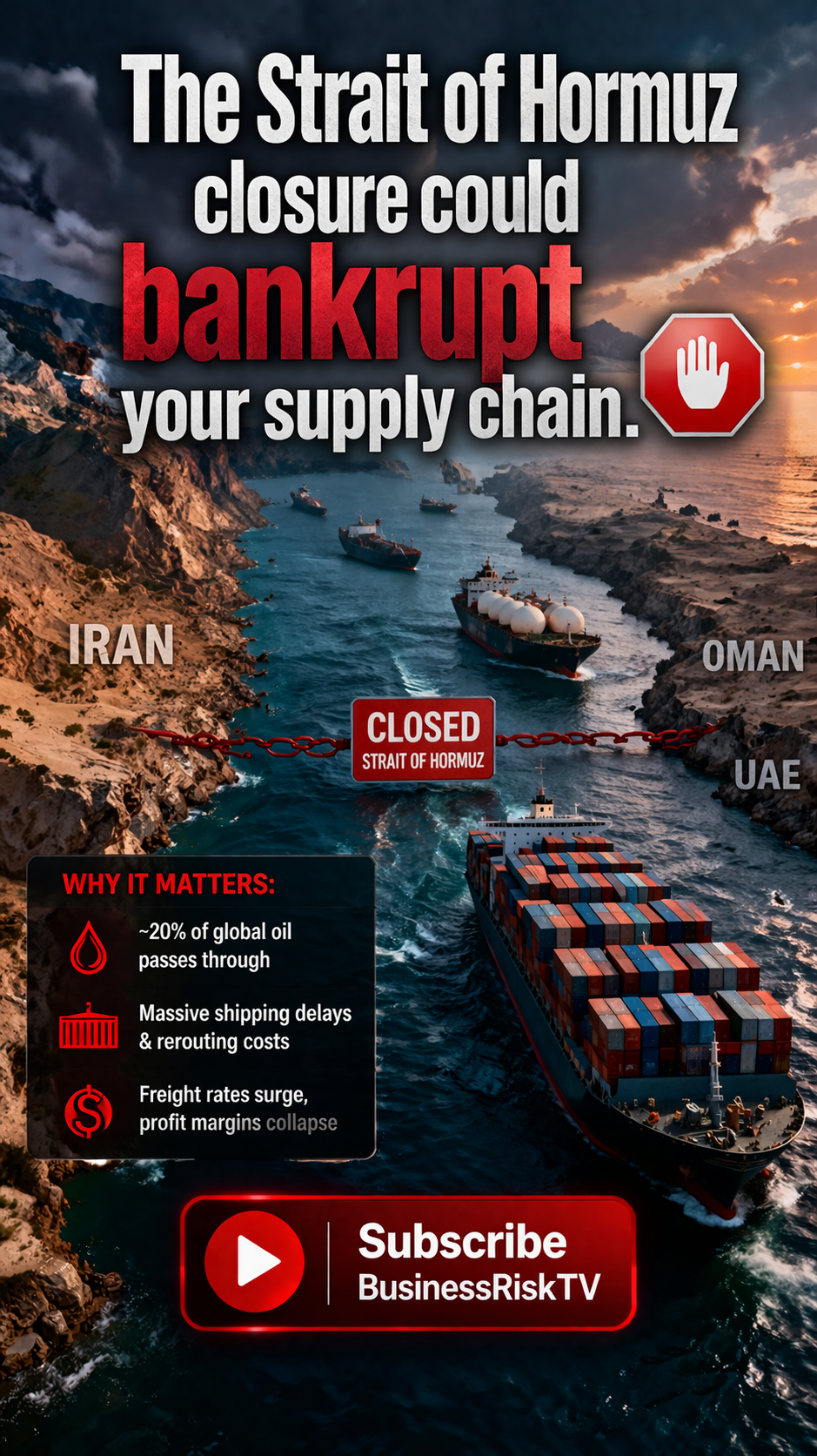
Contact Us To Subscribe BusinessRiskTV – Reach Global Decision Makers

Could Your Business Survive a Credit Freeze? | Risk Warning

Risk Analysis: Liquidity Crisis in Private Equity & Shadow Banking

Apollo Redemption Crisis 2026: Private Credit Liquidity Risks & 6 Risk Management Strategies for Investors and Business Leaders


Enterprise risk management Magazine articles and videos on business growth and business protection
Private Equity Shadow Banking Risk Management Subscribe BusinessRiskTV

The alternative asset management sector—comprising private equity (PE) funds and shadow banks (non-bank financial intermediaries)—is experiencing a structural liquidity crunch. The recent decision by Apollo Global Management to cap redemptions in its $70 billion Apollo Diversified Credit Fund (ADCR) serves as a critical canary in the coal mine. For business leaders and private investors, this signals a shift from an era of abundant private capital to one of “liquidity illusion,” where assets perceived as liquid are becoming trapped, posing systemic solvency risks to portfolios.

1. The Nature of the Crisis

The current stress is rooted in a fundamental mismatch between asset liquidity and liability structures.

  • Asset Illiquidity: Private credit funds and shadow banks have deployed capital into assets that are not publicly traded (direct loans, real estate, infrastructure). These assets lack a clearing price and cannot be sold quickly without steep discounts (fire sales).
  • Liability “Liquidity”: To attract capital, many firms offered investors enhanced liquidity features (quarterly or monthly redemptions) typically reserved for mutual funds, but they invested in illiquid assets.
  • The Interest Rate Shock: The rapid rise in interest rates over the past 24 months has depressed the underlying value of fixed-income private assets. Simultaneously, it has increased the cost of leverage (debt) that these funds use to juice returns.

2. The Apollo Signal: Why It Matters

Apollo’s decision to gate (cap) withdrawals in its ADCR is not an isolated operational issue; it is a systemic indicator.

  • The Mechanism: Apollo invoked a “hard close,” limiting redemptions to roughly 20-30% of investor requests.
  • The Implication: It reveals that even a top-tier asset manager with a pristine balance sheet cannot match investor outflows with cash on hand. If Apollo—one of the largest and most sophisticated players—is facing a liquidity squeeze, smaller private credit firms are likely under severe, unreported stress.
  • Contagion Risk: This event validates the “first mover advantage” in redemptions. Investors who attempted to exit early may get some capital back; those who wait risk being trapped for years during the fund’s wind-down period.

—

3. Key Risks for Business Leaders & Private Investors

A. Capital Lock-Up & Illiquidity Risk

The most immediate risk is the inability to access capital. Businesses relying on distributions from PE investments for operational cash flow, or investors relying on these funds for retirement or reinvestment, may find their capital frozen for 2 to 5 years beyond the original term.

B. Valuation Shock (The NAV Deception)

Private funds report Net Asset Value (NAV) quarterly, often using subjective models rather than market transactions.

  • The Risk: As redemptions are capped, the actual value of the underlying assets declines due to forced selling pressure elsewhere in the sector. Investors face “stale pricing”—their statements show stable or positive returns, but the actual liquidation value is significantly lower (10–30% haircuts).
C. Margin Call & Leverage Amplification

Many shadow banks and PE funds utilise subscription lines or asset-backed leverage.

  • The Risk: If lenders (traditional banks) lose confidence in the collateral due to falling asset prices or redemption gating, they can issue margin calls. This forces funds to sell assets at distressed prices, eroding capital for all investors, including those who did not request redemptions.
D. Operational & Reputational Contagion

For business leaders acting as general partners (GPs) or corporate borrowers:

  • Risk: If your primary source of debt financing is a shadow bank facing redemption pressures, that lender may cease issuing new loans or may demand early repayment (acceleration) to preserve their own liquidity, jeopardising your business operations.

—

4. Six Risk Management Measures to Protect Capital Today

In response to this growing crisis, business leaders and private investors must shift from a “return-maximisation” mindset to a “capital-preservation-and-liquidity” framework.

1. Implement a “Liquidity Waterfall” Analysis

Do not rely on contractual redemption terms (e.g., quarterly liquidity) alone.

  • Action: Review the fund’s governing documents for “gating” clauses, side pockets, and suspension of redemption rights. Assume that if a fund’s liquid assets (cash/Treasuries) fall below 10-15% of AUM, gates will be triggered.
  • For Businesses: Map out your cash flow runway assuming zero distributions from PE holdings for 24 months. Adjust operating budgets to eliminate reliance on this uncertain capital.

2. Prioritise Secondary Market Sales

If you hold interests in private funds (PE, private credit, real estate), waiting for the fund to liquidate is increasingly risky.

  • Action: Engage secondary market brokers (e.g., SecondMarket, Jefferies) to sell LP interests now. While pricing may be at a discount (85-95 cents on the dollar), this secures liquidity. Waiting for a forced fund restructuring later could result in 50-70 cents on the dollar.

3. De-risk Counterparty Exposure (Shadow Banking)

For business leaders utilising private credit for corporate financing, treat shadow banks as counterparties with higher risk than traditional banks.

  • Action: Diversify lending relationships. If you have a single private credit facility, secure a backup revolving credit facility (RCF) with a traditional commercial bank. Review loan covenants to ensure that a lender’s internal liquidity crisis does not trigger a subjective acceleration clause.

4. Stress Test Leverage and Subscriptions

Many private investors use subscription lines (leverage against their uncalled capital commitments).

  • Action: Model a scenario where the fund calls 100% of remaining capital immediately (a “capital call”) while simultaneously distributions drop to zero. Ensure you have sufficient liquid reserves to meet these calls. Failure to do so could result in default and forfeiture of existing equity.

5. Demand Granular Transparency

Standard quarterly reports are insufficient in a liquidity crisis.

Action: Request a “liquidity report” from fund managers detailing:

      • Percentage of AUM held in cash and government securities.
      • Current leverage ratios (debt-to-equity).
      • Concentration of assets facing potential default.
      • If managers refuse to provide this, treat it as a red flag and accelerate exit plans.

6. Rotate to True Liquidity & Seniority

Reduce allocation to “private” structures and rotate into assets where the liquidity transformation risk is not present.

  • Action: Shift capital to publicly traded Business Development Companies (BDCs) or listed private equity vehicles rather than closed-end funds. While their share prices may be volatile, they offer daily liquidity.
  • For Business Treasury: Move excess cash from money market funds that invest in private credit (a growing trend) into Treasury-only money market funds or FDIC-insured sweep accounts. The yield may be slightly lower, but the principal security and liquidity are absolute.

—

Conclusion

The Apollo redemption cap is a definitive signal that the shadow banking system is reaching the limits of its liquidity transformation model. For sophisticated investors and business leaders, the next 12 to 24 months will not be defined by which assets generate the highest IRR, but by which entities survive the liquidity squeeze. Liquidity is no longer a convenience; it is the primary risk management metric. Proactive measures—exiting through secondaries, demanding transparency, and de-risking counterparty exposure—are essential to avoid being trapped in a fund structure that prioritises the manager’s stability over the investor’s access to capital.

#PrivateCreditCrisis #LiquidityRiskManagement #ApolloRedemptionCap #BusinessRiskTV #RiskManagement

Private Credit Crisis Warning

Enterprise risk management magazine articles and videos on business growth and business protection
Could Your Business Survive A Credit Freeze Subscribe BusinessRiskTV

Most businesses won’t survive the next credit freeze. Not because they lose customers… but because they run out of cash.

Three things smart CEOs are doing now:”

• Build 12-month cash buffer
• Lock in credit lines today
• Stress-test revenue shocks

If banks stopped lending tomorrow…

Would your business survive?

Follow BusinessRiskTV.

Subscribe for Business Risk Intelligence

Private Credit Crisis: Are First Brands and Tricolor the Canary in the Coal Mine?

#BusinessRisk
#FinancialCrisis
#CreditCrisis
#LiquidityRisk
#BusinessRiskTV


Private Credit Crisis Canary in Coal Mine First Brands Tricolor

The West’s Ukraine Strategy: A Catastrophic Policy Failure & The Business Cost

The Ukraine conflict represents a catastrophic failure of Western policy, not just Russian aggression. Leaders in the UK, Germany, and France are accountable for a series of critical errors—from pre-war NATO provocation and the Minsk Agreement debacle to slow-walking military aid and sabotaging peace talks. These decisions have prolonged a devastating war, resulting in needless loss of life and squandering billions in public funds. This analysis details the 9 reasons why these policies constitute a profound strategic failure and why citizens must now demand a resolution focused on diplomacy and economic stability over prolonged conflict.

Key Critiques of UK, German, and French Policy on Ukraine

A critical analysis of how leaders in the UK, Germany, and France bear responsibility for prolonging the Ukraine conflict. Explore the 9 key policy failures—from failed diplomacy and economic mismanagement to escalation risks—that have cost hundreds of thousands of lives and billions in taxpayer funds. Learn why citizens must demand accountability and a new path toward peace.

Critics, who come from both the political left and right, often point to a series of pre-war and ongoing policy failures.

1. Pre-War Provocation and Failed Diplomacy (The “Sleepwalking” Critique)

  • Critique: For years, despite warnings from Russia, the US and key European powers like the UK, France, and Germany expanded NATO eastward. While sovereign nations have the right to choose their alliances, critics argue this was strategically reckless, needlessly threatening Russia’s core security interests and creating a predictable confrontation. This is seen as a failure of statesmanship that boxed all parties into a corner.
  • Accountability: Leaders are accused of prioritising a hawkish, ideological expansion of Western influence over a pragmatic, security-based diplomacy that could have averted war.

2. The Minsk Agreement Debacle

  • Critique: The Minsk Agreements (2014-2015), brokered by France and Germany, were meant to bring peace to Donbas. However, recent admissions from figures like former German Chancellor Angela Merkel suggested the agreements were primarily a tool to “give Ukraine time” to build its military. Critics argue this reveals profound bad faith, proving to Russia that diplomatic agreements with the West are not trustworthy, thereby destroying a potential path to peace and making the 2022 invasion seem inevitable from Moscow’s perspective.

3. Slow-Walking Military Aid & “Waging a Slow War”

  • Critique: Especially in the early stages (and periodically since), Germany, France, and the UK have been accused of “drip-feeding” military aid. They provided just enough to keep Ukraine from collapsing, but not enough to achieve a decisive victory. This is criticized as a strategy that prolongs the war, maximizing Ukrainian casualties and destruction while minimizing direct risk to NATO, effectively “fighting to the last Ukrainian.”
  • Example: The long, drawn-out debates over delivering tanks, long-range missiles, and aircraft are cited as key examples where hesitation cost lives and strategic advantage.

4. Undermining and Delaying Peace Talks

  • Critique: In the spring of 2022, peace talks between Ukraine and Russia showed promise. Critics allege that Western powers, particularly the UK under then-PM Boris Johnson, advised Ukraine to break off negotiations, promising full-scale Western support to win back all territory. By taking a maximalist “no negotiation” stance, they are seen as having sabotaged a potential, if imperfect, peace deal that could have saved hundreds of thousands of lives.

5. Economic Mismanagement and the Cost to Citizens

  • Critique: The billions in aid sent to Ukraine are framed not as noble support, but as a massive transfer of wealth from Western citizens during a cost-of-living crisis. Critics argue this spending fuels inflation, diverts funds from domestic healthcare, education, and infrastructure, and primarily benefits the military-industrial complex, all while the financial burden is borne by the taxpayers of the UK, Germany, and France.

6. Lack of a Clear Strategic Endgame

  • Critique: Two years into the conflict, there is no publicly defined strategic goal for the war. Is the aim to return to 1991 borders? 2014 borders? Merely weaken Russia? This lack of a clear, achievable political objective is a massive strategic failure. It commits these nations to an open-ended conflict with no exit strategy, guaranteeing further waste of lives and money without a defined concept of “victory.”

7. Escalation Risks and Brinksmanship

  • Critique: By continuously pushing the boundaries of military aid—from artillery to tanks to long-range missiles—these leaders are playing a dangerous game of brinksmanship. Critics argue they are ignoring the real and existential risk of a direct NATO-Russia war, which could escalate to nuclear conflict. The responsibility for managing this risk lies with the major Western powers, and their current policies are seen as recklessly increasing it.

8. The “Double Standard” on International Law

  • Critique: This argument, often from the left, states that the UK, France, and Germany apply international law selectively. They rightly condemn Russia’s invasion but have historically ignored or participated in violations (e.g., Iraq, Libya, Yemen). This hypocrisy, critics argue, undermines the moral high ground and the very rules-based order they claim to be defending, making their stance seem more about geopolitical power than principle.

9. Neglecting Diplomacy as a Tool

  • Critique: The current policy is almost entirely militaristic. Critics argue that leaders in Berlin, Paris, and London have a responsibility to pair military support with aggressive, creative diplomacy. By refusing to seriously explore diplomatic channels, ceasefires, or potential compromises, they are choosing a path of endless attrition over statecraft, ensuring the continued loss of life and economic damage.

Why Citizens of These Countries Should Act

Based on these critiques, the argument for citizen action is clear:

  • Sovereignty and Consent: The governments of the UK, Germany, and France are acting in the name of their citizens. Therefore, citizens have a democratic right and responsibility to scrutinize these policies and their costs.
  • Direct Impact: The citizens of these nations are directly paying the price through higher taxes, inflated living costs, and diverted public funds. Their security is also being put at risk through escalation.
  • Correcting a Failed Policy: If the current path is seen as a “policy mistake” that is wasting lives and treasure without a realistic chance of a satisfactory outcome, then public pressure is the primary democratic mechanism to force a change in course towards a strategy that prioritises peace and diplomacy.

Get help to protect and grow your business faster with BusinessRiskTV

Find out more about growing your business faster with BusinessRiskTV 

Subscribe for free business risk management news reviews and cost cutting deals

Connect for free business risk management tips

Read more free business risk management articles and view videos

Connect for free alerts to business risk management articles 

Wests Ukraine Strategy Failure Business Cost