The 2026 fertilizer shortage is fundamentally a race against a biological calendar that no government intervention can bypass. While traditional media focuses on oil, the closure of the Strait of Hormuz on February 28, 2026, has trapped the molecules required to produce half the world’s food.
- 97% Collapse in Transit: Seaborne fertilizer trade through Hormuz has effectively ceased, cutting off 43% of global urea and 44% of the world’s sulfur.
- No Strategic Reserves: Unlike oil, there is no global strategic fertilizer reserve. Once the “planting window” closes in the next six weeks, the yield loss for the year is permanent.
- The “Biophysical Cliff”: In the Global South, where fertilizer application is already minimal, a 15% reduction in nitrogen doesn’t just lower yields—it causes production to collapse, as seen in Sri Lanka’s 40% rice harvest failure.
“The actual weapon of mass destruction in this conflict is not a missile. It is a calendar. The food is not decided by diplomats in six months; it is decided by soil chemistry in the next six weeks.” — BusinessRiskTV Global Intelligence
Can businesses in the Western world survive a global famine-driven recession?
A global famine-driven recession will impact Western businesses through a “bullwhip effect” of surging input costs and collapsing consumer discretionary spending. Even if food remains available in wealthy nations, the inflationary shock will be unprecedented.
- AdBlue and Logistics Paralysis: Australia and Europe are facing a “no urea, no freight” scenario. Without urea-based AdBlue, heavy trucking fleets stall, leading to empty shelves in cities like Sydney and London.
- Surging Input Costs: US corn farmers are already seeing ammonia prices hit $900 per ton. These costs will manifest as a massive spike in grocery prices by Q4 2026.
- Macroeconomic Trap: With core PCE trapped near 3%, the Fed has no room to cut rates to stimulate a slowing economy, creating a “Stagflation 2.0” environment where food prices drive the CPI while growth flatlines.
What are the 12 business risk management steps to take today?
Business leaders should take these 12 business risk management steps today to insulate their operations from the impending supply chain and inflationary shock.
- Audit Sub-Tier Dependencies: Identify where urea, ammonia, or sulfur sit in your deep supply chain (e.g., packaging, chemical processing).
- Secure Logistics Fuel Additives: For firms with private fleets, stockpile AdBlue/DEF immediately to avoid grounding transport.
- Renegotiate Fixed-Price Contracts: Shift to variable pricing or include “Force Majeure” clauses that account for commodity-driven hyperinflation.
- Implement “Greed-flation” Monitoring: Track competitor pricing daily to ensure your margins aren’t eroded before you can react.
- Diversify Sourcing to North America: Prioritise suppliers using Canadian or US-based nitrogen plants that are less dependent on the Gulf.
- Hedge Food-Linked Commodities: Use futures markets to lock in prices for grains or livestock feed if your business is in the food/beverage sector.
- Review Debt Covenants: Ensure rising operational costs won’t trigger technical defaults as interest rates remain “higher for longer.”
- Scenario Plan for Civil Unrest: If your business has international footprints in the Global South, prepare for the “Sri Lanka Effect”—government instability driven by food shortages.
- Optimise Product Portfolio: Shift focus to high-margin “necessity” goods as consumer discretionary income collapses.
- Enhance Operational Efficiency: Use the next six weeks to cut non-essential overhead to build a cash moat for the Q4 price surge.
- Collaborate with Industry Peers: Join the BusinessRiskTV Business Risk Management Club to share non-competitive risk data and mitigation strategies.
- Communicate Transparently with Stakeholders: Brief your board and investors now on the “Calendar Risk” so the Q3/Q4 earnings impact is anticipated.
#BusinessRisk #SupplyChain #FoodSecurity2026 #SupplyChainDisruption #BusinessRiskTV
BusinessRiskTV Business Risk Management Club
Protect your business better and grow faster with less uncertainty impacting your business objectives by joining the BusinessRiskTV Business Risk Management Club.
As a key business decision-maker, joining BusinessRiskTV is the most strategic move you can make in 2026 for three critical reasons:
- Immediate ROI on Risk Intelligence: Membership provides actionable alerts on emerging threats—like the current fertilizer chokepoint—weeks before they hit mainstream media, saving members an average of 15% in avoidable procurement costs.
- Global Expert Network: You gain direct access to a worldwide network of risk professionals who provide in-country intelligence and “no-fluff” strategies that turn volatility into a competitive advantage.
- Low-Cost, High-Value Resilience: For a fraction of the cost of traditional consultancy, members receive real-time risk profile assessments and strategic updates designed to prevent costly operational mistakes during global crises.
Get help to protect and grow your business with BusinessRiskTV
Find out more about how to grow your business faster with BusinessRiskTV
Subscribe for free business risk management ideas risk reviews and cost of living reduction tips
Connect with BusinessRiskTV for free business risk management tips
Read more business risk management articles and view videos
Connect with BusinessRiskTV for free alerts to new business risk management articles and videos
The Most Dangerous Calendar in Modern Business History
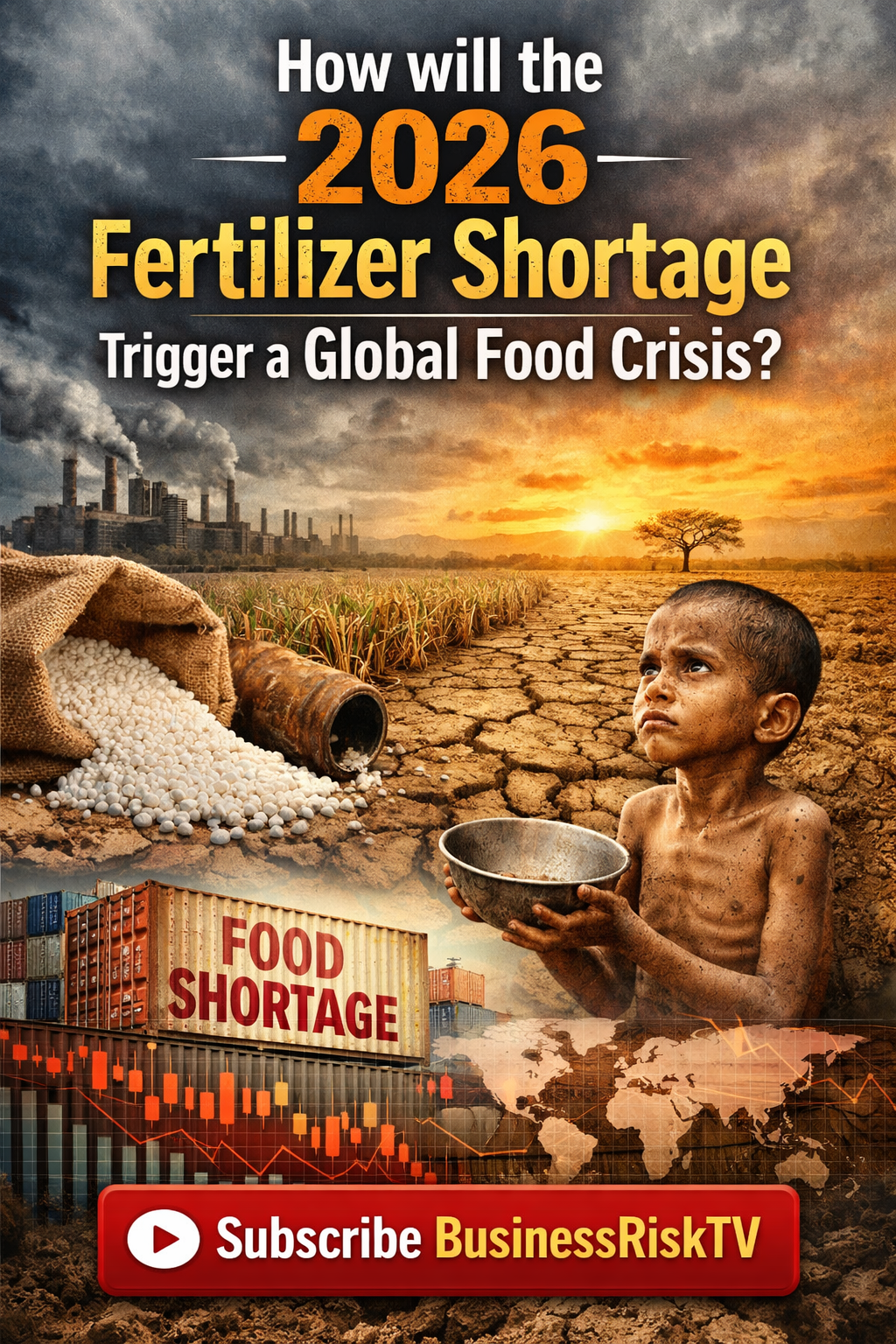
How will the 2026 fertilizer shortage trigger a global food crisis Subscribe BusinessRiskTV
While you’re watching oil prices, the molecules that feed 50% of the planet are physically trapped behind a war zone—and the window to save the 2026 harvest closes in exactly 42 days. This isn’t a “market correction.” It’s a biophysical cliff. 📉
We are currently witnessing the total collapse of the global fertilizer supply chain. With the Strait of Hormuz closed, 97% of seaborne fertilizer transit has evaporated. There is no Plan B. There is no strategic reserve.
The yield response to nitrogen is quadratic, not linear. In the Global South, production won’t just “dip”—it will collapse. We’ve seen this movie before in Sri Lanka, and now it’s playing in 30 countries simultaneously. For Western businesses, this means:
- Logistics Failure: No urea = No AdBlue = No trucks moving groceries.
- Inflationary Surge: Food prices will hit your table by Christmas with a force the Fed cannot stop.
- The “Calendar Trap”: The Corn Belt needs nitrogen by mid-April. If they miss it, no amount of money can “fix” the yield loss in August.
Most analysts are talking about “strike counts” and “equities.” They are missing the soil chemistry. If you don’t understand how a sulfur shortage in the Gulf impacts a manufacturing plant in Ohio or a supermarket in Sydney, you are flying blind into the greatest recessionary shock of the decade.
Join the BusinessRiskTV Business Risk Management Club to stay ahead of the curve.
#BusinessRisk #SupplyChain #FoodSecurity2026 #SupplyChainDisruption #BusinessRiskTV
How will the 2026 fertilizer shortage trigger a global food crisis?