
Stop guessing about bankruptcy. Join the Business Risk Management Club today.
The average cost of a mid-sized company insolvency is £90,000 in director losses. The cost of our club membership? Less than a cup of coffee a day.
3 Facts to Back Up Our Value:
1. Cost: We charge £49.99 per month for full access (introductory deals available for limited time). An insolvency practitioner charges £350+ per hour.
2. Speed: Members get 24/7 access to alternative risk reviews. Banks and risk analysts take weeks.
3. Certainty: We provide real-time geopolitical risks; majority of failed businesses didn’t see the shock coming before too late.
—
Why Should UK Business Leaders Be Worried About Bankruptcy in 2026? (The “Triple Lock” Crisis)
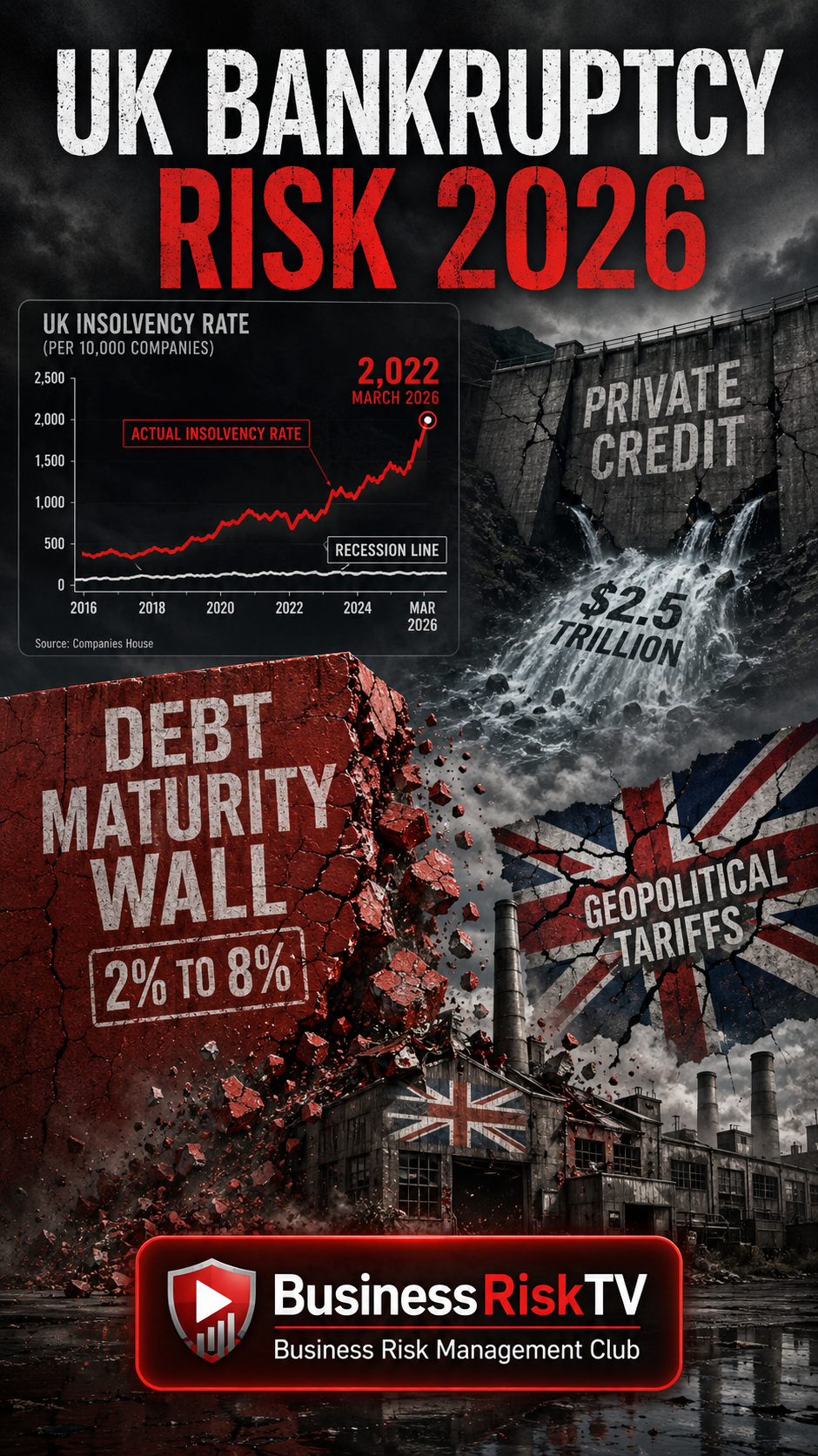
Why UK business leaders should be worried about bankruptcy in 2026 because insolvencies are currently near a 30-year high due to a “triple lock” of debt maturity cliffs, geopolitical trade wars and geopolitical risks, and a hidden private credit crash.
We are not in a normal recession; we are in a debt maturity trap. In March 2026 alone, England and Wales recorded 2,022 company insolvencies, matching the peak levels of the 2008 financial crisis . For a 10-year-old: Imagine borrowing a toy for a week, but when you try to return it, the shop says you now owe 10 times the price, and your pocket money just got cut because your friends are fighting far away. That is 2026.
Are Maturing Debt Instruments the #1 Cause of UK Business Bankruptcies Right Now?
Yes, maturing debt instruments taken out at 2% that are maturing at 8% rates are the single biggest driver of cash flow collapse in the UK in 2026 because refinancing has dried up for the mid-market.
UK borrowing costs hit their highest levels since 1998 recently, with 30-year gilt yields hitting 5.78% . For a 10-year-old: You borrowed £1 to buy lemonade supplies, promising to pay back £1.02. Now, the bank says you must pay back £1.15. If you don’t have that extra 13p, your lemonade stand is gone.
How Do Geopolitical Changes and Tariffs in 2026 Hurt My UK Supply Chain?
Geopolitical changes in 2026, specifically the Iran conflict and the UK-US trade deal delays, are forcing costs up by up to 20% for importers, strangling margins just as debts come due.
The UK just signed a $5 billion Gulf trade deal to bypass Iran war fallout, but the US remains rocky . UK Parliament admits the US deal is “not yet delivering growth” as tariffs fragment the global system . For a 10-year-old: Your favourite toy is made across the street. If the street gets blocked by a fight, you have to fly a helicopter to get the toy. That helicopter costs more than the toy.
Is the “Private Credit” Market Really Drying Up for UK Businesses in 2026?
The threat of credit drying up is real because the Bank of England has warned that the $2.5 trillion private credit market has “echoes of the Great Financial Crisis” and has never been tested at this scale.
Deputy Governor Sarah Breeden explicitly stated that a “private credit crunch” is coming where funds are “gated” (locked) . The House of Lords reports that SME finance has been “squeezed” because banks retreated after 2008 and private credit is now freezing . For a 10-year-old: You usually borrow money from a rich friend. But that friend is suddenly broke and hiding under their bed. Now nobody will lend you the money to buy your lunch.
Are These the Most Common Causes of Bankruptcy in the UK Right Now (2026 Stats)?
Yes, these are the most common causes, but rising employment costs and HMRC aggression are the “silent killers” pushing the UK toward the highest bankruptcy rate in 20 years.
In 2025, an estimated 288,018 UK businesses failed (roughly 5% of all firms) . The construction sector accounts for 17% of all insolvencies due to material costs, while retail is collapsing due to wage bills . The UK is seeing the highest rate of bankruptcies since the early 1990s, driven not just by debt, but by the Employment Rights Act 2025 which doubles redundancy costs .
—
🛡️ 12 Business Risk Management Steps UK Business Leaders Should Take Today
To avoid joining the 2,000+ companies failing monthly, execute these steps immediately:
1. Refinance NOW, not later.
· Action: Approach challenger banks (e.g., Shawbrook, OakNorth) before your current loan matures. Lending growth has slowed to 4.5%, get in the queue now .
2. Stress test for 10% Interest Rates.
· Action: Model your cash flow assuming base rates hit 8%. If you break, cut costs today.
3. Audit your “Phantom Stock”.
· Action: Check supplier contracts for geopolitical escalation clauses. If they aren’t there, add them for the Iran/Gulf fallout .
4. Diversify away from US supply chains.
· Action: Shift 30% of sourcing to the new GCC trade deal partners (UAE, Saudi) to bypass US tariffs .
5. Invoice factoring for immediate cash.
· Action: Sell your unpaid invoices. With credit drying up, cash in hand is king.
6. The “Credit Committee” meeting.
· Action: Hold a weekly 15-minute meeting to check if your customers have issued winding-up petitions. Don’t sell to companies about to go bust .
7. Prepare for Employment Rights Act 2025.
· Action: Set aside a specific fund for “protective awards” (now 180 days pay) before making redundancies .
8. HMRC negotiation strategy.
· Action: HMRC is taking aggressive debt action. Do not ignore their letters; agree on a Time to Pay arrangement before they file a winding-up petition.
9. Invest in Internal Controls (Governance).
· Action: Under the new UK Corporate Governance Code (Jan 1 2026), directors are personally liable for “material weaknesses” in financial controls .
10. Explore a CVA before it’s too late.
· Action: Company Voluntary Arrangements (CVAs) are up 29% year-on-year. Use them to bind creditors to a reduced payment plan before you run out of cash .
11. Cancel the “Golden Quarter” overspend.
· Action: Consumer spending is dropping . Do not stockpile inventory unless it is paid for.
12. Join an Early Warning System.
· Action: Use data providers to see if your bank is increasing “expected credit losses” (like HSBC did with $1.3bn) – this means they will stop lending to you .
Get help to protect and grow your business faster regardless of business environment with help from Business Risk Management Club
Find out more about business risk management club
Subscribe for free business risk alerts risk reviews and cost of business in business reduction tips
Connect with BusinessRiskTV for free business risk management tips
Read more business risk management articles and view videos for free
Connect with BusinessRiskTV for free alerts to new business risk management articles and videos
#UKBankruptcy2026 #BusinessRiskManagement #PrivateCreditCrunch #BusinessRiskTV #RiskManagement
Additional Tags: UK Insolvency Statistics 2026, Maturing Debt Risk, Private Credit Market UK, Bank of England Warning 2026, Geopolitical Tariffs UK, Supply Chain Disruption, Business Risk Management Steps, Avoid Bankruptcy UK, UK Interest Rates 2026, Corporate Governance Code 2026.
⚠️ Important Legal Notice:
I am not a licensed insolvency practitioner or financial advisor. The above information is for educational purposes based on current data trends. For specific legal or financial advice regarding your business, you must consult a qualified professional like those found via the BusinessRiskTV.com network.
UK Bankruptcy Crisis 2026: Why Debt Maturity, Private Credit Fears & Tariffs Are Killing Businesses (12 Steps to Survive)