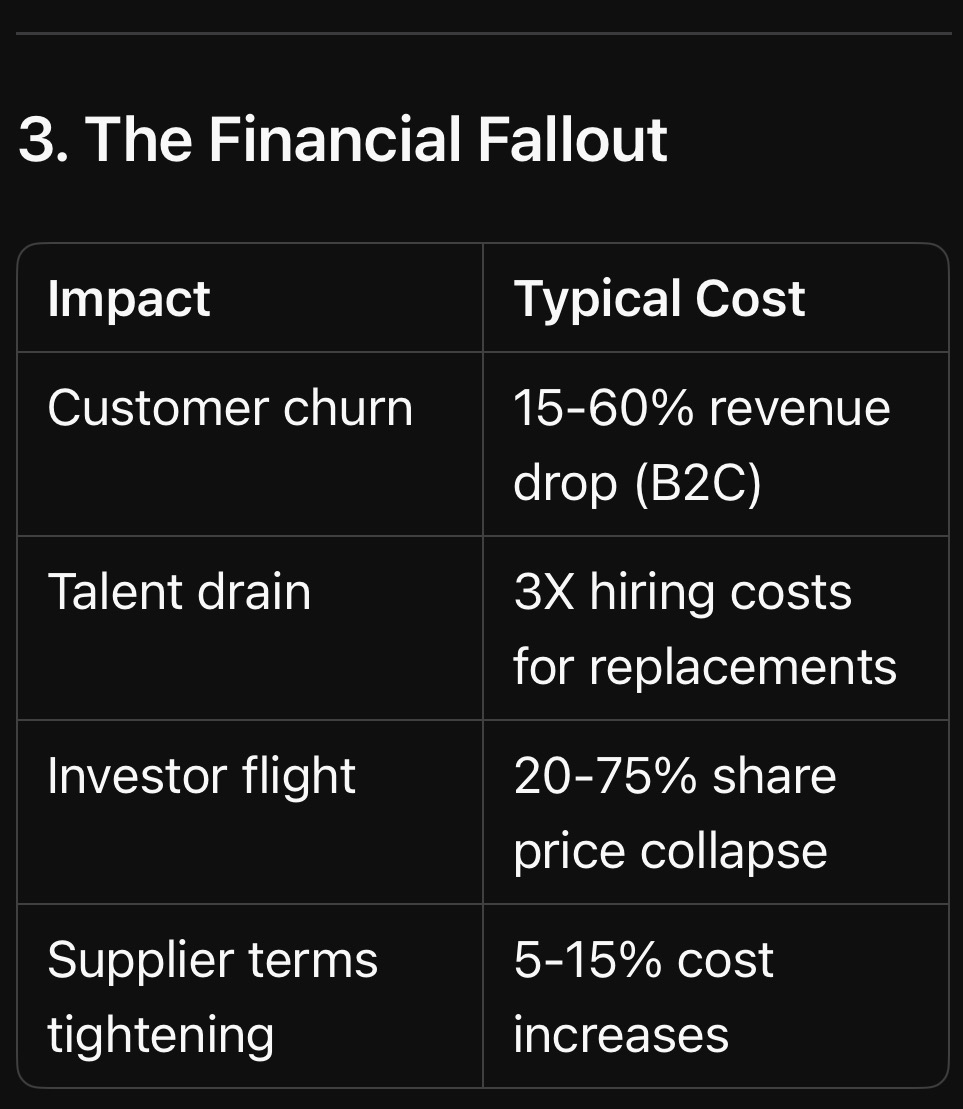
UK businesses face mounting financial and operational disruption heading into 2027, yet many boards still treat resilience as a cost rather than a survival strategy. This post reveals why preparation now is not money wasted, nine practical ways to prepare, the key mistakes leaders make, and where to find cost-effective UK resources. BusinessRiskTV Business Risk Management Club recommends acting before disruption — not after.
Business resilience in 2027: why preparation is not money wasted, 9 ways to prepare now, key mistakes UK leaders make, and where to find free UK support.
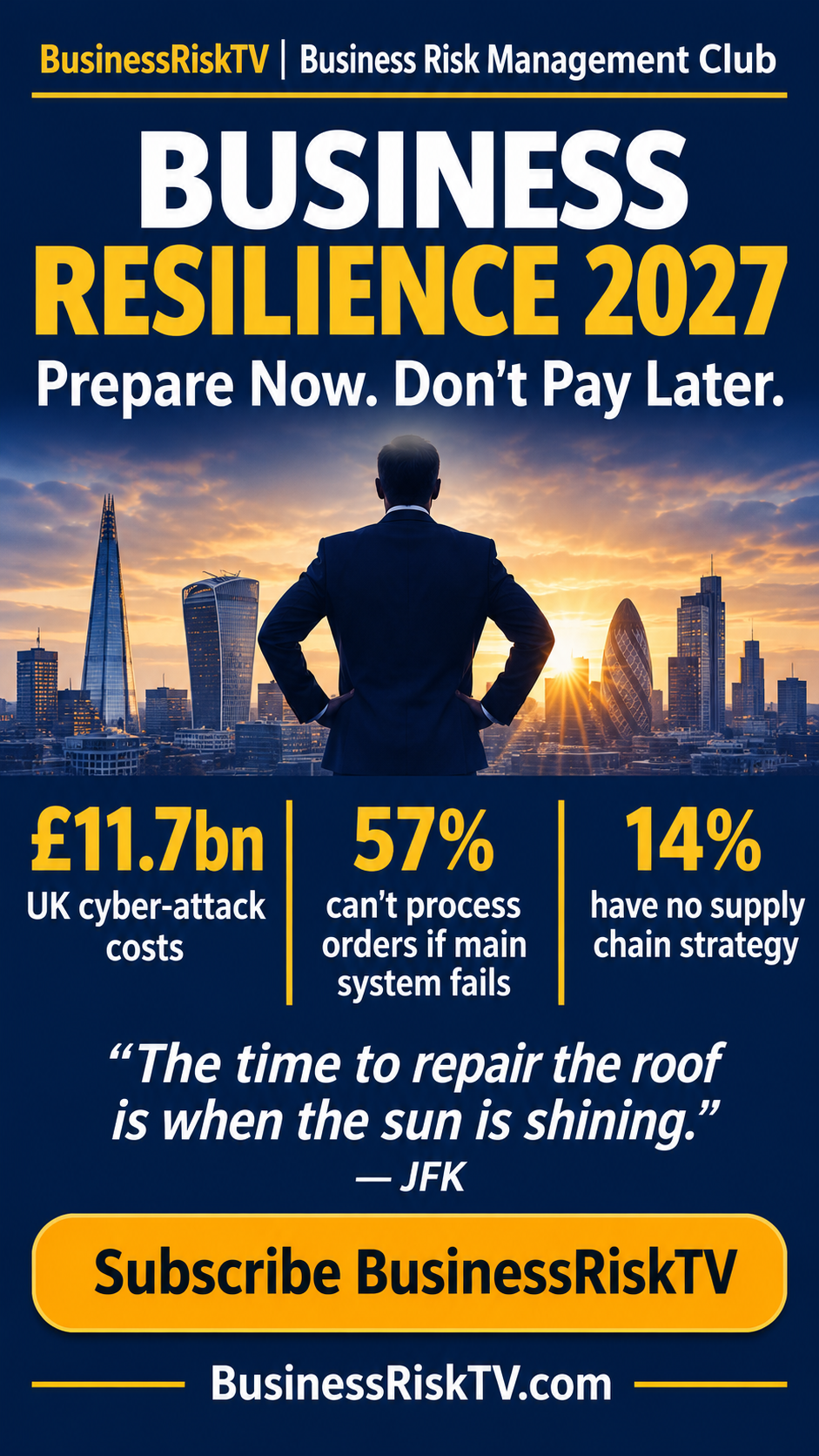
Business Resilience in 2027: The £11.7 Billion Warning UK Leaders Cannot Ignore
BusinessRiskTV Business Risk Management Club recommends building business resilience in preparation for known and unknown risk events in 2027 and beyond. The evidence is damning: UK large businesses absorbed an estimated £11.7 billion in cyber-attack costs in a single year, with £3.7 billion of that spent defending shareholder litigation rather than preventing the breach in the first place . That is not a technology problem. That is a boardroom failure of foresight, prioritisation, and courage. As Winston Churchill allegedly put it: “Let our advance worrying become advance thinking and planning.” Too many UK leaders are doing neither.
Why is preparation now to build business resilience not money wasted?
Preparation now is not money wasted because resilience spending is an ROI-positive insurance premium against catastrophic loss, not an overhead to be trimmed. Grant Thornton’s Enterprise Resilience Survey found that 69% of highly profitable companies build redundancy and flexibility into cost programmes, compared with only 26% of less profitable respondents . The gap between winners and losers is not luck. It is whether leaders treat slack, backup systems, and supplier diversity as strategic assets or as waste. Gallagher and CEBR data proves the point brutally: large UK firms spent just £226 million on external incident response support, yet £5.4 billion on direct trading losses from disruption . The ratio is roughly 24:1. Every pound not spent on preparation is a pound multiplied in consequence. As Benjamin Franklin wrote, “An ounce of prevention is worth a pound of cure” — a cliché only because so few actually act on it.
What are the 9 ways to prepare now for an uncertain 2027?
Nine ways to prepare now include stress-testing financial exposure, diversifying supplier concentration, and embedding resilience accountability at board level. PwC’s Risk Agenda 2027 warns that UK CEOs spend only 11% of their time on issues beyond a five-year horizon, while 55% is consumed by sub-one-year concerns . That is strategic inertia dressed up as busyness. Here is what decisive leaders should do:
Map single points of failure across suppliers, systems, and key customers. Nearly half (47%) of UK businesses generate more than half their sales from their top three customers — a revenue concentration risk that turns one lost account into an existential event.
Stress-test cashflow against a “no-main-system” scenario. 57% of UK businesses admit they could not continue sales order processing or purchasing if their main system failed.
Lock in financing before you need it. Lloyds data shows 75% of businesses claim they have the right financial tools, yet only 46% use cashflow forecasting and 30% have working capital facilities in place . Confidence without capability is delusion.
Build redundancy into cost-cutting programmes. 52% of UK firms have only partly commenced strategies to avoid financial losses from supply chain disruption; 14% have no strategy at all.
Run scenario exercises that assume the worst. PwC’s Minimum Viable Company framework urges boards to define what operations are truly non-negotiable before disruption hits, not during it.
Diversify supplier geography and logistics routes. Geopolitical instability in 2027 — from trade barriers to energy shocks — rewards those who are not dependent on a single corridor or vendor.
Insure for the second-order costs, not just the first. 88% of large UK firms have cyber insurance, but only 59% are covered for third-party legal claims — the exact cost that reached £3.7 billion last year.
Cross-train staff and document institutional knowledge. PwC recounts a bank whose international payments system went offline for three days because the one employee with the back-end password was hiking without internet . That is not bad luck. That is bad management.
Make resilience a standing board agenda item with named ownership. Business in the Community’s research found many firms are “unaware” of Local Resilience Forum support or simply lack the capacity to engage — a failure of curiosity and prioritisation.
What are the key mistakes business leaders often make when trying to build business resilience?
The key mistake business leaders make is treating efficiency as the opposite of resilience, cutting slack until the organisation snaps at the first shock. Grant Thornton’s Joe Mulligan put it plainly: “Lean is good up to a point. But cut too far and you weaken the muscle organisations need to perform” . The second mistake is assuming resilience is an IT project. It is not. It is a capital allocation decision, a supplier relationship decision, and a board governance decision. The third mistake is waiting for certainty. PwC notes that UK corporate debt is around its lowest level this century, yet business investment remains below its pre-2016 trend — healthy balance sheets are being hoarded, not deployed into resilience . As the old saying goes, “You can’t control the wind, but you can adjust the sails.” Too many UK boards are arguing about the forecast instead of trimming the canvas.
Who are the often-guilty key decision makers at fault?
The often-guilty key decision makers at fault are CEOs, CFOs, and boards who prioritise quarterly earnings over multi-year survivability. The UK government has written directly to FTSE 350 Board Chairs demanding cyber resilience be a top priority — a signal that ministers believe voluntary boardroom attention has failed . The Business Continuity Institute found that while 67.8% of organisations claim a board member is ultimately accountable for resilience, the CEO specifically holds that accountability in only 26.5% of cases, down from 39.5% the previous year . Accountability is being diffused, delegated, and diluted. Meanwhile, PwC’s data shows UK CEOs spending more than half their time on sub-one-year issues . The guilty party is not the risk manager who flagged the vulnerability. It is the executive who nodded, thanked them, and moved to the next slide. As John F. Kennedy observed, “The time to repair the roof is when the sun is shining.” UK boardrooms have had years of sunshine. The clouds are gathering.
When are key business decision makers involved in building business resilience?
Key business decision makers are involved in building business resilience far too late — typically after a disruption has already crystallised losses, not before. The SCALA research is unambiguous: over half of UK businesses have only partially begun strategies to protect against financial loss from supply chain disruption, and 14% have done nothing . This is involvement as firefighting, not foresight. The correct timing is continuous and embedded: resilience should sit on every board agenda, every capital allocation decision, and every supplier review. Lloyds data shows 59% of firms are adjusting strategy in response to uncertainty — but adjustment after the fact is not preparation; it is damage limitation . The Business in the Community report captures the fatalism: “Until we are in a situation, we don’t think about it and therefore react — rather than adopt a proactive approach” . That quote should be printed on the wall of every UK boardroom as a warning.
Where in the UK can you find resources to help you prepare most cost-effectively?
The most cost-effective UK resources are free, publicly funded, and embarrassingly underused: Local Resilience Forums (LRFs), Business Continuity Institute guidance, and government-backed cyber resilience tools. Leicestershire County Council’s LRF offers free webinars, business continuity plan templates, and industry-led tools through its Risk Ready Businesses page . This is not diluted advice — it is practitioner-built, locally tailored, and costs nothing but the time to engage. Business in the Community’s research found that many businesses simply do not know their LRF exists, or lack the capacity to reach out . That is an unforgivable excuse when the alternative is a £3.7 billion litigation bill . The National Cyber Security Centre provides free board-level cyber guidance, and the UK Government Resilience Framework explicitly calls for “active partnership” between business and government . The resources exist. The will does not. As Sun Tzu wrote, “In the midst of chaos, there is also opportunity” — and the opportunity here is to prepare cheaply now rather than expensively later.
The Bottom Line for 2027
UK business leaders have been warned. The data is public, the costs are quantified, and the tools are free. What is missing is the uncomfortable honesty that resilience is not a cost centre but a survival function. The £11.7 billion in cyber losses, the 57% of firms that cannot process orders if their main system fails, the 14% with no supply chain strategy at all — these are not statistics. They are indictments . BusinessRiskTV Business Risk Management Club exists for leaders who refuse to be part of that indictment. Prepare now. The alternative is paying later, with interest.
Your board just approved a £2m cost-cutting programme. Congratulations — you may have just funded your own disruption.
Here’s the uncomfortable number: 69% of highly profitable UK companies build redundancy into their cost programmes. Only 26% of less profitable ones do. That gap isn’t luck. It’s a decision.
And the cost of getting it wrong is brutal.
UK large businesses absorbed an estimated £11.7 billion in cyber-attack costs in a single year. £3.7 billion of that went on defending shareholder litigation — not on stopping the breach.
Read that again. They paid lawyers after the damage. They didn’t pay for prevention before it.
Meanwhile:
→ 57% of UK businesses admit they couldn’t process sales orders or purchasing if their main system failed.
→ 14% have no supply chain disruption strategy at all.
→ CEOs spend just 11% of their time on anything beyond a five-year horizon.
That last one should sting. The future is arriving in 2027 whether your board agenda is ready or not.
So here’s the question that separates survivors from statistics:
If your main system went down tomorrow morning, how many days of trading would you lose?
If you can’t answer that in under 10 seconds — you’ve just found your first resilience gap. And you’re not alone.
The uncomfortable truth is that most UK leaders aren’t short of information. They’re short of the courage to spend money on something that hasn’t gone wrong yet.
Winston Churchill reportedly said: “Let our advance worrying become advance thinking and planning.”
Too many UK boardrooms are doing neither. They’re waiting for certainty that will never arrive.
The good news? The most cost-effective resilience resources in the UK are free — Local Resilience Forums, Business Continuity Institute guidance, and NCSC board-level cyber tools. The reason they go unused isn’t cost. It’s curiosity.
Free tools. Public data. Quantified risk. And still, 14% of firms have no supply chain strategy.
You don’t get to call that bad luck. That’s bad management.
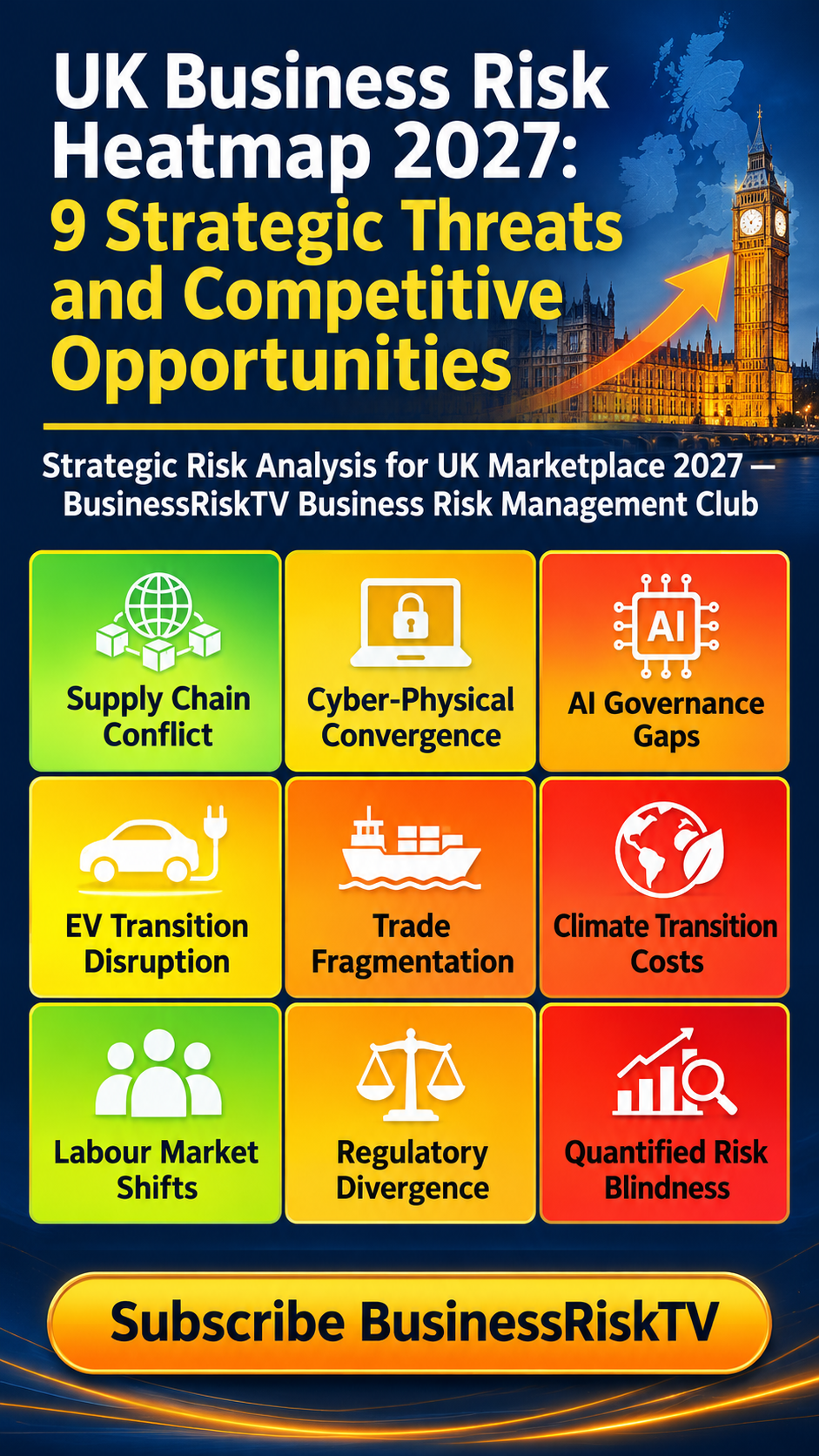
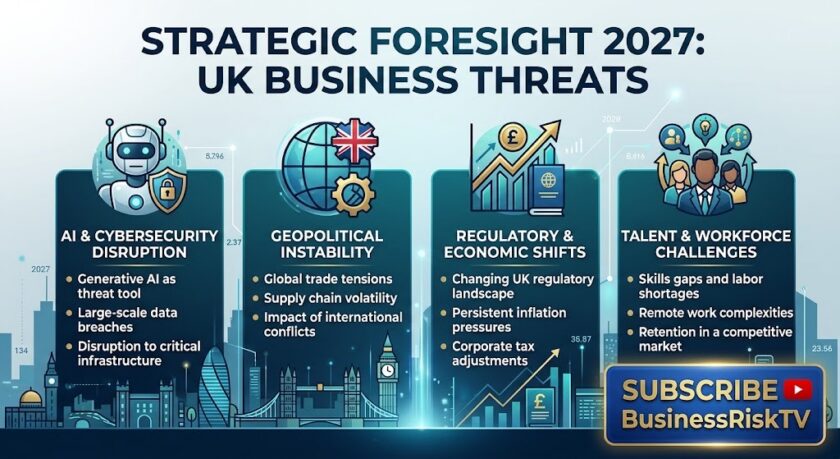
Strategic foresight gives UK businesses a competitive edge before 2027 threats crystallise. This BusinessRiskTV analysis identifies nine risks — from supply chain conflict to quantified risk blindness — with ONS and industry data, plus the steps decision-makers must take now to beat competitors.
Identify 9 strategic threats UK businesses face in 2027 and how to act now. BusinessRiskTV Business Risk Management Club strategic risk analysis.
Strategic Foresight 2027: How UK Businesses Can Identify Threats Before Competitors
BusinessRiskTV Business Risk Management Club Strategic Risk Analysis for UK Marketplace 2027 is the solution to the problem of strategic risk management in the UK for 2027. As the UK business landscape faces converging geopolitical, technological, and regulatory pressures, the window for reactive strategy is closing. The Office for National Statistics reported in May 2026 that 38% of UK businesses with 10 or more employees were already concerned about international conflict impacting supply chains—a 28 percentage point rise from December 2025 . BusinessRiskTV’s Business Risk Management Club provides the structured foresight framework UK decision-makers need to convert these early signals into competitive advantage before rivals react.
“The true sign of intelligence is not knowledge, but imagination.” — Albert Einstein, cited in INSEAD’s Distant Foresight Index research
Why Does Strategic Foresight Early Give a Competitive Advantage in the UK?
Strategic foresight early gives a competitive advantage in the UK because it enables businesses to shape regulatory environments, set industry standards, and define customer expectations before competitors recognise the threat. A firm that articulates a clear, well-researched vision of the future can effectively create the very future it is prepared to dominate . Shell’s pioneering scenario planning in the late 1960s anticipated a potential oil supply disruption; when the 1973 crisis hit, Shell was better prepared than competitors and gained a decisive advantage through diversification .
The financial case is stark. Aon’s 2026 UK report found that only 16% of UK firms have quantified their exposure to business interruption, and just 12.4% have quantified supply chain disruption exposure . Without quantification, senior leaders cannot make informed investment decisions or structure appropriate insurance programmes. Beazley’s January 2026 survey of 3,500 leaders across seven countries found that 94% of global businesses intend to build resilience through insurance and risk management in 2026, with 31% specifically planning to invest in risk management and loss prevention.
First-mover regulatory influence: Early foresight allows firms to engage with regulators before rules crystallise, shaping outcomes favourably
Talent and capital allocation: Identifying threats early enables redeployment of resources before sunk costs become stranded
Competitor blind spots: Most firms focus on immediate industry metrics; distant foresight captures weak signals beyond sector boundaries
Insurance and risk transfer pricing: Firms that quantify exposure early access better terms before insurers reprice systemic risks 
What Are 9 Potential Issues in 2027 That UK Businesses Must Prepare For Now?
Nine potential issues in 2027 that UK businesses must prepare for now include supply chain conflict exposure, cyber-physical convergence, AI governance gaps, EV transition disruption, geopolitical trade fragmentation, climate transition costs, labour market restructuring, regulatory divergence, and quantified risk blindness. Each represents a threat that can be converted into opportunity through structured foresight.
Supply chain conflict and shipping disruption will intensify in 2027, with ONS data already showing 25% of UK businesses concerned about shipping disruption in April 2026—up 18 percentage points from December 2025. Import costs increased for 44% of importing businesses in March 2026 compared with the previous year, the highest proportion since June 2023 . Act now: Map tier-2 and tier-3 suppliers for conflict-exposed regions; pre-negotiate alternative logistics routes; stress-test working capital against 20% freight cost increases.
2. Cyber-Physical Convergence and Business Interruption
Cyber-physical convergence will create business interruption events in 2027 that traditional risk frameworks cannot handle, with 27.3% of UK organisations already having suffered significant financial losses from business interruption. Beazley’s outlook warns that converging risks mean digital, transitional, and geopolitical disruption are creating simultaneous pressures across every part of the business . Act now: Quantify cyber-physical interdependencies; test incident response against a 5-day operational shutdown scenario; review insurance limits against modelled exposure.
3. AI Governance and Model Risk
AI governance and model risk will become a board-level regulatory issue in 2027, with financial services firms already facing Consumer Duty obligations that demand demonstrable oversight of automated decision-making. The FCA’s expectations and emerging AI regulation will require boards to evidence accountability. Act now: Establish an AI use-case register with risk ratings; implement model validation before deployment; train boards on AI accountability.
4. Electric Vehicle Transition Operational Disruption
Electric vehicle transition will disrupt operational models in 2027, with the Zero Emissions Vehicle Mandate reshaping the UK vehicle parc and creating different operational pressures for fleet-dependent businesses. The AA has already invested in specialist EV training and is progressively introducing EVs into its own fleet, converting transition risk into operational readiness. Act now: Audit fleet dependency on internal combustion maintenance skills; model EV charging infrastructure costs; retrain frontline staff.
5. Geopolitical Trade Fragmentation and Rules of Origin
Geopolitical trade fragmentation will raise compliance costs in 2027, with 39% of exporting businesses reporting increased exporting costs in March 2026—the highest since September 2023 . Act now: Review rules of origin documentation; model tariff scenarios for EU and US trade; consider nearshoring critical inputs.
6. Climate Transition Cost Pass-Through
Climate transition costs will accelerate in 2027, with Beazley identifying climate and environmental risk as representing 20% of average business risk concern globally. The European Space Agency’s foresight work warns that intensifying climate impacts will affect European economies through the investment required to build resilience and adopt mitigating technologies . Act now: Stress-test energy cost exposure; assess carbon border adjustment mechanism impact; identify quick-win efficiency investments.
7. Labour Market Restructuring and Skills Gaps
Labour market restructuring will create skills shortages in 2027 as AI adoption and green transition reshape demand, with 4% of UK businesses having temporarily paused trading and 2% permanently ceased by late April 2026 . Act now: Map critical skills against 2027 requirements; initiate reskilling programmes; review contingent labour strategies.
8. Regulatory Divergence Post-Brexit
Regulatory divergence will increase compliance complexity in 2027, requiring UK-specific frameworks for product marking, data, and financial services. The Food Standards Agency is already developing novel regulatory approaches for cell-cultivated products through its sandbox programme, signalling sector-specific divergence . Act now: Assign regulatory horizon scanning ownership; budget for dual compliance; engage with regulators early.
9. Quantified Risk Blindness
Quantified risk blindness will leave UK firms unable to justify resilience investment in 2027, with only 21.6% having a formal business interruption plan and just 16% quantifying exposure. Aon warns that without quantification, leaders struggle to make informed decisions or plan for the true cost of prolonged disruption . Act now: Commission quantitative risk assessment; link insurance limits to modelled loss scenarios; present board-level risk appetite statements.
What Steps Should Key Business Decision Makers Take Today to Beat Competitors in 2027?
Key business decision makers should today establish a structured distant foresight function, quantify their top three risk exposures, and integrate scenario planning into capital allocation. The INSEAD Distant Foresight Index approach helps organisations identify potentially destructive threats beyond industry boundaries, avoiding the fate of Blockbuster, Nokia, and Kodak . The European Space Agency’s foresight practice demonstrates that developing scenarios challenges assumptions and tests strategies against multiple futures, ensuring organisations remain proactive rather than reactive.
Appoint a foresight owner with board access, not buried in strategy or innovation teams
Run a 2027 threat quantification sprint covering business interruption, supply chain, and cyber, using structured financial modelling rather than intuition
Establish weak-signal monitoring across sectors beyond your own, using the INSEAD distant foresight methodology
Integrate foresight into FP&A so capital allocation is stress-tested across multiple scenarios, not a single base case
Engage regulators proactively on emerging issues before rules crystallise
Report foresight outputs to the board quarterly, treating them with the same rigour as financial reporting
“Don’t wait for the future to happen to you, create it.” — Frank Spencer and Yvette Montero-Salvatico, TFSX, cited in strategic foresight literature
Who Will Benefit Most from Strategic Foresight in the UK?
Businesses in supply chain-intensive, technology-dependent, and regulated sectors will benefit most from strategic foresight in the UK, particularly those with complex international exposure or fleet-dependent operations. Beazley’s survey found that 94% of global businesses plan to build resilience through insurance and risk management, indicating widespread recognition that interconnected risks amplify one another .
Manufacturers and importers facing 44% import cost increases and rules-of-origin complexity
Logistics and fleet operators managing EV transition and fuel price volatility
Financial services firms navigating AI governance and Consumer Duty obligations
Food and life sciences businesses facing novel regulatory pathways for emerging products
Any UK business with quantified exposure below board-level visibility—the 84% without quantified business interruption risk
When Must Key Business Decision Makers Act?
Key business decision makers must act now, in Q4 2026, because 2027 planning cycles are already underway and early movers will capture regulatory influence and insurance pricing advantages before systemic risks are fully priced. The ONS data shows concern about supply chain conflict rose 28 percentage points between December 2025 and April 2026—a pace that leaves late movers reacting to events rather than shaping them . Shell’s advantage in 1973 came from scenario work conducted years earlier.
Q1 2027: Integrate scenario outputs into capital allocation; review insurance programme against modelled exposures
Q2 2027: Launch weak-signal monitoring; report first foresight dashboard to board
Ongoing: Quarterly scenario refresh; annual full foresight review
Which Industries Should Be Most Concerned or Best Prepared to Take Advantage?
Manufacturing, logistics, financial services, food and life sciences, and fleet-dependent service industries should be most concerned about 2027 threats, while those same sectors are best positioned to capture advantage through early preparation. The FSA is actively developing regulatory pathways for cell-cultivated products, creating first-mover advantages for compliant innovators . The AA has already invested in specialist EV training and is progressively introducing EVs into its own fleet, converting transition risk into operational readiness.
Manufacturing: Highest exposure to supply chain conflict and import cost inflation ; opportunity in nearshoring and dual-sourcing
Logistics and transport: EV transition reshaping service profiles; opportunity in specialist EV capability
Financial services: AI governance and Consumer Duty convergence; opportunity in trusted AI assurance services
Food and life sciences: Novel regulatory pathways ; opportunity in early regulatory engagement
Insurance and risk advisory: Demand surge for quantification and scenario services ; opportunity in specialised foresight products
Energy-intensive sectors: Transition cost exposure; opportunity in efficiency-led differentiation
FAQ: Strategic Foresight 2027 and UK Business Risk
What is strategic foresight and why does it matter for UK businesses in 2027?
Strategic foresight is the capacity to explore multiple plausible futures and develop strategies that remain robust across a range of scenarios . It matters for UK businesses in 2027 because UK insolvencies are forecast to remain 21% above pre-pandemic averages even as they decline, with 24,800 failures expected in 2027 . The World Economic Forum notes that organisations with foresight capabilities “don’t just react to change, they shape it” . Shell has used scenario planning since the 1970s to anticipate geopolitical risks, including the OPEC oil embargo, and continues using it to navigate the energy transition.
Which UK sectors face the greatest insolvency risk heading into 2027?
Construction, wholesale and retail, hospitality and real estate face the greatest insolvency risk heading into 2027. Construction has accounted for around 17% of all UK insolvencies in every rolling period tracked by the Insolvency Service through mid-2026, with wholesale and retail trade consistently at 15% to 16% . Consumer-facing sectors have seen the sharpest rises in critical distress: leisure and cultural businesses rose 27.1%, hotels and accommodation 26.6%, and sport and health clubs 21.0% over the past year. Begbies Traynor Group warns that because insolvencies typically lag financial distress, the UK could see increases in business failures during 2027.
What do ONS statistics say about UK business concerns for 2027?
ONS statistics show UK business concerns about supply chain disruption have risen sharply. In late April 2026, 38% of businesses with 10 or more employees were concerned about international conflict impacting supply chains, a 28 percentage point rise from December 2025; 25% were concerned about shipping disruption, up 18 percentage points . Import costs increased for 44% of importing businesses in March 2026 compared with the previous year, the highest proportion since June 2023, while 39% of exporters reported increased costs . Additionally, 4% of businesses reported temporarily paused trading and 2% permanently ceased trading in late April 2026.
How does strategic foresight give a competitive advantage over competitors?
Strategic foresight gives a competitive advantage by enabling firms to shape regulatory environments, set industry standards, and define customer expectations before rivals recognize threats. The World Economic Forum states that leading companies using foresight are “more agile in crises, better prepared for disruption and more consistent in their long-term commitments to stakeholders” . Cisco employs technology foresight to spot emerging tech trends, guide R&D investments, and position itself in markets of the future . The alternative is illustrated by Nokia and Kodak, which failed to anticipate threats beyond their immediate industry boundaries despite having the resources to do so.
What geopolitical technology risks should UK businesses monitor for 2027?
UK businesses should monitor control over AI technology, critical minerals, and cloud infrastructure as geopolitical risks for 2027. PwC warns that technology is now widely seen as a national security issue, with the US and China using trade barriers to limit competitors’ progress across raw materials, components, knowledge and intellectual property, and data and compute infrastructure . Businesses need to map where AI models are used, which provider and jurisdiction controls them, and what dependencies and concentration risks they face . Access to critical minerals and rare earth elements is increasingly linked to geopolitical competition, affecting tech, defence, and energy transition sectors.
When must UK business leaders act to prepare for 2027 threats?
UK business leaders must act now, in Q4 2026, because 2027 planning cycles are underway and early movers capture regulatory influence and insurance pricing advantages before systemic risks are fully priced. Allianz Trade forecasts insolvencies declining to 24,800 in 2027, but this remains 21% above pre-pandemic averages, and 213,000 UK jobs are directly at risk from business insolvencies between 2026 and 2027 . Begbies Traynor warns that further increases in energy costs or inflation could accelerate financial distress, with insolvency increases likely in 2027 . The window between competitive trade credit insurance pricing and rising counterparty risk may not stay open indefinitely.
Which industries are best positioned to take advantage of 2027 opportunities?
Industries that quantify risk exposure early and engage regulators proactively are best positioned for 2027 opportunities. PwC’s UK economic outlook notes that UK corporate debt is around its lowest level this century, providing some protection, but real business investment remains below its pre-2016 trend . The IMF expects UK GDP growth of 1.3% in 2027, and the UK was the only G7 economy to receive an upgrade in the latest forecasts . Businesses that convert short-term resilience into private-sector investment and productivity gains will capture advantage, particularly in sectors where competitors remain paralyzed by uncertainty. PwC found that UK CEOs spend only 11% of their time on issues extending beyond five years.
What practical steps should decision-makers take today?
Decision-makers should appoint a foresight owner with board access, quantify their top three risk exposures, and integrate scenario planning into capital allocation. The World Economic Forum recommends structured dialogue with leadership teams to benchmark foresight capabilities against peers and identify blind spots in sensing change and translating foresight into strategy . ONS data shows 26% of businesses now use AI, up 8 percentage points year-on-year, and 18% plan to adopt it in the next three months . Businesses should map AI dependencies, review rules of origin documentation, and stress-test working capital against freight cost increases, given that 56% of concerned businesses expect sourcing costs to rise.
Get help to protect and grow your business faster with BusinessRiskTV
Don’t just survive—thrive. In today’s volatile UK market, being resilient isn’t enough. Discover the anti-fragility mentality, a powerful concept that helps businesses grow stronger from shocks and uncertainty. Our guide reveals the dangers of feeling too scared to grow, explains why positively fighting back against business fears works better, and provides 9 practical risk management strategies to build a more robust, adaptable, and profitable business. Learn how to transform every crisis into a competitive advantage.
Discover how an anti-fragility mentality can help your UK business thrive on stress and volatility. Learn why fear of growth is dangerous and get 9 practical risk management strategies to build a more robust, adaptable, and profitable company.
Anti-Fragility Mentality: The UK Business Guide to Thriving on Volatility 🇬🇧
In the complex and unpredictable world of business, it’s not enough to be resilient or robust; you must be anti-fragile. This is a concept, popularised by author Nassim Nicholas Taleb, that suggests some systems, like a business, don’t just withstand shocks—they actually get stronger because of them. While a resilient company recovers from a crisis, an anti-fragile one learns, adapts, and improves. Instead of just surviving, an anti-fragile business uses volatility, uncertainty, and stress as fuel for growth. This is especially relevant for UK businesses navigating a post-Brexit, globalised, and tech-driven market.
The Dangers of Business Fear and Over-Cautiousness
When leaders are too scared to grow, their business becomes fragile. Fear of failure or even fear of success can lead to a state of paralysis. Instead of embracing opportunities, a business with a risk-averse culture will hesitate, self-sabotage, and miss out on potential gains. This mindset can:
Stifle innovation: You avoid new technologies, markets, or product lines, leaving you vulnerable to competitors who are bolder.
Prevent scalability: Your business systems, processes, and team structures become too rigid to handle growth, leading to spiralling costs and poor service if demand increases.
Create dependency: Over-reliance on a single client, supplier, or revenue stream makes the business incredibly fragile.
Damage morale: A culture of fear can demotivate employees and discourage them from taking initiative.
Expose you to a slow decline: While you might avoid a sudden crisis, a cautious approach often leads to a gradual loss of market share and relevance.
Why Positively Fighting Back Against Crisis Works Better
An anti-fragile business doesn’t just react to a crisis; it uses the crisis to its advantage. Instead of a defensive mindset, it adopts an offensive one, turning problems into opportunities. This approach works better because:
It forces innovation: A crisis can be a powerful catalyst for change, forcing you to find creative solutions you wouldn’t have considered otherwise.
It builds stronger systems: A crisis reveals weaknesses. By addressing these weak points, you build more robust, efficient, and reliable systems for the future.
It strengthens relationships: Transparent communication and proactive problem-solving during a crisis builds trust with employees, customers, and partners.
It creates a competitive advantage: While your competitors are busy recovering, you’re using the disruption to pull ahead, secure new markets, or attract talent.
Who Can Help You Take More Calculated Risks
Taking calculated risks is a team sport. While the final decision rests with the leadership, a smart leader leverages the entire business to inform their choices. Key roles that can help you become more anti-fragile include:
The Finance Team: Your finance department is crucial. They provide the data and analysis needed to understand the potential financial impact of a risk.
Embrace Optionality: Have multiple, low-risk options available. For example, explore several new markets with a small investment rather than committing to one with a large one.
Redundancy is a Virtue: Don’t rely on a single supplier or a single server. Create backups and redundancies to prevent single points of failure.
Conduct “Pre-Mortems”: Instead of a post-mortem after failure, imagine a project has failed and work backwards to identify the reasons. This helps anticipate risks before they occur.
Decentralise Authority: Empower smaller teams to make decisions. This allows for faster responses to local challenges and opportunities.
Maintain a Cash Buffer: Keep enough cash on hand to cover a significant period of low revenue. This financial buffer is the bedrock of anti-fragility.
Gamify Risk Management: Use internal games or simulations to train your team on how to respond to unexpected events, building both muscle memory and a proactive mindset.
Diversify Your Team’s Skillset: Hire for versatility and adaptability. A team with diverse skills is more likely to find creative solutions during a crisis.
Build Strong Stakeholder Relationships: Foster trust with your customers, suppliers, and investors. Strong relationships provide a support network that is invaluable in a downturn.
Get help to protect and grow your business faster with BusinessRiskTV
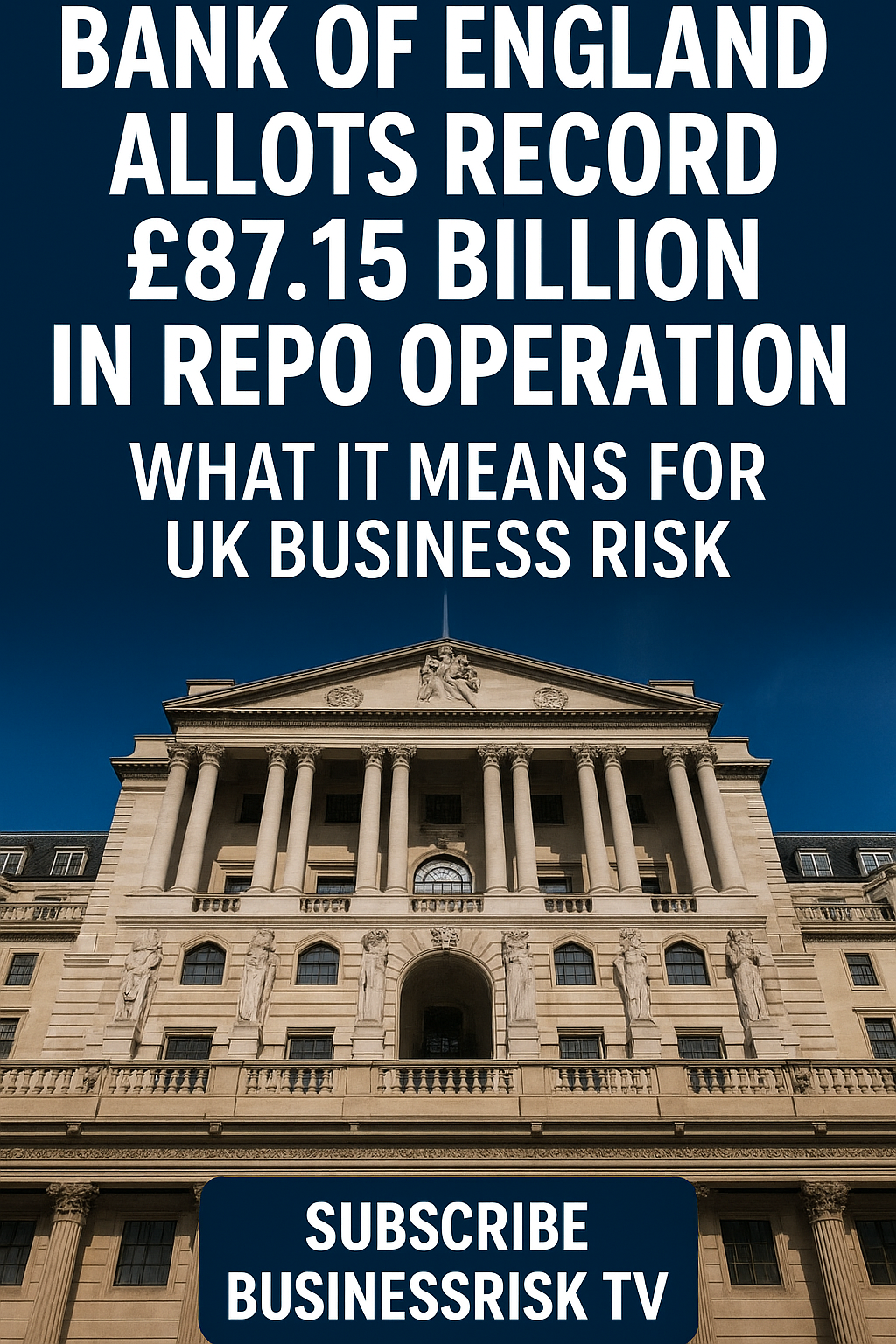
The Bank of England’s recent record £87.15 billion repo allotment, a tool used to provide liquidity to banks as the central bank reduces its bond holdings, could signal underlying stress in the UK banking sector. This growing reliance on the central bank for funds raises a red flag for the financial stability and economic safety of the UK. Discover what this means for the wider economy and learn six crucial risk management strategies every business leader should implement now to protect and grow their enterprise more resiliently in an uncertain economic climate.
Bank of England Allots Record £87.15 Billion in Repo Operation: What It Means for UK Business Risk
The Bank of England’s Record Repo Allotment: A Warning for UK Business? 🚨
The Bank of England recently allotted a record £87.15 billion in a short-term repo operation, a move that provides a substantial injection of liquidity into the UK’s banking system. While this may seem like a routine technical adjustment by the central bank, the increasing reliance on these operations could be a significant red flag for the safety of the UK’s financial system and wider economy.
What Is a Repo Operation and Why Is This a Red Flag?
A repo (repurchase agreement) is essentially a short-term loan. The Bank of England lends money to commercial banks and in return, the banks provide high-quality assets (like government bonds) as collateral. The Bank’s increasing use of this tool is directly linked to its Quantitative Tightening (QT) programme, which involves selling off the government bonds it bought during the era of Quantitative Easing (QE). The purpose of these repo operations is to prevent a potential liquidity squeeze in the financial system as the central bank reduces its balance sheet.
The record allotment is a red flag for a few key reasons:
Growing Illiquidity: The fact that banks are demanding a record amount of funds from the central bank suggests they may be struggling to find liquidity elsewhere in the market. This could indicate underlying stress in the banking sector and a reluctance among banks to lend to each other.
Systemic Risk: This reliance on the Bank of England for funding could be a sign of increased systemic risk. If a major bank were to face a sudden liquidity crisis, the central bank would be its lender of last resort. The increasing size of these operations shows the potential scale of that reliance.
Uncertainty and Instability: A record-breaking allotment, particularly one that exceeds a recent record, creates a narrative of growing instability. This can erode confidence in the banking system and the wider economy, making businesses and investors more hesitant to spend and invest. This uncertainty trickles down to businesses and consumers, affecting everything from investment decisions to household spending.
6 Risk Management Measures for Businesses
In an environment of economic uncertainty, business leaders must be proactive to protect their organisations. Here are six essential risk management measures to enhance resilience:
Strengthen Cash Flow and Liquidity:Cash is king, especially in a downturn. Focus on optimising your working capital by accelerating accounts receivable, negotiating longer payment terms with suppliers, and maintaining a healthy cash reserve. Create detailed cash flow forecasts to anticipate potential shortfalls and manage expenses.
Diversify Revenue Streams and Supply Chains:Over-reliance on a single product, service, customer, or supplier is a major vulnerability. Actively seek new markets, customer segments, and partnerships. For your supply chain, identify alternative vendors and consider strategies like near-shoring or holding a small buffer of critical inventory to mitigate potential disruptions.
Manage Debt and Capital Expenditure Wisely: During uncertain times, it is crucial to avoid taking on excessive debt. Evaluate all major capital expenditure projects. Postpone or cancel non-essential investments that don’t directly contribute to immediate revenue or operational efficiency.
Review and Optimise Operational Costs:Take a hard look at all business expenses. Eliminate unnecessary costs without sacrificing the quality of your product or service. This could involve renegotiating contracts, leveraging technology for greater efficiency, or consolidating services. The goal is to create a leaner, more resilient cost structure.
Why the Bank of England’s Record Repo Allotment Is a Red Flag
The Bank of England’s record-breaking repo allotment is a significant red flag because it points to potential underlying stress and growing liquidity issues within the UK banking system. While repo operations are a standard tool for central banks to manage monetary policy, the increasing size of these allotments, especially in the context of the central bank’s quantitative tightening (QT) programme, reveals a deeper problem.
Growing Illiquidity and Inter-bank Distrust: The primary role of a central bank’s repo operation is to provide liquidity. A record amount being requested by commercial banks suggests they are struggling to secure the funds they need from each other. In a healthy banking system, banks would lend to one another in the inter-bank market. The fact that they are turning to the Bank of England in such high volumes could indicate a breakdown of trust between financial institutions, which is a classic symptom of a stressed system.
Systemic Risk: The increasing reliance on the central bank for funding raises concerns about systemic risk. Systemic risk is the risk of a collapse of an entire financial system due to the failure of one or more institutions. If a significant portion of the banking sector is dependent on the Bank of England for liquidity, a sudden shock or disruption could have a cascading effect across the entire system. This over-reliance makes the financial system less resilient and more vulnerable to unforeseen events.
Uncertainty and Economic Instability: A record repo allotment creates a sense of uncertainty and instability in the market. The public and investors may interpret this as a signal that the banking system is not as robust as it appears. This loss of confidence can have a tangible impact on the wider economy. It can lead to a tightening of lending standards, making it harder for businesses and households to access credit, and it can also deter investment, ultimately slowing down economic growth. The large allotment, therefore, isn’t just a technical exercise; it’s a barometer of growing financial vulnerability in the UK.
Read more free business risk management articles and view videos
6 Essential Business Risk Management Measures for UK Business Leaders
In today’s complex and uncertain economic environment, proactive business risk management is no longer an option—it’s a necessity. UK business leaders must move beyond a reactive approach and build genuine resilience into the core of their operations. Here are six essential measures to take action on now.
Optimise working capital: Focus on accelerating accounts receivable by offering incentives for early payment or enforcing stricter payment terms. At the same time, negotiate more favourable payment terms with your suppliers to extend your accounts payable.
Create robust cash flow forecasts: Use financial modelling and scenario planning to predict potential cash shortfalls. This will help you anticipate problems and give you time to secure financing or make cost adjustments before a crisis hits.
Maintain a cash reserve: Aim to build a buffer of cash sufficient to cover at least three to six months of operating expenses. This reserve acts as a critical safety net against unexpected disruptions.
2. Diversify Revenue Streams and Supply Chains
Over-reliance on a single customer, product, or supplier is a major vulnerability. Diversification builds a more robust and flexible business model.
Review and diversify your supply chain: Identify and vet alternative suppliers, especially for critical raw materials or components. Consider a dual-sourcing model or incorporating local suppliers to mitigate risks from global transport issues or geopolitical events.
3. Conduct Scenario Planning and Stress Testing
Don’t wait for a crisis to expose your weaknesses. Proactive scenario planning allows you to test your business model against a range of potential threats.
Identify key risks: Create a comprehensive risk register that outlines potential risks (e.g., economic downturn, supply chain disruption, cyber-attack) and their potential impact.
High levels of debt can become a significant burden in a tightening credit environment.
Limit new borrowing: Be cautious about taking on new debt, particularly for non-essential projects. Evaluate every borrowing decision based on its potential return on investment and its impact on your balance sheet.
Re-evaluate capital projects: Postpone or cancel major capital expenditures that are not critical for business operations or do not have a clear and immediate path to profitability. Prioritize investments that enhance operational efficiency and resilience.
5. Review and OPTIMISE Operational Costs
A lean and efficient cost structure improves profitability and allows you to better weather economic storms.
Targets decision-makers searching for the financial impact of weak risk practices
THE HIDDEN TAX OF POOR RISK MANAGEMENT
Your business is leaking money. Not in the obvious ways — like overspending or inefficiency — but in silent, insidious drains you might not even see. Poor risk management isn’t just about avoiding disasters; it’s a profit killer, a growth stifler, and, in the worst cases, an executioner of businesses that could have thrived.
Consider this: 30% of bankruptcies are due to operational failures that could have been mitigated with better risk practices (OECD). That’s not bad luck—it’s self-inflicted. And if you think your company is immune, think again.
This isn’t theoretical. Every day, businesses hemorrhage cash through:
Employee disengagement —teams that don’t see risk as their problem, costing you in errors, delays, and lost innovation.
The result? Lower profitability. Stunted growth. And, in extreme cases, extinction.
But here’s the good news: this is entirely optional and fixable.
In this e-book, we’ll expose the 12 most damaging costs of poor risk management —many of which you’re likely paying right now — and deliver 12 actionable solutions to turn risk from a liability into a competitive advantage. You’ll learn how to:
Engage every employee in risk ownership (not just compliance, but profit protection).
Stop financial bleed from preventable failures.
Turn risk-aware decision-making into a growth engine.
This isn’t another dry risk management manual. This is a survival guide for profitable, resilient business leadership.
Ready to plug the leaks? Let’s begin.
🚨 YOUR BUSINESS IS LEAKING £££ – FIND THE HOLES! 🚨
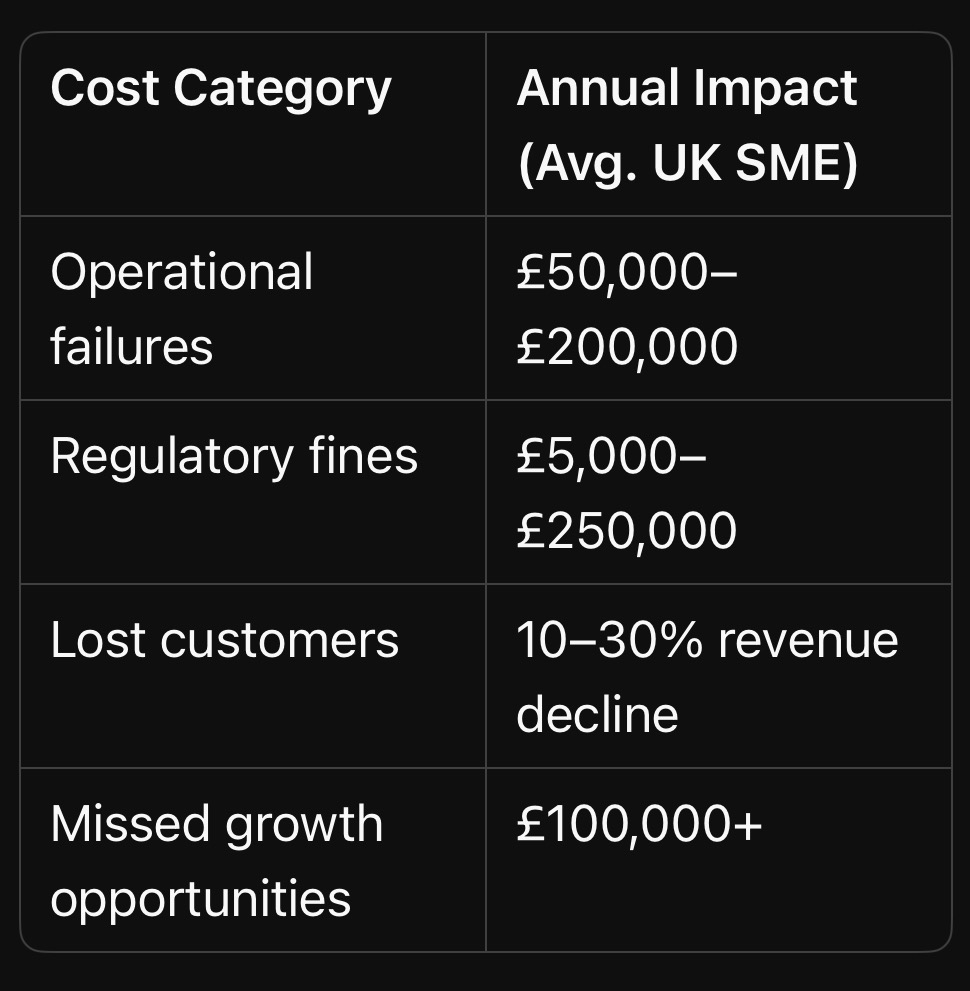
83% of UK SMEs lose £50k+ yearly from hidden risks they don’t even measure:
❌ Operational failures burning cash ❌Supply chain disasters killing margins
❌ Cyberattacks costing millions
BusinessRiskTV’s NEW eBook reveals:
✅ 12 PROVEN FIXES to stop profit leaks
✅ Real case studies from UK businesses
✅ Simple checklists to act TODAY
Chapter 1: The Hidden Costs of Poor Risk Management – How Ignoring Risk Erodes Your Profits and Threatens Survival
Introduction: The Silent Profit Killer
Every business faces risks—some obvious, others invisible. But when risk management is an afterthought, those risks don’t just linger; they multiply costs, shrink margins, and sabotage growth. This chapter exposes the real financial and operational toll of poor risk management—and why most businesses underestimate it.
—
1. The Direct Financial Costs: Where the Money Leaks
A. Unexpected Losses from Operational Failures
Example: A manufacturing firm ignores equipment maintenance, leading to a breakdown that halts production for 48 hours. The result? £250,000 in lost revenue + £50,000 in emergency repairs.
Stat: Companies with weak operational risk management see 30% higher unexpected costs (Deloitte).
B. Regulatory Fines & Legal Penalties
Case Study: A UK SME in financial services fails to comply with GDPR, resulting in a £180,000 fine —plus reputational damage.
Stat: 60% of small UK businesses aren’t fully compliant with key regulations (FSB).
Key Takeaway: Poor risk management isn’t just about avoiding disasters — it’s a tax on profitability, growth, and survival.
—
Actionable Insight: Audit one high-cost risk in your business this week (e.g., late payments, compliance gaps). What’s it really costing you?*
—
Chapter 2: The True Cost of Operational Failures – How Inefficient Risk Management Cripples Your Business
Introduction: The Domino Effect of Poor Operational Risk Controls
Operational risks don’t just cause one-off incidents—they trigger chain reactions that drain cash, demoralise teams, and erode customer trust. This chapter exposes the hidden, cascading costs of mismanaged operational risks and why most businesses only see the tip of the iceberg.
—
1. The Obvious Costs: What You Can’t Ignore
A. Downtime & Lost Production
Manufacturing Example: A single machine failure halts a production line for 8 hours → £25,000 in lost output + overtime costs to catch up.
Hospitality Example: A restaurant’s refrigeration breakdown spoils £3,000 of stock overnight — plus angry customers.
Stat: UK manufacturers lose £180 billion/year to unplanned downtime (EEF).
B. Emergency Repairs & Rush Orders
Reactive spending costs 3–5X more than planned maintenance.
Case Study: A logistics firm ignores fleet maintenance → two vans fail MOTs simultaneously → £8k in last-minute rentals + delayed deliveries.
C. Waste & Rework
Construction Example: Poor quality control leads to £50,000 of defective materials — then doubles labour costs to fix errors.
Stat: 20–30% of project budgets are wasted on rework (KPMG).
—
2. The Hidden Costs: What You’re Not Tracking (But Should Be)
A. Employee Productivity Drain
Scenario: A retail store’s outdated inventory system causes daily stock discrepancies. Staff waste 4 hours/day manually reconciling data instead of selling.
Stat: UK workers spend 15% of their time fixing preventable issues (PwC).
B. Management Distraction & Burnout
Small Business Reality: The owner spends 60% of their week putting out fires (supplier delays, IT crashes) instead of growing the business.
Psychological Cost: Chronic stress → poor decisions → more risks.
C. Customer Churn & Reputation Erosion
E-commerce Example: A fulfilment centre’s picking errors lead to 10% of orders arriving wrong → 15% of customers never return.
Stat: 70% of customers switch brands after just 2–3 bad experiences (Salesforce).
—
3. The Strategic Costs: How Operational Risks Stunt Growth
A. Lost Competitive Advantage
Case Study: A UK bakery’s unreliable oven delays a product launch by 3 months —competitors dominate supermarket shelves first.
B. Innovation Paralysis
Teams stuck in “firefighting mode” never test new ideas.
Example: A tech firm’s IT team spends 80% of time fixing outages → zero R&D progress.
C. Investor & Partner Distrust
Supply Chain Example: A fashion brand’s repeated delivery failures lead to two major retailers dropping them —£500k annual revenue gone.
—
4. The Survival Threat: When Operational Risks Become Fatal
A. Cash Flow Death Spiral
Construction Firm Case Study:
1. Poor contract risk assessment → unpaid invoices pile up
2. Equipment breakdown → project delays
3. Penalties for late delivery → bank calls in loan Result: Administration within 6 months.
B. The Carillion Effect
How ignoring operational risks (contract mismanagement, cash flow gaps) led to the UK’s biggest corporate collapse.
—
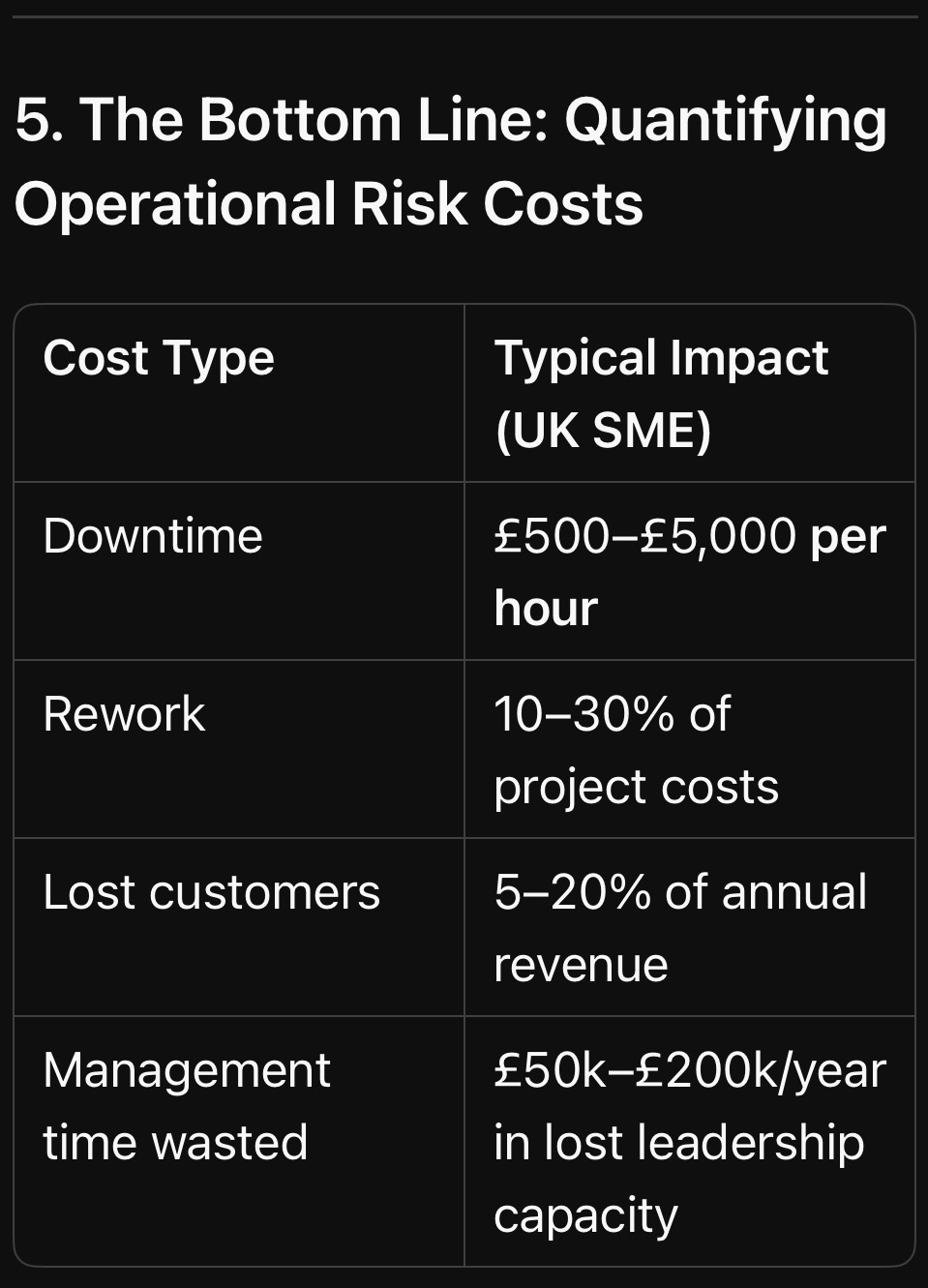
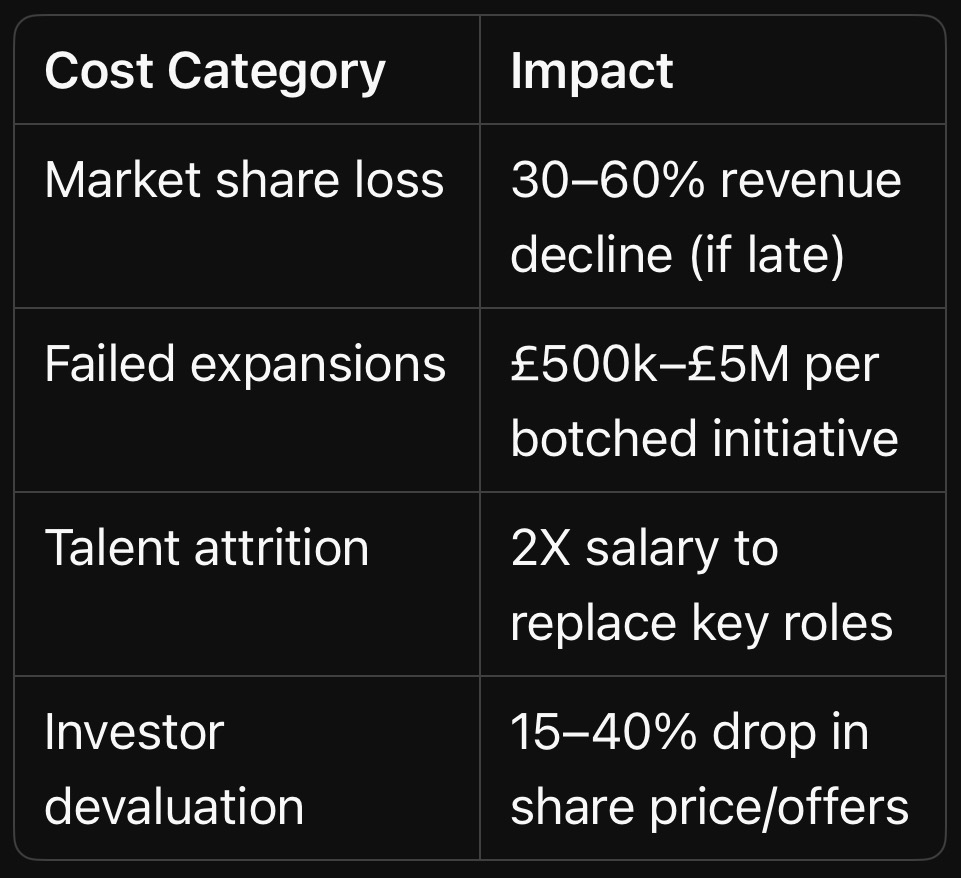
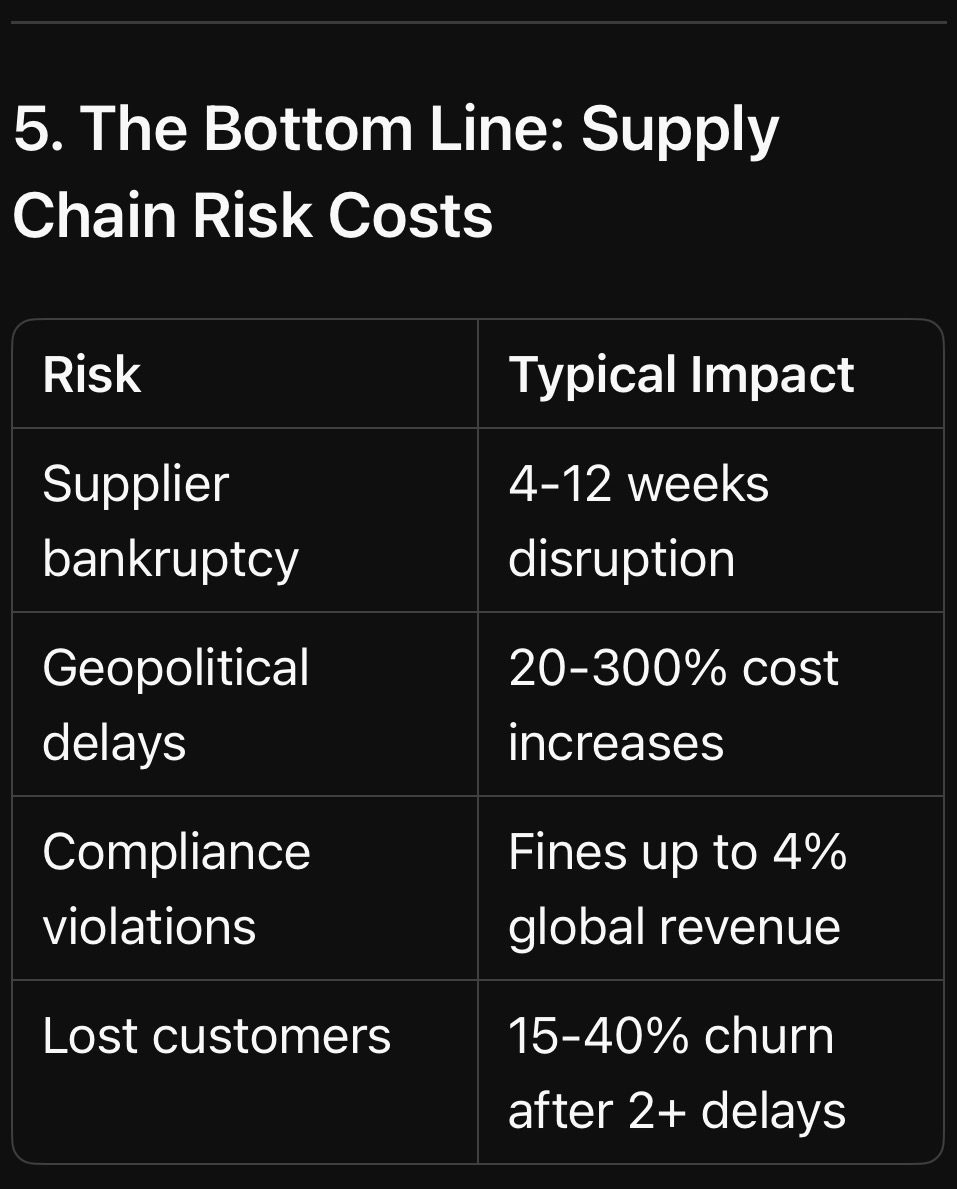
5. The Bottom Line: Quantifying Operational Risk Costs
Key Insight: Operational risks don’t just cost money—they steal time, talent, and future opportunities.
—
More From BusinessRiskTV Business Experts Hub : How to Fix It
We explore how to turn operational risk management into a profit centre, including:
The 5-minute daily habit that prevents 80% of failures
How to engage frontline teams in risk reduction (with real-world examples)
Actionable Task: Map one critical operational process (e.g., order fulfilment). Where could a single failure cost you £10k+?
—
Chapter 3: Strategic Risks – How Blind Spots in Planning Can Bankrupt Even Profitable Businesses
Introduction: The Silent Assassin of Business Growth
Strategic risks don’t announce themselves with alarms — they creep in unnoticed while leadership is distracted by day-to-day operations. By the time the damage is visible, it’s often too late to pivot. This chapter exposes how poor strategic risk management destroys market position, erodes competitive edge, and turns industry leaders into cautionary tales.
—
1. What Are Strategic Risks? (And Why They’re Different)
Key Takeaway: Strategic risks don’t just hurt profits — they erase entire business models.
—
More from BusinessRiskTV Business Experts Hub : How to Anticipate & Outmanoeuvre Strategic Risks
We explore practical frameworks to:
Spot industry shifts early (using weak signals)
Stress-test your strategy against disruption
Turn risks into opportunities (like Amazon’s pivot from books to cloud)
Actionable Task: List one strategic assumption your business relies on (e.g., “Customers will always prefer X”). How would you survive if it’s wrong?
—
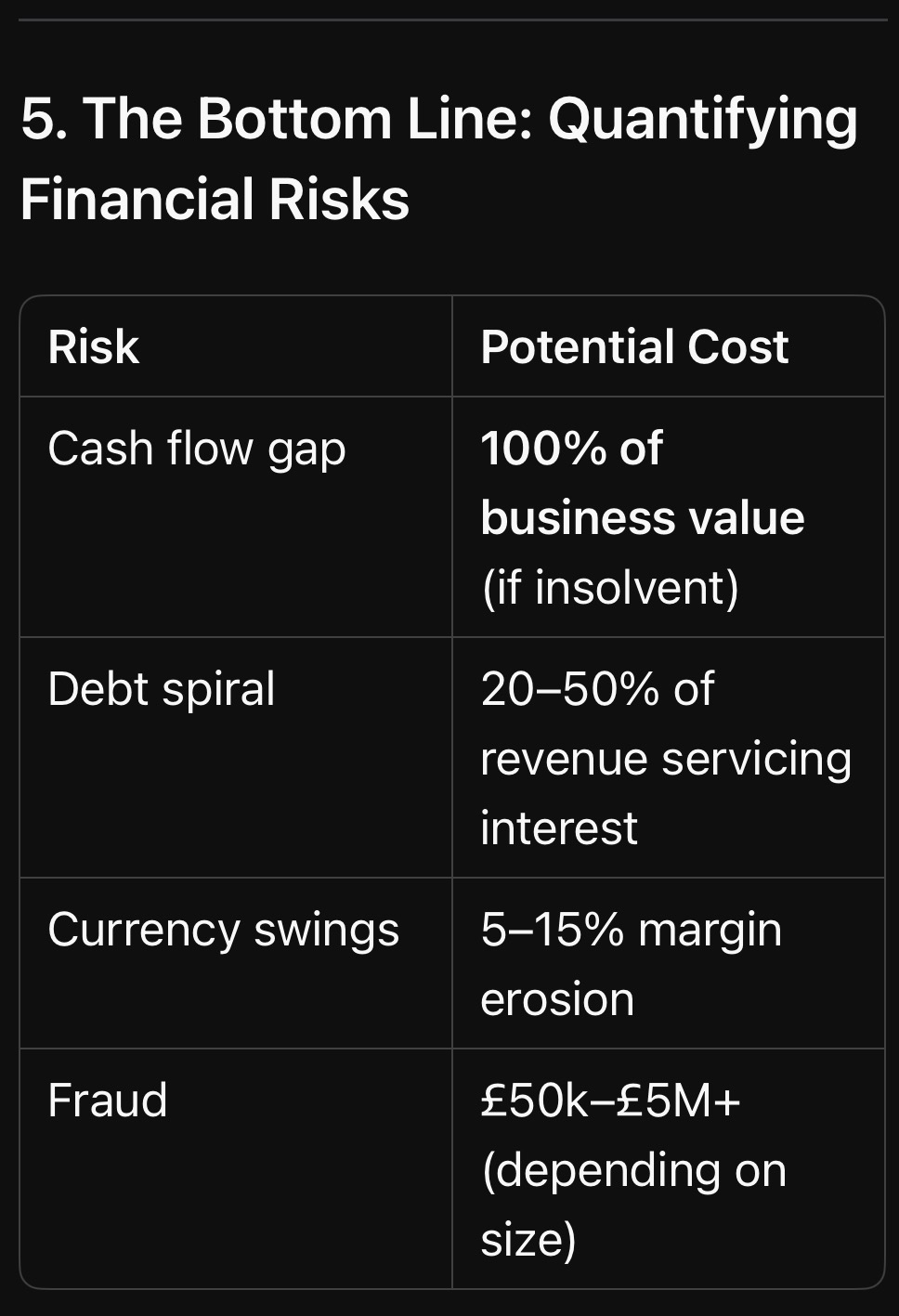
Chapter 4: Financial Risks – How Poor Cash Flow & Debt Management Can Sink Your Business Overnight
Introduction: The Silent Killer of Healthy Businesses
Profit doesn’t equal survival. Thousands of UK businesses post record revenues—right before going bust. Why? Because financial risk management isn’t about counting pennies — it’s about anticipating traps that strangle cash flow, trigger defaults, and collapse supply chains.
This chapter exposes the lethal financial risks hiding in plain sight — and why even profitable companies run out of money.
—
1. The Obvious (But Ignored) Financial Risks
A. Cash Flow Crises – The #1 Business Killer
Reality: 82% of UK business failures cite cash flow problems as the primary cause (UK Insolvency Service).
Example: A £5M-turnover construction firm collapses because:
– Client pays invoices 90 days late
– Supplier demands upfront payments due to past delays
– Bank rejects emergency loan Result: Liquidation despite £1.2M in “paper profits.”
B. Debt Avalanches – When Borrowing Backfires
Case Study: A fast-growing e-commerce firm takes on high-interest debt to fund inventory. Sales dip, interest compounds, and suddenly 60% of revenue services debt.
– Stat: 40% of UK SMEs struggle with unmanageable debt (Bank of England).
C. Currency & Commodity Swings
Example: A UK bakery’s flour costs jump 30% after a wheat shortage. Contracts lock in prices — margins vanish overnight.
—
2. The Hidden Financial Risks That Compound Quietly
A. Customer Concentration Risk
Scenario: A B2B software firm gets 70% of revenue from one client. When that client leaves, payroll can’t be met.
Rule of Thumb: No single client should exceed 15–20% of revenue.
B. Supplier Dependency & Price Shocks
Case Study: A car manufacturer relies on one battery supplier. When shortages hit, production stalls for 3 months → £9M loss.
C. Fraud & Financial Mismanagement
Stat: UK businesses lose £137B yearly to fraud, waste, and accounting errors (PwC).
Example: A finance director “cooks the books” — investors pull out when the truth surfaces.
—
3. The Strategic Fallout: When Financial Risks Spiral
A. Credit Downgrades & Banking Nightmares
Example: A once-stable firm misses a loan covenant — interest rates spike 5%, lines of credit freeze.
B. Investor Panic & Equity Crashes
Case Study: A tech startup’s burn rate exceeds projections — VCs demand emergency restructuring, slashing valuation by 50%.
C. Employee Exodus (When Paychecks Bounce)
Stat: 78% of employees leave within 6 months of payroll issues (CIPD).
—
4. The Ultimate Cost: Bankruptcy Dominoes
A. The “Profitable But Insolvent” Paradox
How It Happens:
1. Big contracts signed → revenue looks strong
2. Clients pay late → cash dries up
3. Suppliers demand payment → no money for salaries/tax
4. HMRC forces liquidation despite “growth.”
B. The Carillion Effect (Again)
£7B collapse triggered by:
– Aggressive accounting
– Reliance on unsustainable contracts
– No cash buffer for delays
Key Insight: Financial risks don’t just reduce profits — they erase businesses in weeks.
—
More from BusinessRiskTV Business Experts Hub : How to Fix It
We explore real-world financial risk strategies, including:
The 13-week cash flow rule (used by turnaround experts)
How to renegotiate debt before it’s too late
Building a “war chest” for crises
Actionable Task: Run a “stress test” on your cash flow: What if 2 clients pay 60 days late?
—
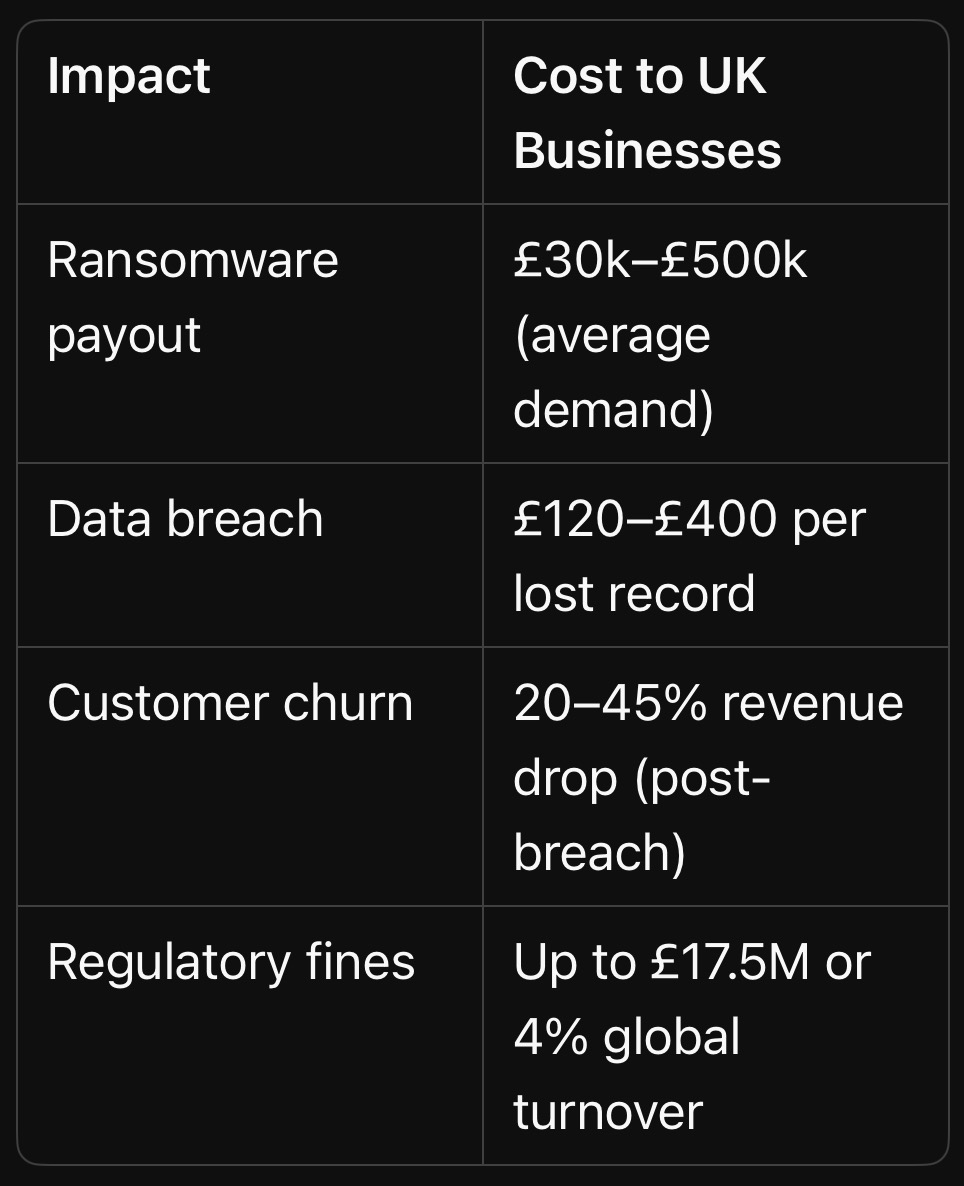
Chapter 5: Cyber Risks – The Invisible Threat That Could Bankrupt Your Business by Breakfast
Introduction: The Digital Time Bomb Ticking in Your Business
Imagine arriving at work to find:
Your customer database on the dark web
Fraudsters draining £250,000 from your account
Ransomware locking every file until you pay Bitcoin
This isn’t a movie plot — it’s Monday morning for thousands of UK businesses. Cyber risks don’t just steal data; they extort cash, destroy reputations, and trigger regulatory hell. And here’s the worst part: Most victims never see it coming until the damage is done.
—
1. The Direct Costs: What Happens When Cybercrime Hits
A. Ransomware: The Digital Kidnapping Epidemic
2023 Reality: A UK construction firm’s blueprints, invoices, and payroll systems encrypted. Hackers demand £120,000 to unlock files.
Stat: 73% of UK businesses hit by ransomware in 2023 (NCSC).
Brutal Truth: Paying doesn’t guarantee recovery — 32% never get full data back (Sophos).
B. Data Breaches: When Your Customers Become Victims
Case Study: A mid-sized retailer’s poorly secured e-commerce platform leaks 380,000 credit cards.
£500,000 GDPR fine
£1.2M in fraud reimbursements
22% customer churn
Stat: Average UK data breach cost: £3.4 million (IBM).
C. Business Email Compromise (BEC): The Silent Heist
How It Works: A hacker impersonates your CEO, emails finance: “Urgent: Transfer £80k to new supplier.”
UK Losses: £1.3 billion stolen via BEC in 2023 (UK Finance).
—
2. The Hidden Costs That Cripple You Later
A. Reputation Freefall & Customer Exodus
After a breach:
– 58% of customers avoid breached brands (Verizon)
– Recovery Cost: 3–5X more on marketing to rebuild trust
B. Operational Paralysis
Example: A law firm’s servers go down for 72 hours post-attack. £350k in billable hours lost + client lawsuits.
C. Insurance Nightmares
Post-Claim Realities:
– Premiums triple
– Mandatory audits drain management time
– Some policies simply won’t renew
—
3. The Strategic Fallout: Long-Term Business Damage
A. Lost Contracts & Blacklisting
Government/Corporate Tenders Now Demand:
– Cyber Essentials Certification (missing? Disqualified automatically)
– Proof of incident response plans
B. Investor Flight
Startup Killer: A fintech’s pre-IPO breach scares off VCs, slashing valuation by 60%.
C. Director Liability (Yes, You Can Go to Jail)
UK Law: Under GDPR & NIS Directive, negligent executives face fines up to £17.5M or 4% of global revenue — plus disqualification.
—
4. Why Cyber Risks Are Worse Than You Think
A. It’s Not Just “Big Targets”
61% of UK attacks hit SMEs (Verizon) — hackers bet they’re unprepared.
B. Remote Work = 300% More Attack Surfaces
Example: An employee’s compromised home laptop gives hackers access to your entire CRM.
C. AI-Powered Attacks Are Here
New Threat: Deepfake audio of your CFO “calling” finance to wire funds.
Key Insight: Cyber risks aren’t an “IT problem” — they’re an existential business threat.
—
More from BusinessRiskTV Business Experts Hub : How to Fight Back
We will explore real-world cyber defenses, including:
The 5-step SME ransomware shield (costs <£5k/year)
– How to trick hackers into avoiding you (attackers prefer easy targets)
– Turning employees into human firewalls
Actionable Task: Run this free test now: [Have I Been Pwned](https://haveibeenpwned.com/) to check if your work emails are already in hacker databases.
—
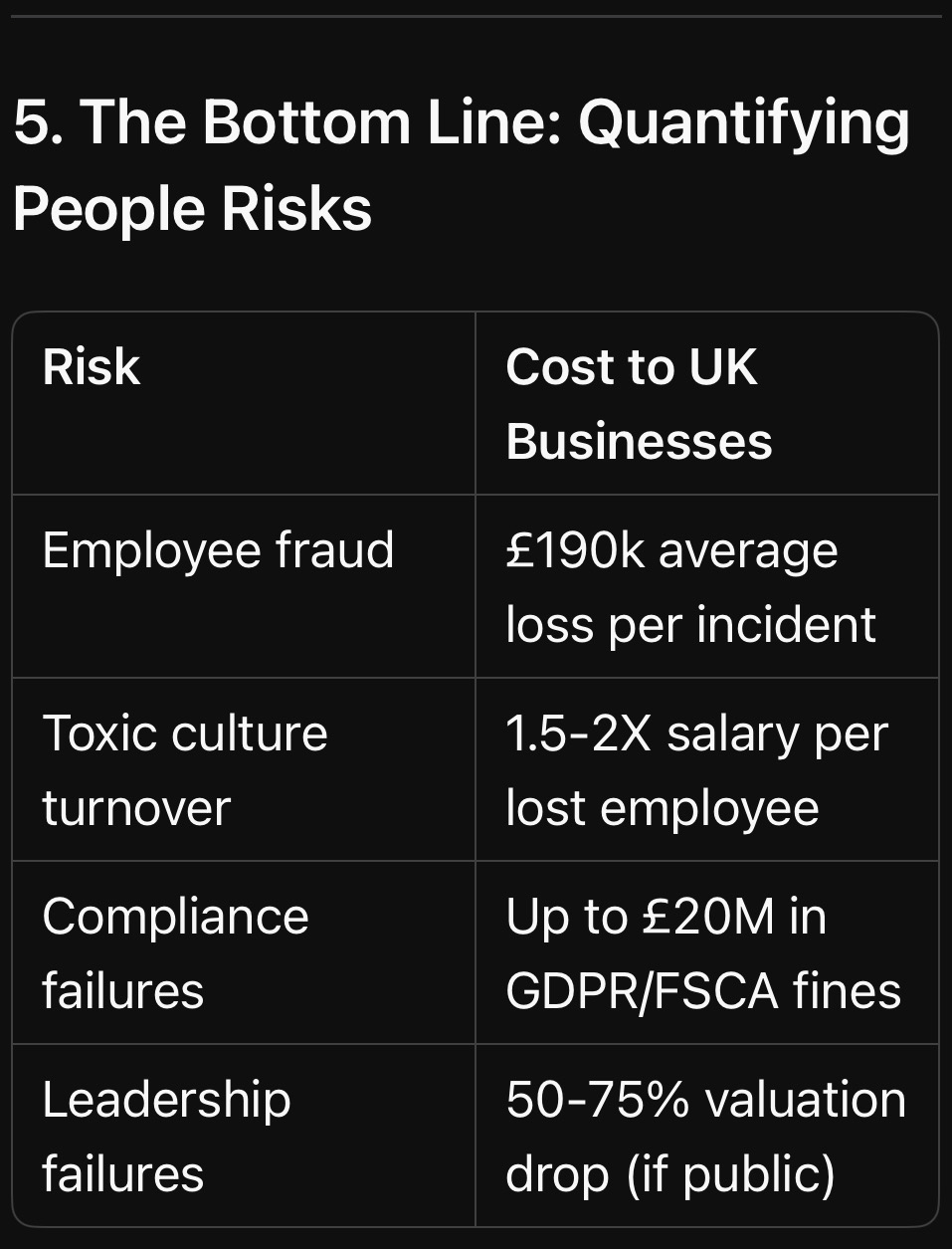
Chapter 6: Human Risks – When Your Greatest Asset Becomes Your Biggest Liability
Introduction: The Enemy Inside Your Walls
Your employees can either be your strongest defence — or your weakest link. Negligence, disengagement, and malicious actions cost UK businesses £30 billion annually (ACAS). This chapter exposes how poor people risk management leads to:
– Catastrophic errors
– Culture collapse
– Regulatory disasters
– Fraud epidemics
And why traditional HR policies fail to prevent 89% of these risks (PwC).
—
1. The Obvious (But Ignored) Human Risks
A. The High Cost of Disengagement
Example: A retail chain’s apathetic staff miss 40% of shoplifting incidents —costing £220,000/year in stolen stock.
Stat: Disengaged employees are 450% more likely to cause operational errors (Gallup).
B. Turnover Tsunamis
Case Study: A tech firm’s toxic culture drives out 7 senior engineers in 6 months — delaying a £2M product launch by 11 months.
Replacement Cost: Up to 2X annual salary per lost employee (Oxford Economics).
C. Training Gaps That Become Legal Nightmares
Reality Check: A warehouse worker badly operates a forklift, causing £80k in damages + HSE fines—because “training was just a 10-minute video.”
—
2. The Hidden (But More Dangerous) Human Risks
A. Insider Threats: When Employees Attack
Shocking Stat: 58% of data breaches involve insiders (Verizon).
Methods:
– The Malicious: IT admin sells customer data (£50k on dark web)
– The Careless: Accountant emails payroll files to personal Gmail
B. Culture Risks: How Toxicity Spreads
Example: A sales team’s “win at all costs” mentality leads to fraudulent client promises — £600k in lawsuits + FCA investigation.
C. Leadership Blind Spots
CEO Overconfidence: Ignoring team warnings about a flawed expansion → £3M write-off.
Stat: 82% of business failures trace back to poor leadership decisions (KPMG).
—
3. The Strategic Fallout: When People Risks Sink Companies
A. The Volkswagen Emissions Scandal
Root Cause: A culture where “nobody dared question” fraudulent engineering.
– Cost: €32 billion in fines/losses + permanent brand damage.
B. The Barclays CEO Scandal
How It Happened: Leadership’s obsession with “star hires” led to unchecked bullying — triggering £1M fines + investor revolt.
C. The Everyday SME Killer
Scenario: Your “trusted” bookkeeper embezzles £150k over 3 years — exposed only during a tax audit.
—
4. Why Traditional Approaches Fail
Annual compliance training?86% of employees forget it within 30 days (MIT).
“Hotline whistleblowing”?62% of staff fear retaliation (EY).
Top-down policies? Frontline teams see them as “head office nonsense.”
Key Insight: Your employees create or destroy value daily — often without realising it.
—
More from BusinessRiskTV Business Experts Hub : How to Transform Human Risk into Advantage
We explore battle-tested solutions, including:
The “Psychological Safety” hack
How to spot insider threats before they strike
Turning compliance into competitive edge
Actionable Task: Run a 5-minute “risk culture pulse check” with your team this week: “What’s one process you think could fail catastrophically?”
—
Chapter 7: Supply Chain Risks – The Fragile Web That Could Strangle Your Business Overnight
Introduction: Your Business Is Only as Strong as Its Weakest Supplier
A single delayed shipment. One insolvent vendor. A geopolitical shockwave. Suddenly, your production line stops, customers revolt, and cash flow evaporates.
Key Insight: Supply chains have become the ultimate leverage point — for your competitors or your downfall.
—
More from BusinessRiskTV Business Experts Hub : How to Build an Unbreakable Supply Chain
We explore wartime-tested strategies, including:
The “3D Supplier Mapping” trick (used by Special Forces logisticians)
How to turn suppliers into partners (not adversaries)
When to nearshore/onshore without bankrupting yourself
Actionable Task: Identify one “critical” supplier you couldn’t operate without. How would you survive if they vanished tomorrow?
—
Chapter 8: Reputational Risks – When Trust Collapses Faster Than Your Share Price
Introduction: The 24-Hour Business Execution
A single tweet. One viral video. A disgruntled employee’s LinkedIn post. In today’s digital wildfire, your hard-earned reputation can evaporate before your crisis team finishes their first coffee.
The brutal reality:
87% of consumers will abandon a brand after a reputation crisis (YouGov)
It takes 4-7 years to build trust but just 4 bad days to destroy it (Edelman Trust Barometer)
65% of a company’s market value is tied to intangible assets like reputation (Ocean Tomo)
This isn’t about PR spin – it’s about preventing the preventable and surviving the unpredictable.
—
1. The Obvious Reputation Killers
A. Social Media Firestorms
Case Study: A restaurant manager’s racist comment caught on video → 300,000 angry tweets in 48 hours → permanent 40% revenue drop
Stat: Viral crises spread 20x faster than management can respond (MIT Sloan)
B. Executive Scandals
The P&G CEO Effect: A $375 billion company lost $40B in market cap in days after CEO’s inappropriate relationship surfaced
“No comment” = “We’re guilty” in public perception
Corporate-speak increases distrust by 41% (Edelman)
Legal-first responses often worsen the crisis
—
5. The Survival Playbook (Preview)
More from BusinessRiskTV Business Experts Hub we will explore modern reputation armour, including:
The “Dark Web Early Warning” system (catch crises before they explode)
Turning employees into reputation ambassadors
When to apologise vs. when to fight back
Actionable Task: Google “[Your Brand] + scandal” right now. What autocomplete suggestions appear?
—
Chapter 9: Climate Risks – The Existential Threat That’s Already Costing Your Business
Introduction: Your Business Is on the Frontlines of the Climate Crisis
Climate change isn’t a distant threat — it’s eroding profits, disrupting supply chains, and rewriting industry rules rightnow. In 2024 alone, climate disasters caused $2 trillion in global losses, with businesses absorbing the brunt through:
Operational shutdowns (e.g., factories flooded, data centres overheated
Soaring insurance premiums (up 300% in high-risk zones)
Regulatory penalties (e.g., non-compliance with carbon disclosure rules)
This chapter exposes the hidden costs of climate risks — and why most companies are dangerously unprepared.
—
1. The Two Faces of Climate Risk
A. Physical Risks: When Nature Attacks
1. Acute Disasters:
– Example: Hurricane Helene (2024) caused $225B in damages, disrupting microchip supplies by destroying a key quartz supplier .
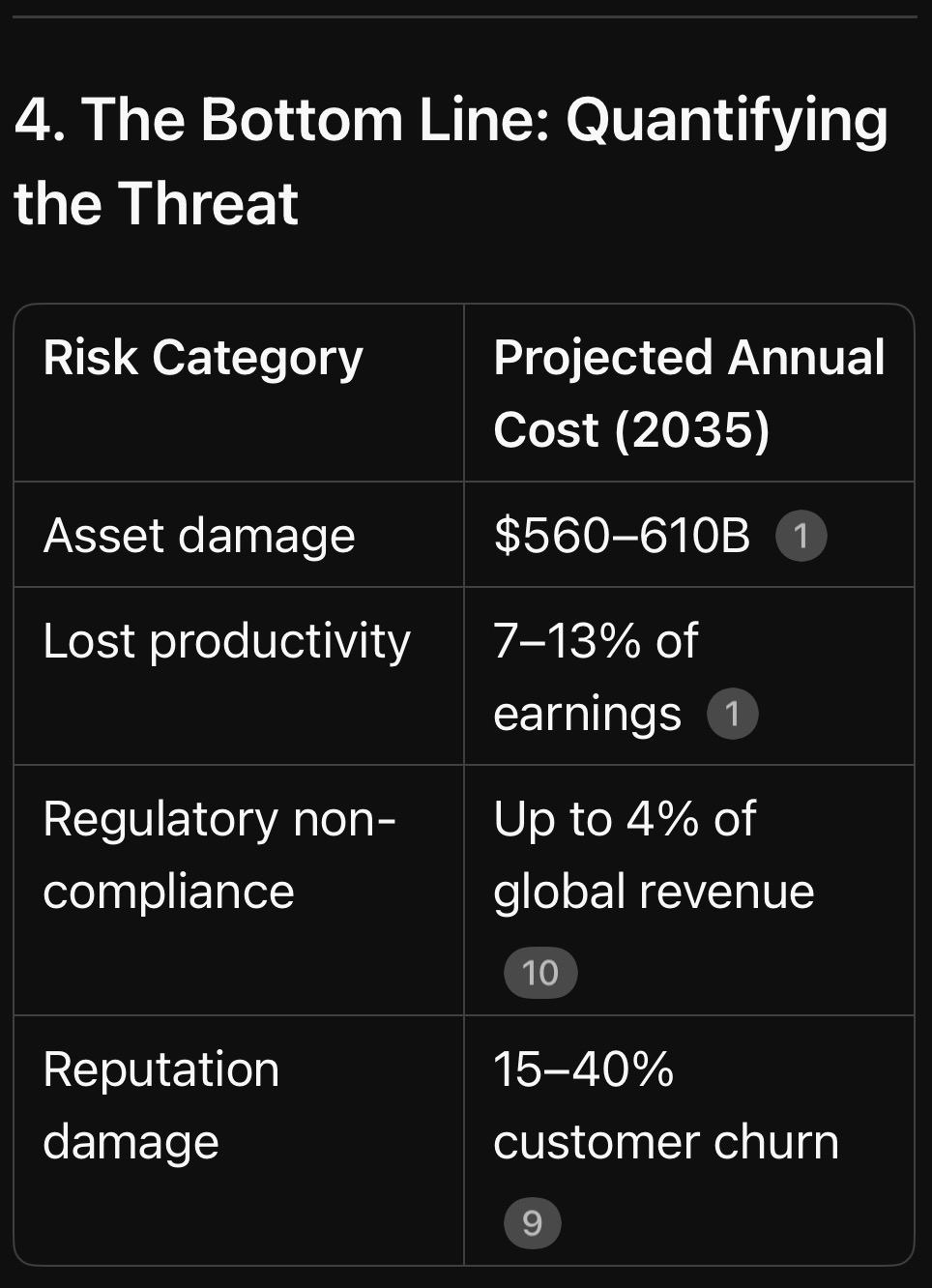
– Stat: Severe weather events now cost businesses $560–610B yearly in asset losses .
2. Chronic Pressures:
– Heatwaves reduce worker productivity by 15–20% in sectors like construction and agriculture .
– Droughts forced a UK beverage company to halt production for 6 weeks due to water shortages .
B. Transition Risks: The Legal and Market Backlash
1. Policy Shocks:
– Carbon taxes could erase 20% of profits for high-emission firms by 2030 .
– Example: EU’s Carbon Border Tax added 10–20% costs for non-compliant imports .
2. Reputation Fallout:
– 75% of consumers boycott brands with poor sustainability records .
– Investor Flight: ESG-backlash aside, 90% of Fortune 500 firms now face shareholder climate lawsuits .
—
2. The Hidden Costs You’re Not Tracking
A. Supply Chain Domino Effects
Case Study: Floods in Thailand (2023) disrupted 40% of global hard drive production → tech firms lost $20B+
Stat: 73% of companies admit their supply chains are “highly vulnerable” to climate shocks .
B. Workforce Crises
Heat Stress: UK warehouses saw 30% more sick days during 2024’s record summer .
Talent Drain: 67% of Gen Z employees reject jobs at firms with weak climate policies .
C. Stranded Assets
Example: Oil companies wrote off $300B in reserves as “unburnable” due to net-zero policies.
Projection: 20% of commercial real estate will be uninsurable by 2030 .
Key Insight: Climate risks are profit killers — not just “ESG checkboxes.”
—
More from BusinessRiskTV Business Experts Hub : How to Fight Back
We will explore actionable climate resilience strategies, including:
The “3D Supply Chain Mapping” tactic (used by Special Forces logisticians)
How to turn carbon cuts into tax savings
AI-powered climate forecasting tools
Actionable Task: Run a 5-minute vulnerability scan: Which single climate threat (e.g., flood, heatwave) couldshut down your operations for 48 hours?
—
*Sources: World Economic Forum , Allianz , Beazley , Optera , EPA *
Chapter 10: 12 Actionable Solutions to Transform Risk into Competitive Advantage
Introduction: Risk Management Isn’t About Survival—It’s About Dominance
The most profitable companies don’t just avoid risks — they weaponise them. Toyota’s supply chain resilience made it the #1 automaker during the chip shortage. Amazon turned cybersecurity into a $35B AWS profit centre.
This chapter delivers 12 battle-tested solutions to stop losing money and start outpacing competitors.
—
Solution 1: The “Risk Ownership” Culture Hack
Problem: Employees see risk as “management’s problem.”
Fix:
– Tie 10-15% of bonuses to risk KPIs (e.g., near-miss reports, compliance audits)
– Example: A logistics firm reduced warehouse injuries by 62% after adding safety metrics to performance reviews
Action Step: This week, have each department identify one preventable risk they’ll now “own.”
—
Solution 2: The 5-Minute Daily Risk Radar
Problem: Monthly reports miss emerging threats.
Fix:
– Daily 5-minute standups on:
Top 3 operational vulnerabilities (e.g., server capacity, inventory levels)
Weak signals (e.g., supplier payment delays, social media complaints)
Case Study: A manufacturer caught a critical component shortage 3 weeks early by tracking supplier lead times daily
**Template:**
“`
[ ] Key risk #1 status
[ ] New threat detected
[ ] Mitigation action
“`
—
Solution 3: Cyber “Human Firewall” Training That Works
Problem: Boring compliance training fails.
Fix:
Monthly simulated phishing with “hacked” employees retaking interactive VR training
Result: One law firm reduced click-through rates from 28% to 3% in 6 months
Free Tool: Use CanIPhish for automated simulations
—
Solution 4: The 13-Week Cash Flow War Chest
Problem: Companies die from cash flow gaps, not lack of profit.
Fix:
1. Map all cash inflows/outflows week-by-week
2. Identify 3 survival levers (e.g., delayed payables, early collections)
3. Stress test with:
– 30% sales drop
– 60-day client payment delays
Example: A restaurant chain survived COVID by pre-negotiating 90-day rent deferrals before lockdowns
—
Solution 5: Supplier “X-Ray” Audits
Problem: 4th-tier suppliers can bankrupt you.
Fix:
– Demand blockchain-tracked materials for critical inputs
– Red Team Test: Randomly delay payments to check supplier liquidity
– Stat: Firms with mapped supply chains recover 9x faster from disruptions
—
Solution 6: AI-Powered Risk Forecasting
Toolkit:
Climate: Cervest (predict asset flooding)
Cyber: Darktrace (autonomous threat detection)
Financial: Simudyne (stress test scenarios)
ROI Example: A insurer cut claims by 22% using flood prediction AI
—
Solution 7: The “Pre-Mortem” Strategy Session
Problem: Executives ignore failure scenarios.
Fix: Before decisions:
1. Imagine the project has failed catastrophically
2. Brainstorm exactly why
3. Build safeguards
Case Study: Boeing’s 737 Max crashes could’ve been prevented by this method
—
Solution 8: Embedded Risk Officers
Innovation: Place risk champions in:
– R&D teams (kill flawed prototypes early)
– Sales (flag unrealistic client promises)
– Result: A pharma firm avoided $200M in FDA fines by catching compliance gaps during drug development
—
Solution 9: Dynamic Risk Scoring
Tool: Custom risk dashboards weighting:
– Probability (1–10)
– Impact (£)
– Velocity (how fast threat is growing)
– Example: A bank auto-prioritises risks scoring >£500k impact
—
Solution 10: The “Unthinkable” Drill
Annual Exercise: Simulate:
– CEO arrested
– HQ destroyed
– Key Result: BrewDog survived a ransomware attack because they’d practiced IT failovers quarterly
—
Solution 11: Turn Risk Into Revenue
Examples:
– Tesla sells carbon credits ($1.8B in 2023)
– Maersk’s green shipping premiums command 20% price hikes