Two-Speed Europe: Is the EU’s New “E6” Core a Path to Collapse? | BusinessRiskTV

Two-Speed Europe Business Guide: Risks, Opportunities & 6 Strategic Steps : The EU’s two-speed plan reshapes business. Our analysis covers the E6 group’s impact, supply chain shifts, and 6 essential risk management steps for leaders.

The E6 Core and the Coming EU Cracks: A Contrarian Risk Analysis for Business

The Inconvenient Truth: A Multi-Speed EU Reflects a Failing Political System

The proposal for a “two-speed Europe” championed by German Finance Minister Lars Klingbeil is not a clever, flexible solution for the European Union. It is a desperate, last-ditch political manoeuvre that starkly reveals the bloc’s fundamental dysfunction. The core thesis is this: The EU has become so politically paralysed that it can no longer function as a cohesive unit, forcing its largest and wealthiest members to abandon the pretence of consensus. The formation of the “E6” (Germany, France, Italy, Spain, Poland, Netherlands) is not a temporary working group; it is the blueprint for an elite, high-speed political and economic directorate designed to override the cumbersome machinery of the full 27-member union. This move does not save the EU; it initiates its reconfiguration into a core-periphery model that will breed permanent resentment and could catalyse the bloc’s gradual disintegration, particularly as political winds shift within its own core.

While defenders claim this is a “pragmatic” solution to EU decision-making inertia, the reality is that it formalises failure. It accepts that the core EU treaty principle of achieving “ever closer union” among equals is dead, replaced by a system where a few powerful states simply move forward and impose their agenda. This is not a benign technicality. It creates a de facto first- and second-class membership, where the “peripheral” nations are systematically disadvantaged, their policy autonomy undermined, and their ability to shape the European project severely diminished.

The “E6” Core Group: A Cartel That Will Ignore and Override the Rest

The risk that the E6 will act as an internal cartel, sidelining the wishes of other member states, is not a hypothetical fear—it is the explicit purpose of the formation.

  • Circumventing Vetoes and Imposing Policy: The primary motivation for the E6 is to bypass the EU’s unanimity requirement on sensitive matters like foreign policy, taxation, and security. When Luxembourg’s Prime Minister argued for a two-speed model, his logic was chillingly clear: “When a country says ‘I don’t want to,’ I can say: ‘Well, too bad. Don’t block me. Let me get on with it with others'”. This sentiment is the E6’s operating principle.
  • Existing Precedents of Core-Periphery Exploitation: This is not a new dynamic, but the hardening of an existing, exploitative one. An academic study examining the post-2009 crisis period shows how EU austerity policies, dictated by core institutions, devastated peripheral economies like Greece, locking them into a dependent relationship and widening economic and social gaps. The E6 formalises this power imbalance, allowing the core to set fiscal, defence, and industrial policies that serve their interests first.
  • The Single Market as a Tool of Coercion: Proponents argue that “outsider” nations will remain linked via the single market. In practice, this means they will be forced to accept regulations and standards set by the E6 to maintain market access, but will have no substantive vote in creating them. They become rule-takers, not rule-makers. The EU’s internal market, once a tool for convergence, risks becoming a mechanism for enforcing the core’s will on the periphery.

From Multi-Speed to Total Breakdown: The Domino Scenario of Collapse

The greatest existential threat to the EU is not this proposal itself, but the long-term political chain reaction it sets off.

  • Accelerating Divergence and Breeding Nationalism: A formalised two-tier system will halt economic and social convergence. One analyst warns it could increase economic divergence, leading to greater migration pressures and ultimately calls to limit the EU’s foundational principle of free movement. This fuels the very nationalist, anti-EU sentiments the bloc fears. Countries left in the “slow lane” will see their citizens grow disillusioned with a union that offers them diminished prospects and influence.
  • Political Shockwaves from Within the Core: The E6 is not a monolith. Poland’s inclusion is particularly volatile, given its government’s history of fierce clashes with Brussels over the rule of law. A future populist government in Italy, Spain, or even France could look at the E6’s commitments and decide to follow a British path. The exit of a single major E6 member would not just weaken the core; it would shatter the entire political and economic logic of the two-speed model, potentially triggering a rush for the exits.
  • The “Grexit” Precedent on a Grand Scale: The Greek debt crisis proved that the EU core was willing to entertain the expulsion of a member to preserve the eurozone. A two-speed Europe makes this concept operational. Weaker economies that fail to keep pace could face intense pressure to leave certain policy areas or be politically marginalised, creating a de facto “flexible disintegration”. Once the principle of an “inner circle” is accepted, the unthinkable—managing a member’s partial or full exit—becomes a policy tool.

Six Controversial Risk Management Steps for Business Leaders

Given this bleak prognosis, business leaders must abandon hope for EU stability and adopt a ruthless, realpolitik strategy.

1. Abandon “EU-Wide” Strategy; Adopt a “Core-First, Periphery-Contingent” Model

  • Action: Immediately re-allocate capital and strategic focus to the E6 nations. Treat the rest of the EU as a secondary, higher-risk market. Develop separate investment theses: one for the integrated, subsidy-rich core, and another for the volatile periphery.
  • Rationale: Future EU funding, defence contracts, and regulatory advantages will be heavily concentrated within the core. The periphery will suffer from capital flight and policy neglect.

2. Prepare for the End of the Single Market as We Know It

  • Action: Conduct stress tests on your supply chains and logistics for scenarios where free movement of goods, services, or people is restricted between the core and periphery, or where the core imposes new digital or regulatory borders.
  • Rationale: The political logic of a two-tier Europe inherently leads to regulatory divergence and potential barriers. Businesses cannot assume the single market’s integrity will survive this political fracturing.

3. Bet on the Core’s “Fortress” Economy—Especially in Defense and Tech

  • Action: Aggressively pivot business development towards sectors explicitly prioritised by the E6: defence manufacturing, dual-use technologies, critical raw material processing, and fintech platforms aligned with a deeper capital markets union.
  • Rationale: The E6’s agenda is to build strategic autonomy. This means massive, protected subsidies and procurement contracts for core-based champions, explicitly turning “defence into an engine for growth”.

4. Establish Political Risk Units Focused on Nationalist Movements in E6 Countries

  • Action: Move beyond tracking Brussels policy. Invest in intelligence-gathering on rising anti-EU, populist parties in Italy, France, and Poland. Model the business impact of any one of them winning power and renouncing E6 commitments.
  • Rationale: The stability of the entire new structure rests on the continued political alignment of its core members. This is its greatest vulnerability. A political shock in one E6 nation could unravel everything overnight.

5. Develop “Nation-State” Lobbying Capabilities to Bypass Brussels

  • Action: Drastically reduce reliance on pan-EU trade associations. Build direct, powerful lobbying operations within the national parliaments and ministries of Berlin, Paris, and Rome.
  • Rationale: Real power is shifting from EU institutions back to the capitals of the core nations. The E6 will decide policy in closed-door meetings, not in the European Parliament.

6. Scenario Plan for the “Domino Exit” and EU Liquidation

  • Action: Develop a confidential contingency plan for a rapid, uncoordinated unwind of the EU. This includes legal entity restructuring, currency re-denomination risk plans, and strategies for protecting assets.
  • Rationale: While not the most likely scenario, the two-speed model makes a catastrophic failure sequence plausible. Leaders who dismiss this possibility are ignoring the historical precedent of how political unions can unravel with stunning speed when their central bargain breaks down.

Conclusion: Navigating the Unravelling

The two-speed Europe is a sign of profound weakness, not strength. It is an admission that the grand political project of unification has stalled and is now being replaced by a mercantilist club dominated by its largest economies. For businesses, the era of a predictable, rules-based EU is ending. The new era will be defined by geopolitical manoeuvring, privileged access for insiders, and heightened systemic risk. The prudent leader will not plan for a more integrated Europe, but for a fragmented one, where survival depends on picking the right side in a quiet internal conflict that has already begun.

#TwoSpeedEurope #EUCollapse #GeopoliticalRisk #BusinessStrategy #E6Core

Get help to protect and grow your business with BusinessRiskTV regardless of uncertainties in the business environment

Find out more about growing your business faster through greater uncertainty 

Subscribe for free business risk management ideas risk reviews and cost reduction tips

Connect with us for free business risk management tips

Read more business risk management articles and view videos for free

Connect with us for free alerts to new business risk management articles and videos 

Two-Speed Europe: Is the EU’s New “E6” Core a Path to Collapse? | BusinessRiskTV
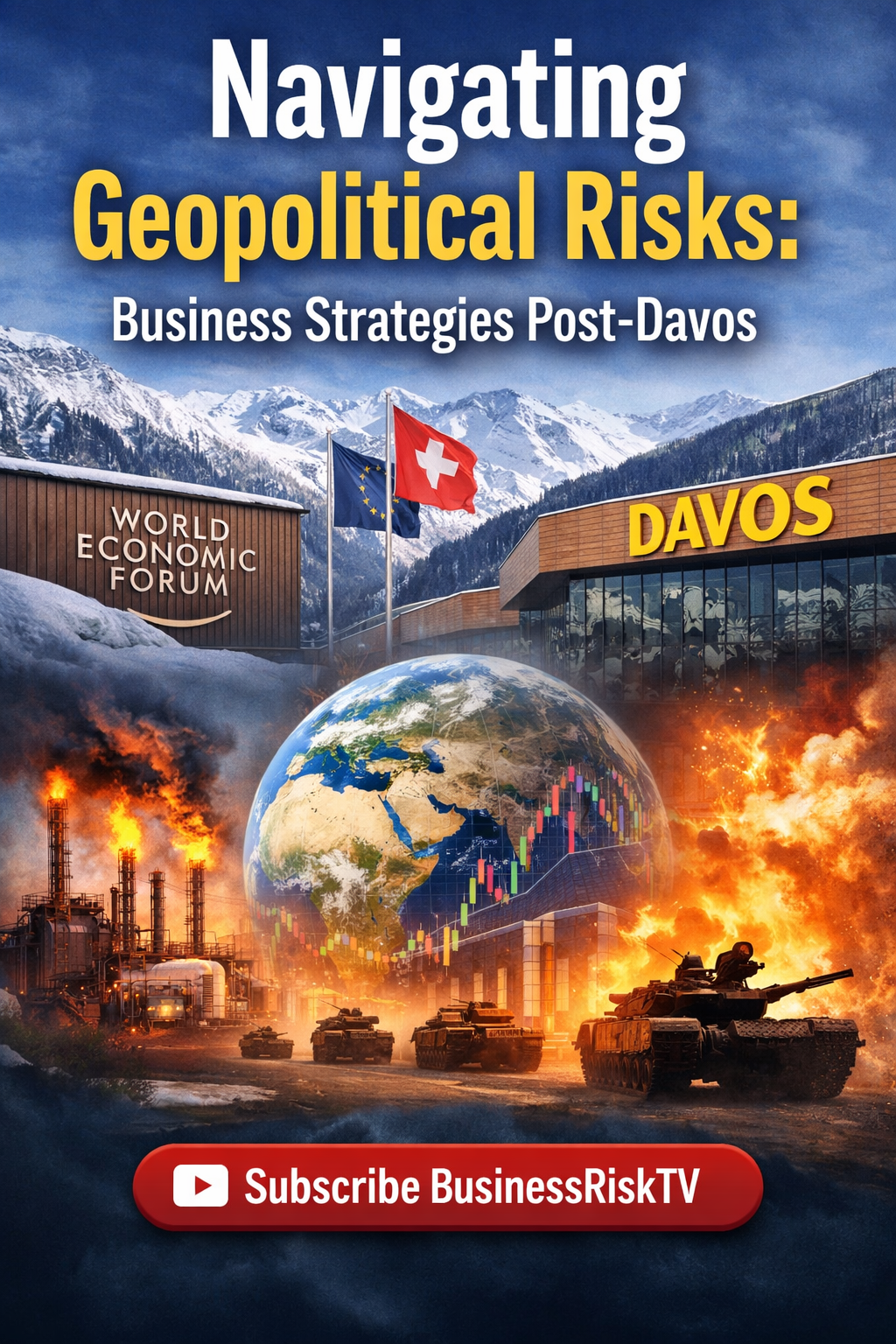
Navigating Geopolitical Storms: Business Risk Analysis Post-Davos 2026

The 2026 World Economic Forum in Davos revealed a stark rupture in transatlantic relations, creating immediate and long-term risks for global businesses. This analysis breaks down the key takeaways for leaders and provides six actionable steps to protect and grow your business in an era of heightened geopolitical confrontation.

The Davos Divide and the New Risk Landscape

The 2026 World Economic Forum in Davos will be remembered not for its solutions, but for its stark exposures. The confrontation between European leaders and the American administration laid bare a deep fracture in the Western alliance, moving geopolitical tensions from the background to the forefront of executive decision-making. President Trump’s antagonistic speech, which included grievances against European allies, questioning of NATO commitments, and a relentless focus on acquiring Greenland, signalled a profound shift toward a world where confrontation is replacing collaboration.

For business leaders, this is not merely political theatre. It is a direct and material risk. The WEF’s own Global Risks Report 2026 identifies “geoeconomic confrontation” as the top risk most likely to trigger a global crisis this year, followed by state-based armed conflict. This environment demands a new playbook for risk management—one that is proactive, integrated, and resilient. The old model of globalisation, with its deeply integrated supply chains and stable multilateral rules, is under severe pressure. As one analysis notes, companies are now forced to consider parallel supply chains and navigate a world where data, trade, and investment are increasingly weaponised.

This post provides a clear-eyed analysis of the key business risks emerging from Davos and outlines six practical, immediate steps to turn this uncertainty into a strategic advantage.

Key Risk Exposures for Businesses After Davos 2026

The events at Davos crystallised several interconnected risk categories that threaten business operations, strategy, and financial performance.

1. Accelerated Geoeconomic Fragmentation & Supply Chain Rupture

The core takeaway is the active unravelling of decades of economic integration. The U.S. administration’s focus on unilateral deals and transactional relationships, as seen with the “framework” for Greenland, undermines the predictable, rules-based system. For businesses, this translates directly into severe supply chain vulnerability. As noted in research from Wharton, companies are being forced to build duplicate, resilient supply chains—a China-centric one and a non-China-centric one—which creates enormous cost and redundancy. This fragmentation is no longer a future threat; it is a present-day operational and financial challenge.

2. Policy Volatility and Regulatory Divergence

Davos highlighted a growing chasm in core policy areas, especially climate and energy. While European leaders and CEOs like Allianz’s Oliver Bäte passionately defended the green transition, calling backlash “bulls—,” the U.S. administration championed fossil fuels and mocked renewable energy policies. This divergence creates a nightmare of regulatory compliance. Companies operating transatlantically face conflicting mandates, as seen historically with EU laws forcing tech changes (like the USB-C port mandate) and strict data rules like GDPR. The risk is being caught in a regulatory crossfire, incurring massive costs to comply with opposing standards in different markets.

3. The Weaponisation of Data and Digital Platforms

A novel and under appreciated risk highlighted in broader analyses is the politicisation of data. Governments increasingly demand control over data of multinational companies within their borders, using it as a tool for political leverage. This was evident in past pressures on tech companies during geopolitical tensions. In a world of “multipolarity without multilateralism,” your customer data, operational data, and intellectual property are no longer just corporate assets—they are geopolitical pawns. This creates immense risks for data security, privacy compliance, and brand reputation.

4. Erosion of the Social License to Operate

Businesses are increasingly “stuck in the middle” of societal and political polarisation. The “streets versus elites” narrative is rising, and companies face pressure to take stands on divisive issues while also demonstrating fealty to national governments. The WEF report identifies misinformation and disinformation as the #2 global risk over the next two years, which can rapidly inflame public sentiment against a brand. Navigating these waters without a clear strategy exposes companies to boycotts, talent attrition, and lasting reputational damage.

Six Practical Risk Management Steps for Business Leaders

In this age of competition, a reactive, wait-and-watch approach is a direct threat to survival. Here is your six-step action plan to build resilience and discover opportunity.

Step 1: Conduct a Geopolitical Stress Test on Your Core Operations

Immediately move beyond traditional SWOT analysis. Launch a cross-functional task force to conduct a dedicated geopolitical stress test. This involves mapping your entire value chain—from critical material sourcing and Tier-N suppliers to key logistics corridors and primary sales markets—against a map of escalating geopolitical flashpoints. Quantify the impact of potential disruptions. For example, what is the financial exposure if a specific trade corridor is tariffed or closed? What alternative suppliers exist outside of geopolitical hotspots? The goal is to move from qualitative worry to quantitative preparedness.

Step 2: Build a Dynamic Early Warning System

You cannot manage what you do not see. Relying on quarterly risk reports is obsolete. Implement an AI-powered early warning system that monitors real-time signals. This system should track not just news, but proposed legislation, social media sentiment, and trade policy adjustments in all your operational regions. Use technology to set alerts for specific keywords related to your industry, as some firms track terms like “oil drilling” in legislative texts. This transforms scattered data into actionable intelligence, giving you a crucial time advantage to respond.

Step 3: Formalise a “Political Risk War Room” and Governance

Political risk can no longer be siloed in government affairs. Follow the advice of experts and establish a cross-functional geostrategic committee that reports directly to the C-suite and board. This committee should include leaders from supply chain, finance, legal, communications, and strategy. Its mandate is to meet regularly, review early-warning intelligence, assess potential financial impacts, and authorise pre-planned contingency actions. This governance structure ensures rapid, coordinated decision-making when a crisis emerges.

Step 4: Develop “Plug-and-Play” Contingency Plans for Key Scenarios

For your top three geopolitical risk scenarios (e.g., “Sudden Tariffs on Key Import,” “Embargo on Technology Exports to Market X,” “Forced Local Data Storage Mandate”), develop pre-approved contingency playbooks. These should outline clear trigger points, decision authorities, and specific actions. For instance, a playbook for new tariffs might include immediate steps to activate alternative shipping routes, pre-negotiated contracts with alternative suppliers, and a communications template for customers. This shifts the response from panic to execution.

Step 5: Diversify Stakeholder Capital and Government Relationships

In a fragmented world, relationships are a critical risk mitigation asset. Proactively diversify your stakeholder engagement beyond traditional channels. Build relationships with policymakers, regulators, and community leaders in all your key markets before a crisis hits. Furthermore, explore financial resilience tools like political risk insurance to protect physical assets and investments in unstable regions. Also, reassess your capital structure and banking relationships to ensure you have access to liquidity from diverse sources if financial markets seize up due to geopolitical shock.

Step 6: Embed Strategic Agility into Your Business Model

Ultimately, the greatest risk is the status quo. Use this moment of clarity to build inherent agility into your business model. This includes:

  • Product Design: Develop products with modular designs that can be easily adapted to different regulatory or standards environments (e.g., different power specs, data protocols).
  • Manufacturing: Invest in flexible, smaller-scale production facilities (like “micro-factories”) that can be relocated or repurposed faster than monolithic plants.
  • Talent Strategy: Cultivate a distributed leadership bench with deep regional expertise, empowering local teams to make rapid decisions in response to local disruptions.

Conclusion: From Risk to Resilient Growth

The message from Davos 2026 is unambiguous: the business environment has fundamentally shifted. The greatest danger now is inaction—the risk of assuming the old rules still apply. However, within this volatility lies significant opportunity. Companies that proactively manage these geopolitical risks will not only protect their existing value but will gain a powerful competitive edge. They will be the ones able to seize market share as slower competitors falter, negotiate from a position of strength with governments, and attract investment as havens of stability.

The time for vague concern is over. The time for deliberate, structured action is now. Begin your geopolitical stress test this week.

Protect and grow your business faster with BusinessRiskTV

Find out more about growing your business faster with less uncertainty impacting your business objectives 

Subscribe for free business risk management ideas risk reviews and cost reduction tips

Connect with us for free business risk management tips

Read more free business risk management articles and view videos for free

Connect with us for free alerts to new business risk management articles and videos

Navigating Geopolitical Storms: Business Risk Analysis Post-Davos 2026

Risks Business Leaders Fear Most : Geopolitical Risks 2024

Make sure you know who could damage your business or present new opportunities for growth

2024: Navigating the Political Storm – A Business Leader’s Guide to Risk Management

As we gaze into the crystal ball of 2024, the political landscape shimmers with both opportunity and peril. For business leaders, navigating this terrain requires not just a keen eye for the market, but an astute understanding of the political forces that can shape – or shatter – their best-laid plans. Let’s look at political risk insights and risk management strategies needed to mitigate the biggest political risks of the year ahead.

The Looming Giants: Four Major Political Risks of 2024

  1. The US Presidential Election: Buckle up, folks, it’s a wild ride. With the incumbent facing a resurgent opposition and a potential third-party candidate throwing a wrench in the gears, the 2024 US election promises to be a nail-biter. The volatility will spill over into global markets, impacting trade, investment, and even travel.

Quote: “Politics are almost as exciting as war, and quite as unpredictable.” – Winston Churchill

  1. Geopolitical Tensions: The simmering tensions between major powers, fuelled by ideological clashes and resource competition, threaten to boil over in 2024. From the South China Sea to the Ukraine conflict, businesses with footprints in these volatile regions must prepare for disruptions and potential sanctions.

Quote: “In times of conflict, the law falls silent.” – Marcus Tullius Cicero

  1. The Rise of Populism: The siren song of populism continues to enchant disillusioned voters, potentially ushering in leaders with unpredictable agendas and protectionist policies. Businesses reliant on open markets and global supply chains must adapt to navigate these shifting sands.

Quote: “A nation cannot exist half slave and half free.” – Abraham Lincoln

  1. Climate Change and Social Unrest: As the existential threat of climate change intensifies, so too does the potential for social unrest and political instability. Businesses operating in vulnerable regions must factor in the possibility of protests, civil disobedience, and even government clampdowns.

Quote: “The Earth has provided for life for billions of years… it will do so for billions more without us.” – Carl Sagan

Risk Management Toolbox: Strategies for Weathering the Storm

While the future is inherently uncertain, proactive risk management can turn challenges into opportunities. Here are some key strategies to consider:

  1. Scenario Planning: Develop multiple scenarios based on different political outcomes, allowing you to adapt and pivot quickly. Think of it as playing chess ahead of time, considering all your opponent’s possible moves.

  2. Diversification: Don’t put all your eggs in one basket. Spread your investments and operations across diverse regions and markets, diluting your exposure to any single political risk.

  3. Lobbying and Engagement: Build relationships with policymakers and key stakeholders. Proactive engagement can ensure your voice is heard and your interests are considered as policies are formulated.

  4. Crisis Communication: Have a clear communication plan in place for navigating potential crises. Transparency and timely updates can mitigate reputational damage and build trust with stakeholders.

  5. Seek Expert Guidance: Don’t go it alone. Leverage the expertise of political risk consultants who can provide tailored insights and strategies for navigating complex political landscapes.

Remember, the key to successful risk management is not predicting the future, but being prepared for whatever it throws your way. By understanding the biggest political risks of 2024 and implementing these proactive strategies, you can turn uncertainty into a competitive advantage and steer your business toward continued success. And as Sun Tzu wisely advised, “Know the enemy and know yourself; in every battle, you will then be victorious.”

Get help to protect and grow your business

Find Out More

Subscribe for free risk alerts and risk reviews

Contact Us

Read more free business risk management articles

Contact Us

Lions Led By Donkeys

We get the politicians we deserve!

The A Political Quagmire: Navigating Uncertain Seas in the US and UK

The year 2023 has painted a stark picture of political dysfunction in both the United States and the United Kingdom. In the US, a gridlocked Congress produced a meager 23 bills, a far cry from the legislative productivity expected from the world’s leading democracy. Across the Atlantic, the echoes of Brexit continue to reverberate, with the UK Parliament bogged down in endless debates instead of tackling the pressing economic challenges facing the nation. This grim reality poses a significant challenge for individuals and businesses in both countries, leaving them adrift in a sea of uncertainty.

The American Stalemate: A Congress in Paralysis

The 2023 legislative output of the US Congress stands as a testament to the deep partisan divide currently gripping American politics. Republicans and Democrats seem locked in a perpetual tug-of-war, more interested in scoring political points than finding common ground. This has resulted in a legislative drought, leaving crucial issues like healthcare reform, infrastructure development, and climate change unaddressed.

For individuals, this political paralysis translates into a sense of disillusionment and a feeling of being forgotten by their elected representatives. The lack of progress on key issues like healthcare affordability and student loan debt directly impacts their lives, while the inaction on climate change raises anxieties about the future. Meanwhile, businesses face an unpredictable regulatory environment, hindering investment and economic growth.

Navigating the Labyrinth: What Americans Can Do

In the face of this legislative inertia, individuals and businesses must become the architects of their own destinies. Here are some strategies to navigate the American political quagmire:

  • Stay informed: Stay abreast of current events and political developments. Follow reputable news sources from both sides of the spectrum to understand the nuances of the issues and hold your elected officials accountable.
  • Engage constructively: Reach out to your representatives and express your concerns and priorities. Support organizations that advocate for issues you care about and participate in peaceful protests and demonstrations.
  • Vote strategically: Research the candidates in your local and national elections and vote based on their track record and policy positions. Consider candidates who demonstrate a willingness to compromise and work across the aisle.
  • Focus on local politics: Engage with your local community and participate in local elections. Local governments often have a significant impact on daily life, and your involvement can make a real difference.
  • Support civic engagement initiatives: Encourage and educate others about the importance of political participation. Promote initiatives that foster civil discourse and bridge the partisan divide.

Brexit’s Bitter Aftermath: UK’s Economy Lost in the Fog

While the US suffers from congressional gridlock, the UK grapples with the fallout of Brexit. The 2016 referendum, which saw a narrow vote to leave the European Union, has plunged the nation into a protracted political and economic crisis. Parliament remains embroiled in endless debates about the terms of the withdrawal agreement, with little progress made on addressing the concerns of businesses and citizens regarding trade, immigration, and the future of the National Health Service.

For individuals, Brexit has brought uncertainty about jobs, wages, and access to essential goods and services. Businesses face complex bureaucratic hurdles and the potential for reduced market access. The ongoing political turmoil erodes confidence in the economy and dampens investment, further hindering growth.

Charting a Course Forward: How the UK Can Steer Out of Troubled Waters

To emerge from this quagmire, the UK needs a renewed focus on pragmatism and national unity. Here are some potential pathways forward:

  • Prioritise the economy: Parliament must shift its focus from Brexit minutiae to addressing the immediate concerns of businesses and citizens. Policies that stimulate economic growth, create jobs, and support vulnerable communities are essential.
  • Seek common ground: Political parties must find ways to cooperate and compromise on key issues.Collaborative leadership that transcends partisan divides is crucial for navigating the challenges ahead.
  • Foster open dialogue: The government must engage in transparent communication with the public, clearly explaining the implications of various Brexit scenarios and seeking feedback on potential solutions.
  • Invest in education and skills training: Equipping the workforce with the necessary skills to thrive in the post-Brexit landscape is crucial for long-term economic success.
  • Promote international cooperation: Building strong relationships with other countries, both within and outside of the EU, will be essential for securing trade deals and fostering economic opportunity.

A Common Challenge, Different Solutions

While the political landscapes of the US and UK differ significantly, the challenges they face share a common thread: a lack of effective governance and a disconnect between elected officials and the people they represent. To overcome these hurdles, both nations must rediscover the spirit of compromise, prioritise the needs of their citizens and businesses, and embrace pragmatism over ideology.

The road ahead will undoubtedly be challenging, but by staying informed, engaging constructively, and holding their leaders accountable, individuals and businesses can play a vital role.

Get help to protect and grow your business

Find Out More

Subscribe for free business risk management news and risk reviews

Contact Us

Read more free business risk management articles

Contact Us

Pros and Cons Of Economic Migration into UK and USA

Trying to take wokeness out of key business risk management threats and opportunities

Can Economic Migrants Be the Recessionary Storm’s Lifeline? A 2024 Outlook for UK and USA

As storm clouds gather on the economic horizon, recessionary whispers turn into anxious roars in both the UK and the USA. In this tumultuous climate, a fascinating question emerges: Could economic migrants potentially act as a life raft, mitigating the damage of a potential recession in 2024?

As an expert economic analyst ( Keith Lewis ), I delve into this intricate issue, dissecting the potential role of economic migration in weathering the coming economic storm in these two major economies.

Buoying the Economy in Rough Seas:

Several arguments propose that economic migrants can serve as a buffer against recessionary forces:

  • Labour force resilience: With skilled and willing newcomers filling critical labour gaps, particularly in sectors facing shortages, economic migrants can bolster productivity and output. This can stabilise the economy and counteract downward trends, as evidenced by the contribution of migrant workers to sectors like UK healthcare and US agriculture.
  • Demand lifeline: By injecting fresh purchasing power into the economy, migrants can stimulate businesses and create jobs. This can boost aggregate demand, a crucial driver of economic recovery, as research by the OECD suggests with increased migration boosting GDP growth in several European countries.
  • Innovation anchor: Migrants often bring a wealth of entrepreneurial spirit and skills, driving business creation and innovation. This can foster economic growth and generate employment opportunities, potentially alleviating recessionary pressures, as demonstrated by the significant role of immigrants in US startup ecosystems.
  • Fiscal stability: As migrant workers contribute through income taxes and payroll deductions, they can bolster government revenue streams. This can provide crucial budgetary resources for social programs and infrastructure investments, helping governments navigate and mitigate the impact of a recession, as analyses in the UK suggest regarding the positive fiscal contribution of immigration.

However, navigating these turbulent waters necessitates caution:

  • Wage suppression: An influx of migrant workers can put downward pressure on wages,particularly for low-skilled jobs.This can dampen consumer spending and exacerbate inequalities, hindering overall economic growth, as studies in the US have shown in specific sectors.
  • Social tensions: Large-scale migration can strain social services and resources, potentially leading to public anxieties and fueling xenophobia.This can make it politically challenging to maintain open borders, even with potential economic benefits, as witnessed in the current political climates of both the UK and the USA.
  • Integration hurdles: Successful integration of migrants into the workforce and society is crucial for maximising their economic contribution. Language barriers, cultural differences, and lack of recognition of foreign qualifications can hinder integration, limiting the positive economic impact of migration. Robust policies promoting skill recognition and language training are essential to overcome these hurdles.

Navigating the Choppy Waters of 2024:

Assessing the evidence requires acknowledging the complexities of this issue. Studies on the direct link between economic migration and recessionary tendencies remain inconclusive, with varying results depending on factors like the skillsets of migrants, existing labour market conditions, and government policies. A tailored approach, considering specific national contexts, is crucial.

Charting the Course in 2024 and Beyond:

To leverage the potential benefits of economic migration while mitigating potential drawbacks in 2024 and beyond, both the UK and the USA can consider the following:

  • Skill-based migration strategies: Prioritising the entry of migrants with skills in high demand to address labour shortages and boost productivity, ensuring a win-win for both businesses and the economy.
  • Effective integration programs: Investing in language training, skills recognition, and cultural orientation programs can facilitate smooth integration, maximising the positive economic contribution of migrants and fostering social cohesion.
  • Robust social safety nets: Ensuring adequate social services and resources for both native and migrant populations can mitigate potential tensions and prevent economic hardship during a recession.
  • Data-driven policymaking: Continuously monitoring and analysing the impacts of migration policies on both the economy and social fabric is crucial for evidence-based policy adjustments and ensuring responsible management of migration in the face of economic challenges.

Conclusion:

While economic migrants cannot entirely prevent a recession, they can potentially play a crucial role in minimising its impact and expediting economic recovery. However, it is essential to acknowledge the complexities and potential challenges associated with migration. Openness to talent, coupled with responsible management, integration efforts, and data-driven policymaking, can harness the potential of economic migration to navigate the choppy waters of 2024 and build resilient economies for the future. Remember, weathering economic storms requires a balanced approach, embracing the potential of diverse resources while ensuring responsible and inclusive practices.

Subscribe to more business risk management articles videos and risk reviews

Contact Us

Grow your business faster and protect it from economic recession

Contact Us

Develop your career or fill painful skills gaps faster and cheaper

Contact Us

 .

Greatest Geopolitical Risks 2024

Managing political risks better with BusinessRiskTV

The Looming Shadow: Navigating the Labyrinth of Geopolitical Risks in 2024

The world in 2023 stands at a crossroads. As the shadow of a global pandemic recedes, new anxieties grip the international landscape. Tensions simmer in familiar hotspots, while emerging threats whisper on the horizon. In this labyrinth of uncertainties, one question burns bright: what will be the greatest geopolitical risk in 2024?

Predicting the future is a fool’s errand, but anticipating and preparing for potential storms is the essence of responsible leadership. While pinpointing a singular “greatest” risk might be an oversimplification, we can examine four contenders each capable of casting a long, disruptive shadow in 2024:

1. The Dragon and the Tiger: Escalating Tensions in the Taiwan Strait:

The Taiwan Strait, a narrow waterway separating mainland China and the self-governing island of Taiwan, has long been a tinderbox of geopolitical tension. China, viewing Taiwan as a breakaway province, refuses to renounce the use of force in achieving reunification. Taiwan, on the other hand, maintains robust democratic institutions and enjoys strong international support, particularly from the United States.

In 2024, several factors could elevate the risk of confrontation in the Taiwan Strait:

  • Increased Chinese military assertiveness: Beijing’s recent actions, like frequent incursions into Taiwanese airspace and military drills simulating island invasion, signal a growing determination to assert its dominance.
  • Taiwan’s presidential elections: Scheduled for January 2024, the elections could see the victory of a pro-independence candidate, further inflaming Chinese grievances.
  • Miscalculations and accidents: Unforeseen incidents, either military mishaps or deliberate provocations, could spiral into an unintended conflict with devastating consequences.

The potential ramifications of a Taiwan Strait conflict are immense. A full-scale war could trigger a massive humanitarian crisis, disrupt global supply chains, and plunge the world into a new era of Cold War-esque tensions.

2. The Ukrainian Quagmire: War’s Long Shadow and Spillover Risks:

The ongoing war in Ukraine continues to cast a long, dark shadow over Europe and the global order. Even if a resolution were reached in 2024, the war’s legacy will extend far beyond the battlefield. Here are some potential avenues for risk:

  • Protracted conflict and instability: Even a ceasefire wouldn’t guarantee lasting peace. A simmering conflict in Ukraine could destabilise the region, create a humanitarian crisis, and strain international relations.
  • Spillover effects into neighbouring countries: The war could trigger unrest or refugee crises in bordering nations like Moldova, Belarus, and the Baltic states.
  • Weapons proliferation and escalation: The possibility of Russia or Ukraine resorting to unconventional weapons or dragging other powers into the conflict cannot be entirely discounted.

The war in Ukraine has already disrupted the global food and energy markets, impacting economies worldwide. A further escalation could exacerbate these vulnerabilities, leading to economic hardship and political instability in vulnerable regions.

3. Iran’s Nuclear Tightrope: Unveiling the Bomb or Stepping Back from the Brink?

Iran’s nuclear programme remains a contentious issue, raising concerns about its potential for weapons development and regional instability. In 2024, the trajectory of Iran’s nuclear ambitions could significantly impact the geopolitical landscape:

  • Collapse of the JCPOA: The 2015 Joint Comprehensive Plan of Action, which aimed to curb Iran’s nuclear programme in exchange for sanctions relief, currently hangs by a thread. Its collapse could pave the way for Iran to accelerate its nuclear activities,raising the specter of a military strike from Israel or the United States.
  • Internal political dynamics: The political climate in Iran could influence its approach to the nuclear issue. Hardliners gaining ascendancy could increase the risk of confrontation, while moderates gaining ground could offer an opportunity for renewed diplomacy.
  • Regional proxy conflicts: Iran’s support for Shia militias across the Middle East could exacerbate existing tensions and potentially trigger wider regional conflicts.

A nuclear-armed Iran could reshape the Middle East power dynamics, posing a significant threat to Israel and its allies. It could also trigger a nuclear arms race in the region, further destabilising an already volatile part of the world.

4. Climate Change and the Looming Resource Wars:

While traditionally considered a non-traditional security threat, climate change is increasingly recognised as a potential driver of geopolitical instability. In 2024, its impact could become more pronounced through:

  • Resource scarcity and competition: Water scarcity, food insecurity, and energy shortages driven by climate change could exacerbate existing resource competition, potentially leading to conflicts over crucial resources.
  • Mass migration and displacement: Climate-induced migration could strain social and political systems in receiving countries, potentially triggering unrest and xenophobia.

More Business Risk Management Articles Videos and Risk Reviews

Contact us

Promote and Market Your Business

Business Risk Management Club


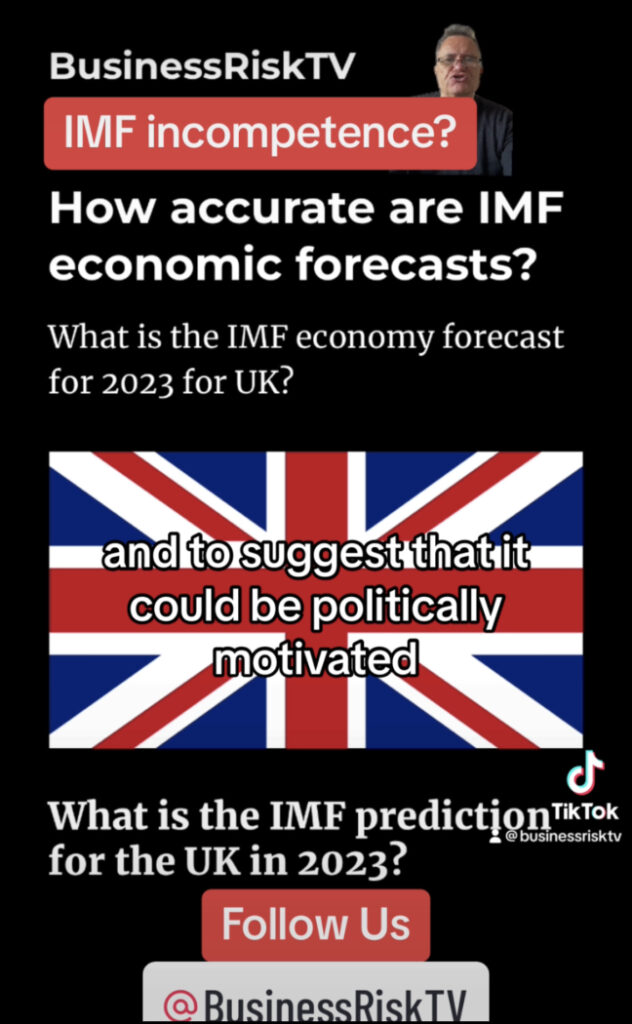
How accurate are IMF economic forecasts?

What is the IMF economy forecast for 2023 for UK?

What is the IMF prediction for the UK in 2023?

The International Monetary Fund (IMF) has been criticised for its wild economic forecast swings for the UK in 2023. In April, the IMF predicted that the UK economy would contract by 0.3% in 2023. However, in July, the IMF upgraded its forecast to 0.4% growth. This sharp reversal has led some to question the IMF’s credibility and to suggest that it is politically motivated.

There are a number of factors that could explain the IMF’s wild forecast swings. One possibility is that the IMF was simply wrong in its initial assessment of the UK economy. The UK economy has been facing a number of challenges in 2023, including rising inflation, a cost of living crisis, and the ongoing war in Ukraine. However, the UK economy has also shown some resilience in recent months. GDP growth has been positive, and unemployment has remained low.

Another possibility is that the IMF was caught off guard by the UK government’s response to the economic challenges. In April, the UK government announced a number of measures to help businesses and consumers cope with the rising cost of living. These measures included a windfall tax on energy companies and a cut to fuel duty. The IMF may have underestimated the impact of these measures on the UK economy.

Whatever the reason for the IMF’s wild forecast swings, it has led some to question the organisation’s credibility. The IMF is an influential organisation that provides economic advice to governments around the world. If the IMF cannot be trusted to provide accurate economic forecasts, then its advice is less valuable.

The IMF’s credibility has also been damaged by its previous inaccurate predictions. In 2008, the IMF predicted that the global financial crisis would have a limited impact on the UK economy. However, the UK economy was one of the hardest hit by the crisis. The IMF’s inaccurate prediction led some to question whether the organisation was too close to the financial sector and whether it was not willing to challenge the status quo.

In addition to its inaccurate predictions, the IMF has also been criticised for its political bias. Some critics have argued that the IMF is more likely to give favourable advice to countries that are aligned with the United States. For example, the IMF was criticised for its handling of the Greek debt crisis. The IMF imposed harsh austerity measures on Greece, which many believe exacerbated the country’s economic problems.

The IMF’s wild forecast swings for the UK in 2023 and its previous inaccurate predictions have led some to question the organisation’s credibility and to suggest that it is politically motivated. The IMF will need to do more to restore its credibility if it wants to maintain its influence in the global economy.

In addition to the points raised above, there are a number of other factors that could be contributing to the IMF’s wild forecast swings for the UK. These include:

  • The complexity of the global economy, which makes it difficult to predict with certainty how events will unfold.
  • The uncertainty surrounding the UK’s future relationship with the European Union.
  • The changing political landscape in the UK.

The IMF is a valuable organisation that provides important economic advice to governments around the world. However, the IMF’s credibility has been damaged by its wild forecast swings and its previous inaccurate predictions. The IMF will need to do more to restore its credibility if it wants to maintain its influence in the global economy.

What is the IMF prediction for the UK in 2023? What is the IMF economy forecast for 2023? What is the IMF economic growth forecast for the UK? How accurate are IMF economic forecasts?
IMF Forecasting Incompetence? How accurate are IMF economic forecasts? IMF UK growth forecast 2023. Read on …

More business risk management articles videos and country or industry risk reviews

How accurate are IMF economic forecasts?

UK Economic Future

UK economic outlook with BusinessRiskTV.com

Subscribe to BusinessRiskTV for free UK business and the economy alerts and bulletins notifications

UK economic forecast next 5 years. Global business and economy experts opinions analysis and review of best guess for UK economy. Network with top business leaders and risk management professionals to help you make better more informed business decisions.

Businesses in the UK will grow over the next 5 years. Will your business be one of them. Not all businesses in UK will grow. The UK business leaders which take the right decisions to protect and grow their business will grow their business regardless of the UK economic future.

What of the future? Economic growth not contraction. The fundamentals of the UK economy are strong. Can your business exploit the opportunities for growth that are ahead?

Enter code #UKeconomicfuture

Promote and market your business in the UK on BusinessRiskTV for 12 months

Effective Digital Marketing Strategy
Reach influencers key decision makers and the business leaders who will buy from your business

Recommended articles and videos trending on BusinessRiskTV

Is printing money a Ponzi scheme designed to bail governments out and create asset bubbles to make rich richer and poor poorer?

The claim that printing money by western central banks is a Ponzi scheme is a controversial one. Some economists argue that it is true, as printing money can lead to inflation, which erodes the value of money saved by citizens and investors. Others argue that printing money can be a necessary tool to stimulate economic growth, and that the negative effects of inflation can be managed.

Here are some of the potential consequences of printing money:

  • Inflation: When the government prints more money, it increases the amount of money in circulation. This can lead to inflation, as people have more money to spend and demand for goods and services increases. Inflation can make it more expensive to buy goods and services, and can erode the value of savings.
  • Devaluation of the currency: If the government prints too much money, it can lead to the devaluation of the currency. This means that the currency will become worth less in terms of other currencies. This can make it more expensive for businesses to import goods and services, and can make it more difficult for people to travel abroad.
  • Unintended consequences:Printing money can also have unintended consequences. For example, it can lead to asset bubbles, as people invest in assets in the hope that their value will increase. This can lead to a financial crisis if the asset bubble bursts.

It is important to note that the effects of printing money can vary depending on the specific circumstances. For example, the effects of printing money during a recession may be different from the effects of printing money during a period of economic growth.

In conclusion, the claim that printing money by western central banks is a Ponzi scheme is a complex one. There are both potential benefits and risks associated with printing money, and the effects can vary depending on the specific circumstances.

Jobs Trending Now

What You Need To Know About UK Business and Economy Today

UK Mystery Shopper Services

UK Online Trade Show

UK Business Magazine

Ask The Experts On The UK Economy and Business Prospects For Free

Find out when the next live business management expert panel is hosted on BusinessRiskTV. Subscribe to BusinessRiskTV for free alerts and bulletins.

Free Business Management Advice and Tips

Find ways to grow your business faster more resiliently and with less uncertainty

Our innovative approach to business growth will help your business grow faster regardless of the UK economic outlook. Some businesses always grow and there is no reason it could not be your business.

How to grow your business online
Help to grow your business faster

Sure there is uncertainty about the UKs economic future. When has there been certainty? The key is to find ways to grow whatever the economic future or at least protect your business so it is resilient and survives.

There are undeniable challenges ahead for UK business leaders. Identify them assess their impact on your business and set a risk management plan and strategy for business resilience.

MarketplacesExhibitions
OffersRisk Magazine

#BusinessRiskTV #UKeconomy #UKbusiness #UKmagazine #UKonline #UKmarketplace #UKnews #UKreports #UKreview

BusinessRiskTV UK Economic Future