AI Private Equity Debt Risks: Parallels to 2008 Subprime Crisis

As private equity pours billions into AI corporate bonds to fund the “Big Seven” tech expansion, striking parallels to the 2008 subprime mortgage crisis are emerging. Explore the risks of circular funding, opaque credit ratings, and what this “AI Supercycle” debt means for global business stability and the economy in 2026.

Is AI Debt the New Subprime? The Private Equity Risks Facing the Big Seven

The global economy is currently witnessing a massive capital deployment into Artificial Intelligence infrastructure, largely driven by the “Big Seven” tech giants and fuelled by complex private equity debt. However, beneath the surface of this technological gold rush, risk managers are identifying structural echoes of the 2008 financial crisis. From “circular funding” loops to the role of credit rating agencies, the parallels are becoming too significant to ignore.

The Structural Parallels Between Mortgages and Models

In 2008, the “bedrock” was residential real estate; in 2026, it is the data centre. The fundamental belief driving today’s market is that AI demand will grow exponentially forever, mirroring the pre-2008 mantra that “home prices never go down.”

Credit rating agencies are once again under the spotlight. Just as they assigned AAA ratings to subprime mortgage-backed securities based on flawed correlations, they are now assessing AI-related corporate bonds and infrastructure debt with high grades. These ratings often rely on the perceived strength of the “Big Seven” (Microsoft, Alphabet, Amazon, Meta, Apple, Nvidia, and Tesla), yet they may overlook the rapid depreciation of the underlying collateral—GPUs and specialised servers that could become obsolete within years.

The Danger of Circular Funding and Shadow Banking

One of the most concerning parallels is the rise of “Circular Financing.” We are seeing a loop where tech giants invest equity into AI startups, which then use that same capital to lease compute power back from the investor’s cloud platforms. This inflates revenue figures and creates a “phantom” growth narrative.

Private equity firms and private credit lenders—the “shadow banks” of the modern era—are providing the leverage for these deals with less transparency than traditional regulated banks. This opacity mirrors the off-balance-sheet vehicles that hid systemic risk two decades ago. If the cash flows from AI applications do not materialise fast enough to service this debt, the entire “infinite money loop” could collapse, leading to a significant credit crunch.

What This Means for Global Businesses and the Economy

For modern businesses, this debt-heavy environment presents a unique set of risks. Companies relying on AI infrastructure could face sudden service disruptions or skyrocketing costs if their providers suffer a liquidity crisis. Furthermore, as regulators begin to flag these risks, the cost of borrowing for even non-AI businesses may rise as capital markets tighten in anticipation of a “re-rating.”

While some analysts argue that the “Big Seven” have enough cash to withstand a bubble burst, the systemic risk lies in the interconnectivity of the private equity ecosystem. A default in the mid-market AI sector could trigger margin calls and a “flight to quality,” potentially leading to a “tech-led” recession. Unlike 2008, the impact may be concentrated within the technology and private equity sectors, but in a world where tech is the backbone of all industry, the ripple effects will be felt globally.

To protect your business from the systemic risks associated with the AI debt bubble and private equity volatility, business leaders should implement a multi-layered risk management strategy.

Here are six actionable tips to build resilience today:

1. Conduct a “Shadow Infrastructure” Audit

Many businesses are unknowingly exposed to AI debt through their third-party vendors. Identify which of your critical service providers—from CRM systems to cybersecurity—rely on “Big Seven” cloud infrastructure or are heavily funded by private equity.

  • Action: Create a risk map of your technology stack. If a key vendor is part of a “circular funding” loop, they are higher risk for sudden insolvency or price hikes.

2. Diversify Across “Model Families”

Avoid “vendor lock-in” by ensuring your AI integrations are model-agnostic. Relying on a single provider’s API makes you vulnerable to their specific credit rating or debt obligations.

  • Action: Use an orchestration layer that allows you to swap between different Large Language Models (LLMs) or cloud providers (e.g., shifting from Azure to AWS or a private local server) without rewriting your entire codebase.

3. Move from Efficiency to “Compute Sovereignty”

During the 2008 crisis, businesses with “on-balance-sheet” assets fared better than those with complex lease agreements. Similarly, in an AI credit crunch, having your own dedicated compute resources can be a lifeline.

  • Action: For mission-critical AI tasks, consider “Small Language Models” (SLMs) that can run on local, owned hardware rather than relying exclusively on the expensive, debt-funded “Big AI” clouds.

4. Implement “Reverse Stress Testing”

Instead of asking “What if revenue drops?”, ask “What if our AI costs triple or the service goes offline for a month?”

5. Monitor “Counterparty Contagion” in Your Supply Chain

The AI debt risk isn’t just in tech; it’s in any industry where private equity has used “AI transformation” as a reason to over-leverage.

6. Build a “Physical-First” Contingency Plan

In a world increasingly dependent on virtualised, debt-backed intelligence, the ultimate hedge is physical and operational resilience.

#BusinessRisk #AIDebt #FinancialCrisis2026 #BusinessRiskTV #RiskManagement

Get help to protect and grow your business faster with BusinessRiskTV

Find out more about growing your business faster marketing and advertising with BusinessRiskTV 

Subscribe for free business risk management ideas risk reviews and cost reduction tips

Connect with us for free business risk management tips

Read more business risk management articles and videos for free

Connect with BusinessRiskTV for free alerts to new business risk management articles and videos 

AI Private Equity Debt Risks: Parallels to 2008 Subprime Crisis

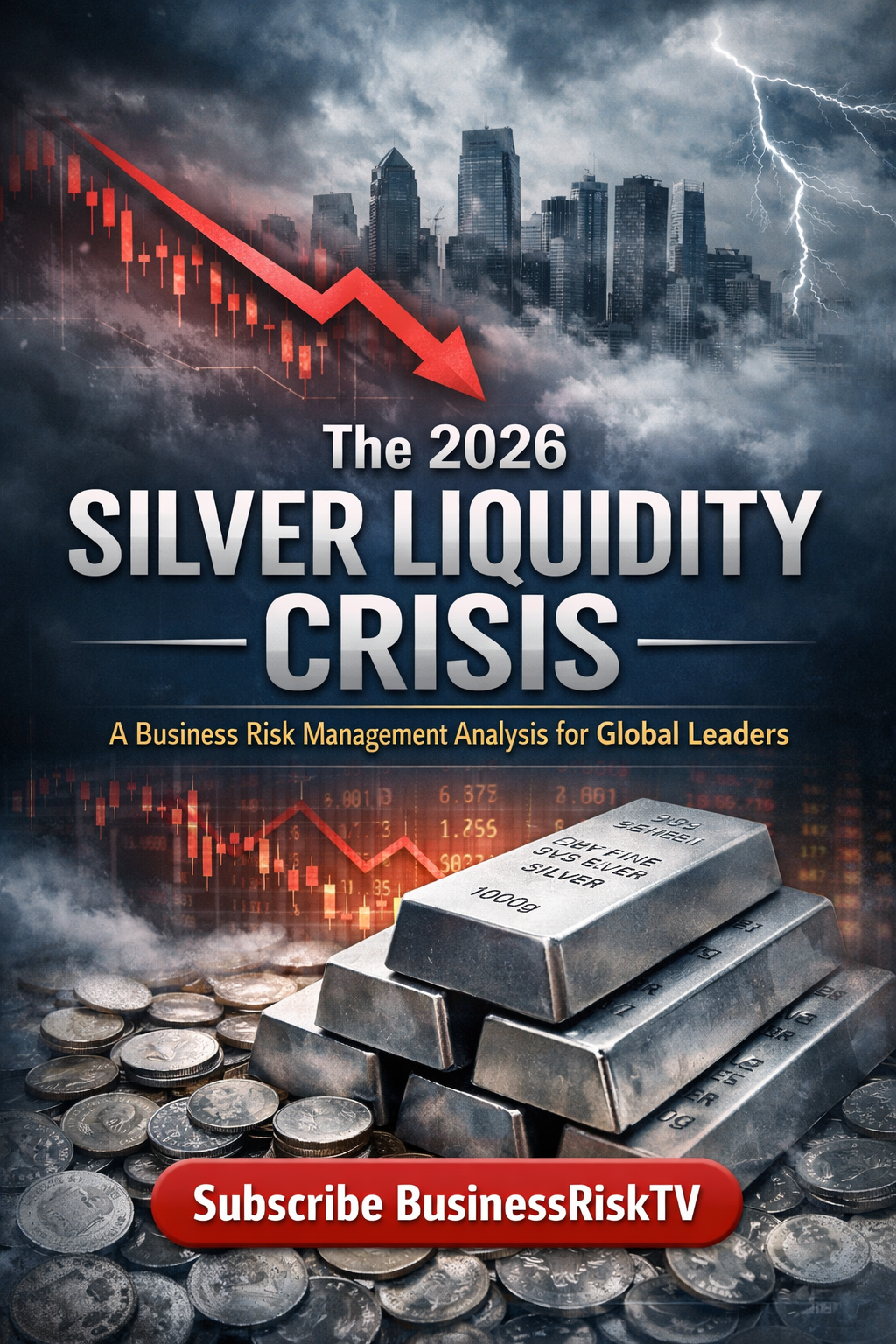
Silver Market Crisis and Business Risks

Global silver markets are facing a systemic crisis in 2026 due to China’s export ban and COMEX inventory depletion. This article outlines 6 critical risk management steps for businesses to secure physical silver and mitigate paper market volatility.

The 2026 Silver Supply Crisis: Is the COMEX Paper Market a Systemic Risk to Your Business?

The global silver market has entered a period of unprecedented structural instability. In early 2026, the long-predicted “decoupling” of paper silver prices from physical reality has finally arrived. For business leaders in the technology, green energy, and automotive sectors, the reliability of the COMEX silver market is no longer a given—it is a critical vulnerability.

The Perfect Storm: China’s Export Ban and the Singapore Shutdown

Enterprise risk management magazine articles and videos on business growth and business protection
GLOBAL SILVER CRUNCH 2026: SYSTEMIC RISK FOR BUSINESSES

The current crisis is driven by two massive geopolitical and logistical shifts that have fundamentally altered the flow of physical metal:

  1. China’s Physical Fortress: As the world’s leading refiner, China’s decision to ban the export of physical silver has “ring-fenced” a massive portion of the global supply for its own domestic AI and solar infrastructure.

  2. The Singapore Liquidity Gap: The sudden shutdown of major physical supply hubs in Singapore has removed a vital “safety valve” for Western manufacturers, leaving the market reliant on depleted COMEX and LBMA vaults.

Why the COMEX “Paper Market” is a Systemic Threat

The COMEX operates on a fractional reserve system. In a stable environment, only a small percentage of contract holders ever stand for physical delivery. However, as physical silver premiums skyrocket in the East, the “paper-to-physical” ratio has become unsustainable.

If industrial users lose confidence in the exchange’s ability to deliver physical metal, the resulting “short squeeze” could lead to a systemic failure, leaving businesses with useless paper hedges and no raw materials to maintain production lines.


6 Strategic Risk Management Measures for Business Leaders

To navigate the 2026 silver disruption, executive teams must pivot from traditional procurement to a strategic resilience model.

1. Secure Direct Mine-to-Manufacturer Off-take Agreements

Eliminate the “middleman” of the exchanges. By establishing direct contracts with primary silver miners in jurisdictions like Mexico, Peru, and Australia, businesses can guarantee a physical flow of metal that is not subject to the liquidity crises of paper markets.

2. Transition to Strategic Physical Stockpiling

The “Just-in-Time” delivery model is a liability in a deficit market. Business leaders should treat silver as a strategic asset, holding 6 to 12 months of physical inventory in secure, private, non-bank vaults to ensure operational continuity during exchange “force majeure” events.

3. Aggressive R&D in Material Substitution (Thrifts)

In sectors like photovoltaics (PV) and EV manufacturing, reducing silver intensity is now a competitive necessity. Invest in R&D to accelerate the adoption of copper-plated contacts or advanced conductive polymers to lower your “silver-per-unit” exposure.

4. Implement Vertical Integration with “Urban Mining”

The silver supply of the future is in the scrap of the past. Partnering with or acquiring e-waste recycling firms allows a company to create a closed-loop supply chain, reclaiming silver from end-of-life electronics to feed new production.

5. Geopolitical Supply Chain Diversification

With China’s export ban in place, businesses must aggressively vet new refining partners in “friendly” nations. Diversifying your refining sources across multiple geographic zones mitigates the risk of further export licenses or geopolitical tariffs.

6. Dynamic Pricing and Force Majeure Contract Audits

Review all downstream customer contracts. Ensure your pricing models allow for “raw material surcharges” to pass on extreme silver volatility. Additionally, audit your procurement contracts to ensure “delivery failure” by an exchange is not used by suppliers as a valid excuse for non-performance.


Conclusion: Adapting to the New Metallic Reality

The era of cheap, abundant, and easily hedged silver is over. The COMEX paper market remains a useful price discovery tool for now, but it can no longer be the sole foundation of an industrial supply chain. Leaders who act now to secure physical flows will thrive; those who rely on paper may find their production lines at a standstill.

#SilverCrisis2026 #SupplyChainRisk #BusinessResilience #BusinessRiskTV #RiskManagement

Get help to protect and grow your business faster with BusinessRiskTV

Find out more about growing your business faster with BusinessRiskTV 

Subscribe for free business risk management ideas risk reviews and cost reduction tips

Connect with us for free business risk management tips

Read more business risk management articles and view videos for free

Connect with us for free alerts to new business risk management articles and videos 

Silver Market Crisis and Business Risks

Critical Thinking Versus Collective Stupidity: Rise Above Groupthink in Business

Discover why critical thinking beats collective stupidity in business. Learn how to avoid groupthink pitfalls and make better decisions with BusinessRiskTV.com’s risk management resources.

Critical Thinking vs Collective Stupidity: Rise Above Groupthink in Business Decision-Making

The Thinking Crisis in Modern Business

In today’s complex business environment, we face a critical crossroads: apply disciplined critical thinking or succumb to the comfortable confines of collective groupthink. The pain of uncertainty often pushes business leaders toward the seeming safety of consensus opinions and mainstream solutions. However, this avoidance of independent thinking comes at a steep price—surrendering your competitive edge, innovation, and ultimately, your business success to the “collective stupidity” that occurs when groups prioritise harmony over accurate analysis.

When critical thinking is no longer deployed, it is replaced by this collective stupidity. Most people are more comfortable agreeing with the crowd instead of questioning the common narrative. Yet as the saying goes, “when everyone is thinking the same thing, no one is thinking properly.” This article explores how business leaders can cultivate genuine critical thinking, avoid the pitfalls of groupthink, and how BusinessRiskTV.com provides tools and communities to support this vital leadership capability.

What is Critical Thinking in Business? Beyond Judgement and Assumption

Defining Critical Thinking

Critical thinking is far more than just being critical; it is a disciplined process of actively analysing, synthesising, and evaluating information to guide decision-making. In its exemplary form, it is based on universal intellectual values including clarity, accuracy, precision, consistency, relevance, sound evidence, good reasons, depth, breadth, and fairness.

The Foundation for Critical Thinking defines it as “that mode of thinking—about any subject, content, or problem—in which the thinker improves the quality of his or her thinking by skillfully taking charge of the structures inherent in thinking and imposing intellectual standards upon them.” For business leaders, this means consistently questioning assumptions, analysing data from multiple sources, and considering decisions from various perspectives before reaching conclusions.

The Critical Thinking Framework in Practice

Understanding the components of critical thinking helps business leaders implement this approach systematically. Critical thinking combines both skills and mindset across several dimensions:

Analytical Thinking involves breaking down complex business problems into manageable components, examining ideas, identifying arguments, and understanding root causes. In practice, this means systematically evaluating market research, financial reports, and operational data rather than accepting surface-level explanations.

Evaluative Thinking requires assessing the credibility of claims and strength of arguments. Business leaders must judge vendor proposals, investment opportunities, or strategic initiatives based on evidence and logical reasoning rather than popularity or tradition.

Synthetic Thinking connects information from multiple sources to form new insights and conclusions. This enables developing innovative business strategies by combining customer feedback, competitive intelligence, and operational capabilities in novel ways.

Self-Disciplined Thinking means consistently applying intellectual standards to one’s own thinking processes. Successful leaders create decision-making frameworks that force examination of personal biases and assumptions before reaching conclusions.

Fair-Minded Thinking involves considering opposing viewpoints and challenging one’s own preconceptions. Organizations that excel at critical thinking actively seek out dissenting opinions in leadership meetings and establish “devil’s advocate” roles to ensure all perspectives are considered.

The Cost of Collective Stupidity: Groupthink in Business

Understanding Groupthink Dynamics

Groupthink is a term developed by social psychologist Irving Janis in 1972 to describe suboptimal decisions made by a group due to social pressures that lead to flawed outcomes. It occurs when the drive for consensus within a group becomes so powerful that it overrides realistic appraisal of alternatives and critical thinking.

This “collective stupidity” represents a form of structural rigidity where organisations continue failing approaches simply because “that’s how we’ve always done it.” As one business innovator noted, “We’d rather be stupid than different”—highlighting the perplexing preference for known failure over the perceived risk of change.

Symptoms and Impact of Groupthink

Irving Janis identified eight symptoms of groupthink that remain relevant to modern businesses:

The Illusion of Invulnerability creates excessive optimism and encourages unnecessary risk-taking while Collective Rationalisation causes members to discount warnings and not reconsider assumptions. The Belief in Inherent Morality leads groups to ignore ethical consequences of decisions while Stereotyped Views of Out-groups fosters negative or dismissive views of competitors or critics.

Direct Pressure on Dissenters emerges when members are pressured not to express arguments against group consensus, reinforced by Self-Censorship where doubts and deviations from perceived group consensus are not expressed. The Illusion of Unanimity falsely assumes the majority view is unanimous while Self-Appointed “Mindguards” protect the group from information that might problematize the consensus.

The impact on businesses can be devastating, resulting in poor decisions due to lack of opposition or critical evaluation, stifled creativity and innovation, overconfidence in flawed strategies, overlooking optimal solutions to business challenges, and building failure into budgets and operations rather than seeking better approaches.

Real-World Examples of Groupthink in Business

Multiple case studies demonstrate how groupthink prevails over evidence-based success:

Boston Scientific experienced a 53% increase in closed sales after piloting an innovative sales method, yet rejected adoption because the model was deemed “too controversial for easy adoption.”

Kaiser Permanente saw sales efficiency jump from 110 visits/18 closed sales to 27 visits/25 closed sales using a new approach, but maintained their existing compensation structure based on visit volume rather than success.

Proctor & Gamble rejected a dramatically more effective sales method because it would require adapting manufacturing and support systems—essentially refusing success due to anticipated implementation challenges.

These cases illustrate the powerful hold of “the way we’ve always done it” even when evidence clearly demonstrates superior alternatives.

How BusinessRiskTV.com Fosters Critical Thinking and Mitigates Business Risks

Breaking Free from Collective Hypnosis

BusinessRiskTV.com positions itself as an antidote to conventional business thinking, urging leaders to “break free from the collective hypnosis often presented as certain risk information.” Their approach emphasises that “playing it safe is the biggest risk of all” in today’s rapidly changing business environment.

Rather than offering standardised solutions, BusinessRiskTV.com provides diverse perspectives and critical analysis tools to help business leaders develop their independent thinking capacity. Their platform acknowledges that “if you do not think for yourself, someone else will think and act for you, but they may not have your best interests at heart”—highlighting the vital importance of independent critical thinking in business protection and growth.

Services and Resources for Critical Thinkers

BusinessRiskTV.com offers multiple resources designed specifically to combat groupthink and foster critical thinking:

The Risk Management Think Tank provides access to diverse perspectives beyond mainstream business thinking while the Enterprise Risk Management Magazine delivers practical insights for applying critical thinking to risk management. Business Risk Watch offers ongoing monitoring of emerging threats and opportunities complemented by Live Online Workshops featuring interactive sessions for developing critical thinking skills.

Networking Opportunities facilitate connections with leaders globally across multiple industries while Expert Briefings deliver unfiltered intelligence on global business risks. Their approach is built on the premise that “without innovation, without the risk of disruption in the name of success, continued failure is the only option”—directly challenging the groupthink mentality that maintains failing approaches.

What To Do Now: Join BusinessRiskTV.com Business Risk Management Club

Membership Options Explained

BusinessRiskTV.com offers three membership tiers to suit different organisational and individual needs:

The Basic Risk Manager plan is free and includes alerts to business risk management news, access to some Member Only business intelligence, and entry to selected deals and Flash Sales.

The Pro Risk Manager plan requires an annual fee but provides full service features including discounted products, ability to submit articles and advertorials, listing in sponsors directory, and access to comprehensive risk management tools.

The Corporate Member plan is free and includes alerts to business risk management content, access to corporate business intelligence, and entry to selected deals and Flash Sales.

Developing Your Critical Thinking Capacity

Beyond membership, BusinessRiskTV.com encourages developing personal critical thinking skills through these approaches:

Question Your Sources by regularly evaluating the credibility, accuracy, and potential biases of your information sources. Analyse Arguments Systematically by breaking down problems, identifying underlying assumptions, and examining evidence from multiple angles.

Encourage Dissenting Views by actively seeking out and rewarding alternative perspectives in your organisation. Apply Structured Evaluation Frameworks using established critical thinking frameworks for important business decisions. Embrace Intellectual Humility by recognizing that “no one is a critical thinker through-and-through” and remaining open to revising your thinking.

Choose Thinking Over Conformity

The discomfort of uncertainty is not a reason to accept someone else’s certainty. Just because the pain of your uncertainty is uncomfortable does not mean you should accept someone else’s certainty just to feel better. In business leadership, the easy path of following consensus and mainstream thinking often leads to mediocre results at best, and catastrophic failures at worst.

Critical thinking is difficult—which is precisely why most people judge rather than analyse, follow rather than lead. But this difficulty represents a competitive opportunity for those willing to develop this crucial skill. As the search results emphasize, “when everyone is thinking the same thing, no one is thinking properly.”

Business success in our complex, rapidly changing environment requires breaking free from collective stupidity and developing the courage to think independently. Are you ready to “step away from the crowd exhibiting collective stupidity and instead critically think about what is best for your business”? The first step is recognising that true leadership requires not just thinking, but thinking critically.

#CriticalThinking #Groupthink #BusinessRiskManagement #DecisionMaking #BusinessRiskTV

Get help to protect and grow your business faster with BusinessRiskTV

Find out more about growing your business faster with BusinessRiskTV 

BusinessRiskTV Business Risk Management Club Membership

Subscribe for free business risk management ideas risk reviews and cost reduction services

Connect with us for free business risk management tips

Contact Us To Subscribe BusinessRiskTV – Reach Global Decision Makers

Read more business risk management articles and view videos for free

Connect with us for free alerts to new business risk management articles and videos 

Critical Thinking Versus Collective Stupidity Groupthink in Business

The West’s Ukraine Strategy: A Catastrophic Policy Failure & The Business Cost

The Ukraine conflict represents a catastrophic failure of Western policy, not just Russian aggression. Leaders in the UK, Germany, and France are accountable for a series of critical errors—from pre-war NATO provocation and the Minsk Agreement debacle to slow-walking military aid and sabotaging peace talks. These decisions have prolonged a devastating war, resulting in needless loss of life and squandering billions in public funds. This analysis details the 9 reasons why these policies constitute a profound strategic failure and why citizens must now demand a resolution focused on diplomacy and economic stability over prolonged conflict.

Key Critiques of UK, German, and French Policy on Ukraine

A critical analysis of how leaders in the UK, Germany, and France bear responsibility for prolonging the Ukraine conflict. Explore the 9 key policy failures—from failed diplomacy and economic mismanagement to escalation risks—that have cost hundreds of thousands of lives and billions in taxpayer funds. Learn why citizens must demand accountability and a new path toward peace.

Critics, who come from both the political left and right, often point to a series of pre-war and ongoing policy failures.

1. Pre-War Provocation and Failed Diplomacy (The “Sleepwalking” Critique)

  • Critique: For years, despite warnings from Russia, the US and key European powers like the UK, France, and Germany expanded NATO eastward. While sovereign nations have the right to choose their alliances, critics argue this was strategically reckless, needlessly threatening Russia’s core security interests and creating a predictable confrontation. This is seen as a failure of statesmanship that boxed all parties into a corner.
  • Accountability: Leaders are accused of prioritising a hawkish, ideological expansion of Western influence over a pragmatic, security-based diplomacy that could have averted war.

2. The Minsk Agreement Debacle

  • Critique: The Minsk Agreements (2014-2015), brokered by France and Germany, were meant to bring peace to Donbas. However, recent admissions from figures like former German Chancellor Angela Merkel suggested the agreements were primarily a tool to “give Ukraine time” to build its military. Critics argue this reveals profound bad faith, proving to Russia that diplomatic agreements with the West are not trustworthy, thereby destroying a potential path to peace and making the 2022 invasion seem inevitable from Moscow’s perspective.

3. Slow-Walking Military Aid & “Waging a Slow War”

  • Critique: Especially in the early stages (and periodically since), Germany, France, and the UK have been accused of “drip-feeding” military aid. They provided just enough to keep Ukraine from collapsing, but not enough to achieve a decisive victory. This is criticized as a strategy that prolongs the war, maximizing Ukrainian casualties and destruction while minimizing direct risk to NATO, effectively “fighting to the last Ukrainian.”
  • Example: The long, drawn-out debates over delivering tanks, long-range missiles, and aircraft are cited as key examples where hesitation cost lives and strategic advantage.

4. Undermining and Delaying Peace Talks

  • Critique: In the spring of 2022, peace talks between Ukraine and Russia showed promise. Critics allege that Western powers, particularly the UK under then-PM Boris Johnson, advised Ukraine to break off negotiations, promising full-scale Western support to win back all territory. By taking a maximalist “no negotiation” stance, they are seen as having sabotaged a potential, if imperfect, peace deal that could have saved hundreds of thousands of lives.

5. Economic Mismanagement and the Cost to Citizens

  • Critique: The billions in aid sent to Ukraine are framed not as noble support, but as a massive transfer of wealth from Western citizens during a cost-of-living crisis. Critics argue this spending fuels inflation, diverts funds from domestic healthcare, education, and infrastructure, and primarily benefits the military-industrial complex, all while the financial burden is borne by the taxpayers of the UK, Germany, and France.

6. Lack of a Clear Strategic Endgame

  • Critique: Two years into the conflict, there is no publicly defined strategic goal for the war. Is the aim to return to 1991 borders? 2014 borders? Merely weaken Russia? This lack of a clear, achievable political objective is a massive strategic failure. It commits these nations to an open-ended conflict with no exit strategy, guaranteeing further waste of lives and money without a defined concept of “victory.”

7. Escalation Risks and Brinksmanship

  • Critique: By continuously pushing the boundaries of military aid—from artillery to tanks to long-range missiles—these leaders are playing a dangerous game of brinksmanship. Critics argue they are ignoring the real and existential risk of a direct NATO-Russia war, which could escalate to nuclear conflict. The responsibility for managing this risk lies with the major Western powers, and their current policies are seen as recklessly increasing it.

8. The “Double Standard” on International Law

  • Critique: This argument, often from the left, states that the UK, France, and Germany apply international law selectively. They rightly condemn Russia’s invasion but have historically ignored or participated in violations (e.g., Iraq, Libya, Yemen). This hypocrisy, critics argue, undermines the moral high ground and the very rules-based order they claim to be defending, making their stance seem more about geopolitical power than principle.

9. Neglecting Diplomacy as a Tool

  • Critique: The current policy is almost entirely militaristic. Critics argue that leaders in Berlin, Paris, and London have a responsibility to pair military support with aggressive, creative diplomacy. By refusing to seriously explore diplomatic channels, ceasefires, or potential compromises, they are choosing a path of endless attrition over statecraft, ensuring the continued loss of life and economic damage.

Why Citizens of These Countries Should Act

Based on these critiques, the argument for citizen action is clear:

  • Sovereignty and Consent: The governments of the UK, Germany, and France are acting in the name of their citizens. Therefore, citizens have a democratic right and responsibility to scrutinize these policies and their costs.
  • Direct Impact: The citizens of these nations are directly paying the price through higher taxes, inflated living costs, and diverted public funds. Their security is also being put at risk through escalation.
  • Correcting a Failed Policy: If the current path is seen as a “policy mistake” that is wasting lives and treasure without a realistic chance of a satisfactory outcome, then public pressure is the primary democratic mechanism to force a change in course towards a strategy that prioritises peace and diplomacy.

Get help to protect and grow your business faster with BusinessRiskTV

Find out more about growing your business faster with BusinessRiskTV 

Subscribe for free business risk management news reviews and cost cutting deals

Connect for free business risk management tips

Read more free business risk management articles and view videos

Connect for free alerts to business risk management articles 

Wests Ukraine Strategy Failure Business Cost

Anti-Fragility Mentality: The UK Business Guide to Thriving on Volatility

Don’t just survive—thrive. In today’s volatile UK market, being resilient isn’t enough. Discover the anti-fragility mentality, a powerful concept that helps businesses grow stronger from shocks and uncertainty. Our guide reveals the dangers of feeling too scared to grow, explains why positively fighting back against business fears works better, and provides 9 practical risk management strategies to build a more robust, adaptable, and profitable business. Learn how to transform every crisis into a competitive advantage.

Discover how an anti-fragility mentality can help your UK business thrive on stress and volatility. Learn why fear of growth is dangerous and get 9 practical risk management strategies to build a more robust, adaptable, and profitable company.

Anti-Fragility Mentality: The UK Business Guide to Thriving on Volatility 🇬🇧

In the complex and unpredictable world of business, it’s not enough to be resilient or robust; you must be anti-fragile. This is a concept, popularised by author Nassim Nicholas Taleb, that suggests some systems, like a business, don’t just withstand shocks—they actually get stronger because of them. While a resilient company recovers from a crisis, an anti-fragile one learns, adapts, and improves. Instead of just surviving, an anti-fragile business uses volatility, uncertainty, and stress as fuel for growth. This is especially relevant for UK businesses navigating a post-Brexit, globalised, and tech-driven market.


The Dangers of Business Fear and Over-Cautiousness

When leaders are too scared to grow, their business becomes fragile. Fear of failure or even fear of success can lead to a state of paralysis. Instead of embracing opportunities, a business with a risk-averse culture will hesitate, self-sabotage, and miss out on potential gains. This mindset can:

  • Stifle innovation: You avoid new technologies, markets, or product lines, leaving you vulnerable to competitors who are bolder.
  • Prevent scalability: Your business systems, processes, and team structures become too rigid to handle growth, leading to spiralling costs and poor service if demand increases.
  • Create dependency: Over-reliance on a single client, supplier, or revenue stream makes the business incredibly fragile.
  • Damage morale: A culture of fear can demotivate employees and discourage them from taking initiative.
  • Expose you to a slow decline: While you might avoid a sudden crisis, a cautious approach often leads to a gradual loss of market share and relevance.

Why Positively Fighting Back Against Crisis Works Better

An anti-fragile business doesn’t just react to a crisis; it uses the crisis to its advantage. Instead of a defensive mindset, it adopts an offensive one, turning problems into opportunities. This approach works better because:

  • It forces innovation: A crisis can be a powerful catalyst for change, forcing you to find creative solutions you wouldn’t have considered otherwise.
  • It builds stronger systems: A crisis reveals weaknesses. By addressing these weak points, you build more robust, efficient, and reliable systems for the future.
  • It strengthens relationships: Transparent communication and proactive problem-solving during a crisis builds trust with employees, customers, and partners.
  • It creates a competitive advantage: While your competitors are busy recovering, you’re using the disruption to pull ahead, secure new markets, or attract talent.

Who Can Help You Take More Calculated Risks

Taking calculated risks is a team sport. While the final decision rests with the leadership, a smart leader leverages the entire business to inform their choices. Key roles that can help you become more anti-fragile include:

  • Senior Leadership: A strong, forward-thinking leadership team that fosters a culture of smart risk-taking and learning from failure.
  • The Finance Team: Your finance department is crucial. They provide the data and analysis needed to understand the potential financial impact of a risk.
  • IT & Cybersecurity: They assess the risks associated with new technologies and ensure your digital infrastructure can handle growth and shocks.
  • Department Heads: They have a direct view of operational risks and can identify opportunities for improvement.
  • Employees at all levels: Front-line staff often have the best insights into day-to-day problems and can suggest innovative solutions.

Where You Can Protect Yourself from an Over-Cautious Mentality

To counter a culture of over-cautiousness, you need to create an environment where smart risk-taking is encouraged. Focus on these areas:

  • Your company culture: Foster a “growth mindset” that views mistakes as learning opportunities rather than failures.
  • Your team structure: Empower teams to make decisions without excessive layers of approval.
  • Your communication channels: Create open and transparent communication where bad news and new ideas can be shared without fear.
  • Your strategic planning: Incorporate scenario planning and “what-if” exercises to prepare for a range of potential outcomes, both good and bad.

When to Feel More Robust

You can feel more robust and confident in your business’s ability to handle stress when you have:

  • Consistent cash flow: A healthy financial position provides the buffer needed to withstand shocks and invest in new opportunities.
  • A diversified portfolio: You’re not reliant on a single customer, product, or market.
  • Strong systems and processes: Your business operations are streamlined, efficient, and can handle increased demand without breaking.
  • An engaged and skilled team: Your employees are aligned with your goals and are ready to adapt to changing circumstances.

9 Practical Anti-Fragility Risk Management Strategies

  1. Embrace Optionality: Have multiple, low-risk options available. For example, explore several new markets with a small investment rather than committing to one with a large one.
  2. Redundancy is a Virtue: Don’t rely on a single supplier or a single server. Create backups and redundancies to prevent single points of failure.
  3. Conduct “Pre-Mortems”: Instead of a post-mortem after failure, imagine a project has failed and work backwards to identify the reasons. This helps anticipate risks before they occur.
  4. Adopt a “Fail Fast, Learn Faster” Mindset: Launch small, experimental projects (Minimum Viable Products) to test ideas without significant risk.
  5. Decentralise Authority: Empower smaller teams to make decisions. This allows for faster responses to local challenges and opportunities.
  6. Maintain a Cash Buffer: Keep enough cash on hand to cover a significant period of low revenue. This financial buffer is the bedrock of anti-fragility.
  7. Gamify Risk Management: Use internal games or simulations to train your team on how to respond to unexpected events, building both muscle memory and a proactive mindset.
  8. Diversify Your Team’s Skillset: Hire for versatility and adaptability. A team with diverse skills is more likely to find creative solutions during a crisis.
  9. Build Strong Stakeholder Relationships: Foster trust with your customers, suppliers, and investors. Strong relationships provide a support network that is invaluable in a downturn.

Get help to protect and grow your business faster with BusinessRiskTV

Find out more about business protection and business growth with BusinessRiskTV 

Subscribe for free business risk management ideas reviews and cost reduction deals

Connect with us for free business risk management tips

Read more free business risk management articles and view videos

Connect with us for free alerts to new business risk management articles and videos 

Anti-Fragility Mentality Business UK Risk Management Strategies

The 2025 Insurance Crisis: Is the Sky Falling?

Insurer of Last Resort Failure: Implications for Businesses

California. 2025. Wildfires raged. Homes vanished. Insurance companies, battered by years of escalating losses, simply stopped writing new policies. Homeowners were left stranded, unable to secure coverage, their dreams of homeownership reduced to ash. This wasn’t a dystopian novel; it was a chilling glimpse into a potential future where the insurance landscape is dramatically shifting, leaving businesses and individuals alike facing unprecedented uncertainty.

2025 Insurance Crisis: Navigating the New Normal for Businesses

The insurance industry is in the midst of a perfect storm. Climate change is fuelling more frequent and intense natural disasters. Cyberattacks are growing in sophistication and scale. And inflation is squeezing insurers’ margins, making it harder to price risk accurately. As a result, insurers are becoming increasingly selective, cancelling policies for high-risk properties, withdrawing entirely from certain markets, and even refusing to cover specific perils. This leaves businesses and individuals facing a daunting question: who will insure the uninsurable?

Enter the “insurer of last resort.” This concept, while seemingly reassuring, is fraught with challenges. These entities, often government-backed programmes, are designed to step in when the private market fails. However, they are not immune to the same financial pressures that are crippling the private insurance sector. What happens when the insurer of last resort runs out of money? The consequences could be catastrophic, potentially leading to systemic failures within the insurance industry and a cascade of economic and social disruptions.

The global rise in bond yields on sovereign debt is further exacerbating the situation. As interest rates climb, the cost of capital for insurers increases, making it more expensive to invest reserves and potentially impacting their ability to offer competitive premiums. This could lead to a vicious cycle: higher premiums, reduced affordability, and ultimately, a decline in insurance coverage.

This crisis demands a multi-pronged approach. Governments must play a crucial role in mitigating climate change, improving disaster preparedness, and strengthening the regulatory framework for the insurance industry. Businesses, too, must adapt. Proactive risk management strategies, including robust cybersecurity measures and investments in climate resilience, are essential for navigating this uncertain landscape.

The good news is that there are concrete steps businesses can take to protect themselves. By diversifying their risk portfolios, exploring alternative risk transfer mechanisms, and building strong relationships with their insurers, businesses can enhance their resilience and navigate the evolving insurance landscape.

The insurance crisis is a stark reminder that the world is changing rapidly. The risks we face are evolving, and the traditional models of insurance may not be sufficient to address these challenges. By understanding the forces at play and taking proactive steps to mitigate risk, businesses can ensure their continued success in this era of unprecedented uncertainty.

The 2025 Insurance Crisis: A Deep Dive

The insurance industry is facing a confluence of challenges that threaten its very foundation. Climate change is no longer a distant threat; it is a harsh reality. Extreme weather events, from devastating wildfires to catastrophic floods, are becoming more frequent and intense, wreaking havoc on communities and straining the financial resources of insurers.

Cyberattacks are also escalating in frequency and severity. Sophisticated ransomware attacks can cripple businesses, disrupt critical infrastructure, and cause significant financial losses. The sheer scale and complexity of these attacks are pushing the limits of traditional insurance models.

Furthermore, inflation is squeezing insurers’ margins. The rising cost of claims, coupled with the increasing cost of capital, is making it difficult for insurers to price risk accurately and maintain profitability. This is particularly challenging in the face of emerging risks like pandemics and geopolitical instability.

As a result of these pressures, insurers are becoming increasingly selective in the risks they are willing to underwrite. They are canceling policies for properties deemed to be high-risk, such as those located in wildfire-prone areas or coastal zones. They are withdrawing from certain markets altogether, leaving homeowners and businesses without access to affordable coverage. And they are even refusing to cover specific perils, such as flood damage or cyberattacks, leaving policyholders exposed to significant financial losses.

This shift in the insurance landscape has profound implications for businesses and individuals. Homeowners are facing the terrifying prospect of being uninsurable, leaving them financially devastated in the event of a disaster. Businesses, meanwhile, are struggling to obtain adequate coverage for their operations, which can jeopardize their ability to compete and thrive.

The Insurer of Last Resort: A Flawed Solution?

The concept of an “insurer of last resort” is intended to provide a safety net when the private insurance market fails. These entities, often government-backed programmes, are designed to step in and provide coverage for those who cannot obtain it in the private market.

However, the insurer of last resort model faces significant challenges. These programmes are often underfunded and ill-equipped to handle the scale of potential losses in the face of catastrophic events. For example, in the aftermath of Hurricane Katrina, the National Flood Insurance Program (NFIP) faced a massive shortfall, leaving taxpayers on the hook for billions of dollars in losses.

Furthermore, relying solely on the insurer of last resort can create a moral hazard. If individuals and businesses know that they will be covered by a government-backed programme, they may be less incentivised to mitigate their own risks. This can lead to increased reliance on government assistance and potentially exacerbate the very problems that the insurer of last resort is intended to address.

The Impact of Rising Bond Yields

The global rise in bond yields on sovereign debt is adding further pressure to the insurance industry. As interest rates climb, the cost of capital for insurers increases. This makes it more expensive for them to invest their reserves and potentially impacts their ability to offer competitive premiums.

Higher interest rates can also lead to increased borrowing costs for businesses and homeowners. This can reduce their ability to afford insurance coverage, further exacerbating the problem of underinsurance.

Navigating the Crisis: A Call to Action

This crisis demands a multi-pronged approach. Governments must play a crucial role in mitigating climate change, improving disaster preparedness, and strengthening the regulatory framework for the insurance industry. This includes investing in renewable energy sources, implementing stricter building codes, and modernising disaster warning systems.

The insurance industry itself must also adapt. Insurers need to develop innovative products and pricing models that better reflect the evolving risk landscape. This could include using data analytics and artificial intelligence to more accurately assess risk and develop more personalised pricing models.

Businesses, too, must play an active role in mitigating risk. Proactive risk management strategies are essential for navigating this uncertain landscape. This includes:

  1. Conducting thorough risk assessments: Identify and assess the potential risks facing your business, including natural disasters, cyberattacks, and supply chain disruptions.
  2. Implementing robust risk mitigation measures: Develop and implement strategies to mitigate these risks, such as investing in cybersecurity measures, strengthening supply chains, and improving disaster preparedness.
  3. Diversifying your risk portfolio: Explore alternative risk transfer mechanisms, such as captive insurance companies and catastrophe bonds, to diversify your risk exposure.
  4. Building strong relationships with your insurers: Maintain open and transparent communication with your insurers to ensure that your coverage needs are adequately addressed.
  5. Investing in climate resilience: Take steps to improve the resilience of your operations to climate change, such as relocating critical infrastructure to safer locations and investing in energy-efficient technologies.
  6. Advocating for sound public policy: Engage with policymakers to advocate for policies that support a strong and resilient insurance market.
  7. Embracing innovation: Explore innovative insurance products and technologies, such as parametric insurance and blockchain-based solutions, to address emerging risks.
  8. Investing in employee training: Educate your employees on the importance of risk management and empower them to identify and report potential threats.
  9. Developing a robust business continuity plan: Ensure that your business can continue to operate in the event of a disruption, such as a natural disaster or cyberattack.

The insurance crisis is a stark reminder that the world is changing rapidly. The risks we face are evolving, and the traditional models of insurance may not be sufficient to address these challenges. By understanding the forces at play and taking proactive steps to mitigate risk, businesses can enhance their resilience and navigate the evolving insurance landscape.

This is not a time for complacency. The insurance crisis is a wake-up call for businesses and individuals alike. By working together, we can build a more resilient and sustainable future where everyone has access to the insurance coverage they need.

Disclaimer: This article is for informational purposes only and should not be construed as financial or legal advice.

Get help to protect and grow your business faster

Find out more about Business Risk Management Club Corporate Membership 

Subscribe for free business risk management tips reviews and cost reduction ideas

Connect with us for free

Read more business risk management articles and watch videos for free

Connect with us for free

Enterprise Risk Management Magazine
Insurance Crisis

Read more on 2025 Insurance Crisis:

  1. Impact of Rising Bond Yields on Insurance Premiums 2025
  2. Insurer of Last Resort Failure: Implications for Businesses
  3. Climate Change & Insurance Crisis: Risk Management Strategies
  4. Cancelling Insurance Policies: What Businesses Should Do
  5. 2025 Insurance Crisis: Navigating the New Normal for Businesses

Relevant hashtags :

  1. #InsuranceCrisis2025
  2. #BusinessRiskManagement
  3. #ClimateChangeImpact
  4. #InsurerOfLastResort
  5. #RiskMitigationStrategies
  6. #BusinessRiskTV
  7. #ProRiskManager
  8. #Csuite
  9. #Fintech
  10. #Sustainability

x

The 2025 Insurance Crisis: Is the Sky Falling?