Business Resilience 2027: 9 Ways to Prepare UK Firms Now

UK businesses face mounting financial and operational disruption heading into 2027, yet many boards still treat resilience as a cost rather than a survival strategy. This post reveals why preparation now is not money wasted, nine practical ways to prepare, the key mistakes leaders make, and where to find cost-effective UK resources. BusinessRiskTV Business Risk Management Club recommends acting before disruption — not after.

Business resilience in 2027: why preparation is not money wasted, 9 ways to prepare now, key mistakes UK leaders make, and where to find free UK support.

Business Resilience in 2027: The £11.7 Billion Warning UK Leaders Cannot Ignore

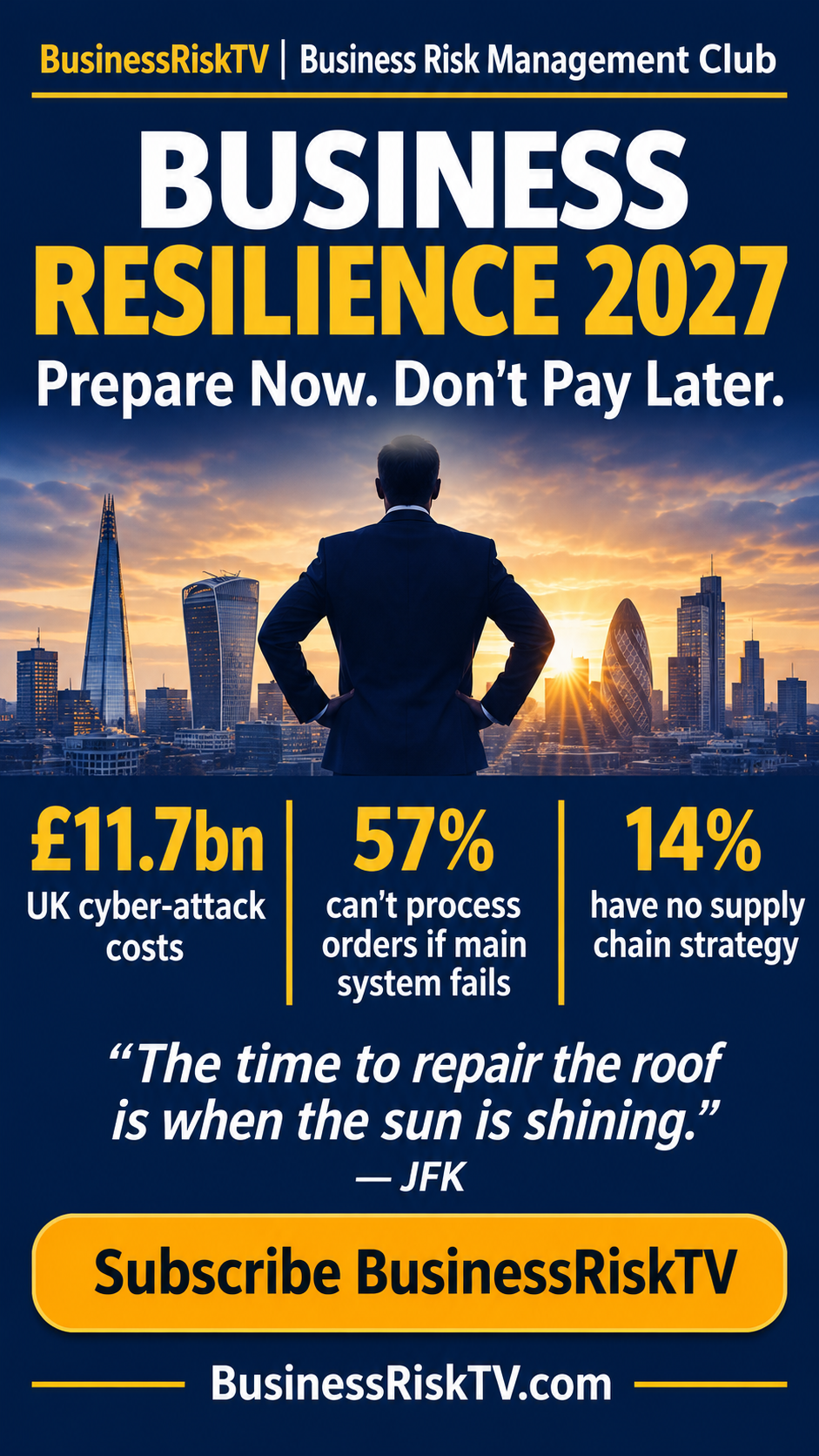
BusinessRiskTV Business Risk Management Club recommends building business resilience in preparation for known and unknown risk events in 2027 and beyond. The evidence is damning: UK large businesses absorbed an estimated £11.7 billion in cyber-attack costs in a single year, with £3.7 billion of that spent defending shareholder litigation rather than preventing the breach in the first place . That is not a technology problem. That is a boardroom failure of foresight, prioritisation, and courage. As Winston Churchill allegedly put it: “Let our advance worrying become advance thinking and planning.” Too many UK leaders are doing neither.‌

Why is preparation now to build business resilience not money wasted?

Preparation now is not money wasted because resilience spending is an ROI-positive insurance premium against catastrophic loss, not an overhead to be trimmed. Grant Thornton’s Enterprise Resilience Survey found that 69% of highly profitable companies build redundancy and flexibility into cost programmes, compared with only 26% of less profitable respondents . The gap between winners and losers is not luck. It is whether leaders treat slack, backup systems, and supplier diversity as strategic assets or as waste. Gallagher and CEBR data proves the point brutally: large UK firms spent just £226 million on external incident response support, yet £5.4 billion on direct trading losses from disruption . The ratio is roughly 24:1. Every pound not spent on preparation is a pound multiplied in consequence. As Benjamin Franklin wrote, “An ounce of prevention is worth a pound of cure” — a cliché only because so few actually act on it.‌

What are the 9 ways to prepare now for an uncertain 2027?

Nine ways to prepare now include stress-testing financial exposure, diversifying supplier concentration, and embedding resilience accountability at board level. PwC’s Risk Agenda 2027 warns that UK CEOs spend only 11% of their time on issues beyond a five-year horizon, while 55% is consumed by sub-one-year concerns . That is strategic inertia dressed up as busyness. Here is what decisive leaders should do:‌

  1. Map single points of failure across suppliers, systems, and key customers. Nearly half (47%) of UK businesses generate more than half their sales from their top three customers — a revenue concentration risk that turns one lost account into an existential event.‌
  2. Stress-test cashflow against a “no-main-system” scenario. 57% of UK businesses admit they could not continue sales order processing or purchasing if their main system failed.
  3. Lock in financing before you need it. Lloyds data shows 75% of businesses claim they have the right financial tools, yet only 46% use cashflow forecasting and 30% have working capital facilities in place . Confidence without capability is delusion.‌
  4. Build redundancy into cost-cutting programmes. 52% of UK firms have only partly commenced strategies to avoid financial losses from supply chain disruption; 14% have no strategy at all.
  5. Run scenario exercises that assume the worst. PwC’s Minimum Viable Company framework urges boards to define what operations are truly non-negotiable before disruption hits, not during it.
  6. Diversify supplier geography and logistics routes. Geopolitical instability in 2027 — from trade barriers to energy shocks — rewards those who are not dependent on a single corridor or vendor.
  7. Insure for the second-order costs, not just the first. 88% of large UK firms have cyber insurance, but only 59% are covered for third-party legal claims — the exact cost that reached £3.7 billion last year.
  8. Cross-train staff and document institutional knowledge. PwC recounts a bank whose international payments system went offline for three days because the one employee with the back-end password was hiking without internet . That is not bad luck. That is bad management.‌
  9. Make resilience a standing board agenda item with named ownership. Business in the Community’s research found many firms are “unaware” of Local Resilience Forum support or simply lack the capacity to engage — a failure of curiosity and prioritisation.

What are the key mistakes business leaders often make when trying to build business resilience?

The key mistake business leaders make is treating efficiency as the opposite of resilience, cutting slack until the organisation snaps at the first shock. Grant Thornton’s Joe Mulligan put it plainly: “Lean is good up to a point. But cut too far and you weaken the muscle organisations need to perform” . The second mistake is assuming resilience is an IT project. It is not. It is a capital allocation decision, a supplier relationship decision, and a board governance decision. The third mistake is waiting for certainty. PwC notes that UK corporate debt is around its lowest level this century, yet business investment remains below its pre-2016 trend — healthy balance sheets are being hoarded, not deployed into resilience . As the old saying goes, “You can’t control the wind, but you can adjust the sails.” Too many UK boards are arguing about the forecast instead of trimming the canvas.‌

Who are the often-guilty key decision makers at fault?

The often-guilty key decision makers at fault are CEOs, CFOs, and boards who prioritise quarterly earnings over multi-year survivability. The UK government has written directly to FTSE 350 Board Chairs demanding cyber resilience be a top priority — a signal that ministers believe voluntary boardroom attention has failed . The Business Continuity Institute found that while 67.8% of organisations claim a board member is ultimately accountable for resilience, the CEO specifically holds that accountability in only 26.5% of cases, down from 39.5% the previous year . Accountability is being diffused, delegated, and diluted. Meanwhile, PwC’s data shows UK CEOs spending more than half their time on sub-one-year issues . The guilty party is not the risk manager who flagged the vulnerability. It is the executive who nodded, thanked them, and moved to the next slide. As John F. Kennedy observed, “The time to repair the roof is when the sun is shining.” UK boardrooms have had years of sunshine. The clouds are gathering.‌

When are key business decision makers involved in building business resilience?

Key business decision makers are involved in building business resilience far too late — typically after a disruption has already crystallised losses, not before. The SCALA research is unambiguous: over half of UK businesses have only partially begun strategies to protect against financial loss from supply chain disruption, and 14% have done nothing . This is involvement as firefighting, not foresight. The correct timing is continuous and embedded: resilience should sit on every board agenda, every capital allocation decision, and every supplier review. Lloyds data shows 59% of firms are adjusting strategy in response to uncertainty — but adjustment after the fact is not preparation; it is damage limitation . The Business in the Community report captures the fatalism: “Until we are in a situation, we don’t think about it and therefore react — rather than adopt a proactive approach” . That quote should be printed on the wall of every UK boardroom as a warning.‌

Where in the UK can you find resources to help you prepare most cost-effectively?

The most cost-effective UK resources are free, publicly funded, and embarrassingly underused: Local Resilience Forums (LRFs), Business Continuity Institute guidance, and government-backed cyber resilience tools. Leicestershire County Council’s LRF offers free webinars, business continuity plan templates, and industry-led tools through its Risk Ready Businesses page . This is not diluted advice — it is practitioner-built, locally tailored, and costs nothing but the time to engage. Business in the Community’s research found that many businesses simply do not know their LRF exists, or lack the capacity to reach out . That is an unforgivable excuse when the alternative is a £3.7 billion litigation bill . The National Cyber Security Centre provides free board-level cyber guidance, and the UK Government Resilience Framework explicitly calls for “active partnership” between business and government . The resources exist. The will does not. As Sun Tzu wrote, “In the midst of chaos, there is also opportunity” — and the opportunity here is to prepare cheaply now rather than expensively later.‌

The Bottom Line for 2027

UK business leaders have been warned. The data is public, the costs are quantified, and the tools are free. What is missing is the uncomfortable honesty that resilience is not a cost centre but a survival function. The £11.7 billion in cyber losses, the 57% of firms that cannot process orders if their main system fails, the 14% with no supply chain strategy at all — these are not statistics. They are indictments . BusinessRiskTV Business Risk Management Club exists for leaders who refuse to be part of that indictment. Prepare now. The alternative is paying later, with interest.‌

#BusinessResilience2027 #UKBusinessRisk

Sources

Grant Thornton – Enterprise Resilience Survey (69% vs 26% redundancy statistic)
• Source: Grant Thornton official article “Lean, not fragile: Promote efficiency and safeguards” ‌
• Link: https://grantthornton.com/insights/articles/advisory/2025/promote-efficiency-and-safeguards
• Also cited in ABF Journal : https://www.abfjournal.com/grant-thornton-survey-enterprise-resilience-drives-efficiency-and-profitability-across-organizations/‌
SCALA Research – “The Resilience Gap” (47% customer concentration, 57% main system failure)
• Source: Consultancy.uk report ‌
• Link: https://www.consultancy.uk/news/43853/building-supply-chain-resilience-is-top-of-mind-but-execution-lags-behind
• Also reported by Motor Transport and Air Cargo Week ‌‌
PwC – Risk Agenda 2027 / CEO Survey (UK CEOs time allocation: 55% near-term, 11% beyond five years)
• Source: PwC UK official PDF ‌
• Link: https://www.pwc.co.uk/risk/assets/pdf/risk-agenda-banking-and-capital-markets-2027.pdf
• Also cited in The Executive Magazine ‌
Business Continuity Institute – Continuity and Resilience Report (CEO accountability at 26.5%, down from 39.5%)
• Source: BCI official PDF ‌
• Link: https://www.thebci.org/static/d0b2dfc1-b8f9-4087-b72f988b05d5d975/BCI-Continuity-and-Resilience-Report-2023.pdf
Business in the Community – Resilient Business Networks Report (LRF awareness gap, “reactive not proactive” quote)
• Source: BITC official PDF ‌‌
• Link: https://www.bitc.org.uk/wp-content/uploads/2025/05/bitc-report-resilient-business-networks-project-may25.pdf
Lloyds Bank – Business Barometer (59% adjusting strategy; financial tools data)
• Source: Lloyds Banking Group official press release ‌
• Link: https://www.lloydsbankinggroup.com/media/press-releases/2026/lloyds/businesses-show-resilience.html
UK Government – Cyber Resilience Pledge / Ministerial letter to FTSE 350
• Source: GOV.UK pledge pack PDF ‌
• Link: https://assets.publishing.service.gov.uk/media/69e79ddc9ca985145673b7d9/Government_Cyber_Resilience_Pledge_Pack.pdf
• UK Parliament written answer confirming ministerial letter to FTSE 350 : https://questions-statements.parliament.uk/written-questions/detail/2025-10-23/HL11273/‌

Help to protect and grow your business faster with BusinessRiskTV

Find out more about growing your business faster with BusinessRiskTV

Subscribe for free business risk management ideas risk reviews and cost of doing business in UK reduction tips

Connect with BusinessRiskTV for free business risk management tips

Read more business risk management articles and view videos for free

Connect with BusinessRiskTV for free alerts to new business risk management articles and videos

Your board just approved a £2m cost-cutting programme. Congratulations — you may have just funded your own disruption.

Here’s the uncomfortable number: 69% of highly profitable UK companies build redundancy into their cost programmes. Only 26% of less profitable ones do. That gap isn’t luck. It’s a decision.

And the cost of getting it wrong is brutal.

UK large businesses absorbed an estimated £11.7 billion in cyber-attack costs in a single year. £3.7 billion of that went on defending shareholder litigation — not on stopping the breach.

Read that again. They paid lawyers after the damage. They didn’t pay for prevention before it.

Meanwhile:

→ 57% of UK businesses admit they couldn’t process sales orders or purchasing if their main system failed.
→ 14% have no supply chain disruption strategy at all.
→ CEOs spend just 11% of their time on anything beyond a five-year horizon.

That last one should sting. The future is arriving in 2027 whether your board agenda is ready or not.

So here’s the question that separates survivors from statistics:

If your main system went down tomorrow morning, how many days of trading would you lose?

If you can’t answer that in under 10 seconds — you’ve just found your first resilience gap. And you’re not alone.

The uncomfortable truth is that most UK leaders aren’t short of information. They’re short of the courage to spend money on something that hasn’t gone wrong yet.

Winston Churchill reportedly said: “Let our advance worrying become advance thinking and planning.”

Too many UK boardrooms are doing neither. They’re waiting for certainty that will never arrive.

The good news? The most cost-effective resilience resources in the UK are free — Local Resilience Forums, Business Continuity Institute guidance, and NCSC board-level cyber tools. The reason they go unused isn’t cost. It’s curiosity.

Free tools. Public data. Quantified risk. And still, 14% of firms have no supply chain strategy.

You don’t get to call that bad luck. That’s bad management.

Want the full strategy, the 9-step checklist, and details on the Business Risk Management Club?

📧 Email editor@businessrisktv.com for more information on the Business Risk Management Club.

Save this post. Send it to your CFO. Then ask your board one question: are we prepared for 2027, or just busy?

#BusinessResilience2027 #UKBusinessRisk

Business Resilience 2027: 9 Ways to Prepare UK Firms Now
Strategic Foresight 2027: 9 UK Business Threats to Beat

Strategic foresight gives UK businesses a competitive edge before 2027 threats crystallise. This BusinessRiskTV analysis identifies nine risks — from supply chain conflict to quantified risk blindness — with ONS and industry data, plus the steps decision-makers must take now to beat competitors.

Identify 9 strategic threats UK businesses face in 2027 and how to act now. BusinessRiskTV Business Risk Management Club strategic risk analysis.

Strategic Foresight 2027: How UK Businesses Can Identify Threats Before Competitors

BusinessRiskTV Business Risk Management Club Strategic Risk Analysis for UK Marketplace 2027 is the solution to the problem of strategic risk management in the UK for 2027. As the UK business landscape faces converging geopolitical, technological, and regulatory pressures, the window for reactive strategy is closing. The Office for National Statistics reported in May 2026 that 38% of UK businesses with 10 or more employees were already concerned about international conflict impacting supply chains—a 28 percentage point rise from December 2025 . BusinessRiskTV’s Business Risk Management Club provides the structured foresight framework UK decision-makers need to convert these early signals into competitive advantage before rivals react.‌

“The true sign of intelligence is not knowledge, but imagination.” — Albert Einstein, cited in INSEAD’s Distant Foresight Index research

Why Does Strategic Foresight Early Give a Competitive Advantage in the UK?

Strategic foresight early gives a competitive advantage in the UK because it enables businesses to shape regulatory environments, set industry standards, and define customer expectations before competitors recognise the threat. A firm that articulates a clear, well-researched vision of the future can effectively create the very future it is prepared to dominate . Shell’s pioneering scenario planning in the late 1960s anticipated a potential oil supply disruption; when the 1973 crisis hit, Shell was better prepared than competitors and gained a decisive advantage through diversification .‌‌

The financial case is stark. Aon’s 2026 UK report found that only 16% of UK firms have quantified their exposure to business interruption, and just 12.4% have quantified supply chain disruption exposure . Without quantification, senior leaders cannot make informed investment decisions or structure appropriate insurance programmes. Beazley’s January 2026 survey of 3,500 leaders across seven countries found that 94% of global businesses intend to build resilience through insurance and risk management in 2026, with 31% specifically planning to invest in risk management and loss prevention.

  • First-mover regulatory influence: Early foresight allows firms to engage with regulators before rules crystallise, shaping outcomes favourably
  • Talent and capital allocation: Identifying threats early enables redeployment of resources before sunk costs become stranded
  • Competitor blind spots: Most firms focus on immediate industry metrics; distant foresight captures weak signals beyond sector boundaries
  • Insurance and risk transfer pricing: Firms that quantify exposure early access better terms before insurers reprice systemic risks ‌

    What Are 9 Potential Issues in 2027 That UK Businesses Must Prepare For Now?

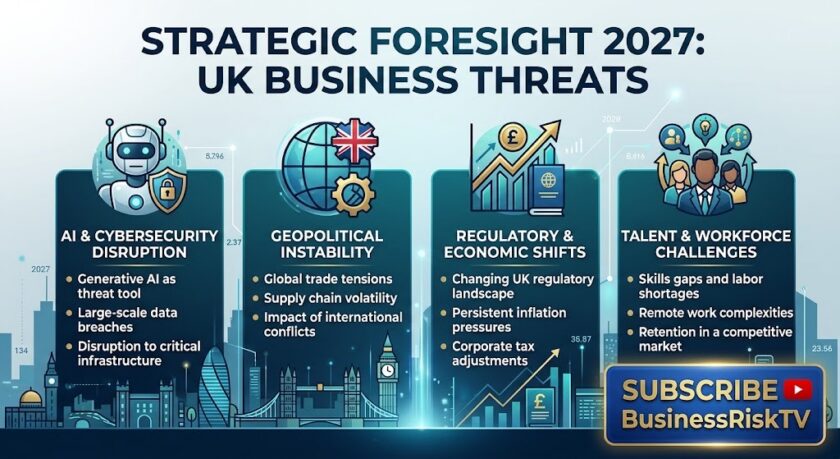
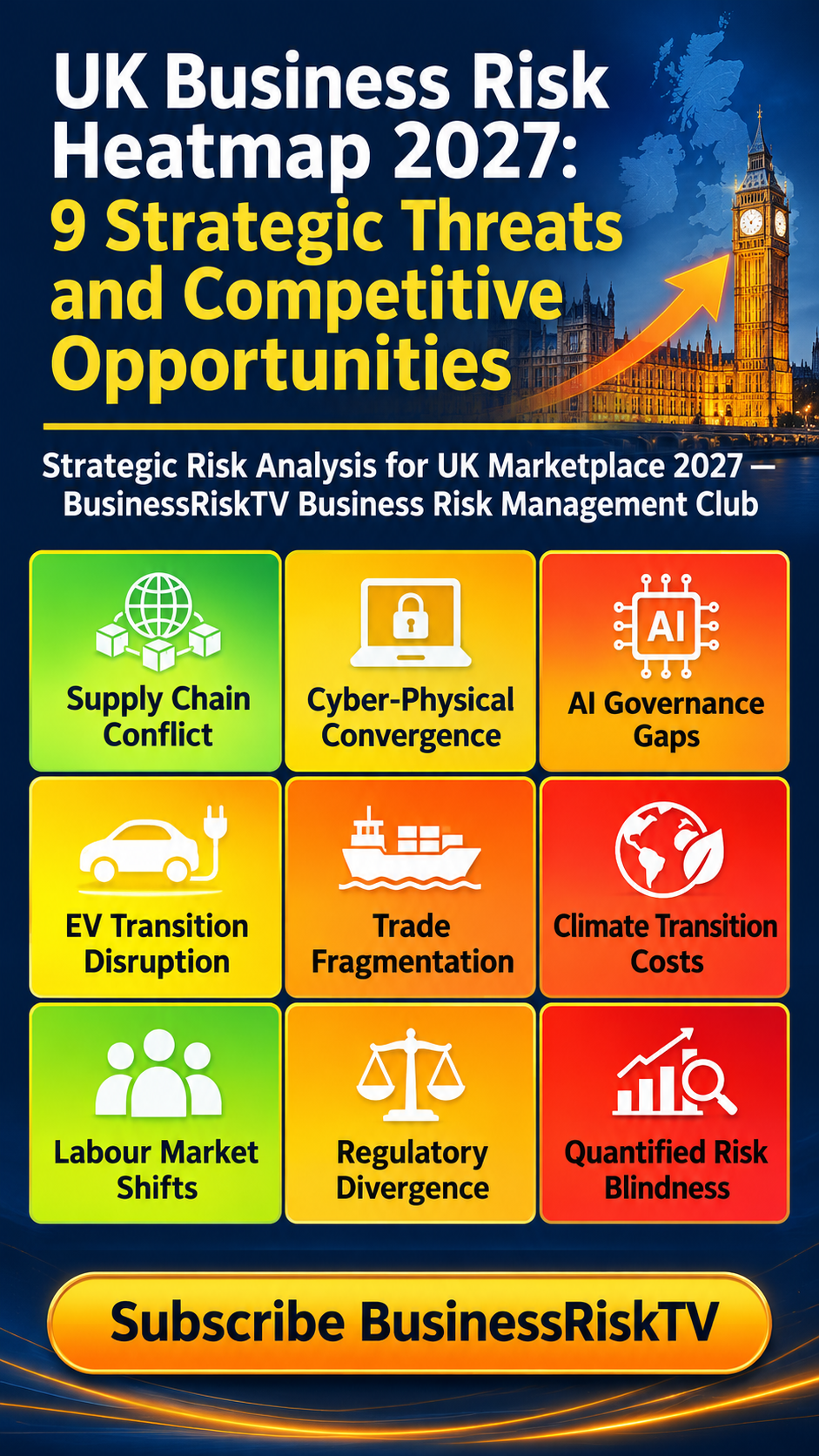
Nine potential issues in 2027 that UK businesses must prepare for now include supply chain conflict exposure, cyber-physical convergence, AI governance gaps, EV transition disruption, geopolitical trade fragmentation, climate transition costs, labour market restructuring, regulatory divergence, and quantified risk blindness. Each represents a threat that can be converted into opportunity through structured foresight.

UK business risk 2027
Foresight 2027 UK Business Threats Subscribe BusinessRiskTV

#StrategicForesight2027 #UKBusinessRisk #BusinessRiskTV #RiskManagement

1. Supply Chain Conflict and Shipping Disruption

Supply chain conflict and shipping disruption will intensify in 2027, with ONS data already showing 25% of UK businesses concerned about shipping disruption in April 2026—up 18 percentage points from December 2025. Import costs increased for 44% of importing businesses in March 2026 compared with the previous year, the highest proportion since June 2023 . Act now: Map tier-2 and tier-3 suppliers for conflict-exposed regions; pre-negotiate alternative logistics routes; stress-test working capital against 20% freight cost increases.‌

2. Cyber-Physical Convergence and Business Interruption

Cyber-physical convergence will create business interruption events in 2027 that traditional risk frameworks cannot handle, with 27.3% of UK organisations already having suffered significant financial losses from business interruption. Beazley’s outlook warns that converging risks mean digital, transitional, and geopolitical disruption are creating simultaneous pressures across every part of the business . Act now: Quantify cyber-physical interdependencies; test incident response against a 5-day operational shutdown scenario; review insurance limits against modelled exposure.‌

3. AI Governance and Model Risk

AI governance and model risk will become a board-level regulatory issue in 2027, with financial services firms already facing Consumer Duty obligations that demand demonstrable oversight of automated decision-making. The FCA’s expectations and emerging AI regulation will require boards to evidence accountability. Act now: Establish an AI use-case register with risk ratings; implement model validation before deployment; train boards on AI accountability.

4. Electric Vehicle Transition Operational Disruption

Electric vehicle transition will disrupt operational models in 2027, with the Zero Emissions Vehicle Mandate reshaping the UK vehicle parc and creating different operational pressures for fleet-dependent businesses. The AA has already invested in specialist EV training and is progressively introducing EVs into its own fleet, converting transition risk into operational readiness. Act now: Audit fleet dependency on internal combustion maintenance skills; model EV charging infrastructure costs; retrain frontline staff.‌

5. Geopolitical Trade Fragmentation and Rules of Origin

Geopolitical trade fragmentation will raise compliance costs in 2027, with 39% of exporting businesses reporting increased exporting costs in March 2026—the highest since September 2023 . Act now: Review rules of origin documentation; model tariff scenarios for EU and US trade; consider nearshoring critical inputs.

6. Climate Transition Cost Pass-Through

Climate transition costs will accelerate in 2027, with Beazley identifying climate and environmental risk as representing 20% of average business risk concern globally. The European Space Agency’s foresight work warns that intensifying climate impacts will affect European economies through the investment required to build resilience and adopt mitigating technologies . Act now: Stress-test energy cost exposure; assess carbon border adjustment mechanism impact; identify quick-win efficiency investments.‌

7. Labour Market Restructuring and Skills Gaps

Labour market restructuring will create skills shortages in 2027 as AI adoption and green transition reshape demand, with 4% of UK businesses having temporarily paused trading and 2% permanently ceased by late April 2026 . Act now: Map critical skills against 2027 requirements; initiate reskilling programmes; review contingent labour strategies.‌

8. Regulatory Divergence Post-Brexit

Regulatory divergence will increase compliance complexity in 2027, requiring UK-specific frameworks for product marking, data, and financial services. The Food Standards Agency is already developing novel regulatory approaches for cell-cultivated products through its sandbox programme, signalling sector-specific divergence . Act now: Assign regulatory horizon scanning ownership; budget for dual compliance; engage with regulators early.‌

9. Quantified Risk Blindness

Quantified risk blindness will leave UK firms unable to justify resilience investment in 2027, with only 21.6% having a formal business interruption plan and just 16% quantifying exposure. Aon warns that without quantification, leaders struggle to make informed decisions or plan for the true cost of prolonged disruption . Act now: Commission quantitative risk assessment; link insurance limits to modelled loss scenarios; present board-level risk appetite statements.‌

What Steps Should Key Business Decision Makers Take Today to Beat Competitors in 2027?

Key business decision makers should today establish a structured distant foresight function, quantify their top three risk exposures, and integrate scenario planning into capital allocation. The INSEAD Distant Foresight Index approach helps organisations identify potentially destructive threats beyond industry boundaries, avoiding the fate of Blockbuster, Nokia, and Kodak . The European Space Agency’s foresight practice demonstrates that developing scenarios challenges assumptions and tests strategies against multiple futures, ensuring organisations remain proactive rather than reactive.‌

  • Appoint a foresight owner with board access, not buried in strategy or innovation teams
  • Run a 2027 threat quantification sprint covering business interruption, supply chain, and cyber, using structured financial modelling rather than intuition
  • Establish weak-signal monitoring across sectors beyond your own, using the INSEAD distant foresight methodology
  • Integrate foresight into FP&A so capital allocation is stress-tested across multiple scenarios, not a single base case
  • Engage regulators proactively on emerging issues before rules crystallise
  • Report foresight outputs to the board quarterly, treating them with the same rigour as financial reporting‌

“Don’t wait for the future to happen to you, create it.” — Frank Spencer and Yvette Montero-Salvatico, TFSX, cited in strategic foresight literature

Who Will Benefit Most from Strategic Foresight in the UK?

Businesses in supply chain-intensive, technology-dependent, and regulated sectors will benefit most from strategic foresight in the UK, particularly those with complex international exposure or fleet-dependent operations. Beazley’s survey found that 94% of global businesses plan to build resilience through insurance and risk management, indicating widespread recognition that interconnected risks amplify one another .‌

  • Manufacturers and importers facing 44% import cost increases and rules-of-origin complexity
  • Logistics and fleet operators managing EV transition and fuel price volatility
  • Financial services firms navigating AI governance and Consumer Duty obligations
  • Food and life sciences businesses facing novel regulatory pathways for emerging products
  • Any UK business with quantified exposure below board-level visibility—the 84% without quantified business interruption risk

    When Must Key Business Decision Makers Act?

    Key business decision makers must act now, in Q4 2026, because 2027 planning cycles are already underway and early movers will capture regulatory influence and insurance pricing advantages before systemic risks are fully priced. The ONS data shows concern about supply chain conflict rose 28 percentage points between December 2025 and April 2026—a pace that leaves late movers reacting to events rather than shaping them . Shell’s advantage in 1973 came from scenario work conducted years earlier.

  • Immediate (Q4 2026): Commission quantified risk assessment; appoint foresight owner; initiate regulator engagement
  • Q1 2027: Integrate scenario outputs into capital allocation; review insurance programme against modelled exposures
  • Q2 2027: Launch weak-signal monitoring; report first foresight dashboard to board
  • Ongoing: Quarterly scenario refresh; annual full foresight review

    Which Industries Should Be Most Concerned or Best Prepared to Take Advantage?

Manufacturing, logistics, financial services, food and life sciences, and fleet-dependent service industries should be most concerned about 2027 threats, while those same sectors are best positioned to capture advantage through early preparation. The FSA is actively developing regulatory pathways for cell-cultivated products, creating first-mover advantages for compliant innovators . The AA has already invested in specialist EV training and is progressively introducing EVs into its own fleet, converting transition risk into operational readiness.

  • Manufacturing: Highest exposure to supply chain conflict and import cost inflation ; opportunity in nearshoring and dual-sourcing
  • Logistics and transport: EV transition reshaping service profiles; opportunity in specialist EV capability
  • Financial services: AI governance and Consumer Duty convergence; opportunity in trusted AI assurance services
  • Food and life sciences: Novel regulatory pathways ; opportunity in early regulatory engagement
  • Insurance and risk advisory: Demand surge for quantification and scenario services ; opportunity in specialised foresight products‌
  • Energy-intensive sectors: Transition cost exposure; opportunity in efficiency-led differentiation

Sources

  1. INSEAD Knowledge, Developing a Toolkit for Strategic Foresight: https://knowledge.insead.edu/strategy/developing-toolkit-strategic-foresight
  2. Wiley, Addressing the Sceptical CFO: The Finance Case for Foresight (PDF excerpt): https://media.wiley.com/product_data/excerpt/80/13944258/1394425880.pdf
  3. Food Standards Agency, Thematic Report on Emerging Food Innovations in the UK: https://www.food.gov.uk/our-work/thematic-report-on-emerging-food-innovations-in-the-uk
  4. Office for National Statistics, Business Insights and Impact on the UK Economy: 7 May 2026: https://www.ons.gov.uk/businessindustryandtrade/business/businessservices/bulletins/businessinsightsandimpactontheukeconomy/7may2026
  5. The AA, Results and Presentations (Annual Report FY26): https://www.theaacorporate.com/investors/results-and-presentations
  6. Beazley, Feeling the Heat: Converging Risk Landscape Forces Business to Rethink Insurance Protection (February 2026): https://www.beazley.com/en-US/news-and-events/feeling-the-heat-converging-risk-landscape-forces-business-to-rethink-insurance-protection/
  7. European Space Agency, Navigating the Future with Strategic Foresight & Planning (PDF): https://esamultimedia.esa.int/docs/20242310_ESA_A5_FLYER_FINAL.pdf
  8. Insurance Business UK, Few UK Firms Quantify Their Disruption Risk, Aon Finds (November 2026): https://www.insurancebusinessmag.com/uk/news/cyber/few-uk-firms-quantify-their-disruption-risk-aon-finds-595709.aspx

FAQ: Strategic Foresight 2027 and UK Business Risk

What is strategic foresight and why does it matter for UK businesses in 2027?

Strategic foresight is the capacity to explore multiple plausible futures and develop strategies that remain robust across a range of scenarios . It matters for UK businesses in 2027 because UK insolvencies are forecast to remain 21% above pre-pandemic averages even as they decline, with 24,800 failures expected in 2027 . The World Economic Forum notes that organisations with foresight capabilities “don’t just react to change, they shape it” . Shell has used scenario planning since the 1970s to anticipate geopolitical risks, including the OPEC oil embargo, and continues using it to navigate the energy transition.

Which UK sectors face the greatest insolvency risk heading into 2027?

Construction, wholesale and retail, hospitality and real estate face the greatest insolvency risk heading into 2027. Construction has accounted for around 17% of all UK insolvencies in every rolling period tracked by the Insolvency Service through mid-2026, with wholesale and retail trade consistently at 15% to 16% . Consumer-facing sectors have seen the sharpest rises in critical distress: leisure and cultural businesses rose 27.1%, hotels and accommodation 26.6%, and sport and health clubs 21.0% over the past year. Begbies Traynor Group warns that because insolvencies typically lag financial distress, the UK could see increases in business failures during 2027.

What do ONS statistics say about UK business concerns for 2027?

ONS statistics show UK business concerns about supply chain disruption have risen sharply. In late April 2026, 38% of businesses with 10 or more employees were concerned about international conflict impacting supply chains, a 28 percentage point rise from December 2025; 25% were concerned about shipping disruption, up 18 percentage points . Import costs increased for 44% of importing businesses in March 2026 compared with the previous year, the highest proportion since June 2023, while 39% of exporters reported increased costs . Additionally, 4% of businesses reported temporarily paused trading and 2% permanently ceased trading in late April 2026.

How does strategic foresight give a competitive advantage over competitors?

Strategic foresight gives a competitive advantage by enabling firms to shape regulatory environments, set industry standards, and define customer expectations before rivals recognize threats. The World Economic Forum states that leading companies using foresight are “more agile in crises, better prepared for disruption and more consistent in their long-term commitments to stakeholders” . Cisco employs technology foresight to spot emerging tech trends, guide R&D investments, and position itself in markets of the future . The alternative is illustrated by Nokia and Kodak, which failed to anticipate threats beyond their immediate industry boundaries despite having the resources to do so.‌

What geopolitical technology risks should UK businesses monitor for 2027?

UK businesses should monitor control over AI technology, critical minerals, and cloud infrastructure as geopolitical risks for 2027. PwC warns that technology is now widely seen as a national security issue, with the US and China using trade barriers to limit competitors’ progress across raw materials, components, knowledge and intellectual property, and data and compute infrastructure . Businesses need to map where AI models are used, which provider and jurisdiction controls them, and what dependencies and concentration risks they face . Access to critical minerals and rare earth elements is increasingly linked to geopolitical competition, affecting tech, defence, and energy transition sectors.‌

When must UK business leaders act to prepare for 2027 threats?

UK business leaders must act now, in Q4 2026, because 2027 planning cycles are underway and early movers capture regulatory influence and insurance pricing advantages before systemic risks are fully priced. Allianz Trade forecasts insolvencies declining to 24,800 in 2027, but this remains 21% above pre-pandemic averages, and 213,000 UK jobs are directly at risk from business insolvencies between 2026 and 2027 . Begbies Traynor warns that further increases in energy costs or inflation could accelerate financial distress, with insolvency increases likely in 2027 . The window between competitive trade credit insurance pricing and rising counterparty risk may not stay open indefinitely.

Which industries are best positioned to take advantage of 2027 opportunities?

Industries that quantify risk exposure early and engage regulators proactively are best positioned for 2027 opportunities. PwC’s UK economic outlook notes that UK corporate debt is around its lowest level this century, providing some protection, but real business investment remains below its pre-2016 trend . The IMF expects UK GDP growth of 1.3% in 2027, and the UK was the only G7 economy to receive an upgrade in the latest forecasts . Businesses that convert short-term resilience into private-sector investment and productivity gains will capture advantage, particularly in sectors where competitors remain paralyzed by uncertainty. PwC found that UK CEOs spend only 11% of their time on issues extending beyond five years.

What practical steps should decision-makers take today?

Decision-makers should appoint a foresight owner with board access, quantify their top three risk exposures, and integrate scenario planning into capital allocation. The World Economic Forum recommends structured dialogue with leadership teams to benchmark foresight capabilities against peers and identify blind spots in sensing change and translating foresight into strategy . ONS data shows 26% of businesses now use AI, up 8 percentage points year-on-year, and 18% plan to adopt it in the next three months . Businesses should map AI dependencies, review rules of origin documentation, and stress-test working capital against freight cost increases, given that 56% of concerned businesses expect sourcing costs to rise.

Get help to protect and grow your business faster with BusinessRiskTV

Find out more about growing your business faster with BusinessRiskTV 

Subscribe for free business risk management ideas risk reviews and cost of doing business reduction tips

Connect with BusinessRiskTV for free business risk management tips

Read more business risk management articles and view videos for free

Connect with BusinessRiskTV for free alerts to new business risk management articles and videos 

Strategic Foresight 2027: 9 UK Business Threats to Beat

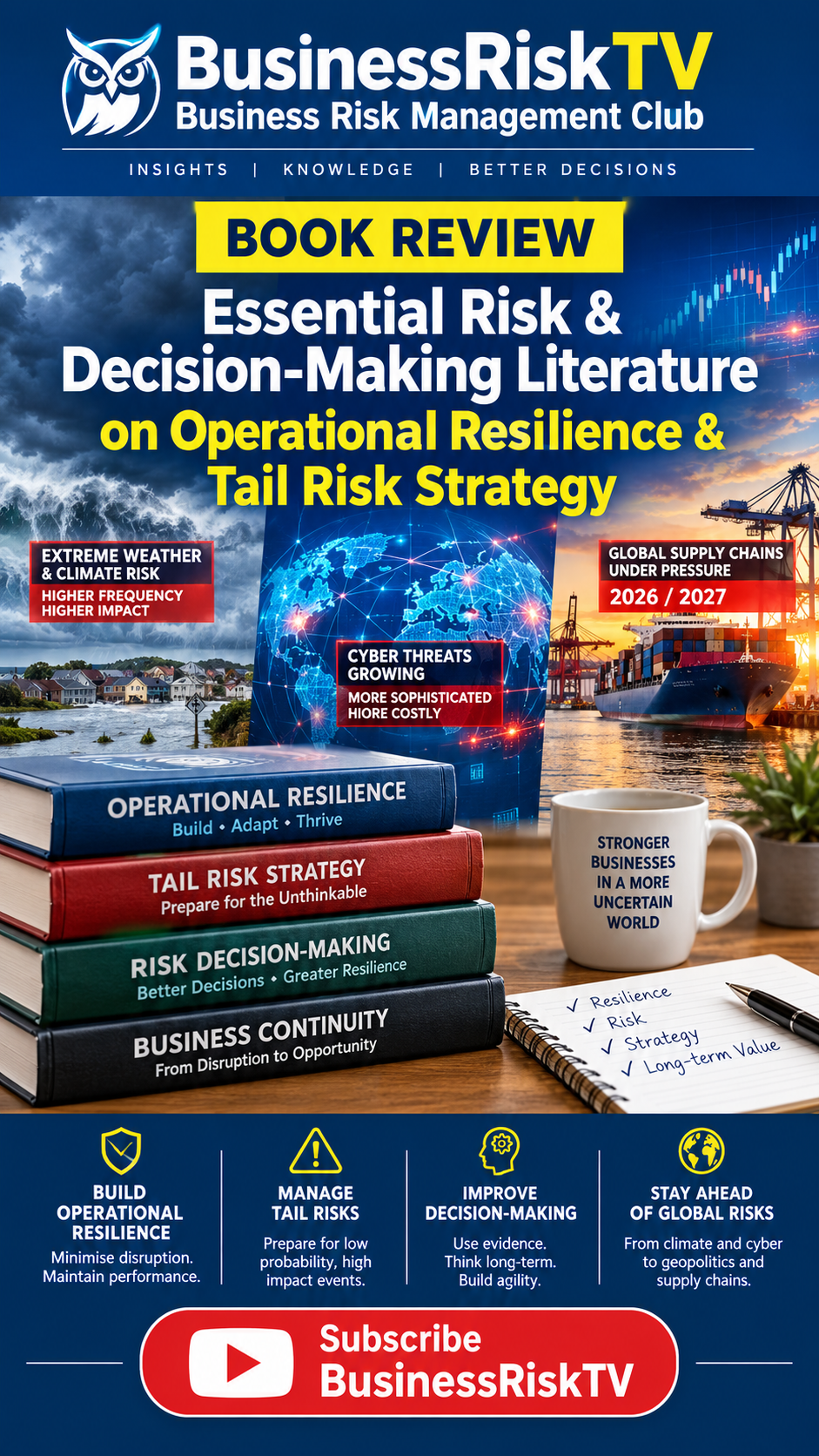
Which 3 Nassim Taleb Books Should Directors Read for Tail Risk & Operational Resilience in 2026?

How do directors, project managers & strategists navigate systemic uncertainty? BusinessRiskTV reviews Taleb’s 3 books with UK ONS stats & practical tail risk steps.

BusinessRiskTV Business Risk Management Club recommends these 3 books to help the reader make better decisions on Operational Resilience & Tail Risk Strategy.

That single sentence encapsulates why the following review exists. The scale of the problem is not theoretical. The Office for National Statistics reported that 40% of UK trading businesses with 10 or more employees cited economic uncertainty as the most significant challenge impacting turnover in early April 2026—the highest proportion since the question was introduced in April 2022. Government analysis of operational disruption across UK sectors shows that while typical incidents cost between 0.2% and 4.6% of annual turnover, tail events can dominate total losses and threaten business continuity entirely. Cyber-attacks alone cost UK businesses £3.7 billion in litigation over the past year, with shareholder lawsuits accounting for nearly a third of that total. Against this backdrop, Nassim Nicholas Taleb’s Incerto trilogy—Fooled by Randomness, The Black Swan, and Antifragile—provides the conceptual infrastructure that directors, project managers, and strategists need to navigate systemic uncertainties and cognitive bias in decision-making.‌

What Makes Nassim Nicholas Taleb’s Incerto Trilogy Essential Risk & Decision-Making Literature for Operational Resilience & Tail Risk Strategy?

Taleb’s Incerto trilogy is essential risk and decision-making literature for operational resilience and tail risk strategy because it systematically dismantles the illusions that lead organisations to underestimate rare, high-impact events and overestimate their ability to predict and control complex systems. The three books form a coherent progression: Fooled by Randomness (2001) exposes how humans mistake luck for skill; The Black Swan (2007) reveals how rare, unpredictable events shape history and markets; Antifragile (2012) offers a framework for building systems that benefit from disorder.

Why This Matters for Directors, Project Managers & Strategists:

  • Directors face board-level decisions where governance failures linked to cognitive bias carry escalating legal and financial consequences. UK boards are already experiencing “quiet distress” as prolonged financial strain and delayed decisions create D&O exposure earlier in the risk cycle.
  • Project managers operate at the intersection of uncertainty and delivery, often relying on linear projections and optimistic timelines that fail catastrophically when tail events hit. Research shows that organisations with structured decision trackers score more than 20 percentage points higher on early-warning indicator tracking and bias exploration than those without.
  • Strategists build models that assume a stable future, yet the ONS Business Insights survey consistently shows economic uncertainty dominating business challenges month after month.‌
    Each book serves a distinct function in the operational resilience toolkit. Together, they constitute a complete curriculum in probabilistic thinking, tail risk awareness, and adaptive system design.

What Is the Core Argument of Fooled by Randomness, and How Does It Apply to Business Decision-Making?

The core argument of Fooled by Randomness: The Hidden Role of Chance in Life and in the Markets is that humans systematically confuse randomness with causality, attributing success to skill and failure to controllable factors, thereby creating brittle decision-making frameworks that collapse when randomness reasserts itself. Taleb demonstrates that much of what passes for expertise in finance, management, and strategy is indistinguishable from luck dressed in the language of analysis.

Why This Matters Practically:

  • Distinguish signal from noise in performance data. Taleb argues that short-term results are dominated by variance, not skill. When evaluating business unit performance or project outcomes, directors should demand longer time horizons and statistical significance testing before drawing conclusions. UK businesses reporting turnover decreases (27% in April 2026) and increases (15% in July) often attribute these swings to strategy or market conditions when random fluctuation may be the dominant driver.‌
  • Identify survivorship bias in case studies. Business literature is filled with success stories of companies that “did everything right.” Taleb’s point is that we never see the graveyard of companies that did the same things and failed due to bad luck. Strategy teams should actively seek out failure cases and control groups.
  • Resist the narrative fallacy in post-mortems. After any project, there is enormous pressure to construct a coherent story explaining outcomes. Taleb warns this narrative impulse prevents genuine learning.

Business Application:

Project managers should implement decision journals that record expectations before outcomes are known, creating a feedback loop that reveals whether success was skill or circumstance. Directors should push for probabilistic language in board papers—”we assess a 60% likelihood” rather than “we are confident”—forcing explicit recognition of uncertainty. Strategists should stress-test strategic plans against scenarios where random negative events cluster, rather than assuming they distribute evenly across time.

What Is the Central Thesis of The Black Swan, and Which Businesses Are Most Vulnerable to Its Implications?

The central thesis of The Black Swan: The Impact of the Highly Improbable is that rare, unpredictable, high-consequence events—Black Swans—dominate outcomes in complex systems, yet our psychological and institutional frameworks are systematically blind to their possibility, leaving businesses dangerously exposed to catastrophic surprise. Taleb identifies the “triplet of opacity”: the illusion of understanding, the retrospective distortion of events, and the overvaluation of factual information.

Which Businesses Are Most Vulnerable:

  • Financial services firms face existential Black Swan exposure. Bank of England research shows 82% of UK banks, insurers and asset managers now cite cyber attacks as a top-five risk to the financial system, up ten percentage points from 2024. A meaningful share of large financial institutions face a roughly 10% annual probability of losing 10% or more of annual profit to a single cyber event.
  • Supply chain-dependent manufacturers and retailers are directly exposed to geopolitical Black Swans. In April 2026, 47% of UK businesses experiencing global supply chain disruption cited the conflict in the Middle East as the reason—up 34 percentage points from February.‌
  • Energy-intensive businesses face compounding tail risks from price volatility and geopolitical disruption. 60% of UK businesses reported concern about energy prices in early May 2026, with accommodation and food service businesses reaching 86% concern.‌
  • Technology and digital businesses are exposed through cyber, regulatory, and concentration risk. The PRA’s 2026 operational resilience policy statement explicitly addresses “rising threats to operational resilience at firms and their growing reliance on externally supplied services”.‌

When to Use The Black Swan Learning Points:

Business Application:

Directors should establish dedicated tail risk committees that meet independently of standard risk reviews, focusing exclusively on low-probability, high-impact scenarios. Project managers should build “kill criteria” into major projects—pre-defined conditions under which the project is stopped—rather than assuming continuation. Strategists should model scenarios where multiple Black Swans occur simultaneously, recognising that disruptions cluster rather than distribute evenly.

What Does Antifragile Teach About Building Organisations That Improve Under Stress, and How Can This Be Implemented?

Antifragile: Things That Gain From Disorder teaches that some systems are not merely robust (resistant to shocks) or resilient (recovering after shocks), but antifragile—they actually improve, strengthen, and grow when exposed to volatility, randomness, and stressors. Taleb argues this property is the highest form of adaptation available to organisations, and it can be deliberately engineered through structural choices, incentive design, and optionality.

Key Antifragile Principles for Business:

  • Barbell strategy: Combine extreme conservatism in core operations with aggressive, small-scale experimentation in growth areas. 75% of grant-funded UK charities use formal risk tools compared to 35% of non-grant-funded organisations, suggesting structured approaches enable greater risk capacity when combined with appropriate funding.
  • Optionality over prediction: Rather than forecasting the future, build portfolios of options that benefit from multiple possible outcomes. This directly addresses the observation that economic uncertainty has been the most reported challenge affecting business turnover since October 2022.
  • Skin in the game: Decision-makers must bear the consequences of their decisions. HM Treasury’s 2026 guidance to accounting officers frames value for money as a “balanced judgement of strategic alignment, long-term resilience, and risk,” moving beyond simple cost minimisation.
  • Redundancy as investment: Duplicate systems, diversified suppliers, and cross-trained teams are not waste—they are the raw material of antifragility.

When to Apply Antifragile Learning Points:

  • During organisational design—to build structures that benefit from uncertainty rather than merely surviving it.
  • During supply chain strategy—to move from just-in-time efficiency to diversified, optionality-rich sourcing.
  • During technology investment—to prioritise systems that learn from attacks and failures rather than merely resist them.
  • During talent development—to cultivate teams comfortable with volatility and skilled at rapid adaptation.

Business Application:

Operations directors should conduct “stress tests with benefit”—scenarios where the organisation not only survives disruption but emerges stronger because competitors are weakened. For example, a manufacturer with diversified suppliers can gain market share when single-source competitors face disruption. Project managers should build rapid prototyping and learning loops into delivery schedules, treating small failures as information rather than stigma. Strategists should allocate a portion of capital to small, high-optionality bets that could pay off massively in Black Swan scenarios, while simultaneously reducing exposure to ruinous tail risks.

Which Businesses Will Benefit Most from Taleb’s Frameworks, and Where in the World Are They Likely Operating?

The businesses that will benefit most from Taleb’s frameworks are those operating in high-uncertainty, high-interconnection, and high-consequence environments—particularly in the UK, Europe, North America, and Asia-Pacific where regulatory pressure, geopolitical fragmentation, and technological disruption intersect.

Sector-by-Sector Analysis:

  • Financial services in London, New York, Singapore, and Frankfurt face the most acute combination of regulatory scrutiny, cyber exposure, and tail risk concentration. The PRA’s PS7/26 operational resilience policy, effective from 2026, requires firms to report operational incidents and material third-party arrangements with significantly reduced burden but enhanced oversight. UK financial services compliance costs now exceed £33.9 billion annually, representing roughly 13% of average operating costs.‌
  • Manufacturing and logistics across the UK, Germany, Netherlands, and key Asian hubs are directly exposed to supply chain Black Swans. The ONS reported 7% of UK businesses experiencing global supply chain disruption in April 2026, with nearly half citing Middle East conflict.‌
  • Energy and utilities in the UK, Norway, Gulf states, and Australia face compounded tail risks from price volatility, geopolitical disruption, and transition uncertainty. 28% of UK businesses cited energy prices as a reason for considering raising prices in June 2026.‌
  • Technology and digital platform businesses globally face cyber Black Swans, regulatory tail risks, and concentration risk. The Bank of England’s 2026 H1 Systemic Risk Survey found 82% of financial institutions citing cyber attacks as a top-five systemic risk.‌
  • Healthcare and pharmaceutical supply chains across Europe, North America, and Asia are exposed to pandemic Black Swans, regulatory disruption, and geopolitical supply chain risk.
  • Professional services firms advising on risk, strategy, and resilience are both beneficiaries (demand for their services grows) and exposed to reputational tail risks if they fail to apply these frameworks themselves.

Geographic Concentration:

  • United Kingdom: Highest regulatory intensity for operational resilience, with FCA/PRA rules now in “steady-state” from 2026, enhanced regulatory powers, and cost recovery provisions.
  • European Union: DORA (Digital Operational Resilience Act) in force across Europe, aligning with UK approaches but creating additional compliance complexity for cross-border firms.
  • United States: Less prescriptive regulation but higher litigation and shareholder activism risk, particularly around cyber governance failures.
  • Asia-Pacific: Rapid economic growth combined with geopolitical tension, supply chain concentration, and varying regulatory maturity creates a high-Black-Swan environment.
  • Middle East and Africa: Geopolitical disruption, energy price volatility, and infrastructure risk create compounding tail exposure.

How Should Organisations Integrate Taleb’s Key Learning Points into Decision-Making to Boost Performance and Reduce Risk Events Derailing Business Objectives?

Organisations should integrate Taleb’s key learning points by embedding probabilistic thinking, tail risk assessment, and antifragile design principles into the governance, project management, and strategy functions at the point of decision, not as an afterthought. The evidence suggests this is not optional: UK business confidence dropped to a net figure of -76 in March 2026, compared to -63 in February, according to Institute of Directors research. Fewer businesses were set up in Q1 2026 than in any comparable period on record. The organisations that survive and thrive will be those that internalise Taleb’s lessons before the next Black Swan arrives.

Board-Level Integration:

  • Establish a Tail Risk Committee reporting directly to the board, separate from the standard audit and risk committee, with a mandate to challenge assumptions of normality and identify ruin exposure.
  • Require probabilistic decision papers: every significant capital allocation or strategic decision must include explicit probability assessments, not point forecasts.
  • Implement decision journals that record expectations, rationale, and confidence levels before outcomes are known, reviewed quarterly to identify systematic biases.

Project Management Integration:

  • Build kill criteria into every major project: pre-defined conditions under which the project is terminated, removing sunk-cost bias from continuation decisions.
  • Apply barbell resource allocation: commit 80-90% of resources to high-confidence, low-variance delivery, and 10-20% to experimental, high-optionality initiatives that could benefit from disorder.
  • Conduct pre-mortems at project initiation: assume the project has failed catastrophically and work backwards to identify causes.

Strategy Integration:

  • Replace single-scenario planning with multiple scenarios including Black Swan scenarios where multiple disruptions compound.
  • Develop antifragile supply chains with diversified sourcing, redundancy, and optionality—accepting higher baseline costs as insurance against tail events.
  • Invest in optionality: maintain cash reserves, flexible contracts, and strategic options that can be exercised when volatility creates opportunity.

Operational Resilience Integration:

  • Align with regulatory requirements proactively: the PRA’s operational resilience framework requires firms to remain within impact tolerances for important business services under severe but plausible disruption scenarios.
  • Conduct regular stress tests that include cyber, geopolitical, and supply chain scenarios simultaneously, recognising that disruptions cluster.
  • Measure resilience value not just as cost avoidance but as competitive advantage: government analysis shows that increased resilience reduces both the likelihood of severe outcomes and the scale of losses when disruption occurs.‌

When to Apply These Frameworks:

  • Annually during strategy and budget cycles: full Black Swan scenario review and antifragile portfolio assessment.
  • Quarterly during board risk reviews: tail risk exposure review and decision journal analysis.
  • Monthly during project reviews: kill criteria assessment and pre-mortem updates.
  • Continuously through operational monitoring: early-warning indicators and antifragile capacity metrics.
  • Post-incident after any disruption: structured learning review applying Fooled by Randomness lessons about attribution.

Why Are These Books Particularly Relevant for Operational Resilience & Tail Risk Strategy in September 2026?

These books are particularly relevant in September 2026 because the operating environment has become precisely the kind of high-volatility, high-interconnection, high-consequence system that Taleb’s frameworks were designed to address. The ONS Business Insights survey for April 2026 showed economic uncertainty at 40% for larger businesses—the highest proportion since the question was introduced. Global supply chain disruption reached 9% in March 2026, the highest since December 2022. The PRA’s operational resilience rules are now in full effect, with “steady-state” expectations and enhanced regulatory powers to demand information, direct remediation, and recover supervisory costs. Bank of England analysis confirms that “average impacts are not representative of overall risk exposure” and that “tail events can dominate total losses and can threaten business continuity”.‌‌

Taleb’s trilogy provides the intellectual architecture to navigate this environment. Fooled by Randomness teaches the discipline of statistical scepticism. The Black Swan reveals the structural blind spots that make organisations vulnerable to rare events. Antifragile offers the design principles to build systems that improve under stress. Together, they constitute a complete risk literacy curriculum for directors, project managers, and strategists who need to make decisions when the future refuses to behave as forecast.

The value proposition is not merely defensive. Organisations that internalise these lessons will identify opportunities that competitors miss—in supply chain restructuring, in optionality-rich investment strategies, in resilient operational models that become competitive advantages when disruption hits. The question is not whether the next Black Swan will arrive, but whether your organisation will be fooled by randomness when it does.

#OperationalResilience #TailRiskStrategy

Get help to protect and grow your business faster with BusinessRiskTV

Find out more about growing your business faster with BusinessRiskTV Business Risk Management Club

Subscribe for free business risk management ideas risk reviews and business discounts to reduce your business cost of being in business

Connect with BusinessRiskTV for free business risk management tips

Read more business risk management articles and view videos for free

Connect with BusinessRiskTV for free alerts to new business risk management articles and videos 

Most “resilient” UK businesses are just lucky. And 40% of larger UK firms just admitted economic uncertainty is beating them.

That’s not a vibe. That’s the ONS Business Insights survey, April 2026: 40% of UK trading businesses with 10+ employees cited economic uncertainty as the top challenge hitting turnover — the highest since the question began in April 2022.

So here’s the uncomfortable question: if your risk register still assumes the future looks like the last 5 years, what exactly are you protecting?

BusinessRiskTV Business Risk Management Club recommends these books to help the reader make better decisions on Operational Resilience & Tail Risk Strategy.

Keep reading — because the third book is the one that changes how you allocate capital.

There are 3 books that do more for operational resilience than most 40-page board packs:

1. Fooled by Randomness — Nassim Nicholas Taleb
It asks: how much of your “performance” is skill, and how much is luck?

If UK businesses swing from 27% reporting turnover decreases to 15% reporting increases in a matter of months, how much of that is strategy — and how much is noise?
Most post-mortems invent a story. Taleb shows you why that story is usually wrong.

2. The Black Swan — Nassim Nicholas Taleb
It asks: what rare event would wipe out the plan?

82% of UK banks, insurers and asset managers now cite cyber attacks as a top-five risk to the financial system, per Bank of England H1 2026 research.
47% of UK businesses hit by global supply chain disruption in April 2026 blamed the Middle East conflict — up 34 percentage points from February.
Cyber-attacks cost UK businesses £3.7bn in litigation over the past year.
That’s not a tail risk. That’s a board-level blind spot.

Wait — here’s the counterintuitive part.

3. Antifragile — Nassim Nicholas Taleb
It asks: what gets stronger when stressed?
Not “robust.” Not “resilient.” Antifragile.

The PRA’s 2026 operational resilience policy puts firms in “steady-state” with enhanced powers to demand information, direct remediation and recover supervisory costs.
UK financial services compliance costs now exceed £33.9bn a year — roughly 13% of average operating costs.
If you’re spending that much on defence, Taleb’s barbell strategy is the difference between surviving volatility and profiting from it.

Here’s the 3-question test most teams never run:

  1. What would actually ruin us — not just hurt quarterly earnings?
  2. What looks like skill but is statistically indistinguishable from luck?
  3. What part of the business gets stronger when suppliers fail, cyber hits, or energy spikes?

If you can’t answer those three with specific numbers and named owners, you don’t have a tail risk strategy. You have a hope strategy!

Directors, project managers and strategists: this is why these books matter now. Not in theory. In capital allocation, kill criteria, supplier diversification, decision journals and pre-mortems.

Email editor@businessrisktv.com with the subject line TALEB 3 and tell me which of the three books your board needs to read first.

Featured Books

Incerto Series 1-3 Books Collection Set by Nassim Nicholas Taleb (Fooled by Randomness, The Black Swan & Antifragile)

As an Amazon Associate I earn from qualifying purchases.

Which 3 Nassim Taleb Books Should Directors Read for Tail Risk & Operational Resilience in 2026?