Traditional risk registers are failing UK businesses. Discover why holistic enterprise risk management protects and grows your business faster — 9 practical ways.
Why Traditional Risk Registers Are Killing UK Business Growth — And How Holistic Enterprise Risk Management Fixes It
BusinessRiskTV Business Risk Management Club recommends holistic enterprise risk management methodology as the solution to the problem of protecting and growing a business faster in UK. The traditional risk register is not just inadequate — it is actively dangerous for any UK business leader who wants to grow, because it creates the illusion of control while blinding you to the interconnected threats and opportunities that actually determine whether your business thrives or dies. The ICAEW declared in February 2026 that “ERM as enterprise list management is dead,” warning that risk registers “grow longer, not sharper” while risk discussions remain “disconnected from strategy and capital decisions” . If your business risk management still revolves around a spreadsheet that gets updated once a quarter, you are not managing risk — you are managing paperwork. And your competitors who have embedded holistic enterprise risk management into every strategic, operational and project decision are already pulling ahead.
What is holistic enterprise risk management?
Holistic enterprise risk management is a company-wide approach that identifies, assesses, manages and monitors all risks — strategic, operational, financial and regulatory — as an interconnected system rather than as isolated items on a list . It moves beyond the traditional risk register’s static, point-in-time snapshot and instead embeds risk intelligence into the daily decision-making of the business, from the boardroom to the front line. FERMA, the Federation of European Risk Management Associations, defines the evolved approach as one where “risk, opportunity and strategy are managed in harmony to sustain long-term enterprise resilience,” explicitly shifting from a “purely threat-focused approach to one that emphasises value creation” . In practical UK terms, holistic ERM asks not “what risks do we have?” but “what outcomes must we continue to deliver, whatever happens?” — a fundamental reframing that the ICAEW argues is essential for survival in 2026’s polycrisis environment.
Why are traditional risk registers no longer enough for UK businesses in 2026?
Traditional risk registers are no longer enough because they are static, siloed and backward-looking in a business environment where threats are interconnected, fast-moving and increasingly technological. The ONS reported in November 2026 that 21% of UK businesses with 10 or more employees were concerned about cyber attacks impacting supply chains over the next year — a 9 percentage point increase from September 2025 — while 12% were concerned about artificial intelligence, the highest proportion since the question was introduced . A risk register that lists “cyber risk” as a single line item with a likelihood score of 3 and an impact score of 4 tells you nothing about how a supplier breach in one jurisdiction cascades into operational disruption, regulatory exposure and reputational damage simultaneously. Pinsent Masons warned in 2026 that controls are “degrading assets” and that static residual risk ratings are “increasingly detached from operational reality” because they fail to capture how inherent risk, control effectiveness and residual risk move together . Vanta’s 2026 research found that spreadsheets remain the most widely used GRC tool — yet they “won’t support ERM programs” because they “reinforce siloed, point-in-time risk oversight” . The register is not a management tool. It is a comfort blanket.
Who will benefit from embedding holistic enterprise risk management in business decision making?
Every UK business leader who makes decisions under uncertainty will benefit — but the gains are most dramatic for owners, directors, CFOs and risk managers in businesses with more than 10 employees operating across multiple risk domains. FERMA’s 2026 white paper explicitly calls for corporate risk management to be recognised “not as a technical or compliance function” but as “a strategic capability that supports enterprise-wide resilience and growth” . The beneficiaries are not just risk professionals. They are the CEO who needs to know whether a supply chain diversification decision will actually reduce exposure or simply shift it; the CFO who needs to quantify the correlation-adjusted impact of two simultaneous risks rather than scoring them separately; and the board director who needs to demonstrate to regulators and investors that risk oversight is active, not theatrical. The ONS found that 38% of businesses with 10 or more employees were concerned about international conflict impacting supply chains in April 2026 — a 28 percentage point rise from December 2025 — and 44% of importing businesses reported increased importing costs . Those businesses need integrated intelligence, not a longer list.
When will holistic enterprise risk management deliver positive results for a business?
Holistic enterprise risk management delivers positive results when it is embedded into the rhythm of decision-making — not when it is treated as an annual compliance exercise — with early wins typically visible within the first two to three decision cycles. The ICAEW’s 2026 analysis is blunt: traditional ERM fails because it asks “what risks do we have?” rather than “what outcomes must we continue to deliver, whatever happens?” . The shift to holistic ERM begins delivering value as soon as leadership starts using risk intelligence to inform capital allocation, project approval and strategic prioritisation. FERMA’s vision is of an ecosystem where “risk management is a cornerstone of sustainable success” — a continuous capability, not a periodic deliverable . In practical terms, the first results appear when a business stops scoring risks in isolation and starts debating which risks matter to the strategy, which opportunities are being missed because they look risky on a register, and which controls are actually degrading silently beneath the surface.
Which UK businesses will benefit most from a holistic enterprise risk management approach to strategic, operational and project decision making?
UK businesses with complex operations, multiple risk exposures, growth ambitions or regulatory scrutiny will benefit most — and the evidence suggests that nearly every business with 10 or more employees now falls into at least one of those categories. The ONS November 2026 data shows 31% of businesses with 10 or more employees concerned about international conflict impacting supply chains, 21% concerned about cyber attacks, 12% concerned about AI, and 12% concerned about climate change . A small consultancy with one office and no supply chain does not need holistic ERM. But a manufacturer importing components, a professional services firm handling client data across jurisdictions, a construction company managing project risk across multiple sites, or a technology business deploying AI tools without a governance framework — these are the businesses where the gap between a risk register and holistic ERM is the difference between resilience and ruin. FERMA’s 2026 white paper recommends “flexible” ERM frameworks that adapt to different organisational contexts, precisely because a one-size-fits-all register approach fails businesses of different shapes and exposures.
How does holistic enterprise risk management improve business performance and create value?
Holistic enterprise risk management improves business performance by connecting risk intelligence directly to strategy, capital allocation and opportunity capture — turning risk from a cost centre into a value driver. FERMA’s CEO Laurent Nihoul states it plainly: risk management should be “not merely a defensive mechanism, but an integrated system that both protects and enables value creation” . The old model treated risk as something to be minimised. The holistic model treats risk as something to be understood, priced and exploited where the reward justifies the exposure. As the ICAEW’s 2026 article argues, “there is no return without risk” — boards should be asking “where do I want to be risk seeking?” rather than only “what could go wrong?” . This is not semantic gymnastics. It changes which projects get funded, which markets get entered, which suppliers get diversified and which talent gets hired. A business that understands its risk appetite can move faster into opportunity because it knows which risks it is equipped to take.
What are 9 practical ways to use holistic enterprise risk management methodology to protect and grow a UK business faster?
These nine practical applications of holistic enterprise risk management methodology will protect and grow a UK business faster by replacing static compliance with dynamic decision intelligence.
- Replace the single risk register with a risk universe hierarchy that separates enterprise-level, business-unit and project-level risks, so the board sees the interconnected picture while operational teams manage granular exposure.
- Run correlation-adjusted risk scenarios that model two or more simultaneous risks — because more than 80% of the largest value-destroying risk events involve multiple concurrent risks, according to actuarial research.
- Embed risk appetite thresholds into capital allocation and project approval gates, so that no material investment proceeds without an explicit statement of which risks are being accepted and why.
- Treat controls as degrading assets that require continuous monitoring, not annual attestation — Pinsent Masons warns that documented controls can remain unchanged while actual effectiveness deteriorates silently.
- Integrate AI and technology governance directly into risk governance, because automated decision tools are now controls in their own right and cannot be assessed as effective if the underlying models and data are not.
- Use horizon scanning and scenario planning as a standing board agenda item, not an annual workshop, to anticipate the interconnected risks that a static register cannot see.
- Assign named owners to every material risk and control, with decision rights escalating by severity — routine tolerance within business units, material risk acceptance to the executive or board.
- Measure risk management by outcomes protected and opportunities captured, not by the number of risks logged or the completeness of the register — the ICAEW’s critique is that time is spent “scoring risks rather than debating what truly matters”.
- Build a risk-aware culture where escalation is rewarded, because the ONS data shows that concerns about supply chain, cyber and AI risks are rising simultaneously — and the businesses that hear about problems early are the ones that survive them.
What do famous thinkers say about the benefits of managing business risks better?
Warren Buffett warned that “risk comes from not knowing what you’re doing” — a direct indictment of the risk register mentality that logs threats without understanding their interconnections . Peter Bernstein, author of Against the Gods, defined the essence of risk management as “maximising the areas where we have some control over the outcome while minimising the areas where we have absolutely no control over the outcome” . That is precisely what holistic ERM does: it identifies where control is possible, where exposure is unavoidable, and where the two intersect with strategy. Tom Gilb’s warning is perhaps the most urgent for UK business leaders in 2026: “If you don’t actively attack the risks, they will actively attack you” . And Buffett’s most famous risk aphorism — “only when the tide goes out do you discover who’s been swimming naked” — is a reminder that the businesses with thin risk management will be exposed first when the next supply chain shock, cyber incident or regulatory change arrives.
Why is the traditional risk register costing UK businesses money?
The traditional risk register costs UK businesses money because it consumes resources while failing to prevent the losses it is supposed to avert — and it blinds leadership to the opportunities that holistic risk management would capture. The ONS November 2026 data shows that 69% of UK businesses expressed concern about energy prices and 70% about fuel prices, with 77% of larger businesses concerned about energy . A register that lists “energy cost risk” as a line item does nothing to help a manufacturer model the correlation between energy prices, shipping costs and customer demand — or to decide whether to hedge, diversify suppliers or pass costs through. Pinsent Masons identifies the deeper cost: static risk assessments create “artificially low” residual risk reporting that is “detached from operational reality,” meaning boards are making decisions on false intelligence . The cost is not just the software licence or the risk manager’s salary. It is the bad decisions made on the basis of a false sense of security.
Who is the key business decision maker that must own holistic enterprise risk management?
The CEO owns holistic enterprise risk management, because risk and strategy are inseparable — and delegating it to a compliance function guarantees it will fail. FERMA’s 2026 white paper explicitly argues that corporate risk management should be “recognised as a strategic capability” rather than a technical or compliance function, and that governance, management and assurance functions must collaborate to shift “from a control-oriented mindset towards a proactive approach” . The ICAEW’s 2026 analysis of board risk oversight notes that the UK Corporate Governance Code places “clear expectations on boards to establish a robust framework for risk management and internal control,” and that effective practice “extends beyond compliance” to active oversight, alignment between strategy and risk appetite, and a culture of early escalation . The CEO cannot outsource this to the risk manager any more than they can outsource strategy to the finance team. The risk manager provides the intelligence. The CEO makes the decisions. But in a holistic ERM model, those decisions are informed by a continuous, integrated understanding of risk and opportunity — not a quarterly spreadsheet review.
What UK government and independent data proves holistic risk management is value for money?
The independent evidence from respected UK and European risk bodies proves that holistic risk management delivers value for money by preventing losses that static registers fail to catch. The ICAEW declared traditional ERM “dead” in 2026, citing McKinsey’s finding of “declining confidence in traditional risk frameworks, particularly in addressing emerging and interconnected risks linked to technology, resilience, and long-term value” . FERMA’s 2026 white paper represents the consensus of the European risk management profession: risk management must be repositioned “as a strategic driver of organisational value rather than a defensive function” . The ONS data provides the urgency: cyber concern impacting supply chains rose 9 percentage points year-on-year to 21% of larger businesses, AI concern hit its highest level since the question was introduced at 12%, and international conflict concern stood at 31% in November 2026 . These are not risks that can be managed by adding lines to a register. They require the integrated, forward-looking intelligence that only holistic ERM provides. The value for money case is simple: the cost of embedding holistic ERM is a fraction of the cost of a single unmanaged correlated risk event — and the opportunity cost of missing growth because your risk framework cannot distinguish between a threat to avoid and a risk worth taking is incalculable.
BusinessRiskTV Business Risk Management Club exists for UK business leaders who refuse to accept the comfort blanket of the traditional risk register. We operate outside standard structures to attract pure abundance — continuous business expansion, optimal health and resilience, and wealth creation for the risk manager who has the courage to challenge orthodoxy. The ICAEW says ERM as we know it is dead. FERMA says risk must enable value creation. The ONS data says the threats are rising and interconnected. The only question is whether you will keep updating the register while your competitors embed holistic risk management and grow faster. The choice is yours.
Core Institutional Sources
- ICAEW — “ERM is dead (as we know It): Why strategic resilience must lead in 2026” (key source for “risk registers grow longer, not sharper,” “enterprise list management,” etc.)
https://icaew-sitecore-cd-as.azurewebsites.net/technical/internal-audit-community/internal-audit-articles/erm-is-dead-why-strategic-resilience-must-lead-in-2026 - ICAEW — “The role of boards in managing risk” (source for board risk oversight, limitations of risk registers, risk and strategy being inseparable)
https://www.icaew.com/technical/corporate-governance/insights-from-the-icaew-corporate-governance-conference-2026/the-role-of-boards-in-managing-risk - FERMA — White Paper on Building Organisational Value Through Strategic Risk Management (source for core statements such as “risk management is not merely a defensive mechanism but an integrated system that protects and enables value creation”) https://ferma.eu/buildingorganisationalvaluethroughstrategicriskmanagement/
- Pinsent Masons — “Why regulated firms must move beyond static risk assessments” (source for “controls are degrading assets,” static residual risk being detached from reality) https://www.pinsentmasons.com/out-law/analysis/regulated-firms-risk-assessments
- Vanta — “What is a risk register and how to keep it actionable” (source for spreadsheet risk registers reinforcing siloed, point-in-time oversight) https://www.vanta.com/resources/what-is-a-risk-register 
ONS Official Statistics
- ONS — Business insights and impact on the UK economy: 5 November 2026 (source for cyber attacks 21%, AI 12%, international conflict 31%, climate change 12%, energy prices 69%/77%, etc.) https://www.ons.gov.uk/businessindustryandtrade/business/businessservices/bulletins/businessinsightsandimpactontheukeconomy/5november2026
- ONS — Business insights and impact on the UK economy: 7 May 2026 (source for 38% concerned about international conflict affecting supply chains, 44% of importers reporting increased costs, etc.) https://www.ons.gov.uk/businessindustryandtrade/business/businessservices/bulletins/businessinsightsandimpactontheukeconomy/7may2026
Famous Quotes
- Warren Buffett — “Risk comes from not knowing what you’re doing.” (Forbes citation) https://www.forbes.com/sites/jamesberman/2014/04/20/the-three-essential-warren-buffett-quotes-to-live-by/
- Peter Bernstein — “The essence of risk management lies in maximising the areas where we have some control over the outcome while minimising the areas where we have absolutely no control over the outcome.” (Goodreads citation) https://www.goodreads.com/quotes/list/7606719-patrick-mak
- Tom Gilb — “If you don’t actively attack the risks, they will actively attack you.” (Software Excellence Academy citation) https://www.softwareexcellenceacademy.com/risk-management-resources
- Warren Buffett — “Only when the tide goes out do you discover who’s been swimming naked.” (AJ Bell Investcentre citation) https://www.investcentre.co.uk/articles/risk-more-than-four-letter-word 
Additional Supporting Sources (used for background argumentation)
- Brave Consultancy — “Is ERM dead? No – but it is no longer sufficient” https://www.brave-governance.com/is-erm-dead-no-but-it-is-no-longer-sufficient/
Get help to protect and grow your business faster with BusinessRiskTV
Find out more about growing your business faster with ERM
Subscribe for free business risk management ideas risk reviews and cost of doing business reduction tips
Connect with BusinessRiskTV for free business risk management tips
Read more business risk management articles and view videos for free
Connect with BusinessRiskTV for free alerts to new business risk management articles and videos
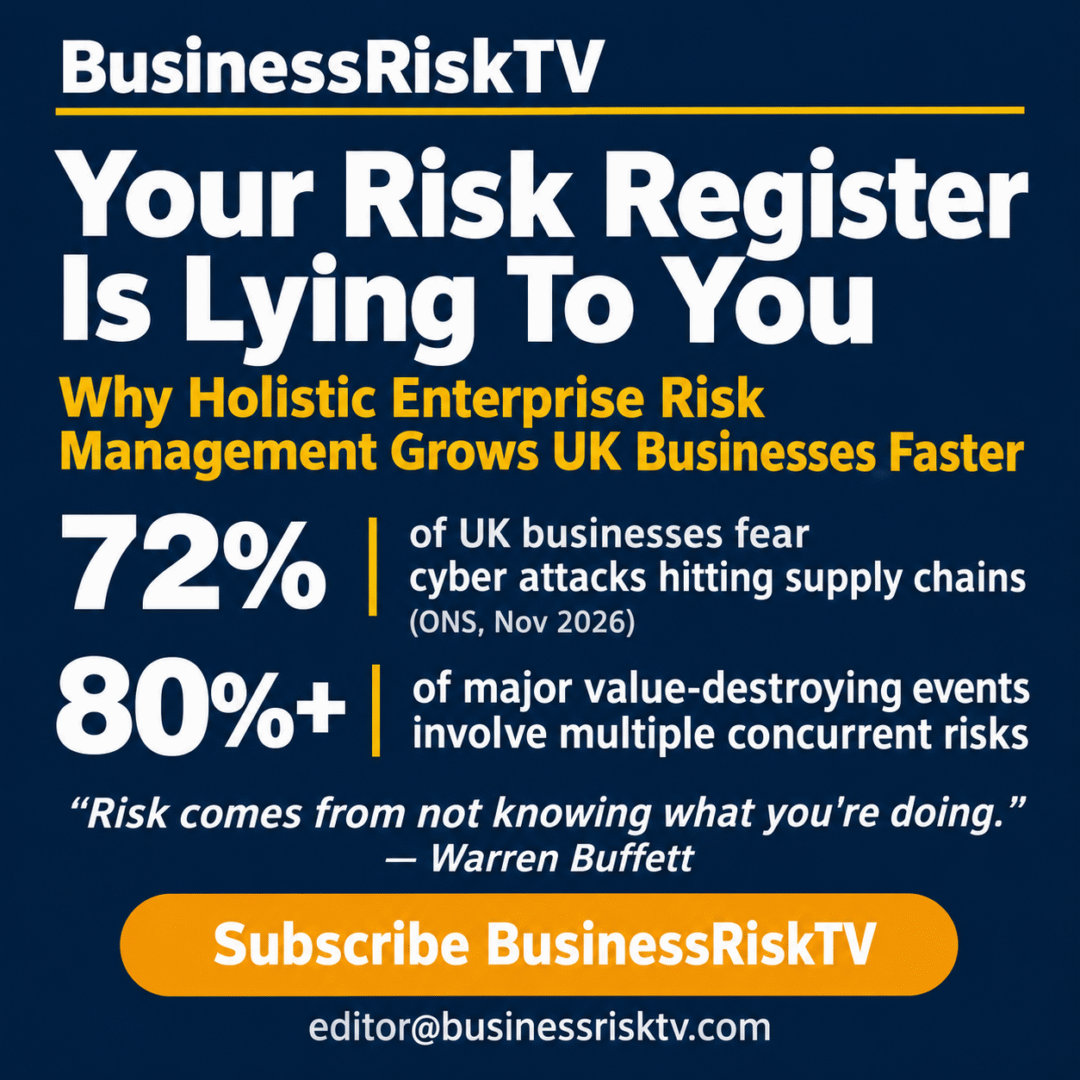
Your risk register is not protecting your business. It is lying to you.
And it has been for years.
Here is the uncomfortable truth most UK boardrooms will not say out loud: a spreadsheet with 47 risks scored “likelihood 3, impact 4” is not risk management. It is theatre. It is a comfort blanket that makes directors feel prudent while the actual threats — the ones that move fast, connect to each other and destroy value — pass straight through the gaps.
Don’t take my word for it. In 2026, the ICAEW declared traditional ERM “dead,” warning that risk registers “grow longer, not sharper” while staying “disconnected from strategy and capital decisions.” Pinsent Masons went further: controls are “degrading assets,” and static residual risk ratings are “increasingly detached from operational reality.”
Translation? Boards are making decisions on false intelligence. And it is costing them.
Meanwhile, the ONS reported in November 2026 that:
- 21% of UK businesses with 10+ employees are worried about cyber attacks hitting supply chains — up 9 percentage points in a year
- 12% are concerned about AI — the highest level since the question was introduced
- 31% are concerned about international conflict disrupting supply chainsYou cannot manage those three risks on three separate lines of a register. They are connected. They compound. They arrive together.
That is why holistic enterprise risk management is not a nice-to-have. It is the difference between a business that grows through shocks and one that is exposed by them.
What actually changes when you embed it:
→ You stop scoring risks in isolation and start modelling correlation — because over 80% of the largest value-destroying events involve multiple concurrent risks
→ You separate enterprise, business-unit and project risk universes so the board sees the big picture and teams manage the detail
→ You build risk appetite thresholds into capital allocation and project approval gates — no material investment proceeds without naming which risks are being accepted and why
→ You treat controls as assets that degrade silently, not boxes ticked once a year
→ You measure risk management by outcomes protected and opportunities captured — not by how many rows are in the spreadsheetWarren Buffett said it best: “Risk comes from not knowing what you’re doing.”
Peter Bernstein said it better: risk management is “maximising the areas where we have some control over the outcome while minimising the areas where we have absolutely no control.”
That is exactly what holistic ERM does. And the businesses doing it in the UK right now are not just safer — they are faster. They enter markets sooner, fund the right projects, diversify suppliers before the crisis hits, and grow while competitors are still updating column F.
Here is the retention question worth sitting with: if your risk register vanished tomorrow, what would actually change about how your business makes decisions?
If the answer is “nothing,” you do not have risk management. You have a document.
The ICAEW says ERM as we know it is dead. FERMA says risk must become a strategic driver of value creation, not a defensive function. The ONS data says the threats are rising and interlocking.
The only question left is whether you will keep updating the register while your competitors embed holistic ERM and grow faster.
BusinessRiskTV Business Risk Management Club exists for UK business leaders who refuse the comfort blanket. We operate outside standard structures — focused on continuous business expansion, optimal resilience, and creating real wealth for the risk manager with the courage to challenge orthodoxy.
Your next move: email editor@businessrisktv.com for more information on the Business Risk Management Club, and find out how to embed holistic enterprise risk management into your strategic, operational and project decisions — before the tide goes out.
#RiskRegisterIsDead #HolisticERM
Holistic Enterprise Risk Management: Why Risk Registers Fail UK Business