Risk Less. Grow More. – BusinessRiskTV.com for Smarter Enterprise
Tag: Business Risks and Solutions
BusinessRiskTV Business Risks and Solutions
Business Risks:
Financial Risk: Financial risks arise from factors such as market volatility, currency fluctuations, and liquidity issues.
Operational Risk: Operational risks arise from internal factors such as inadequate processes, human errors, or technical glitches.
Strategic Risk: Strategic risks arise from external factors such as competitors, changing market dynamics, or technological changes.
Legal Risk: Legal risks arise from lawsuits, compliance issues, or changes in regulations.
Reputational Risk: Reputational risks arise from negative public perception, damaged brand image, or loss of customer trust.
Solutions:
Diversification: Diversification can help reduce financial risk by spreading investments across different asset classes or geographic regions.
Improved Processes: Implementing robust processes and quality controls can help mitigate operational risks.
Scenario Planning: Scenario planning can help organisations prepare for and mitigate strategic risks by anticipating potential outcomes and developing contingency plans.
Compliance Management: Effective compliance management can help mitigate legal risks by ensuring adherence to relevant laws and regulations.
Crisis Management: Effective crisis management plans can help mitigate reputational risks by enabling organisations to respond quickly and transparently to crises.
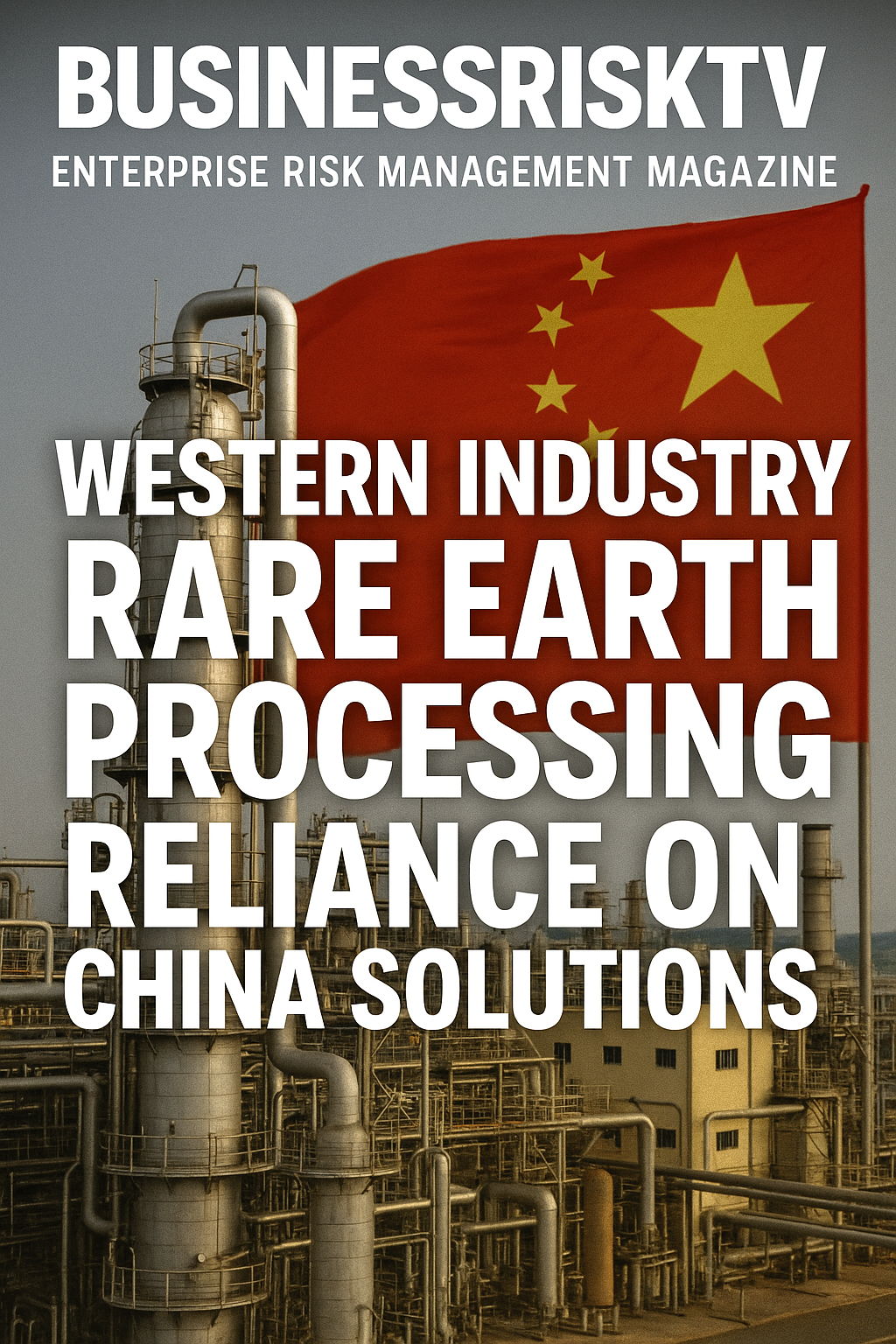
How does China’s near-monopoly on rare earth processing threaten your business and wallet? Discover the hidden costs for Western manufacturing, from EVs to smartphones, and learn urgent risk management strategies for industry leaders and consumers alike.
The Raw Nerve: Why China’s Grip on Rare Earths Threatens Western Prosperity
Western industry’s 90% reliance on China for rare earth processing is a catastrophic vulnerability. This article unmasks the threat to car manufacturing, consumer goods, and our very future, offering actionable strategies for business leaders to reclaim control and protect profitability.
“If China ever decided to turn off the tap, the lights would go out in boardrooms across the West. We’re not just talking about iPhones and Tesla, we’re talking about the very bedrock of our industrial future. This isn’t a theoretical exercise; it’s a present and growing danger. And frankly, we’ve been utterly complacent.” That’s the stark reality, isn’t it? For too long, Western business leaders have operated under the illusion of an open global market, blissful in their pursuit of short-term cost efficiencies. But what if that efficiency comes at the price of existential vulnerability? The sheer scale of China’s dominance in rare earth mineral processing isn’t just a challenge; it’s an economic weapon poised at our collective throat. This isn’t some abstract geopolitical squabble. This directly impacts your company’s bottom line, your nation’s security, and every consumer’s daily life. It’s time we faced the uncomfortable truth: our industrial future, indeed our very technological sovereignty, is hanging by a thread, and that thread leads directly to Beijing. This isn’t about protectionism; it’s about survival.
The Uncomfortable Truth: China’s Rare Earth Monopoly and Its Perilous Implications
Let’s not mince words. China doesn’t just have a significant share of rare earth mineral processing; it holds a near-monopoly, a stranglehold that few outside the industry truly comprehend. Reports indicate that China controls approximately 90% of the world’s rare earth processing capacity. Let that sink in. Ninety percent. While China may account for around 69% of global rare earth production from its mines, the critical bottleneck, the true leverage point, lies in its unparalleled ability to process these raw materials into usable forms.This isn’t just about digging rocks out of the ground; it’s about the complex, environmentally intensive, and technically demanding process of separation, refining, and alloy production. For decades, Western nations, driven by lower labour costs and less stringent environmental regulations in China, offshored these vital but dirty processes. We outsourced our dirty laundry, and in doing so, we handed over the keys to our industrial kingdom.
This overwhelming dependency on China for rare earth processing presents a colossal problem for Western manufacturing, particularly for high-tech sectors and, critically, the automotive industry.Rare earth elements (REEs) are not, despite their name, inherently rare in the Earth’s crust.However, they are rarely found in concentrated, easily extractable deposits, and their extraction and processing are notoriously complex and environmentally damaging. But their unique magnetic, luminescent, and electrical properties make them indispensable.
Consider the automotive sector. The transition to electric vehicles (EVs) is predicated on the availability of powerful, efficient electric motors. Guess what powers those motors? Neodymium-iron-boron (NdFeB) permanent magnets, which contain critical rare earth elements like neodymium and praseodymium, often enhanced with dysprosium and terbium for high-temperature performance. Without these magnets, EVs become less efficient, heavier, and significantly more expensive. China produces nearly 90% of the world’s rare earth magnets. A sudden restriction or even a significant delay in the supply of processed rare earths from China could, quite literally, grind Western EV production to a halt. We’ve seen this play out in recent months: when China introduced new export restrictions in 2025, Western auto plants faced immediate bottlenecks, even production halts.The ripple effect isn’t confined to EVs; conventional vehicles still use rare earths in catalytic converters, alternators, and various sensors. Imagine the disruption: assembly lines idled, product launches delayed, and billions in revenue evaporated, all because of a single point of failure in our supply chain.
Beyond the automotive industry, the implications cascade across virtually every advanced manufacturing sector. Wind turbines, central to our renewable energy ambitions, rely heavily on rare earth magnets for their generators.Modern defense systems – from precision-guided missiles and fighter jets to radar systems and advanced sensors – are critically dependent on these materials.Consumer electronics like smartphones, laptops, and flat-screen displays incorporate multiple rare earth elements. Medical devices, industrial robotics, and even the catalysts used in petroleum refining all demand a steady, reliable supply of processed rare earths. If China decides to weaponise this dominance – as it has demonstrated a willingness to do in past trade disputes – Western industries will face unprecedented supply shocks, escalating costs, and a debilitating loss of competitive edge. This isn’t merely about higher prices; it’s about the fundamental ability to produce cutting-edge technology and maintain a viable industrial base.
The Consumer Conundrum: The Hidden Cost of Our Dependency
For Western consumers, the problem of rare earth processing dependency on China manifests in several tangible and uncomfortable ways. Firstly, and most immediately, expect higher prices.When the supply of critical components becomes constrained, manufacturers face increased costs for raw materials and processing. These costs, inevitably, are passed on to the consumer. That new electric vehicle you’ve been eyeing? Its price tag will likely climb. The latest smartphone? Expect it to be more expensive. This isn’t just a minor fluctuation; it’s a structural increase driven by geopolitical risk.
Secondly, prepare for reduced availability and choice. If manufacturing lines in the West cannot secure the necessary rare earth elements, product shortages will become commonplace. Waiting lists for popular EV models could stretch indefinitely. The newest, most innovative electronic gadgets might simply not reach store shelves in sufficient quantities. This translates into a frustrating consumer experience, where demand outstrips supply, and innovation is stifled not by a lack of ideas, but by a lack of fundamental materials.
Thirdly, and perhaps most insidiously, this dependency impacts the very pace of technological advancement and the green transition. Our ambitious climate goals, heavily reliant on renewable energy technologies like wind turbines and EVs, are vulnerable. If the materials needed to build these technologies are controlled by a single, potentially adversarial power, the transition to a sustainable future could be significantly delayed or derailed entirely. Consumers might find that access to cleaner energy and transport options is curtailed, not by a lack of desire or investment, but by a strategic bottleneck. We talk about energy independence, but what about mineral independence? Without it, our energy transition dreams remain just that: dreams.
Finally, there’s the less tangible but equally important aspect of national security and economic stability. When a nation’s core industries and defence capabilities are reliant on a foreign power for critical components, it introduces an inherent vulnerability. This can lead to compromises in design, limitations in military readiness, and a chilling effect on innovation as companies become wary of investing in products that could be suddenly cut off from their vital inputs. Consumers ultimately pay the price for this instability through higher taxes to fund strategic stockpiles, increased national debt, and a general erosion of economic resilience.
A Call to Action: Managing the Risk and Reclaiming Our Future
So, what should Western countries and their industries be doing about this precarious situation? Passivity is no longer an option; it is an act of economic self-sabotage. We need a multi-pronged, aggressive strategy that acknowledges the severity of the threat and prioritises long-term resilience over short-term cost savings. This is an enterprise risk management challenge of the highest order, and it demands decisive action from business leaders.
For Western Industries: A Blueprint for Resilience
Diversify Sourcing – Immediately and Aggressively: This is non-negotiable. Companies must move beyond a “China-first” mentality. Identify and develop relationships with new mining and processing facilities in allied nations. Countries like Australia, Canada, the United States, and even parts of Africa and South America hold significant rare earth reserves. Invest in these operations! Don’t just wait for the market to deliver; actively participate in building these alternative supply chains. This means long-term purchase agreements, direct investments in promising ventures, and forming strategic alliances that span the entire value chain, from mine to magnet. Yes, it will be more expensive in the short term. But the cost of disruption, of industrial paralysis, far outweighs any perceived savings from relying solely on China. Business leaders must educate their boards and shareholders: security of supply is a competitive advantage, not an optional expense.
Invest in Domestic Processing Capabilities: This is the elephant in the room. We extracted ourselves from the dirty work, and now we must embrace it again, but this time with a commitment to sustainable practices. Governments must provide incentives, certainly, but private industry cannot wait. Forge public-private partnerships. Build the refineries, the separation plants, the alloy production facilities on Western soil. Develop clean processing technologies that minimise environmental impact – this can be a new source of competitive advantage, a way to differentiate our supply chains. This won’t happen overnight; it requires significant capital expenditure and a long-term vision, but it is absolutely essential. We cannot be reliant on any single nation for the critical processing step.
Drive Innovation in Substitution and Recycling: This is where engineering brilliance meets strategic imperative.
Substitution: Can we develop alternative materials or designs that reduce or eliminate the need for specific rare earth elements? BMW, for instance, has explored EV motor designs that use fewer or no rare earth magnets, albeit with some trade-offs in efficiency.Toyota has developed heat-resistant magnets with less neodymium and no terbium or dysprosium. This needs to become a widespread R&D priority. Fund your R&D teams to aggressively pursue rare-earth-free alternatives. Challenge them, empower them, and reward them for breakthroughs.
Recycling (“Urban Mining”): The vast quantities of rare earths already embedded in discarded electronics, EVs, and wind turbines represent a valuable, untapped resource. Invest in advanced recycling technologies that can efficiently and economically recover these elements from end-of-life products. Develop closed-loop systems within your manufacturing processes. This not only reduces reliance on virgin materials but also aligns with broader sustainability goals. Governments should incentivise collection and recycling infrastructure, but industries must lead the charge in developing the technical solutions.
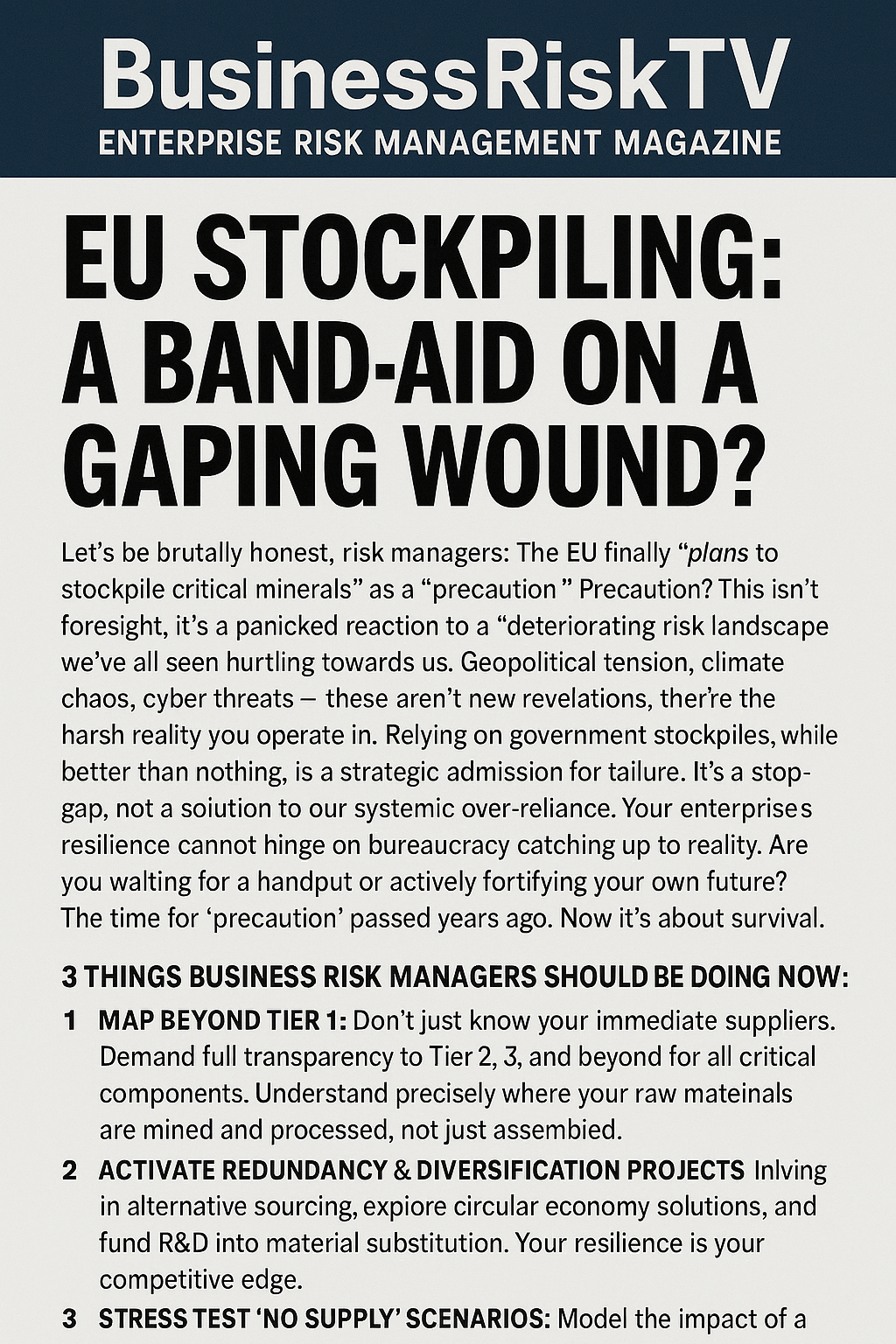
Strategic Stockpiling: While not a long-term solution, maintaining strategic reserves of critical rare earth elements and even finished magnets can provide a vital buffer against short-term supply disruptions. This is an insurance policy. It buys time for alternative supply chains to mature or for new technologies to come online. It’s a pragmatic recognition of current vulnerabilities. Work with national governments to ensure these stockpiles are sufficient and regularly rotated.
Supply Chain Transparency and Visibility: You can’t manage what you can’t see. Companies must implement robust supply chain tracking systems that provide granular visibility into the origin and processing of rare earth components. Understand your exposure at every tier. Demand this information from your suppliers, and if they cannot provide it, find suppliers who can. This isn’t just about compliance; it’s about existential risk management.
For Western Consumers: Empowering Your Choices
Consumers might feel powerless in the face of such a colossal geopolitical challenge, but that’s simply not true. Your purchasing decisions and your voice carry significant weight.
Demand Supply Chain Transparency: Ask brands where their materials come from. As a consumer, you have the right to know if your new EV, your smartphone, or even your home appliances are built with materials sourced from resilient, ethical, and diversified supply chains. Vote with your wallet. Support companies that are actively demonstrating a commitment to responsible sourcing and reducing their reliance on single-point-of-failure suppliers. Make it clear that you are willing to pay a fair price for products that contribute to a secure and sustainable future, not just a cheap one.
Embrace Longevity and Repairability: The faster we consume and discard electronic devices, the greater the demand for new rare earth materials. Choose products designed for durability and repairability. Support the “right to repair” movement. By extending the lifespan of your devices, you are directly reducing the pressure on new rare earth mining and processing. This is a direct, actionable step you can take.
Support Recycling Initiatives: Participate actively in electronic waste recycling programs. While the recycling infrastructure for rare earths is still developing, your participation helps build the critical mass needed for these systems to scale. Don’t let your old phone sit in a drawer; ensure it enters the recycling stream. Advocate for better recycling facilities in your local community.
Educate Yourself and Others: Understand the issue. Talk about it. The more public awareness there is, the greater the pressure on businesses and governments to act decisively. This isn’t just an obscure industrial issue; it’s fundamental to our technological future and national security.
The era of cheap, easy access to critical materials, particularly rare earths, from a single dominant source is over. Western industries and consumers alike face a reckoning. We have outsourced our vulnerabilities, and now we must pay the price – either through proactive, strategic investment and difficult choices, or through economic stagnation and a chilling surrender of our technological future. The choice, for once, is clear. It’s time to act. It’s time to build a future where our prosperity is not dictated by the whims of a single foreign power, but by our own ingenuity, resilience, and strategic foresight.
Get help to protect and grow your business faster with BusinessRiskTV
Read more business risk management articles and view videos for free
Protect your company’s future: China’s rare earth processing dominance poses an unprecedented risk to Western manufacturing. This deep dive provides business leaders with vital insights and a roadmap for diversifying supply chains, investing in domestic capabilities, and securing profitability.
The West’s dangerous rare earth dependency on China is a ticking time bomb for industry and consumers. This article offers blunt truths and essential strategies for business leaders to navigate this critical supply chain risk.
Targets decision-makers searching for the financial impact of weak risk practices
THE HIDDEN TAX OF POOR RISK MANAGEMENT
Your business is leaking money. Not in the obvious ways — like overspending or inefficiency — but in silent, insidious drains you might not even see. Poor risk management isn’t just about avoiding disasters; it’s a profit killer, a growth stifler, and, in the worst cases, an executioner of businesses that could have thrived.
Consider this: 30% of bankruptcies are due to operational failures that could have been mitigated with better risk practices (OECD). That’s not bad luck—it’s self-inflicted. And if you think your company is immune, think again.
This isn’t theoretical. Every day, businesses hemorrhage cash through:
Employee disengagement —teams that don’t see risk as their problem, costing you in errors, delays, and lost innovation.
The result? Lower profitability. Stunted growth. And, in extreme cases, extinction.
But here’s the good news: this is entirely optional and fixable.
In this e-book, we’ll expose the 12 most damaging costs of poor risk management —many of which you’re likely paying right now — and deliver 12 actionable solutions to turn risk from a liability into a competitive advantage. You’ll learn how to:
Engage every employee in risk ownership (not just compliance, but profit protection).
Stop financial bleed from preventable failures.
Turn risk-aware decision-making into a growth engine.
This isn’t another dry risk management manual. This is a survival guide for profitable, resilient business leadership.
Ready to plug the leaks? Let’s begin.
🚨 YOUR BUSINESS IS LEAKING £££ – FIND THE HOLES! 🚨
83% of UK SMEs lose £50k+ yearly from hidden risks they don’t even measure:
❌ Operational failures burning cash ❌Supply chain disasters killing margins
❌ Cyberattacks costing millions
BusinessRiskTV’s NEW eBook reveals:
✅ 12 PROVEN FIXES to stop profit leaks
✅ Real case studies from UK businesses
✅ Simple checklists to act TODAY
Chapter 1: The Hidden Costs of Poor Risk Management – How Ignoring Risk Erodes Your Profits and Threatens Survival
Introduction: The Silent Profit Killer
Every business faces risks—some obvious, others invisible. But when risk management is an afterthought, those risks don’t just linger; they multiply costs, shrink margins, and sabotage growth. This chapter exposes the real financial and operational toll of poor risk management—and why most businesses underestimate it.
—
1. The Direct Financial Costs: Where the Money Leaks
A. Unexpected Losses from Operational Failures
Example: A manufacturing firm ignores equipment maintenance, leading to a breakdown that halts production for 48 hours. The result? £250,000 in lost revenue + £50,000 in emergency repairs.
Stat: Companies with weak operational risk management see 30% higher unexpected costs (Deloitte).
B. Regulatory Fines & Legal Penalties
Case Study: A UK SME in financial services fails to comply with GDPR, resulting in a £180,000 fine —plus reputational damage.
Stat: 60% of small UK businesses aren’t fully compliant with key regulations (FSB).
Key Takeaway: Poor risk management isn’t just about avoiding disasters — it’s a tax on profitability, growth, and survival.
—
Actionable Insight: Audit one high-cost risk in your business this week (e.g., late payments, compliance gaps). What’s it really costing you?*
—
Chapter 2: The True Cost of Operational Failures – How Inefficient Risk Management Cripples Your Business
Introduction: The Domino Effect of Poor Operational Risk Controls
Operational risks don’t just cause one-off incidents—they trigger chain reactions that drain cash, demoralise teams, and erode customer trust. This chapter exposes the hidden, cascading costs of mismanaged operational risks and why most businesses only see the tip of the iceberg.
—
1. The Obvious Costs: What You Can’t Ignore
A. Downtime & Lost Production
Manufacturing Example: A single machine failure halts a production line for 8 hours → £25,000 in lost output + overtime costs to catch up.
Hospitality Example: A restaurant’s refrigeration breakdown spoils £3,000 of stock overnight — plus angry customers.
Stat: UK manufacturers lose £180 billion/year to unplanned downtime (EEF).
B. Emergency Repairs & Rush Orders
Reactive spending costs 3–5X more than planned maintenance.
Case Study: A logistics firm ignores fleet maintenance → two vans fail MOTs simultaneously → £8k in last-minute rentals + delayed deliveries.
C. Waste & Rework
Construction Example: Poor quality control leads to £50,000 of defective materials — then doubles labour costs to fix errors.
Stat: 20–30% of project budgets are wasted on rework (KPMG).
—
2. The Hidden Costs: What You’re Not Tracking (But Should Be)
A. Employee Productivity Drain
Scenario: A retail store’s outdated inventory system causes daily stock discrepancies. Staff waste 4 hours/day manually reconciling data instead of selling.
Stat: UK workers spend 15% of their time fixing preventable issues (PwC).
B. Management Distraction & Burnout
Small Business Reality: The owner spends 60% of their week putting out fires (supplier delays, IT crashes) instead of growing the business.
Psychological Cost: Chronic stress → poor decisions → more risks.
C. Customer Churn & Reputation Erosion
E-commerce Example: A fulfilment centre’s picking errors lead to 10% of orders arriving wrong → 15% of customers never return.
Stat: 70% of customers switch brands after just 2–3 bad experiences (Salesforce).
—
3. The Strategic Costs: How Operational Risks Stunt Growth
A. Lost Competitive Advantage
Case Study: A UK bakery’s unreliable oven delays a product launch by 3 months —competitors dominate supermarket shelves first.
B. Innovation Paralysis
Teams stuck in “firefighting mode” never test new ideas.
Example: A tech firm’s IT team spends 80% of time fixing outages → zero R&D progress.
C. Investor & Partner Distrust
Supply Chain Example: A fashion brand’s repeated delivery failures lead to two major retailers dropping them —£500k annual revenue gone.
—
4. The Survival Threat: When Operational Risks Become Fatal
A. Cash Flow Death Spiral
Construction Firm Case Study:
1. Poor contract risk assessment → unpaid invoices pile up
2. Equipment breakdown → project delays
3. Penalties for late delivery → bank calls in loan Result: Administration within 6 months.
B. The Carillion Effect
How ignoring operational risks (contract mismanagement, cash flow gaps) led to the UK’s biggest corporate collapse.
—
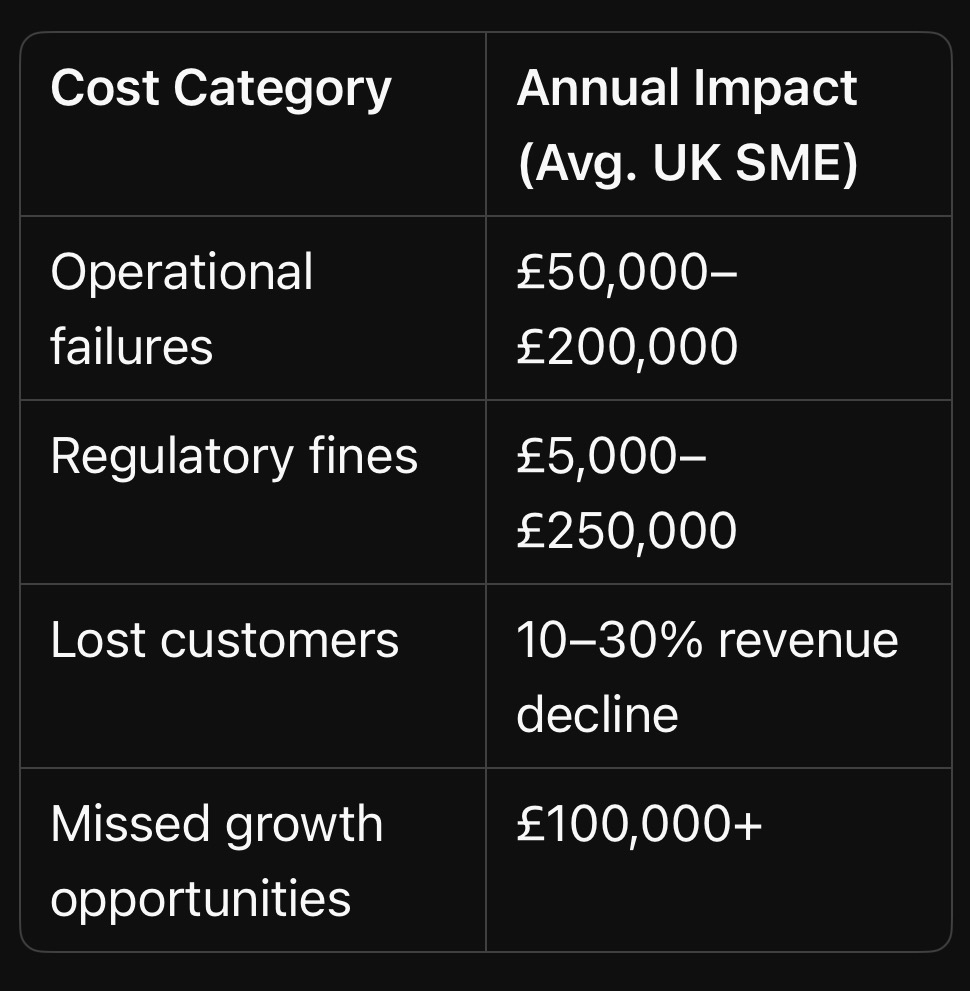
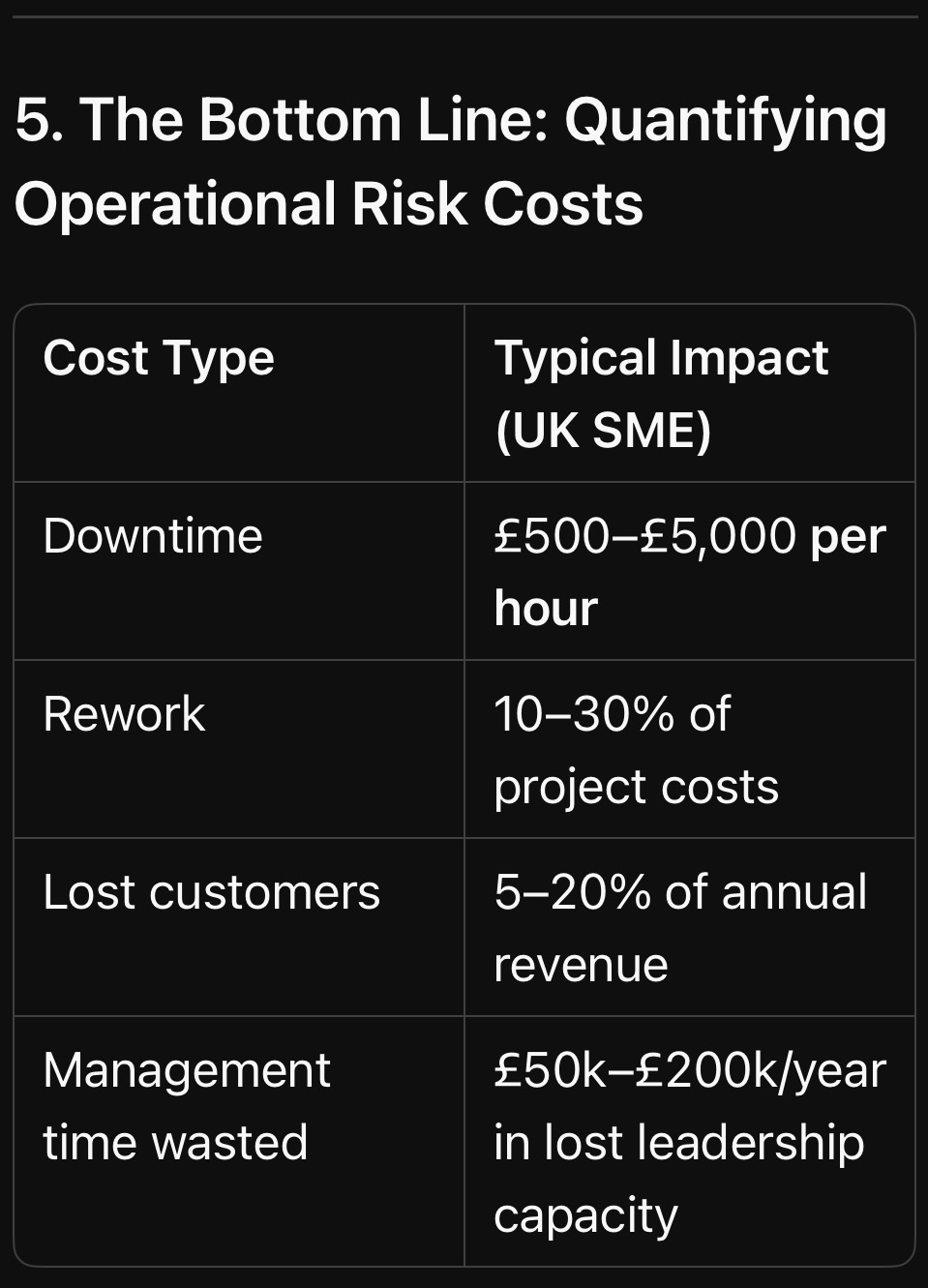
5. The Bottom Line: Quantifying Operational Risk Costs
Key Insight: Operational risks don’t just cost money—they steal time, talent, and future opportunities.
—
More From BusinessRiskTV Business Experts Hub : How to Fix It
We explore how to turn operational risk management into a profit centre, including:
The 5-minute daily habit that prevents 80% of failures
How to engage frontline teams in risk reduction (with real-world examples)
Actionable Task: Map one critical operational process (e.g., order fulfilment). Where could a single failure cost you £10k+?
—
Chapter 3: Strategic Risks – How Blind Spots in Planning Can Bankrupt Even Profitable Businesses
Introduction: The Silent Assassin of Business Growth
Strategic risks don’t announce themselves with alarms — they creep in unnoticed while leadership is distracted by day-to-day operations. By the time the damage is visible, it’s often too late to pivot. This chapter exposes how poor strategic risk management destroys market position, erodes competitive edge, and turns industry leaders into cautionary tales.
—
1. What Are Strategic Risks? (And Why They’re Different)
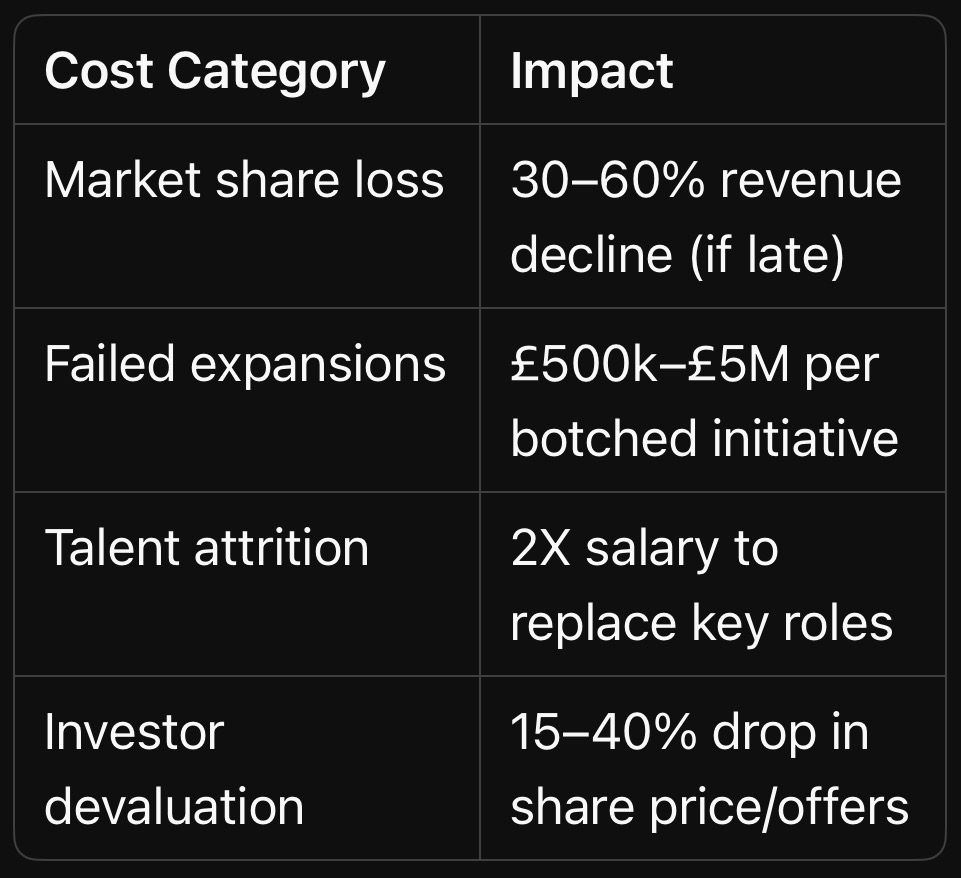
Key Takeaway: Strategic risks don’t just hurt profits — they erase entire business models.
—
More from BusinessRiskTV Business Experts Hub : How to Anticipate & Outmanoeuvre Strategic Risks
We explore practical frameworks to:
Spot industry shifts early (using weak signals)
Stress-test your strategy against disruption
Turn risks into opportunities (like Amazon’s pivot from books to cloud)
Actionable Task: List one strategic assumption your business relies on (e.g., “Customers will always prefer X”). How would you survive if it’s wrong?
—
Chapter 4: Financial Risks – How Poor Cash Flow & Debt Management Can Sink Your Business Overnight
Introduction: The Silent Killer of Healthy Businesses
Profit doesn’t equal survival. Thousands of UK businesses post record revenues—right before going bust. Why? Because financial risk management isn’t about counting pennies — it’s about anticipating traps that strangle cash flow, trigger defaults, and collapse supply chains.
This chapter exposes the lethal financial risks hiding in plain sight — and why even profitable companies run out of money.
—
1. The Obvious (But Ignored) Financial Risks
A. Cash Flow Crises – The #1 Business Killer
Reality: 82% of UK business failures cite cash flow problems as the primary cause (UK Insolvency Service).
Example: A £5M-turnover construction firm collapses because:
– Client pays invoices 90 days late
– Supplier demands upfront payments due to past delays
– Bank rejects emergency loan Result: Liquidation despite £1.2M in “paper profits.”
B. Debt Avalanches – When Borrowing Backfires
Case Study: A fast-growing e-commerce firm takes on high-interest debt to fund inventory. Sales dip, interest compounds, and suddenly 60% of revenue services debt.
– Stat: 40% of UK SMEs struggle with unmanageable debt (Bank of England).
C. Currency & Commodity Swings
Example: A UK bakery’s flour costs jump 30% after a wheat shortage. Contracts lock in prices — margins vanish overnight.
—
2. The Hidden Financial Risks That Compound Quietly
A. Customer Concentration Risk
Scenario: A B2B software firm gets 70% of revenue from one client. When that client leaves, payroll can’t be met.
Rule of Thumb: No single client should exceed 15–20% of revenue.
B. Supplier Dependency & Price Shocks
Case Study: A car manufacturer relies on one battery supplier. When shortages hit, production stalls for 3 months → £9M loss.
C. Fraud & Financial Mismanagement
Stat: UK businesses lose £137B yearly to fraud, waste, and accounting errors (PwC).
Example: A finance director “cooks the books” — investors pull out when the truth surfaces.
—
3. The Strategic Fallout: When Financial Risks Spiral
A. Credit Downgrades & Banking Nightmares
Example: A once-stable firm misses a loan covenant — interest rates spike 5%, lines of credit freeze.
B. Investor Panic & Equity Crashes
Case Study: A tech startup’s burn rate exceeds projections — VCs demand emergency restructuring, slashing valuation by 50%.
C. Employee Exodus (When Paychecks Bounce)
Stat: 78% of employees leave within 6 months of payroll issues (CIPD).
—
4. The Ultimate Cost: Bankruptcy Dominoes
A. The “Profitable But Insolvent” Paradox
How It Happens:
1. Big contracts signed → revenue looks strong
2. Clients pay late → cash dries up
3. Suppliers demand payment → no money for salaries/tax
4. HMRC forces liquidation despite “growth.”
B. The Carillion Effect (Again)
£7B collapse triggered by:
– Aggressive accounting
– Reliance on unsustainable contracts
– No cash buffer for delays
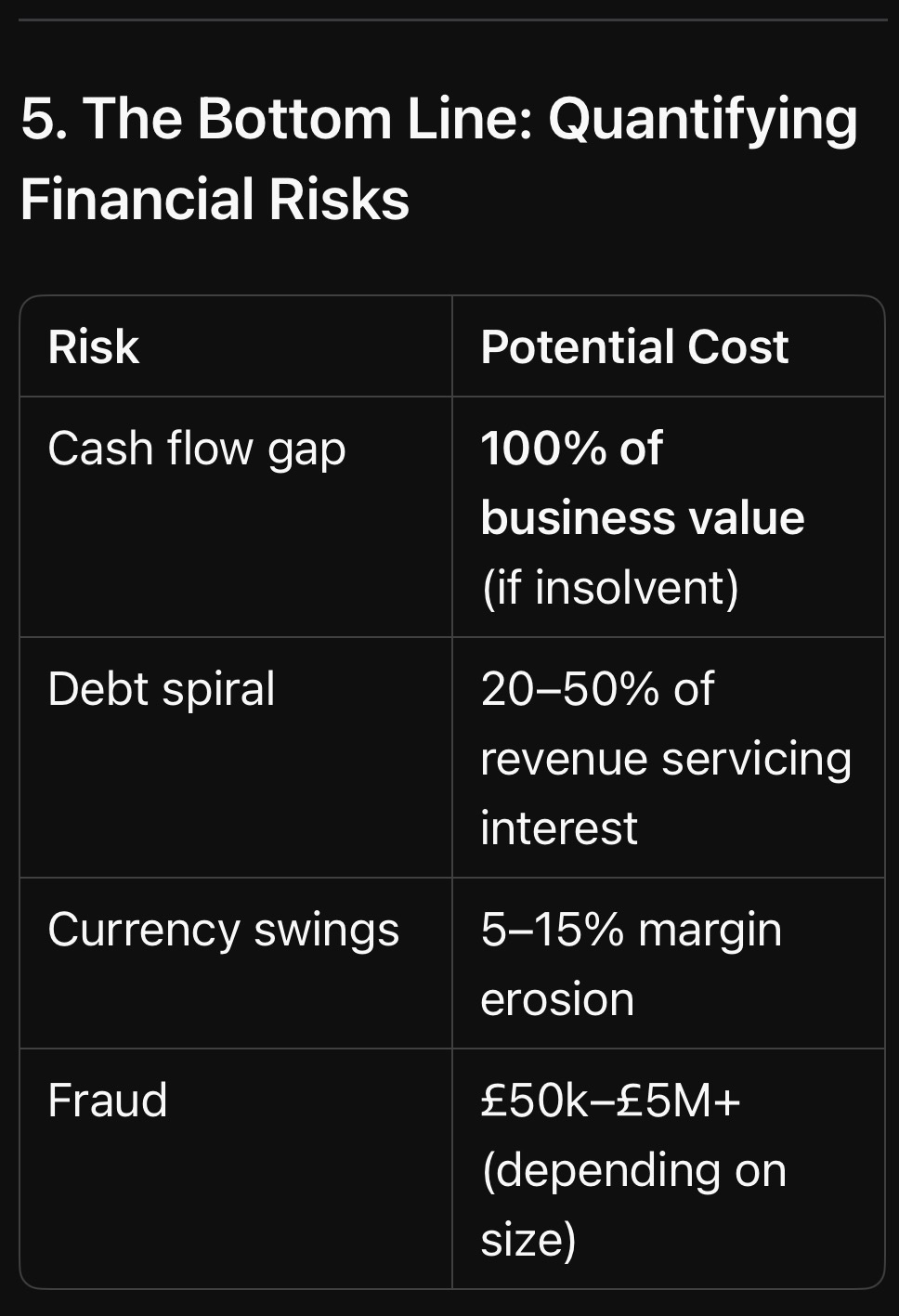
Key Insight: Financial risks don’t just reduce profits — they erase businesses in weeks.
—
More from BusinessRiskTV Business Experts Hub : How to Fix It
We explore real-world financial risk strategies, including:
The 13-week cash flow rule (used by turnaround experts)
How to renegotiate debt before it’s too late
Building a “war chest” for crises
Actionable Task: Run a “stress test” on your cash flow: What if 2 clients pay 60 days late?
—
Chapter 5: Cyber Risks – The Invisible Threat That Could Bankrupt Your Business by Breakfast
Introduction: The Digital Time Bomb Ticking in Your Business
Imagine arriving at work to find:
Your customer database on the dark web
Fraudsters draining £250,000 from your account
Ransomware locking every file until you pay Bitcoin
This isn’t a movie plot — it’s Monday morning for thousands of UK businesses. Cyber risks don’t just steal data; they extort cash, destroy reputations, and trigger regulatory hell. And here’s the worst part: Most victims never see it coming until the damage is done.
—
1. The Direct Costs: What Happens When Cybercrime Hits
A. Ransomware: The Digital Kidnapping Epidemic
2023 Reality: A UK construction firm’s blueprints, invoices, and payroll systems encrypted. Hackers demand £120,000 to unlock files.
Stat: 73% of UK businesses hit by ransomware in 2023 (NCSC).
Brutal Truth: Paying doesn’t guarantee recovery — 32% never get full data back (Sophos).
B. Data Breaches: When Your Customers Become Victims
Case Study: A mid-sized retailer’s poorly secured e-commerce platform leaks 380,000 credit cards.
£500,000 GDPR fine
£1.2M in fraud reimbursements
22% customer churn
Stat: Average UK data breach cost: £3.4 million (IBM).
C. Business Email Compromise (BEC): The Silent Heist
How It Works: A hacker impersonates your CEO, emails finance: “Urgent: Transfer £80k to new supplier.”
UK Losses: £1.3 billion stolen via BEC in 2023 (UK Finance).
—
2. The Hidden Costs That Cripple You Later
A. Reputation Freefall & Customer Exodus
After a breach:
– 58% of customers avoid breached brands (Verizon)
– Recovery Cost: 3–5X more on marketing to rebuild trust
B. Operational Paralysis
Example: A law firm’s servers go down for 72 hours post-attack. £350k in billable hours lost + client lawsuits.
C. Insurance Nightmares
Post-Claim Realities:
– Premiums triple
– Mandatory audits drain management time
– Some policies simply won’t renew
—
3. The Strategic Fallout: Long-Term Business Damage
A. Lost Contracts & Blacklisting
Government/Corporate Tenders Now Demand:
– Cyber Essentials Certification (missing? Disqualified automatically)
– Proof of incident response plans
B. Investor Flight
Startup Killer: A fintech’s pre-IPO breach scares off VCs, slashing valuation by 60%.
C. Director Liability (Yes, You Can Go to Jail)
UK Law: Under GDPR & NIS Directive, negligent executives face fines up to £17.5M or 4% of global revenue — plus disqualification.
—
4. Why Cyber Risks Are Worse Than You Think
A. It’s Not Just “Big Targets”
61% of UK attacks hit SMEs (Verizon) — hackers bet they’re unprepared.
B. Remote Work = 300% More Attack Surfaces
Example: An employee’s compromised home laptop gives hackers access to your entire CRM.
C. AI-Powered Attacks Are Here
New Threat: Deepfake audio of your CFO “calling” finance to wire funds.
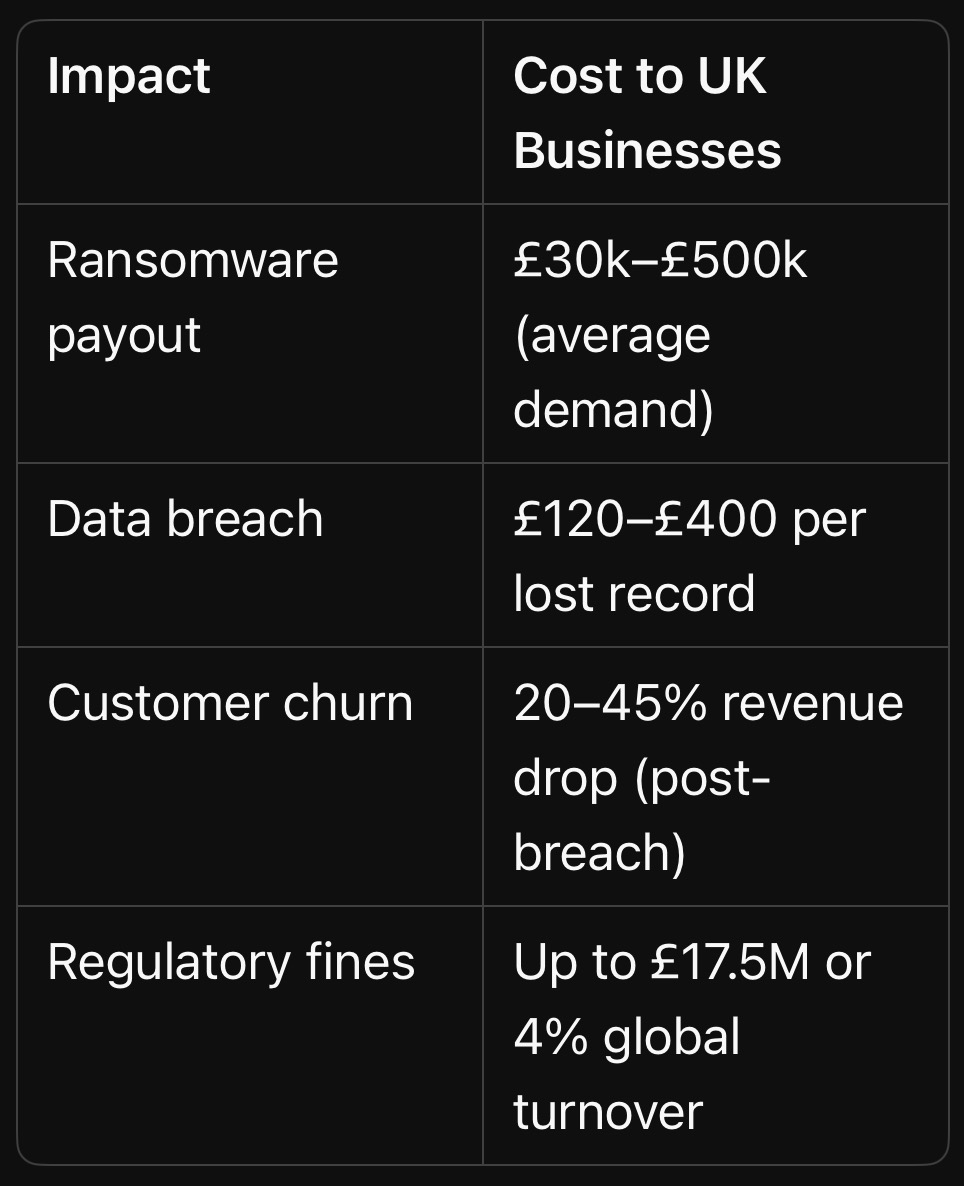
Key Insight: Cyber risks aren’t an “IT problem” — they’re an existential business threat.
—
More from BusinessRiskTV Business Experts Hub : How to Fight Back
We will explore real-world cyber defenses, including:
The 5-step SME ransomware shield (costs <£5k/year)
– How to trick hackers into avoiding you (attackers prefer easy targets)
– Turning employees into human firewalls
Actionable Task: Run this free test now: [Have I Been Pwned](https://haveibeenpwned.com/) to check if your work emails are already in hacker databases.
—
Chapter 6: Human Risks – When Your Greatest Asset Becomes Your Biggest Liability
Introduction: The Enemy Inside Your Walls
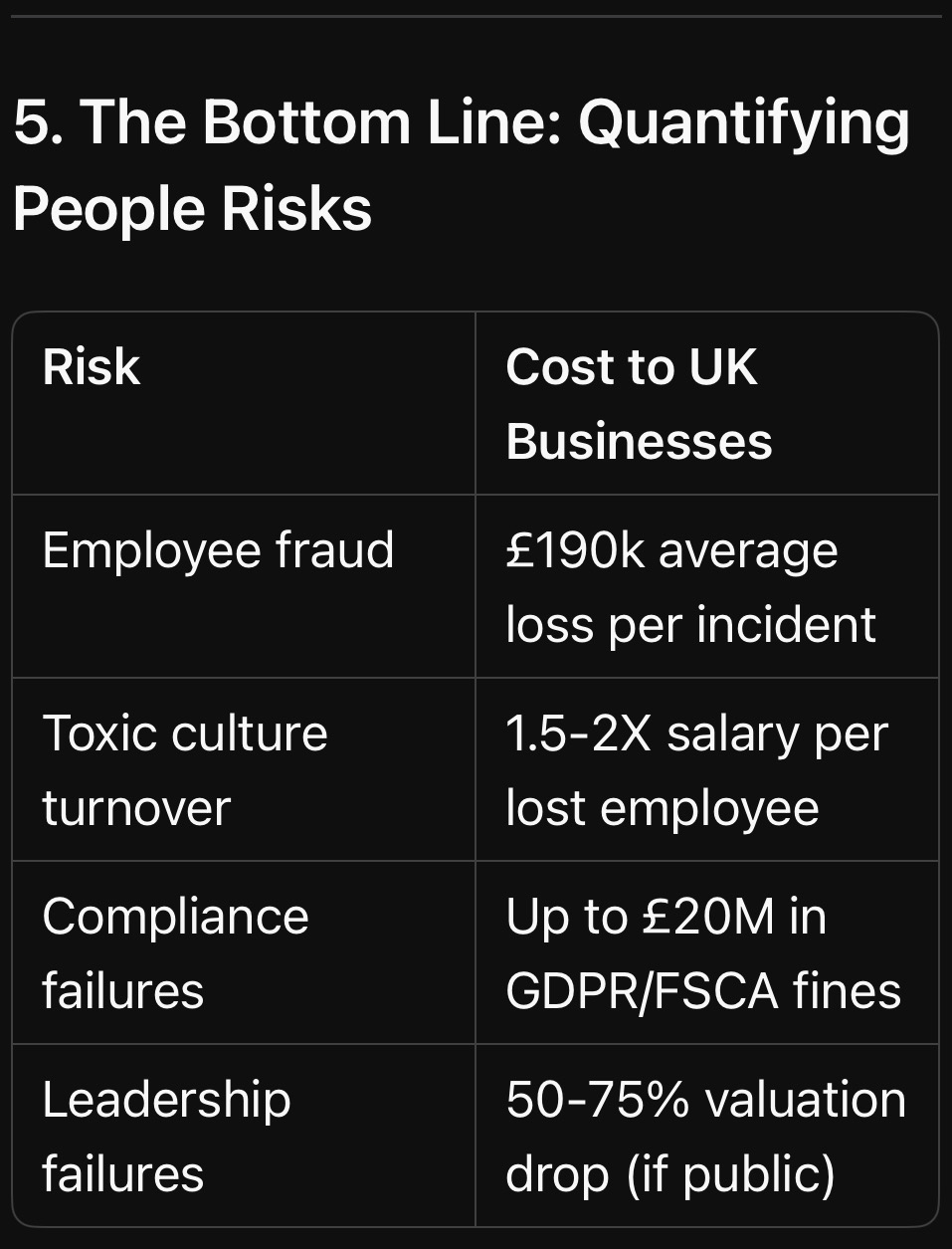
Your employees can either be your strongest defence — or your weakest link. Negligence, disengagement, and malicious actions cost UK businesses £30 billion annually (ACAS). This chapter exposes how poor people risk management leads to:
– Catastrophic errors
– Culture collapse
– Regulatory disasters
– Fraud epidemics
And why traditional HR policies fail to prevent 89% of these risks (PwC).
—
1. The Obvious (But Ignored) Human Risks
A. The High Cost of Disengagement
Example: A retail chain’s apathetic staff miss 40% of shoplifting incidents —costing £220,000/year in stolen stock.
Stat: Disengaged employees are 450% more likely to cause operational errors (Gallup).
B. Turnover Tsunamis
Case Study: A tech firm’s toxic culture drives out 7 senior engineers in 6 months — delaying a £2M product launch by 11 months.
Replacement Cost: Up to 2X annual salary per lost employee (Oxford Economics).
C. Training Gaps That Become Legal Nightmares
Reality Check: A warehouse worker badly operates a forklift, causing £80k in damages + HSE fines—because “training was just a 10-minute video.”
—
2. The Hidden (But More Dangerous) Human Risks
A. Insider Threats: When Employees Attack
Shocking Stat: 58% of data breaches involve insiders (Verizon).
Methods:
– The Malicious: IT admin sells customer data (£50k on dark web)
– The Careless: Accountant emails payroll files to personal Gmail
B. Culture Risks: How Toxicity Spreads
Example: A sales team’s “win at all costs” mentality leads to fraudulent client promises — £600k in lawsuits + FCA investigation.
C. Leadership Blind Spots
CEO Overconfidence: Ignoring team warnings about a flawed expansion → £3M write-off.
Stat: 82% of business failures trace back to poor leadership decisions (KPMG).
—
3. The Strategic Fallout: When People Risks Sink Companies
A. The Volkswagen Emissions Scandal
Root Cause: A culture where “nobody dared question” fraudulent engineering.
– Cost: €32 billion in fines/losses + permanent brand damage.
B. The Barclays CEO Scandal
How It Happened: Leadership’s obsession with “star hires” led to unchecked bullying — triggering £1M fines + investor revolt.
C. The Everyday SME Killer
Scenario: Your “trusted” bookkeeper embezzles £150k over 3 years — exposed only during a tax audit.
—
4. Why Traditional Approaches Fail
Annual compliance training?86% of employees forget it within 30 days (MIT).
“Hotline whistleblowing”?62% of staff fear retaliation (EY).
Top-down policies? Frontline teams see them as “head office nonsense.”
Key Insight: Your employees create or destroy value daily — often without realising it.
—
More from BusinessRiskTV Business Experts Hub : How to Transform Human Risk into Advantage
We explore battle-tested solutions, including:
The “Psychological Safety” hack
How to spot insider threats before they strike
Turning compliance into competitive edge
Actionable Task: Run a 5-minute “risk culture pulse check” with your team this week: “What’s one process you think could fail catastrophically?”
—
Chapter 7: Supply Chain Risks – The Fragile Web That Could Strangle Your Business Overnight
Introduction: Your Business Is Only as Strong as Its Weakest Supplier
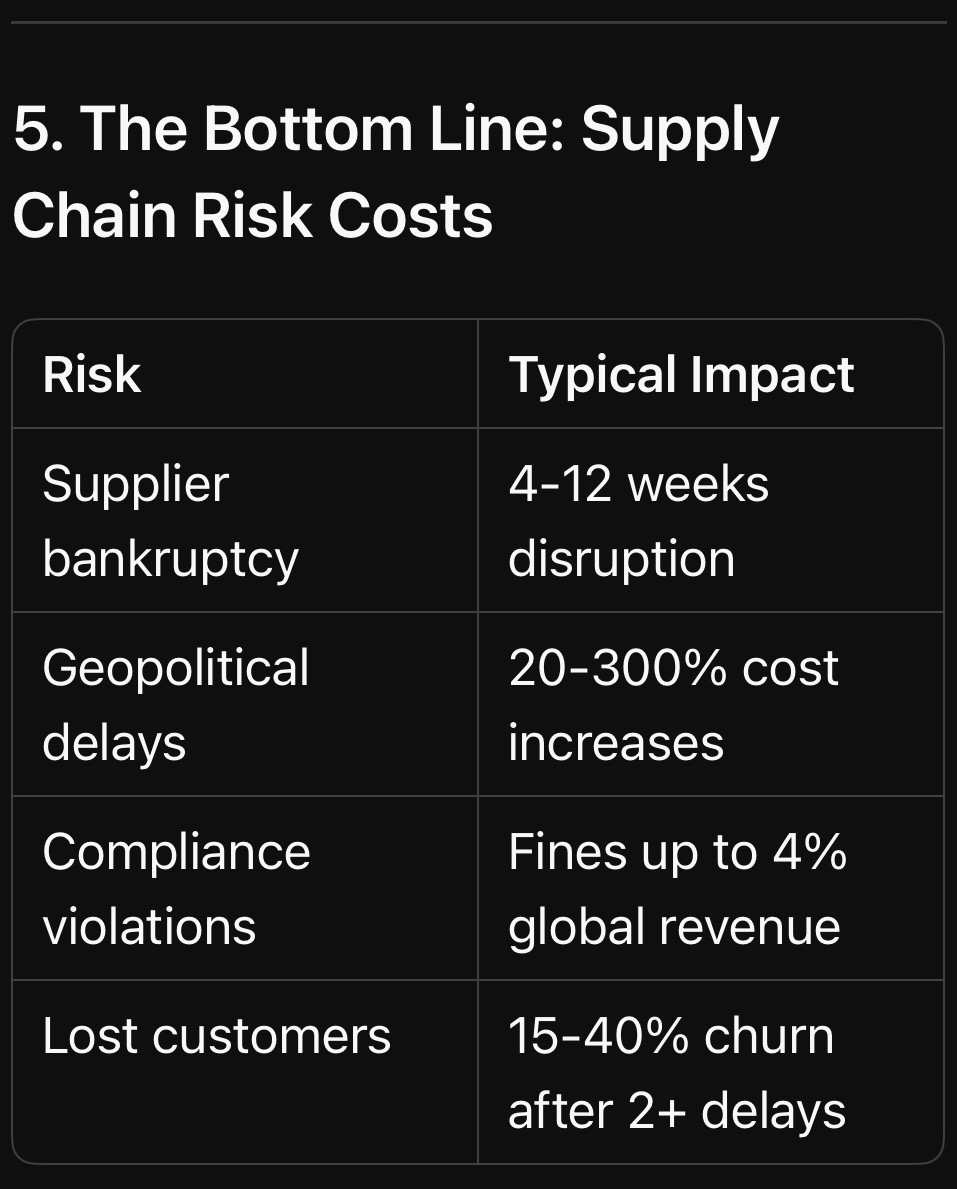
A single delayed shipment. One insolvent vendor. A geopolitical shockwave. Suddenly, your production line stops, customers revolt, and cash flow evaporates.
Key Insight: Supply chains have become the ultimate leverage point — for your competitors or your downfall.
—
More from BusinessRiskTV Business Experts Hub : How to Build an Unbreakable Supply Chain
We explore wartime-tested strategies, including:
The “3D Supplier Mapping” trick (used by Special Forces logisticians)
How to turn suppliers into partners (not adversaries)
When to nearshore/onshore without bankrupting yourself
Actionable Task: Identify one “critical” supplier you couldn’t operate without. How would you survive if they vanished tomorrow?
—
Chapter 8: Reputational Risks – When Trust Collapses Faster Than Your Share Price
Introduction: The 24-Hour Business Execution
A single tweet. One viral video. A disgruntled employee’s LinkedIn post. In today’s digital wildfire, your hard-earned reputation can evaporate before your crisis team finishes their first coffee.
The brutal reality:
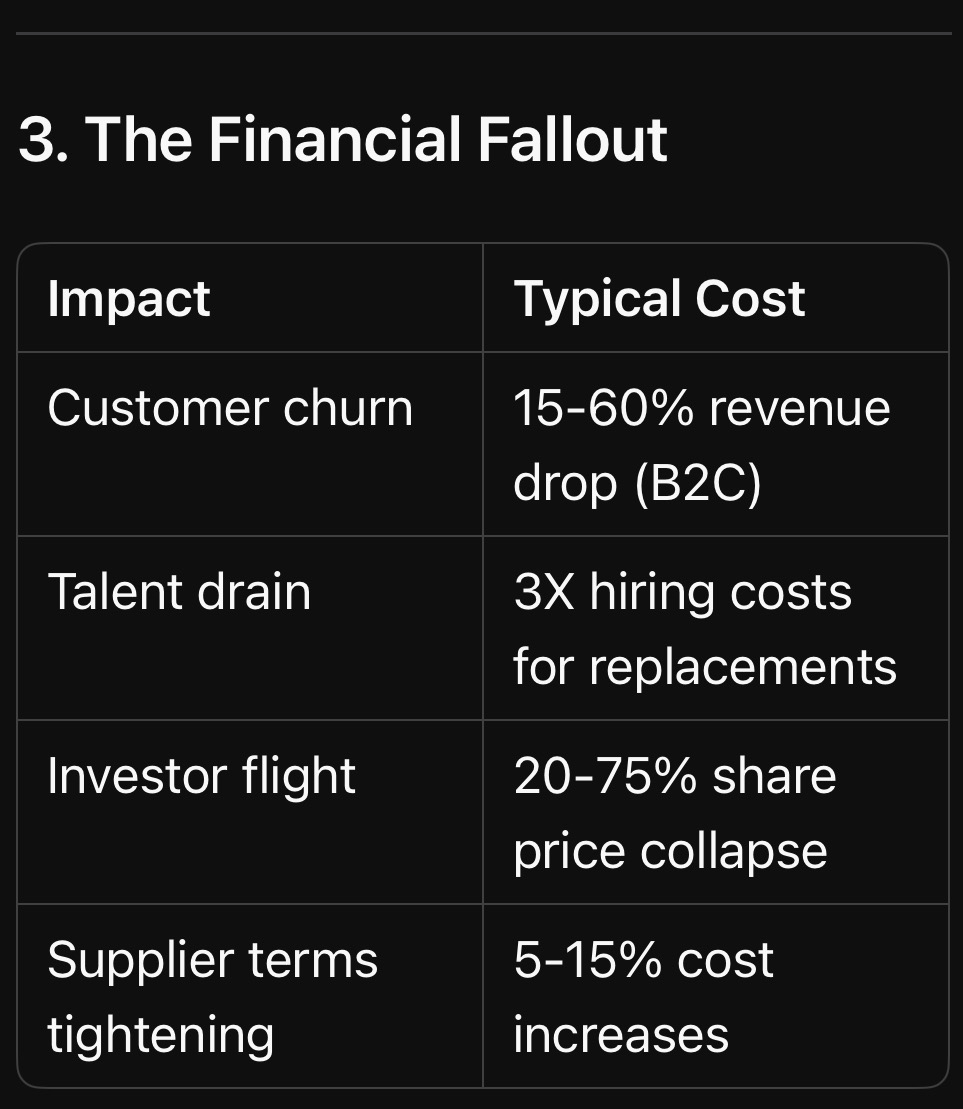
87% of consumers will abandon a brand after a reputation crisis (YouGov)
It takes 4-7 years to build trust but just 4 bad days to destroy it (Edelman Trust Barometer)
65% of a company’s market value is tied to intangible assets like reputation (Ocean Tomo)
This isn’t about PR spin – it’s about preventing the preventable and surviving the unpredictable.
—
1. The Obvious Reputation Killers
A. Social Media Firestorms
Case Study: A restaurant manager’s racist comment caught on video → 300,000 angry tweets in 48 hours → permanent 40% revenue drop
Stat: Viral crises spread 20x faster than management can respond (MIT Sloan)
B. Executive Scandals
The P&G CEO Effect: A $375 billion company lost $40B in market cap in days after CEO’s inappropriate relationship surfaced
“No comment” = “We’re guilty” in public perception
Corporate-speak increases distrust by 41% (Edelman)
Legal-first responses often worsen the crisis
—
5. The Survival Playbook (Preview)
More from BusinessRiskTV Business Experts Hub we will explore modern reputation armour, including:
The “Dark Web Early Warning” system (catch crises before they explode)
Turning employees into reputation ambassadors
When to apologise vs. when to fight back
Actionable Task: Google “[Your Brand] + scandal” right now. What autocomplete suggestions appear?
—
Chapter 9: Climate Risks – The Existential Threat That’s Already Costing Your Business
Introduction: Your Business Is on the Frontlines of the Climate Crisis
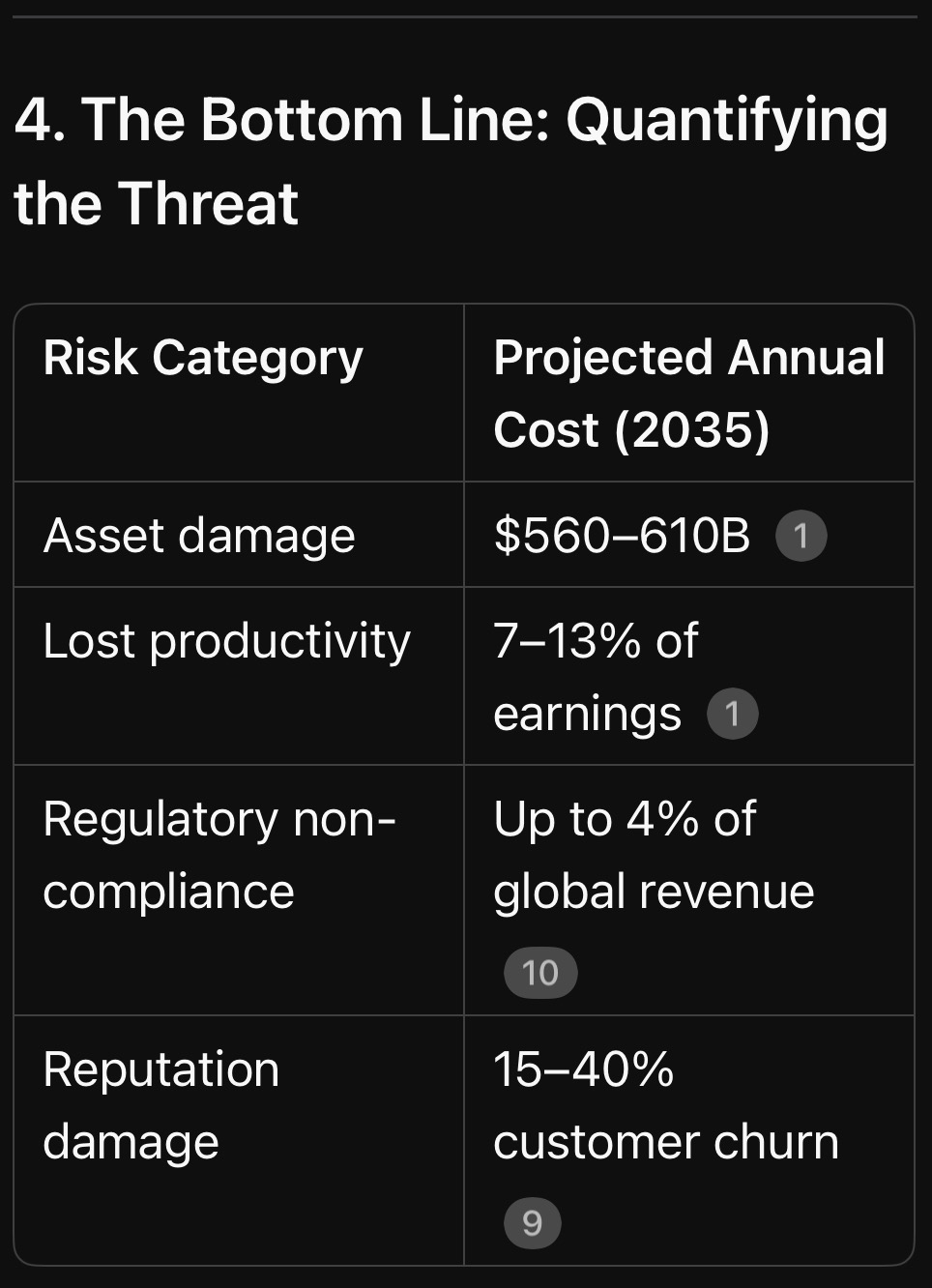
Climate change isn’t a distant threat — it’s eroding profits, disrupting supply chains, and rewriting industry rules rightnow. In 2024 alone, climate disasters caused $2 trillion in global losses, with businesses absorbing the brunt through:
Operational shutdowns (e.g., factories flooded, data centres overheated
Soaring insurance premiums (up 300% in high-risk zones)
Regulatory penalties (e.g., non-compliance with carbon disclosure rules)
This chapter exposes the hidden costs of climate risks — and why most companies are dangerously unprepared.
—
1. The Two Faces of Climate Risk
A. Physical Risks: When Nature Attacks
1. Acute Disasters:
– Example: Hurricane Helene (2024) caused $225B in damages, disrupting microchip supplies by destroying a key quartz supplier .
– Stat: Severe weather events now cost businesses $560–610B yearly in asset losses .
2. Chronic Pressures:
– Heatwaves reduce worker productivity by 15–20% in sectors like construction and agriculture .
– Droughts forced a UK beverage company to halt production for 6 weeks due to water shortages .
B. Transition Risks: The Legal and Market Backlash
1. Policy Shocks:
– Carbon taxes could erase 20% of profits for high-emission firms by 2030 .
– Example: EU’s Carbon Border Tax added 10–20% costs for non-compliant imports .
2. Reputation Fallout:
– 75% of consumers boycott brands with poor sustainability records .
– Investor Flight: ESG-backlash aside, 90% of Fortune 500 firms now face shareholder climate lawsuits .
—
2. The Hidden Costs You’re Not Tracking
A. Supply Chain Domino Effects
Case Study: Floods in Thailand (2023) disrupted 40% of global hard drive production → tech firms lost $20B+
Stat: 73% of companies admit their supply chains are “highly vulnerable” to climate shocks .
B. Workforce Crises
Heat Stress: UK warehouses saw 30% more sick days during 2024’s record summer .
Talent Drain: 67% of Gen Z employees reject jobs at firms with weak climate policies .
C. Stranded Assets
Example: Oil companies wrote off $300B in reserves as “unburnable” due to net-zero policies.
Projection: 20% of commercial real estate will be uninsurable by 2030 .
Key Insight: Climate risks are profit killers — not just “ESG checkboxes.”
—
More from BusinessRiskTV Business Experts Hub : How to Fight Back
We will explore actionable climate resilience strategies, including:
The “3D Supply Chain Mapping” tactic (used by Special Forces logisticians)
How to turn carbon cuts into tax savings
AI-powered climate forecasting tools
Actionable Task: Run a 5-minute vulnerability scan: Which single climate threat (e.g., flood, heatwave) couldshut down your operations for 48 hours?
—
*Sources: World Economic Forum , Allianz , Beazley , Optera , EPA *
Chapter 10: 12 Actionable Solutions to Transform Risk into Competitive Advantage
Introduction: Risk Management Isn’t About Survival—It’s About Dominance
The most profitable companies don’t just avoid risks — they weaponise them. Toyota’s supply chain resilience made it the #1 automaker during the chip shortage. Amazon turned cybersecurity into a $35B AWS profit centre.
This chapter delivers 12 battle-tested solutions to stop losing money and start outpacing competitors.
—
Solution 1: The “Risk Ownership” Culture Hack
Problem: Employees see risk as “management’s problem.”
Fix:
– Tie 10-15% of bonuses to risk KPIs (e.g., near-miss reports, compliance audits)
– Example: A logistics firm reduced warehouse injuries by 62% after adding safety metrics to performance reviews
Action Step: This week, have each department identify one preventable risk they’ll now “own.”
—
Solution 2: The 5-Minute Daily Risk Radar
Problem: Monthly reports miss emerging threats.
Fix:
– Daily 5-minute standups on:
Top 3 operational vulnerabilities (e.g., server capacity, inventory levels)
Weak signals (e.g., supplier payment delays, social media complaints)
Case Study: A manufacturer caught a critical component shortage 3 weeks early by tracking supplier lead times daily
**Template:**
“`
[ ] Key risk #1 status
[ ] New threat detected
[ ] Mitigation action
“`
—
Solution 3: Cyber “Human Firewall” Training That Works
Problem: Boring compliance training fails.
Fix:
Monthly simulated phishing with “hacked” employees retaking interactive VR training
Result: One law firm reduced click-through rates from 28% to 3% in 6 months
Free Tool: Use CanIPhish for automated simulations
—
Solution 4: The 13-Week Cash Flow War Chest
Problem: Companies die from cash flow gaps, not lack of profit.
Fix:
1. Map all cash inflows/outflows week-by-week
2. Identify 3 survival levers (e.g., delayed payables, early collections)
3. Stress test with:
– 30% sales drop
– 60-day client payment delays
Example: A restaurant chain survived COVID by pre-negotiating 90-day rent deferrals before lockdowns
—
Solution 5: Supplier “X-Ray” Audits
Problem: 4th-tier suppliers can bankrupt you.
Fix:
– Demand blockchain-tracked materials for critical inputs
– Red Team Test: Randomly delay payments to check supplier liquidity
– Stat: Firms with mapped supply chains recover 9x faster from disruptions
—
Solution 6: AI-Powered Risk Forecasting
Toolkit:
Climate: Cervest (predict asset flooding)
Cyber: Darktrace (autonomous threat detection)
Financial: Simudyne (stress test scenarios)
ROI Example: A insurer cut claims by 22% using flood prediction AI
—
Solution 7: The “Pre-Mortem” Strategy Session
Problem: Executives ignore failure scenarios.
Fix: Before decisions:
1. Imagine the project has failed catastrophically
2. Brainstorm exactly why
3. Build safeguards
Case Study: Boeing’s 737 Max crashes could’ve been prevented by this method
—
Solution 8: Embedded Risk Officers
Innovation: Place risk champions in:
– R&D teams (kill flawed prototypes early)
– Sales (flag unrealistic client promises)
– Result: A pharma firm avoided $200M in FDA fines by catching compliance gaps during drug development
—
Solution 9: Dynamic Risk Scoring
Tool: Custom risk dashboards weighting:
– Probability (1–10)
– Impact (£)
– Velocity (how fast threat is growing)
– Example: A bank auto-prioritises risks scoring >£500k impact
—
Solution 10: The “Unthinkable” Drill
Annual Exercise: Simulate:
– CEO arrested
– HQ destroyed
– Key Result: BrewDog survived a ransomware attack because they’d practiced IT failovers quarterly
—
Solution 11: Turn Risk Into Revenue
Examples:
– Tesla sells carbon credits ($1.8B in 2023)
– Maersk’s green shipping premiums command 20% price hikes
How can supply chain risk owners mitigate impact of 2025 import tariffs
Navigating the Tariff Maze: A Supply Chain Risk Owner’s Roadmap for 2025
The global trade landscape just shifted again! April 2025 saw the implementation of new import tariffs across several key sectors, and if you’re a supply chain risk owner, you’re likely feeling the tremors. These aren’t just minor cost adjustments; they represent a fundamental reshaping of international commerce, demanding a proactive and strategic response. The stakes are high. A recent report by the International Trade Consortium estimates that these new tariffs could increase the cost of goods for some businesses by as much as 15% within the next year. Ignoring this reality is no longer an option; understanding and mitigating the risks while identifying potential opportunities is now paramount for supply chain resilience and growth.
This article dives deep into the implications of these 2025 import tariffs for supply chain risk management. We’ll explore the multifaceted ways these tariffs exert pressure on your operations, and more importantly, we’ll equip you with nine concrete strategies to not only weather the storm but also to potentially capitalise on the changing tides. So, buckle up, because navigating this new tariff terrain requires agility, foresight, and a willingness to adapt. Let’s get started!
What Do New Tariffs Mean for Supply Chain Risk Management in 2025?
The introduction of new import tariffs in 2025 throws a significant wrench into the well-oiled machine of global supply chains. For supply chain risk management, this translates into a heightened level of complexity and a broader spectrum of potential disruptions. It’s no longer just about managing supplier relationships or logistical hurdles; tariffs introduce a layer of financial and strategic uncertainty that permeates every aspect of the supply chain.
Think about it! Suddenly, the cost assumptions you’ve built your models on are no longer valid. The carefully negotiated prices with overseas suppliers might now be subject to significant surcharges, impacting your profit margins and potentially your competitive pricing. This immediate financial impact is just the tip of the iceberg.
These tariffs can trigger a cascade of risks across the entire supply chain ecosystem. They can lead to:
Increased Costs: This is the most direct and obvious impact. Tariffs act as a tax on imported goods, directly increasing the cost of raw materials, components, and finished products.This can squeeze margins, force price increases for consumers, and potentially reduce demand.
Supply Chain Disruption: As tariffs make certain import sources less attractive, businesses may need to rapidly shift their sourcing strategies. This can lead to disruptions as new suppliers are onboarded, quality control processes are established, and logistical networks are reconfigured.
Demand Fluctuations: Increased prices due to tariffs can lead to a decrease in demand for certain goods. Conversely, tariffs on competing products might create unexpected surges in demand for domestically produced alternatives or imports from countries not subject to the tariffs.
Geopolitical Instability: The imposition of tariffs can be a symptom or a cause of broader geopolitical tensions. This can lead to further trade disputes, retaliatory tariffs, and increased uncertainty in international trade relations, making long-term planning incredibly challenging.
Compliance Challenges:Navigating the complexities of new tariff regulations, including rules of origin, documentation requirements, and potential exemptions, can be a significant administrative burden and increase the risk of non-compliance penalties.
Increased Competition: Domestic industries protected by tariffs might become more competitive, putting pressure on businesses that rely on imported goods. Similarly, businesses in countries not subject to the tariffs might gain a competitive advantage in markets affected by them.
Essentially, new import tariffs amplify existing supply chain risks and introduce entirely new ones.Supply chain risk owners in 2025 must adopt a more dynamic and holistic approach to risk management, one that explicitly considers the impact of trade policy on every decision.
12 Reasons Import Tariffs Impact on Supply Chain Risk Management
The impact of import tariffs on supply chain risk management is far-reaching and multifaceted. Here are 12 key reasons why these tariffs demand the attention of every supply chain risk owner:
Direct Cost Inflation: This is the most immediate and tangible impact. Tariffs directly increase the price of imported goods, leading to higher costs for manufacturers, distributors, and ultimately consumers. This erodes profit margins and can impact competitiveness. For example, a 10% tariff on imported steel directly increases the cost for automotive manufacturers relying on that material.
Increased Price Volatility:Tariffs introduce uncertainty into pricing.Changes in trade policy or the threat of new tariffs can cause significant fluctuations in the cost of imported goods, making budgeting and forecasting more challenging. Imagine trying to set your product prices when the cost of your key components could change drastically overnight due to tariff adjustments.
Sourcing Diversification Challenges: When tariffs make traditional import sources less viable, companies are forced to explore alternative suppliers, often in new geographies. This introduces risks related to supplier reliability, quality control, ethical labour practices, and differing regulatory environments. Finding a new supplier of specialised electronics components in a different country, for instance, requires significant due diligence.
Logistical Network Disruption: Shifting sourcing patterns necessitates adjustments to logistics networks. New transportation routes, warehousing locations, and customs procedures need to be established, potentially leading to delays, increased transportation costs, and complexities in managing a more dispersed supply chain. Think about the logistical challenges of suddenly needing to ship goods from Southeast Asia instead of China.
Working Capital Strain: Higher input costs due to tariffs can significantly increase the working capital requirements of a business. Companies need more funds to finance inventory and accounts payable. This can put a strain on cash flow, especially for smaller and medium-sized enterprises. Holding more inventory at higher tariffed prices ties up significant capital.
Demand Forecasting Uncertainty:Tariffs can impact consumer demand in unpredictable ways. Higher prices might lead to decreased demand, while tariffs on competing products could create unexpected surges. Accurate demand forecasting becomes significantly more difficult in this volatile environment. Predicting consumer reaction to price increases on everyday goods due to tariffs is a complex task.
Increased Risk of Counterfeit Goods: As tariffs drive up the cost of legitimate imports, the incentive for counterfeit goods to enter the market increases. This poses risks to brand reputation, product safety, and ultimately consumer trust. The risk of counterfeit luxury goods flooding the market increases when tariffs make genuine items more expensive.
Compliance and Regulatory Complexity: Navigating the intricacies of tariff regulations, including rules of origin, classification codes, and documentation requirements, can be a significant burden. Errors in compliance can lead to penalties, delays, and even seizure of goods. Understanding the specific HS codes and origin rules for each imported component becomes critical.
Geopolitical and Trade Policy Uncertainty:Tariffs are often a tool in broader geopolitical strategies. This means that trade policies can change rapidly and unexpectedly, creating a high degree of uncertainty for businesses engaged in international trade. A sudden escalation in trade tensions between two major economies can have immediate and significant consequences for global supply chains.
Erosion of Competitive Advantage:Businesses that rely on cost-effective imports may see their competitive advantage erode as tariffs increase their input costs. This can make it harder to compete with domestic producers or companies sourcing from regions not subject to the tariffs. A company that built its business model on low-cost imported textiles might suddenly find itself at a disadvantage compared to domestic manufacturers.
Increased Risk of Supply Chain Bottlenecks: As companies rush to find alternative sourcing or adjust their supply chains, bottlenecks can emerge in transportation, warehousing, and customs processing.These bottlenecks can lead to delays and further increase costs. Ports and customs facilities might become overwhelmed as import patterns shift.
Impact on Innovation and Product Development:Higher costs for imported components or materials can stifle innovation and product development. Companies may be forced to use less expensive, lower-quality alternatives or delay the introduction of new products. The ability to incorporate cutting-edge but tariffed technologies into new products might be hampered.
9 Ways Supply Chain Managers Can Avoid/Reduce the Negative Impact of Tariffs and Seize New Business Growth Opportunities from Tariffs
Navigating the complexities of new import tariffs requires a proactive and strategic approach. Here are nine ways supply chain managers can mitigate the negative impacts and potentially uncover new growth opportunities:
Thoroughly Analyse Your Current Supply Chain Footprint: The first step is to gain a deep understanding of how the new tariffs will specifically impact your existing supply chain. This involves identifying all imported goods subject to tariffs, quantifying the potential cost increases, and assessing the reliance on specific suppliers and geographies. Conduct a detailed SKU-level analysis to understand the tariff implications for each product. Actionable Step: Create a matrix mapping your key imported materials and components against the new tariff rates and their origin.
Explore Sourcing Diversification and Nearshoring/Reshoring: Reducing reliance on tariffed imports is crucial. Actively investigate alternative suppliers in countries not subject to the tariffs. Consider the feasibility of nearshoring (moving production closer to home) or reshoring (bringing production back to your domestic market). Evaluate the total landed cost, including transportation, lead times, and quality control, when considering new sourcing options. Actionable Step: Initiate conversations with potential alternative suppliers in tariff-exempt regions and conduct feasibility studies for nearshoring or reshoring key production processes.
Renegotiate Contracts with Existing Suppliers: Engage in open and honest discussions with your current suppliers. Explore options for cost sharing, value engineering, or alternative pricing structures that might help mitigate the impact of tariffs. Long-term partnerships might involve collaborative efforts to find cost efficiencies throughout the supply chain. Actionable Step: Schedule meetings with key suppliers to discuss the tariff implications and explore potential contract adjustments.
Optimise Inventory Management Strategies: In a tariff-heavy environment, efficient inventory management becomes even more critical. Carefully balance the need to avoid stockouts with the increased cost of holding inventory due to higher import prices. Explore strategies like postponement, where final product configuration is delayed until demand is clearer, or implementing more agile inventory models. Actionable Step: Review your current inventory levels and forecasting accuracy, and explore opportunities to implement more responsive inventory management techniques.
Invest in Supply Chain Technology and Visibility:Enhanced visibility across your supply chain is essential for identifying potential disruptions and reacting quickly to changes. Invest in technologies like advanced analytics, real-time tracking, and supply chain mapping to gain a comprehensive view of your international flows and potential tariff impacts. Actionable Step: Evaluate and implement supply chain visibility platforms that provide real-time data on shipments and potential tariff-related delays.
Seek Tariff Relief and Duty Drawback Opportunities: Explore potential avenues for tariff relief, such as applying for exemptions or utilising duty drawback programmes (refunds on duties paid on imported goods that are subsequently exported). Understanding the specific tariff regulations and available relief mechanisms can significantly reduce costs. Actionable Step: Consult with customs brokers and trade compliance experts to identify potential tariff relief or duty drawback opportunities relevant to your imports.
Innovate Product Design and Material Usage: Consider redesigning products to reduce reliance on tariffed materials or components. Explore the use of alternative materials that are either domestically sourced or imported from tariff-exempt regions. This can lead to both cost savings and enhanced supply chain resilience. Actionable Step: Engage your R&D and engineering teams to explore product redesign options that minimise the use of tariffed inputs.
Explore New Market Opportunities and Export Strategies: While tariffs pose challenges for imports, they can also create new opportunities in domestic markets or in countries where your products might now be more competitive due to tariffs on goods from other nations. Explore new export markets that might be less affected by the tariffs impacting your imports. Actionable Step: Conduct market research to identify potential new domestic or international market opportunities arising from the changed tariff landscape.
Foster Collaboration and Communication Across the Organisation: Effectively navigating the tariff landscape requires strong collaboration between procurement, logistics, finance, sales, and legal teams. Open communication and shared understanding of the risks and opportunities are essential for developing and implementing effective mitigation strategies. Actionable Step: Establish a cross-functional task force to address the challenges and opportunities presented by the new import tariffs, ensuring alignment across all relevant departments.
By proactively implementing these strategies, supply chain managers can not only mitigate the negative impacts of the 2025 import tariffs but also position their organisations to seize new business growth opportunities in this evolving global trade environment. The key is to be agile, informed, and ready to adapt to the changing currents of international commerce.
#UKFutureTech : UK market with future-oriented tech today
Imagine: a world where the constraints of geography, language, and traditional financial structures dissolve. Not a utopian fantasy, but a tangible horizon, constructed from the converging forces of multilingual AI, quantum computing, blockchain, and tokenisation. The antiquated systems of education, the ones that often feel like holding pens for young minds, are no longer the sole gatekeepers to prosperity. I’m talking about a paradigm shift. One where the individual, armed with the right knowledge and tools, can architect their own destiny.
“The future is already here – it’s just not evenly distributed,” William Gibson famously observed. And he was right. Because we see the seeds of this future, a future where traditional barriers crumble, springing up all around us. But how do we harness it? How do we move from passive observer to active architect? This is not a theoretical exercise. This is about building a tangible, actionable framework for wealth, health, and happiness in a world undergoing radical transformation. Busting us out of the limitations of the past, we must first understand the tools at our disposal.
Let’s cut through the noise. Forget the platitudes. Forget the motivational fluff. We’re here for concrete strategies, actionable insights, and a clear roadmap. We’re here to build a lifestyle where the old rules don’t apply. Understanding how to leverage these tools is not just about financial gain. It’s about unlocking a new level of personal freedom. It’s about building a life that is truly aligned with your values. It’s about, quite simply, living better. And we can do it.
Navigating the Future of Wealth, Health, and Happiness
The Linguistic Labyrinth – Breaking Down Language Barriers with AI
Language, historically, has been a barrier, a moat surrounding opportunities. But the rise of sophisticated multilingual AI is changing the game. We’re not talking about clunky translation software. I’m talking about AI that understands nuance, context, and cultural subtleties. Imagine instantly accessing global markets, forming international partnerships, and engaging with diverse communities, all without linguistic limitations. This is the power of multilingual AI.
Actionable Insight 1: Leverage Real-Time Translation and Localisation Tools:
Investigate and integrate AI-powered translation tools like DeepL, Google Translate API, and Microsoft Translator API into your communication workflows.
Explore platforms that offer real-time translation for video conferencing and webinars, facilitating seamless international collaboration.
Utilise localisation services that adapt content for specific cultural contexts, ensuring your message resonates with diverse audiences.
Identify key international markets and create content tailored to their linguistic and cultural preferences.
Use AI-powered tools to analyse language trends and optimise your content for search engines in multiple languages.
Consider creating multilingual versions of your website, blog, and social media content to expand your reach.
Actionable Insight 3: Learn Key Phrases in High-Value Languages:
Even with AI, understanding basic phrases in key languages like Mandarin, Spanish, or Arabic can significantly enhance communication and build rapport.
Use language learning apps like Language Transfer, Duolingo, Babbel, or Memrise to acquire practical language skills.
Focus on phrases related to your industry or area of interest, making your communication more relevant and effective.
The ability to communicate effectively across languages opens up a world of opportunities. It’s about more than just translating words; it’s about bridging cultural gaps and building meaningful connections. And this is vital. Busting us out of the isolation that limited language creates.
The Quantum Leap – Unlocking Computational Power for Innovation
Quantum computing, once a theoretical concept, is now a tangible reality. It promises to revolutionise industries from finance to healthcare, offering unprecedented computational power. This isn’t just about faster computers. It’s about unlocking solutions to problems that were previously considered unsolvable.
Actionable Insight 4: Stay Informed About Quantum Computing Developments:
Follow leading research institutions and companies involved in quantum computing, such as IBM Quantum, Google Quantum AI, and Microsoft Quantum.
Subscribe to industry publications and attend conferences to stay up-to-date on the latest advancements.
Explore online courses and resources to gain a foundational understanding of quantum computing principles.
Actionable Insight 5: Identify Potential Applications in Your Field:
Consider how quantum computing could be used to optimise processes, solve complex problems, or develop new products and services in your industry.
Explore potential applications in areas like financial modelling, drug discovery, materials science, and artificial intelligence.
Actionable Insight 6: Build a Network of Quantum Computing Experts:
Connect with researchers, developers, and entrepreneurs working in the field of quantum computing.
Attend industry events and join online communities to expand your network and learn from others.
Consider collaborating with quantum computing startups or research institutions on joint projects.
The potential of quantum computing is immense. And we are just beginning to scratch the surface. This technology will reshape the world as we know it. We must be prepared. Busting us out of the computational limitations of the classic computer, the quantum computer opens new doors.
The Blockchain Revolution – Decentralising Finance and Trust
Blockchain technology is transforming industries by decentralising data and transactions. It offers transparency, security, and efficiency, disrupting traditional financial systems and creating new opportunities for innovation. This is about more than just cryptocurrencies. It’s about building trust in a decentralised world.
Actionable Insight 7: Understand the Fundamentals of Blockchain Technology:
Learn about the underlying principles of blockchain, including cryptography, consensus mechanisms, and distributed ledgers.
Explore different blockchain platforms, such as Ethereum, Binance Smart Chain, and Solana, and their respective strengths and weaknesses.
Familiarise yourself with key concepts like smart contracts, decentralised applications (dApps), and decentralised finance (DeFi).
Actionable Insight 8: Explore Opportunities in Decentralised Finance (DeFi):
Investigate DeFi platforms that offer lending, borrowing, and yield farming opportunities.
Learn about stablecoins and their role in mitigating volatility in the cryptocurrency market.
Consider participating in decentralised autonomous organisations (DAOs) to contribute to the governance of DeFi projects.
Actionable Insight 9: Utilise Blockchain for Supply Chain Management and Data Security:
Explore how blockchain can be used to track products and ensure transparency in supply chains.
Implement blockchain-based solutions for data security and identity management, protecting sensitive information from unauthorised access.
Consider using blockchain for digital asset management and intellectual property protection.
The blockchain is more than a technology; it’s a paradigm shift. It’s about empowering individuals and creating a more equitable and transparent world. And this is critical. Busting us out of centralised financial systems, the blockchain offers a new level of freedom.
The Tokenisation of Everything – Creating New Asset Classes and Opportunities
Tokenisation is the process of converting real-world assets into digital tokens on a blockchain. This creates new asset classes, increases liquidity, and democratises access to investment opportunities. This is about more than just digital collectibles. It’s about redefining ownership and value.
Actionable Insight 10: Explore the Potential of Non-Fungible Tokens (NFTs):
Learn about the different types of NFTs and their applications in art, music, gaming, and other industries.
Consider creating or investing in NFTs that align with your interests and values.
Explore platforms like OpenSea, Rarible, and SuperRare for buying and selling NFTs.
Actionable Insight 11: Investigate Tokenised Real Estate and Other Asset Classes:
Explore platforms that offer tokenised real estate investments, allowing you to diversify your portfolio with fractional ownership.
Investigate opportunities in tokenised commodities, securities, and other asset classes.
Understand the regulatory landscape surrounding tokenised assets and ensure compliance with relevant laws.
Actionable Insight 12: Develop Tokenisation Strategies for Your Business:
Consider how tokenisation can be used to create new revenue streams, improve customer engagement, or enhance brand loyalty.
Explore the potential of creating loyalty tokens, community tokens, or other digital assets that represent value for your business.
Consult with blockchain experts and legal professionals to develop a comprehensive tokenisation strategy.
Tokenisation is about democratising access to assets and creating new opportunities for wealth creation. It’s about unlocking the value of everything. And we can do it. Busting us out of traditional investment models, tokenisation opens up new possibilities.
Integrating the Technologies – Building a Holistic Ecosystem
The true power lies in integrating these technologies into a holistic ecosystem. Multilingual AI facilitates global communication, quantum computing unlocks computational power, blockchain decentralises finance and tokenisation creates new asset classes. Imagine a world where you can seamlessly communicate with anyone in the world, access unprecedented computational power to solve complex problems, participate in decentralised financial systems, and invest in tokenised assets, all within a single, interconnected ecosystem. This is the future we are building.
Actionable Insight 13: Develop a Personal Ecosystem Strategy:
Identify your key goals and objectives in terms of wealth, health, and happiness.
Determine which technologies are most relevant to your goals and how they can be integrated.
Create a roadmap for implementing your ecosystem strategy, including timelines and milestones.
Actionable Insight 14: Build a Network of Interdisciplinary Experts:
Connect with experts in AI, quantum computing, blockchain, and tokenisation.
Attend industry events and join online communities to expand your network and learn from others.
Consider forming partnerships with individuals and organisations that complement your skills and expertise.
Actionable Insight 15: Embrace Continuous Learning and Adaptation:
The technologies we are discussing are constantly evolving, so it is essential to stay informed and adapt to new developments.
Develop a habit of continuous learning by reading industry publications, attending webinars, and experimenting with new tools and platforms.
Be open to change and willing to pivot your strategy as needed.
By integrating these technologies, we can create a powerful ecosystem that empowers individuals to achieve their full potential. This is about more than just individual success. It’s about building a more equitable and prosperous world for all. Busting us out of siloed thinking, we need to create a synergistic system.
Health and Longevity – Leveraging Technology for Well-being
The pursuit of wealth should not come at the expense of health. Technology can play a vital role in enhancing our well-being and extending our lifespan. We can leverage AI, quantum computing, and blockchain to personalise healthcare, optimise nutrition, and track our fitness.
Actionable Insight 16: Utilise AI-Powered Health and Fitness Trackers:
Explore wearable devices and apps that use AI to monitor your vital signs, track your activity levels, and provide personalised insights into your health.
Use AI-powered nutrition apps to optimise your diet and ensure you are getting the nutrients your body needs.
Consider using AI-powered mental health apps to manage stress, improve sleep, and enhance your overall well-being.
Actionable Insight 17: Explore Personalised Medicine and Genomics:
Learn about the potential of genomics and personalised medicine to tailor healthcare treatments to your individual genetic makeup.
Investigate companies and research institutions that are developing innovative solutions in this field.
Consider participating in genetic testing to gain insights into your health risks and predispositions.
Actionable Insight 18: Leverage Blockchain for Secure Health Data Management:
Explore blockchain-based solutions for storing and sharing health data securely and efficiently.
Consider using blockchain to track the provenance of pharmaceuticals and ensure the authenticity of medical supplies.
Investigate the potential of blockchain to facilitate decentralised clinical trials and accelerate medical research.
Health is the foundation of a fulfilling life. We must prioritise our well-being and leverage technology to optimise our health and longevity. Busting us out of outdated healthcare models, we can use technology to empower our own health.
The Future of Education – Beyond Traditional Models
The traditional education system is often ill-equipped to prepare individuals for the rapidly changing world. We need to embrace new models of learning that are personalised, flexible, and accessible. We can leverage AI, blockchain, and online platforms to create a more effective and engaging learning experience.
Actionable Insight 19: Embrace Online and Blended Learning:
Consider pursuing micro-credentials and certifications that demonstrate your skills and expertise.
Utilise online communities and forums to connect with other learners and experts in your field.
Actionable Insight 20: Leverage AI for Personalised Learning:
Explore AI-powered learning platforms that adapt to your individual learning style and pace.
Use AI-powered tutoring tools to get personalised support and feedback.
Consider using AI to create personalised learning paths and recommendations.
Actionable Insight 21: Utilise Blockchain for Educational Credentials and Verification:
Explore blockchain-based solutions for issuing and verifying educational credentials.
Consider using blockchain to create a decentralised learning record that is portable and secure.
Investigate the potential of blockchain to facilitate peer-to-peer learning and knowledge sharing.
Education should be a lifelong pursuit, not a one-time event. We must embrace new models of learning that empower individuals to acquire the skills and knowledge they need to thrive in the future. Busting us out of the old school system, we need to build a new one.
Building a Global Community – Connecting and Collaborating
The future is global. We need to build a community of like-minded individuals who are passionate about leveraging technology to create a better world. We can use online platforms, social media, and virtual events to connect and collaborate with people from all over the globe.
Actionable Insight 22: Join Online Communities and Forums:
Participate in online communities and forums related to AI, quantum computing, blockchain, and tokenisation.
Network with other professionals and learn about the latest trends and developments.
Consider speaking at events to share your expertise and build your reputation.
Actionable Insight 24: Collaborate on Open-Source Projects:
Contribute to open-source projects related to AI, blockchain, and other technologies.
Collaborate with other developers and researchers to create innovative solutions.
Build your portfolio and demonstrate your skills by contributing to meaningful projects.
We are stronger together. By building a global community, we can accelerate innovation and create a more equitable and prosperous world. Busting us out of our isolated bubbles, we must build bridges.
Ethical Considerations – Building a Sustainable Future
As we embrace these powerful technologies, it is essential to consider the ethical implications. We must ensure that these technologies are used for good and that they benefit all of humanity. We need to build a sustainable future that is both prosperous and equitable.
Actionable Insight 25: Promote Ethical AI and Blockchain Development:
Support organisations and initiatives that are working to develop ethical guidelines and standards for AI and blockchain.
Consider the potential biases and unintended consequences of these technologies.
Advocate for responsible innovation and transparency.
Actionable Insight 26: Invest in Sustainable and Impactful Projects:
Support projects and initiatives that are addressing global challenges such as climate change, poverty, and inequality.
Consider investing in companies and organisations that are committed to sustainability and social responsibility.
Use your skills and expertise to contribute to projects that are making a positive impact.
Actionable Insight 27: Educate and Empower Others:
Share your knowledge and expertise with others to help them understand the potential and implications of these technologies.
Mentor and support aspiring entrepreneurs and innovators.
Advocate for policies that promote innovation and equitable access to technology.
We have a responsibility to use these technologies wisely. By prioritising ethical considerations and building a sustainable future, we can create a world that is both prosperous and just. Busting us out of short sightedness, we must consider the long term.
Conclusion: The Algorithm of Abundance – A Call to Action
The future is not something that happens to us. It is something we create. We have the tools and the knowledge to build a world of abundance, health, and happiness. It is up to us to take action and make it happen. We encourage you to embrace these technologies, build your own ecosystem of abundance, and join the global community of innovators who are shaping the future.
The algorithm of abundance is not a theoretical concept. It is a tangible reality that we can create together. Let’s get started.
Get help to protect and grow your business faster with BusinessRiskTV
How to build a resilient business growth strategy despite political and economic uncertainty
“In the turbulent theatre of modern business, where the next political decree can feel like a plot twist from a poorly written drama, one statistic stands stark: 8 out of 10 businesses fail within the first 18 months. Not because of a lack of passion, not because of poor ideas, but often, because of unmanaged risks. You, like me and countless other resilient business leaders, refuse to let external chaos dictate your destiny. We’re driven by an insatiable hunger for growth, a refusal to be sidelined by political whims. If your appetite for business expansion is undiminished, if you’re searching for a community of like-minded individuals to navigate the ever-shifting sands of commerce, then you’ve found your tribe. Welcome to the BusinessRiskTV Business Risk Management Club. This isn’t just another networking group; it’s a strategic alliance, a fortress of knowledge, and a launchpad for accelerated, resilient growth.”
Let’s face it. We’ve all seen the news. Regulations change overnight. Markets fluctuate wildly. And don’t even get me started on the global economic climate. You’re a business leader. You’re not looking for excuses, you’re looking for solutions. That’s why we built this club.
What is the BusinessRiskTV Business Risk Management Club?
It’s a curated community designed to empower you with the tools, insights, and connections needed to thrive in any environment. We understand that risk isn’t just about avoiding disaster; it’s about identifying opportunities hidden within uncertainty. It’s about turning potential threats into competitive advantages.
Strategic Insights: You’ll gain access to exclusive webinars, workshops, and reports from leading risk management experts. We’re not talking about generic advice. We’re talking about actionable strategies tailored to the real-world challenges you face.
Peer-to-Peer Learning: Connect with a network of seasoned business leaders who understand the pressures you face. Share best practices, collaborate on projects, and find mentors who can guide you through your growth journey.
Risk Mitigation Tools: We provide members with access to proprietary risk assessment tools and frameworks, enabling you to identify and mitigate potential threats before they impact your bottom line.
Growth Acceleration: Our focus is on empowering you to capitalise on emerging opportunities and accelerate your business growth, regardless of the external environment.
“You can’t control the weather, but you can build a stronger ship.” This is the core of our philosophy. We equip you to navigate any storm.
Risk Management Business Intelligence You Can Work From:
Monthly Risk Intelligence Briefings:
These briefings provide in-depth analysis of emerging risks and opportunities, covering geopolitical, economic, and technological trends.
Each briefing includes actionable recommendations and case studies to help you apply the insights to your own business.
We will break down complex information into digestible, practical takeaways.
For example, a recent briefing explored the impact of AI on cybersecurity, providing strategies for protecting your business from evolving threats.
Interactive Risk Assessment Workshops:
These workshops guide you through a structured process for identifying and assessing risks within your organisation.
You’ll learn how to develop risk mitigation plans and monitor their effectiveness.
We use real-world scenarios and interactive exercises to enhance your understanding.
“I have seen many businesses fail due to lack of planning, these workshops will provide you with the tools to plan.”
We will provide templates for risk registers and risk impact matrices.
Industry-Specific Risk Forums:
Connect with peers in your industry to discuss specific risk challenges and share best practices.
These forums provide a platform for collaborative problem-solving and knowledge sharing.
We cover a wide range of industries, including finance, technology, healthcare, and manufacturing.
We will focus on the most pressing risk that affect each industry.
Exclusive Access to Risk Management Tools:
Our members receive access to proprietary risk assessment software and templates, enabling them to streamline their risk management processes.
These tools include risk registers, risk impact matrices, and scenario planning templates.
We provide training and support to help you maximise the value of these tools.
We will provide the tools that allow you to visualise your risk.
Personalised Risk Consulting:
Members can schedule one-on-one consultations with our risk management experts to address specific challenges and develop tailored solutions.
These consultations provide personalised guidance and support to help you achieve your business goals.
We focus on delivering practical, actionable advice that you can implement immediately.
We will pair you with a risk management expert that specialises in your industry.
“Navigating Political Uncertainty” Forum:
This ongoing series focuses on providing strategies to mitigate the impact of political changes on your business.
We analyse policy shifts, regulatory changes, and geopolitical events, providing actionable insights.
Experts will provide deep insights, and we will translate that into practical advice.
“Political uncertainty is a constant, we must adapt.”
“Cybersecurity Resilience” Training:
With the increasing prevalence of cyber threats, this training programme equips you with the knowledge and skills to protect your business.
We cover topics such as data protection, threat detection, and incident response.
Hands-on exercises and real-world case studies enhance your understanding.
We will show you how to build a robust cybersecurity framework.
“Supply Chain Risk Management” Workshops:
In today’s interconnected world, supply chain disruptions can have a significant impact on your business.
These workshops provide strategies for building resilient supply chains and mitigating potential disruptions.
We cover topics such as supplier risk assessment, inventory management, and logistics optimisation.
We will provide you with a framework to analyse your supply chain.
“Financial Risk Mitigation” Seminars:
These seminars focus on providing strategies for managing financial risks, including market volatility, credit risk, and liquidity risk.
Experts will provide insights into financial modelling, risk analysis, and hedging strategies.
We will help you build a robust financial risk management framework.
“Innovation Risk Management” Programme:
Innovation is essential for growth, but it also involves risks.
This programme provides strategies for managing the risks associated with innovation, including product development, market entry, and technology adoption.
We will provide a framework for balancing innovation with risk mitigation.
Addressing You Directly:
You understand the challenges of running a business in today’s environment. You’ve seen the impact of unpredictable regulations and economic fluctuations. You’re looking for a community of like-minded leaders who share your drive and resilience. That’s exactly what you’ll find in the BusinessRiskTV Business Risk Management Club.
Viewers, you’re not alone in your pursuit of growth. You’re not alone in facing the challenges of risk management. We’re here to provide you with the tools, insights, and connections you need to succeed.
The Power of Business Risk Management Club Community:
The club is more than just a collection of resources; it’s a vibrant community of business leaders who are committed to helping each other succeed. We believe that by sharing knowledge and collaborating on solutions, we can overcome any obstacle.
A seasoned entrepreneur, said, “The greatest risk is not taking any risk at all.” But he also stressed the importance of calculated risks, informed decisions, and robust risk management strategies. That’s what we’re here to provide.
Why Join Business Risk Management Club Now?
The business landscape is changing rapidly. The risks are greater than ever. But so are the opportunities. By joining the BusinessRiskTV Business Risk Management Club, you’ll be positioned to capitalise on these opportunities and navigate the challenges with confidence.
Our Commitment to You:
We are committed to providing you with the highest quality resources and support. We are constantly updating our content and tools to ensure that you have access to the latest insights and best practices.
Join the BusinessRiskTV Business Risk Management Club Today:
Don’t let uncertainty hold you back. Join our community of resilient business leaders and accelerate your growth.
Explore our website today to learn more about the BusinessRiskTV Business Risk Management Club and to join our community.
We believe that every business has the potential to thrive, regardless of the challenges it faces. By joining our club, you’ll gain the tools, insights, and connections you need to unlock your full potential.
We look forward to welcoming you to our community.