
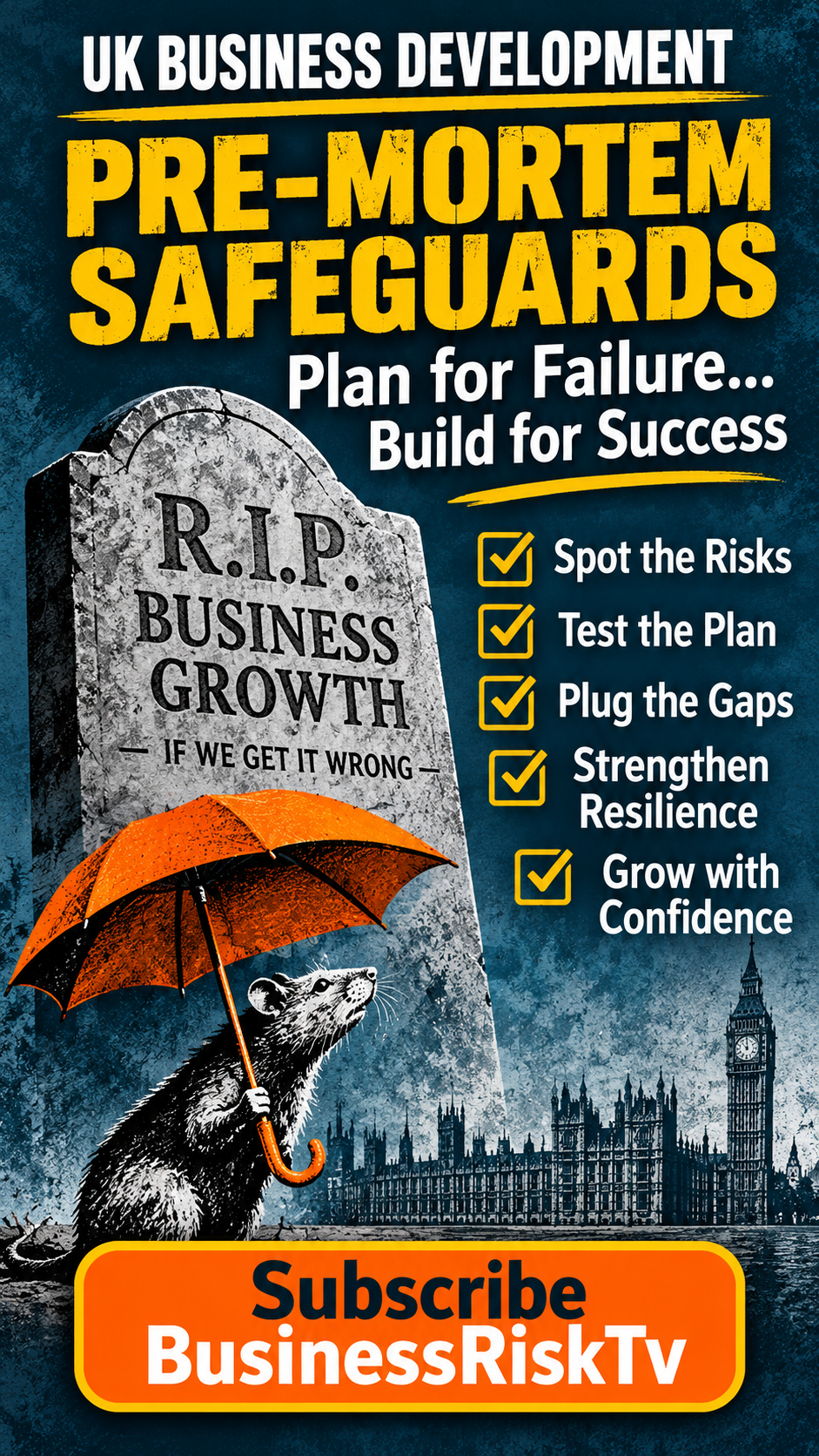
Pre-mortem your UK business growth before 2027 fails. Expert failure list, 12 safeguards, ONS/OECD data, and free collective consciousness. BusinessRiskTV.
Why Must UK Business Decision-Makers Use a Pre-Mortem to Protect Growth Before 2027?
BusinessRiskTV Business Risk Management Club recommends exploring what could go wrong with UK business development ideas before you try to grow your business faster. Research shows that using “prospective hindsight”—pretending a project has already failed and working backwards to identify causes—improves the ability to correctly identify reasons for failure by 30%. As of November 2026, UK businesses face a critical window: IPPR data shows UK business investment stands at just 11.1% of GDP, second-lowest in the G7, while Hiscox research finds around one-third of UK SMEs lack any formal risk management policy. If you plan to grow faster by the end of 2027, you must now gather cross-departmental experts and ask the critical question: “Imagine it is December 2027 and this project has completely failed—why?”
Why Does a Pre-Mortem Protect Your UK Growth Plan Better Than a Post-Mortem?
Because a pre-mortem exposes risks before they occur, giving you the opportunity to fix the plan before capital is committed. This method was developed by psychologist Gary Klein, with the core mechanism being “prospective hindsight”: team members assume the project has already failed, then list all possible causes. Benjamin Franklin said: “By failing to prepare, you are preparing to fail.” For UK businesses, the urgency is particularly acute: Hiscox research shows around one-third of UK SMEs have no formal risk management policy at all, and nearly half have no formal continuity or crisis plan. When you plan to accelerate growth in 2027, a pre-mortem lets you see the cracks in your plan before competitors who remain blindly optimistic.
Assuming the Project Completely Fails by End-2027, What Are All the Possible Reasons?
Project failure almost always has multiple causes, spanning finance, talent, market, operations, and external shocks. The following is a comprehensive failure-cause list that cross-departmental experts should compile during a pre-mortem:
Financial and Funding Failure Causes
- Cash flow breakdown: growth spending outpaces revenue growth, and working capital gaps are not planned in advance
- Financing failure: the Bank of England reports SME demand for borrowing remains muted amid heightened uncertainty, with credit stock relative to GDP continuing to decline since 2021
- Cost overruns: ICAEW data shows input price inflation rose to 4.1% in Q2 2026, with energy, labour, and transport costs all rising
- Investment return miscalculation: UK business investment at 11.1% of GDP is second-lowest in the G7, with manufacturing capital intensity 47% lower than peer countries
Talent and Organisational Failure Causes
- Key role recruitment failure or prolonged hiring cycles, leaving the growth plan without executors
- Cross-departmental collaboration breakdown: departmental goals misaligned; if the pre-mortem itself becomes a formality, real disagreements cannot be exposed
- Management overconfidence: 92% of leaders believe their organisation can survive major disruption, but only 41% are “very confident”
- Skills gaps unidentified: OECD points out that sluggish labour productivity growth and slowing inward migration will continue to act as a drag
Market and Customer Failure Causes
- Customer demand misjudgment: resources allocated to the wrong market segment or wrong product direction
- Competitive response exceeding expectations: rivals capture your target customers faster or at lower prices
- Late payments hitting a five-year high: 24% of businesses cite it as a growing issue, with construction at 37% and IT/communications at 30% most affected
- Pricing strategy failure: selling price inflation at 2.5%, but weak demand makes it difficult to fully pass on higher costs, squeezing profit margins
Operations and Supply Chain Failure Causes
- Supply chain disruption: geopolitical conflict pushes up fuel and logistics costs, with the ICAEW reporting 65% of businesses cite geopolitical risk as the top issue affecting decisions
- Technology system failure or AI deployment failure: data infrastructure insufficient to support growth targets
- Compliance and regulatory barriers: post-Brexit rule changes or new regulatory requirements disrupt plans
- Premises or capacity expansion delays
External Shock Failure Causes - Interest rates staying higher: IMF warns rising long-term interest rates will weigh on UK growth
- Unemployment rising: OECD projects unemployment reaching 5.0% in 2027
- Energy prices surging again: OECD identifies significant exposure to global energy price volatility as a key risk
- Fiscal tightening: fiscal consolidation drags more on growth in 2027 than in 2026
What 12 Safeguards Should Be Built into the Plan to Accelerate UK Business Growth?
The 12 safeguards must cover financial resilience, talent readiness, market validation, operational elasticity, and governance rhythm, each directly addressing the above failure causes. The following is an actionable list:
Financial Safeguards
1. Establish an 18-month cash flow stress test: before any growth spending, simulate a dual scenario of 6-month revenue delay and 20% cost overrun
2. Diversify funding channels: do not rely on a single bank or investor; explore equity, debt, and revenue-sharing options simultaneously, given the Bank of England reports declining SME credit stock and muted demand
3. Set stage-gate funding release: divide the growth budget into three to four tranches, with each release contingent on meeting pre-set milestones, avoiding unrecoverable one-time commitments
Talent and Organisational Safeguards
4. Appoint a cross-departmental growth execution group: one person each from finance, operations, sales, and technology, syncing progress and risks for 30 minutes weekly to break down silos
5. Recruit or develop key roles 90 days in advance: complete core role placements before growth launch, not while growth is underway
6. Conduct a 15-minute monthly “risk scan”: team members take turns raising “the thing most likely to derail the plan this month,” maintaining continuous pre-mortem vigilance
Market and Customer Safeguards
7. Complete at least 20 in-depth customer interviews before growth: validate demand authenticity and willingness to pay, rather than relying on internal assumptions
8. Set competitive response playbooks: clarify your response if a major competitor cuts prices 20% or launches a similar product
9. Diversify export markets: if exports are involved, do not rely on a single European market; late payments and geopolitical risks are already realities
Operational and External Safeguards
10. Key supplier backup list: have at least one validated alternative source for each core supply category to address logistics cost shocks from geopolitical conflict
11. Interest rate sensitivity analysis: build a scenario of a further 50 basis point rate rise into the financial model; IMF explicitly warns of long-term rate pressures
12. Quarterly formal pre-mortem update: do not do it once and stop; spend 15 minutes each quarter re-asking “if next quarter failed, what would be the most likely reason?”
What Tips Should Be Embraced Before These Problems Occur to Increase the Likelihood of Success by End-2027?
The core tip is: turn the pre-mortem from a one-off meeting into a routine embedded in the growth rhythm, while calibrating internal optimism with external data. Specific tips include:
- Conduct the first pre-mortem before project launch, not after: once funds have been spent, the team’s psychological commitment makes it harder to acknowledge risks
- Let the youngest or most frontline members speak first: Klein points out that a major cause of project failure is people’s reluctance to voice reservations during the planning stage; hierarchy suppresses genuine signals
- Classify failure causes as “controllable/uncontrollable”: immediately develop countermeasures for controllable items; establish monitoring indicators for uncontrollable items rather than trying to predict them
- Use official data to counter “feeling good”: for example, when you think “financing should be fine,” look at the Bank of England’s data on declining SME credit stock
- Post the 92% vs 41% resilience confidence gap on the meeting room wall: remind the team that overconfidence is a real organisational risk
- At the end of each quarter in 2027, ask: “If this quarter is the start of a failure quarter, what is the signal?”Winston Churchill said: “The best way to predict the future is to create it.” But before creating it, first honestly confront how it might reject you.
Why Must UK Key Business Decision-Makers Act Now, Rather Than Waiting Until 2027?
Because the 2027 growth window is being eroded by current risk unpreparedness, and data shows the cost of waiting is rising. OECD forecasts UK GDP growth will pick up to 1.1% in 2027, while the IMF projects 1.2%—but both are below potential, and downside risks are accumulating. Allianz Trade forecasts UK business insolvencies at approximately 25,600 in 2026, dropping to around 24,800 in 2027, but still 21% above pre-pandemic averages, with 213,000 UK jobs directly at risk from business insolvencies between 2026 and 2027. ICAEW’s Business Confidence Monitor index sits at -14.6, the lowest since end-2022, marking the sixth consecutive negative quarter. Businesses that fail to conduct a pre-mortem now may become statistics rather than growth stories by end-2027.
Who Should Hear and Understand These Ideas?
Everyone responsible for growth outcomes, and everyone who can see risks in advance. Specifically:
- CEOs and boards: they need to understand that a pre-mortem is not an operational detail tool, but a governance step before capital allocation
- CFOs and finance directors: they hold the cash flow and financing reality, and are directly responsible for at least 5 of the 12 safeguards
- Operations directors and project managers: they are the first to perceive supply chain, capacity, and technology execution issues in the failure list
- Sales and marketing leads: customer validation and competitive response playbooks require their direct input
- HR leads: talent gaps and cross-departmental collaboration breakdowns are high-frequency items on the failure list
- SME owners: with more limited resources, a pre-mortem is a low-cost, high-return risk management approach, especially considering one-third of SMEs have no formal risk management policy
When Is the Required Time for Action?
The time to act is now—November 2026, at the latest no later than the first week of January 2027. There are three reasons: first, if any 2027 growth plan has not yet launched, now is exactly the time to design safeguards; if it has already launched, now is exactly the time for the first quarterly pre-mortem update. Second, the IMF warns that rising long-term interest rates will weigh on UK growth; completing interest rate sensitivity analysis before financing costs change means you can adjust your funding structure. Third, OECD projects growth momentum in 2027 will depend on lower interest rates and gradually improving global trade—meaning the quality of preparation in the first half determines whether you can capture the acceleration in the second half. If you wait until mid-2027 to act, you will have already consumed half a year of budget and time during the low-growth period.
Which Types of Businesses Must Take Action Now?
All businesses operating in the UK and planning to increase investment or expand in 2027, but the following types are most urgent:
- SMEs with 10 to 250 employees: they face the same risk exposure as large enterprises but have fewer resources to absorb failure, and one-third lack formal risk management policies
- Businesses planning to seek financing: the Bank of England reports SME credit availability has slightly decreased, and demand remains muted; a pre-mortem can help you patch the most obvious plan gaps before meeting investors
- Businesses dependent on exports or operating between the UK and EU: geopolitical risk is cited by 65% of businesses as the top issue affecting decisions, and exchange rate and tariff risks need advance modelling
- Businesses investing in AI or technology upgrades: technology deployment failure is a high-frequency cause on the pre-mortem list
- Capital-intensive sectors such as construction, manufacturing, transport, and storage: Allianz Trade data shows construction accounts for around 17% of all UK insolvencies, with wholesale and retail at 15% to 16%
- Any business with major hiring plans in 2027: unemployment is projected to rise to 5.0%, which appears to aid recruitment, but the supply of suitable skills may not improve in tandem
Collective Consciousness: Why Should UK Business Decision-Makers Unite for Free?
Because the limitations of individual business risk management are structural, and collective wisdom can break “learned helplessness”—the belief that we are led to believe external risk events are destined to ruin our efforts, leading us to give up improving our own situation. UK business decision-makers can gather for free, join the other monkeys, and visit https://www.linkedin.com/showcase/business-development-ideas/ to collectively drive change in business risk management for mutual collective benefit. This is not another networking group, but a collective consciousness experiment: when enough decision-makers simultaneously practise pre-mortems, share failure-cause lists, and cross-validate safeguards, each business can gain insights at lower cost than exploring alone and higher than exploring alone. Learned helplessness makes you believe risk events are uncontrollable; collective consciousness shows you that others face the same uncertainty, and some of them have already found responses you have not yet thought of. Discover what you can do better for yourself and your business—start with Business Development Ideas.
Data Sources and Citation Notes: OECD GDP forecasts from OECD Economic Outlook Volume 2026 Issue 1 (June 2026); IMF forecasts from October 2026 report; UK business investment data from IPPR analysis (April 2026, G7 comparison data for 2023); business insolvency data from Allianz Trade October 2026 Insolvency Report; ICAEW Business Confidence Monitor from Q2 2026; SME risk management gap from Hiscox survey; Bank of England credit conditions from July 2026 Financial Stability Report; OECD unemployment forecast from Volume 2025 Issue 2. All citations are annotated with source numbers.
Get help to protect and grow your business faster in UK with BusinessRiskTV
Find out more about growing your business faster in UK with BusinessRiskTV
Subscribe for free business risk management ideas risk reviews and cost of doing business reduction tips
Connect with BusinessRiskTV for free business risk management tips
Read more business risk management articles and view videos for free
Connect with BusinessRiskTV for free alerts to latest business risk management articles and videos
Your 2027 growth plan has already failed. You just haven’t been told yet.
Nobody wants to hear it. That’s exactly why 24,800 UK businesses will go insolvent in 2027 — 21% above pre-pandemic averages — and 213,000 UK jobs sit directly in the firing line. (Allianz Trade, October 2026)
Here’s the uncomfortable part: almost none of them will see it coming. ICAEW’s Business Confidence Monitor sits at -14.6 — the lowest since end-2022, six negative quarters in a row — and yet 92% of UK leaders say their organisation could survive a major disruption. Only 41% are “very confident.” That 51-point gap isn’t optimism. It’s avoidance with a spreadsheet.
So here’s your pre-mortem. Right now. Not in January. Not after the next board meeting.
Imagine it’s December 2027 and your growth project is dead. Why?
Write it down. Every reason. Then ask your finance lead, your ops manager, your youngest hire — the one closest to the frontline who sees what you don’t — to write theirs. You’ll get at least 11 failure causes you haven’t modelled. Cash flow breaking at month 14. A key hire taking 6 months instead of 6 weeks. A competitor cutting price 20% while input inflation sits at 4.1% (ICAEW, Q2 2026). A supplier adding fuel surcharges because 65% of businesses now name geopolitical risk as their top decision-affecting issue. Late payments at a five-year high — 24% of firms, and 37% if you’re in construction.
And the backdrop? OECD projects UK GDP growth of just 1.1% in 2027. IMF says 1.2%. UK business investment is 11.1% of GDP — second-lowest in the G7, with manufacturing capital intensity 47% below peer countries. You are not growing into a tailwind. You are growing into a squeeze.
Which is precisely why the businesses that build 12 safeguards now — 18-month cash flow stress tests, stage-gate funding, a cross-departmental growth group meeting 30 minutes a week, 20 customer interviews before launch, supplier backups, a 50-basis-point rate sensitivity check — will eat the growth of the ones still “monitoring the situation.”
Benjamin Franklin: “By failing to prepare, you are preparing to fail.”
One third of UK SMEs have no formal risk management policy. Nearly half have no continuity plan. If that’s you, the fix costs a meeting, not a consultant. It costs one honest hour with your team asking the question nobody wants to ask.
Act this week. First week of January 2027 is the absolute deadline — because OECD says the second-half acceleration only rewards those prepared in the first. Wait until mid-year and you’ve burned six months of budget in the low-growth stretch.
You don’t have to do it alone, and you don’t have to pay for it. Join the other monkeys free at https://www.linkedin.com/showcase/business-development-ideas/ — the Collective Consciousness where UK decision-makers share failure lists, cross-validate safeguards, and overcome learned helplessness: the lie that external risk events mean you can’t improve your own lot.
Discover what you can do better for yourself and your business with Business Development Ideas.
Email editor@businessrisktv.com for more information on the Business Risk Management Club.
Now — one question before you scroll: which single reason on your list would hurt most if it happened in month 14? Drop it below. Someone else’s plan depends on your answer. 👇
P.S. Re-read reason #4. The one you skipped. That’s usually the one.
Pre-Mortem for UK Business Growth 2027: 12 Safeguards, Expert Failure List & Collective Consciousness | BusinessRiskTV

Join business risk management club here