Ukraine War Risk Analysis: The Monroe Doctrine in Europe and the Path to WW3

This risk analysis decodes the Ukraine conflict through the lens of the Monroe Doctrine, arguing Russia views NATO expansion and “defensive” missiles in Eastern Europe as an existential threat akin to the Cuban Missile Crisis. We assess the tangible pathways for escalation to a wider war and the critical need for strategic de-escalation to manage this global business risk.

Business Risk Management Analysis: The Ukrainian Conflict and Escalation to a Wider War

This analysis assesses the high-level strategic risks in the Ukraine conflict, framing them through historical parallels, core security doctrines, and the potential for catastrophic escalation. The central thesis is that the deployment of advanced Western missile systems near Russia’s borders is perceived by Moscow as a direct, existential threat akin to the 1962 Cuban Missile Crisis, creating a volatile environment where miscalculation could lead to a third world war.

1. The Core Threat: “Decapitating” Missiles and the Russian Perception

From a risk management perspective, the primary threat driver is not the conventional war in Ukraine itself, but the strategic weapons systems being deployed around Russia’s periphery.

  • The Nature of the Threat: Systems like the Aegis Ashore sites in Poland and Romania, while officially labelled as defencive “missile shields,” are perceived by Russia as possessing offensive potential. The launchers used for SM-3 interceptor missiles are functionally similar to those used for land-attack cruise missiles. This ambiguity allows Russia to frame them as a “decapitating” strike threat—a first-strike weapon capable of neutralising Russia’s nuclear command-and-control and retaliatory capabilities, thereby crippling its ultimate deterrent.
  • The Historical Parallel: The Cuban Missile Crisis: This is not a superficial comparison in Moscow’s view. In 1962, the United States considered the deployment of Soviet nuclear missiles in Cuba—a small, neighbouring country—an intolerable, existential threat and was prepared to go to war to have them removed. Russia applies the same logic in reverse. It views NATO’s eastward expansion and the placement of advanced missile systems in its former sphere of influence as a modern-day equivalent of the Cuban Missile Crisis. The potential future deployment of such systems to a country like Venezuela would only reinforce this narrative and mirror the 1962 scenario exactly.

2. The Doctrinal Framework: The “Monroe Principle” Applied to Ukraine

The driving geopolitical principle behind Russia’s actions is a mirror of the American Monroe Doctrine.

  • The Original Doctrine: The U.S. Monroe Doctrine (1823) declared the Western Hemisphere its sphere of influence, deeming it off-limits to further European colonisation or political interference.
  • The Russian Interpretation: Russia has effectively declared a similar doctrine for its “near abroad,” particularly Ukraine. From the Kremlin’s perspective, a neutral or buffer Ukraine is a fundamental security requirement. A Ukraine integrated into NATO—a military alliance historically opposed to Russia—is as unacceptable to Moscow as a Mexico or Canada in a military alliance with China or Russia would be to Washington. This principle explains the intensity of Russia’s response; it is fighting what it sees as a defensive war to prevent a hostile power from consolidating on its doorstep.

3. The Ultimate Risk: Escalation to a Third World War

The convergence of the missile threat and the Monroe-style doctrine creates a high-probability, high-impact risk scenario for a wider conflict. The pathways to escalation are multiple:

  • Direct Engagement: An accidental or intentional strike on NATO territory (e.g., in Poland or Romania) by a Russian missile, or vice-versa, could trigger NATO’s Article 5 collective defense clause, leading directly to a Russia-NATO war.
  • Hybrid Warfare Blowback: Acts of sabotage attributed to Russia (e.g., against undersea infrastructure) or provocative actions like the repeated violations of NATO airspace could spiral out of control. A single miscalculation in this “gray zone” could be misread as an act of war, demanding a conventional military response.
  • Inadvertent Escalation: The fog of war creates immense risk. An errant missile, the misidentification of an aircraft, or a miscommunication during a high-alert period could trigger a cycle of retaliation that neither side initially intended.

4. Analysis of the “Forever War” Driver Claim

The assertion that intelligence services like MI6 (UK), BND (Germany), and DGSE (France) are deliberately driving a “forever war” is a significant claim. A risk analysis must distinguish between stated policy and verifiable evidence.

  • The Official Policy Stance: The publicly stated goal of the UK, France, and Germany is to support Ukraine’s sovereignty and prevent a Russian victory that would undermine European security and the international order. Their actions—providing weapons, intelligence, and training—are consistent with this stated goal of enabling Ukraine to defend itself.
  • The “Forever War” Narrative: The claim that these agencies are actively sabotaging peace to prolong the conflict is primarily propagated by the Russian government and commentators who align with that viewpoint. While individual politicians or analysts in the West may argue that prolonged conflict serves to weaken Russia strategically, there is a lack of publicly available, verified intelligence or official documentation proving a coordinated policy by MI6, BND, and the DGSE to deliberately instigate a “forever war.” From a risk management standpoint, this narrative remains an unverified, high-severity contingent liability rather than a confirmed fact upon which to base a strategic assessment. The driving objective of Western powers appears to be achieving a favorable outcome for Ukraine, not perpetuating a war for its own sake, though the effect of their support is indeed a prolonged conflict.

Conclusion and Risk Mitigation

The highest-priority risk is the potential for direct conflict between Russia and NATO. To defuse the situation, risk mitigation must address the core perceived threats:

  1. Strategic Arms Control: A renewed and urgent dialogue on strategic stability and missile defense is critical. Clarifying the capabilities and intent of systems in Eastern Europe, potentially with verification measures, could reduce the “decapitation strike” fear that drives Russian escalation.
  2. Addressing the Sphere of Influence: While morally problematic, any durable settlement will likely need to implicitly acknowledge Russia’s Monroe-style security concerns regarding Ukraine’s alliance status, finding a formula for Ukrainian security that does not involve NATO membership.
  3. De-escalation Channels: Maintaining and strengthening direct military-to-military communication lines between Russia and NATO is essential to manage incidents and prevent inadvertent escalation.

Failure to manage these core risks creates a business environment for the world where the threat of a great power conflict remains unacceptably high.

Here are 6 actionable risk management steps business leaders should take today to protect their operations from the geopolitical risks outlined in the analysis.

Global Business Risk Network: Connect, Learn, and Lead in Risk Management

6 Risk Management Steps for Business Leaders

1. Formalise Geopolitical Risk Monitoring

  • Action: Move beyond ad-hoc news reading. Establish a formal process, assigning a team or using a dedicated service to monitor geopolitical intelligence with a specific focus on:
    • NATO-Russia rhetoric and military posturing.
    • Incidents in border regions of Poland, Romania, and the Baltic states.
    • Developments in potential flashpoints like Kaliningrad or the Black Sea.
  • Rationale: Early warning of escalating tensions provides crucial lead time to activate contingency plans before markets or supply chains are paralysed.

2. Stress-Test Supply Chains for “Choke Point” Failure

  • Action: Identify single points of failure, especially those dependent on routes or regions exposed to the conflict zone (e.g., air corridors over Eastern Europe, key ports on the Black Sea, rail lines through Poland). Model scenarios involving the closure of these channels and pre-qualify alternative suppliers and logistics routes.
  • Rationale: A direct NATO-Russia incident would immediately disrupt transport and logistics across Eastern Europe, severing critical arteries for business.

3. Develop a Tiered “Escalation” Response Plan

  • Action: Create a dynamic response plan with clear triggers for different levels of escalation, not just a binary “crisis/no-crisis” switch. For example:
    • Level 1 (Heightened Tension): Review and communicate travel security protocols.
    • Level 2 (Direct Incident): Activate remote work mandates for staff in affected regions, freeze new investments.
    • Level 3 (Open Conflict): Execute evacuation plans, implement full business continuity protocols.
  • Rationale: A phased approach prevents panic and ensures a measured, appropriate response as a situation deteriorates.

4. Fortify Cybersecurity Posture Immediately

  • Action: Assume that a wider geopolitical conflict will involve significant cyber warfare. Mandate multi-factor authentication across all systems, ensure backups are air-gapped and immutable, and conduct fresh table-top exercises for scenarios like ransomware attacks on critical infrastructure or wiper malware targeting corporate networks.
  • Rationale: Businesses are considered legitimate targets in state-level cyber conflicts. Proactive defence is no longer optional.

5. Model Financial Shock Scenarios

  • Action: Work with finance to model the impact of a sudden energy price spike, a freeze in capital markets, rapid currency devaluation, or the collapse of trade with a broader set of countries. Stress-test liquidity and credit lines under these conditions.
  • Rationale: The financial contagion from a great-power conflict would be immediate and severe, potentially locking companies out of vital capital.

6. Conduct a Critical Talent and Operations Review

  • Action: Audit your workforce and key operations to identify critical dependencies on personnel, facilities, or partners located in NATO member states bordering Russia and Ukraine. Develop plans for remote work, relocation, or knowledge transfer to mitigate the risk of these assets becoming inaccessible or unsafe.
  • Rationale: Protecting human capital is the first priority. Furthermore, the loss of a key team or facility in a frontline state could cripple business units.

Get help to protect and grow your business faster with less uncertainty impacting on your business objectives

Find out more about growing your business faster with less uncertainty via better risk management information 

Subscribe for free business risk management ideas risk reviews and cost reduction ideas

Connect with us for free business risk management tips

Contact Us To Subscribe BusinessRiskTV – Reach Global Decision Makers

Read more business risk management articles and view videos

Connect with us for free new business risk management articles and videos alerts

The West’s Ukraine Strategy: A Catastrophic Policy Failure & The Business Cost

Ukraine War Risk Analysis: The Monroe Doctrine in Europe and the Path to WW3

Mastering Business Risks

Best ways to grow a business faster with less risk UK

Mastering Business Risks: A Comprehensive Guide to Dominating Your Marketplace

By Keith Lewis

Published by BusinessRiskTV.com


Enterprise Risk Management Magazine articles on business growth and business protection
Right Now UK Business Leaders Are Stuck!

Table of Contents

  1. Introduction: Why Understanding Real Risks is the Key to Business Success
  2. The Problem: Why UK Business Leaders Struggle with Risk Management
  3. The Consequences of Ignoring Real Business Risks
  4. Internal vs. External Risks: What’s Really Threatening Your Business?
  5. Overcoming Fear of Failure — and Success
  6. Why Settling for the Status Quo is the Biggest Risk of All
  7. How to Identify the Real Risks to Your Business Survival and Growth
  8. Assessing Risks: Tools and Strategies for Better Decision-Making
  9. Controlling Risks: Turning Threats into Opportunities
  10. The Role of Innovation in Reducing Risk and Accelerating Growth
  11. Expanding Sales More Profitably in the UK Market
  12. The Power of Networking: Leveraging BusinessRiskTV.com’s Business Experts Hub
  13. Connecting Buyers and Sellers More Effectively Online
  14. Case Studies: Businesses That Mastered Risk and Dominated Their Markets
  15. Action Plan: Stop Waiting, Start Executing
  16. Conclusion: Elevate Your Business Above Uncertainty

Introduction: Why Understanding Real Risks is the Key to Business Success

In today’s volatile business environment, only those who truly understand the real risks will manage them better. Many business leaders in the UK are operating with blind spots—unaware of the threats that could derail their growth or the opportunities they’re missing.

This book is not just about risk avoidance; it’s about risk mastery. It’s about preparing for the most valuable opportunities and dominating your marketplace. You already have what it takes to be greater than you’ve been so far — but you must overcome fear, stop waiting, and act now.

Whether you’re afraid of failure — or even success — this guide will help you break through barriers, identify the real risks, and turn them into advantages.

The Problem: Why UK Business Leaders Struggle with Risk Management

Many UK business leaders:

  • Lack deep knowledge of the risks affecting their industry.
  • Don’t know which risks to take to grow faster.
  • Don’t have the right experts to help them assess and control risks.
  • Underestimate internal risks (like leadership gaps or cash flow issues).
  • Overestimate external risks (like economic downturns or competition).

This knowledge gap leads to missed opportunities, slower growth, and unnecessary vulnerabilities.

Expanding the Problem: The Need for Innovation and Profitable Growth

Why should UK business leaders innovate? Because standing still is riskier than evolving. Companies that fail to adapt:

  • Lose market share to competitors.
  • Become irrelevant in changing industries.
  • Miss profitable expansion opportunities.

The solution? Strategic risk-taking. This book will show you how to expand sales more profitably by focusing on high-reward, low-risk strategies.

The Risk Management Solutions with BusinessRiskTV.com

You don’t have to navigate risks alone. BusinessRiskTV.com offers:
Business Experts Hub – Network with risk management professionals.
Risk Assessment Tools – Make smarter decisions.
Online Marketplace – Connect buyers and sellers more cost-effectively.

By leveraging these resources, you can gain clarity, reduce uncertainty, and seize opportunities faster.

Stop Waiting—Act Now!

Enterprise Risk Management Magazine articles on business growth and business protection
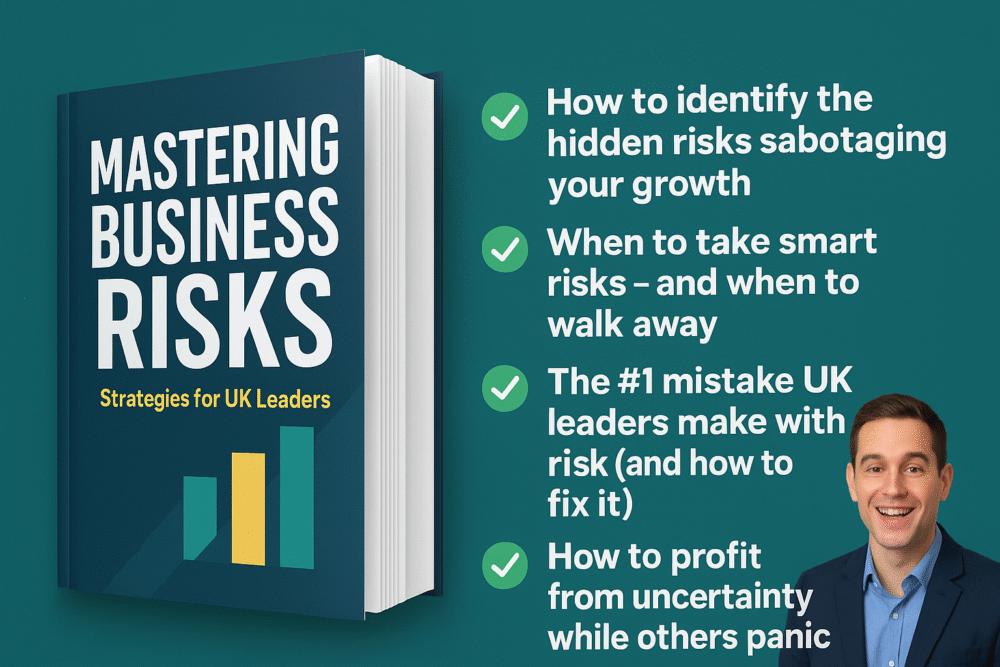
Mastering Business Risks : Strategies for UK Leaders

This ebook provides a step-by-step roadmap to:

✔ Identify and assess your biggest risks.
✔ Innovate with confidence.
✔ Grow sales profitably.
✔ Dominate your market.

The time for hesitation is over. Master your risks, elevate your business, and leave competitors behind.

Get Your Copy Today and Start Dominating Your Marketplace!
Available now on BusinessRiskTV.com

Enterprise Risk Management Magazine articles on business growth and business protection
Buy Mastering Business Risks eBook

Get help to protect and grow your business faster with BusinessRiskTV

Find out more about Business Risks Management Club Membership 

Subscribe for free Business risk management tips risk reviews and cost cutting ideas

Connect with us for free business risk management tips

Read more business risk management articles and view videos for free

Connect with us for free business risk management articles and videos 

Read and view more:

  1. “How to identify and control business risks in the UK”
  2. “Best ways to grow a business faster with less risk UK”
  3. “Business risk management experts UK advice”
  4. “How to increase sales profitably in the UK market”
  5. “Overcoming fear of business failure and success UK”
  6. “Where to find business risk management help in the UK”

#UKBusinessGrowth #RiskManagementUK #BusinessSuccessUK #EntrepreneurMindsetUK #ProfitWithLessRisk #DominateYourMarket

Mastering Business Risks

The Global Threat of Government Censorship and Its Impact on Business Leaders: A Critical Analysis

The importance of freedom of speech to critical business risk analysis

Freedom of Speech and Business Risk: A Vital Connection

Freedom of speech is the cornerstone of democracy, enabling the free exchange of ideas, information, and opinions. For business leaders, this freedom is essential in evaluating risks, assessing markets, and making informed decisions. The ability to speak openly, criticise policies, and question norms allows leaders to gather diverse perspectives, facilitating the identification of true business risks and the mitigation of potential threats.

Risk Management Magazine
Freedom Of Speech

However, when governments impose censorship, the free flow of information is compromised. George Orwell’s observation, “Journalism is printing what someone else does not want printed; everything else is public relations,” rings true, especially in the corporate world. Suppression of information prevents leaders from accessing accurate risk assessments, leaving them vulnerable to false perceptions that can hinder strategic planning. Without freedom of speech, business leaders are unable to gauge real threats, creating a facade of stability while underlying risks go unnoticed.

In business, risk management relies heavily on access to honest, unfiltered information. Without it, companies face decisions based on distorted realities, making them susceptible to unforeseen disasters. For instance, a company might enter a seemingly stable market, only to discover later that political unrest was censored, thus misjudging the risk. Understanding genuine business risks requires a transparent and open environment where information flows freely, enabling businesses to act preemptively and avoid potential crises.

Enterprise Risk Management Magazine articles
Freedom Of Speech Risks

19 Reasons Why Censorship is Detrimental to Business Risk Management

1. Distorted Market Perception: Censorship leads to the suppression of unfavourable market trends or political instability, creating a misleading view of the business environment.

2. Restricted Access to Critical Data: Business leaders are deprived of key information, such as economic data or political developments, that could impact their decisions.

3. Inability to Assess Political Risks: Governments that censor political dissent make it difficult to understand the underlying political risks that could destabilise markets or sectors.

4. Misinformation Proliferation: When free speech is stifled, misinformation and propaganda take its place, leading to poor business decisions based on false narratives.

5. Poor Investment Decisions: Without access to the truth, businesses may invest in unstable regions or industries without recognising the risks.

6. Undermined Trust: Censorship creates an environment of uncertainty and mistrust, as business leaders are unable to trust the information they receive from censored sources.

7. Innovation Suppression: In markets where free expression is limited, innovation is stifled, reducing opportunities for businesses to develop new products or services.

8. Erosion of Corporate Transparency: Companies in countries with strict censorship may be forced to comply with opaque government policies, reducing their own transparency and ethical standards.

9. Ethical Dilemmas: Businesses operating in censored environments may face ethical conflicts, especially if they are required to comply with censorship laws that conflict with their values.

10. Lack of Early Warning Signs: In censored regimes, the lack of open discourse prevents businesses from recognising early signs of social or political unrest, which could affect market stability.

11. Barriers to Global Collaboration: Censorship in one region can prevent companies from collaborating effectively with global partners who have access to more accurate information.

12. Limited Crisis Management: In crisis situations, real-time information is critical. Censorship delays or blocks access to vital information, hampering effective crisis management.

13. Regulatory Ambiguities: Censorship often comes with ambiguous regulations that are inconsistently enforced, creating legal risks for businesses operating in those regions.

14. Increased Corruption: Censorship often goes hand in hand with corruption, which increases operational risks for businesses in censored markets.

15. Poor Reputation Management: Censorship limits a business’s ability to manage its reputation, especially if false information about the company cannot be challenged in the public domain.

16. Workforce Demoralisation: Employees working under censorship may feel powerless to voice concerns or report wrongdoing, leading to poor morale and reduced productivity.

17. Unreliable Supply Chain Management: Businesses rely on accurate information to manage supply chains, especially in times of disruption. Censorship hides supply chain risks, leading to operational inefficiencies.

18. Consumer Misinformation: Censorship can distort consumer opinions and preferences, leading businesses to make misguided marketing decisions.

19. Overreliance on Government Data: In censored environments, business leaders may be forced to rely solely on government-provided data, which could be manipulated to conceal economic or political instability.

How Business Leaders Can Access Real Risk Analysis in Censored Environments

While government censorship presents a significant challenge to business risk management, there are several strategies that business leaders can adopt to access real risk analysis and make informed decisions.

1. Leverage Independent Media: Independent media outlets often provide uncensored news and insights. By diversifying news sources and focusing on independent journalism, businesses can gain a clearer understanding of political, economic, and social risks.

2. Collaborate with International Experts: Engaging with international analysts, consultants, and academic institutions can provide a more global perspective on local risks. These experts often have access to uncensored data and can provide insights that local sources might not.

3. Invest in Private Risk Assessments: Businesses can commission private risk assessments from independent firms that specialise in market analysis, political risks, and economic trends. These firms often have access to unfiltered information through their global networks.

4. Monitor Social Media and Online Communities: In many censored environments, dissenting voices find alternative channels of expression through social media, encrypted communication platforms, or online forums. Monitoring these platforms can provide early warning signals of unrest or instability.

5. Use Open-Source Intelligence (OSINT): OSINT involves collecting and analysing publicly available information from a variety of sources, including social media, public forums, satellite imagery, and international news outlets. OSINT can provide invaluable insights into emerging risks.

6. Engage Local Partners with Caution: Local partners with insider knowledge of censored regions can provide on-the-ground intelligence. However, it’s crucial to assess the reliability and motivations of these partners to ensure unbiased reporting.

7. Consult Think Tanks: Many think tanks operate independently and provide valuable research on political, social, and economic risks in censored regions. Their reports can offer a more transparent view of the business landscape.

8. Adopt Corporate Diplomacy: Building strong relationships with local governments, regulatory bodies, and international organisations can help businesses navigate censored environments more effectively. Corporate diplomacy enables leaders to gain insider knowledge and negotiate better terms for their operations.

9. Encourage Internal Whistleblowing: Within organisations, encouraging internal whistleblowing mechanisms can help businesses identify risks that might otherwise be concealed by external censorship. Ensuring employees feel safe to report concerns is essential for maintaining transparency.

10. Participate in Global Business Networks: Engaging with global business networks such as chambers of commerce, trade associations, and multinational corporations can offer a broader perspective on the risks associated with censored regions. These networks often share critical insights based on their own experiences.

11. Utilise Blockchain for Transparency: In environments where censorship affects financial and transactional transparency, blockchain technology can provide a decentralised, tamper-proof record of transactions, ensuring that businesses maintain clear oversight of their operations.

The Benefits of Independent Business Risk Analysis via BusinessRiskTV and the Business Risk Management Club

Given the limitations imposed by government censorship, accessing independent and reliable business risk analysis is more important than ever. This is where platforms like BusinessRiskTV and the Business Risk Management Club play a crucial role.

At BusinessRiskTV, we specialise in providing independent business risk insights that are free from the influence of government censorship. Our team of global risk experts offers real-time analysis, helping businesses to navigate complex markets and make informed decisions based on transparent and unbiased data. By joining the Business Risk Management Club, business leaders can access a wealth of knowledge, tools, and resources to better manage the risks associated with censored environments.

Here are some of the key benefits of independent business risk analysis via BusinessRiskTV and the Business Risk Management Club:

1. Access to Unfiltered Information: We provide insights into global markets that are not influenced by government propaganda or censorship, ensuring that business leaders receive accurate information.

2. Real-Time Risk Analysis: Our team monitors global trends in real-time, providing businesses with timely and relevant updates on political, economic, and social risks.

3. Expert Insights: Our network of analysts, consultants, and industry experts ensures that members receive comprehensive and diverse perspectives on potential risks.

4. Early Warning Systems: We identify early warning signs of instability in censored regions, allowing businesses to act proactively and mitigate potential risks.

5. Tailored Risk Assessments: BusinessRiskTV offers personalised risk assessments based on your specific industry, market, and business goals, ensuring that your business strategy is aligned with real-world risks.

6. Collaborative Risk Management: As a member of the Business Risk Management Club, you’ll have the opportunity to collaborate with other business leaders, share insights, and develop strategies for managing risks in challenging environments.

7. Ethical Business Practices: Our platform encourages ethical business practices and transparency, helping you to navigate the legal and moral challenges that come with operating in censored markets.

8. Educational Resources: BusinessRiskTV provides a wide range of educational resources, including webinars, reports, and case studies, to help business leaders stay informed about the latest trends in risk management.

By utilising independent business risk analysis through BusinessRiskTV, business leaders can gain a competitive edge, reduce uncertainty, and make more informed decisions. In an increasingly complex global landscape, the ability to access independent, uncensored information is not just a competitive advantage – it is essential for survival. In today’s interconnected world, the risks facing businesses are multifaceted and often hidden behind a veil of censorship, propaganda, and misinformation. Accessing real, accurate data allows companies to make decisions that are not only profitable but also sustainable in the long term.

Why Independent Business Risk Analysis Matters

For business leaders operating in a world of increasing censorship, having access to independent risk analysis is critical. The risks of relying solely on censored or biased information are too great. With false perceptions of stability, businesses may make poor investments, overlook political risks, and expose themselves to significant financial and operational hazards.

Moreover, independent risk analysis fosters transparency and trust—two pillars that are foundational to long-term business success. It helps companies operate ethically, making decisions that align with their values and ensuring that they are prepared for whatever challenges may arise.

Independent platforms like BusinessRiskTV not only provide an essential service for businesses seeking to navigate censored environments, but they also ensure that decision-making is based on objective, fact-driven insights. When businesses are equipped with accurate risk data, they can move confidently in their markets, mitigate potential crises before they escalate, and maintain their reputation even in the face of external pressures.

Joining BusinessRiskTV’s Business Risk Management Club: A Strategic Move for Business Leaders

For business leaders seeking to navigate the complex, and often opaque, global business environment, joining BusinessRiskTV’s Business Risk Management Club provides access to independent, reliable, and actionable risk insights. The club is designed to equip its members with the tools, knowledge, and networks needed to not only survive but thrive in the face of growing censorship and misinformation.

Through BusinessRiskTV’s global network of risk experts and partners, members can stay ahead of potential threats, identify emerging risks, and develop proactive strategies for managing uncertainty. The collaborative nature of the club also enables business leaders to share their experiences, learn from one another, and build a community of informed and empowered decision-makers.

Conclusion: The Power of Independent Business Risk Analysis

Censorship is a growing challenge for businesses worldwide, distorting the perception of risk and complicating decision-making processes. In an era where governments increasingly control the flow of information, the importance of independent business risk analysis cannot be overstated. Business leaders need reliable, uncensored data to accurately assess risks and avoid making decisions based on manipulated or incomplete information.

BusinessRiskTV’s Business Risk Management Club offers a solution to this challenge, providing business leaders with access to real-time, unbiased risk assessments that allow them to make informed, ethical, and strategic decisions. By leveraging independent analysis, businesses can protect their interests, build resilience, and ensure long-term success even in the face of global censorship.

Ultimately, the ability to navigate censorship, misinformation, and political risks will define the success of businesses in the future. By embracing independent risk analysis, business leaders can ensure they are prepared for the challenges ahead and are in a position to seize opportunities in an ever-changing world. Join BusinessRiskTV’s Business Risk Management Club today and equip your business with the insights it needs to succeed in a complex, censored world.

Join our Business Risk Management Club

Collaborate with BusinessRiskTV to grow your business faster with less uncertainty
Click On Button To Join Today

Subscribe for free business risk alerts and risk reviews

Connect with us for free

Read more business risk management articles for free

Connect with us for free

Read more:

1. Impact of government censorship on business leaders
2. Freedom of speech and business risk management
3. How censorship affects global businesses
4. Independent business risk analysis platforms
5. Censorship risks for corporate decision-makers
6. George Orwell quote on journalism and censorship
7. Business challenges in censored environments
8. Why censorship is bad for business risk management
9. Real-time business risk analysis without censorship
10. BusinessRiskTV independent risk management analysis

Key Hashtags :

1. #BusinessRiskManagement
2. #FreedomOfSpeech
3. #CensorshipImpact
4. #CorporateRisk
5. #IndependentAnalysis
6. #GlobalBusinessRisk
7. #UncensoredBusiness
8. #TransparentLeadership
9. #BusinessRiskSolutions
10. #BusinessRiskTV