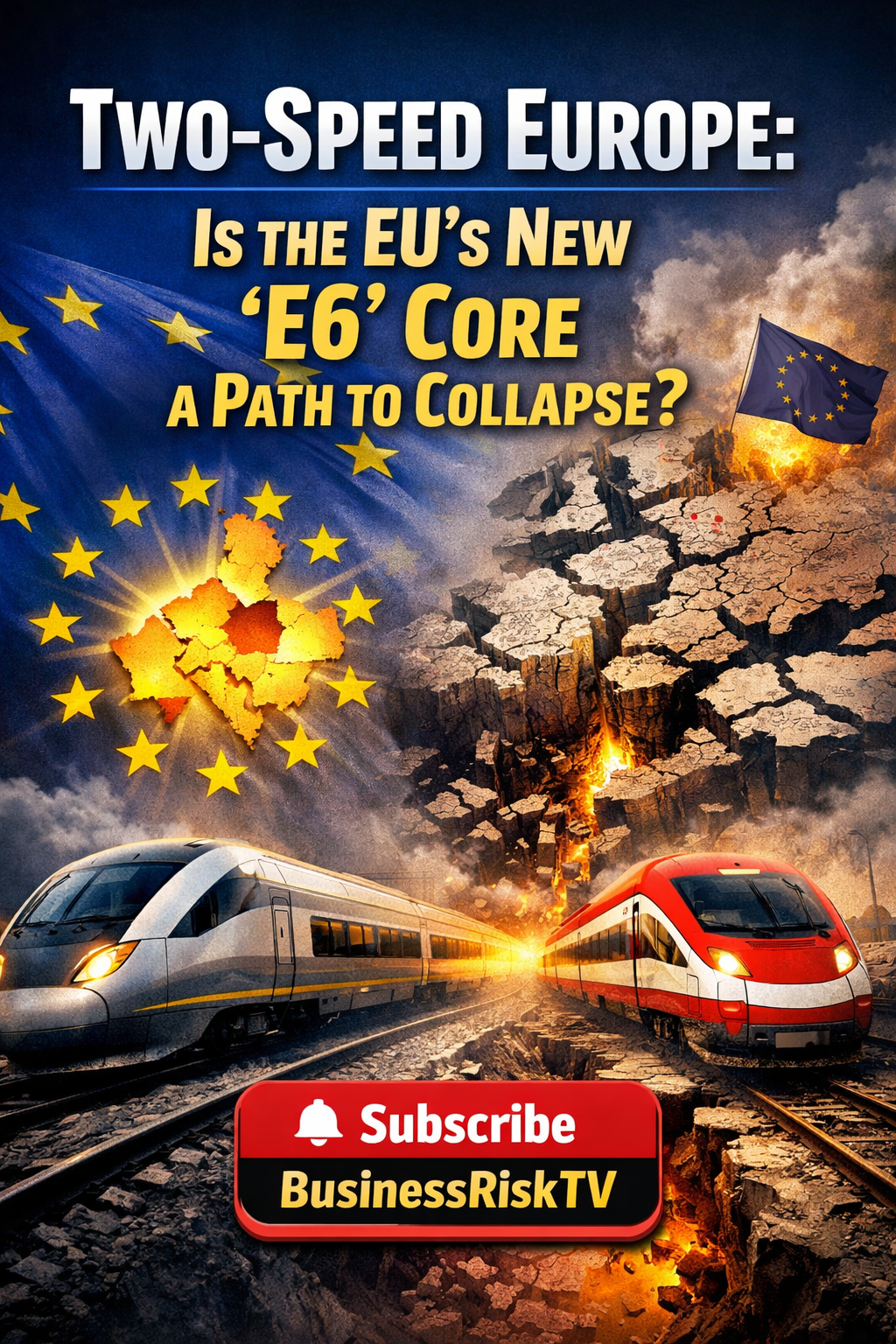
Two-Speed Europe: Is the EU’s New “E6” Core a Path to Collapse? | BusinessRiskTV

Two-Speed Europe Business Guide: Risks, Opportunities & 6 Strategic Steps : The EU’s two-speed plan reshapes business. Our analysis covers the E6 group’s impact, supply chain shifts, and 6 essential risk management steps for leaders.

The E6 Core and the Coming EU Cracks: A Contrarian Risk Analysis for Business

The Inconvenient Truth: A Multi-Speed EU Reflects a Failing Political System

The proposal for a “two-speed Europe” championed by German Finance Minister Lars Klingbeil is not a clever, flexible solution for the European Union. It is a desperate, last-ditch political manoeuvre that starkly reveals the bloc’s fundamental dysfunction. The core thesis is this: The EU has become so politically paralysed that it can no longer function as a cohesive unit, forcing its largest and wealthiest members to abandon the pretence of consensus. The formation of the “E6” (Germany, France, Italy, Spain, Poland, Netherlands) is not a temporary working group; it is the blueprint for an elite, high-speed political and economic directorate designed to override the cumbersome machinery of the full 27-member union. This move does not save the EU; it initiates its reconfiguration into a core-periphery model that will breed permanent resentment and could catalyse the bloc’s gradual disintegration, particularly as political winds shift within its own core.

While defenders claim this is a “pragmatic” solution to EU decision-making inertia, the reality is that it formalises failure. It accepts that the core EU treaty principle of achieving “ever closer union” among equals is dead, replaced by a system where a few powerful states simply move forward and impose their agenda. This is not a benign technicality. It creates a de facto first- and second-class membership, where the “peripheral” nations are systematically disadvantaged, their policy autonomy undermined, and their ability to shape the European project severely diminished.

The “E6” Core Group: A Cartel That Will Ignore and Override the Rest

The risk that the E6 will act as an internal cartel, sidelining the wishes of other member states, is not a hypothetical fear—it is the explicit purpose of the formation.

  • Circumventing Vetoes and Imposing Policy: The primary motivation for the E6 is to bypass the EU’s unanimity requirement on sensitive matters like foreign policy, taxation, and security. When Luxembourg’s Prime Minister argued for a two-speed model, his logic was chillingly clear: “When a country says ‘I don’t want to,’ I can say: ‘Well, too bad. Don’t block me. Let me get on with it with others'”. This sentiment is the E6’s operating principle.
  • Existing Precedents of Core-Periphery Exploitation: This is not a new dynamic, but the hardening of an existing, exploitative one. An academic study examining the post-2009 crisis period shows how EU austerity policies, dictated by core institutions, devastated peripheral economies like Greece, locking them into a dependent relationship and widening economic and social gaps. The E6 formalises this power imbalance, allowing the core to set fiscal, defence, and industrial policies that serve their interests first.
  • The Single Market as a Tool of Coercion: Proponents argue that “outsider” nations will remain linked via the single market. In practice, this means they will be forced to accept regulations and standards set by the E6 to maintain market access, but will have no substantive vote in creating them. They become rule-takers, not rule-makers. The EU’s internal market, once a tool for convergence, risks becoming a mechanism for enforcing the core’s will on the periphery.

From Multi-Speed to Total Breakdown: The Domino Scenario of Collapse

The greatest existential threat to the EU is not this proposal itself, but the long-term political chain reaction it sets off.

  • Accelerating Divergence and Breeding Nationalism: A formalised two-tier system will halt economic and social convergence. One analyst warns it could increase economic divergence, leading to greater migration pressures and ultimately calls to limit the EU’s foundational principle of free movement. This fuels the very nationalist, anti-EU sentiments the bloc fears. Countries left in the “slow lane” will see their citizens grow disillusioned with a union that offers them diminished prospects and influence.
  • Political Shockwaves from Within the Core: The E6 is not a monolith. Poland’s inclusion is particularly volatile, given its government’s history of fierce clashes with Brussels over the rule of law. A future populist government in Italy, Spain, or even France could look at the E6’s commitments and decide to follow a British path. The exit of a single major E6 member would not just weaken the core; it would shatter the entire political and economic logic of the two-speed model, potentially triggering a rush for the exits.
  • The “Grexit” Precedent on a Grand Scale: The Greek debt crisis proved that the EU core was willing to entertain the expulsion of a member to preserve the eurozone. A two-speed Europe makes this concept operational. Weaker economies that fail to keep pace could face intense pressure to leave certain policy areas or be politically marginalised, creating a de facto “flexible disintegration”. Once the principle of an “inner circle” is accepted, the unthinkable—managing a member’s partial or full exit—becomes a policy tool.

Six Controversial Risk Management Steps for Business Leaders

Given this bleak prognosis, business leaders must abandon hope for EU stability and adopt a ruthless, realpolitik strategy.

1. Abandon “EU-Wide” Strategy; Adopt a “Core-First, Periphery-Contingent” Model

  • Action: Immediately re-allocate capital and strategic focus to the E6 nations. Treat the rest of the EU as a secondary, higher-risk market. Develop separate investment theses: one for the integrated, subsidy-rich core, and another for the volatile periphery.
  • Rationale: Future EU funding, defence contracts, and regulatory advantages will be heavily concentrated within the core. The periphery will suffer from capital flight and policy neglect.

2. Prepare for the End of the Single Market as We Know It

  • Action: Conduct stress tests on your supply chains and logistics for scenarios where free movement of goods, services, or people is restricted between the core and periphery, or where the core imposes new digital or regulatory borders.
  • Rationale: The political logic of a two-tier Europe inherently leads to regulatory divergence and potential barriers. Businesses cannot assume the single market’s integrity will survive this political fracturing.

3. Bet on the Core’s “Fortress” Economy—Especially in Defense and Tech

  • Action: Aggressively pivot business development towards sectors explicitly prioritised by the E6: defence manufacturing, dual-use technologies, critical raw material processing, and fintech platforms aligned with a deeper capital markets union.
  • Rationale: The E6’s agenda is to build strategic autonomy. This means massive, protected subsidies and procurement contracts for core-based champions, explicitly turning “defence into an engine for growth”.

4. Establish Political Risk Units Focused on Nationalist Movements in E6 Countries

  • Action: Move beyond tracking Brussels policy. Invest in intelligence-gathering on rising anti-EU, populist parties in Italy, France, and Poland. Model the business impact of any one of them winning power and renouncing E6 commitments.
  • Rationale: The stability of the entire new structure rests on the continued political alignment of its core members. This is its greatest vulnerability. A political shock in one E6 nation could unravel everything overnight.

5. Develop “Nation-State” Lobbying Capabilities to Bypass Brussels

  • Action: Drastically reduce reliance on pan-EU trade associations. Build direct, powerful lobbying operations within the national parliaments and ministries of Berlin, Paris, and Rome.
  • Rationale: Real power is shifting from EU institutions back to the capitals of the core nations. The E6 will decide policy in closed-door meetings, not in the European Parliament.

6. Scenario Plan for the “Domino Exit” and EU Liquidation

  • Action: Develop a confidential contingency plan for a rapid, uncoordinated unwind of the EU. This includes legal entity restructuring, currency re-denomination risk plans, and strategies for protecting assets.
  • Rationale: While not the most likely scenario, the two-speed model makes a catastrophic failure sequence plausible. Leaders who dismiss this possibility are ignoring the historical precedent of how political unions can unravel with stunning speed when their central bargain breaks down.

Conclusion: Navigating the Unravelling

The two-speed Europe is a sign of profound weakness, not strength. It is an admission that the grand political project of unification has stalled and is now being replaced by a mercantilist club dominated by its largest economies. For businesses, the era of a predictable, rules-based EU is ending. The new era will be defined by geopolitical manoeuvring, privileged access for insiders, and heightened systemic risk. The prudent leader will not plan for a more integrated Europe, but for a fragmented one, where survival depends on picking the right side in a quiet internal conflict that has already begun.

#TwoSpeedEurope #EUCollapse #GeopoliticalRisk #BusinessStrategy #E6Core

Get help to protect and grow your business with BusinessRiskTV regardless of uncertainties in the business environment

Find out more about growing your business faster through greater uncertainty 

Subscribe for free business risk management ideas risk reviews and cost reduction tips

Connect with us for free business risk management tips

Read more business risk management articles and view videos for free

Connect with us for free alerts to new business risk management articles and videos 

Two-Speed Europe: Is the EU’s New “E6” Core a Path to Collapse? | BusinessRiskTV
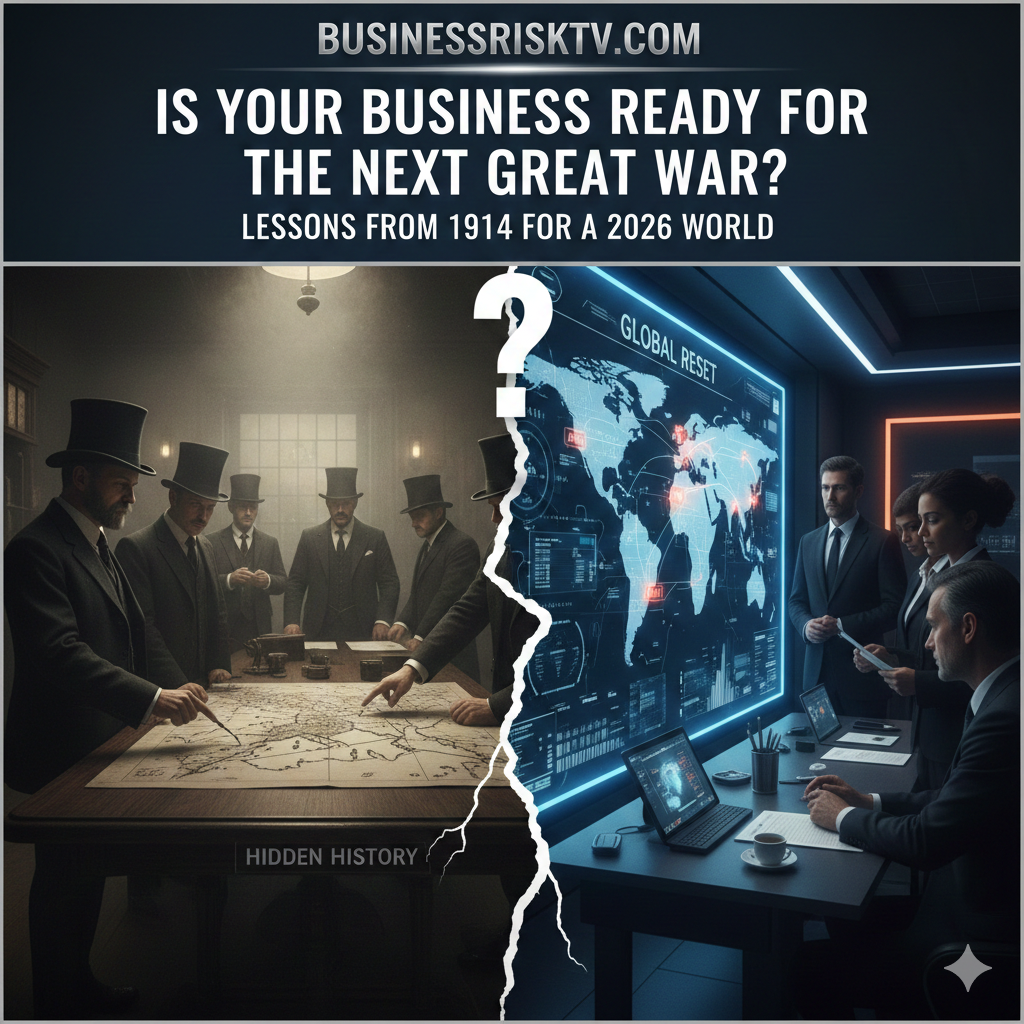
Hidden History & Business Risk: Is Your Strategy Prepared for a 1914-Style Global Reset?

Is history repeating itself? Our deep-dive analysis of Hidden History: The Secret Origins of the First World War by Docherty and Macgregor reveals the hidden geopolitical risks facing modern corporations. Learn how “Secret Elite” agendas and systemic collusion can trigger global market collapses, and discover six critical reasons why today’s business leaders must shift from reactive to proactive resilience. Don’t let your supply chain be the next casualty of a “Black Swan” event—prepare your business for the next Great Reset.

In Hidden History: The Secret Origins of the First World War, Gerry Docherty and Jim Macgregor argue that WWI wasn’t a series of diplomatic blunders, but a calculated destruction of Germany orchestrated by a secret “Elite” in London.

From a Business Risk Management (BRM) perspective, this narrative serves as a masterclass in identifying “Black Swan” events that are actually “Grey Rhinos”—highly probable, high-impact threats that are often ignored until it’s too late.


Business Risk Analysis: The “Hidden History” Lens

If we treat the geopolitical landscape of 1914 as a market, the book highlights several critical risk categories:

  • Systemic Corruption & Collusion: The authors suggest that a small group (the “Secret Elite”) manipulated national policy for long-term strategic gain. For a business, this represents Counterparty Risk—the danger that the “rules of the game” are being written by competitors or regulators behind closed doors.

  • Information Asymmetry: The book claims the public was fed a narrative of “Belgian neutrality” to mask deeper agendas. In business, relying on mainstream data or “consensus” can lead to a failure in Strategic Forecasting.

  • Geopolitical Contagion: The transition from a localised Balkan conflict to a global catastrophe illustrates how quickly Supply Chain Disruption and Market Volatility can scale when hidden alliances are triggered.


6 Reasons Why History Could Repeat Itself Soon

Current global dynamics mirror the pre-1914 era in several unsettling ways:

  1. Thucydides’ Trap: Just as the British Empire feared a rising Germany, the current tension between the U.S. and China creates a structural risk where a dominant power feels forced to suppress a challenger.

  2. Echo Chambers & Propaganda: The “Secret Elite” used the press to whip up anti-German sentiment. Today, AI-driven algorithms and social media echo chambers can radicalise populations and manufacture consent for conflict faster than ever.

  3. Complex Alliance Webs: Much like the secret treaties of 1914, modern mutual defence pacts and “informal” military partnerships mean a spark in a small region (like the South China Sea or Eastern Europe) could force a global decoupling.

  4. Resource Scarcity & Energy Shifts: The 1914 era was about the shift from coal to oil and control of the Berlin-Baghdad railway. Today, the race for rare earth minerals and semiconductor dominance creates similar “must-win” flashpoints.

  5. Economic Financialisation: The book argues high-finance interests drove the war. Today’s global economy is heavily leveraged; a massive debt crisis could tempt leaders to use “war footing” as a distraction or a way to reset the financial system.

  6. Technological Arrogance: In 1914, leaders believed the war would be “over by Christmas” due to superior tech. Today, the belief that Cyber Warfare or Precision Strikes will lead to “short, clean” conflicts often ignores the reality of unpredictable escalation.


How Business Leaders Can Protect Their Interests

To avoid being collateral damage in a “Hidden History” style escalation, leaders should move from reactive to proactive resilience:

The Lesson: History suggests that the greatest risks aren’t the ones we see on the news, but the ones being discussed in private rooms by those who benefit from the chaos.

Executive Scenario Planning Template Example

Focus: Geopolitical Resilience & Strategic Redundancy

This template is designed to help executive teams move past “business as usual” and confront the non-linear risks highlighted by Docherty and Macgregor. It focuses on the “Hidden History” premise: that the biggest threats are often pre-planned or systemic, rather than accidental.

1. The “Hidden Ally” Audit

In 1914, secret agreements forced nations into a war they hadn’t publicly debated. Businesses often have similar “hidden” dependencies.

  • Mapping Dependencies: List your Top 5 critical vendors. Do they share a single point of failure (e.g., all rely on the same shipping lane, the same energy grid, or the same political regime)?

  • The “What If” Trigger: If Country X imposes an immediate export ban on a key component tomorrow, how many days can your operations survive?

  • Action: Identify one “Non-Aligned” alternative supplier for every critical dependency.

2. Narrative & Information Risk Analysis

The “Secret Elite” used media to shape public perception. In a modern crisis, your brand could be caught in the crossfire of state-sponsored disinformation.

3. Scenario Matrix: Four Degrees of Disruption

Use this table to evaluate your readiness for different levels of escalation:

Disruption Level Scenario Example Business Impact Mitigation Priority
Level 1: Friction Increased tariffs / Trade war Margin compression Pricing agility & tax optimization
Level 2: Segregation Sanctions / Regional internet split Loss of specific market access Ring-fencing regional assets
Level 3: Hard Decoupling Complete trade embargoes Supply chain collapse Localization of manufacturing
Level 4: Kinetic Conflict Global War / Infrastructure hit Total operational halt Physical security & cash liquidity

4. Financial “War Chest” Strategy

The book argues that those with liquid assets and prior knowledge thrived during the transition to war.

  • Liquidity Stress Test: In a scenario where credit markets freeze (similar to 1914 or 2008), do you have enough non-digital or highly liquid reserves to cover 6 months of payroll?

  • Currency Diversification: Are your cash reserves held in a single currency? Consider a “Geopolitical Basket” (e.g., USD, CHF, Gold, or decentralised assets) to hedge against a systemic collapse of one fiat system.


Next Steps for the Leadership Team:

  1. Assign a “Red Team”: Appoint three team members to play “Devil’s Advocate” for every major strategic expansion. Their job is to find the “Hidden History” reason why the expansion will fail.

  2. Quarterly Geopolitical Brief: Move beyond standard economic reports. Look at defence spending trends and undersea cable/satellite investments to see where the “Secret Elites” of today are placing their bets.

To keep this lean and focused, here is a “Red Team” questionnaire designed to puncture optimism bias and reveal the hidden systemic risks in your 5-year plan.

These questions are framed to uncover the “Secret Elite” style risks—those factors that aren’t on a standard balance sheet but can sink a company during a geopolitical shift.

Phase 1: The Dependency & “Invisible Hand” Test

  • The Single-Point-of-Failure Audit: If a “black swan” event permanently closed the borders of your primary manufacturing or service hub tomorrow, does the business have a “Plan B” that doesn’t rely on that same geographic region?

  • The Shadow Influence Check: Are our key strategic partners or investors also heavily invested in our direct competitors or in nations with conflicting interests? Who benefits if our current 5-year plan fails?

  • The Subsidy/Regulation Trap: Is our projected growth dependent on current government subsidies or “friendly” regulations? If a political shift occurred and those were stripped away to fund a “war footing” economy, is the project still viable?

Phase 2: Information & Infrastructure Resilience

  • The Narrative Pivot: If our brand becomes politically “toxic” in a major market due to circumstances entirely outside our control (e.g., a national conflict), can we “ring-fence” that region and continue operating elsewhere, or is our identity too centralised?

  • The Analog Fail-Safe: If a sophisticated cyber-offensive took down the primary cloud service providers we use for 30 days, do we have any “manual” or localised way to fulfill orders or maintain core operations?

  • The “Secret” Intelligence Gap: Are we making decisions based on “consensus data” (mainstream media/economic reports) that everyone else sees, or do we have “boots on the ground” insights into the physical movement of goods and local political sentiment?

Phase 3: Financial & Strategic Exit Ramps

  • The Liquidity Lock: If the global banking system experienced a “bank holiday” or a freeze on international transfers (similar to the start of WWI), do we have the local currency or physical assets to keep our global staff paid for 90 days?

  • The Sunk Cost Trap: At what specific “tripwire” (e.g., a specific sanction or a specific percentage of inflation) do we agree to abandon a major project rather than “doubling down” out of pride or previous investment?

  • The Leadership Vacuum: If our executive team were unable to communicate for 72 hours due to a total communications blackout, does the next layer of management have the clear authority and “commander’s intent” to make high-stakes decisions?


How to use this:

Distribute these questions to your leadership team. Have each member answer them anonymously first. You will often find that your “boots on the ground” staff (Ops, Supply Chain) see the “Hidden History” risks much more clearly than the C-suite.

#BusinessRisk #GeopoliticalRisk #HiddenHistoryWW1 #BusinessRiskTV #RiskManagement

Get help to protect and grow your business faster through any business environment you have to operate within

Learn more about growing your business through uncertain world

Subscribe for free business risk management ideas risk reviews and cost reduction tips

Connect with us for free business risk management tips

Read more business risk management articles and view videos for free

Connect with us for free alerts to new business risk management articles and videos 

Hidden History & Business Risk: Is Your Strategy Prepared for a 1914-Style Global Reset?