Ukraine War Risk Analysis: The Monroe Doctrine in Europe and the Path to WW3

This risk analysis decodes the Ukraine conflict through the lens of the Monroe Doctrine, arguing Russia views NATO expansion and “defensive” missiles in Eastern Europe as an existential threat akin to the Cuban Missile Crisis. We assess the tangible pathways for escalation to a wider war and the critical need for strategic de-escalation to manage this global business risk.

Business Risk Management Analysis: The Ukrainian Conflict and Escalation to a Wider War

This analysis assesses the high-level strategic risks in the Ukraine conflict, framing them through historical parallels, core security doctrines, and the potential for catastrophic escalation. The central thesis is that the deployment of advanced Western missile systems near Russia’s borders is perceived by Moscow as a direct, existential threat akin to the 1962 Cuban Missile Crisis, creating a volatile environment where miscalculation could lead to a third world war.

1. The Core Threat: “Decapitating” Missiles and the Russian Perception

From a risk management perspective, the primary threat driver is not the conventional war in Ukraine itself, but the strategic weapons systems being deployed around Russia’s periphery.

  • The Nature of the Threat: Systems like the Aegis Ashore sites in Poland and Romania, while officially labelled as defencive “missile shields,” are perceived by Russia as possessing offensive potential. The launchers used for SM-3 interceptor missiles are functionally similar to those used for land-attack cruise missiles. This ambiguity allows Russia to frame them as a “decapitating” strike threat—a first-strike weapon capable of neutralising Russia’s nuclear command-and-control and retaliatory capabilities, thereby crippling its ultimate deterrent.
  • The Historical Parallel: The Cuban Missile Crisis: This is not a superficial comparison in Moscow’s view. In 1962, the United States considered the deployment of Soviet nuclear missiles in Cuba—a small, neighbouring country—an intolerable, existential threat and was prepared to go to war to have them removed. Russia applies the same logic in reverse. It views NATO’s eastward expansion and the placement of advanced missile systems in its former sphere of influence as a modern-day equivalent of the Cuban Missile Crisis. The potential future deployment of such systems to a country like Venezuela would only reinforce this narrative and mirror the 1962 scenario exactly.

2. The Doctrinal Framework: The “Monroe Principle” Applied to Ukraine

The driving geopolitical principle behind Russia’s actions is a mirror of the American Monroe Doctrine.

  • The Original Doctrine: The U.S. Monroe Doctrine (1823) declared the Western Hemisphere its sphere of influence, deeming it off-limits to further European colonisation or political interference.
  • The Russian Interpretation: Russia has effectively declared a similar doctrine for its “near abroad,” particularly Ukraine. From the Kremlin’s perspective, a neutral or buffer Ukraine is a fundamental security requirement. A Ukraine integrated into NATO—a military alliance historically opposed to Russia—is as unacceptable to Moscow as a Mexico or Canada in a military alliance with China or Russia would be to Washington. This principle explains the intensity of Russia’s response; it is fighting what it sees as a defensive war to prevent a hostile power from consolidating on its doorstep.

3. The Ultimate Risk: Escalation to a Third World War

The convergence of the missile threat and the Monroe-style doctrine creates a high-probability, high-impact risk scenario for a wider conflict. The pathways to escalation are multiple:

  • Direct Engagement: An accidental or intentional strike on NATO territory (e.g., in Poland or Romania) by a Russian missile, or vice-versa, could trigger NATO’s Article 5 collective defense clause, leading directly to a Russia-NATO war.
  • Hybrid Warfare Blowback: Acts of sabotage attributed to Russia (e.g., against undersea infrastructure) or provocative actions like the repeated violations of NATO airspace could spiral out of control. A single miscalculation in this “gray zone” could be misread as an act of war, demanding a conventional military response.
  • Inadvertent Escalation: The fog of war creates immense risk. An errant missile, the misidentification of an aircraft, or a miscommunication during a high-alert period could trigger a cycle of retaliation that neither side initially intended.

4. Analysis of the “Forever War” Driver Claim

The assertion that intelligence services like MI6 (UK), BND (Germany), and DGSE (France) are deliberately driving a “forever war” is a significant claim. A risk analysis must distinguish between stated policy and verifiable evidence.

  • The Official Policy Stance: The publicly stated goal of the UK, France, and Germany is to support Ukraine’s sovereignty and prevent a Russian victory that would undermine European security and the international order. Their actions—providing weapons, intelligence, and training—are consistent with this stated goal of enabling Ukraine to defend itself.
  • The “Forever War” Narrative: The claim that these agencies are actively sabotaging peace to prolong the conflict is primarily propagated by the Russian government and commentators who align with that viewpoint. While individual politicians or analysts in the West may argue that prolonged conflict serves to weaken Russia strategically, there is a lack of publicly available, verified intelligence or official documentation proving a coordinated policy by MI6, BND, and the DGSE to deliberately instigate a “forever war.” From a risk management standpoint, this narrative remains an unverified, high-severity contingent liability rather than a confirmed fact upon which to base a strategic assessment. The driving objective of Western powers appears to be achieving a favorable outcome for Ukraine, not perpetuating a war for its own sake, though the effect of their support is indeed a prolonged conflict.

Conclusion and Risk Mitigation

The highest-priority risk is the potential for direct conflict between Russia and NATO. To defuse the situation, risk mitigation must address the core perceived threats:

  1. Strategic Arms Control: A renewed and urgent dialogue on strategic stability and missile defense is critical. Clarifying the capabilities and intent of systems in Eastern Europe, potentially with verification measures, could reduce the “decapitation strike” fear that drives Russian escalation.
  2. Addressing the Sphere of Influence: While morally problematic, any durable settlement will likely need to implicitly acknowledge Russia’s Monroe-style security concerns regarding Ukraine’s alliance status, finding a formula for Ukrainian security that does not involve NATO membership.
  3. De-escalation Channels: Maintaining and strengthening direct military-to-military communication lines between Russia and NATO is essential to manage incidents and prevent inadvertent escalation.

Failure to manage these core risks creates a business environment for the world where the threat of a great power conflict remains unacceptably high.

Here are 6 actionable risk management steps business leaders should take today to protect their operations from the geopolitical risks outlined in the analysis.

Global Business Risk Network: Connect, Learn, and Lead in Risk Management

6 Risk Management Steps for Business Leaders

1. Formalise Geopolitical Risk Monitoring

  • Action: Move beyond ad-hoc news reading. Establish a formal process, assigning a team or using a dedicated service to monitor geopolitical intelligence with a specific focus on:
    • NATO-Russia rhetoric and military posturing.
    • Incidents in border regions of Poland, Romania, and the Baltic states.
    • Developments in potential flashpoints like Kaliningrad or the Black Sea.
  • Rationale: Early warning of escalating tensions provides crucial lead time to activate contingency plans before markets or supply chains are paralysed.

2. Stress-Test Supply Chains for “Choke Point” Failure

  • Action: Identify single points of failure, especially those dependent on routes or regions exposed to the conflict zone (e.g., air corridors over Eastern Europe, key ports on the Black Sea, rail lines through Poland). Model scenarios involving the closure of these channels and pre-qualify alternative suppliers and logistics routes.
  • Rationale: A direct NATO-Russia incident would immediately disrupt transport and logistics across Eastern Europe, severing critical arteries for business.

3. Develop a Tiered “Escalation” Response Plan

  • Action: Create a dynamic response plan with clear triggers for different levels of escalation, not just a binary “crisis/no-crisis” switch. For example:
    • Level 1 (Heightened Tension): Review and communicate travel security protocols.
    • Level 2 (Direct Incident): Activate remote work mandates for staff in affected regions, freeze new investments.
    • Level 3 (Open Conflict): Execute evacuation plans, implement full business continuity protocols.
  • Rationale: A phased approach prevents panic and ensures a measured, appropriate response as a situation deteriorates.

4. Fortify Cybersecurity Posture Immediately

  • Action: Assume that a wider geopolitical conflict will involve significant cyber warfare. Mandate multi-factor authentication across all systems, ensure backups are air-gapped and immutable, and conduct fresh table-top exercises for scenarios like ransomware attacks on critical infrastructure or wiper malware targeting corporate networks.
  • Rationale: Businesses are considered legitimate targets in state-level cyber conflicts. Proactive defence is no longer optional.

5. Model Financial Shock Scenarios

  • Action: Work with finance to model the impact of a sudden energy price spike, a freeze in capital markets, rapid currency devaluation, or the collapse of trade with a broader set of countries. Stress-test liquidity and credit lines under these conditions.
  • Rationale: The financial contagion from a great-power conflict would be immediate and severe, potentially locking companies out of vital capital.

6. Conduct a Critical Talent and Operations Review

  • Action: Audit your workforce and key operations to identify critical dependencies on personnel, facilities, or partners located in NATO member states bordering Russia and Ukraine. Develop plans for remote work, relocation, or knowledge transfer to mitigate the risk of these assets becoming inaccessible or unsafe.
  • Rationale: Protecting human capital is the first priority. Furthermore, the loss of a key team or facility in a frontline state could cripple business units.

Get help to protect and grow your business faster with less uncertainty impacting on your business objectives

Find out more about growing your business faster with less uncertainty via better risk management information 

Subscribe for free business risk management ideas risk reviews and cost reduction ideas

Connect with us for free business risk management tips

Contact Us To Subscribe BusinessRiskTV – Reach Global Decision Makers

Read more business risk management articles and view videos

Connect with us for free new business risk management articles and videos alerts

The West’s Ukraine Strategy: A Catastrophic Policy Failure & The Business Cost

Ukraine War Risk Analysis: The Monroe Doctrine in Europe and the Path to WW3

Geoengineering Business Risk Management: Why Congress Is Investigating and 6 Tips to Protect Your Company

Weather modification and geoengineering are no longer science fiction—they are emerging enterprise risks. With U.S. Congressional investigations and state-level bans on the rise, business leaders must act now. Discover the 6 essential risk management tips to protect your global operations from this new frontier of threats.

Is your business prepared for the risks of climate engineering? 🌍 Our latest article breaks down why the U.S. Congress is investigating and provides 6 actionable risk management tips you need to adopt now.

#Geoengineering #BusinessRisk #RiskManagement

While research into climate-altering technologies is advancing, the evolving legal landscape and potential for unintended consequences mean business leaders can no longer afford to treat geoengineering as a distant speculation. It is a developing enterprise risk that demands immediate attention.

What Are Weather Modification and Geoengineering?

These terms refer to deliberate, large-scale interventions in Earth’s systems:

  • Weather Modification aims for short-term, local changes to weather patterns. The most common technique is cloud seeding, which involves dispersing substances like silver iodide into clouds to enhance precipitation or snowpack . It is practiced in several U.S. states, primarily to combat drought. Geoengineering (or climate intervention) seeks to counteract climate change on a regional or global scale. The two main approaches are:
    • Solar Radiation Management (SRM): Techniques like stratospheric aerosol injection, which aims to cool the planet by reflecting sunlight away from Earth, similar to the effect of a large volcanic eruption .
    • Carbon Dioxide Removal (CDR): Methods that extract CO₂ from the atmosphere or ocean .

A key distinction is that weather modification is intended for local, short-term effects, while geoengineering is designed for larger, longer-lasting impacts .

The Shifting Regulatory and Oversight Landscape

The governance of these technologies is in flux, moving from scientific debate into the political and legal arena, which directly impacts business risk.

  • Growing Political Scrutiny: The U.S. Congress is showing increased interest. A subcommittee in the House of Representatives has held hearings demanding transparency on government weather and climate engineering activities . This political focus highlights the issue’s rising profile and the potential for future regulations.
  • Emerging State-Level Bans: In the absence of comprehensive federal law, states are taking action. Florida recently passed a law prohibiting the intentional release of substances to alter weather, temperature, or sunlight, making it a felony . Similar bills have been introduced in states like Texas, Pennsylvania, and North Carolina . This creates a complex patchwork of regulations for companies operating across state lines.
  • Lack of International Framework: There is no binding international treaty governing solar geoengineering research or deployment . This legal vacuum creates uncertainty for global businesses and raises the risk of international disputes if one country’s actions are perceived to cause harm in another .

Why This Matters for Global Businesses

For business leaders, this is not a theoretical environmental issue but a tangible source of strategic risk.

  • New Physical and Operational Risks: Geoengineering could create novel and unpredictable climate conditions. A company’s risk management must now consider scenarios like “termination shock”—a rapid and dangerous temperature increase if a sustained solar geoengineering program were to suddenly stop . This could threaten supply chains, agricultural production, and infrastructure in ways that existing climate models do not capture.
  • Perception and Geopolitical Risks: Even the perception of geoengineering can be destabilizing. In a world of geopolitical competition, a natural disaster could be wrongly or rightly attributed to a rival’s weather modification program, leading to political tensions that disrupt global trade and markets . Businesses could be caught in the crossfire of such disputes.
  • Legal and Reputational Exposure: As seen with the state-level bans, companies involved in or perceived to be supporting these technologies could face legal liability, hefty fines, and reputational damage . The lack of a clear regulatory framework makes it difficult to assess and mitigate these risks.

Risk Management Tips for Business Leaders

Enterprises should take proactive, low-regret actions now to build resilience against these emerging threats .

  1. Integrate Climate Intervention into Enterprise Risk Management (ERM): ERM teams should formally assess how geoengineering could impact the organization. This involves interviewing key stakeholders to evaluate visibility (awareness of risks), agility (ability to adapt plans), and resilience (capacity to recover from disruptions).
  2. Develop Specific Key Risk Indicators (KRIs): Move beyond general climate metrics. Create KRIs that directly tie to geoengineering and extreme weather, such as the value of assets in regions proposing geoengineering bans or the percentage of supply chain partners located in high-risk weather modification zones.
  3. Model Multiple Financial Scenarios: Use climate-risk financial modeling tools to estimate the potential financial impact of both the physical effects of geoengineering and the transition risks from new regulations. These calculations help quantify the value at risk.
  4. Strengthen Supply Chain Redundancy and Diversification: Geoengineering could alter regional weather patterns, benefiting some areas and harming others. Diversify suppliers and logistics routes to avoid over-concentration in any single geographic region that might be disproportionately affected.
  5. Invest in Data Gathering and Digital Resilience: The ability to monitor and model these new risks depends on data. Invest in cloud-based risk management software to process complex climate and regulatory data streams. Ensure digital operations are resilient to adapt quickly to new information.
  6. Conduct a Regulatory Horizon Scan: Proactively monitor the evolving regulatory landscape at state, federal, and international levels. This is crucial for anticipating new compliance requirements and avoiding costly legal surprises .

The decisions made by governments and scientists about geoengineering will have profound implications for the stability of the global climate and, by extension, the global economy . By understanding these technologies and implementing a robust risk management strategy now, business leaders can protect their assets and build a more resilient enterprise for an uncertain future.

Get help to protect and grow your business faster with less uncertainty

Find out more about growing your business faster with BusinessRiskTV 

Subscribe for free business risk management ideas risk reviews and cost reduction ideas

Connect with us for free business risk management tips

Read more free business risk management articles and view videos

Connect with us for free alerts to new business risk management news reviews and tips

Geoengineering Business Risk Management: Why Congress Is Investigating and 6 Tips to Protect Your Company

Bank of England Repo Record: A Red Flag for the UK Economy? | Business Risk TV

The Bank of England’s recent record £87.15 billion repo allotment, a tool used to provide liquidity to banks as the central bank reduces its bond holdings, could signal underlying stress in the UK banking sector. This growing reliance on the central bank for funds raises a red flag for the financial stability and economic safety of the UK. Discover what this means for the wider economy and learn six crucial risk management strategies every business leader should implement now to protect and grow their enterprise more resiliently in an uncertain economic climate.

Bank of England Allots Record £87.15 Billion in Repo Operation: What It Means for UK Business Risk

The Bank of England’s Record Repo Allotment: A Warning for UK Business? 🚨

The Bank of England recently allotted a record £87.15 billion in a short-term repo operation, a move that provides a substantial injection of liquidity into the UK’s banking system. While this may seem like a routine technical adjustment by the central bank, the increasing reliance on these operations could be a significant red flag for the safety of the UK’s financial system and wider economy.


What Is a Repo Operation and Why Is This a Red Flag?

A repo (repurchase agreement) is essentially a short-term loan. The Bank of England lends money to commercial banks and in return, the banks provide high-quality assets (like government bonds) as collateral. The Bank’s increasing use of this tool is directly linked to its Quantitative Tightening (QT) programme, which involves selling off the government bonds it bought during the era of Quantitative Easing (QE). The purpose of these repo operations is to prevent a potential liquidity squeeze in the financial system as the central bank reduces its balance sheet.

The record allotment is a red flag for a few key reasons:

  • Growing Illiquidity: The fact that banks are demanding a record amount of funds from the central bank suggests they may be struggling to find liquidity elsewhere in the market. This could indicate underlying stress in the banking sector and a reluctance among banks to lend to each other.
  • Systemic Risk: This reliance on the Bank of England for funding could be a sign of increased systemic risk. If a major bank were to face a sudden liquidity crisis, the central bank would be its lender of last resort. The increasing size of these operations shows the potential scale of that reliance.
  • Uncertainty and Instability: A record-breaking allotment, particularly one that exceeds a recent record, creates a narrative of growing instability. This can erode confidence in the banking system and the wider economy, making businesses and investors more hesitant to spend and invest. This uncertainty trickles down to businesses and consumers, affecting everything from investment decisions to household spending.

6 Risk Management Measures for Businesses

In an environment of economic uncertainty, business leaders must be proactive to protect their organisations. Here are six essential risk management measures to enhance resilience:

  1. Strengthen Cash Flow and Liquidity: Cash is king, especially in a downturn. Focus on optimising your working capital by accelerating accounts receivable, negotiating longer payment terms with suppliers, and maintaining a healthy cash reserve. Create detailed cash flow forecasts to anticipate potential shortfalls and manage expenses.
  2. Diversify Revenue Streams and Supply Chains: Over-reliance on a single product, service, customer, or supplier is a major vulnerability. Actively seek new markets, customer segments, and partnerships. For your supply chain, identify alternative vendors and consider strategies like near-shoring or holding a small buffer of critical inventory to mitigate potential disruptions.
  3. Conduct Scenario Planning and Stress Testing: Don’t wait for a crisis to hit. Create multiple worst-case, best-case, and most-likely scenarios for your business. For each scenario, outline the potential impact on revenue, costs, and profit. This will help you identify weak points and develop contingency plans in advance.
  4. Manage Debt and Capital Expenditure Wisely: During uncertain times, it is crucial to avoid taking on excessive debt. Evaluate all major capital expenditure projects. Postpone or cancel non-essential investments that don’t directly contribute to immediate revenue or operational efficiency.
  5. Review and Optimise Operational Costs: Take a hard look at all business expenses. Eliminate unnecessary costs without sacrificing the quality of your product or service. This could involve renegotiating contracts, leveraging technology for greater efficiency, or consolidating services. The goal is to create a leaner, more resilient cost structure.
  6. Prioritise Customer and Employee Retention: In a tough economic climate, your most valuable assets are your loyal customers and skilled employees. Focus on providing exceptional customer service to retain your existing client base. For employees, transparent communication and a supportive work environment can boost morale and productivity, reducing the risk of losing key talent.

#UKBusinessRisk #BoE #RepoOperation #BusinessRiskTV #RiskManagement

Get help to protect and grow your business resiliently with BusinessRiskTV

Find out more about business protection and growth in UK

Subscribe for free business risk management ideas reviews and cost reduction tips

Connect with us for free business risk management tips

Why the Bank of England’s Record Repo Allotment Is a Red Flag

The Bank of England’s record-breaking repo allotment is a significant red flag because it points to potential underlying stress and growing liquidity issues within the UK banking system. While repo operations are a standard tool for central banks to manage monetary policy, the increasing size of these allotments, especially in the context of the central bank’s quantitative tightening (QT) programme, reveals a deeper problem.

  • Growing Illiquidity and Inter-bank Distrust: The primary role of a central bank’s repo operation is to provide liquidity. A record amount being requested by commercial banks suggests they are struggling to secure the funds they need from each other. In a healthy banking system, banks would lend to one another in the inter-bank market. The fact that they are turning to the Bank of England in such high volumes could indicate a breakdown of trust between financial institutions, which is a classic symptom of a stressed system.
  • Systemic Risk: The increasing reliance on the central bank for funding raises concerns about systemic risk. Systemic risk is the risk of a collapse of an entire financial system due to the failure of one or more institutions. If a significant portion of the banking sector is dependent on the Bank of England for liquidity, a sudden shock or disruption could have a cascading effect across the entire system. This over-reliance makes the financial system less resilient and more vulnerable to unforeseen events.
  • Uncertainty and Economic Instability: A record repo allotment creates a sense of uncertainty and instability in the market. The public and investors may interpret this as a signal that the banking system is not as robust as it appears. This loss of confidence can have a tangible impact on the wider economy. It can lead to a tightening of lending standards, making it harder for businesses and households to access credit, and it can also deter investment, ultimately slowing down economic growth. The large allotment, therefore, isn’t just a technical exercise; it’s a barometer of growing financial vulnerability in the UK.

Read more free business risk management articles and view videos

Connect with us for free business risk management analysis alerts

6 Essential Business Risk Management Measures for UK Business Leaders

In today’s complex and uncertain economic environment, proactive business risk management is no longer an option—it’s a necessity. UK business leaders must move beyond a reactive approach and build genuine resilience into the core of their operations. Here are six essential measures to take action on now.

1. Strengthen Cash Flow and Liquidity

Cash is the lifeblood of any business. In times of economic instability, a strong cash position can be the difference between survival and failure.

  • Optimise working capital: Focus on accelerating accounts receivable by offering incentives for early payment or enforcing stricter payment terms. At the same time, negotiate more favourable payment terms with your suppliers to extend your accounts payable.
  • Create robust cash flow forecasts: Use financial modelling and scenario planning to predict potential cash shortfalls. This will help you anticipate problems and give you time to secure financing or make cost adjustments before a crisis hits.
  • Maintain a cash reserve: Aim to build a buffer of cash sufficient to cover at least three to six months of operating expenses. This reserve acts as a critical safety net against unexpected disruptions.

2. Diversify Revenue Streams and Supply Chains

Over-reliance on a single customer, product, or supplier is a major vulnerability. Diversification builds a more robust and flexible business model.

3. Conduct Scenario Planning and Stress Testing

Don’t wait for a crisis to expose your weaknesses. Proactive scenario planning allows you to test your business model against a range of potential threats.

4. Manage Debt and Capital Expenditure Wisely

High levels of debt can become a significant burden in a tightening credit environment.

  • Limit new borrowing: Be cautious about taking on new debt, particularly for non-essential projects. Evaluate every borrowing decision based on its potential return on investment and its impact on your balance sheet.
  • Re-evaluate capital projects: Postpone or cancel major capital expenditures that are not critical for business operations or do not have a clear and immediate path to profitability. Prioritize investments that enhance operational efficiency and resilience.

5. Review and OPTIMISE Operational Costs

A lean and efficient cost structure improves profitability and allows you to better weather economic storms.

6. Build a Strong Risk Culture

Risk management is not just the responsibility of a single department; it should be a shared mindset across the entire organisation.

Bank Of England Repo Red Flag UK Economy Business Risk Management

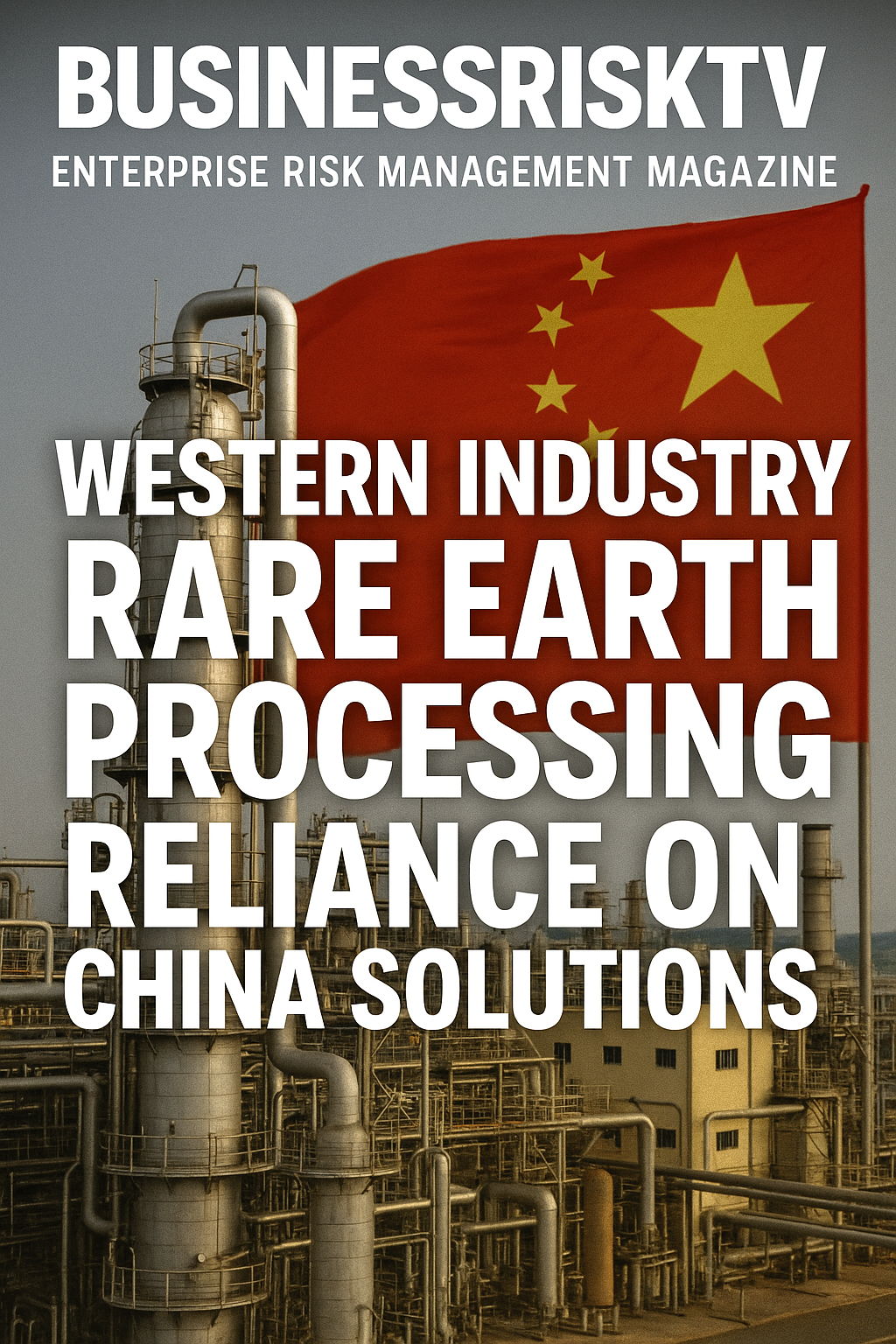
Western industry rare earth processing reliance on China solutions

How does China’s near-monopoly on rare earth processing threaten your business and wallet? Discover the hidden costs for Western manufacturing, from EVs to smartphones, and learn urgent risk management strategies for industry leaders and consumers alike.

The Raw Nerve: Why China’s Grip on Rare Earths Threatens Western Prosperity

Western industry’s 90% reliance on China for rare earth processing is a catastrophic vulnerability. This article unmasks the threat to car manufacturing, consumer goods, and our very future, offering actionable strategies for business leaders to reclaim control and protect profitability.

“If China ever decided to turn off the tap, the lights would go out in boardrooms across the West. We’re not just talking about iPhones and Tesla, we’re talking about the very bedrock of our industrial future. This isn’t a theoretical exercise; it’s a present and growing danger. And frankly, we’ve been utterly complacent.” That’s the stark reality, isn’t it? For too long, Western business leaders have operated under the illusion of an open global market, blissful in their pursuit of short-term cost efficiencies. But what if that efficiency comes at the price of existential vulnerability? The sheer scale of China’s dominance in rare earth mineral processing isn’t just a challenge; it’s an economic weapon poised at our collective throat. This isn’t some abstract geopolitical squabble. This directly impacts your company’s bottom line, your nation’s security, and every consumer’s daily life. It’s time we faced the uncomfortable truth: our industrial future, indeed our very technological sovereignty, is hanging by a thread, and that thread leads directly to Beijing. This isn’t about protectionism; it’s about survival.

The Uncomfortable Truth: China’s Rare Earth Monopoly and Its Perilous Implications

Let’s not mince words. China doesn’t just have a significant share of rare earth mineral processing; it holds a near-monopoly, a stranglehold that few outside the industry truly comprehend. Reports indicate that China controls approximately 90% of the world’s rare earth processing capacity. Let that sink in. Ninety percent. While China may account for around 69% of global rare earth production from its mines, the critical bottleneck, the true leverage point, lies in its unparalleled ability to process these raw materials into usable forms. This isn’t just about digging rocks out of the ground; it’s about the complex, environmentally intensive, and technically demanding process of separation, refining, and alloy production. For decades, Western nations, driven by lower labour costs and less stringent environmental regulations in China, offshored these vital but dirty processes. We outsourced our dirty laundry, and in doing so, we handed over the keys to our industrial kingdom.

This overwhelming dependency on China for rare earth processing presents a colossal problem for Western manufacturing, particularly for high-tech sectors and, critically, the automotive industry. Rare earth elements (REEs) are not, despite their name, inherently rare in the Earth’s crust. However, they are rarely found in concentrated, easily extractable deposits, and their extraction and processing are notoriously complex and environmentally damaging. But their unique magnetic, luminescent, and electrical properties make them indispensable.

Consider the automotive sector. The transition to electric vehicles (EVs) is predicated on the availability of powerful, efficient electric motors. Guess what powers those motors? Neodymium-iron-boron (NdFeB) permanent magnets, which contain critical rare earth elements like neodymium and praseodymium, often enhanced with dysprosium and terbium for high-temperature performance. Without these magnets, EVs become less efficient, heavier, and significantly more expensive. China produces nearly 90% of the world’s rare earth magnets. A sudden restriction or even a significant delay in the supply of processed rare earths from China could, quite literally, grind Western EV production to a halt. We’ve seen this play out in recent months: when China introduced new export restrictions in 2025, Western auto plants faced immediate bottlenecks, even production halts. The ripple effect isn’t confined to EVs; conventional vehicles still use rare earths in catalytic converters, alternators, and various sensors. Imagine the disruption: assembly lines idled, product launches delayed, and billions in revenue evaporated, all because of a single point of failure in our supply chain.

Beyond the automotive industry, the implications cascade across virtually every advanced manufacturing sector. Wind turbines, central to our renewable energy ambitions, rely heavily on rare earth magnets for their generators. Modern defense systems – from precision-guided missiles and fighter jets to radar systems and advanced sensors – are critically dependent on these materials. Consumer electronics like smartphones, laptops, and flat-screen displays incorporate multiple rare earth elements. Medical devices, industrial robotics, and even the catalysts used in petroleum refining all demand a steady, reliable supply of processed rare earths. If China decides to weaponise this dominance – as it has demonstrated a willingness to do in past trade disputes – Western industries will face unprecedented supply shocks, escalating costs, and a debilitating loss of competitive edge. This isn’t merely about higher prices; it’s about the fundamental ability to produce cutting-edge technology and maintain a viable industrial base.

The Consumer Conundrum: The Hidden Cost of Our Dependency

For Western consumers, the problem of rare earth processing dependency on China manifests in several tangible and uncomfortable ways. Firstly, and most immediately, expect higher prices. When the supply of critical components becomes constrained, manufacturers face increased costs for raw materials and processing. These costs, inevitably, are passed on to the consumer. That new electric vehicle you’ve been eyeing? Its price tag will likely climb. The latest smartphone? Expect it to be more expensive. This isn’t just a minor fluctuation; it’s a structural increase driven by geopolitical risk.

Secondly, prepare for reduced availability and choice. If manufacturing lines in the West cannot secure the necessary rare earth elements, product shortages will become commonplace. Waiting lists for popular EV models could stretch indefinitely. The newest, most innovative electronic gadgets might simply not reach store shelves in sufficient quantities. This translates into a frustrating consumer experience, where demand outstrips supply, and innovation is stifled not by a lack of ideas, but by a lack of fundamental materials.

Thirdly, and perhaps most insidiously, this dependency impacts the very pace of technological advancement and the green transition. Our ambitious climate goals, heavily reliant on renewable energy technologies like wind turbines and EVs, are vulnerable. If the materials needed to build these technologies are controlled by a single, potentially adversarial power, the transition to a sustainable future could be significantly delayed or derailed entirely. Consumers might find that access to cleaner energy and transport options is curtailed, not by a lack of desire or investment, but by a strategic bottleneck. We talk about energy independence, but what about mineral independence? Without it, our energy transition dreams remain just that: dreams.

Finally, there’s the less tangible but equally important aspect of national security and economic stability. When a nation’s core industries and defence capabilities are reliant on a foreign power for critical components, it introduces an inherent vulnerability. This can lead to compromises in design, limitations in military readiness, and a chilling effect on innovation as companies become wary of investing in products that could be suddenly cut off from their vital inputs. Consumers ultimately pay the price for this instability through higher taxes to fund strategic stockpiles, increased national debt, and a general erosion of economic resilience.

A Call to Action: Managing the Risk and Reclaiming Our Future

So, what should Western countries and their industries be doing about this precarious situation? Passivity is no longer an option; it is an act of economic self-sabotage. We need a multi-pronged, aggressive strategy that acknowledges the severity of the threat and prioritises long-term resilience over short-term cost savings. This is an enterprise risk management challenge of the highest order, and it demands decisive action from business leaders.

For Western Industries: A Blueprint for Resilience

  1. Diversify Sourcing – Immediately and Aggressively: This is non-negotiable. Companies must move beyond a “China-first” mentality. Identify and develop relationships with new mining and processing facilities in allied nations. Countries like Australia, Canada, the United States, and even parts of Africa and South America hold significant rare earth reserves. Invest in these operations! Don’t just wait for the market to deliver; actively participate in building these alternative supply chains. This means long-term purchase agreements, direct investments in promising ventures, and forming strategic alliances that span the entire value chain, from mine to magnet. Yes, it will be more expensive in the short term. But the cost of disruption, of industrial paralysis, far outweighs any perceived savings from relying solely on China. Business leaders must educate their boards and shareholders: security of supply is a competitive advantage, not an optional expense.
  2. Invest in Domestic Processing Capabilities: This is the elephant in the room. We extracted ourselves from the dirty work, and now we must embrace it again, but this time with a commitment to sustainable practices. Governments must provide incentives, certainly, but private industry cannot wait. Forge public-private partnerships. Build the refineries, the separation plants, the alloy production facilities on Western soil. Develop clean processing technologies that minimise environmental impact – this can be a new source of competitive advantage, a way to differentiate our supply chains. This won’t happen overnight; it requires significant capital expenditure and a long-term vision, but it is absolutely essential. We cannot be reliant on any single nation for the critical processing step.
  3. Drive Innovation in Substitution and Recycling: This is where engineering brilliance meets strategic imperative.
    • Substitution: Can we develop alternative materials or designs that reduce or eliminate the need for specific rare earth elements? BMW, for instance, has explored EV motor designs that use fewer or no rare earth magnets, albeit with some trade-offs in efficiency. Toyota has developed heat-resistant magnets with less neodymium and no terbium or dysprosium. This needs to become a widespread R&D priority. Fund your R&D teams to aggressively pursue rare-earth-free alternatives. Challenge them, empower them, and reward them for breakthroughs.
    • Recycling (“Urban Mining”): The vast quantities of rare earths already embedded in discarded electronics, EVs, and wind turbines represent a valuable, untapped resource. Invest in advanced recycling technologies that can efficiently and economically recover these elements from end-of-life products. Develop closed-loop systems within your manufacturing processes. This not only reduces reliance on virgin materials but also aligns with broader sustainability goals. Governments should incentivise collection and recycling infrastructure, but industries must lead the charge in developing the technical solutions.
  4. Strategic Stockpiling: While not a long-term solution, maintaining strategic reserves of critical rare earth elements and even finished magnets can provide a vital buffer against short-term supply disruptions. This is an insurance policy. It buys time for alternative supply chains to mature or for new technologies to come online. It’s a pragmatic recognition of current vulnerabilities. Work with national governments to ensure these stockpiles are sufficient and regularly rotated.
  5. Supply Chain Transparency and Visibility: You can’t manage what you can’t see. Companies must implement robust supply chain tracking systems that provide granular visibility into the origin and processing of rare earth components. Understand your exposure at every tier. Demand this information from your suppliers, and if they cannot provide it, find suppliers who can. This isn’t just about compliance; it’s about existential risk management.

For Western Consumers: Empowering Your Choices

Consumers might feel powerless in the face of such a colossal geopolitical challenge, but that’s simply not true. Your purchasing decisions and your voice carry significant weight.

  1. Demand Supply Chain Transparency: Ask brands where their materials come from. As a consumer, you have the right to know if your new EV, your smartphone, or even your home appliances are built with materials sourced from resilient, ethical, and diversified supply chains. Vote with your wallet. Support companies that are actively demonstrating a commitment to responsible sourcing and reducing their reliance on single-point-of-failure suppliers. Make it clear that you are willing to pay a fair price for products that contribute to a secure and sustainable future, not just a cheap one.
  2. Embrace Longevity and Repairability: The faster we consume and discard electronic devices, the greater the demand for new rare earth materials. Choose products designed for durability and repairability. Support the “right to repair” movement. By extending the lifespan of your devices, you are directly reducing the pressure on new rare earth mining and processing. This is a direct, actionable step you can take.
  3. Support Recycling Initiatives: Participate actively in electronic waste recycling programs. While the recycling infrastructure for rare earths is still developing, your participation helps build the critical mass needed for these systems to scale. Don’t let your old phone sit in a drawer; ensure it enters the recycling stream. Advocate for better recycling facilities in your local community.
  4. Educate Yourself and Others: Understand the issue. Talk about it. The more public awareness there is, the greater the pressure on businesses and governments to act decisively. This isn’t just an obscure industrial issue; it’s fundamental to our technological future and national security.

The era of cheap, easy access to critical materials, particularly rare earths, from a single dominant source is over. Western industries and consumers alike face a reckoning. We have outsourced our vulnerabilities, and now we must pay the price – either through proactive, strategic investment and difficult choices, or through economic stagnation and a chilling surrender of our technological future. The choice, for once, is clear. It’s time to act. It’s time to build a future where our prosperity is not dictated by the whims of a single foreign power, but by our own ingenuity, resilience, and strategic foresight.

Get help to protect and grow your business faster with BusinessRiskTV

Find out more about Business Risk Management Club here

Subscribe for free business risk management tips risk reviews and cost reduction opportunities

Connect with us for free business protection and business growth tips

Read more business risk management articles and view videos for free

Protect your company’s future: China’s rare earth processing dominance poses an unprecedented risk to Western manufacturing. This deep dive provides business leaders with vital insights and a roadmap for diversifying supply chains, investing in domestic capabilities, and securing profitability.

Connect with us for free business risk management news and risk reviews

The West’s dangerous rare earth dependency on China is a ticking time bomb for industry and consumers. This article offers blunt truths and essential strategies for business leaders to navigate this critical supply chain risk.

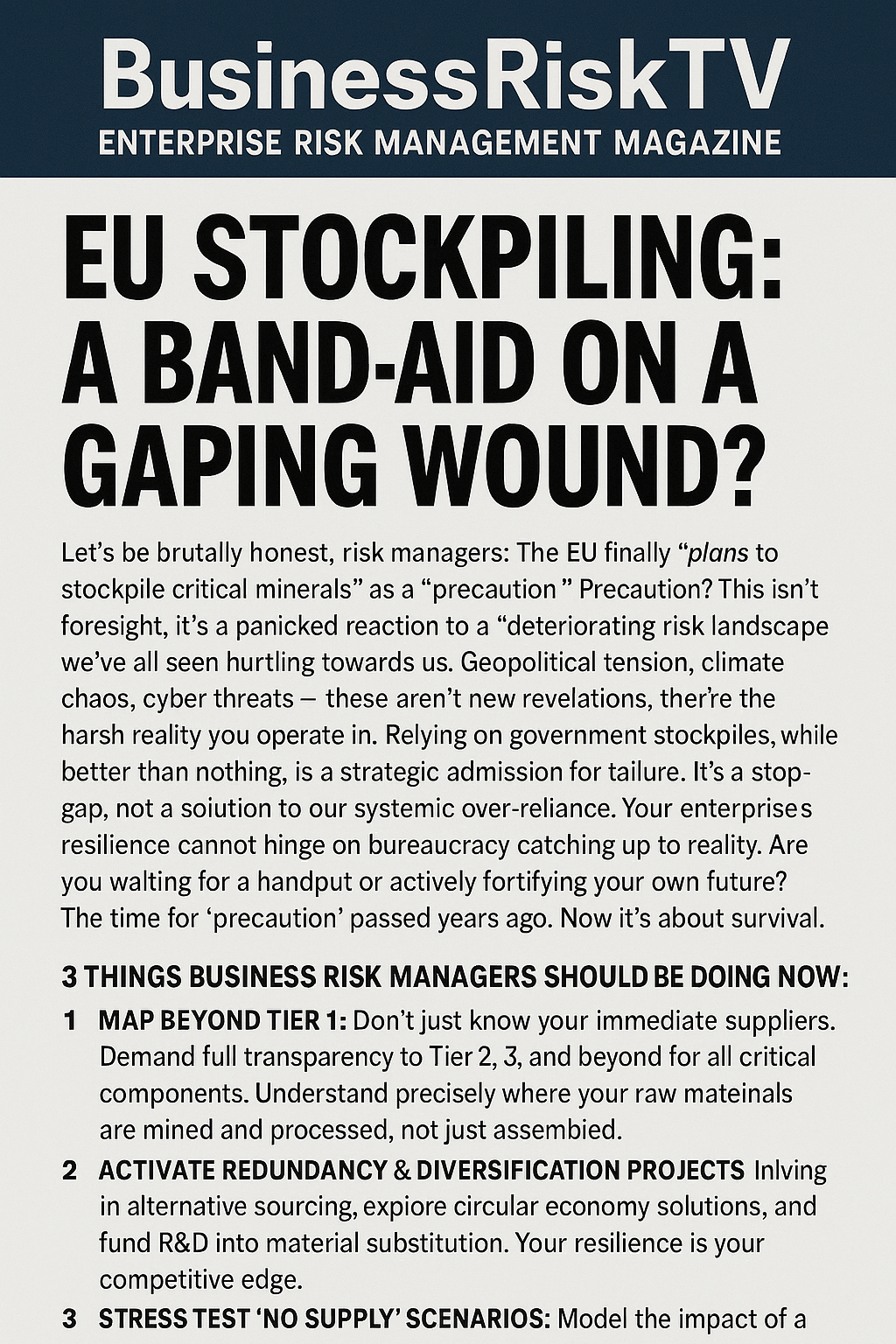
EU Stockpiling: A Band-Aid on a Gaping Wound?

Enterprise Risk Management Magazine articles and videos on business protection and business growth
EU Stockpiling: A Band-Aid on a Gaping Wound?

Read more:

  1. “Western industry rare earth processing reliance on China solutions”
  2. “Mitigating rare earth supply chain risk for EV manufacturers”
  3. “Consumer impact of China’s rare earth monopoly pricing”
  4. “Strategic investment rare earth recycling Western industrial strategy”
  5. “Diversifying critical mineral processing outside China business leaders

Relevant Hashtags:

  1. #RareEarthsCrisis
  2. #SupplyChainResilience
  3. #WesternIndustryFuture
  4. #CriticalMineralsStrategy
  5. #EVManufacturingRisk

Western industry rare earth processing reliance on China solutions

How Could Risk Management Online Help My Business?

Develop a new risk based strategy to enhance your business performance with BusinessRiskTV.com

Research the best business management solutions for your business. Develop an effective enterprise risk management ERM plan and strategy for greater business success. Integrate enterprise risk management principles and practices to grow your business faster with less uncertainty.

Subscribe to BusinessRiskTV for free enterprise risk management ERM alerts and bulletins

Is your business prepared for the next big risk? Join Risk Management Online and gain access to expert insights, networking opportunities, and exclusive resources to elevate your ERM. Build resilience, enhance decision-making, and protect your organisation. Join our community of risk professionals today! 

Connect with leading risk experts worldwide! Risk Management Online offers a vibrant community, exclusive content, and practical tools to improve your ERM. Share insights, learn from peers, and advance your career. Join us today! 

Don’t wait for a crisis! Proactive risk management is key. Join Risk Management Online now for expert insights, networking, and resources to strengthen your ERM. Build a more resilient future for your organisation.

Ready to take your ERM to the next level? Risk Management Online provides the tools and community you need. Access expert insights, network with peers, and stay ahead of emerging risks. Join today! #BusinessStrategy

Master risk. Build resilience. Join Risk Management Online. Expert insights, community connections, and practical tools for ERM success.

Join BusinessRiskTV for free today

#RiskManagement #EnterpriseRiskManagement #RiskExperts #RiskManagementOnline #ERM #BusinessGrowth #BusinessStrategy #BusinessResilience #BusinessContinuity

Risk Management Online 27000 plus members and counting

Risk Management Online has over 27000 members from around the world who are interested in business enterprise risk management solutions

Positive Enterprise Risk Management with BusinessRiskTV.com
Positive Risk Management

Get enterprise strategic and operational business solutions

Ask business management experts to help remove your uncertainty and improve your business performance. We support the aim of Risk Management Online to promote the use of enterprise risk management ERM to better protect and grow businesses wherever they want to operate in the world

We collaborate with Risk Management Online members on specific projects for mutual benefit of the participating project leaders. Finding a better way to do business is the overriding aim.

Promote and market your business on BusinessRiskTV for 12 months

Join Risk Management Online
Click here

Business Solutions Get Business Risk Support BusinessRiskTV

Do you think your business could do better than it presently does or is likely to do in the near future?

Most businesses could do better. Small and medium sized businesses SMEs need to be more innovative than large corporate entities if they are to grow to compete with the big boys one day!

Advertising For SMEs Small Business Advertising Ideas

We think that many innovative business minds are under utilised. Is yours?

Get in touch. At the very least, we can point you in the direction of the free Risk Management Online group with more than 27000 members. There you can ask for help and solve some business problems for free. Alternatively you could join BusinessRiskTV and its business partners who seek to creatively collaborate on new business solutions on specific projects.

You could even create you own business project

Call in business risk experts to help you overcome barriers restricting your business.

Learn more about Risk Management Online


Marketplaces Exhibitions
Deals Discounts Risk Magazine

#BusinessRiskTV #RiskManagementOnline #RiskManagement #EnterpriseRiskManagement #ERM #GRC

BusinessRiskTV Risk Management Online