The global economy in 2026 is facing a “silent” systemic threat. While headlines focus on the immediate spike in oil prices following the closure of the Strait of Hormuz, a far more insidious risk is brewing in the shadows: the collapse of the global sulphur and sulphuric acid supply chain.
As a core pillar of the Business Risk Management Club, we analyse the interconnectedness of risks that others overlook. For business leaders, understanding this “liquid gold” of heavy industry is no longer optional—it is a survival requirement.
The Invisible Backbone of Global Industry: A Strategic Risk Analysis
Why is sulphuric acid the “Blood” of the modern economy?
Sulphuric acid is the most widely used industrial chemical on Earth because it is the primary reagent required to extract high-value minerals like copper, lithium, and nickel. In 2026, the transition to green energy has made copper demand skyrocket, yet you cannot have copper without sulphuric acid for the leaching process.
Beyond mining, it is the fundamental ingredient in phosphate fertilizers, which support roughly 50% of global food production. A shortage in sulphur doesn’t just stop factories; it triggers global food insecurity and halts the production of EV batteries and semiconductors.
Why has the Strait of Hormuz closure not fully impacted the economy yet?
The impact of the maritime blockade has been delayed because global supply chains initially relied on “buffer” inventories and the “fast-channel” focus on petroleum prices. However, the Strait is the exit point for over 50% of the world’s traded liquid sulphur—a byproduct of oil and gas refining in the Middle East.
While the U.S. and other nations have drawn from strategic reserves, those reserves are depleting. We are currently in the “lag phase” of a classic bullwhip effect. Within the next 3 to 6 months, the lack of sulphur will lead to a secondary manufacturing shock that will be far more difficult to “drill” our way out of than an oil shortage.
Why is the claim that this does not impact the USA economy dangerously wrong?
The assertion that the U.S. is insulated due to domestic energy independence fails to account for integrated global commodity pricing and downstream mineral dependency. Even if the U.S. produces its own oil, it cannot unilaterally replace the lost volume of Middle Eastern sulphur required for its domestic agricultural and mining sectors.
“The Strait of Hormuz is an ‘economic clock of war.’ A short closure is an oil shock, but a prolonged closure becomes a systemic collapse of growth and inflation.” — LSE Business Review, March 2026.
Three facts on the cost and value of this crisis:
-
Cost of Inaction: The price of sulphuric acid has surged by over 40% since the blockade began, directly increasing the “all-in sustaining cost” (AISC) for copper miners by an estimated 15%.
-
Global Trade Value: Over 30% of seaborne fertilizer and 20% of global LNG pass through this 21-mile-wide choke point; the U.S. economy is tied to the global price of these goods regardless of local production.
-
The Inflation Multiplier: In April 2026, U.S. gas prices hit $4.00 per gallon, a 30% increase that acts as a regressive tax on every level of the American supply chain.
12 Risk Management Measures for Business Leaders
To protect your organisation against this escalating threat, the Business Risk Management Club recommends the following immediate actions:
-
Diversify Chemical Suppliers: Audit your Tier 2 and Tier 3 suppliers to ensure you aren’t indirectly reliant on Middle Eastern sulphur.
-
Secure Long-Term Offtake Agreements: Move from spot-market purchasing to fixed-volume contracts for critical reagents.
-
Invest in Circular Recovery: Implement on-site acid recovery systems to recycle sulphuric acid in mining and manufacturing processes.
-
Dynamic Pricing Models: Incorporate “commodity surcharges” into customer contracts to pass through volatile raw material costs.
-
Inventory Buffering: Increase “Safety Stock” levels for sulphur-dependent components from 30 days to 90+ days.
-
Geopolitical Scenario Planning: Conduct quarterly “War Room” sessions to model the impact of a 12-month Strait closure.
-
Resource Substitution: Explore bio-based or alternative leaching agents where technically feasible.
-
Logistics Redundancy: Identify “Land-Bridge” or alternative shipping routes that bypass the Strait, even at a higher initial cost.
-
Currency Hedging: Hedge against the volatility of the U.S. dollar and Middle Eastern currencies tied to energy exports.
-
Regulatory Monitoring: Track changes in “low-emission sulphuric acid” credits, which are becoming a major tradeable commodity.
-
Stakeholder Communication: Transparently brief investors on your exposure to the “Sulphur Gap.”
-
Enhanced Cybersecurity: Protect supply chain data systems, as digital infrastructure is the first target during physical blockades.
#GlobalEconomy2026 #RiskManagement #StraitOfHormuz #BusinessRiskTV #RiskManagement
Get help to protect and grow your business faster with BusinessRiskTV regardless of business environment
Find out more from BusinessRiskTV about growing your business through changing times
Subscribe for free business risk management ideas risk reviews and cost reduction tips
Connect with BusinessRiskTV for free business risk management tips
Read more business risk management articles on BusinessRiskTV and view videos @RiskBusiness YouTube Channel
Connect with BusinessRiskTV for free alerts to new business risk management articles and videos
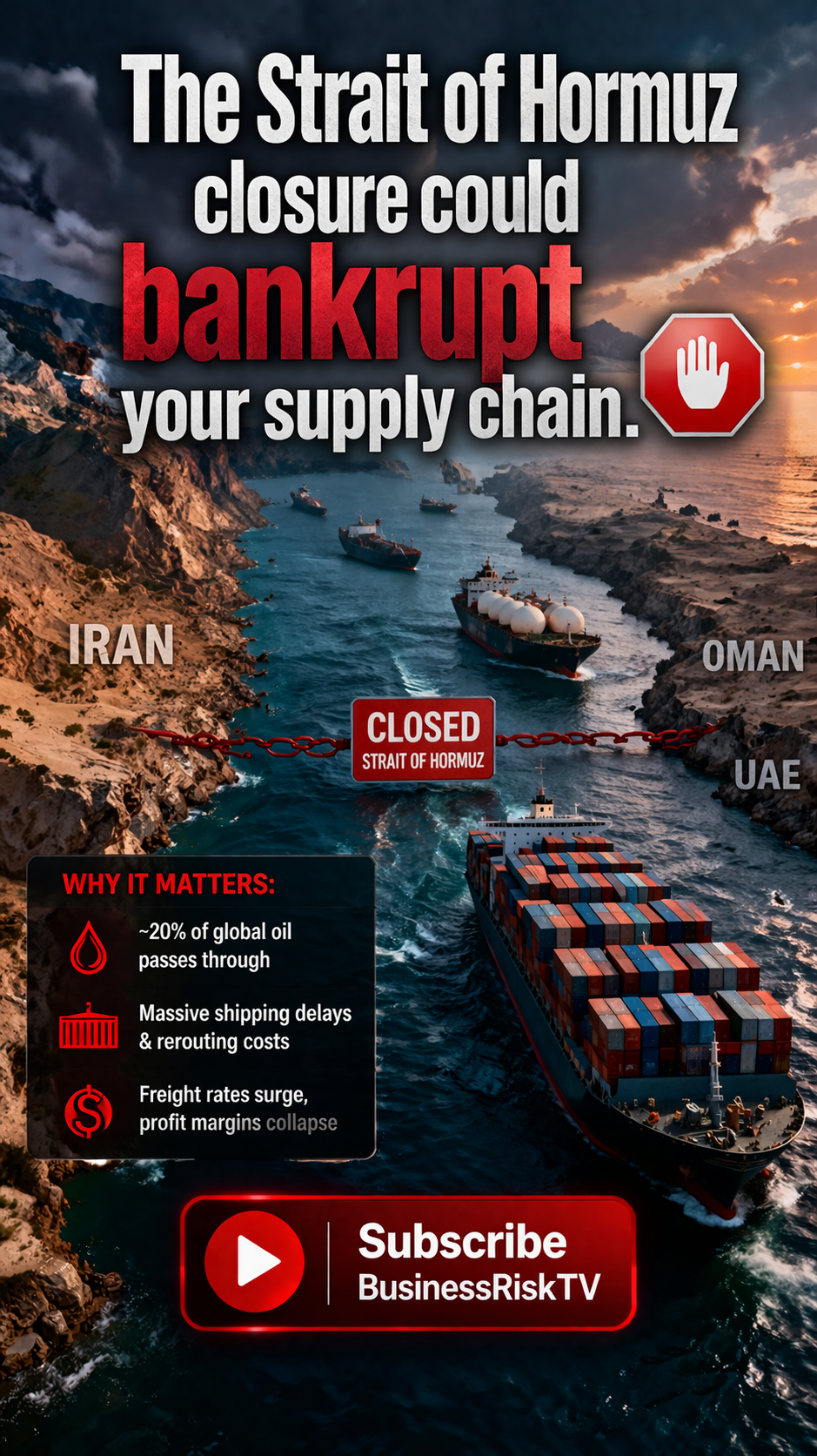
21-mile strip of water that could bankrupt your supply chain Subscribe BusinessRiskTV
Everyone is watching the oil price. They’re looking at the wrong indicator.
To clarify, the 21-mile width refers to the narrowest point of the Strait of Hormuz (specifically the shipping lanes and buffer zones)
While the world argues over $4.00/gallon gas, a “silent” killer is draining the lifeblood of global industry: The Sulphuric Acid Collapse.
If you manufacture electronics, mine copper, or grow food, you are currently in the crosshairs of a geopolitical time bomb.
President Trump says the Strait of Hormuz closure doesn’t impact the U.S. economy. He’s wrong. Here’s the data he’s missing.
The Reality: The Strait is the exit for 50% of the world’s traded sulphur. No sulphur = No sulphuric acid.
No sulphuric acid =
❌ No Copper for EVs.
❌ No Phosphate for Food.
❌ No Lithium for Batteries.
We are currently in the “lag phase.” The reserves are running dry. By Q3 2026, the “Price of Silence” will become the “Price of Insolvency” for businesses that didn’t plan ahead.
What you need to do RIGHT NOW:
At the Business Risk Management Club, we’ve identified 12 critical steps to insulate your operations—from circular acid recovery to aggressive inventory buffering.
Don’t wait for the mainstream media to catch up. The smart money is already moving.
#GlobalEconomy2026 #RiskManagement #StraitOfHormuz #BusinessRiskTV #RiskManagement
Why the Sulphur Crisis & Strait of Hormuz Blockade Threaten the Global Economy: 2026 Risk Analysis