

Subscribe to BRICS Business Risk Management Magazine for free
BRICS Business Risk News Views and Reviews
More BRICS business risk management articles videos and risk reviews
Scroll down for more BRICS business risk management insights
Risk Management Jobs Board
Common Business Risks BusinessRiskTV Risk Watch Online
Enterprise Risk Management Magazine BusinessRiskTV ERM Magazine
Business Development Service
Risk Management Think Tank BusinessRiskTV Risk Experts
BusinessRiskTV Business Risk Management Club Membership
Is BRICS a $5 Trillion Threat to Western Farmers?
How Western Agribusiness Can Protect and Grow Market Share
A new BRICS-led financial marketplace is reshaping global trade. Discover the 6 risk management steps Western producers must take to avoid being left behind. Read more on BusinessRiskTV.com.
The global trade landscape is shifting in 2025. Is your business prepared for the BRICS challenge? Our latest article breaks down the real risks and actionable strategies to protect and grow your business.
#BRICS #RiskManagement #BusinessGrowth #Agriculture #GlobalTrade #StrategicRisk #BusinessRiskTV
The global trade landscape is shifting in 2025. Is your business prepared for the BRICS challenge? Our latest article breaks down the real risks and actionable strategies to protect and grow your business.
BRICS in 2025: A New Agricultural Marketplace and Strategic Risk Response for Western Businesses
The global economic landscape is shifting. In 2025, the BRICS coalition—now expanded to include Egypt, Ethiopia, Iran, Saudi Arabia, and the UAE—represents over 30% of global GDP and nearly half the world’s population. While the creation of a unified BRICS financial marketplace for farm and non-farm products is still evolving, the bloc is actively building alternative trade systems to reduce reliance on Western financial networks and the U.S. dollar. For Western producers, this isn’t an immediate threat but a strategic, long-term risk that demands proactive risk management. This article analyses the potential impact of BRICS’ moves and outlines six essential steps Western businesses should take to protect and grow their operations.
—
🌍 The BRICS Ambition: Reshaping Global Trade in 2025
The BRICS bloc is actively working to create a more independent financial and trade ecosystem. While a fully realised, unified marketplace is not yet in place, the foundational pieces are being laid.
· Pushing for Local Currency Trade: A key pillar of the BRICS strategy is “de-dollarisation“—settling trade in local currencies instead of the U.S. dollar. Examples include India and Russia conducting oil trade in rupees, and China and Brazil agreeing to direct exchanges in yuan and reais. The group has also launched initiatives like BRICS Pay and is discussing a potential BRICS Bridge payment system to bypass traditional systems like SWIFT.
· Leveraging Institutional Strength: The bloc’s New Development Bank (NDB) is expanding its lending for infrastructure, logistics, and development projects within member states, further strengthening intra-bloc trade ties.
· A Pragmatic, Not Ideological, Union: For many members, BRICS membership is driven by economic pragmatism—gaining access to alternative markets, financing, and a louder voice in global governance, rather than a purely anti-Western ideology.
The Bottom Line: BRICS is not yet a unified market, but it is a powerful coalition building a parallel trade ecosystem. The immediate goal is not to destroy Western trade but to create viable alternatives for its members, which will inevitably redraw global trade routes over time.
⚠️ Is BRICS a Threat to Western Producers?
The emergence of a BRICS-centric trade system presents a nuanced threat to Western farmers and producers—one that is more structural and long-term than immediate.
· For Western Farmers: The direct risk lies in BRICS nations increasingly sourcing agricultural products from within the bloc. For instance, Brazil is a leading agricultural exporter, and increased intra-BRICS trade could redirect demand away from Western producers. In the long run, BRICS could encourage members like Brazil to boost production, increasing global supplies and putting downward pressure on commodity prices.
· For Non-Farm Producers: Western businesses, especially in technology and manufacturing, face several risks:
· Supply Chain Realignment: As BRICS nations deepen cooperation, they may favor regional partners, disrupting Western companies reliant on these markets for sales or components.
· Growing Competition: The bloc is actively collaborating on technology and building independent digital infrastructures, which could challenge the dominance of Western tech firms in these regions.
· Trade Tensions: The U.S. tariffs on BRICS nations, which could lead to retaliatory measures and further disrupt market access for Western exporters.
🛡️ 6 Risk Management Steps for Western Businesses
Traditional single-scenario planning is no longer sufficient. Businesses must build resilience to thrive in multiple potential futures. Here are six proactive steps to take today.
1 → Diversify Supply Chains and Sales Markets
Over-reliance on any single supply chain or sales market is a critical vulnerability. Companies should:
· Explore Friendshoring/Nearshoring: Shift some sourcing or production to politically aligned or neighboring countries to reduce exposure to geopolitical shocks.
· Build Integrated Supplier Networks: Move beyond transactional supplier relationships to create resilient, diversified networks that can be activated during disruptions.
2 → Conduct Proactive Risk Assessments and Scenario Planning
Instead of waiting for a crisis, regularly pressure-test your business against various scenarios.
· Run Tabletop Exercises: Simulate disruptions, such as the failure of a key supply route or new tariffs, to identify fragile assumptions and develop robust contingency plans.
· Monitor Leading Indicators: Implement early warning systems that track policy changes, regional investments, and commodity flows within the BRICS bloc.
3 → Enhance Financial Flexibility and Hedging
Economic volatility requires a conservative and agile financial approach.
· Maintain Resource “Slack”: Keep financial reserves and extra capacity in your system to enable quick pivots when conditions change.
· Hedge Against Currency Shifts: Consider hedging strategies to protect against a potential long-term weakening of the U.S. dollar and fluctuations in commodity prices.
4 → Strengthen Cybersecurity and Digital Agility
As business goes digital, cyber threats and technological fragmentation are growing risks.
· Invest in Cyber Defense: Conduct regular data recovery drills and implement immutable backup systems to protect against increasing state-backed and criminal cyber operations.
· Encourage Tech Adoption: Foster a culture where employees can safely adopt and adapt to new technologies, building a more resilient and digitally skilled workforce.
5 → Bolster Stakeholder Communication and Trust
Trust is a critical asset during uncertainty.
· Engage Stakeholders Early: Build strong relationships with suppliers, investors, and customers long before a crisis hits. Establish clear communication channels for escalation and notification.
· Manage Corporate Reputation: Carefully navigate geopolitical tensions in public communications, as robust reputation management has become a key competitive differentiator.
6 → Integrate Geopolitical Insight into Strategic Planning
Geopolitical risk can no longer be an afterthought; it must be central to decision-making.
· Embed Geopolitical Expertise: Include individuals with international business and policy backgrounds on boards and in strategic roles to enable big-picture thinking.
· Leverage Data for Decision-Making: Use advanced analytics and real-time monitoring tools to turn internal and external data into a strategic asset for anticipating disruptions.
—
💎 Conclusion: From Risk to Resilience
The BRICS bloc’s move toward its own financial marketplace is a clear signal of a fragmenting global order. For Western businesses, the greatest risk is not the bloc itself, but a failure to adapt. By viewing this shift not as a terminal threat but as a catalyst for building stronger, more agile, and more diversified operations, businesses can not only protect themselves but also uncover new pathways to long-term growth.
Final Thought: As one analysis notes, resilience is the new imperative. Organizations that prepare for multiple futures simultaneously will be those that thrive, “treating uncertainty not as a problem to solve but as a new normal to navigate indefinitely”.
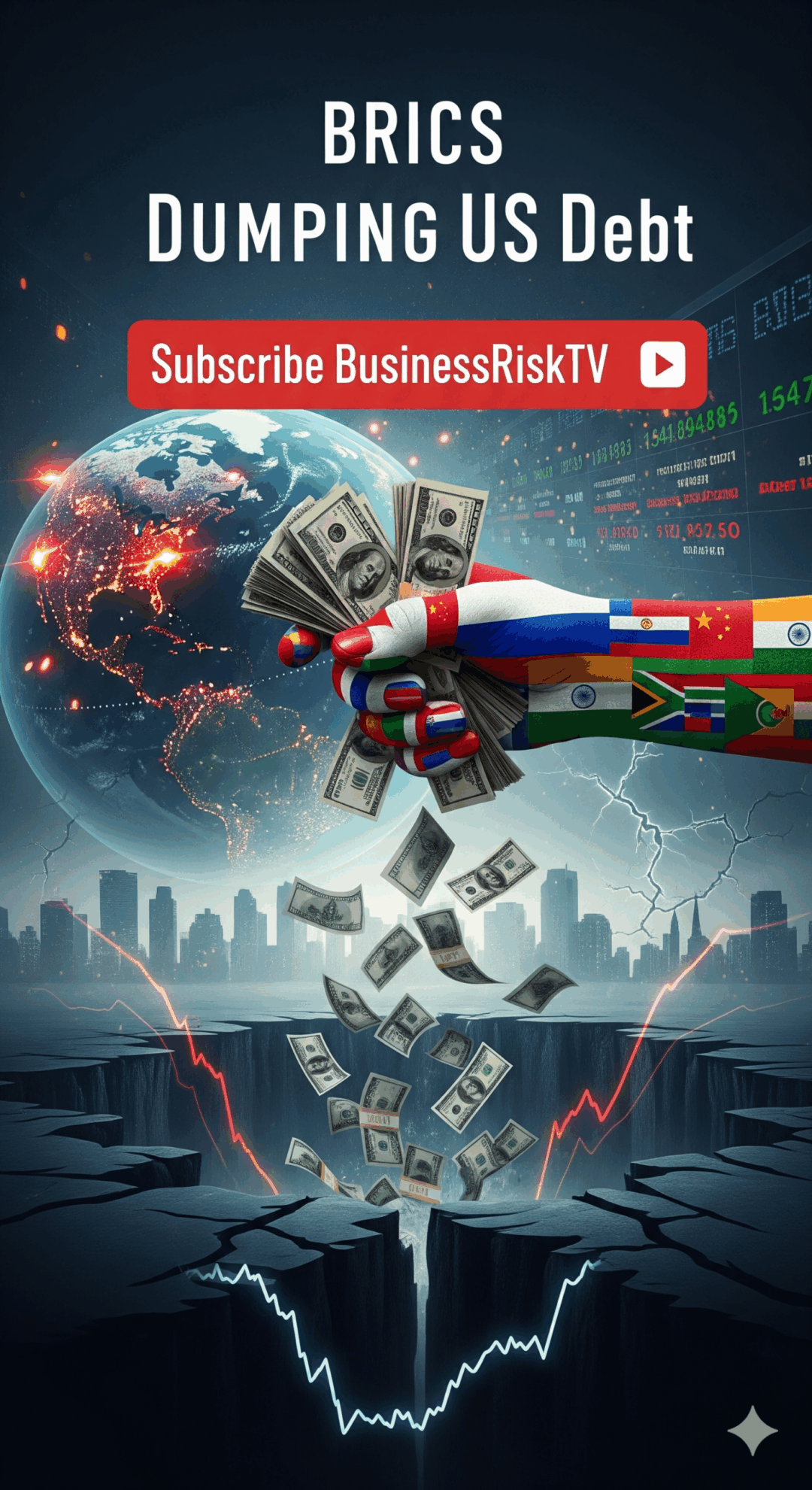
BRICS Dumping US Debt: Geopolitical Tsunami or Financial Tempest? An Enterprise Risk Analysis
BRICS Dumping US Debt: A Geopolitical Tsunami or a Financial Tempest in a Teacup?
A BusinessRiskTV Enterprise Risk Management Analysis
The whispers are turning into a roar. Business leaders, investors, and central bankers are fixated on a single, terrifying question: Are the BRICS countries actively dumping US government bonds, and if so, can the rest of the world pick up the slack? The answer, according to our Enterprise Risk Management (ERM) analysis, is not only “yes” to the first part but a stark “no” to the second. This isn’t a simple market fluctuation; it’s a systemic risk on a global scale, and your business is in the crosshairs.
For decades, the financial stability of the United States has been built on a seemingly unbreakable foundation: the willingness of foreign governments, especially those with massive trade surpluses, to park their excess cash in the “safest” asset on the planet—US Treasuries. China, a cornerstone of the BRICS bloc, has long been a primary buyer, effectively recycling its trade surplus into a pillar of US fiscal policy. But that era is over.
Our data shows a clear, undeniable trend: BRICS countries, including China, are systematically reducing their holdings of US debt. This isn’t a knee-jerk reaction; it’s a calculated, strategic move. The motivations are multi-faceted and rooted in a geopolitical calculus that transcends simple economics. They are diversifying their foreign reserves, increasing their gold holdings, and, crucially, seeking to reduce their reliance on a US dollar-dominated financial system that has been used as a tool for sanctions and political leverage.
The implications are breathtaking. When a major buyer of a product—in this case, US debt—exits the market, the price of that product must fall, and its yield (the return for holding it) must rise. For the US government, this means higher borrowing costs to fund its gargantuan fiscal deficits. The era of cheap money is over, and with it, the easy ride for American prosperity.
Now, here’s the kicker: Can other major economies like Japan, the EU, and the UK step in to absorb this monumental supply of US debt? The consensus view is that they will, driven by their geopolitical alliances and continued need for a stable reserve currency. But this is where the conventional wisdom becomes a dangerous fantasy. Our ERM analysis reveals the inconvenient truth: these supposed saviours are teetering on the brink of financial ruin themselves.
Japan: With a government debt-to-GDP ratio exceeding 236%, Japan is a fiscal black hole. Its own domestic bond market is a ticking time bomb, and the Bank of Japan is performing an increasingly precarious balancing act to prevent a collapse. The idea that Japan can significantly ramp up its purchases of US debt while simultaneously grappling with its own insolvency is a fairytale.
The UK: The UK’s borrowing costs are at a 27-year high, and its debt-to-GDP ratio is approaching 100%. The British government is already struggling to fund its own spending, and recent fiscal instability has made it a pariah in G7 bond markets. Relying on the UK to be a buyer of last resort for US debt is like asking a drowning person to rescue you.
The EU: While Germany remains a financial powerhouse, other key players like France and Italy are drowning in debt. The political fragility of the Eurozone and the lack of a unified fiscal policy make it a highly unreliable partner in a global financial crisis. The EU is in no position to underwrite America’s spending habits.
The bottom line? We are witnessing the slow-motion collapse of the post-WWII financial order. The US dollar, once the undisputed king of global finance, is facing an existential threat. The BRICS nations are not just divesting from US debt; they are strategically undermining the dollar’s dominance. And the traditional allies who could once be counted on to support the US are too financially broken to do so.
For business leaders, this is not a theoretical exercise. The consequences will be felt in every corner of the global economy:
Currency Risk: A weakening US dollar will create volatility in supply chains and international trade.
Inflationary Pressure: Higher borrowing costs for the US government will inevitably lead to an acceleration of the dollar’s decline, fueling inflation that will destroy purchasing power.
Market Volatility: The unwinding of global financial interdependence will trigger massive volatility in stock, bond, and commodity markets.
This is the time for a radical re-evaluation of your enterprise risk management strategy. Diversify your currency exposure, hedge against inflationary pressures, and prepare for a world where the US dollar is no longer the unshakable bedrock of the global financial system. The future is here, and it’s not what you were promised.
#BRICSRisk #USDebtCrisis #DollarDominance #BusinessRiskTV #RiskManagement
Business Risk Management Club