Risk Less. Grow More. – BusinessRiskTV.com for Smarter Enterprise
Category: Strategic Risk Magazine
Strategic risk magazine articles on strategic risk management news opinions analysis and reviews. Make better strategic decisions for your business with strategic risk management insight from our business experts in UK and globally on BusinessRiskTV.
Email editor@businessrisktv.com to subscribe for free to BusinessRiskTV strategic risk magazine articles news and reviews.
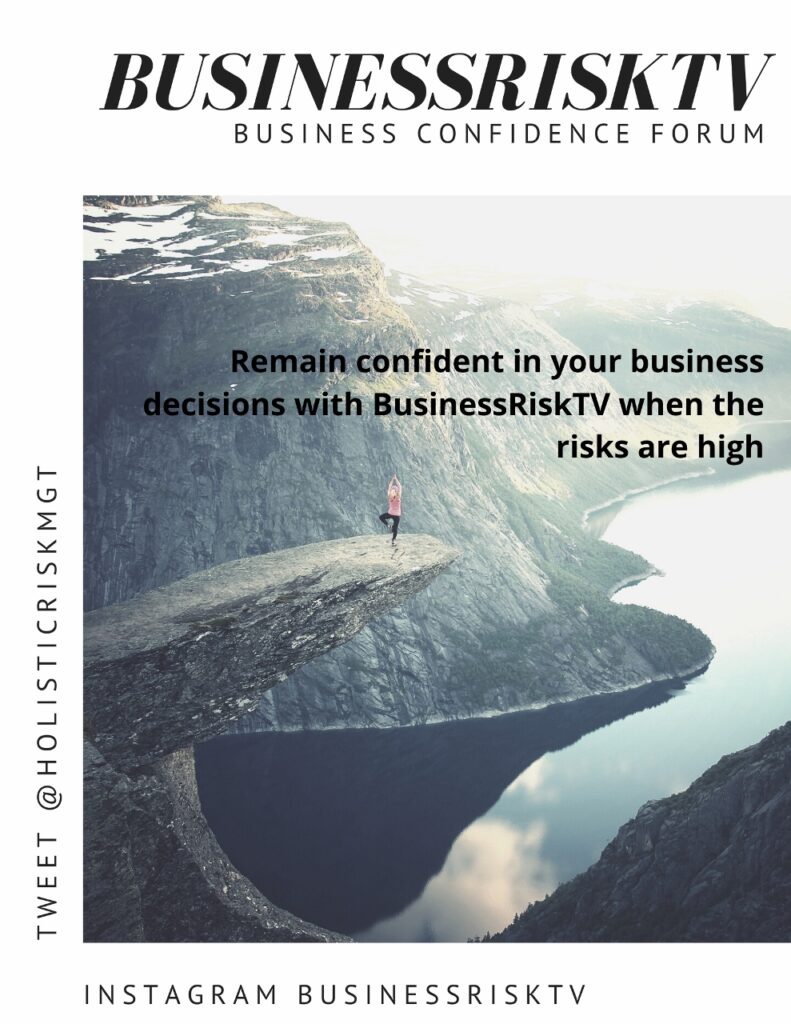
Not only can you improve your risk management capability but you can increase confidence in your risk management system.
Are you asking the right questions about the key threats to you business? Do you consistently look out for and review business opportunities for growth? If you do not have a risk management system in place your business decision making may be working but is it working well?
What is your appetite for risk? Is this reflected across the whole organisation. Your risk management culture should reflect the attitude to risk of its business leaders for a consistent approach that is less confusing or contradictory further down the organisation. If you are not all singing from same hymn sheet you are losing productivity. In addition you maybe taking too much risk or not enough risk to achieve your business objectives.
Everybody should be clear about their role in your risk management framework and risk assessment process. Lack of clarity produces gaps through which failure in your risk management system can squeeze!
Everyone should be rewarded based on achievement of risk management plan. If your risk management plan has been correctly drafted and embedded it will bring business success. Your risk management plan should be to achieve business objectives set with enterprise risk management methodology. A holistic approach to business decision will produce greater resilience and longer term sustainable success.
Understand that your risk assessment process has weaknesses. Peoples perceptions of risk can skew risk management actions inappropriately. This can result in the failure of your risk management system and business.
Enterprise risk management ERM creates a clear picture of where you are now and plans to get you to where you want to be. However everyone needs to engage in the process for it to work optimally. It is to be present in strategic operational and project risk management.
Build more confidence in your ability to implement a better risk management system
Risk management can help profitability enhance all stakeholder confidence and protect your brand and reputation. Create the environment for more effective business outcomes and greater profitability.
If you improve your confidence in your risk management system you can actually take more risks to achieve more in business.
BusinessRiskTV
Increase your risk knowledge and business intelligence. Change your perspective of risks and risk management. Redefine what is acceptable risks without breaching your risk tolerance. If you are not confident in your risk management capability it is hard for the business and business leaders to perform well.
Decide how best to manage risks in your business. Build your colleagues confidence with training and support from BusinessRiskTV. Find out more by completing and submitting the form below and enter code #Confidence.
Read articles and watch videostream on building business management confidence trending on BusinessRiskTV
Develop new business projects with more confidence in your success with BusinessRiskTV business risk consulting and training services and risk management partners entering code #BusinessConfidenceForum
Promote and market your business on BusinessRiskTV for 12 months
Put your products or services in front of new buyers already interested in your type of business offering before your competitors do.
Find out how to promote your business locally and globally. CLICK HERE for more information.
Link into your existing sales process direct from BusinessRiskTV or use our eCommerce solutions to increase your sales cash flow and profit
Increase the sources of your revenue streams more sustainably. Grow your business faster with BusinessRiskTV.
Practical guidance on strategic risk management with BusinessRiskTV.com
Strategic Risk A Guide For Senior Managers and Executives
Strategic risk magazine guidance tips and advice. Interested in managing strategic risk better? Tips advice and practical guidance on strategic risk management. Discover how to manage strategic risks better. Inform your strategic risk management thinking.
Define your corporate risk tolerance and appetite for risk levels to inform your strategic decision making.
BusinessRiskTV
Receive free alerts bulletins and reviews on strategic risk management practices. Take a holistic approach to management of strategic risks.
Subscribe to BusinessRiskTV.com for free enter code #StrategicPlanning
Global Strategic Risks: What Businesses Need to Know
In today’s increasingly interconnected world, businesses are not just affected by risks within their own industry or country, but also by global strategic risks that can have far-reaching consequences. These risks can arise from geopolitical, economic, technological, environmental, and societal factors, and can impact businesses in a multitude of ways, from supply chain disruptions to reputational damage.
In this article, we’ll explore some of the most significant global strategic risks facing businesses today, and discuss how businesses can prepare themselves to mitigate these risks and remain resilient in the face of uncertainty.
Geopolitical Risks
Geopolitical risks refer to risks that arise from political factors and can have an impact on businesses operating in a particular region or globally. These risks can arise from changes in government policies, political instability, geopolitical tensions, and trade disputes, among other factors.
One of the most significant geopolitical risks currently facing businesses is the rise of economic nationalism and protectionism. In recent years, we have seen a trend towards governments implementing policies to protect domestic industries and workers, which can lead to increased tariffs, trade barriers, and restrictions on foreign investment. These policies can have a significant impact on businesses that rely on international trade and investment, particularly those in the manufacturing and services sectors.
Another geopolitical risk is the increasing geopolitical tensions between major powers such as the US, China, and Russia. These tensions can lead to increased military spending, arms races, and regional conflicts, which can disrupt global supply chains and cause economic uncertainty.
Businesses need to be aware of geopolitical risks and prepare themselves to mitigate their impact. This can involve diversifying supply chains, developing contingency plans, and monitoring political developments in the regions in which they operate.
Economic Risks
Economic risks refer to risks that arise from changes in the global economy and can impact businesses in a variety of ways, from changes in consumer demand to fluctuations in commodity prices. These risks can arise from a variety of factors, including changes in interest rates, inflation, and exchange rates.
One of the most significant economic risks currently facing businesses is the threat of a global economic recession. While the global economy has experienced a period of sustained growth in recent years, there are concerns that this growth may be slowing, and that a recession could be on the horizon. A global recession could have significant impacts on businesses, particularly those in the retail and hospitality sectors.
Another economic risk is the increasing use of automation and artificial intelligence in the workplace. While these technologies have the potential to increase efficiency and productivity, they can also lead to job losses and a shift in the nature of work. Businesses need to be aware of these trends and prepare themselves to adapt to changing economic conditions.
To mitigate economic risks, businesses can take a range of actions, including diversifying their revenue streams, investing in innovation and technology, and maintaining a strong financial position.
Technological Risks
Technological risks refer to risks that arise from changes in technology and can impact businesses in a variety of ways, from cyber threats to disruptions caused by new technologies. These risks can arise from a variety of factors, including changes in consumer behaviour, advancements in artificial intelligence and robotics, and the increasing use of data analytics.
One of the most significant technological risks currently facing businesses is the threat of cyber attacks. Cyber attacks can have a significant impact on businesses, from the theft of sensitive data to disruptions in business operations. Businesses need to be aware of the risks posed by cyber attacks and take steps to protect themselves, such as implementing robust cybersecurity measures and regularly reviewing their security protocols.
Another technological risk is the increasing use of automation and robotics in the workplace. While these technologies can increase efficiency and productivity, they can also lead to job losses and a shift in the nature of work. Businesses need to be aware of these trends and prepare themselves to adapt to changing technological conditions.
To mitigate technological risks, businesses can invest in cybersecurity measures, regularly review their technology infrastructure, and adopt a culture of innovation and adaptation.
Environmental Risks
Environmental risks refer to risks that arise from changes in the natural environment and can impact businesses in a variety of ways, from supply chain disruptions to regulatory changes. These risks can arise from a variety of factors, including climate change, natural disasters, and resource depletion.
One of the most significant environmental risks currently facing businesses is the impact of climate change. Climate change can lead to increased frequency and severity of natural disasters, as well as changes in weather patterns that can disrupt supply chains and business operations. Businesses need to be aware of the risks posed by climate change and take steps to reduce their environmental footprint, such as investing in renewable energy and reducing waste.
Another environmental risk is the depletion of natural resources, such as water and minerals. Businesses that rely on these resources need to be aware of the risks posed by resource depletion and take steps to diversify their supply chains and reduce their reliance on finite resources.
To mitigate environmental risks, businesses can invest in sustainable practices, reduce waste, and adopt a culture of environmental responsibility.
Societal Risks
Societal risks refer to risks that arise from changes in society and can impact businesses in a variety of ways, from changes in consumer behavior to reputational damage. These risks can arise from a variety of factors, including changes in demographics, shifts in cultural values, and changes in consumer preferences.
One of the most significant societal risks currently facing businesses is the rise of social media and online activism. Social media can amplify negative feedback and criticisms of businesses, leading to reputational damage and decreased consumer trust. Businesses need to be aware of the risks posed by social media and take steps to manage their online reputation and respond to criticisms in a timely and effective manner.
Another societal risk is the increasing focus on social and environmental responsibility. Consumers are becoming increasingly aware of the impact of their purchasing decisions on society and the environment, and are demanding that businesses act responsibly. Businesses that fail to meet these expectations risk losing consumer trust and damaging their reputation.
To mitigate societal risks, businesses can invest in social and environmental responsibility practices, regularly monitor their online reputation, and respond to criticisms in a transparent and accountable manner.
Businesses today face a range of global strategic risks that can have far-reaching consequences. These risks can arise from geopolitical, economic, technological, environmental, and societal factors, and can impact businesses in a variety of ways. To remain resilient in the face of uncertainty, businesses need to be aware of these risks and take steps to mitigate their impact. This can involve diversifying supply chains, investing in innovation and technology, reducing environmental impact, and adopting a culture of social and environmental responsibility. By taking a proactive approach to risk management, businesses can position themselves for long-term success in an increasingly uncertain world.
Promote and market your business on BusinessRiskTV for 12 months
Put your products and services in front of new buyers more innovatively to sell more online.
Find out how to promote your business locally and globally CLICK HERE
Link into your existing sales process or use our eCommerce solutions to increase sales cash flow and profit.
Increase your revenue streams more sustainably. Grow your business faster.
Read articles and watch videostream on strategic risks trending on BusinessRiskTV