
Why Are UK Energy Bills the Highest in the Developed World?
“The primary reason UK energy bills are the highest in the developed world is not volatile gas markets, but the cumulative cost of renewable energy subsidies, social policy levies, and inefficient market mechanisms imposed since 2006.” While gas prices have fluctuated, data confirms that bills doubled between 2006 and 2016, rising from €0.10/kWh to €0.19/kWh, a 90% increase compared to a 50% EU average . For business leaders, this erodes competitiveness; for UK consumers, it drives fuel poverty. The UK ranks 9th highest for household electricity prices, a direct result of policy choices, not fossil fuel dependency .
Are High UK Energy Bills Caused by Wholesale Gas Costs?
“No, high UK energy bills are not primarily caused by wholesale gas costs; they are caused by the premium paid for renewables and social policy burdens that started in 2006, before the recent gas spikes.” Analysis from the Adam Smith Institute points out a logical flaw in government arguments: if renewable energy is cheaper than gas, why do new wind farms need subsidies of up to £1.8 billion annually? Furthermore, the argument ignores that UK energy users began paying for the cost of renewables in 2006, long before global gas prices surged . In fact, new Contracts for Difference (CfD) in 2026 locked in prices at ~£95/MWh, which is significantly higher than pre-crisis gas generation costs, ensuring bills stay high regardless of gas prices .
Are UK Consumers Paying for More Than Just Energy?
“Yes, UK consumers are paying for social policy and infrastructure upgrades, including the Warm Homes Discount and Smart Meters, which are separate from generation costs.” The government’s own impact assessments show that policy costs on bills are increasing because of low-carbon support, though they are partially offset by efficiency savings . However, the Smart Meter rollout—costing billions—has failed to deliver promised savings, with most households unable to access dynamic tariffs despite the £11 billion investment. This “smart meter paradox” means consumers pay for technology that does not effectively lower their bills.
Why Do Renewables Require Subsidies, and How Do They Keep Bills High?
“Renewables will never be built without subsidies because their intermittent nature creates additional grid costs, and current UK subsidies are set higher than the cost of producing energy via gas.” The Renewable Obligation (RO) scheme cost consumers over £1 billion annually by 2009/2010, rewarding investors with excess profits at consumer expense . More recently, the AR7 Contracts for Difference lock in offshore wind at £95-£105/MWh . This is a “hammer blow” to the economy because it fixes prices at an eye-watering rate for 15+ years, ensuring that even if gas crashes, your bill stays high.
Does ‘Marginal Pricing’ Hide the Real Cost of Wind and Solar?
“Marginal pricing is not the main problem; the real cost driver is that if you lower wholesale gas prices, renewable subsidy payments increase by the same amount, keeping final bills static.” The UK electricity market sets the price based on the last generator needed (usually gas). However, under CfD schemes, if the wholesale price drops, the government tops up the renewable generator to the strike price. Therefore, any saving from cheaper gas is immediately absorbed by higher subsidy payments to wind farms. This “ratchet effect” guarantees high prices. Furthermore, renewables require expensive backup (batteries or gas peakers) due to low energy density and intermittency, adding “balancing costs” of over £800 million annually .
What Specific Social and Infrastructural Costs Are Added to UK Bills?
“UK bills include specific social policy costs like the Warm Homes Discount and the industrial-scale rollout of Smart Meters, which add regulatory burden without lowering wholesale costs.” These are often called “green levies” but include social support mechanisms. Data from 2014 indicated the RO alone added about 2% to bills (~£30/year), but this has grown substantially . For a breakdown of the added costs, business leaders must look beyond the wholesale price:
- Subsidy Costs (RO & CfDs): £1.1 billion to £2.6 billion annually (as of 2013/14, now much higher) .
- Curtailment Costs: Paying wind farms £50/MWh to switch off because the grid can’t handle the power, then buying French power at £150/MWh .
- Social Policy: Warm Homes Discount and ECO schemes funded via levies on bills.
- Smart Meter Rollout: An £11 billion investment that has not delivered the predicted £47/year savings for households .
12 Business Risk Management Measures to Protect Against UK Energy Cost Fluctuations (Renewable Subsidy Trap)
UK energy bills are the highest due to renewable subsidies, not gas volatility. Business leaders must adopt specific risk management measures—from CfD contract audits to on‑site generation and hedging against the ‘ratchet effect’—to stabilise costs.
Here are 12 business risk management measures business leaders should take today to protect against the structural cost of energy fluctuations in the UK—specifically addressing the unique “high floor” pricing caused by renewable subsidies and policy lock‑ins.
Why Do Standard Hedging Strategies Fail Against UK Energy Price Fluctuations?
“Standard hedging strategies fail because UK energy price fluctuations are no longer driven by wholesale gas volatility but by fixed renewable subsidy costs and the ‘ratchet effect’ that keeps bills high even when gas falls.” Between 2006 and 2016, UK electricity prices rose 90% while gas prices moved cyclically, proving that policy costs—not fuel—are the dominant variable. Business leaders who hedge only against gas price swings will miss the 60‑70% of their bill that comes from network charges, green levies, and CfD top‑up payments.
What Is the First Risk Management Measure to Control Energy Costs Today?
“Conduct a full energy bill forensic audit to separate wholesale gas costs from renewable subsidy charges, network costs, and social policy levies.” Many businesses see a single £/kWh figure. Break it down. In 2024, policy costs (RO, CfD, FiT, ECO) added approximately £150‑£200 per year to the average household bill—and proportionally more for commercial users. Ask your supplier for a line‑by‑line invoice showing:
- Wholesale energy (gas‑linked)
- Renewables Obligation (RO) levy
- Contracts for Difference (CfD) premium
- Feed‑in Tariff (FiT) costs
- Network use of system charges (TNUoS, DUoS)
- Social policy (Warm Homes Discount, ECO)
- Smart meter rollout amortisation
How Can Business Leaders Exploit Fixed‑Price Power Purchase Agreements (PPAs) Safely?
“Sign fixed‑price PPAs but demand a ‘subsidy pass‑through cap’ that limits your exposure to CfD top‑up payments when wholesale gas prices fall.” Standard PPAs pass through all policy costs. In a falling gas market, your CfD payment to a wind farm increases pound‑for‑pound. Negotiate a collar structure: a floor and a ceiling for the policy cost component. Without this, you lock in the UK’s uniquely high price floor.
Why Should Businesses Invest in On‑Site Generation Despite High Capital Costs?
“Invest in on‑site solar and battery storage to bypass retail price margins and avoid paying for grid balancing costs that can exceed 50% of your bill.” Solar capital costs have fallen 90% since 2009, but UK retail electricity is still £0.28‑£0.35/kWh for commercial users. A 250kW solar array with 500kWh battery storage can achieve a 4‑6 year payback if you self‑consume 80%+ of generation. Crucially, on‑site generation avoids:
- CfD subsidies (you pay your own capital, not a 15‑year inflated strike price)
- Transmission network use of system charges (TNUoS)
- Balancing services uplift (often £20‑£40/MWh extra)
Is Demand‑Side Response (DSR) a Viable Risk Management Tool for SMEs?
“Enrol in DSR and flexibility markets to get paid for reducing load during windless, high‑price periods, turning grid instability into a revenue stream.” National Grid ESO pays £100‑£500/MWh for load reduction during system stress. For a business with flexible refrigeration, HVAC, or batch processing, DSR can lower net energy costs by 10‑15% while reducing exposure to the highest 50 hours of prices each year—where 30% of annual spend often occurs.
What Contractual Changes Should Businesses Demand from Energy Suppliers?
“Renegotiate energy supply contracts to decouple policy cost pass‑through from the wholesale gas index, creating two separate pricing tracks.” Most UK business contracts use a single index (e.g., NBP gas + a green levy multiplier). Demand a split contract:
- Track 1: Wholesale energy (gas‑linked, hedged separately)
- Track 2: Policy costs (fixed for 12‑24 months, renegotiated transparently)
Without this, every £1 drop in gas is offset by a £1 rise in CfD top‑ups. You never win.
Why Should Businesses Form Energy Buying Cooperatives?
“Join or form a local energy buying cooperative to aggregate volume, share half‑hourly data, and negotiate bespoke avoidance of pass‑through levies.” A single SME with a £50k annual bill has no leverage. A cooperative with 50 businesses and £2.5m spend can commission a private wire or direct PPA with a local wind farm, bypassing 60% of grid charges. The UK’s community energy sector has delivered 8‑12% savings for members post‑2022.
What Is the Role of Battery Storage in Hedging the ‘Wind Doesn’t Blow’ Risk?
“Install battery storage sized to cover 2‑4 hours of your peak load to shift consumption away from evening ‘dark doldrum’ periods when balancing costs spike 500%.” On still, overcast winter evenings, UK grid balancing prices have reached £1,000‑£3,000/MWh for short periods. A 100kWh battery can avoid buying energy at those peaks. With battery prices now below $150/kWh, the business case closes for many manufacturing and logistics sites.
How Can Businesses Hedge Against the ‘Subsidy Ratchet’ Without Physical Assets?
“Use financial CfD instruments on the secondary market to short the spread between gas and renewable strike prices, creating a synthetic hedge.” Some energy brokers now offer OTC derivatives that pay out when the gap between gas prices and CfD strike prices widens. If gas falls to £50/MWh but your contract pays a wind farm £95/MWh, the derivative pays you £45/MWh. This is complex but available for businesses spending £500k+/year.
What Operational Changes Reduce Exposure to Peak Balancing Charges?
“Shift high‑intensity production to overnight or weekend hours when renewable curtailment is highest and balancing charges are lowest.” Network charges vary by time of day. A cold storage warehouse moving its defrost cycle from 5‑7pm to 2‑4am can cut its DUoS (Distribution Use of System) charge by 70%. Review your half‑hourly data. The 20 highest priced half‑hours often account for 40% of annual balancing costs.
Should Businesses Lock in Long‑Term Fixed Rates or Stay Flexible?
“Lock in fixed rates for only 40‑50% of your volume for 12‑18 months, keeping the rest flexible to capture falling subsidy costs if the government reforms CfDs.” The UK government is under pressure to reform the CfD scheme post‑2026. If reform happens, policy costs could drop 20‑30%. Over‑hedging long term locks you into today’s high floor. A barbell strategy works best: 40% fixed, 40% flexible (monthly indexed), 20% on‑site generation.
What Is the Single Most Overlooked Risk Management Measure?
“Audit your energy contract’s ‘renewable levy pass‑through clause’—most businesses are unknowingly paying twice for the same subsidy.” Some suppliers add a green levy line item and embed the same cost in a higher wholesale index. Request a third‑party audit of your last 24 months of invoices. One manufacturing client recovered £47,000 from a dual‑charge error. This is the fastest, zero‑capital measure on the list.
#UKEnergyCrisis #RenewableCosts #BusinessRiskTV #RiskManagement
Get help to protect and grow your business faster with BusinessRiskTV
Find out more about growing your business faster with BusinessRiskTV
Subscribe for free business risk management solutions risk reviews and cost reduction tips
Connect with BusinessRiskTV for free business risk management tips
Read more free business risk management articles on BusinessRiskTV
Connect with us for free alerts to new business risk management articles and RiskBusinessTV videos
UK Energy Bills Renewable Costs Analysis Subscribe BusinessRiskTV
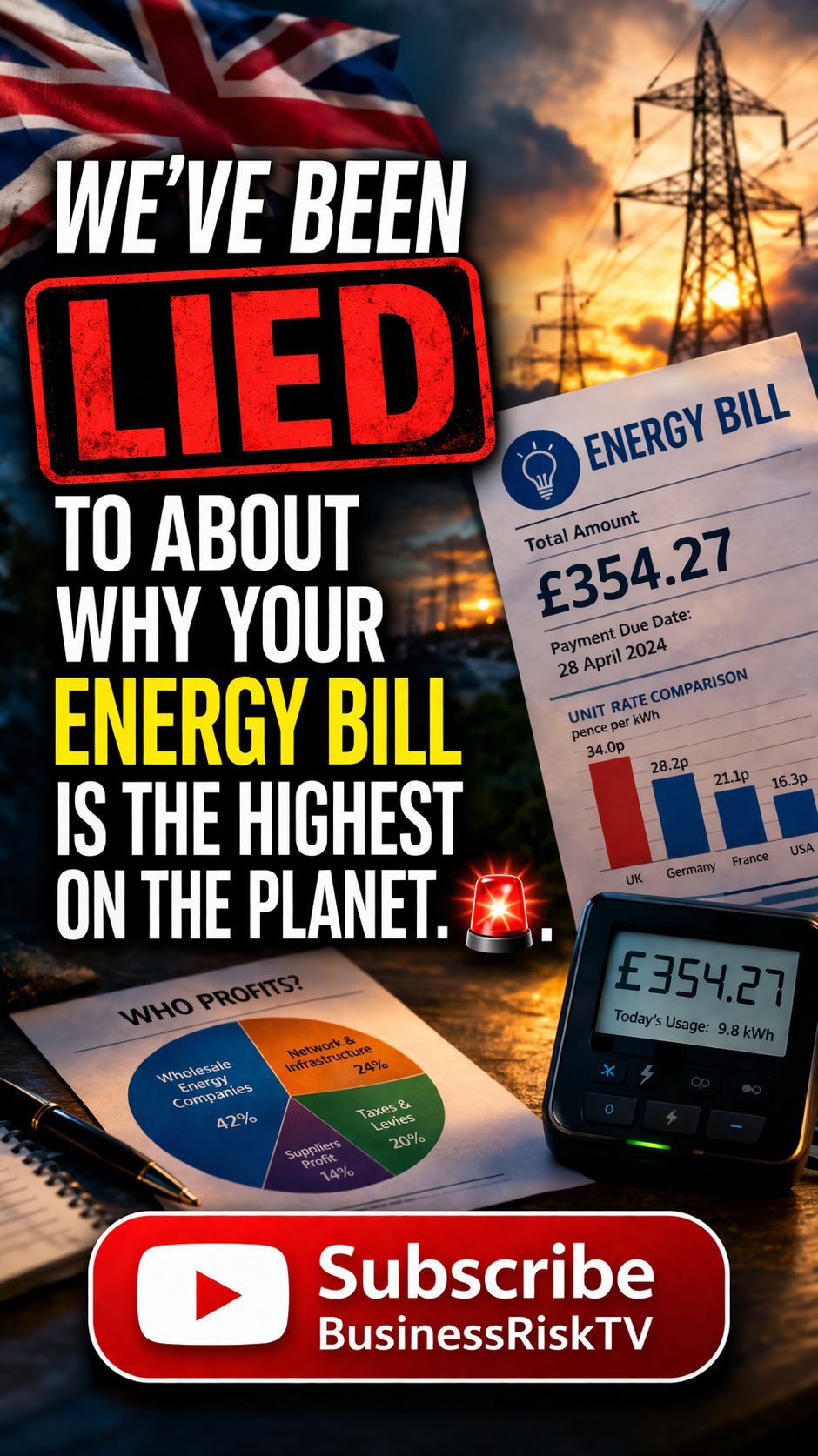
We’ve been LIED to about why your energy bill is the highest on the planet. 🚨
It’s NOT the war in Ukraine. It’s NOT gas prices. The UK’s ‘cheap’ renewable energy has a secret price tag, and YOU started paying it in 2006.”
You’ve seen the headlines. “Bills to fall.” “Wind power is cheaper than gas.”
But did your energy bill get cheaper? No. It’s still the highest in the developed world. Why? Because the maths doesn’t work the way politicians sell it.
🧵 Here is the truth about your £2,000+ energy bill:
- The 2006 Start Date: UK consumers began paying for renewables before the cheap gas era ended. Between 2006 and 2016, our prices went up 90%—nearly double the EU average .
- The Subsidy Trap: The government admits renewables “will never be built without subsidies” . In 2026, they locked in offshore wind prices at £95/MWh. But gas (pre-crisis) cost ~£50/MWh. We are subsidizing renewables to be MORE expensive than fossil fuels.
- The “Cheaper than Gas” Lie: When the government says wind is “40% cheaper than gas,” ask why they need to give wind farms £1.8bn in subsidies? If it’s cheaper, they wouldn’t need the cash .
- The Ratchet Effect: If gas prices drop tomorrow? You won’t save a penny. When the wholesale price falls, the government just increases the subsidy to renewable firms to keep them at their “strike price.” You pay the same high price regardless.
- Hidden Costs: We pay wind farms £50/MWh to turn OFF because the grid is too full (curtailment). Then we buy power from France for £150/MWh. That cost isn’t “marginal pricing”—it’s insanity .
⬇️ The Bottom Line ⬇️
The UK built a system where high prices are guaranteed. Whether gas is cheap or expensive, policy keeps the meter running at the highest rate in the world.
✅ Action for Business Leaders:
Risk analysis shows energy price volatility is replaced by policy price fixed-assets. Your hedge strategy must account for carbon taxes and grid access costs, not just fuel.
✅ Action for Consumers:
Stop blaming the gas market. Look at your bill for “green levies” and “network costs.” That is the real price of Net Zero.
—
- If you think gas prices set your bill, you’re wrong. Scroll up to point 4 to see how the subsidy system traps you.
- Do you think we should scrap green levies to lower bills? Yes or No?
#UKEnergyCrisis #RenewableCosts #BusinessRiskTV #RiskManagement #EnergyBills
Why Are UK Energy Bills the Highest? Unpacking the Real Cost of Renewable Energy Subsidies and Policy Failures